REVIEW 1 major objections 4 minor 2 references
Veronese polytopes: Extending the framework of cyclic polytopes
T0 review · 1 major / 4 minor · reviewed 2026-08-12 · deepseek-v4-flash
Pith's one-line read Veronese polytopes, a broad generalization of cyclic polytopes, are shown to be classified up to combinatorial equivalence by circular compositions—finite cyclically ordered sets with at most d dividers.
desk verdict A genuine generalization of cyclic polytopes with a clean combinatorial classification; the main theorems are sound and the paper deserves a serious referee. read the letter →
The pith
A machine-rendered reading of the paper's core claim, the machinery that carries it, and where it could break.
The reading
What carries the argument
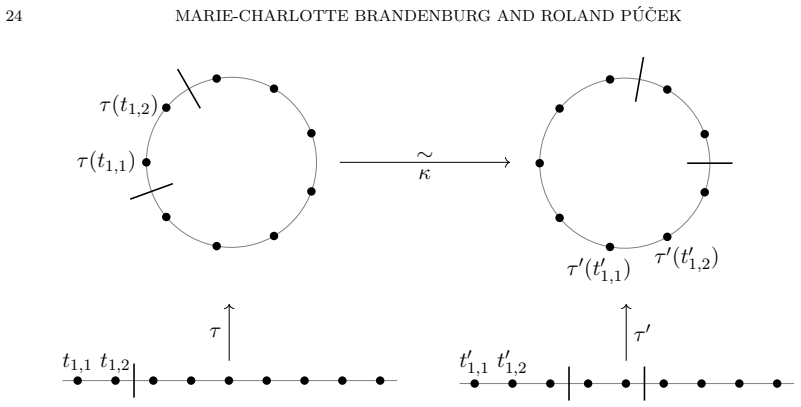
The central object is the rational normal curve ψ : P¹ → P^d, together with an affine chart defined by a linear functional ξ. The signs of the degree-at-most-d polynomial q_ξ(t) = Σ_{i=0}^d ξ_i t^i on the ordered vertex set T partition T into discrete intervals with alternating signs; Theorem 2.3.4 proves that these signed σ-decompositions are in bijection with the chambers of the hyperplane arrangement cut out by the annihilators of the vertices. Passing to the projective circle P¹, the points where ψ meets the chart's hyperplane at infinity become 'dividers' that separate arcs, producing a circular composition (T̃, D̃) with at most d dividers. The paper's workhorse is the circular facet condition: a d-subset is a facet exactly when it contains one point from each divider and the remaining points form disjoint consecutive pairs. This condition converts the generalized Gale evenness condition into pure circle combinatorics and carries the classification.
What would settle it
A concrete way to test the load-bearing step is to enumerate all chambers of the hyperplane arrangement for small parameters (for example d=4, n=8) and check that the number of distinct signed σ-decompositions of T equals the maximal number of chambers, 2 Σ_{j=0}^d binom(n-1, j); any sign pattern that is alternating on T but not realizable by any degree-at-most-d polynomial would disprove Theorem 2.3.4 and invalidate the circular-composition classification of Theorem 3.2.6.
Extended reading notes
Core claim
The paper establishes that a Veronese polytope—the convex hull of the points ν_d(t)/⟨ξ, ν_d(t)⟩ for t in a finite set T, where ν_d is the moment curve and ξ a nonzero linear functional—is, up to combinatorial equivalence, entirely determined by the data of a finite cyclically ordered set with 'dividers.' The main theorem (Theorem 3.2.6) gives a bijective correspondence between combinatorial types of d-dimensional Veronese polytopes and isomorphism classes of circular compositions with at most d dividers, and maps facets bijectively onto subsets satisfying the circular facet condition. This discrete encoding makes the polytope's facial structure transparent: facets correspond to choosing one point from each divider plus a set of consecutive pairs. The paper further shows that all simplicial d-polytopes with d+1, d+2, or d+3 vertices are realizable as Veronese polytopes, that the d-dimensional cross-polytope and certain stacked polytopes lie in the class, and that the number of facets of any Veronese polytope is given by a closed product-sum formula in the interval sizes of its circular composition.
Load-bearing premise
The classification assumes the bijection of Theorem 2.3.4 between chambers of the hyperplane arrangement and signed σ-decompositions of T; if some alternating sign pattern on T were not realizable by a degree-at-most-d polynomial q_ξ, the facet characterizations and the circular-composition classification would collapse.
Editorial extensions
If this is right
- Every combinatorial type of Veronese d-polytope is encoded by a circular composition, so questions about isomorphisms, subpolytopes, and face counts reduce to finite combinatorics on a cyclically ordered set.
- All simplicial polytopes with at most d+3 vertices are Veronese, giving a uniform geometric realization for the smallest-vertex simplicial polytopes in every dimension.
- Cross-polytopes and particular stacked polytopes are Veronese, so the class spans the range from facet-maximizing neighbourly polytopes to facet-minimizing stacked polytopes.
- For odd d, Veronese polytopes with a single divider are combinatorially cyclic, while even-dimensional examples with two intervals can be non-neighbourly; the cyclic polytopes sit inside the class as distinguished members.
- The closed formula for the number of facets allows direct computation from the circular composition's interval sizes, without constructing the polytope.
Reading between the lines
- One could test whether the circular-composition classification extends to oriented matroids: Veronese polytopes may be exactly the polytopes whose oriented matroid is representable by a rational normal curve with a marked affine chart, linking them to alternating oriented matroids.
- The authors' computational tables suggest the conjectures that cyclic polytopes are the only neighbourly Veronese polytopes for n > d+3 and that the stacked polytope of Theorem 3.3.5 is the only stacked Veronese polytope; proving these would delimit the class sharply and connect to the Upper and Lower Bound Theorems.
- Because every simplicial d-polytope with d+3 vertices is Veronese, one might ask whether Veronese polytopes can serve as a test family for the realizability of arbitrary simplicial polytopes with few vertices, or whether the parity condition in the facet encoding hides a deeper obstruction.
- The same chamber-to-sign decomposition strategy could be applied to Segre–Veronese factorization structures, potentially classifying compatible polytopes for more general factorization structures by similar discrete circle data.
Editorial analysis
A structured set of objections, weighed in public.
Referee Report
Summary. The paper introduces Veronese polytopes as convex hulls of finite point sets on the rational normal curve in an affine chart, generalizing cyclic polytopes. The main results are: a Gale-type evenness condition (Theorem 2.2.3) characterizing facets via signs of p_S/q_xi; a bijection between chambers of the associated hyperplane arrangement and signed sigma-decompositions of T (Theorem 2.3.4); combinatorial characterizations of facets as sigma-parity alternating sequences and via the S1/S2/S3 decomposition (Theorems 3.1.3 and 3.1.6); a bijection between combinatorial types of Veronese d-polytopes and isomorphism classes of circular compositions with at most d dividers (Theorem 3.2.6); and applications including realization of every simplicial d-polytope with at most d+3 vertices, cross-polytopes, stacked polytopes, and a closed facet-count formula (Theorem 3.4.1). The paper is rich in examples and includes computational tables for small dimensions.
Significance. If the main classification is correct, this is a substantial contribution to discrete geometry. It provides a uniform combinatorial model for a large family of simplicial polytopes that contains cyclic polytopes, cross-polytopes, stacked polytopes, and all simplicial d-polytopes with at most d+3 vertices. The extension of Gale's evenness condition and the circular-composition classification are natural and potentially useful tools. The paper also connects these polytopes to factorization structures and gives an explicit facet-counting formula. The central derivation, especially the chamber-to-signed-decomposition bijection in Theorem 2.3.4 and the polynomial sign argument in Theorem 2.2.3, is carefully argued; I agree with the reader's report that the interpolation step in Theorem 2.3.4 is sound and the region count confirms the bijection. The computational enumeration is a useful complement, although the supporting script is not shipped.
major comments (1)
- [Definition 3.2.2 and Theorem 3.2.6] The notion of isomorphism of circular compositions is defined as a map kappa from T to T' that induces a bijection between C_D(T) and C_D'(T'), with no condition that kappa be injective, surjective, or preserve the cyclic order. As stated, this relation is not symmetric: in the proof of Corollary 3.2.4 the inclusion V subset T of the vertex set is used as an isomorphism from (tau(V), D_V) to (tau(T), D_T), but when |T| > |V| there is generally no map in the reverse direction inducing the inverse bijection on facet sets. Consequently, 'isomorphism classes' in Theorem 3.2.6 is not a well-defined equivalence class unless the intended relation is the equivalence relation generated by such maps. The converse direction of Corollary 3.2.4 also needs an argument that a map inducing a bijection between facet sets is injective on the vertices appearing in facets; without such injectivity, a non-injective vertex map need not induce an isomorphism of face lattices. I recommend defining an isomorphism of circular compositions as a bijection between the sets of points that occur in facets (equivalently, an isomorphism of the induced facet hypergraphs), and then proving or citing the standard fact that a vertex bijection inducing a facet bijection between two simplicial polytopes yields a combinatorial equivalence.
minor comments (4)
- [Example 3.1.4] The vector xi is written with four coordinates (0, -1, 0, 0), but the surrounding discussion and Example 3.4.3 require five coordinates, namely (0, -1, 0, 0, 0), since q_xi(t) = -t in dimension d = 4.
- [Remark 3.3.8 and Tables 1-2] The enumeration results are attributed to a SageMath computation, but no script or algorithmic description is provided. Including the code or at least a precise enumeration method would make the computational evidence reproducible.
- [Theorem 3.2.6, proof of surjectivity] The surjectivity proof is quite compressed, especially the parity bookkeeping around k = l versus k = l - 1 and the choice of base point. A few additional sentences explaining these cases would improve readability and make the construction easier to verify.
- [Section 3.1, notation] The notation I^sigma_even and I^sigma_odd in Remark 3.1.2 is introduced informally; a formal definition of these unions of intervals would help, since they are used in the proof of Theorem 3.1.3.
Circularity Check
No significant circularity: the facet criteria and circular-composition classification are derived from the curve geometry and verified against classical cyclic polytope results; self-citations are background only.
full rationale
The paper's central derivation chain is self-contained. Theorem 2.2.3 is a standard supporting-hyperplane criterion: the rational function λ_{ξ,S}(t)=p_S(t)/q_ξ(t) has constant sign on T\S exactly when all generating points lie on one side of the hyperplane through S. Theorem 2.3.4 converts chambers into signed σ-decompositions: the sign of q_ξ on T depends only on the chamber, and every alternating sign pattern with at most d roots is realized by the explicit polynomial q(t)=∏(t−s_i), with the count 2∑_{j=0}^d C(n−1,j) matching the maximal number of regions of the arrangement. Theorem 3.2.6 is a direct combinatorial translation rather than a circular prediction: the circular facet condition is defined purely from cyclically ordered points and dividers, Theorem 3.2.3 proves that it coincides with facethood, and surjectivity is shown by constructing a σ-decomposition from any abstract circular composition. The only self-citations ([Puc22], [Puc23]) supply the factorization-structure definitions and the normal-direction shape, but the normal direction is verified in the paper and all new facet characterizations are proved from the curve geometry; they are not load-bearing inputs. The results are independently checked by recovering Gale's evenness condition for ξ=ε_0, by matching cyclic-polytope facet counts, and by SageMath enumeration in Tables 1–2, so the derivation is not equivalent to its own inputs.
Assumptions & free parameters
assumptions (4)
- domain assumption The factorization curve of the Veronese factorization structure is the rational normal curve, and Proposition 1.3.3 describes all compatible polytopes as convex hulls of points on it in an affine chart.
- standard math Any k <= d+1 distinct points on the rational normal curve are linearly independent (Lemma 1.1.4).
- standard math The rational normal curve in P^d is uniquely determined by d+3 points in general position.
- standard math Real polynomials of degree at most d with prescribed alternating sign patterns exist and correspond to chambers of the hyperplane arrangement (interpolation argument).
invented entities (1)
-
Circular composition (a cyclically ordered set together with a set of dividers)
independent evidence
Cite this review
Pith. "Pith review of Veronese polytopes: Extending the framework of cyclic polytopes." pith.science (2026). https://pith.science/paper/6DCRKHZS
@misc{pith2026241113702,
  author       = {Pith},
  title        = {Pith review of: Veronese polytopes: Extending the framework of cyclic polytopes},
  year         = {2026},
  howpublished = {\url{https://pith.science/paper/6DCRKHZS}},
  note         = {Machine review of arXiv:2411.13702}
}
abstract
This article introduces the theory of Veronese polytopes, a broad generalisation of cyclic polytopes. These arise as convex hulls of points on curves with one or more connected components, obtained as the image of the rational normal curve in affine charts. We describe their facial structure by extending Gale's evenness condition, and provide a further combinatorial characterisation of facets via $\sigma$-parity alternating sequences. Notably, we establish a bijective correspondence between combinatorial types of Veronese polytopes and partitions of finite sets equipped with a cyclic order, called circular compositions. We show that, although the only Veronese $3$-polytopes are the cyclic $3$-polytopes and the octahedron, in general dimension they form a rich and diverse class including all combinatorial types of simplicial $d$-polytopes with at most $d+3$ vertices, the cross-polytope and particular stacked polytopes. In addition, we characterise which curves defining Veronese polytopes are $d$-order curves, and provide a closed formula for the number of facets of any Veronese polytope.
Figures


Figures from the paper (5 more)



Reference graph
Works this paper leans on
-
[322]
Ambitoric ge- ometry II: extremal toric surfaces and Einstein 4-orbifolds
doi: 10.1023/A:1022251819334. [ACG15] Vestislav Apostolov, David M.J. Calderbank, and Paul Gauduchon. “Ambitoric ge- ometry II: extremal toric surfaces and Einstein 4-orbifolds”. In: Annales scientifiques de l’ ´Ecole normale sup´ erieure48.5 (2015), pp. 1075–1112. doi: 10.24033/asens.22 66. [ACG16] Vestislav Apostolov, David MJ Calderbank, and Paul Gaudu...
-
[1088]
The geometry of weakly self-dual K¨ ahler surfaces
doi: 10.1007/s00208-020-02095-1 . [ACG03] Vestislav Apostolov, David MJ Calderbank, and Paul Gauduchon. “The geometry of weakly self-dual K¨ ahler surfaces”. In:Compositio Mathematica 135.3 (2003), pp. 279–
Reviewed August 12, 2026 · model on record in the stance chip above.
Discussion (0). Continue with ORCID to comment.