REVIEW 3 major objections 4 minor 24 references
Asynchronous Federated Learning Using Outdated Local Updates Over TDMA Channel
T0 review · 3 major / 4 minor · reviewed 2026-08-12 · deepseek-v4-flash
Pith's one-line read Asynchronous federated learning over a TDMA channel converges at rate O(G^2/√K), where G is the number of TDMA groups; adding an intentional delay lowers the effective staleness and speeds convergence.
desk verdict A new TDMA group-staleness model and a sensible intentional-delay heuristic, but the main convergence theorem is unproven because the proof uses ||x+y||^2 ≤ ||x||^2 + ||y||^2. read the letter →
The pith
A machine-rendered reading of the paper's core claim, the machinery that carries it, and where it could break.
The reading
What carries the argument
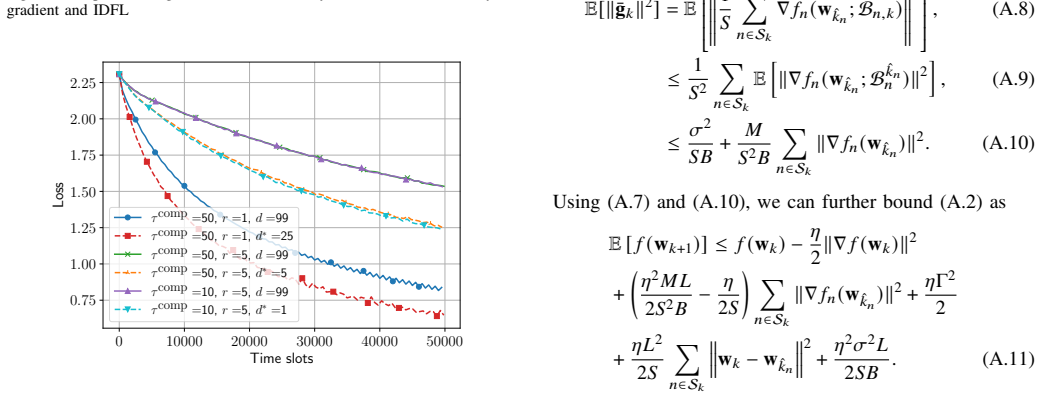
The load-bearing object is the staleness identity d_{n,k}=G−1: after the first G training rounds, every TDMA group transmits a gradient computed from the global model G−1 rounds old, independent of device index. This converts asynchrony into a deterministic, constant delay and lets the analysis treat every update as uniformly stale. The proof machinery is the four-lemma descent argument that bounds the mismatch between local and global gradients and the accumulated drift across the stale window, then telescopes the stale sums to produce the O($G^{2}$/√K) rate. The second mechanism is the intentional-delay scheduler in Algorithm 2, which changes when each device receives the global model so that training starts from a fresher model; Proposition 1 picks the largest delay α that still hides computation inside communication, giving effective staleness d^* = G−1−α.
What would settle it
Evaluate the inequality in Lemma 2 with ∇f_n(w)-∇f(w)=1 and ∇f(w)=1; it claims 4≤2, so the proof step is false. A concrete check is to redo equation (26) with the valid bound ||x+y||^2 ≤ 2||x||^2+2||y||^2 and see whether the coefficient of the gradient-norm sum stays positive under the stated step-size condition; if it cannot, the claimed O($G^{2}$/√K) rate is not established by the given argument.
Extended reading notes
Core claim
The central claim is that asynchronous FL over a TDMA channel converges at rate O($G^{2}$/√K) for the average squared gradient norm, where G=N/S is the number of TDMA groups and K is the number of global rounds. The proof works by first establishing the staleness identity d_{n,k}=G−1 for every device in every round k≥G, so the asynchronous process becomes a constant-delay update. Lemma 1 bounds the one-round loss decrease; Lemma 2 bounds the local-vs-global gradient mismatch; Lemma 3 bounds the accumulated parameter drift over the stale window; Lemma 4 converts the stale-gradient sums back into current gradient norms. Theorem 1 then closes the rate under L-smoothness, a bounded second moment, and a bounded heterogeneity assumption, with step size η≤β/√(K+1). A separate claim is that introducing an intentional delay α, chosen by Proposition 1, reduces the effective staleness to d^* = G−1−α, and the experiments report that this accelerates convergence in the tested settings.
Load-bearing premise
The proof's Lemma 2 rests on the inequality ||x+y||^2 ≤ ||x||^2+||y||^2, which fails for nonzero vectors, and this same step is reused in Lemma 3 and the appendix, so the bounds on the stale-gradient error that Theorem 1 depends on are not derived.
Editorial extensions
If this is right
- If Theorem 1 is correct, the convergence rate degrades quadratically in the number of TDMA groups, so the group count is the direct lever for how much staleness can be tolerated before the rate worsens.
- The intentional-delay scheme should outperform plain asynchronous FL for the same time budget whenever the computation-to-communication ratio allows a positive α, with the largest gains at small group sizes.
- Applying the intentional delay shifts the optimal group size: a smaller S becomes preferable because global updates happen more often and the delay recovers most of the staleness penalty.
- The staleness identity implies that steady-state behavior, not the initial transient, governs convergence, so performance can be predicted from N, S, and τ_comp/r alone.
- In the experiments, the S=1 configuration with intentional delay beats the synchronized S=N configuration on MNIST, indicating that asynchronous operation can be strictly preferable when the time budget is fixed.
Reading between the lines
- An editorial check: Lemma 2 uses ||x+y||^2 ≤ ||x||^2+||y||^2, which is false; replacing it with the valid 2||x||^2+2||y||^2 bound changes constants in Lemmas 3 and 4, so Theorem 1's rate would need re-derivation to see whether O(G^2/√K) survives the extra factors.
- The intentional-delay rule suggests an online tuning procedure: since α is chosen from τ_comp/r, a system could adapt α as channel conditions or device speeds change during training.
- The fixed-delay analysis would break under heterogeneous device speeds, because the staleness identity G−1 becomes device- and time-dependent; a natural extension is a delay-distribution analysis rather than a single scalar.
- The quadratic dependence on G implies a design optimum that the paper does not state in closed form: for fixed N and time budget, the best S balances update frequency against staleness, and the reported shift from S=10 to S=5 in CIFAR-10 illustrates that optimum moving with α.
Editorial analysis
A structured set of objections, weighed in public.
Referee Report
Summary. The paper studies asynchronous federated learning (FL) over a time-division multiple access (TDMA) channel. Devices are partitioned into TDMA groups of size S, each group transmits in turns while other groups compute local updates. The paper derives the staleness of local updates as G-1 (where G=N/S), analyzes convergence under smoothness, bounded second moments, and bounded heterogeneity, and claims the rate O(G^2/√K) for the average squared gradient norm. Based on this analysis, the authors propose 'intentional delay FL' (IDFL), which deliberately delays global-model reception to reduce effective staleness, and provide simulation results on MNIST and CIFAR-10 showing empirical improvements.
Significance. If the convergence theorem were valid, the paper would make a useful contribution by linking the TDMA group size to the staleness of local updates and by proposing a simple, communication-side mechanism (intentional delay) to reduce staleness without extra time slots. The system model in Section III and the IDFL algorithm in Section V are clearly presented, and the experiments are extensive. However, the central theoretical claim, Theorem 1, is not established because the proof relies on a false square-norm inequality. Since the convergence rate is the main contribution and motivates the proposed IDFL strategy, the current manuscript cannot be accepted.
major comments (3)
- [Section IV, Lemma 2] The proof of Lemma 2 (Eq. (24)) uses the inequality ||∇f_n(w_hat)-∇f(w_hat)+∇f(w_hat)||^2 ≤ ||∇f_n(w_hat)-∇f(w_hat)||^2 + ||∇f(w_hat)||^2. This is false in general; for example, with x=y=1 it would assert 4 ≤ 2. The step is not a valid application of the triangle inequality, and Assumption 3 does not prevent this failure because both vectors can point in the same direction. Since Lemma 2 is used to bound the terms in (26) and in the proof of Lemma 3, the derivation of Theorem 1 is not sound.
- [Appendix A, Eq. (A.5)] The same false inequality is used in Appendix A to write ||∇f(w_k)-∇f_n(w_hat)||^2 ≤ ||∇f(w_k)-∇f(w_hat)||^2 + ||∇f(w_hat)-∇f_n(w_hat)||^2. The correct bound is ||a+b||^2 ≤ 2||a||^2+2||b||^2, which introduces an extra factor of 2 in Lemma 1 and hence in Eq. (23). This affects the constants in the subsequent convergence proof, so Lemma 1 as stated is not justified.
- [Appendix B, Eq. (B.1)] In the proof of Lemma 3, the squared norm of the sum over j from k_hat_n to k-1 is bounded by the sum of the individual squared norms without a factor for the number of terms. The standard inequality is ||∑_{i=1}^m x_i||^2 ≤ m ∑_{i=1}^m ||x_i||^2, with m equal to the staleness d_{n,k}. Since d_{n,k}=G-1 for k≥G, this repair puts an explicit factor of G into the drift bound in (25), which propagates into Theorem 1 and changes the step-size condition (30). Consequently, the claimed O(G^2/√K) rate in (31) is not derived.
minor comments (4)
- [Section IV, Lemma 2 statement] The statement of Lemma 2 writes ∑ E[||f(w_hat)||^2] where the proof and the surrounding text concern ∇f(w_hat); the notation should be corrected to ||∇f(w_hat)||^2.
- [Eq. (27)] In the last term of (27), the summation index is written as ∑_{n∈} without specifying the set; it should be ∑_{n∈S_k}.
- [Section V, Proposition 1] The symbol d^* is used in (33) before it is defined in (34); please reorder or add a short explanation around its first occurrence.
- [Section VI, Table I] The caption of Table I is referenced in the text as 'Table I' but the table itself appears without a numbered caption; please ensure all tables are numbered and referenced consistently.
Circularity Check
No material circularity: the convergence analysis is self-contained and the intentional-delay algorithm is validated empirically, not by construction.
full rationale
The paper's central derivation, Theorem 1, starts from standard Assumptions 1-3 and derives the rate O(G^2/sqrt K) by algebra in Lemmas 1-4 and Appendices A-D. The staleness identity d_{n,k}=G-1 is a direct consequence of the TDMA schedule in Algorithm 1, not an assumption of the theorem's conclusion. Lemma 4's combinatorial bounds and the step-size condition eta <= beta/sqrt(K+1) are derived in-text rather than imported from prior work. The intentional-delay strategy in Algorithm 2 is motivated by the authors' own convergence expression, but Proposition 1 derives alpha from the timing constraints (35)-(37), and the claimed acceleration is then checked against MNIST/CIFAR-10 simulations in Section VI; no fitted parameter is relabeled as a prediction. The paper does contain self-citations ([7], [9], [12], [13]) but these appear only in background statements about dynamic batch sizes, device counts, and over-the-air aggregation; they do not carry the convergence proof or the protocol design. The flagged issue in Lemma 2 - the inequality ||x+y||^2 <= ||x||^2+||y||^2 and its reuse in Appendix B/A.5 - is a mathematical correctness concern if true, not circularity: it does not make any input equal to any output by definition. Because the derivation chain is self-contained and the simulations are external evidence, the circularity score is 0.
Assumptions & free parameters
free parameters (1)
- Step size η =
0.01 (MNIST and CIFAR-10 simulations)
assumptions (5)
- standard math Global loss is L-smooth (Assumption 1)
- standard math Bounded second moment of stochastic gradients (Assumption 2)
- domain assumption Bounded data heterogeneity (Assumption 3)
- domain assumption Homogeneous device computation capability q (Section II)
- ad hoc to paper Lemma 2 inequality ||x+y||^2 ≤ ||x||^2+||y||^2
Cite this review
Pith. "Pith review of Asynchronous Federated Learning Using Outdated Local Updates Over TDMA Channel." pith.science (2026). https://pith.science/paper/FWTBCI6M
@misc{pith2026241113861,
  author       = {Pith},
  title        = {Pith review of: Asynchronous Federated Learning Using Outdated Local Updates Over TDMA Channel},
  year         = {2026},
  howpublished = {\url{https://pith.science/paper/FWTBCI6M}},
  note         = {Machine review of arXiv:2411.13861}
}
read the original abstract
In this paper, we consider asynchronous federated learning (FL) over time-division multiple access (TDMA)-based communication networks. Considering TDMA for transmitting local updates can introduce significant delays to conventional synchronous FL, where all devices start local training from a common global model. In the proposed asynchronous FL approach, we partition devices into multiple TDMA groups, enabling simultaneous local computation and communication across different groups. This enhances time efficiency at the expense of staleness of local updates. We derive the relationship between the staleness of local updates and the size of the TDMA group in a training round. Moreover, our convergence analysis shows that although outdated local updates hinder appropriate global model updates, asynchronous FL over the TDMA channel converges even in the presence of data heterogeneity. Notably, the analysis identifies the impact of outdated local updates on convergence rate. Based on observations from our convergence rate, we refine asynchronous FL strategy by introducing an intentional delay in local training. This refinement accelerates the convergence by reducing the staleness of local updates. Our extensive simulation results demonstrate that asynchronous FL with the intentional delay can rapidly reduce global loss by lowering the staleness of local updates in resource-limited wireless communication networks.
Figures


Figures from the paper (4 more)


Reference graph
Works this paper leans on
-
[1]
Communication-Efficient Learning of Deep Networks from Decentral- ized Data,
B. McMahan, E. Moore, D. Ramage, S. Hampson, and B. A. y. Arcas, “Communication-Efficient Learning of Deep Networks from Decentral- ized Data,” in Proc. 20th Int. Conf. on Artif. Intell. Stat. , vol. 54, Apr. 2017, pp. 1273–1282
work page 2017
-
[2]
Federated learning: Strategies for improving communication efficiency,
J. Kone ˇcn`y, H. B. McMahan, F. X. Yu, P. Richtárik, A. T. Suresh, and D. Bacon, “Federated learning: Strategies for improving communication efficiency,” arXiv preprint arXiv:1610.05492 , 2016
arXiv 2016
-
[3]
Local sgd converges fast and communicates little,
S. U. Stich, “Local sgd converges fast and communicates little,” arXiv preprint arXiv:1805.09767, 2018
arXiv 2018
-
[4]
H. Yu, S. Yang, and S. Zhu, “Parallel restarted SGD with faster con- vergence and less communication: Demystifying why model averaging works for deep learning,” in Proc. of the AAAI Conf. Artif. Intell. , vol. 33, no. 01, 2019, pp. 5693–5700
work page 2019
-
[5]
A. Reisizadeh, A. Mokhtari, H. Hassani, A. Jadbabaie, and R. Pedarsani, “Fedpaq: A communication-efficient federated learning method with periodic averaging and quantization,” in Int. conf. Artif. Intell. Stat. PMLR, 2020, pp. 2021–2031
work page 2020
-
[6]
To talk or to work: Dynamic batch sizes assisted time efficient federated learning over future mobile edge devices,
D. Shi, L. Li, M. Wu, M. Shu, R. Yu, M. Pan, and Z. Han, “To talk or to work: Dynamic batch sizes assisted time efficient federated learning over future mobile edge devices,” IEEE Trans. Wireless Commun. , vol. 21, no. 12, pp. 11 038–11 050, 2022
2022
-
[7]
Optimal Batch Allocation for Wireless Federated Learning
J. Song and S.-W. Jeon, “Optimal batch allocation for wireless federated learning,” arXiv preprint arXiv:2404.02395 , 2024
work page Pith review arXiv 2024
-
[8]
A joint learning and communications framework for federated learning over wireless networks,
M. Chen, Z. Yang, W. Saad, C. Yin, H. V . Poor, and S. Cui, “A joint learning and communications framework for federated learning over wireless networks,” IEEE Trans. Wireless Commun. , vol. 20, no. 1, pp. 269–283, 2020
work page 2020
Show all 24 references
-
[9]
Wireless distributed edge learning: How many edge devices do we need?
J. Song and M. Kountouris, “Wireless distributed edge learning: How many edge devices do we need?” IEEE J. Sel. Areas Commun. , vol. 39, no. 7, pp. 2120–2134, 2020
2020
-
[10]
Scheduling policies for federated learning in wireless networks,
H. H. Yang, Z. Liu, T. Q. Quek, and H. V . Poor, “Scheduling policies for federated learning in wireless networks,” IEEE Trans. Commun., vol. 68, no. 1, pp. 317–333, 2019
2019
-
[11]
Joint device selection and bandwidth allocation for cost-efficient federated learning in industrial internet of things,
X. Ji, J. Tian, H. Zhang, D. Wu, and T. Li, “Joint device selection and bandwidth allocation for cost-efficient federated learning in industrial internet of things,” IEEE Internet Things J. , vol. 10, no. 10, pp. 9148– 9160, 2023
2023
-
[12]
Over-the-air aggregation-based federated learning in cache-enabled wireless edge networks,
J.-P. Hong, S. Park, and W. Choi, “Over-the-air aggregation-based federated learning in cache-enabled wireless edge networks,” in Proc. IEEE Int. Conf. on Commun. , Jun. 2023, pp. 1994–1999
2023
-
[13]
Base station dataset-assisted broadband over-the-air aggregation for communication-efficient federated learning,
——, “Base station dataset-assisted broadband over-the-air aggregation for communication-efficient federated learning,” IEEE Trans. Wireless Commun., vol. 22, no. 11, pp. 7259–7272, Nov. 2023
2023
-
[14]
Latency minimization for tdma-based wireless federated learn- ing networks,
D. Xu, “Latency minimization for tdma-based wireless federated learn- ing networks,” IEEE Trans. V eh. Technol., 2024
2024
-
[15]
Device scheduling for energy-efficient federated learning over wireless network based on tdma mode,
Y . Hu, H. Huang, and N. Yu, “Device scheduling for energy-efficient federated learning over wireless network based on tdma mode,” in 2020 Int. Conf. on Wireless Commun. Signal Process. (WCSP) . IEEE, 2020, pp. 286–291
2020
-
[16]
Wireless quantized federated learning: A joint computation and communication design,
P. S. Bouzinis, P. D. Diamantoulakis, and G. K. Karagiannidis, “Wireless quantized federated learning: A joint computation and communication design,” IEEE Trans. Commun. , vol. 71, no. 5, pp. 2756–2770, 2023
2023
-
[17]
Multi- channel aloha optimization for federated learning with multiple models,
R. V . da Silva, J. Choi, J. Park, G. Brante, and R. D. Souza, “Multi- channel aloha optimization for federated learning with multiple models,” IEEE Wireless Commun. Lett. , vol. 11, no. 10, pp. 2180–2184, 2022
2022
-
[18]
Adaptive federated learning with gradient compression in uplink noma,
H. Sun, X. Ma, and R. Q. Hu, “Adaptive federated learning with gradient compression in uplink noma,” IEEE Trans. V eh. Technol., vol. 69, no. 12, pp. 16 325–16 329, 2020
2020
-
[19]
Asynchronous decentralized parallel stochastic gradient descent,
X. Lian, W. Zhang, C. Zhang, and J. Liu, “Asynchronous decentralized parallel stochastic gradient descent,” in Int. Conf. Mach. Learn. PMLR, 2018, pp. 3043–3052
2018
-
[20]
Sharper convergence guaran- tees for asynchronous sgd for distributed and federated learning,
A. Koloskova, S. U. Stich, and M. Jaggi, “Sharper convergence guaran- tees for asynchronous sgd for distributed and federated learning,” Adv. Neural Inf. Process. Syst. , vol. 35, pp. 17 202–17 215, 2022
2022
-
[21]
Asynchronous federated learning over wireless communication networks,
Z. Wang, Z. Zhang, Y . Tian, Q. Yang, H. Shan, W. Wang, and T. Q. Quek, “Asynchronous federated learning over wireless communication networks,” IEEE Trans. Wireless Commun. , vol. 21, no. 9, pp. 6961– 6978, 2022
2022
-
[22]
Scheduling and aggregation design for asynchronous federated learning over wireless networks,
C.-H. Hu, Z. Chen, and E. G. Larsson, “Scheduling and aggregation design for asynchronous federated learning over wireless networks,” IEEE J. Sel. Areas Commun. , vol. 41, no. 4, pp. 874–886, 2023
2023
-
[23]
The MNIST database of handwritten digit images for machine learning research,
L. Deng, “The MNIST database of handwritten digit images for machine learning research,” IEEE Signal Process. Mag. , vol. 29, no. 6, pp. 141– 142, 2012
2012
-
[24]
Learning multiple layers of features from tiny images,
A. Krizhevsky, “Learning multiple layers of features from tiny images,” University of Toronto, Tech. Rep. TR-2009, 2009
2009
Reviewed August 12, 2026 · model on record in the stance chip above.
Discussion (0). Continue with ORCID to comment.