REVIEW 5 major objections 5 minor 33 references
Nonlinear dynamics in an artificial feedback spin maser
T0 review · 5 major / 5 minor · reviewed 2026-08-12 · deepseek-v4-flash
Pith's one-line read Simulating an ideal 129Xe spin maser, this paper shows that once the artificial feedback field is as strong as or stronger than the static bias field, the Bloch dynamics split into high-order harmonic, nonperiodic, and frequency-comb…
desk verdict Plausible map of strong-feedback spin maser dynamics, but the key regimes need numerical validation before I'd trust them. read the letter →
The pith
A machine-rendered reading of the paper's core claim, the machinery that carries it, and where it could break.
The reading
What carries the argument
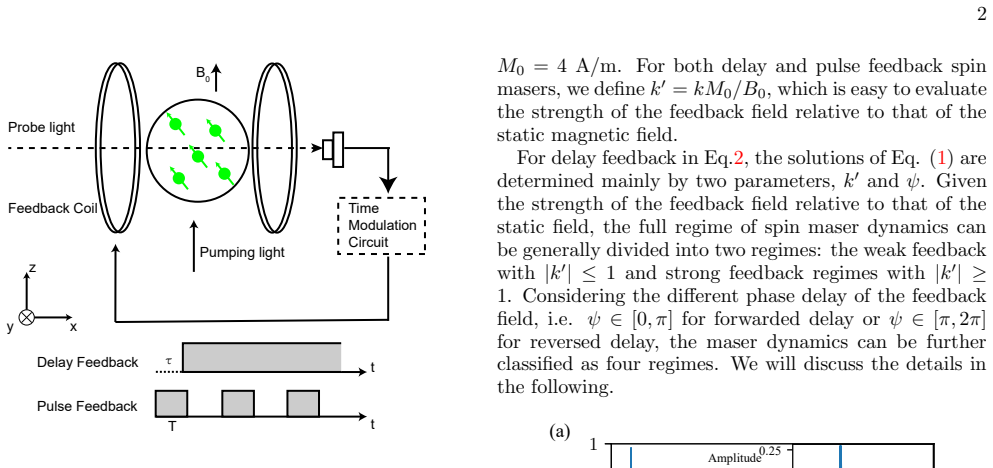
The load-bearing mechanism is the feedback-driven Bloch equation system (Eqs. 1–3). The detected transverse magnetization generates the feedback field $B_x = kM_x(t-\tau)$ in the delay protocol, or $B_x = kM_y(t)$ during pulses in the pulse protocol, closing the loop between detection and excitation. The delay is parametrized as $\tau = \psi/\omega_0$, which converts the delay into a phase $\psi$, and the dimensionless ratio $k' = kM_0/B_0$ measures the feedback field against the static field. The simulations integrate these delay differential equations with the JiTCDDE solver, which the authors find necessary because Runge–Kutta becomes inefficient once the strong-feedback nonlinearity develops.
What would settle it
Run a real 129Xe maser with feedback strength $k' \approx 2$ and reversed phase delay around $\psi = 225^\circ$: if the spectrum shows only the fundamental and no peak at $3\nu$ while the maser still oscillates, or if raising the feedback to $k' \approx 10$ does not make the oscillations nonperiodic, then the predicted strong-feedback regimes are not present in that apparatus.
Extended reading notes
Core claim
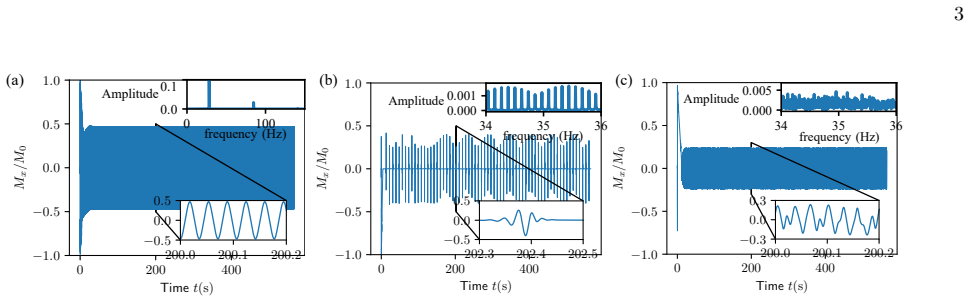
The paper's central discovery, on its own terms, is that feedback-driven Bloch equations for a single-species spin maser have a complete dynamical phase diagram controlled by two parameters: the feedback strength $k' = kM_0/B_0$ and the phase delay $\psi = \omega_0\tau$. The threshold $k' = 1$ separates the weak-feedback regime, where the frequency shift is linear in the phase delay, from a strong-feedback regime where the feedback field dominates the spin-field interaction and the system behaves like a spin in a strong oscillating field. For strong feedback with reversed phase delay ($\psi \in [\pi, 2\pi]$), the spectrum shows a shifted fundamental $\nu$ along with a third harmonic at $3\nu$, and at still higher strength the oscillations become nonperiodic; for strong feedback with forward delay ($\psi \in [0, \pi]$), the maser emits pulsed oscillations with a comb-like spectrum. In the pulse feedback protocol, switching the feedback field on for intervals $T$ produces a frequency comb with carrier at $\nu_0 = 35.34$ Hz and repetition rate $\nu_g = 1/(2T) = 0.1$ Hz.
Load-bearing premise
The analysis assumes an ideal feedback loop: no noise, no coil bandwidth limit, no detection latency, no rubidium–xenon spin-exchange coupling, and a time delay that maps linearly to phase via $\tau = \psi/\omega_0$; if real feedback circuits filter the high harmonics or if fixed delays do not track the Larmor frequency, the predicted strong-feedback regimes may not be observable.
Editorial extensions
If this is right
- An ideal 129Xe spin maser with feedback strength $k' \ge 1$ will show, for reversed phase delay, a spectrum with a shifted fundamental and a third harmonic at $3\nu$, and at $k' = 10$ nonperiodic oscillations instead of steady sinusoidal emission.
- For strong feedback with forward phase delay, the maser spectrum broadens into a comb-like chirp rather than a single line, so the same device can serve as either a narrow-line maser or a broadband comb source depending on $\psi$.
- The pulse feedback protocol yields a magnetic frequency comb with carrier $\nu_0 = 35.34$ Hz and spacing $\nu_g = 1/(2T)$, both tunable by changing $B_0$ and $T$, requiring no optical cavity and no external modulation field.
- The complete $(k', \psi)$ phase map—FID, Zeeman maser, harmonic/nonperiodic, and comb regions—goes beyond earlier weak-feedback treatments and gives a checklist of signatures to look for in artificial-feedback spin maser experiments.
Reading between the lines
- Because the model assumes an ideal feedback coil with no bandwidth limit, a real coil that attenuates the third harmonic at $3\nu \approx 105$ Hz could suppress the predicted harmonic peak even if the nonlinear spin dynamics occur; this is a directly testable experimental check.
- The mapping $\tau = \psi/\omega_0$ makes the phase delay frequency-dependent, whereas real electronic delays are fixed; relaxing this assumption could shift the boundaries in the $(\psi, k')$ diagram when $B_0$ is tuned, so the predicted regime map may need revision for frequency-swept operation.
- The model omits Rb–Xe spin-exchange coupling, which the authors flag as a possible origin of continuous-time-crystal behaviour in hybrid masers; including that coupling may either suppress or enrich the nonperiodic regime reported here.
- The pulse feedback comb, demonstrated for 129Xe parameters, should transfer to other noble-gas spins (e.g. $^3$He) with different $T_2$ and $\gamma$, changing the comb linewidth and sensitivity; whether the comb's phase coherence survives feedback-phase noise is not addressed in the paper.
Editorial analysis
A structured set of objections, weighed in public.
Referee Report
Summary. The paper studies an idealized 129Xe spin maser with optical detection and artificial feedback, modeled by Bloch equations with either time-delayed feedback (Bx = k Mx(t−τ), Eq. 2) or pulsed feedback (Bx = k My(t) during half-periods, Eq. 3). By numerically solving these equations with the JiTCDDE solver, the authors divide the dynamics into weak and strong feedback regimes. In the strong-feedback regime (|k′| ≥ 1), they report high-order harmonic generation, nonperiodic (possibly chaotic) spin oscillations, and frequency-comb-like spectra. They also propose a pulse-feedback protocol that produces a magnetic frequency comb with line spacing 1/(2T) at a 35.34 Hz carrier. All conclusions are based on a small number of representative simulations; no experimental data, convergence tests, or quantitative chaos diagnostics are provided.
Significance. If the reported strong-feedback phenomena are correct, the paper would extend the understanding of spin-maser dynamics beyond the well-studied weak-feedback regime and offer a simple, cavity-free route to an ultralow-frequency magnetic frequency comb, with potential applications in precision magnetometry and searches for spin-dependent exotic interactions. The pulse-feedback protocol is particularly attractive because its comb spacing follows directly from the modulation period and is easily tunable. However, the significance is conditional: the central claims of nonperiodic dynamics and comb generation rest on single unvalidated simulations, and the lack of numerical convergence studies leaves open the possibility of artifacts. The paper's strengths are its clear setup of the standard delayed-Bloch model and its identification of a parameter region (|k′| ≥ 1) that previous works did not systematically explore.
major comments (5)
- [Strong feedback regime, Fig. 3(c)] The claim of nonperiodic spin oscillations is supported only by a single 400-second time trace of Mx(t). No Lyapunov exponent, Poincaré section, or correlation dimension is computed, so the observed irregularity could equally be a long-period orbit, quasiperiodicity, or a transient that would eventually settle onto a simpler attractor. Since this regime is one of the paper's central findings, a quantitative dynamical characterization is required.
- [Strong feedback regime, Fig. 3(b)] The 'frequency comb' identification is based on a spectrum with a few broad peaks. The paper reports no comb line spacing, linewidth, coherence time, or comparison with the expected spacing from the pulse period. For a finite integration window, a periodic pulse train always yields a comb-like spectrum if the resolution is insufficient to separate closely spaced lines; the present evidence does not distinguish a true comb from such an artifact.
- [Model and numerical methods, 'We set the maximum time step...'] The numerical section states a fixed maximum time step of Δt = 0.00028 s for the JiTCDDE solver, but no convergence or refinement study is reported. In a strongly nonlinear delay-differential system, the chaotic and comb regimes could in principle be numerical artifacts of the integration step or tolerance. The authors should show that the reported regimes persist with smaller time steps and that the spectra and time-series statistics are converged.
- [Pulse feedback spin maser, Eq. (3) and Fig. 5] There is an internal sign inconsistency: the text states 'We set k′ = 0.1 and T = 5 s' while the caption of Fig. 5 specifies 'k′ = −0.1'. Because the sign of the feedback coefficient determines whether the feedback field is parallel or antiparallel to My(t), this inconsistency is not a mere typographical issue and prevents reproduction. Additionally, the comb spacing νg = 1/(2T) follows directly from the periodic pulse train with period 2T; the paper should acknowledge that this is an expected consequence of amplitude modulation rather than a new nonlinear effect.
- [Strong feedback regime and Fig. 4] The text claims a 'full picture' of spin maser dynamics over k′ ∈ [0.001, 100] and ψ ∈ [0, 2π], but Fig. 4 appears to be a schematic diagram rather than a numerically computed phase map. The boundaries between the four regimes are not derived from an explicit parameter scan, and the criteria for assigning a point to 'harmonic', 'nonperiodic', or 'comb' are not given. Clarify whether Fig. 4 reports simulation data and, if so, describe the grid resolution and regime-classification procedure.
minor comments (5)
- [Throughout, 'k′ ≥ 1'] The text repeatedly says the strong-feedback regime corresponds to 'k′ ≥ 1', but all strong-feedback examples use negative values (k′ = −2, −10). The condition should read |k′| ≥ 1 to be consistent with the earlier definition of weak feedback as |k′| ≤ 1.
- [Model, paragraph on τ = ψ/ω0] The definition τ = ψ/ω0 implies that a fixed electronic time delay would produce a phase ψ that changes with B0. This mapping is appropriate for the idealized simulations presented here, but the authors should comment on how it relates to experimental implementations, where the delay is typically a fixed time constant.
- [Introduction, paragraph 3] There is a typo: 'albeti' should be 'albeit' in the sentence 'still lacking albeti recent simulation works'.
- [Eq. (4) and surrounding text] Since γ is negative for 129Xe, the inequality in Eq. (4) involves a sign convention that is not explicitly discussed. A sentence clarifying how the sign of γ is absorbed into the condition would improve readability.
- [Fig. 5] The figure contains garbled character sequences in the axis labels (e.g., 'uni00000013...'). This is likely a rendering issue in the submitted PDF, but the labels should be checked so that the horizontal and vertical axes are readable.
Circularity Check
No significant circularity: the strong-feedback regimes are emergent from the stated Bloch-equation model, and the self-citation to Ref. [19] is used only as a validation benchmark.
full rationale
The paper's central claims—high-order harmonics, nonperiodic oscillations, and frequency combs under strong feedback—are obtained by numerically solving the feedback-driven Bloch equations (Eq. 1) with specified feedback forms (Eqs. 2 and 3). These are emergent properties of the model dynamics, not quantities fitted to data or imported from prior work. The weak-feedback verification against the authors' earlier Runge-Kutta results (Ref. [19]) is a consistency check, not a load-bearing premise for the new strong-feedback predictions; the same dynamics are independently described by the analytical RWA result (Ref. [18]). The pulse-feedback comb spacing νg = 1/(2T) is explicitly tied to the pulse duration T defined in Eq. 3; this is a design parameter of the proposed protocol, and the simulation spectrum in Fig. 5 confirms the expected comb structure rather than fitting it. No parameter is tuned to produce a target outcome, and no uniqueness theorem or ansatz is imported from self-citations. The absence of Lyapunov exponents, convergence tests, or comb-line quality metrics is a validation rigor concern, not circularity. Therefore the derivation chain is self-contained and non-circular.
Assumptions & free parameters
free parameters (5)
- T1 = T2 =
10 s
- M0 =
4 A/m
- Initial tilt amplitude =
1e-4*M0
- Maximum time step =
0.00028 s
- Pulse duration T =
5 s
assumptions (4)
- standard math Bloch equations with Markovian relaxation describe the spin dynamics (Eq. 1).
- domain assumption The feedback field is exactly Bx = kMx(t-τ) or Bx = kMy(t) with no noise, no coil bandwidth, no parasitic delays (Eqs. 2-3).
- domain assumption The time delay τ maps to phase ψ via τ = ψ/ω0, so that scanning ψ is equivalent to scanning a phase delay at fixed Larmor frequency.
- domain assumption T1 = T2 = 10 s and M0 = 4 A/m are representative for an ideal hyperpolarized 129Xe sample with no wall or gradient effects.
Cite this review
Pith. "Pith review of Nonlinear dynamics in an artificial feedback spin maser." pith.science (2026). https://pith.science/paper/MZTU2HZ4
@misc{pith2026241113930,
  author       = {Pith},
  title        = {Pith review of: Nonlinear dynamics in an artificial feedback spin maser},
  year         = {2026},
  howpublished = {\url{https://pith.science/paper/MZTU2HZ4}},
  note         = {Machine review of arXiv:2411.13930}
}
read the original abstract
Spin masers with optical detection and artificial feedback are widely used in fundamental and practical applications. However, a full picture of the maser dynamics is still absent. By solving the feedback driven Bloch equations, we simulated the dynamics of an ideal spin maser in a broad parameter space. Rich nonlinear dynamics including high order harmonics generation, nonperiodic spin oscillations and frequency comb were revealed when the artificial feedback interaction exceeds the normal spin-field interaction. We also propose a pulse feedback spin maser protocol, which constructs an ultralow field magnetic frequency comb and could be useful in precision atomic magnetometers in searching for spin-dependent exotic interactions.
Figures

Figures from the paper (1 more)

Reference graph
Works this paper leans on
-
[1]
Considering the different phase delay of the feedback field, i.e. ψ ∈ [0, π] for forwarded delay or ψ ∈ [π, 2π] for reversed delay, the maser dynamics can be further classified as four regimes. We will discuss the details in the following. 0 200 400 Time t(s) −1 0 1 M x/M 0 202 τ3 202 τ5 (a) 35.0 35.5 36.0 frequency (Hz) 0.00 0.25Amplitude 0 45 90 135 180...
-
[2]
A. L. Bloom, Principles of operation of the rubidium va- pormagnetometer, Appl. Opt. 1, 61 (1962)
work page 1962
-
[3]
H. G. Dehmelt, Modulation of a light beam by precessing absorbing atoms, Phys. Rev. 105, 1924 (1957)
work page 1957
-
[4]
M. Richards, B. Cowan, M. Secca, and K. Machin, The 3he nuclear zeeman maser, Journal of Physics B: Atomic, Molecular and Optical Physics 21, 665 (1988)
work page 1988
-
[5]
5(a), the spin maser emits short pulses in the time domain
In Fig. 5(a), the spin maser emits short pulses in the time domain. The spectrum represents a typical fre- quency comb with Larmor frequencyν0 = 35.34 Hz as the carrier frequency and νg = 1/(2T ) = 0 .1 Hz as the rep- etition frequency. Different from the optical frequency comb requiring a high quality optical cavity, the pulse spin maser or magnetic freq...
-
[6]
H. G. Robinson and T. Myint, 3He NUCLEAR ZEEMAN MASER, Applied Physics Letters 5, 116 (1964), https://pubs.aip.org/aip/apl/article- pdf/5/6/116/18417328/116 1 online.pdf
work page 1964
-
[7]
T. E. Chupp, R. J. Hoare, R. L. Walsworth, and B. Wu, Spin-exchange-pumped 3He and 129Xe zeeman masers, Phys. Rev. Lett. 72, 2363 (1994)
work page 1994
-
[8]
R. E. Stoner, M. A. Rosenberry, J. T. Wright, T. E. Chupp, E. R. Oteiza, and R. L. Walsworth, Demonstra- tion of a two species noble gas maser, Phys. Rev. Lett. 77, 3971 (1996)
work page 1996
Show all 33 references
-
[9]
D. Bear, T. E. Chupp, K. Cooper, S. DeDeo, M. Rosen- berry, R. E. Stoner, and R. L. Walsworth, Improved fre- quency stability of the dual-noble-gas maser, Phys. Rev. A 57, 5006 (1998)
1998
-
[10]
Yoshimi, K
A. Yoshimi, K. Asahi, K. Sakai, M. Tsuda, K. Yogo, H. Ogawa, T. Suzuki, and M. Nagakura, Nuclear spin maser with an artificial feedback mechanism, Physics Letters A 304, 13 (2002)
2002
-
[11]
Yoshimi, T
A. Yoshimi, T. Inoue, T. Furukawa, T. Nanao, K. Suzuki, M. Chikamori, M. Tsuchiya, H. Hayashi, M. Uchida, N. Hatakeyama, S. Kagami, Y. Ichikawa, H. Miyatake, and K. Asahi, Low-frequency 129xe nuclear spin oscilla- tor with optical spin detection, Physics Letters A 376, 1924 (2012)
2012
-
[12]
T. Sato, Y. Ichikawa, S. Kojima, C. Funayama, S. Tanaka, T. Inoue, A. Uchiyama, A. Gladkov, A. Takamine, Y. Sakamoto, Y. Ohtomo, C. Hirao, M. Chikamori, E. Hikota, T. Suzuki, M. Tsuchiya, T. Fu- rukawa, A. Yoshimi, C. Bidinosti, T. Ino, H. Ueno, Y. Matsuo, T. Fukuyama, N. Yosh...
2018
-
[13]
Bevington, R
P. Bevington, R. Gartman, Y. V. Stadnik, and W. Chalupczak, Dual-frequency cesium spin maser, Phys. Rev. A 102, 032804 (2020)
2020
-
[14]
Jiang, H
M. Jiang, H. Su, Z. Wu, X. Peng, and D. Budker, Floquet maser, Science Advances 7, eabe0719 (2021)
2021
-
[15]
Z. Wang, X. Peng, Z. Xiong, J. Zheng, H. Luo, and H. Guo, Atomic comagnetometer with a closed-loop op- tically aligned 87Rb dual-frequency oscillator, Phys. Rev. Appl. 19, 024021 (2023)
2023
-
[16]
D. Bear, R. E. Stoner, R. L. Walsworth, V. A. Kost- eleck´ y, and C. D. Lane, Limit on lorentz and cpt viola- tion of the neutron using a two-species noble-gas maser, Phys. Rev. Lett. 85, 5038 (2000)
2000
-
[17]
M. A. Rosenberry and T. E. Chupp, Atomic elec- tric dipole moment measurement using spin exchange pumped masers of 129Xe and 3He, Phys. Rev. Lett. 86, 22 (2001)
2001
-
[18]
Afach, B
S. Afach, B. C. Buchler, D. Budker, C. Dailey, A. Dere- vianko, V. Dumont, N. L. Figueroa, I. Gerhardt, Z. D. Gruji´ c, H. Guo, C. Hao, P. S. Hamilton, M. Hedges, D. F. Jackson Kimball, D. Kim, S. Khamis, T. Kor- nack, V. Lebedev, Z.-T. Lu, H. Masia-Roig, M. Monroy, M. Padniuk...
2021
-
[19]
Bevington, R
P. Bevington, R. Gartman, and W. Chalupczak, Alkali-metal spin maser for non-destructive tests, Applied Physics Letters 115, 173502 (2019), https://pubs.aip.org/aip/apl/article- pdf/doi/10.1063/1.5121606/13698489/173502 1 online.pdf
2019 doi
-
[20]
Z. Wang, X. Peng, H. Luo, and H. Guo, Comparison of operation modes for spin-exchange optically-pumped spin oscillators, Journal of Magnetic Resonance 278, 134 (2017)
2017
-
[21]
E. Li, Q. Ma, G. Liu, P. Yun, and S. Zhang, Self-driven hybrid atomic spin oscillator, Physical Review Applied 20, 014029 (2023)
2023
-
[22]
Balachandran, T
B. Balachandran, T. Kalm´ ar-Nagy, and D. E. Gilsinn, Delay differential equations (Springer, 2009)
2009
-
[23]
C. I. Ratcliffe, Xenon nmr, in Annual reports on NMR spectroscopy, Vol. 36 (Elsevier, 1998) pp. 123–221
1998
-
[24]
G. Ansmann, Efficiently and easily integrating differen- tial equations with jitcode, jitcdde, and jitcsde, Chaos: An interdisciplinary journal of nonlinear science 28, https://doi.org/10.1063/1.5019320 (2018)
2018 doi
-
[25]
J. H. Shirley, Solution of the schr¨ odinger equation with a hamiltonian periodic in time, Physical Review 138, B979 (1965)
1965
-
[26]
Cohen-Tannoudji, J
C. Cohen-Tannoudji, J. Dupont-Roc, and G. Grynberg, Atom-photon interactions: basic processes and applica- tions (John Wiley & Sons, 1998)
1998
-
[27]
T. Hula, K. Schultheiss, F. J. T. Gon¸ calves, L. K¨ orber, M. Bejarano, M. Copus, L. Flacke, L. Liensberger, A. Buzdakov, A. K´ akay, M. Weiler, R. Camley, J. Fass- bender, and H. Schultheiss, Spin-wave frequency combs, Applied Physics Letters 121, 112404 (2022)
2022
-
[28]
R. R. Peroor, L. Scafuri, D. A. Bozhko, and E. Iacocca, Frequency comb in a macroscopic mechano-magnetic ar- tificial spin ice (2024), arXiv:2409.13658 [cond-mat.mes- hall]
2024 arXiv
-
[29]
X. Liu, Z. Jin, Z. Li, Z. Zeng, M. Li, Y. Yao, Y. Cao, Y. Zhang, and P. Yan, Low-lying magnon frequency comb in skymion crystals (2024), arXiv:2408.03277 [cond- mat.mtrl-sci]
2024 arXiv
-
[30]
Abergel, Chaotic solutions of the feedback driven bloch equations, Physics Letters A 302, 17 (2002)
D. Abergel, Chaotic solutions of the feedback driven bloch equations, Physics Letters A 302, 17 (2002)
2002
-
[31]
Y.-Y. Lin, N. Lisitza, S. Ahn, and W. S. Warren, Resur- rection of crushed magnetization and chaotic dynamics in solution nmr spectroscopy, Science 290, 118 (2000)
2000
- [32]
-
[33]
W. Wang, M. Feng, Q. Ma, Z. Cai, E. Li, and 6 G. Liu, Observation of continuous time crystal in a spin maser system, arXiv preprint arXiv:2406.15017 https://arxiv.org/abs/2406.15017v1 (2024)
2024 arXiv
Reviewed August 12, 2026 · model on record in the stance chip above.
Discussion (0). Continue with ORCID to comment.