REVIEW 3 major objections 5 minor 87 references
Formation of nonlinear modes in one-dimensional quasiperiodic lattices with a mobility edge
T0 review · 3 major / 5 minor · reviewed 2026-08-12 · deepseek-v4-flash
Pith's one-line read In a one-dimensional Bose-Einstein condensate with a bichromatic quasiperiodic potential, nonlinear localized modes are born through pitchfork or saddle-node bifurcations dictated by the band-edge structure, with the mobility edge…
desk verdict Useful numerical bifurcation study that needs a convergence check before the above-mobility-edge claims (pitchfork, square-root N(mu)) are trusted. read the letter →
The pith
A machine-rendered reading of the paper's core claim, the machinery that carries it, and where it could break.
The reading
What carries the argument
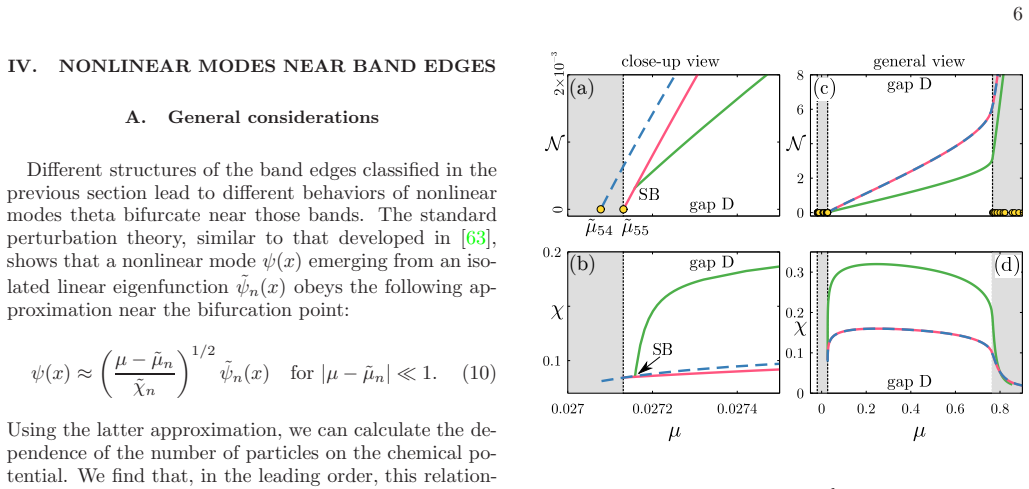
The argument is carried by the approximant path: replace the irrational frequency ratio $\phi$ by a Fibonacci fraction $p/q$, restrict the problem to the periodic cell $I_q=[-\pi q/2,\pi q/2)$ with periodic boundary conditions, and solve the Gross-Pitaevskii equation $\mu\psi=H\psi+g\psi^3$ by Fourier collocation and Newton's method. The organizing device is a classification of right band edges as symmetric-antisymmetric pairs, boundary-localized modes, or isolated symmetric modes. The bifurcation analysis rests on the perturbation formula $\psi(x)\approx((\mu-\tilde{\mu}_n)/\tilde{\chi}_n)^{1/2}\tilde{\psi}_n(x)$, which yields $N(\mu)\approx(\mu-\tilde{\mu}_n)/\tilde{\chi}_n$, where $\tilde{\chi}_n$ is the inverse participation ratio; this formula is what makes below-the-edge branches linear and above-the-edge branches steep and root-like.
What would settle it
Repeat the bifurcation analysis at the next Fibonacci approximants ($p/q=144/89$, $233/144$, $377/233$) or with a different irrational frequency ratio and check whether the predicted patterns persist: a symmetric-antisymmetric edge that changes to a boundary edge and turns a pitchfork into a different bifurcation, or an above-edge $N(\mu)$ branch that deviates from the square-root law, would refute the claimed universality.
Extended reading notes
Core claim
For the symmetric bichromatic potential $V(x)=v_1\cos(2x)+v_2\cos(2\phi x)$ with $\phi$ the golden ratio, the right edge of a linear band can be a symmetric-antisymmetric pair, a single strongly localized symmetric mode, or a mode pinned to the domain boundary. The paper shows that each edge structure dictates a distinct nonlinear scenario: symmetric-antisymmetric pairs trigger pitchfork symmetry-breaking bifurcations whose particle number is set by the ratio of the eigenvalue splitting to the inverse participation ratio; isolated modes hybridize with nearby states to form in-phase and out-of-phase bound states through saddle-node bifurcations; and above the mobility edge, extended linear states develop into gap-soliton-like families with a root-like $N(\mu)$ curve. With a nonzero inter-lattice phase shift, the potential is generically asymmetric, the special eigenvalue pairs disappear, and every linear mode produces a nonlinear family that meets the next eigenvalue, yielding a chain of saddle-node bifurcations before localized modes reach the gap. The central claim is that the mobility edge and the Fibonacci-labelled gap structure of the linear spectrum organize which bifurcation pattern applies.
Load-bearing premise
The conclusions are drawn from finite rational approximants of the golden-ratio potential with periodic boundary conditions, and the paper assumes this approximant path faithfully represents the true infinite quasiperiodic system even though Table I shows the band-edge structure switching between approximants.
Editorial extensions
If this is right
- Below the mobility edge, atom number grows linearly with chemical potential, $N(\mu)\approx (\mu-\tilde{\mu}_n)/\tilde{\chi}_n$, so measuring $N(\mu)$ near a band edge gives the inverse participation ratio of the underlying linear mode.
- Above the mobility edge, an initially extended linear mode gradually localizes as $\mu$ moves into the gap, producing a square-root-like $N(\mu)$ branch characteristic of gap solitons in periodic media.
- In a symmetric bichromatic potential, band edges formed by symmetric-antisymmetric pairs produce pitchfork symmetry breaking at a particle number set by the eigenvalue splitting divided by the inverse participation ratio; isolated or hybridizing edge modes produce saddle-node bifurcations and in-phase/out-of-phase bound states.
- A nonzero phase shift between the two lattices removes the symmetry, converting pitchforks into a cascade of saddle-node bifurcations in which each linear mode contributes a localized branch that reaches the gap.
- Because the Gross-Pitaevskii equation is mathematically equivalent to the nonlinear Schrödinger equation for paraxial light, the same bifurcation patterns should appear as optical mode formation in quasiperiodic photonic lattices.
Reading between the lines
- Beyond the paper's finite-approximant numerics, the setup suggests that in the true quasiperiodic limit the asymmetric case may exhibit an infinite accumulation of saddle-node bifurcations near a band edge, a property the paper does not directly establish.
- The Fibonacci-labelled gaps are special to the golden ratio; for other irrational ratios the universal dichotomy (pitchfork for symmetric, saddle-node cascade for asymmetric) may persist even though the ordering of modes at band edges changes, so testing another ratio would separate the general mechanism from golden-ratio-specific structure.
- In the optical realization, the square-root $N(\mu)$ law above the mobility edge translates into a measurable power-versus-propagation-constant curve for soliton formation in quasiperiodic photonic lattices, and the predicted symmetry-breaking particle number $N_{\mathrm{SB}}\approx(\tilde{\mu}_{55}-\tilde{\mu}_{54})/\tilde{\chi}_{55}$ could be checked directly in a cold-atom experiment.
Editorial analysis
A structured set of objections, weighed in public.
Referee Report
Summary. The paper studies nonlinear steady states of the one-dimensional Gross-Pitaevskii equation with a bichromatic quasiperiodic potential, using rational approximants of the golden-ratio frequency ratio with periodic boundary conditions. The authors classify the right band edges of selected spectral gaps (A–E) and compute bifurcation diagrams of nonlinear modes near those gaps for the approximant p/q = 89/55 with lattice amplitudes v1 = v2 = 0.8. They report symmetry-breaking pitchfork bifurcations for near-degenerate symmetric/antisymmetric pairs below the mobility edge, saddle-node bifurcations due to hybridization of modes with different spatial profiles, a different (square-root-like) N(mu) behavior above the mobility edge, and a cascade of saddle-node bifurcations for a nonzero phase shift. The central claim is that the mobility edge dichotomizes the formation of nonlinear modes: linear N(mu) dependence below, square-root-like above, with the bifurcation taxonomy mimicking symmetric and asymmetric double-well potentials.
Significance. If established, the claimed connection between the fractal linear spectrum, the mobility edge, and the bifurcation structure of nonlinear localized modes would be a useful organizing principle for quasiperiodic BECs and photonic lattices, with clear experimental relevance. The numerical methodology is standard and adequately described: Fourier collocation with 4500 harmonics, Newton's method, and linear-stability analysis via Eq. (8). The perturbation formulas (10)–(11) are standard and Eq. (12) is explicitly checked against numerics. The numerical results are obtained by direct solution of the nonlinear PDE, so there is no circularity in the bifurcation detection. The main weakness is the reliance on a single rational approximant for all nonlinear bifurcation diagrams, while the band-edge classification itself visibly changes across approximants in Table I. This makes the central claims about universal patterns and the role of the mobility edge not yet fully established in the infinite-quasiperiodic limit.
major comments (3)
- [Sec. III, Table I] The manuscript's central claim of universal patterns is undermined by the approximant dependence of the band-edge classification. Table I shows that the same gap changes its right-edge structure as p/q increases: gap A switches between 's-a/s pair', 'boundary', and 'new s-a/s pair'; gap B switches between 'boundary' and 's-a/s pair'; and gap D, the flagship below-mobility-edge pitchfork example in Fig. 4, becomes a 'boundary' edge at p/q = 144/89. Since all nonlinear bifurcation diagrams in Sec. IV are computed only for p/q = 89/55, the paper does not demonstrate that the pitchfork-vs-saddle-node taxonomy is the infinite-system behavior rather than an artifact of that particular approximant. The authors should either compute the relevant bifurcation diagrams for at least one more approximant (e.g., 55/34, 144/89, or 233/144) for gaps C, D, and E, or provide a convergence argument showing that the bifurcation type stabilizes for sufficiently large q.
- [Sec. IV D, Fig. 6] The above-mobility-edge analysis for gap E rests on numerically fragile data. The band edge at p/q = 89/55 is formed by a pair of eigenvalues with splitting ~10^-11, which the authors themselves note is comparable to numerical error, and for p/q = 144/89 the edge is instead a single extended eigenfunction well separated from the coincident pair. The symmetry-breaking bifurcation and the square-root-like N(mu) law shown in Fig. 6 are computed only at 89/55. This does not establish the claimed dichotomy between below- and above-mobility-edge bifurcation scenarios in the quasiperiodic limit. A direct convergence test (e.g., increasing the number of Fourier harmonics for the near-degenerate pair, or repeating the gap-E bifurcation analysis at another approximant) is needed before the central claim can be accepted.
- [Sec. IV A and Sec. IV D] The asserted square-root law for N(mu) above the mobility edge is not actually derived or quantitatively verified. Equation (11) gives a linear dependence N ≈ (mu - mu_n)/chi_n for a bifurcation from an isolated linear mode with fixed IPR. For the extended modes above the mobility edge, chi is not constant along the family, so a different law is expected, but the paper only states that the dependence 'resembles the root-law behavior' and attributes it to similarity with gap solitons in periodic media (Sec. IV D). To make the 'linear below, square-root above' dichotomy load-bearing, the authors should provide a quantitative check (e.g., a log-log fit of N(mu) over the gap, or a reduced-model derivation) and show that it holds for at least one additional approximant.
minor comments (5)
- [Sec. II, Eq. (8)] Typographical errors: 'eigenvalue' appears as 'and eigenvalue' and 'the the remaining' appears in the enumeration of spectral properties. These should be corrected.
- [Sec. IV A] The phrase 'nonlinear modes theta bifurcate near those bands' in the opening sentence of Sec. IV A should read 'that bifurcate'.
- [Fig. 5] The caption of Fig. 5 is dense and the labels SB1, SB2, SN1, SN2 are not all explicitly explained in the caption; a short list of which line corresponds to which family would improve readability.
- [Sec. III, Table I] The caption of Table I states 'the structure of the right band edges adjacent to gaps A–D from Fig. 1' but does not mention that gap E is discussed in the text; adding this would help the reader locate the full classification.
- [Sec. IV E] The asymmetric case is illustrated for a single arbitrarily chosen phase shift theta ≈ 1.7π in gap B. While the cascade of saddle-node bifurcations is plausible, a brief statement about whether θ = 1.7π is generic (e.g., not accidentally restoring symmetry) would strengthen the presentation.
Circularity Check
No circular derivation: the bifurcation results are obtained by direct numerical solution of the Gross-Pitaevskii equation, with perturbation formulas used only as ancillary checks.
full rationale
The paper's central claims are produced by direct simulation of the stationary Gross-Pitaevskii equation (Eq. 3) using Newton's method with periodic boundary conditions, not by fitting or assuming the target bifurcation taxonomy. The perturbation formulas (10)-(11) are standard asymptotic expansions used to interpret the slopes of the N(mu) curves, and the two-mode estimate (12) is explicitly compared with the full numerics: the paper reports 'the approximation (12) gives NSB ~ 6e-4, which is in reasonable agreement with the numerical value NSB ~ 3e-4,' and then discusses the discrepancy. Thus that estimate is a consistency check, not the source of the prediction. The only self-citations, Refs. [50] and [63], supply previous two-mode Josephson-junction and perturbation-theory results that are independently checkable from the equations and are not load-bearing for the new bifurcation classifications. The finite-approximant route and periodic boundary conditions are an approximation strategy stated in Sec. II; Table I does show variation of band-edge structure across rational approximants, but that is a robustness or convergence concern about the infinite-quasiperiodic-system interpretation, not a circular step. No equation is defined in terms of the claimed conclusion, no fitted parameter is relabeled as a prediction, and no uniqueness theorem is imported to force the model choice. Accordingly, no self-definitional, fitted-input, ansatz-smuggling, self-citation-chain, or renaming circularity is present.
Assumptions & free parameters
free parameters (4)
- Lattice amplitudes v1, v2 =
v1 = v2 = 0.8
- Rational approximant p/q =
89/55 for the main nonlinear results
- Phase shift theta =
theta about 1.7 pi for the asymmetric case
- Frequency ratio phi =
golden ratio (1+sqrt(5))/2
assumptions (5)
- domain assumption The approximant path with periodic boundary conditions on a finite domain of length pi q faithfully represents the infinite quasiperiodic system for the bifurcation structure studied here.
- standard math The perturbation expansion of Eq. (10), psi(x) about sqrt((mu - mu_tilde_n)/chi_tilde_n) psi_tilde_n(x), is valid near band edges.
- domain assumption The two-mode reduction giving Eq. (12), NSB about (mu_tilde_55 - mu_tilde_54)/chi_tilde_55, is accurate enough to estimate the symmetry-breaking threshold.
- domain assumption The Gross-Pitaevskii equation is a valid mean-field description of the trapped Bose-Einstein condensate.
- ad hoc to paper The symmetric bichromatic potential of Eq. (2) is sufficiently analogous to a symmetric double well to license double-well bifurcation phenomenology.
Cite this review
Pith. "Pith review of Formation of nonlinear modes in one-dimensional quasiperiodic lattices with a mobility edge." pith.science (2026). https://pith.science/paper/7XUA3O5I
@misc{pith2026241113936,
  author       = {Pith},
  title        = {Pith review of: Formation of nonlinear modes in one-dimensional quasiperiodic lattices with a mobility edge},
  year         = {2026},
  howpublished = {\url{https://pith.science/paper/7XUA3O5I}},
  note         = {Machine review of arXiv:2411.13936}
}
read the original abstract
We investigate the formation of steady states in one-dimensional Bose-Einstein condensates of repulsively interacting ultracold atoms loaded into a quasiperiodic potential created by two incommensurate periodic lattices. We study the transformations between linear and nonlinear modes and describe the general patterns that govern the birth of nonlinear modes emerging in spectral gaps near band edges. We show that nonlinear modes in a symmetric potential undergo both symmetry-breaking pitchfork bifurcations and saddle-node bifurcations, mimicking the prototypical behaviors of symmetric and asymmetric double-well potentials. The properties of the nonlinear modes differ for bifurcations occurring below and above the mobility edge. In the generic case, when the quasiperiodic potential consists of two incommensurate lattices with a nonzero phase shift between them, the formation of localized modes in the spectral gaps occurs through a cascade of saddle-node bifurcations. Because of the analogy between the Gross-Pitaevskii equation and the nonlinear Schr\"odinger equation, our results can also be applied to optical modes guided by quasiperiodic photonic lattices.
Figures


Figures from the paper (4 more)


Reference graph
Works this paper leans on
-
[50]
W. Su, Z. Lin, C. Li, C. Huang, Nonlinear localized gap modes in width-modulated Fibonacci lattices, Results in Physics, 40, 105877 (2022)
work page 2022
-
[1]
Most of these facts have been discussed in previous studies on bichromatic quasiperi- odic potentials (see [ 48–50, 52–62])
Here, we summarize several facts about the linear spectrum that are relevant to our study. Most of these facts have been discussed in previous studies on bichromatic quasiperi- odic potentials (see [ 48–50, 52–62]). (i) The spectrum of the linear eigenvalue problem ( 4) is bounded from below and discrete, due to the 4 periodic boundary conditions. We enum...
-
[2]
In this respect the bichromatic lattice given by Eq
in fact corresponds to a special situation, because (i) it is symmetric with respect to the origin x = 0, and (ii) it achieves its maximum (both local and global) at x = 0. In this respect the bichromatic lattice given by Eq. (
-
[3]
In a more general situation, the bichromatic lattice comprises a combination of mutually shifted incommensurate dependences
resembles a double-well potential with the bar- rier situated at x = 0. In a more general situation, the bichromatic lattice comprises a combination of mutually shifted incommensurate dependences. This more general case will be discussed below in Sec. IV E. To put our work into proper context, we notice that the potential ( 2) differs from the bichromatic ...
-
[4]
J. B. Reeves, B. Gadway, T. Bergeman, I. Danshita, and D. Schneble, Superfluid Bloch dynamics in an incommen- 11 surate optical lattice, New J. Phys. 16, 065011 (2014)
work page 2014
-
[5]
Its period is equal to Lq := πq
is periodic. Its period is equal to Lq := πq . The difference between Vq(x) and V (x) remains small only in a bounded spatial domain. As a result, it becomes relevant to restrict our consideration to a finite domain by imposing the periodic boundary conditions. Specifically, we require Ψ( −πq/ 2,t ) = Ψ( πq/ 2,t ) [ ψ (−πq/ 2) = ψ (πq/ 2)]. (7) The choice of...
-
[6]
24 ≲ µ ≲ − 0
In Table I this sit- 5 p/q = 55/ 34 p/q = 89/ 55 p/q = 144/ 89 p/q = 233/ 144 gap A: − 0. 24 ≲ µ ≲ − 0. 23 s-a/s pair s-a/s pair boundary new s-a/s pair gap B: − 0. 22 ≲ µ ≲ − 0. 17 boundary s-a/s pair s-a/s pair boundary gap C: − 0. 15 ≲ µ ≲ − 0. 02 symmetric mode for any p/q gap D: − 0. 15 ≲ µ ≲ − 0. 02 s-a/s pair s-a/s pair boundary new s-a/s pair Tabl...
-
[7]
ac- tually represent Bloch functions of the band structure associated with the periodic potential Vq(x). This fact may be useful for for interpreting the results; (iii) Peri- odic boundary conditions are ideal for efficient numerical methods used to solve linear eigenproblems of the form ( 4). To solve the linear eigenproblem ( 4) with the pe- riodic potent...
Show all 87 references
-
[8]
In (C) we additionally plot potential Vq(x)
For gap A, the edge cor- responds to a pair of symmetric and antisymmetric eigen- functions (‘s-a/s pair’) at p/q = 55 / 34 and to a new s-a/s pair for p/q = 233 / 144 (see the corresponding row in Ta- ble I); for gap B the band edge corresponds to the same s- a/s pair for p/q...
-
[9]
In this subsection, we will con- sider a more general case that includes a nonzero phase shift between the two periodic lattices
composed of two periodic lattices with a zero phase shift. In this subsection, we will con- sider a more general case that includes a nonzero phase shift between the two periodic lattices. We will use the quasiperiodic potential of the following form V (x) = v1 cos (2x) +v2 co...
-
[10]
J. E. Lye, L. Fallani, C. Fort, V. Guarrera, M. Modugno, D. S. Wiersma, and M. Inguscio, Effect of interactions on the localization of a Bose-Einstein condensate in a quasiperiodic lattice, Phys. Rev. A 75, 061603(R) (2007)
2007
-
[11]
Roati, C
G. Roati, C. D’Errico, L. Fallani, M. Fattori, C. Fort, M. Zaccanti, G. Modugno, M. Modugno, and M. Inguscio, Anderson localization of a non-interacting Bose–Einstein condensate, Nature 453, 895 (2008)
2008
-
[12]
Modugno, Anderson localization in Bose–Einstein condensates, Rep
G. Modugno, Anderson localization in Bose–Einstein condensates, Rep. Prog. Phys. 73, 102401 (2010)
2010
-
[13]
with a nonzero phase shift θ ≈ 1. 7π . The yellow circles in (a) show the chemical poten- tials ˜µ n of the noninteracting BEC. The labels ‘SN1’,. . . ,‘SN4’ indicate saddle-node bifurcations, and the points ‘d,e,f’ in (a,b) correspond to three localized nonlinear modes that g...
-
[14]
H. P. L¨ uschen, S. Scherg, T. Kohlert, M. Schreiber, P. Bordia, X. Li, S. Das Sarma, and I. Bloch, Single-particle mobility edge in a one-dimensional quasiperiodic optical lattice, Phys. Rev. Lett. 120, 160404 (2018)
2018
-
[15]
Tanese, E
D. Tanese, E. Gurevich, F. Baboux, T. Jacqmin, A. Lema ˆ ıtre, E. Galopin, I. Sagnes, A. Amo, J. Bloch, and E. Akkermans, Fractal Energy Spectrum of a Polariton Gas in a Fibonacci Quasiperiodic Potential, Phys. Rev. Lett. 112, 146404 (2014)
2014
-
[16]
Goblot, A
V. Goblot, A. ˇStrkalj, N. Pernet, J. L. Lado, C. Dorow, A. Lema ˆ ıtre, L. Le Gratiet, A. Harouri, I. Sagnes, S. Ravets, A. Amo, J. Bloch, and O. Zilberberg, Emergence of crit- icality through a cascade of delocalization transitions in quasiperiodic chains, Nature Phys. 16, 8...
2020
-
[17]
Lahini, R
Y. Lahini, R. Pugatch, F. Pozzi, M. Sorel, R. Moran- dotti, N. Davidson, and Y. Silberberg, Observation of a Localization Transition in Quasiperiodic Photonic Lat- tices, Phys. Rev. Lett. 103, 013901 (2009)
2009
-
[18]
Arie and N
A. Arie and N. Voloch, Periodic, quasi-periodic, and ran - dom quadratic nonlinear photonic crystals, Laser Pho- ton. Rev. 4, 355 (2010)
2010
-
[19]
Bellingeri, A
M. Bellingeri, A. Chiasera, I. Kriegel, and F. Scotogne lla, Optical properties of periodic, quasi-periodic, and disor - dered onedimensional photonic structures, Opt. Mater. 72, 403 (2017)
2017
-
[20]
Valy Vardeny, A
Z. Valy Vardeny, A. Nahata, and A. Agrawal, Optics of photonic quasicrystals, Nat. Photonics 7, 177 (2013)
2013
-
[21]
Wang, J.-H
Y. Wang, J.-H. Zhang, Y. Li, J. Wu, W. Liu, F. Mei, Y. Hu, L. Xiao, J. Ma, C. Chin, and S. Jia, Observation of Interaction-Induced Mobility Edge in an Atomic Aubry- Andr´ e Wire, Phys. Rev. Lett. 129, 103401 (2022)
2022
-
[22]
Segev, Y
M. Segev, Y. Silberberg, and D. N. Christodoulides, An- derson localization of light, Nature Photonics 7, 197–204 (2013)
2013
-
[23]
Carretero-Gonz´ alez, D
R. Carretero-Gonz´ alez, D. J. Frantzeskakis, and P. G. Kevrekidis, Nonlinear waves in Bose–Einstein conden- sates: physical relevance and mathematical techniques, Nonlinearity 21, R139 (2008)
2008
-
[24]
Longhi, Quantum-optical analogies using photonic structures, Laser & Photon
S. Longhi, Quantum-optical analogies using photonic structures, Laser & Photon. Rev. 3, 243 (2009)
2009
-
[25]
Sakaguchi and B
H. Sakaguchi and B. A. Malomed, Gap solitons in quasiperiodic optical lattices, Phys. Rev. E 74, 026601 (2006)
2006
-
[26]
Huang, C
C. Huang, C. Li, H. Deng, and L. Dong, Gap Solitons in Fractional Dimensions With a Quasi-Periodic Lattice, Ann. Phys. 531, 1900056 (2019)
2019
-
[27]
Kominis and K
Y. Kominis and K. Hizanidis, Power dependent soliton lo - cation and stability in complex photonic structures, Opt. Express 16, 12124 (2008)
2008
-
[28]
B. B. Baizakov, B. A. Malomed, and M. Salerno, in Non- linear Waves: Classical and Quantum Aspects , edited by F. Kh. Abdullaev and V. V. Konotop (Kluwer Academic, Dordrecht, 2004), p. 61
2004
-
[29]
Burlak and A
G. Burlak and A. Klimov, The solitons redistribution in Bose–Einstein condensate in quasiperiodic optical lattic e, Phys. Lett. A 369, 510 (2007)
2007
-
[30]
Burlak and B
G. Burlak and B. A. Malomed, Matter-wave solitons with the minimum number of particles in two-dimensional quasiperiodic potentials, Phys. Rev. E 85, 057601 (2012)
2012
-
[31]
Xie, Z.-Q
P. Xie, Z.-Q. Zhang, and X. Zhang, Gap solitons and soliton trains in finite-sized two-dimensional periodic an d quasiperiodic photonic crystals, Phys. Rev. E 67, 026607 (2003)
2003
-
[32]
M. J. Ablowitz, B. Ilan, E. Schonbrun, and R. Piestun, Solitons in two-dimensional lattices possessing defects, dislocations, and quasicrystal structures, Phys. Rev. E 74, 035601(R) (2006)
2006
-
[33]
M. J. Ablowitz, N. Antar, ˙I. Bakirta¸ s, and B. Ilan, Band- gap boundaries and fundamental solitons in complex two- dimensional nonlinear lattices, Phys. Rev. A 81, 033834 (2010)
2010
-
[34]
M. J. Ablowitz, N. Antar, ˙I. Bakirta¸ s, and B. Ilan, Vortex and dipole solitons in complex two-dimensional nonlinear lattices, Phys. Rev. A 86, 033804 (2012)
2012
-
[35]
Huang, F
C. Huang, F. Ye, X. Chen, Y. V. Kartashov, V. V. Konotop, and L. Torner, Localization-delocalization wavepacket transition in Pythagorean aperiodic poten- tials, Sci. Rep. 6, 32546 (2016)
2016
-
[36]
Huang, L
C. Huang, L. Dong, H. Deng, X. Zhang, P. Gao, Funda- mental and vortex gap solitons in quasiperiodic photonic lattices, Opt. Lett. 46, 5691 (2021)
2021
-
[37]
Y. V. Kartashov, F. Ye, V. V. Konotop, and Ll. Torner, Multifrequency Solitons in Commensurate- Incommensurate Photonic Moir´ e Lattices, Phys. Rev. Lett. 127, 163902 (2021)
2021
-
[38]
Bagˇ chi, Soliton dynamics in quadratic nonlinear me - dia with two-dimensional Pythagorean aperiodic lattices, JOSA B 38, 1276 (2021)
M. Bagˇ chi, Soliton dynamics in quadratic nonlinear me - dia with two-dimensional Pythagorean aperiodic lattices, JOSA B 38, 1276 (2021)
2021
-
[39]
S. K. Ivanov, V. V. Konotop, and Y. V. Kartashov, Vor- tex solitons in moir´ e optical lattices, Opt Lett. 48, 3797– 3800 (2023)
2023
-
[40]
X. Liu, J. Zeng, Two-dimensional localized modes in non - linear systems with linear nonlocality and moir´ e lattices , Front. Phys. 19, 42201 (2024)
2024
-
[41]
P. Wang, Y. Zheng, X. Chen, C. Huang, Y. V. Kartashov, Ll. Torner, V. V. Konotop, and F. Ye, Localization and delocalization of light in photonic moir´ e lattices, Natur e 577, pages42–46 (2020)
2020
-
[42]
Q. Fu, P. Wang, C. Huang, Y. V. Kartashov, Ll. Torner, V. V. Konotop, and F. Ye, Optical soliton formation con- trolled by angle twisting in photonic moir´ e lattices, Nat. Photonics 14, 663 (2020)
2020
-
[43]
Freedman, G
B. Freedman, G. Bartal, M. Segev, R. Lifshitz, D. N. Christodoulides, J. W. Fleischer, Wave and defect dy- namics in nonlinear photonic quasicrystals, Nature 440, 1166–1169 (2006)
2006
-
[44]
Johansson and R
M. Johansson and R. Riklund, Solitonlike states in a one-dimensional nonlinear Schr¨ odinger equation with a deterministic aperiodic potential, Phys. Rev. B 49, 6587 (1994)
1994
-
[45]
Lindquist, M
B. Lindquist, M. Johansson and R. Riklund, Soliton dy- namics and interaction in a deterministic aperiodic non- linear lattice, Phys. Rev. B 50, 9860 (1994)
1994
-
[46]
A. A. Sukhorukov, Enhanced Soliton Transport in Quasiperiodic Lattices with Introduced Aperiodicity, Phys. Rev. Lett. 96, 113902 (2006)
2006
-
[47]
A. J. Mart ´ ınez and M. I. Molina, Surface solitons in quasiperiodic nonlinear photonic lattices, Phys. Rev. A 85, 013807 (2012)
2012
-
[48]
V. V. Grigoriev, F. Biancalana, Bistability and statio n- ary gap solitons in quasiperiodic photonic crystals based on Thue–Morse sequence, Photonics and Nanostructures – Fundamentals and Applications 8, 285 (2010)
2010
-
[49]
Huang, Z
C. Huang, Z. Lin, L. Dong, C. Li, P. Gao, and W. Su, Fundamental and multipole solitons in amplitude- modulated Fibonacci lattices, Opt. Express 29, 35327 12 (2021)
2021
-
[51]
Takahashi, H
M. Takahashi, H. Katsura, M. Kohmoto, and T. Koma, Multifractals competing with solitons on Fibonacci opti- cal lattices, New J. Phys. 14, 113012 (2012)
2012
-
[52]
P. G. Kevrekidis, V. V. Konotop, A. Rodrigues, and D. J. Frantzeskakis, Dynamic generation of matter solitons from linear states via time-dependent scattering lengths, J. Phys. B: At. Mol. Opt. Phys. 38, 1173 (2005)
2005
-
[53]
V. A. Brazhnyi and V. V. Konotop, Theory of nonlinear matter waves in optical lattices. Mod. Phys. Lett. B 18, 627 (2004)
2004
-
[54]
Deissler, M
B. Deissler, M. Zaccanti, G. Roati, C. D’Errico, M. Fat- tori, M. Modugno, G. Modugno, and M. Inguscio, De- localization of a disordered bosonic system by repulsive interactions, Nat. Phys. 6, 354 (2010)
2010
-
[55]
Zilberberg, Topology in quasicrystals [Invited], O pt
O. Zilberberg, Topology in quasicrystals [Invited], O pt. Mater. Express 11, 1143 (2021)
2021
-
[56]
R. B. Diener, G. A. Georgakis, J. Zhong, M. Raizen, and Q. Niu Transition between extended and localized states in a one-dimensional incommensurate optical lat- tice, Phys. Rev. A 64, 033416 (2001)
2001
-
[57]
Modugno, Exponential localization in one- dimensional quasi-periodic optical lattices, New J
M. Modugno, Exponential localization in one- dimensional quasi-periodic optical lattices, New J. Phys. 11, 033023 (2009)
2009
-
[58]
X. Li, X. Li, and S. Das Sarma, Mobility edges in one-dimensional bichromatic incommensurate potentials, Phys. Rev. B 96, 085119 (2017)
2017
-
[59]
H. C. Prates, D. A. Zezyulin, and V. V. Konotop, Bose- Einstein condensates in quasiperiodic lattices: Bosonic Josephson junction, self-trapping, and multimode dy- namics, Phys. Rev. Research 4, 033219 (2022)
2022
-
[60]
Yang, Nonlinear waves in integrable and nonintegrable systems, Philadelphia: SIAM, 2010
J. Yang, Nonlinear waves in integrable and nonintegrable systems, Philadelphia: SIAM, 2010
2010
-
[61]
D. J. Boers, B. Goedeke, D. Hinrichs, and M. Holthaus, Mobility edges in bichromatic optical lattices, Phys. Rev. A 75, 063404 (2007)
2007
-
[62]
G. Roux, T. Barthel, I. P. McCulloch, C. Kollath, U. Schollw¨ ock, and T. Giamarchi, Quasiperiodic Bose- Hubbard model and localization in one-dimensional cold atomic gases, Phys. Rev. A 78, 023628 (2008)
2008
-
[63]
Larcher, F
M. Larcher, F. Dalfovo, and M. Modugno, Effects of in- teraction on the diffusion of atomic matter waves in one- dimensional quasiperiodic potentials, Phys. Rev. A 80, 053606 (2009)
2009
-
[64]
Biddle, B
J. Biddle, B. Wang, D. J. Priour, and S. Das Sarma, Localization in one-dimensional incommensurate lattices beyond the Aubry-Andr´ e model. Phys. Rev. A 80, 021603(R) (2009)
2009
-
[65]
S. K. Adhikari and L. Salasnich, Localization of a Bose- Einstein condensate in a bichromatic optical lattice, Phys. Rev. A 80, 023606 (2009)
2009
-
[66]
Biddle and S
J. Biddle and S. Das Sarma, Predicted Mobility Edges in One-Dimensional Incommensurate Optical Lattices: An Exactly Solvable Model of Anderson Localization, Phys. Rev. Lett. 104, 070601 (2010)
2010
-
[67]
L. Zhou, H. Pu, and W. Zhang, Anderson localization of cold atomic gases with effective spin-orbit interaction in a quasiperiodic optical lattice, Phys. Rev. A 87, 023625 (2013)
2013
-
[68]
Cheng, G
Y. Cheng, G. Tang, and S. K. Adhikari, Localization of a spin-orbit-coupled Bose-Einstein condensate in a bichro- matic optical lattice, Phys. Rev. A 89, 063602 (2014)
2014
-
[69]
C. Li, F. Ye, Y. V. Kartashov, V. V. Konotop, and X. Chen, Localization-delocalization transition in spin- orbit-coupled Bose-Einstein condensate, Sci. Rep. 6, 31700 (2016)
2016
-
[70]
H. Yao, H. Khoudli, L. Bresque, and L. Sanchez- Palencia, Critical Behavior and Fractality in Shallow One-Dimensional Quasiperiodic Potentials, Phys. Rev. Lett. 123, 070405 (2019)
2019
-
[71]
V. V. Konotop, Dimers and discrete breathers in Bose- Einstein condensates in a quasi-periodic potential, Phys. Rev. Research 6, 033113 (2024)
2024
-
[72]
D. A. Zezyulin, G. L. Alfimov, V. V. Konotop, and V. M. P´ erez–Garc ´ ıa, Stability of excited states of a Bose- Einstein condensate in an anharmonic trap, Phys. Rev. A 78, 013606 (2008)
2008
-
[73]
D’Agosta and C
R. D’Agosta and C. Presilla, States without a linear counterpart in Bose-Einstein condensates, Phys. Rev. A 65, 043609 (2002)
2002
-
[74]
R. K. Jackson and M. I. Weinstein, Geometric analysis of bifurcation and symmetry breaking in a Gross-Pitaevskii equation, J. Stat. Phys. 116, 881 (2004)
2004
-
[75]
P. G. Kevrekidis, Z. Chen, B. A. Malomed, D. J. Frantzeskakis, and M. I. Weinstein, Spontaneous sym- metry breaking in photonic lattices: Theory and experi- ment, Phys. Lett. A 340, 275 (2005)
2005
-
[76]
Theocharis, P
G. Theocharis, P. G. Kevrekidis, D. J. Frantzeskakis, and P. Schmelcher, Symmetry breaking in symmetric and asymmetric double-well potentials, Phys. Rev. E 74, 056608 (2006)
2006
-
[77]
G. L. Alfimov and D. A. Zezyulin, Nonlinear modes for the Gross–Pitaevskii equation — a demonstrative com- putation approach, Nonlinearity 20, 2075 (2007)
2007
-
[78]
Matuszewski, B
M. Matuszewski, B. A. Malomed, and M. Trippenbach, Spontaneous symmetry breaking of solitons trapped in a double-channel potential, Phys. Rev. A 75, 063621 (2007)
2007
-
[79]
E. W. Kirr, P. G. Kevrekidis, E. Shlizerman, and M. I. Weinstein, Symmetry-breaking bifurcation in nonlinear Schr¨ odinger/Gross–Pitaevskii equations, SIAM J. Math. Anal. 40, 566 (2008)
2008
-
[80]
Sacchetti, Universal Critical Power for Nonlinear Schr¨ odinger Equations with a Symmetric Double Well Potential, Phys
A. Sacchetti, Universal Critical Power for Nonlinear Schr¨ odinger Equations with a Symmetric Double Well Potential, Phys. Rev. Lett. 103, 194101 (2009)
2009
-
[81]
Shamriz, N
E. Shamriz, N. Dror, and B. A. Malomed, Spontaneous symmetry breaking in a split potential box, Phys. Rev. E 94, 022211 (2016)
2016
-
[82]
P. J. Y. Louis, E. A. Ostrovskaya, C. M. Savage, Yu. S. Kivshar, Bose–Einstein condensates in optical lat- tices: Band-gap structure and solitons, Phys. Rev. A 67, 013602 (2003); N. K. Efremidis, D. N. Christodoulides, Lattice solitons in Bose-Einstein condensates, Phys. Rev. ...
2003
-
[83]
Kapitula, P
T. Kapitula, P. G. Kevrekidis, and Z. Chen, Three is a crowd: Solitary waves in photorefractive media with three potential wells, SIAM J. Appl. Dyn. Syst. 5, 598 (2006)
2006
-
[84]
Sacchetti, Nonlinear Schr¨ odinger equations with multiple-well potential, Physica D 241, 1815 (2012)
A. Sacchetti, Nonlinear Schr¨ odinger equations with multiple-well potential, Physica D 241, 1815 (2012). 13
2012
-
[85]
R. H. Goodman, Bifurcations of relative periodic orbit s in NLS/GP with a triple-well potential, Physica D 359, 39 (2017)
2017
-
[86]
Zhang, Zh
Yo. Zhang, Zh. Liang and B. Wu, Gap solitons and Bloch waves in nonlinear periodic systems, Phys. Rev. A 80, 063815 (2009)
2009
-
[87]
T. R. Akylas, G. Hwang, and J. Yang, From non-local gap solitary waves to bound states in periodic media, Proc. R. Soc. A 468, 116 (2012)
2012
Reviewed August 12, 2026 · model on record in the stance chip above.
Discussion (0). Continue with ORCID to comment.