REVIEW 3 major objections 4 minor 101 references
Ground-state phase transitions in spin-1 Bose-Einstein condensates with spin-orbit coupling
T0 review · 3 major / 4 minor · reviewed 2026-08-12 · deepseek-v4-flash
Pith's one-line read This paper shows that in a spin-1 Bose-Einstein condensate with spin-orbit coupling and a gradient magnetic field, every excited state can become the ground state: at equal coupling strengths the spectrum is exactly solvable, and its…
desk verdict Solid exact spin-1 solution with a clean crossing spectrum; the 'any excited state' claim needs a qualifier. read the letter →
The pith
A machine-rendered reading of the paper's core claim, the machinery that carries it, and where it could break.
The reading
What carries the argument
The load-bearing object is the commuting auxiliary operator $\hat{P} = xF_x - i\partial_x F_y$, which in the harmonic-oscillator basis takes an off-diagonal tridiagonal form with $\hat{a}^\dagger$ and $\hat{a}$ on the super- and sub-diagonals. Because $[\hat{H}, \hat{P}]=0$, the two operators share eigenfunctions; solving $\hat{P}\psi = k_n\psi$ yields closed-form spinor eigenstates built from $f_n$, $f_{n-1}$, $f_{n-2}$ with eigenvalues $k_n=0$ for $n=0$ and $k_n=\sqrt{2n-1}$ for $n\ge 1$, which then give the exact energies $\mu_n$ and the crossing condition. This reduces the ground-state phase-transition problem to a known sequence of level crossings of exactly solvable branches.
What would settle it
Compute or measure the linear (non-interacting) energy spectrum for the same spin-1 system with a large imbalance between the gradient and the SOC strength, e.g., $\Delta=\alpha-\beta=1$: if branches with high $n$ stop crossing into the ground state, or if the level ordering changes so that some excited states never become energetically lowest, the universal claim fails away from the balance line.
Extended reading notes
Core claim
The paper's central discovery is that the Hamiltonian $\hat{H} = -\partial_x^2/2 + x^2/2 - \beta(xF_x - i\partial_x F_y) + \Omega F_z$, at the balance point $\alpha=\beta$ and fixed bias $\Omega=-1$, is exactly solvable. Introducing the ladder operators $\hat{a}^\dagger=(x-\partial_x)/\sqrt{2}$ and $\hat{a}=(x+\partial_x)/\sqrt{2}$, the authors build an auxiliary operator $\hat{P} = xF_x - i\partial_x F_y$ that commutes with $\hat{H}$ and whose eigenfunctions are spinor states built from harmonic-oscillator functions $f_n(x)$. The exact eigenvalues are $\mu_0=-3/2$ and $\mu_n = n - \beta\sqrt{2n-1} - 3/2$ for $n \ge 1$. Because the $\beta$-dependent term grows with $n$, the branch with larger $n$ drops faster in energy, so consecutive branches cross at $\beta_n$ given by $\mu_{n+1}=\mu_n$; hence every excited state $n$ becomes the ground state for some finite $\beta$. The authors verify numerically that these transitions persist for small offsets $\Delta=\alpha-\beta=\pm 0.1$, and in the full nonlinear system with repulsive interactions that the ground state follows the same sequence, with critical points shifting toward $\beta=0$ as the spin-spin repulsion $c_2$ increases. Under weak spin-spin attraction, mixed states made of two adjacent linear eigenstates appear near the crossings; under strong attraction, the ground state localizes off-center as an edge state, which the authors explain by reducing the system to a single-component equation with effective potential $x^2/2 - \beta x$ in the ferromagnetic spinor sector.
Load-bearing premise
The whole analytical ladder of level crossings is derived under the balance condition $\alpha=\beta$ with a fixed bias $\Omega=-1$, and the off-balance and nonlinear evidence covers only small offsets, so the claim that every excited state can be converted into the ground state rests on this balance being maintained.
Editorial extensions
If this is right
- At $\alpha=\beta$, every integer quantum number $n$ corresponds to a critical $\beta_n$ at which the $n$th excited state becomes degenerate with the ground state, so sweeping $\beta$ from small to large values executes a ladder of ground-state phase transitions.
- For the nonlinear system with repulsive spin-spin interaction ($c_2 \ge 0$), the same transition sequence survives, with critical couplings shifting toward smaller $\beta$ as $c_2$ increases, and with the ground state becoming a superposition of next-nearest-neighbor linear eigenstates ($n$ and $n+2$).
- For weak spin-spin attraction ($0 \le -c_2 \le 1$), the ground state near each transition is a bimodal mixed state of two adjacent linear eigenstates with a $\pi/2$ relative phase, giving a nonzero $y$-component of magnetization.
- For strong attraction ($c_2 = -1.5$ and $-2$), the ground state becomes a narrow edge state displaced to $x \approx \beta$, in agreement with the effective single-component potential $x^2/2 - \beta x$.
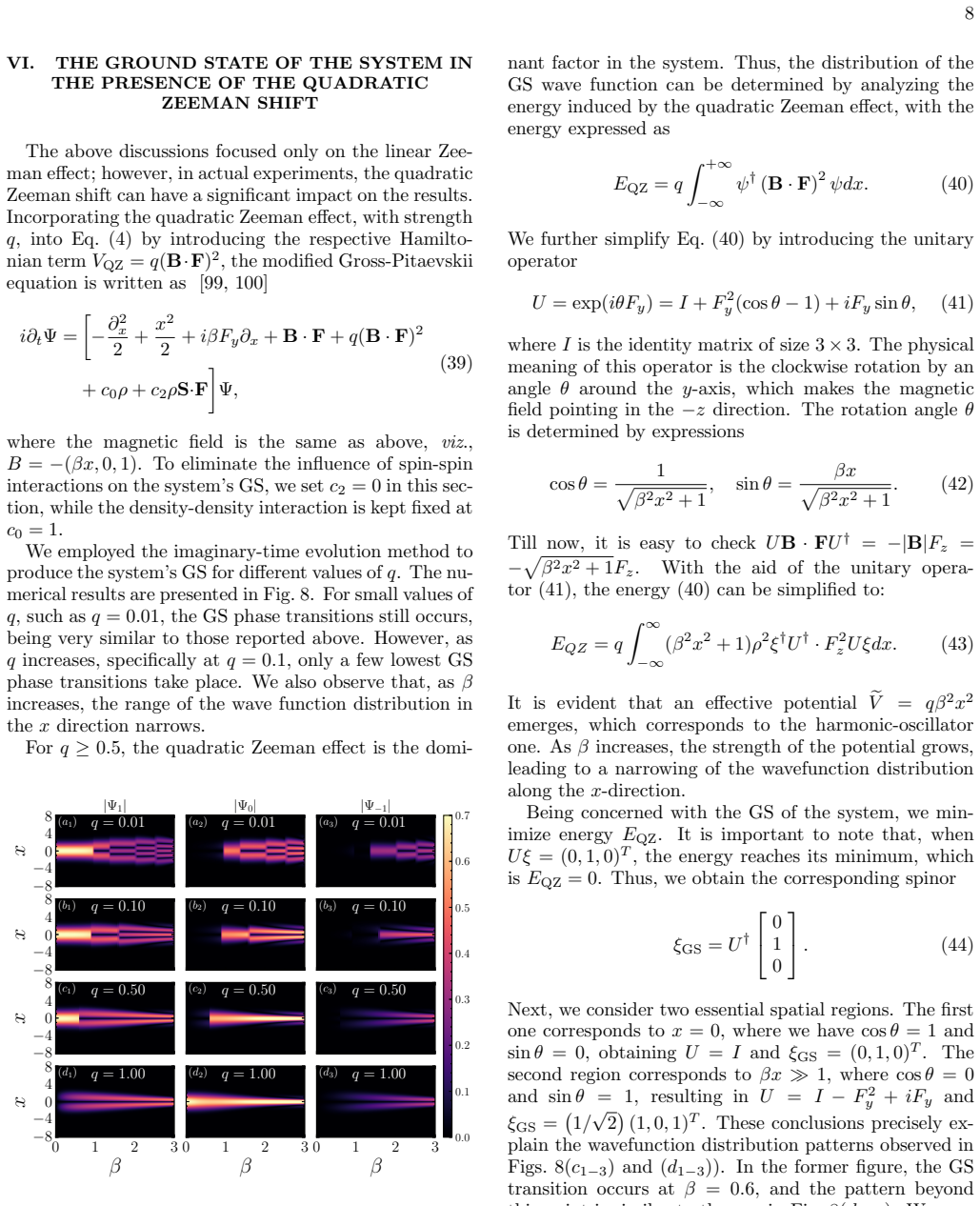
- Including the quadratic Zeeman shift $q$ destroys the higher-$n$ transitions as $q$ grows: at $q \approx 0.1$ only a few lowest transitions remain, and for $q \ge 0.5$ the ground state is controlled by the quadratic Zeeman energy, with particles occupying $\psi_0$ at $x=0$ and transferring to $\psi_{\pm 1}$ at large $|x|$.
Reading between the lines
- An implication the authors leave implicit: the ladder-operator construction should generalize to any linear spin model in which the spin-orbit coupling enters as a linear form in $x$ and $\partial_x$ that preserves the oscillator ladder, so the same level-inversion mechanism should appear in other SOC geometries under the equivalent of $\alpha=\beta$.
- A testable prediction of the exact spectrum: following Eq. (28), the ground-state magnetization $M_z$ should drop in steps of $1/(4n-2)$ each time $\beta$ passes a critical value, giving a direct experimental readout of which excited state has been converted into the ground state.
- Because the exact solution shows exact crossings rather than avoided crossings at $\beta_n$, the degeneracy points are a sensitive probe of symmetry-breaking terms; the paper's own quadratic-Zeeman results confirm this by showing the high-$n$ transitions disappear once $q$ exceeds about 0.1.
- In two dimensions, where the authors point as a natural continuation, the same mechanism should cause vortex states with different angular momenta to invert their energies, producing vortex ground-state phase transitions analogous to the ladder found here.
Editorial analysis
A structured set of objections, weighed in public.
Referee Report
Summary. The paper studies a one-dimensional spin-1 Bose-Einstein condensate with spin-orbit coupling, a harmonic trap, and a magnetic field that has a constant gradient and a fixed bias Ω=-1. The central linear result is obtained for the balanced case α=β: by introducing a 3×3 operator P built from harmonic-oscillator ladder operators, the authors show [H,P]=0 and diagonalize the linear problem exactly. This gives the closed-form spectrum μ_n = n - β√(2n-1) - 3/2 for n≥1 (and μ_0=-3/2), with branch crossings at β_n = (√(2n+1)+√|2n-1|)/2. Since higher-n branches have more negative slopes, each excited state becomes the lowest branch on a finite β interval, which is the paper's headline claim. For α≠β the linear system is treated by truncated oscillator diagonalization for Δ=±0.1. The full nonlinear Gross-Pitaevskii system is solved numerically: repulsive spin-spin interactions preserve the transitions (with a shift of the critical points), weak attraction produces mixed states near the transition, and strong attraction produces spatially shifted edge states. A heuristic single-component reduction is offered for the edge states, and the effect of the quadratic Zeeman shift is analyzed numerically.
Significance. If the claims hold, the paper gives an elegant exactly solvable linear multicomponent system in which the ground state can be tuned through arbitrary excited states, extending earlier spin-1/2 results to spin-1. The algebraic solution is transparent, the spectrum and critical points are given in closed form, and the numerical method (imaginary-time evolution and oscillator truncation) is standard and reproducible. The derivation is not circular: the spectrum is obtained from the Hamiltonian and the numerical weight analysis is a diagnostic, not a fit. The main caveat is that the exact 'any excited state' statement is established only on the codimension-one balance line α=β with fixed Ω=-1; the numerical extension to α≠β is limited to small offsets and low-lying branches. The edge-state explanation is also heuristic rather than quantitative. With appropriate qualification and additional numerical support, the result would be a worthwhile contribution to the spin-orbit-coupled BEC literature.
major comments (3)
- [II, Eqs. (2)-(4) and (8)] The stationary equations (8) do not appear to be the component form of the Hamiltonian (3)-(4) with the spin matrices (2). For example, using p_x=-i∂_x as stated, the linear term in the first component of Hψ is -(αx+β∂_x)/√2 ψ0 + (β∂_x-αx)/√2 ψ_{-1}, whereas Eq. (8) shows -(αx-β∂_x)ψ0 and no linear ψ_{-1} coupling; the middle component similarly misses a factor 1/√2 in the off-diagonal linear terms. Since Eq. (8) is the displayed working form of the model used for all subsequent numerical results, this is a load-bearing inconsistency. The authors should correct Eq. (8) (or, if the simulations actually solve Eq. (4), state that Eq. (8) is the correct reduction and show the derivation), otherwise the nonlinear results cannot be reproduced from the equations as printed.
- [III, Eqs. (20)-(24) and Figs. 1(e)-(f)] The claim in the abstract and conclusion that 'any excited state can transition to the GS' is proven exactly only for α=β with Ω=-1. Away from this line the paper provides numerical diagonalization of Eq. (24) only for Δ=±0.1 and only for the lowest few branches. The Δ x F_x term couples adjacent oscillator manifolds and can turn exact crossings into avoided crossings; nothing in the paper shows that all high-n branches still cross, or that the ordering of branches is preserved, for |Δ| of order one or larger. Please either restrict the headline claim to the balanced line or provide numerical evidence that crossings persist for order-one offsets (e.g., spectra from Eq. (24) for Δ=±1, ±2 with sufficiently large N_t, identifying whether every branch n becomes the global lowest branch on some β interval).
- [V, Eqs. (35)-(38) and Fig. 6] The analytical explanation of the edge states assumes that the ground-state spinor is exactly the ferromagnetic spinor ξ4, so that ψ0=√2ψ1=√2ψ_{-1} and the SOC and Zeeman energies in Eqs. (36)-(37) vanish. The numerical edge states for c2=-1.5 and -2 are superpositions of several linear eigenstates (Fig. 6(c,d)), so the equality (35) is only approximate. The reduction to the scalar shifted-oscillator equation (38) should be presented as a qualitative heuristic, and the authors should quantify the validity of the approximation, for instance by plotting the deviation of the numerical spinor from ξ4 or by comparing the predicted displacement x=β with the numerical average displacement in Fig. 7(b).
minor comments (4)
- [Throughout] There are numerous typos that should be corrected: 'appropariate' in the abstract, 'single-particule' in Section II, 'eigensates' in the Introduction, 'wih' in Section V, and 'The structure of the numerically found GS in can be analyzed' in Section IV.
- [Section V, text near Fig. 7] The text says the shift is 'towards x<0', but the effective potential minimum in Eq. (38) is at x=β and Fig. 7(b) shows positive average displacement; the inequality sign appears to be a typo.
- [Section III, text after Eq. (21)] The statement that a single Schrödinger equation cannot have a degenerate ground state is imprecise in this context; the present system is a set of coupled equations and degeneracies at the crossing points are not a 'violation' of a basic principle. The point about gap closure can be made without this remark.
- [References] Reference [98] contains an apparent page-number typo ('225301 (160403)' should likely be '225301 (2007)' or similar); please check the published version.
Circularity Check
No significant circularity: the central spectrum and level-crossing prediction are derived from the Hamiltonian, not fitted or imported from the authors' prior work.
full rationale
The paper's central claim—that every excited state can become the ground state—follows from the exact linear solution in Section III. The Hamiltonian (10) is diagonalized using the auxiliary operator P in Eq. (11), and the eigenvalues kn in Eq. (15) and chemical potentials µn in Eq. (20) are derived, not fitted. The critical points βn in Eq. (21) are the algebraic roots of µ_{n+1}(β_n)=µ_n(β_n), so the branching structure is a direct consequence of the derived spectrum. No parameter is adjusted to force the crossings, and the numerical nonlinear simulations in Sections IV and V are diagnostic comparisons rather than fits that redefine the prediction. The citations to Refs. [77] and [78], which share authors with the present paper, are used only as motivating context for spin-1/2 analogues; the present spin-1 derivation is self-contained and does not depend on those results. The edge-state explanation in Section V and the quadratic-Zeeman analysis in Section VI are also independent analytical arguments. The restriction of the exact proof to α=β (with numerical evidence for small Δ) concerns the genericity of the result, not circularity, and is explicitly acknowledged in the paper. Thus there is no circular step requiring a nonzero score.
Assumptions & free parameters
assumptions (5)
- domain assumption The mean-field Gross-Pitaevskii equation accurately describes the ground state of the N=1000 atom condensate.
- domain assumption The synthetic SOC has the equal Rashba-Dresselhaus form -beta F_y p_x and the magnetic field is B=(-alpha x,0,Omega) with Omega=-1.
- domain assumption The exact solution is obtained under the balance condition alpha=beta, which is a physical tunable condition.
- standard math Truncating the harmonic-oscillator basis at Nt=50 provides practically exact numerical results.
- ad hoc to paper For strongly attractive spin-spin interactions, the ground-state spinor is well approximated by the ferromagnetic spinor xi_4, making SOC and Zeeman energies negligible.
Cite this review
Pith. "Pith review of Ground-state phase transitions in spin-1 Bose-Einstein condensates with spin-orbit coupling." pith.science (2026). https://pith.science/paper/5467ZE7S
@misc{pith2026241113938,
  author       = {Pith},
  title        = {Pith review of: Ground-state phase transitions in spin-1 Bose-Einstein condensates with spin-orbit coupling},
  year         = {2026},
  howpublished = {\url{https://pith.science/paper/5467ZE7S}},
  note         = {Machine review of arXiv:2411.13938}
}
read the original abstract
We investigate phase transitions of the ground state (GS) of spin-1 Bose-Einstein condensates under the combined action of the spin-orbit coupling (SOC) and gradient magnetic field. Introducing appropariate raising and lowering operators, we exactly solve the linear system. Analyzing the obtained energy spectrum, we conclude that simultaneous variation of the magnetic-field gradient and SOC strength leads to the transition of excited states into the GS. As a result, any excited state can transition to the GS, at appropriate values of the system's parameters. The nonlinear system is solved numerically, showing that the GS phase transition, similar to the one in the linear system, still exists under the action of the repulsive nonlinearity. In the case of weak attraction, a mixed state appears near the GS transition point, while the GS transitions into an edge state under the action of strong attractive interaction.
Figures


Figures from the paper (4 more)


Reference graph
Works this paper leans on
-
[1]
Hauke, F
P. Hauke, F. M. Cucchietti, L. Tagliacozzo, I. Deutsch, and M. Lewenstein, Can one trust quantum simulators? Rep. Prog. Phys. 75, 082401 (2012)
2012
-
[2]
Operators ˆa† and ˆa act on wave function (12) according to the standard relations, ˆa†fn(x) = √ n + 1fn+1(x), ˆafn(x) = √nfn−1(x)
The correspond- ing basis of wave functions fn(x) with n ≥ 0 are provided by eigenstates of the harmonic oscillator [94], viz., fn(x) = 1 π 1/4 1√ 2nn! Hn(x) exp − x2 2 , (12) where Hn(x) are the Hermite polynomials. Operators ˆa† and ˆa act on wave function (12) according to the standard relations, ˆa†fn(x) = √ n + 1fn+1(x), ˆafn(x) = √nfn−1(x). (13) Not...
-
[3]
Lewenstein, A
M. Lewenstein, A. Sanpera, and V. Ahufinger, Ultracold Atoms in Optical Lattices: Simulating Quantum Many- Body Systems (Oxford: Oxford University Press, 2012)
2012
-
[4]
Xiao, M.-C
D. Xiao, M.-C. Chang, and Q. Niu, Berry phase ef- fects on electronic properties, Rev. Mod. Phys. 82, 1959 (2010)
2010
-
[5]
M. Z. Hasan and C. L. Kane, Colloquium: Topological insulators, Rev. Mod. Phys. 82, 3045 (2010)
2010
-
[6]
˘Zuti´ c, J
I. ˘Zuti´ c, J. Fabian, and S. D. Sarma, Spintronics: Fun- damentals and applications, Rev. Mod. Phys. 76, 323 (2004)
2004
-
[7]
B. Liu, R. Zhong, Z. Chen, X. Qin, H. Zhong, Y. Li, and B. A. Malomed, Holding and transferring matter-wave solitons against gravity by spin-orbit-coupling tweezers, New J. Phys. 22, 043004 (2020)
2020
-
[8]
X. F. Zhang, M. Kato, W. Han, S. G. Zhang, and H. Saito, Spin-orbit-coupled Bose-Einstein condensates held under a toroidal trap, Phys. Rev. A 95, 033620 (2017)
2017
Show all 101 references
-
[9]
W. Han, X. F. Zhang, D. S. Wang, H. F. Jiang, W. Zhang, and S. G. Zhang, Chiral supersolid in spin-orbit- coupled Bose gases with soft-core long-range interac- tions, Phys. Rev. Lett. 121, 030404 (2018)
2018
-
[10]
L. Wen, Y. Liang, J. Zhou, Y. Peng, L. Xia, L. B. Niu, and X. F. Zhang, Effects of linear Zeeman split- ting on the dynamics of bright solitons in spin-orbit coupled Bose-Einstein condensates, Acta Phys. Sinica 68, 080301 (2019)
2019
-
[11]
R. F. Zhang, Y. Zhang, and L. li, Ground states of spin- orbit-coupled Bose Einstein condensates in the presence of external magnetic field, Phys. Lett. A 383, 3175 (2019)
2019
-
[12]
Y. Deng, J. Cheng, H. Jing, C. P. Sun, and S. Yi, Spin- orbit coupled dipolar Bose-Einstein condensates, Phys. Rev. Lett. 108, 125301 (2012)
2012
-
[13]
K. Liu, H. He, C. Wang, Y. Chen, and Y. Zhang, Spin-orbit-coupled spin-1 Bose-Einstein condensates in a toroidal trap: Even-petal-number necklacelike state and persistent flow, Phys. Rev. A 105 013323 (2022)
2022
-
[14]
Z. Li, J. Z. Wang, and L. B. Fu, Double Barrier Res- onant Tunneling in Spin-Orbit Coupled Bose-Einstein Condensates, Chin. Phys. Lett. 30, 010301 (2013)
2013
-
[15]
H. Zhu, S. G. Yin, and W. M. Liu, Vortex chains in- duced by anisotropic spin-orbit coupling and magnetic field in spin-2 Bose-Einstein condensates, Chin. Phys. B 31, 060305 (2022)
2022
-
[16]
H. Zhu, S. G. Yin, and W. M. Liu, Manipulating vor- tices in F=2 Bose-Einstein condensates through mag- netic field and spin-orbit coupling, Chin. Phys. B 31, 040306 (2022)
2022
-
[17]
H. L¨ u, S. B. Zhu, J. Qian, and Y. Z. Wang, Spin- orbit coupled Bose-Einstein condensates with Rydberg- dressing interaction, Chin. Phys. B 24, 090308 (2015)
2015
-
[18]
T. D. Stanescu, B. Anderson, and V. M. Galitski, Spin- orbit coupled Bose-Einstein condensates, Phys. Rev. A 78, 023616 (2008)
2008
-
[19]
P. Lu, X. Zhang and C. Dai, Dynamics and formation of vortices collapsed from ring dark solitons in a two- dimensional spin-orbit coupled Bose-Einstein conden- sate, Front. Phys. 17, 42501 (2022)
2022
-
[20]
Y. Yang, P. Gao, L. Zhao, and Zh. Yang, Kink-like breathers in Bose-Einstein condensates with helicoidal spin-orbit coupling,Front. Phys. 17, 32503 (2022)
2022
-
[21]
Zhang, M
Y. Zhang, M. E. Mossman, T. Busch, P. Engels, and C. Zhang, Properties of spin-orbit-coupled Bose-Einstein condensates, Front. Phys. 11, 118103 (2016)
2016
-
[22]
R. X. Zhong, Z. P. Chen, C. Q. Huang, Z. H. Luo, 10 H. S.Tan, B. A. Malomed, and Y. Y. Li, Self-trapping undertwo-dimensional spin-orbit coupling and spatially growing repulsive nonlinearity, Front. Phys. 13, 130311 (2018)
2018
-
[23]
Zhang, L
Y. Zhang, L. Mao, and C. Zhang, Mean-field dynamics of spin-orbit coupled Bose-Einstein condensates, Phys. Rev. Lett. 108, 035302 (2012)
2012
-
[24]
Y.-J. Lin, K. Jim´ enez-Garc ´ ıa, and I. B. Spielman, Spin- orbit-coupled Bose-Einstein condensates, Nature (Lon- don) 471, 83 (2011)
2011
-
[25]
Z. Wu, L. Zhang, W. Sun, X.-T. Xu, B.-Z. Wang, S.- C. Ji, Y. Deng, S. Chen, X.-J. Liu, and J.-W. Pan, Realization of two-dimensional spin-orbit coupling for Bose-Einstein condensates, Science 354, 83 (2016)
2016
-
[26]
Huang, Z
L. Huang, Z. Meng, P. Wang, P. Peng, S. L. Zhang, L. Chen, D. Li, Q. Zhou, and J. Zhang, Experimental real- ization of two-dimensional synthetic spin-orbit coupling in ultracold Fermi gases, Nat. Phys. 12, 540 (2016)
2016
-
[27]
B. M. Anderson, G. Juzeli¯ unas, V. M. Galitski, and I. B. Spieman, Synthetic 3D spin-orbit coupling, Phys. Rev. Lett. 108, 235301 (2012)
2012
-
[28]
Wang, X.-C
Z.-Y. Wang, X.-C. Cheng, B.-Z. Wang, J.-Y. Zhang, Y.- H. Lu, C.-R. Yi, S. Niu, Y. Deng, X.-J. Liu, S. Chen, and J.-W. Pan, Realization of an ideal Weyl semimetal band in a quantum gas with 3D spin-orbit coupling, Science 372, 271 (2021)
2021
-
[29]
Zhang, Z.-W
Y.-C. Zhang, Z.-W. Zhou, B. A. Malomed, and H. Pu, Stable solitons in three dimensional free space without the ground state: Self-trapped Bose-Einstein conden- sates with spin-orbit coupling, Phys. Rev. Lett. 115, 253902 (2015)
2015
-
[30]
Kawakami, T
T. Kawakami, T. Mizushima and K. Machida, Textures of F=2 spinor Bose-Einstein condensates with spin-orbit coupling, Phys. Rev. A 84, 011607 (2011)
2011
-
[31]
Ramachandhran, B
B. Ramachandhran, B. Opanchuk, X.-J. Liu, H. Pu, P. D. Drummond, and H. Hu, Half-quantum vortex state in a spin-orbit-coupled Bose-Einstein condensate, Phys. Rev. A 85, 023606 (2012)
2012
-
[32]
Sakaguchi, B
H. Sakaguchi, B. Li, and B. A. Malomed, Creation of two-dimensional composite solitons in spin-orbit- coupled self-attractive Bose-Einstein condensates in free space, Phys. Rev. E 89, 032920 (2014)
2014
-
[33]
Sakaguchi, E
H. Sakaguchi, E. Y. Sherman, and B. A. Malomed, Vor- tex solitons in two-dimensional spin-orbit coupled Bose- Einstein condensates: Effects of the Rashba-Dresselhaus coupling and Zeeman splitting, Phys. Rev. E94, 032202 (2016)
2016
-
[34]
Sakaguchi and B
H. Sakaguchi and B. Li, Vortex lattice solutions to the Gross-Pitaevskii equation with spin-orbit coupling in optical lattices, Phys. Rev. A 87, 015602 (2013)
2013
-
[35]
H.-B. Luo, B. A. Malomed, W.-M. Liu, and L. Li, Bessel vortices in spin-orbit-coupled binary Bose-Einstein con- densates with Zeeman splitting, Communications in Nonlinear Science and Numerical Simulation, 115, 106769 (2022)
2022
-
[36]
X. Xu, F. Zhao, Y. Zhou, B. Liu, X. Jiang, B. A. Mal- omed, Y. Li, Vortex gap solitons in spin-orbit coupled Bose-Einstein condensates with competing nonlineari- ties, Communications in Nonlinear Science and Numer- ical Simulation 117, 106930 (2023)
2023
-
[37]
X. Chen, Z. Deng, X. Xu, S. Li, Z. Fan, Z. Chen, B. Liu, Y. Li, Nonlinear modes in spatially confined spin- orbit-coupled Bose-Einstein condensates with repulsive nonlinearity, Nonlinear Dyn. 101, 569 (2020)
2020
-
[38]
Deng, Ji
H. Deng, Ji. L, Zh. Chen, Y. Liu, D. Liu, Ch. Jiang, Ch. Kong, and B. A. Malomed, Semi-vortex solitons and their excited states in spin-orbit-coupled binary bosonic condensates, Phys. Rev. E 109, 064201 (2024)
2024
-
[39]
Y. Guo, M. Idrees, J. Lin and H. Li, Stable stripe and vortex solitons in two dimensional spin-orbit coupled Bose-Einstein condensates, Commun. Theor. Phys. 76, 065003 (2024)
2024
-
[40]
Achilleos, D
V. Achilleos, D. J. Frantzeskakis, P. G. Kevrekidis, and D. E. Pelinovsky, Matter-Wave Bright Solitons in Spin- Orbit Coupled Bose-Einstein Condensates, Phys. Rev. Lett. 110, 264101 (2013)
2013
-
[41]
Y. Xu, Y. Zhang, and B. Wu, Bright solitons in spin- orbit-coupled Bose-Einstein condensates, Phys. Rev. A 87, 013614 (2013)
2013
-
[42]
Salasnich and B
L. Salasnich and B. A. Malomed, Localized modes in dense repulsive and attractive Bose-Einstein conden- sates with spin-orbit and Rabi couplings, Phys. Rev. A 87, 063625 (2013)
2013
-
[43]
Y. V. Kartashov, V. V. Konotop, and F. Kh. Abdullaev, Gap Solitons in a Spin-Orbit-Coupled Bose-Einstein Condensate, Phys. Rev. Lett. 111, 060402 (2013)
2013
-
[44]
Salasnich, W
L. Salasnich, W. B. Cardoso, and B. A. Malomed, Lo- calized modes in quasi-two-dimensional Bose-Einstein condensates with spin-orbit and Rabi couplings, Phys. Rev. A 90, 033629 (2014)
2014
-
[45]
V. E. Lobanov, Y. V. Kartashov, and V. V. Kono- top, Fundamental, Multipole, and Half-Vortex Gap Soli- tons in Spin-Orbit Coupled Bose-Einstein Condensates, Phys. Rev. Lett. 112, 180403 (2014)
2014
-
[46]
Y. Li, Y. Liu, Z. Fan, W. Pang, S. Fu, and B. A. Malomed, Two-dimensional dipolar gap solitons in free space with spin-orbit coupling, Phys. Rev. A 95, 063613 (2017)
2017
-
[47]
Sakaguchi and B
H. Sakaguchi and B. A, Malomed, One- and two- dimensional gap solitons in spin-orbit-coupled systems with Zeeman splitting, Phys. Rev. A 97, 013607 (2018)
2018
-
[48]
Y. V. Kartashov, L. Torner, M. Modugno, E. Ya. Sher- man, B. A. Malomed, and V. V. Konotop, Multidimen- sional hybrid Bose-Einstein condensates stabilized by lower-dimensional spin-orbit coupling, Phys. Rev. Re- search 2, 013036 (2020)
2020
-
[49]
Y. Yang, P. Gao, Z. Wu, L. C. Zhao, and Z. Y. Yang, Matter-wave stripe solitons induced by helicoidal spin- orbit coupling, Ann. Phys. 431, 168562 (2021)
2021
-
[50]
F. Liu, H. Triki, Q. Zhou, Oscillatory nondegenerate solitons in spin-orbit coupled spin-1/2 Bose-Einstein condensates with weak Raman coupling, Chaos, Soli- tons and Fractals 186, 115257 (2024)
2024
-
[51]
Q. Wang, J. Qin, J. Zhao, L. Qin, Y. Zhang, X. Feng, L. Zhou, Ch. Yang, Y. Zhou, Z. Zhu, W. Liu, and X. Zhao, Bright solitons in a spin-orbit-coupled dipo- lar Bose-Einstein condensate trapped within a double- lattice, Opt. Express 32, 6658 (2024)
2024
-
[52]
X. Li, J. Qi, D. Zhao, W. Liu, Soliton solutions of the spin-orbit coupled binary Bose-Einstein condensate sys- tem. Acta Phys. Sin., 72, 106701 (2023)
2023
-
[53]
Y. V. Kartashov and V. V. Konotop, Solitons in Bose- Einstein condensates with helicoidal spin-orbit coupling, Phys. Rev. Lett. 118, 190401 (2017)
2017
-
[54]
Sakaguchi and B
H. Sakaguchi and B. A. Malomed, One- and two- dimensional solitons in spin-orbit-coupled Bose-Einstein condensates with fractional kinetic energy, J. Phys. B: At. Mol. Opt. Phys. 55, 155301 (2022). 11
2022
-
[55]
Y. V. Kartashov, E. Y. Sherman, B. A. Malomed, and V.V. Konotop, Stable two-dimensional soliton com- plexes in Bose-Einstein condensates with helicoidal spin-orbit coupling, New J. Phys. 22, 103014 (2020)
2020
-
[56]
Kawakami, T
T. Kawakami, T. Mizushima, M. Nitta, and K. Machida, Stable Skyrmions in SU(2) Gauged Bose- Einstein Condensates, Phys. Rev. Lett. 109, 015301 (2012)
2012
-
[57]
B. Dong, S. Chen, X. Zhang, Vortex, stripe, Skyrmion lattice, and localized states in a spin-orbit coupled dipo- lar condensate, Annals of Physics 447, 169140 (2022)
2022
-
[58]
G. Chen, T. Li, and Y. Zhang, Symmetry-protected skyrmions in three-dimensional spin-orbit-coupled Bose gases, Phys. Rev. A 91, 053624 (2015)
2015
-
[59]
Liu and W
C. Liu and W. M. Liu, Spin-orbit-coupling-induced half- skyrmion excitations in rotating and rapidly quenched spin-1 Bose-Einstein condensates, Phys. Rev. A 86, 033602 (2012)
2012
-
[60]
I. B. Spielman, Light induced gauge fields for ultracold neutral atoms, Annual Rev. Cold At. Mol.1, 145 (2012)
2012
-
[61]
P. Tu, Q. Wang, K. Shao, Y. Zhao, J. Ma, R. Su, and Y. Shi, Rydberg-dressed Bose-Einstein condensate with spin-orbit coupling confined in a radially periodic po- tential, J. Phys. B: At. Mol. Opt. Phys. 56, 15LT01 (2023)
2023
-
[62]
V. A. Stephanovich, E. V. Kirichenko, G. Engel, and A. Sinner, Spin-orbit-coupled fractional oscillators and trapped Bose-Einstein condensates, Phys. Rev. E 109, 014222 (2024)
2024
-
[63]
Zhang and Y
K. Zhang and Y. Chen, Anharmonicity-induced phase transition of spin-orbit coupled Bose-Einstein conden- sates, J. Phys. B: At. Mol. Opt. Phys.56, 025303 (2023)
2023
-
[64]
H. Lyu, Y. Chen, Q. Zhu, and Y. Zhang, Supercurrent- carrying supersolid in spin-orbit-coupled Bose-Einstein condensates, Phys. Rev. Research 6, 023048 (2024)
2024
-
[65]
J. Wang, Y. Li, S. Yang, Ground-state phase diagrams in spin-orbit coupled spin-3 Bose-Einstein condensates, Physica A 597, 127244 (2022)
2022
-
[66]
Zhang, Sh
H. Zhang, Sh. Liu, and Y. Zhang, Faraday patterns in spin-orbit-coupled Bose-Einstein condensates, Phys. Rev. A 105, 063319 (2022)
2022
-
[67]
J. Li , E. Ya Sherman, and A. Ruschhaupt, Quantum heat engine based on a spin-orbit- and Zeeman-coupled Bose-Einstein condensate, Phys. Rev. A 106, L030201 (2022)
2022
-
[68]
S. Xu, Y. Lei, J. Du, Y. Zhao, R. Hua, J. Zeng, Three- dimensional quantum droplets in spin-orbit-coupled Bose-Einstein condensates, Chaos, Solitons and Frac- tals 164, 112665 (2022)
2022
-
[69]
Gangwar, R
S. Gangwar, R. Ravisankar, P. Muruganandam, and P. Mishra, Dynamics of quantum solitons in Lee- Huang-Yang spin-orbit-coupled Bose-Einstein conden- sates, Phys. Rev. A 106, 063315 (2022)
2022
-
[70]
Zhang, L
X. Zhang, L. Wen, L. Wang, G.-P. Chen, R.-B. Tan, and H. Saito, Spin-orbit-coupled Bose gases with nonlocal Rydberg interactionsheld under a toroidal trap, Phys. Rev. A 105, 033306 (2022)
2022
-
[71]
Zhang, L
X. Zhang, L. Xu, S. Yang, Spin-density separation of spin-orbit coupled Bose-Einstein condensates under ro- tation, Phys. Lett. A, 487, 129128 (2023)
2023
-
[72]
Ch. Li, V. V. Konotop, B. A. Malomed, Y. V. Kar- tashov, Bound states in Bose-Einstein condensates with radially-periodic spin-orbit coupling, Chaos, Solitons and Fractals 174, 113848 (2023)
2023
-
[73]
Galitski and I
V. Galitski and I. B. Spielman, Spin-orbit coupling in quantum gases, Nature (London) 494, 49-54 (2013)
2013
-
[74]
Goldman, G
N. Goldman, G. Juzeli¯ unas, P.¨Ohberg, and I. B. Spiel- man, Light-induced gauge fields for ultracold atoms, Rep. Prog. Phys. 77, 126401 (2014)
2014
-
[75]
B. A. Malomed, Creating solitons by means of spin-orbit coupling, EPL 122, 36001 (2018)
2018
-
[76]
Zhai, Degenerate quantum gases with spin-orbit cou- pling: a review, Rep
H. Zhai, Degenerate quantum gases with spin-orbit cou- pling: a review, Rep. Prog. Phys. 78, 026001 (2015)
2015
-
[77]
Z. Ye, Y. Chen, Y. Zheng, X. Chen, B. Liu, Symmetry breaking of a matter-wave soliton in a double-well po- tential formed by spatially confined spin-orbit coupling, Chaos, Solitons and Fractals 130, 109418 (2020)
2020
-
[78]
H.-B. Luo, B. A. Malomed, W.-M. Liu, and L. Li, Tun- able energy-level inversion in spin-orbit-coupled Bose- Einstein condensates, Phys. Rev. A 106, 063311 (2022)
2022
-
[79]
H.-B. Luo, L. Li, B. A. Malomed, Y. Li, and B. Liu, Energy-level inversion for vortex states in spin-orbit- coupled Bose-Einstein condensates, Phys. Rev. A 109, 013326 (2024)
2024
-
[80]
Ma and C
D. Ma and C. Jia, Soliton oscillation driven by spin- orbit coupling in spinor condensates, Phys. Rev. A 100, 023629 (2019)
2019
-
[81]
S. K. Adhikari, Phase separation of vector solitons in spin-orbit-coupled spin-1 condensates, Phys, Rev. A 100, 063618 (2019)
2019
-
[82]
J. T. He, P. P. Fang, and J. Lin, Multi-type solitons in spin-orbit coupled spin-1 Bose-Einstein condensates, Chin. Phys. Lett. 39, 020301 (2022)
2022
-
[83]
J. Wang, J. C. Liang, Z. F. Yu, A. Q. Zhang, and A. X. Zhang, Nonlinear modes coupling of trapped spin-orbit coupled spin-1 Bose-Einstein condensates, Chin. Phys. B 32, 090305 (2023)
2023
-
[84]
J. Lin, T. He, J. Bai, B. Liu, and H. Y. Wang, Spin- orbit-coupled spin-1 Bose-Einstein condensates confined in radially periodic potential, Chin. Phys. B 30, 030302 (2021)
2021
-
[85]
S. W. Song, L. Wen, C. F. Liu, S. C. Gou, and W. M. Liu, Ground states, solitons and spin textures in spin-1 Bose-Einstein condensates, Front. Phys. 8, 302 (2013)
2013
-
[86]
Q. Zhu, L. Pan, Dynamical excitation of spin-orbit cou- pled spin-1 Bose-Einstein condensate in a narrow box trap, Phys. Lett. A 481, 129005 (2023)
2023
-
[87]
J. Wang, J. Liang, Z. Yu, A. Zhang, A. Zhang, J. Xue, Magnetized and unmagnetized phases of trapped spin- orbit coupled spin-1 Bose-Einstein condensates, Phys. Lett. A 471, 128801 (2023)
2023
-
[88]
Gangwar, R
S. Gangwar, R. Ravisankar, H. Fabrelli, P. Muruganan- dam, and P. Mishra, Emergence of unstable avoided crossing in the collective excitationsof spin-1 spin-orbit- coupled Bose-Einstein condensates, Phys. Rev. A 109, 043306 (2024)
2024
-
[89]
Y. Chen, H. Lyu, Y. Xu and Y. Zhang, Elementary excitations in a spin-orbit-coupled spin-1 Bose-Einstein condensate, New J. Phys. 24, 073041 (2022)
2022
-
[90]
Roy, and S
Rajat, A. Roy, and S. Gautam, Collective excitations in cigar-shaped spin-orbit-coupled spin-1 Bose-Einstein condensates, Phys. Rev. A 106, 013304 (2022)
2022
-
[91]
L. C. Zhao, X. W. Luo, and C. Zhang, Magnetic stripe soliton and localized stripe wave in spin-1 Bose-Einstein condensates, Phys. Rev. A 101, 023621 (2020)
2020
-
[92]
J. Li, H. Luo, and L. Li, Bessel vortices in spin-orbit- coupled spin-1 Bose-Einstein condensates, Phys. Rev. A 12 106, 063321 (2022)
2022
-
[93]
Zhao, K.-Y
H. Zhao, K.-Y. Li, S.-B. Dai, Z.-H. Tu, Q.-G. Yang, S.-Q. Zhu, H. Yin, Z. Li, and Z.-Q. Chen, Nanosecond pulsed deep-red laser source by intracavity frequency- doubled crystalline Raman laser, Optics Letters 46, 13 (2021)
2021
-
[94]
Ho, Spinor Bose Condensates in Optical Traps, Phys
T.-L. Ho, Spinor Bose Condensates in Optical Traps, Phys. Rev. Lett. 81, 4 (1998)
1998
-
[95]
L. D. Landau and E. M. Lifshitz, Quantum Mechan- ics: Nonrelativistic Theory (Nauka Publishers, Moscow, 1974)
1974
-
[96]
M. L. Chiofalo, S. Succi, and M. P. Tosi, Ground state of trapped interacting Bose-Einstein condensates by an ex- plicit imaginary-time algorithm, Phys. Rev. E 62, 7438- 7444 (2000)
2000
-
[97]
W. Z. Bao and Q. Du, Computing the ground state solution of Bose-Einstein condensates by a normalized gradient flow, SIAM J. Sci. Comp.25, 1674-1697 (2004)
2004
-
[98]
Y. Li, L. P. Pitaevskii, and S. Stringari, Quantum Tri- criticality and Phase Transitions in Spin-Orbit Cou- pled Bose-Einstein Condensates, Phys. Rev. Lett. 108, 225301 (2012)
2012
-
[99]
C. Wang, C. Gao, C.-M. Jian, and H. Zhai, Spin-Orbit Coupled Spinor Bose-Einstein Condensates, Phys. Rev. Lett. 105, 225301 (160403)
-
[100]
L. Wen, Q. Sun, H. Q. Wang, A. C. Ji, and W. M. Liu, Ground state of spin-1 Bose-Einstein condensates with spin-orbit coupling in a Zeeman field, Phys. Rev. A 86, 043602 (2012)
2012
-
[101]
Stenger, S
J. Stenger, S. Inouye, D. M. Stamper-Kurn, H.-J. Mies- ner, A. P. Chikkatur and W. Ketterle, Spin domains in ground-state Bose-Einstein condensates, Nature (Lon- don) 396, 345-348 (1998)
1998
Reviewed August 12, 2026 · model on record in the stance chip above.
Discussion (0). Continue with ORCID to comment.