REVIEW 3 major objections 4 minor 39 references
Continuum of coupled Wasserstein gradient flows
T0 review · 3 major / 4 minor · reviewed 2026-08-12 · deepseek-v4-flash
Pith's one-line read A continuum of coupled Wasserstein gradient flows gives the entropic relaxation of the AHT scheme an unconditional convergence guarantee that the original algorithm lacks.
desk verdict A substantial and mostly rigorous paper that proves existence, stability, and long-time convergence for a continuum of coupled Wasserstein gradient flows; the main caveat is a skipped compactness argument in the stability lemma that deserves a careful referee. read the letter →
The pith
A machine-rendered reading of the paper's core claim, the machinery that carries it, and where it could break.
The reading
What carries the argument
The carrying object is the fibered Wasserstein distance $W_F$, which for couplings with the same second marginal $\nu$ disintegrates each coupling into fiber measures on $X$ and integrates their squared $W_2$ distances over $Y$. The construction proceeds by a minimizing-movement (JKO-type) scheme with steps $E_\tau(\rho\mid\bar\rho)=\frac{1}{2\tau}W_F(\rho,\bar\rho)^2+E(\rho)$; each step is equivalent to a convex program whose optimality conditions yield the discrete pressure $\Pi^n$ and the transport relation $\rho^{n-1}_y = (\mathrm{id}+\tau\nabla_X(V-\Pi^n+\kappa\log r^n))_\sharp\,\rho^n_y$. The pressure $\Pi$ is determined by the elliptic equation $\nabla\cdot(\mu\nabla\Pi)=\kappa\Delta\mu+\nabla\cdot(\int_Y \nabla_X V\, r\,d\nu)$, acting as the Lagrange multiplier for the volume constraint. The technical bottleneck is that both density and pressure converge only weakly, so the product $\rho\nabla\Pi$ is handled through strong $L^2$ convergence of vertical averages of the density, which gives the joint convergence of the product needed in the weak formulation. Long-time convergence is closed by showing that vanishing dissipation $I(\rho,\Pi)=\int|\nabla_X(V-\Pi+\kappa\log r)|^2\,d\rho$ forces $\rho$ to be the unique diagonal-scaling minimizer of $E$.
What would settle it
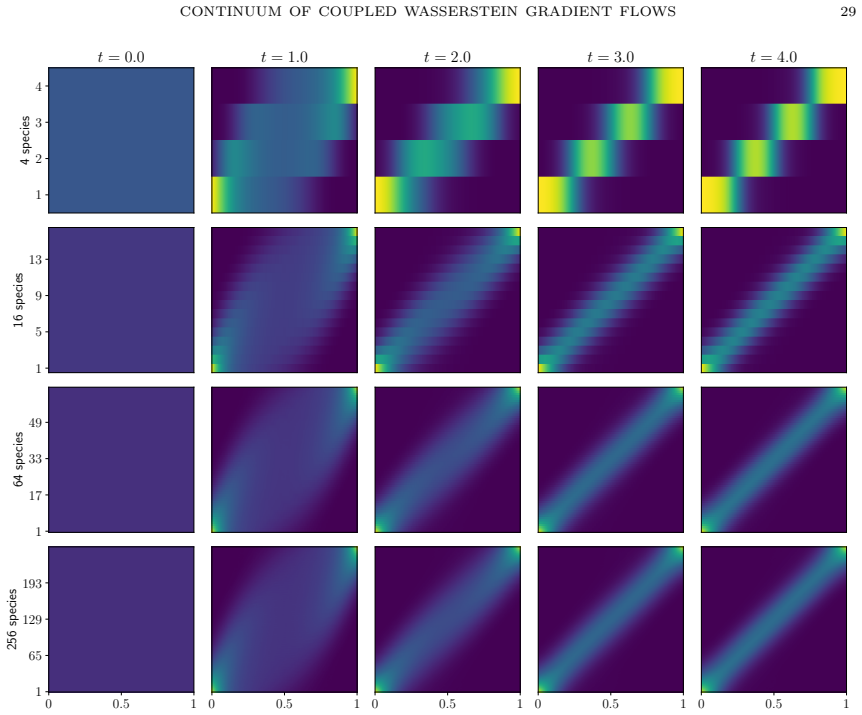
Take $X=Y=[0,1]$, $\mu=\nu$ uniform, $V(x,y)=|x-y|^2/2$, and $\kappa>0$; run the minimizing-movement scheme at decreasing $\tau$ from the flipped initial plan $\rho_0=(\mathrm{id},1-\mathrm{id})_\sharp\mu$. The theorem predicts $E(\rho_t)-E(\rho^*) \to 0$ along the whole trajectory; observing that the trajectory approaches any stationary point other than the entropic plan $\rho^*$, or that the energy gap plateaus above the discretization error as $\tau \to 0$, would falsify Lemma 16.
Extended reading notes
Core claim
The central claim is that the coupled system (1)–(3) is a well-posed gradient flow whose longtime limit solves entropic optimal transport. More precisely, for fixed marginals $\mu$ and $\nu$, positive regularization $\kappa$, and a finite-energy initial coupling, the minimizing-movement sequence built with the fibered Wasserstein distance $W_F$ yields a weak solution $(\rho_t, \Pi_t)$ of the coupled PDEs; a key step is showing that vertical averages of the density converge strongly enough to pass the product of pressure gradient and density to the limit, jointly over infinitely many phases. Any such weak solution converges as $t \to \infty$ to the unique minimizer of $E(\rho)=\int V\,d\rho+\kappa H(\rho)$, namely the entropic optimal transport plan between $\mu$ and $\nu$. The paper also shows that this convergence property is stable under approximation of the second marginal by finitely many phases, recovering multiphase porous-media models in the discrete-to-continuous limit. In the unregularized limit $\kappa=0$, by contrast, suboptimal stationary configurations persist, so relaxation alone does not fix the AHT scheme; some regularization is necessary.
Load-bearing premise
The porosity profile $\mu$ must be bounded away from zero and infinity and have finite Fisher information $\int_X |\nabla\sqrt{\mu}|^2\,dx < \infty$; this regularity is what gives the horizontal $H^1$ control on the density and $L^2$ control on the pressure gradient, so the proof does not cover discontinuous porosities such as the piecewise-constant bottleneck tested numerically.
Editorial extensions
If this is right
- Every weak solution of (1)–(3) converges as $t \to \infty$ to the unique entropic optimal transport plan between $\mu$ and $\nu$, so the entropic relaxation of the AHT scheme is unconditionally convergent.
- The continuum model is the discrete-to-continuous limit of finite multiphase porous-media flows: trajectories for $\nu$ made of finitely many Dirac masses converge to those for a general probability measure $\nu$.
- The minimizing-movement scheme gives a constructive existence proof and a numerical algorithm; the experiments indicate linear convergence of the relative energy gap, opening a route to novel entropic optimal transport solvers on geometric domains.
- For $\kappa=0$, suboptimal stationary configurations exist, so merely relaxing AHT to the space of plans without regularization does not guarantee convergence.
Reading between the lines
- The numerically observed linear decay of $E(\rho_t)-E(\rho^*)$ suggests a quantitative dissipation inequality; proving one would turn the asymptotic guarantee into a complexity bound for entropy-regularized optimal transport computed by minimizing movements.
- The bottleneck experiment with a discontinuous porosity $\mu$ indicates that the Fisher-information hypothesis may be relaxable to piecewise-smooth densities; a proof would extend the results to layered or fractured porous media.
- Because the invariant measure of the flow is the entropic optimal transport plan, the dynamics can be read as an annealing of a Schrödinger bridge; this may connect the convergence proof to quantitative rates for iterative proportional fitting methods such as Sinkhorn's algorithm.
- The same fibered-gradient-flow mechanism may apply to multi-marginal or dynamic transport problems where AHT-style projection algorithms stall, as long as a fiber metric with strong vertical-average compactness can be defined.
Editorial analysis
A structured set of objections, weighed in public.
Referee Report
Summary. The paper studies the stratified drift-diffusion system (1)-(3), in which a continuum of phases y ∈ Y evolves under a joint pointwise volume constraint determined by a fixed first marginal μ. The dynamics are interpreted as a gradient flow in the fibered Wasserstein metric for the entropic optimal transport energy (4). The main results are: existence of global weak solutions via the JKO/minimizing-movement scheme (Section 4, Lemma 10); stability of weak solutions under joint variation of the marginals, including a discrete-to-continuous limit (Section 5, Lemma 13); and long-time convergence of every weak solution to the unique minimizer of the energy, i.e. the entropic optimal transport plan between μ and ν (Section 6, Lemma 16). The paper also shows that in the unregularized limit κ = 0, stationary suboptimal configurations persist, so regularization is essential for unconditional convergence, and it presents numerical experiments illustrating convergence, stability, and a bottleneck test with discontinuous μ.
Significance. If the main claims hold, this is a valuable contribution: it gives the first unconditional convergence guarantee for an entropic relaxation of the Angenent-Haker-Tannenbaum scheme and provides a rigorous variational framework for multiphase porous media flows with a continuum of phases. The paper is largely self-contained, the chain of estimates is detailed, and the energy functional is not fitted to the conclusions: the minimizer structure is cited from an independent source and the entropy parameter κ, time step τ, and discretization parameters are natural model parameters. The numerical section is qualitative and uses small academic examples, but it does support the theoretical statements and even probes regimes outside the stated assumptions. The main weakness is that Lemma 13, which is load-bearing for the stability and asymptotic-convergence results, contains an asserted but not proved compactness step for the varying-marginal case; this needs to be repaired before the central claims can be regarded as fully established.
major comments (3)
- [Section 5, Lemma 13] The proof of the strong convergence of the vertical averages in (95) and (96) is not supplied: after stating that the argument is 'similar' to Lemma 10, the text says that the variation of the marginals μn and νn 'can be factored into the proof without major issues', but no details are given. This is a load-bearing point: Lemma 16 uses Lemma 13 to pass to the limit in the cluster-point argument for long-time convergence, and Lemma 11 and Lemma 14 rely on the product convergence (96) for lower semicontinuity of the dissipation. In particular, the averages ωn are taken against νn, which is only known to converge weak*, so the Aubin-Lions compactness used for fixed ν in Lemma 10 does not transfer automatically. Please provide a complete proof of (95) and (96), or state and prove the needed variant of Aubin-Lions for varying reference measures.
- [Lemma 12, Eq. (83)] The statement (83) reads W2(ρt1,ρt2) ≤ W2_F(ρt1,ρt2) ≤ E(ρ0)(t2-t1), but the proof at the end of Lemma 12 derives W_F^2 ≤ (t2-t1) E(ρ0), so the correct inequality is W_F ≤ sqrt(E(ρ0)(t2-t1)). The printed bound is false in general and also has the wrong scaling in both E(ρ0) and time. Please correct the statement and check all places that use Lemma 12 for equicontinuity; the corrected square-root bound is sufficient for that purpose.
- [Section 1.5 and Section 8, Eq. (116)] The standing assumption (15) that μ is bounded away from 0 and ∞ and has finite Fisher information excludes piecewise-constant porosities, which are a standard case in porous media modeling. The numerical bottleneck experiment in Section 8 uses exactly such a discontinuous μ and says that the observed convergence 'may indicate that the Fisher information bound hypothesis could be further relaxed', but no proof is offered. This is a limitation of scope rather than an internal inconsistency, but it should be stated explicitly: the numerical experiment is outside the hypotheses of the theorems, and if a relaxation is intended, it should be proved or explicitly labeled as a conjecture.
minor comments (4)
- [Lemma 10, Eq. (72)] The sentence after (72) says 'weak* convergence of ωτ dx dt to ωτ dx dt'; the second factor should be ω dx dt. Also verify the displayed equation (72) itself, which appears to have a typo in the final equality.
- [Lemma 11] The proof refers to 'the regularity properties outlined in Lemma 12' and to Lemma 13 before those lemmas are stated. Please reorder the presentation or add explicit forward references so the logical dependence is clear.
- [Throughout] There are several typographical issues, e.g. 'Radon-Nykodym' for 'Radon-Nikodym', 'defing' for 'defining', and 'sufficiently' for 'sufficiently'. These do not affect the mathematics but should be corrected.
- [Section 8] The flipped-initialization experiment with N → ∞ is described as having initial entropy tending to infinity, so it is outside the assumptions of the existence/stability theorems; this should be stated clearly in the text, not only implicitly.
Circularity Check
No circular derivation: the convergence theorem is built from self-contained PDE estimates; the one overlapping-author citation (Lemma 4) is an independent, standard entropic-OT characterization, and Lemma 13's asserted compactness step is a proof gap, not a circular input.
full rationale
The paper's derivation chain is predominantly self-contained. Existence (Lemma 10) is proven from the minimizing-movement scheme via JKO estimates, Aubin-Lions compactness, and the horizontal Fisher-information bound (49); no fitted quantity is renamed as a prediction. The long-time asymptotics (Lemma 16) follow a standard LaSalle-type argument: cluster points produce a limit solution (Lemma 13), summability of dissipation forces I=0 on the limit (Lemma 14), and Lemma 15 identifies I=0 with the unique minimizer. The only result imported from prior work is Lemma 4 on the structure of minimizers of E, cited to [6]; one author (Schmitzer) overlaps with the present paper, but this is an independently published, parameter-free characterization of entropic OT minimizers with stated assumptions that do not include the convergence theorem, so it is real evidence and not a load-bearing unverified self-citation. The stability lemma (Lemma 13) contains an asserted compactness step for vertical averages when marginals vary ('this can be factored into the proof without major issues') that is not written out; this is an omitted proof or potential gap, but it is not circular, because the convergence is not assumed as an input anywhere and the surrounding estimates are proved. Likewise the apparent dimension error in Lemma 12 (WF ≤ E0(t2−t1) instead of the square-root bound) is a typo-level correctness issue, not a circular step. The Fisher-information assumption (15) is a stated restriction, and the bottleneck experiment explicitly lies outside it; this limits generality but does not smuggle in the conclusion. No self-definitional, fitted-input, or renaming circularity is present.
Assumptions & free parameters
free parameters (5)
- κ (entropic regularization strength) =
0.01 in numerics; arbitrary κ>0 in theory
- τ (JKO time step) =
0.25 in numerics; tends to 0 in theory
- M (discretization of X) =
64 or 256
- N (number of phases in numerics) =
4, 16, 64, 256
- δ, a, b in bottleneck porosity =
δ=1/8, b=a/2, a normalizes ∫µ=1
assumptions (9)
- domain assumption X ⊂ R^d compact with connected interior and smooth boundary; Y compact
- domain assumption µ absolutely continuous with density bounded away from 0 and ∞ and finite Fisher information (equation 15)
- domain assumption V ∈ C²(X×Y) non-negative
- domain assumption ν arbitrary probability measure on Y
- domain assumption Initial coupling ρ0 has finite energy E(ρ0)
- standard math Fibered Wasserstein metric WF is a metric with the representations in Lemma 1
- standard math Brenier's theorem: uniqueness and measurability of optimal transport maps for absolutely continuous marginals
- standard math Weighted Poincaré inequality and Aubin-Lions compactness criterion (Rossi-Savaré)
- domain assumption Twist condition: x ↦ ∇_X V(x,y) injective, for κ=0 stationarity example
Cite this review
Pith. "Pith review of Continuum of coupled Wasserstein gradient flows." pith.science (2026). https://pith.science/paper/AMWTAOPC
@misc{pith2026241113969,
  author       = {Pith},
  title        = {Pith review of: Continuum of coupled Wasserstein gradient flows},
  year         = {2026},
  howpublished = {\url{https://pith.science/paper/AMWTAOPC}},
  note         = {Machine review of arXiv:2411.13969}
}
read the original abstract
We study a system of drift-diffusion PDEs for a potentially infinite number of incompressible phases, subject to a joint pointwise volume constraint. Our analysis is based on the interpretation as a collection of coupled Wasserstein gradient flows or, equivalently, as a gradient flow in the space of couplings under a `fibered' Wasserstein distance. We prove existence of weak solutions, long-time asymptotics, and stability with respect to the mass distribution of the phases, including the discrete to continuous limit. A key step is to establish convergence of the product of pressure gradient and density, jointly over the infinite number of phases. The underlying energy functional is the objective of entropy regularized optimal transport, which allows us to interpret the model as the relaxation of the classical Angenent-Haker-Tannenbaum (AHT) scheme to the entropic setting. However, in contrast to the AHT scheme's lack of convergence guarantees, the relaxed scheme is unconditionally convergent. We conclude with numerical illustrations of the main results.
Figures


Figures from the paper (5 more)


Reference graph
Works this paper leans on
-
[1]
Lectures in Mathematics ETH Z¨ urich
Luigi Ambrosio, Nicola Gigli, and Giuseppe Savar´ e.Gradient flows in metric spaces and in the space of proba- bility measures. Lectures in Mathematics ETH Z¨ urich. Birkh¨ auser Verlag, Basel, second edition, 2008
work page 2008
-
[2]
Minimizing flows for the Monge-Kantorovich problem
Sigurd Angenent, Steven Haker, and Allen Tannenbaum. Minimizing flows for the Monge-Kantorovich problem. SIAM J. Math. Anal. , 35(1):61–97, 2003
work page 2003
-
[3]
K. Aziz and A. Settari. Petroleum Reservoir Simulation . Elsevier Applied Science Publishers, Londres, 1979
work page 1979
-
[4]
J. Bear and Y. Bachmat. Introduction to modeling of transport phenomena in porous media . Kluwer Academic Publishers, Dordrecht, The Netherlands, 1990
work page 1990
-
[5]
J.-D. Benamou, G. Carlier, and M. Laborde. An augmented Lagrangian approach to Wasserstein gradient flows and applications. In Gradient flows: from theory to application , volume 54 of ESAIM Proc. Surveys, pages 1–17. EDP Sci., Les Ulis, 2016
work page 2016
-
[6]
Domain decomposition for entropy regularized optimal transport
Mauro Bonafini and Bernhard Schmitzer. Domain decomposition for entropy regularized optimal transport. Numerische Mathematik , 149:819–870, 2021
work page 2021
-
[7]
Y. Brenier. Polar factorization and monotone rearrangement of vector-valued functions. Comm. Pure Appl. Math., 44(4):375–417, 1991
work page 1991
-
[8]
Yann Brenier. Optimal transport, convection, magnetic relaxation and generalized Boussinesq equations.Journal of Nonlinear Science , 19(5):547–570, 10 2009. CONTINUUM OF COUPLED W ASSERSTEIN GRADIENT FLOWS 35
work page 2009
Show all 39 references
-
[9]
Canc` es, T
C. Canc` es, T. O. Gallou¨ et, M. Laborde, and L. Monsaingeon. Simulation of multiphase porous media flows with minimizing movement and finite volume schemes. European J. Appl. Math. , 30(6):1123–1152, 2019
2019
-
[10]
Canc` es, T
C. Canc` es, T. O. Gallou¨ et, and L. Monsaingeon. The gradient flow structure of immiscible incompressible two-phase flows in porous media. C. R. Acad. Sci. Paris S´ er. I Math., 353:985–989, 2015
2015
-
[11]
Canc` es, T
C. Canc` es, T. O. Gallou¨ et, and L. Monsaingeon. Incompressible immiscible multiphase flows in porous media: a variational approach. Anal. PDE, 10(8):1845–1876, 2017
2017
-
[12]
Canc` es, D
C. Canc` es, D. Matthes, and F. Nabet. A two-phase two-fluxes degenerate Cahn-Hilliard model as constrained Wasserstein gradient flow. Arch. Ration. Mech. Anal. , 233(2):837–866, 2019
2019
-
[13]
Canc` es and A
C. Canc` es and A. Zurek. A convergent finite volume scheme for dissipation driven models with volume filling constraint. Numer. Math. , 151:279–328, 2022
2022
-
[14]
Canc` es and D
C. Canc` es and D. Matthes. Construction of a two-phase flow with singular energy by gradient flow methods. J. Diff. Equ. , 344:439–470, 2023
2023
-
[15]
Convergence of entropic schemes for optimal transport and gradient flows
Guillaume Carlier, Vincent Duval, Gabriel Peyr´ e, and Bernhard Schmitzer. Convergence of entropic schemes for optimal transport and gradient flows. SIAM Journal on Mathematical Analysis , 49(2):1385–1418, 2017
2017
-
[16]
A first-order primal-dual algorithm for convex problems with applications to imaging
Antonin Chambolle and Thomas Pock. A first-order primal-dual algorithm for convex problems with applications to imaging. Journal of Mathematical Imaging and Vision , 40(1):120–145, May 2011
2011
-
[17]
Y. Chen, T. T. Georgiou, and M. Pavon. On the relation between optimal transport and Schr¨ odinger bridges: a stochastic control viewpoint. Journal of Optimization Theory and Applications , 169:671–691, 2016
2016
-
[18]
Z. Chen. Degenerate two-phase incompressible flow. I. Existence, uniqueness and regularity of a weak solution. J. Diff. Equ. , 171(2):203–232, 2001
2001
-
[19]
Chen and R
Z. Chen and R. E. Ewing. Fully discrete finite element analysis of multiphase flow in groundwater hydrology. SIAM J. Numer. Anal. , 34(6):2228–2253, 1997
1997
-
[20]
Cordoba, D
D. Cordoba, D. Faraco, and F. Gancedo. Lack of uniqueness for weak solutions of the incompressible porous media equation. Arch. Ration. Mech. An. , 200:725–746, 2011
2011
-
[21]
M. Cuturi. Sinkhorn distances: Lightspeed computation of optimal transportation distances. In Advances in Neural Information Processing Systems 26 (NIPS 2013) , pages 2292–2300, 2013
2013
-
[22]
D. E. Edmunds and B. Opic. Weighted Poincar´ e and Friedrichs inequalities.Journal of the London Mathematical Society, s2-47(1):79–96, 02 1993
1993
-
[23]
Eymard, R
R. Eymard, R. Herbin, and A. Michel. Mathematical study of a petroleum-engineering scheme. M2AN Math. Model. Numer. Anal. , 37(6):937–972, 2003
2003
-
[24]
F¨ orster and L
C. F¨ orster and L. Sz´ ekelyhidi. Piecewise constant subsolutions for the Muskat problem.Commun. Math. Phys. , 363:1051–1080, 2018
2018
-
[25]
Wilfrid Gangbo and Robert J. McCann. The geometry of optimal transportation. Acta Math., 177(2):113–161, 1996
1996
-
[26]
Gigli and F
N. Gigli and F. Otto. Entropic Burgers’ equation via a minimizing movement scheme based on the Wasserstein metric. Calc. Var. Partial Differential Equations , 47(1-2):181–206, 2013
2013
-
[27]
Multimarginal optimal transport with a tree- structured cost and the Schr¨ odinger bridge problem.SIAM Journal on Control and Optimization , 59(4):2428– 2453, 2021
Isabel Haasler, Axel Ringh, Yongxin Chen, and Johan Karlsson. Multimarginal optimal transport with a tree- structured cost and the Schr¨ odinger bridge problem.SIAM Journal on Control and Optimization , 59(4):2428– 2453, 2021
2021
-
[28]
Self-similarity in a thin film Muskat problem.SIAM Journal on Mathematical Analysis, 49(4):2790–2842, 2017
Philippe Lauren¸ cot and Bogdan-Vasile Matioc. Self-similarity in a thin film Muskat problem.SIAM Journal on Mathematical Analysis, 49(4):2790–2842, 2017
2017
-
[29]
Towards a mathematical theory of trajectory inference
Hugo Lavenant, Stephen Zhang, Young-Heon Kim, and Geoffrey Schiebinger. Towards a mathematical theory of trajectory inference. Ann. Appl. Probab., 34(1A), 2024
2024
-
[30]
Otto and W
F. Otto and W. E. Thermodynamically driven incompressible fluid mixtures. J. Chem. Phys. , 107(23):10177– 10184, 1997
1997
-
[31]
Evolution of microstructure in unstable porous media flow: a relaxational approach
Felix Otto. Evolution of microstructure in unstable porous media flow: a relaxational approach. Communica- tions on Pure and Applied Mathematics: A Journal Issued by the Courant Institute of Mathematical Sciences , 52(7):873–915, 1999
1999
-
[32]
Heterogeneous gradient flows in the topology of fibered optimal transport
Jan Peszek and David Poyato. Heterogeneous gradient flows in the topology of fibered optimal transport. Cal- culus of Variations and Partial Differential Equations , 62(9):258, Oct 2023
2023
-
[33]
Computational optimal transport.Foundations and Trends in Machine Learn- ing, 11(5–6):355–607, 2019
Gabriel Peyr´ e and Marco Cuturi. Computational optimal transport.Foundations and Trends in Machine Learn- ing, 11(5–6):355–607, 2019
2019
-
[34]
Tightness, integral equicontinuity and compactness for evolution problems in Banach spaces
Riccarda Rossi and Giuseppe Savar´ e. Tightness, integral equicontinuity and compactness for evolution problems in Banach spaces. Ann. Sc. Norm. Super. Pisa Cl. Sci. (5) , 2(2):395–431, 2003. 36 CL ´EMENT CANC `ES, DANIEL MATTHES, ISMAEL MEDINA, AND BERNHARD SCHMITZER
2003
-
[35]
Optimal Transport for Applied Mathematicians , volume 87 of Progress in Nonlinear Differential Equations and Their Applications
Filippo Santambrogio. Optimal Transport for Applied Mathematicians , volume 87 of Progress in Nonlinear Differential Equations and Their Applications . Birkh¨ auser Boston, 2015
2015
-
[36]
Sz´ ekelyhidi Jr
L. Sz´ ekelyhidi Jr. Relaxation of the incompressible porous media equation. Ann. Sci. ´Ecole Norm. Sup. , 45(3):491–509, 2012
2012
-
[37]
J. L. V´ azquez.The porous medium equation . Oxford Mathematical Monographs. The Clarendon Press Oxford University Press, Oxford, 2007. Mathematical theory
2007
-
[38]
M. H. Vignal. Convergence of a finite volume scheme for an elliptic-hyperbolic system. RAIRO Mod´ el. Math. Anal. Num´ er., 30(7):841–872, 1996
1996
-
[39]
C. Villani. Topics in Optimal Transportation, volume 58 of Graduate Studies in Mathematics . American Math- ematical Society, Providence, 2003. Univ. Lille, CNRS, Inria, UMR8524 – Laboratoire Paul Painlev ´e, F-59000 Lille Email address : clement.cances@inria.fr Department of ...
2003
Reviewed August 12, 2026 · model on record in the stance chip above.
Discussion (0). Continue with ORCID to comment.