REVIEW 4 major objections 5 minor 40 references
Towards Adaptive Asynchronous Federated Learning for Human Activity Recognition
T0 review · 4 major / 5 minor · reviewed 2026-08-12 · deepseek-v4-flash
Pith's one-line read For human activity recognition under federated learning with severely skewed device data, this paper claims the winning design choices are global feature scaling, SGD with momentum, and moderate minority-class augmentation, and it ships…
desk verdict Useful empirical FL-for-IoT paper with a load-bearing error in its core update equation—worth a revision, not a desk reject. read the letter →
The pith
A machine-rendered reading of the paper's core claim, the machinery that carries it, and where it could break.
The reading
What carries the argument
The load-bearing mechanism is the asynchronous aggregation rule of Equation 2, $x_{t+1}=x_t+\alpha_{MR}\frac{n_i}{N}(x_t+\Delta_i)$, implemented in an open-source Flower extension, together with the paper's methodology of evaluating each design decision (scaling, augmentation, optimizer, batch size, learning rate) under fixed update counts and from central and distributed vantage points on the Extrasensory dataset.
What would settle it
Run the same ablation matrix (global vs local scaling, none vs base vs balanced augmentation, SGD-m vs ADAM) on a second naturally non-IID HAR dataset, such as the Heterogeneity Human Activity Recognition dataset or a client-partitioned UCI-HAR, using the same test protocol; if global scaling does not beat local scaling or ADAM beats SGD-m on the minority class, the paper's design-decisions ranking fails.
Extended reading notes
Core claim
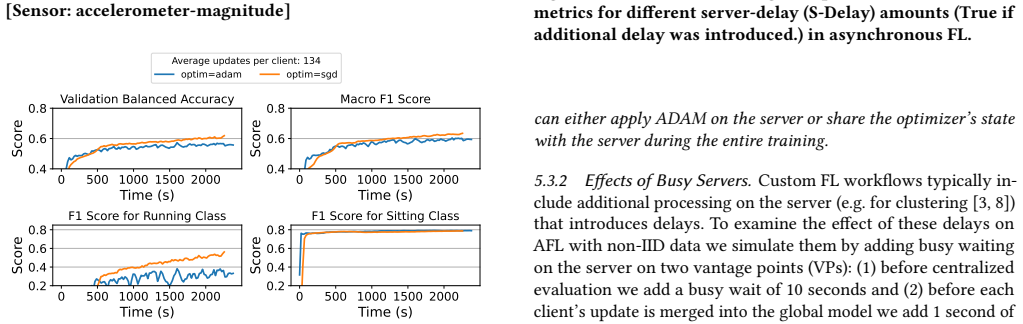
On the paper's own terms, the central discovery is that the apparently messy problem of non-IID federated learning for HAR responds to a small set of preprocessing and optimizer choices, and that these choices interact with the asynchronous setting in a specific way. Equation 2 defines the asynchronous server update: when client $i$ sends gradient $\Delta_i$, the global model becomes $x_{t+1}=x_t+\alpha_{MR}\frac{n_i}{N}(x_t+\Delta_i)$, with mixing ratio $\alpha_{MR}$ and client sample share $n_i/N$. Running this update on the Extrasensory dataset, the paper finds that global feature scaling (sharing client means and standard deviations with the server to form one global standardization) improves all four tracked metrics over client-local scaling; that SGD with momentum outperforms ADAM, which suffers because its per-client optimizer state is reset every round; that moderate Gaussian-noise augmentation ("base") beats both no augmentation and fully balanced augmentation; and that feature skew persists for minority classes even after global standardization. The paper also finds that adding server-side delay degrades model quality, and it provides an open-source Flower extension that implements the asynchronous update.
Load-bearing premise
The ranking of design decisions measured on the Extrasensory dataset, with its particular client split, 64-16-20 local split, mean imputation, and six mutually exclusive labels, carries over to other HAR and IoT federated learning deployments.
Editorial extensions
If this is right
- A practitioner transitioning a HAR system to federated learning should standardize features with global statistics computed across clients rather than per-client statistics; this is the single data-side choice with the clearest performance gain in the paper's ablations.
- Use SGD with momentum, not ADAM, unless the optimizer state is shared or applied server-side; ADAM's per-round state reset makes it weaker and noisier on rare classes in stateless federated optimization.
- Treat data augmentation as a tunable knob: moderate oversampling of rare classes with small Gaussian noise helps, but forcing class balance can backfire by biasing training toward replicated samples.
- For evaluation, use a fair test set assembled from all clients; leaving clients out can omit entire classes and hide the true model quality in highly skewed data.
- In asynchronous FL deployments, server-side latency matters even when the server does no training; measurable delay reduces model quality independent of client update count.
Reading between the lines
- Because the augmentation intensities (20x for running, 8x for cycling) were fixed rather than swept, the claim that "base augmentation is best" may be specific to these multiplicities; sweeping augmentation strength on other datasets is a natural next test.
- The ADAM-versus-SGD-m result likely depends on the very small local epoch count; if the paper's suggested fixes (server-side ADAM or shared state) remove the state-reset problem, the ranking could change, and the paper itself leaves this open.
- The persistence of feature skew after global standardization suggests that simple feature-wise scaling cannot eliminate inter-client distribution shift; techniques that calibrate per-client feature representations (e.g., per-client normalization layers) are an untested extension of the paper's finding.
- The single-dataset evaluation makes transferability the key open question; repeating the same ablation matrix on at least one more naturally non-IID HAR dataset would turn the paper's blueprint into a general result.
Editorial analysis
A structured set of objections, weighed in public.
Referee Report
Summary. The paper proposes a methodology for transitioning from centralized learning to synchronous and asynchronous federated learning for human activity recognition under non-IID data. Using the Extrasensory dataset, the authors evaluate the impact of data augmentation, feature scaling, optimizer choice, learning rate, and batch size on model performance in centralized, synchronous federated, and asynchronous federated settings. They report that moderate Gaussian-noise augmentation, global feature scaling, and SGD with momentum perform best, and they release an open-source extension of the Flower framework intended to enable asynchronous federated learning. The paper positions these results as practical guidance for IoT/HAR deployments and emphasizes the persistence of feature skew after global standardization.
Significance. If the empirical findings are reliable, the paper offers a useful, reproducible blueprint for IoT/HAR practitioners facing non-IID federated data, and the open-source Flower extension is a concrete community resource. The main strengths are the use of a realistic, naturally non-IID dataset, a clearly described preprocessing pipeline, and public code. However, the strength of the empirical conclusions is limited by the use of a single dataset and a single run per configuration, and the central update equations of the paper are stated incorrectly, so the exact algorithms used in the experiments are not specified by the manuscript. The authors explicitly acknowledge the single-dataset limitation in Section 7, which is commendable, but the methodological issues with the aggregation formulas and test-set tuning need to be addressed before the claims can be fully trusted.
major comments (4)
- [Section 2.2, Eq. (1)] The synchronous update rule is misstated. With x_i^{t+1} defined as client i's updated model after local training, the standard FedAvg update is x_{t+1} = sum_{i in S} (n_i/N) x_i^{t+1}, not x_{t+1} = x_t + sum_{i in S} (n_i/N) x_i^{t+1}. As printed, the server would add full client models to the current global model every round rather than replacing the global model with their weighted average. Please correct the equation or explicitly define x_i^{t+1} as a model delta relative to x_t.
- [Section 2.2, Eq. (2)] The asynchronous update rule is dimensionally inconsistent and does not reproduce FedAsync. If Delta_i denotes client gradients, then x_t + Delta_i mixes parameter and gradient spaces; if Delta_i denotes the client model delta x_i - x_t, the extra x_t inside the parentheses is spurious; if Delta_i denotes the full client model, the rule accumulates models and would diverge. The FedAsync convex-combination update should be x_{t+1} = x_t + alpha_MR (n_i/N) Delta_i with Delta_i = x_i - x_t. Because Section 3 states that the server updates the global model according to Equation 2, the actual AFL algorithm implemented in the Flower extension and used in Section 5 is not specified by the paper.
- [Sections 4.4 and 5.1] Hyperparameters (batch size, learning rate, mixing ratio) are selected using the centralized test set: Section 4.4 states that models are evaluated on the test set during tuning, and Section 5.1 uses the centralized test set on the server for final evaluation. Using the same test set for both model selection and final evaluation introduces optimistic bias into all reported numbers in Tables 1 and 2. Please reserve a separate validation split for tuning and report final metrics on a truly held-out test set.
- [Section 5, Table 2] The experimental results are single runs with no error bars, repeated seeds, or significance tests. Consequently, several headline claims are not statistically supported: for example, in Table 2 the SFL balanced accuracy for global versus local scaling is identical (0.61 vs. 0.61) while the text claims global scaling improves all metrics, and the SFL macro-F1 difference is only 0.02. Please provide uncertainty quantification (e.g., multiple seeds with confidence intervals) or soften the comparative claims accordingly.
minor comments (5)
- [Abstract] The abstract says "multi-label classification," but the experiments use six mutually exclusive labels, which is multi-class classification as clarified in Section 4.4; please align the abstract's terminology with the body.
- [Section 4.2.1] There is a typo: "waling" should be "walking."
- [References] References [33] and [34] are the same survey (Xu et al., "Asynchronous federated learning on heterogeneous devices: A survey"); please merge them or remove the duplicate.
- [Section 5.2.3] The claim that global scaling improves "all four tracked metrics" is not fully supported by Table 2, which omits the Sitting F1 score and shows equal SFL balanced accuracy for global and local scaling; please specify that the claim refers to the AFL curves in Figure 4 or add the missing metric.
- [Section 3] The statement that "Flower does not support AFL" should be qualified with respect to the Flower version used, since later versions of the framework may include asynchronous strategies.
Circularity Check
No significant circularity: the paper's claims are empirical measurements over a public dataset, not derivations from self-defined quantities or self-cited results.
full rationale
The paper is an empirical study of design decisions in federated HAR. Its main findings (global scaling beats local scaling, SGD-m beats ADAM, moderate augmentation beats none/balanced) are stated as measured outcomes over the public Extrasensory dataset, with the relevant convergence plots and Table 2 as direct evidence. Hyperparameters are tuned and reported, but they are not relabeled as predictions, and the comparisons are against explicit baselines within the same experimental setup rather than against quantities fitted from the same data. The AFL extension relies on external prior work (FedAsync [32], ASO-Fed [6], PAFLM [15]) and its own open-source implementation, not on a self-citation chain. The self-citations present (e.g., references [17], [20], [21]) are contextual and load-bearing only for unrelated prior system work, not for the paper's central claims. The skeptical concern about Equation 2 being dimensionally inconsistent with the stated FedAsync rule is a correctness or reproducibility issue, not a circularity issue: nothing in the equation or its use is equivalent to its own inputs by construction. Overall, the derivation chain is self-contained against external benchmarks, so the circularity score is 0.
Assumptions & free parameters
free parameters (5)
- augmentation multipliers =
Running 20, Cycling 8, Standing 1, Walking 2
- Gaussian noise std for augmentation =
1e-4
- AFL mixing ratio =
0.8
- batch size and learning rate =
CL: BS=256, LR=0.01; SFL: grid-selected; AFL: BS=128, LR=0.01
- momentum =
0.9
assumptions (4)
- domain assumption Extrasensory dataset is representative of realistic non-IID HAR.
- domain assumption The six labels are mutually exclusive and the MLP with categorical cross-entropy is an adequate model for HAR.
- domain assumption Flower's ray simulation faithfully reproduces asynchronous FL dynamics.
- domain assumption Fair Test Set (FTS) with portions of every client's data is a valid evaluation scheme.
Cite this review
Pith. "Pith review of Towards Adaptive Asynchronous Federated Learning for Human Activity Recognition." pith.science (2026). https://pith.science/paper/CEB6R3VP
@misc{pith2026241114070,
  author       = {Pith},
  title        = {Pith review of: Towards Adaptive Asynchronous Federated Learning for Human Activity Recognition},
  year         = {2026},
  howpublished = {\url{https://pith.science/paper/CEB6R3VP}},
  note         = {Machine review of arXiv:2411.14070}
}
read the original abstract
In this work, we tackle the problem of performing multi-label classification in the case of extremely heterogeneous data and with decentralized Machine Learning. Solving this issue is very important in IoT scenarios, where data coming from various sources, collected by heterogeneous devices, serve the learning of a distributed ML model through Federated Learning (FL). Specifically, we focus on the combination of FL applied to Human Activity Recognition HAR), where the task is to detect which kind of movements or actions individuals perform. In this case, transitioning from centralized learning (CL) to federated learning is non-trivial as HAR displays heterogeneity in action and devices, leading to significant skews in label and feature distributions. We address this scenario by presenting concrete solutions and tools for transitioning from centralized to FL for non-IID scenarios, outlining the main design decisions that need to be taken. Leveraging an open-sourced HAR dataset, we experimentally evaluate the effects that data augmentation, scaling, optimizer, learning rate, and batch size choices have on the performance of resulting machine learning models. Some of our main findings include using SGD-m as an optimizer, global feature scaling across clients, and persistent feature skew in the presence of heterogeneous HAR data. Finally, we provide an open-source extension of the Flower framework that enables asynchronous FL.
Figures


Figures from the paper (2 more)

Reference graph
Works this paper leans on
-
[1]
Davide Anguita, Alessandro Ghio, Luca Oneto, Xavier Parra, Jorge Luis Reyes- Ortiz, et al. 2013. A public domain dataset for human activity recognition using smartphones.. In Esann, Vol. 3. 3
work page 2013
-
[2]
Daniel J Beutel, Taner Topal, Akhil Mathur, Xinchi Qiu, Javier Fernandez-Marques, Yan Gao, Lorenzo Sani, Kwing Hei Li, Titouan Parcollet, Pedro Porto Buarque de Gusmão, et al. 2020. Flower: A friendly federated learning research framework. arXiv preprint arXiv:2007.14390 (2020)
arXiv 2020
-
[3]
Christopher Briggs, Zhong Fan, and Peter Andras. 2020. Federated learning with hierarchical clustering of local updates to improve training on non-IID data. In 2020 international joint conference on neural networks (IJCNN) . IEEE, 1–9
2020
-
[4]
Yujing Chen, Zheng Chai, Yue Cheng, and Huzefa Rangwala. 2021. Asynchronous federated learning for sensor data with concept drift. In 2021 IEEE International Conference on Big Data (Big Data) . IEEE, 4822–4831
work page 2021
-
[5]
Yujing Chen, Yue Ning, Zheng Chai, and Huzefa Rangwala. 2020. Federated multi-task learning with hierarchical attention for sensor data analytics. In 2020 International Joint Conference on Neural Networks (IJCNN) . IEEE, 1–8
work page 2020
-
[6]
Yujing Chen, Yue Ning, Martin Slawski, and Huzefa Rangwala. 2020. Asynchro- nous online federated learning for edge devices with non-iid data. In 2020 IEEE International Conference on Big Data (Big Data) . IEEE, 15–24
work page 2020
-
[7]
Georgios Drainakis, Panagiotis Pantazopoulos, Konstantinos V Katsaros, Vasilis Sourlas, Angelos Amditis, and Dimitra I Kaklamani. 2023. From centralized to Fed- erated Learning: Exploring performance and end-to-end resource consumption. Computer Networks 225 (2023), 109657
work page 2023
-
[8]
Jiaqi Ge, Gaochao Xu, Jianchao Lu, Chenhao Xu, Quan Z Sheng, and Xi Zheng
Show all 40 references
-
[9]
Li Ju, Tianru Zhang, Salman Toor, and Andreas Hellander. 2023. Accelerating fair federated learning: Adaptive federated adam. arXiv preprint arXiv:2301.09357 (2023)
2023 arXiv
-
[10]
Sai Praneeth Karimireddy, Martin Jaggi, Satyen Kale, Mehryar Mohri, Sashank J Reddi, Sebastian U Stich, and Ananda Theertha Suresh. 2020. Mime: Mim- icking centralized stochastic algorithms in federated learning. arXiv preprint arXiv:2008.03606 (2020)
2020 arXiv
-
[11]
Diederik P Kingma and Jimmy Ba. 2014. Adam: A method for stochastic opti- mization. arXiv preprint arXiv:1412.6980 (2014)
2014 arXiv
-
[12]
Pranjal Kumar, Siddhartha Chauhan, and Lalit Kumar Awasthi. 2024. Human Ac- tivity Recognition (HAR) Using Deep Learning: Review, Methodologies, Progress and Future Research Directions.Archives of Computational Methods in Engineering 31, 1 (2024), 179–219. https://doi.org/10.1...
2024 doi
-
[13]
David Leroy, Alice Coucke, Thibaut Lavril, Thibault Gisselbrecht, and Joseph Dureau. 2019. Federated learning for keyword spotting. In ICASSP 2019-2019 IEEE international conference on acoustics, speech and signal processing (ICASSP) . IEEE, 6341–6345
2019
-
[14]
Tian Li, Anit Kumar Sahu, Manzil Zaheer, Maziar Sanjabi, Ameet Talwalkar, and Virginia Smith. 2020. Federated optimization in heterogeneous networks. Proceedings of Machine learning and systems 2 (2020), 429–450
2020
-
[15]
Xiaofeng Lu, Yuying Liao, Pietro Lio, and Pan Hui. 2020. Privacy-preserving asynchronous federated learning mechanism for edge network computing. Ieee Access 8 (2020), 48970–48981
2020
-
[16]
Zili Lu, Heng Pan, Yueyue Dai, Xueming Si, and Yan Zhang. 2024. Federated learning with non-iid data: A survey. IEEE Internet of Things Journal (2024)
2024
-
[17]
Maximilian Maresch and Stefan Nastic. 2024. VATE: Edge-Cloud System for Object Detection in Real-Time Video Streams. In The 8th IEEE International Conference On Fog and Edge Computing (ICFEC 2024)
2024
-
[18]
Brendan McMahan, Eider Moore, Daniel Ramage, Seth Hampson, and Blaise Aguera y Arcas. 2017. Communication-efficient learning of deep net- works from decentralized data. In Artificial intelligence and statistics . PMLR, 1273–1282
2017
-
[19]
Md Golam Morshed, Tangina Sultana, Aftab Alam, and Young-Koo Lee. 2023. Hu- man Action Recognition: A Taxonomy-Based Survey, Updates, and Opportunities. Sensors 23, 4 (2023). https://doi.org/10.3390/s23042182
2023 doi
-
[20]
Stefan Nastic, Georgiana Copil, Hong-Linh Truong, and Schahram Dustdar
-
[21]
Stefan Nastic, Schahram Dustdar, Raith Philipp, Furutanpey Alireza, and Thomas Pusztai. 2022. A Serverless Computing Fabric for Edge & Cloud. In 4th IEEE International Conference on Cognitive Machine Intelligence (CogMi) . https://doi. org/10.1109/CogMI56440.2022.00011
2022
-
[22]
Jiaming Pei, Wenxuan Liu, Jinhai Li, Lukun Wang, and Chao Liu. 2024. A Review of Federated Learning Methods in Heterogeneous scenarios. IEEE Transactions on Consumer Electronics (2024), 1–1. https://doi.org/10.1109/TCE.2024.3385440
2024
-
[23]
Anindita Saha, Sajan Rajak, Jayita Saha, and Chandreyee Chowdhury. 2024. A Survey of Machine Learning and Meta-heuristics Approaches for Sensor- based Human Activity Recognition Systems. Journal of Ambient Intelligence and Humanized Computing 15, 1 (2024), 29–56. https://doi.o...
2024 doi
-
[24]
Gulshan Saleem, Usama Ijaz Bajwa, and Rana Hammad Raza. 2023. Toward human activity recognition: a survey. Neural Computing and Applications 35, 5 (2023), 4145–4182. https://doi.org/10.1007/s00521-022-07937-4
2023 doi
-
[25]
Qiang Shen, Haotian Feng, Rui Song, Stefano Teso, Fausto Giunchiglia, Hao Xu, et al. 2022. Federated multi-task attention for cross-individual human activity recognition. In IJCAI. IJCAI, 3423–3429
2022
-
[26]
Virginia Smith, Chao-Kai Chiang, Maziar Sanjabi, and Ameet S Talwalkar. 2017. Federated multi-task learning. Advances in neural information processing systems 30 (2017)
2017
-
[27]
Konstantin Sozinov, Vladimir Vlassov, and Sarunas Girdzijauskas. 2018. Human activity recognition using federated learning. In 2018 IEEE Intl Conf on Parallel & Distributed Processing with Applications, Ubiquitous Computing & Communications, Big Data & Cloud Computing, Social ...
2018
-
[28]
Allan Stisen, Henrik Blunck, Sourav Bhattacharya, Thor Siiger Prentow, Mikkel Baun Kjærgaard, Anind Dey, Tobias Sonne, and Mads Møller Jensen
-
[29]
Yonatan Vaizman, Katherine Ellis, and Gert Lanckriet. 2017. Recognizing detailed human context in the wild from smartphones and smartwatches. IEEE pervasive computing 16, 4 (2017), 62–74
2017
-
[30]
Yonatan Vaizman, Nadir Weibel, and Gert Lanckriet. 2018. Context recognition in-the-wild: Unified model for multi-modal sensors and multi-label classifica- tion. Proceedings of the ACM on Interactive, Mobile, Wearable and Ubiquitous Technologies 1, 4 (2018), 1–22
2018
-
[31]
In Proceedings of the 13th ACM conference on embedded networked sensor systems
Smart devices are different: Assessing and mitigatingmobile sensing het- erogeneities for activity recognition. In Proceedings of the 13th ACM conference on embedded networked sensor systems . 127–140
-
[32]
Cong Xie, Sanmi Koyejo, and Indranil Gupta. 2019. Asynchronous federated optimization. arXiv preprint arXiv:1903.03934 (2019)
2019 arXiv
-
[33]
Chenhao Xu, Youyang Qu, Yong Xiang, and Longxiang Gao. 2023. Asynchronous federated learning on heterogeneous devices: A survey. Computer Science Review 50 (2023), 100595. https://doi.org/10.1016/j.cosrev.2023.100595
2023
-
[34]
Yujia Wang, Yuanpu Cao, Jingcheng Wu, Ruoyu Chen, and Jinghui Chen. 2024. Tackling the Data Heterogeneity in Asynchronous Federated Learning with Cached Update Calibration. In The Twelfth International Conference on Learning Representations. https://openreview.net/forum?id=4aywmeb97I
2024
-
[35]
Salman Avestimehr
Tuo Zhang, Lei Gao, Chaoyang He, Mi Zhang, Bhaskar Krishnamachari, and A. Salman Avestimehr. 2022. Federated Learning for the Internet of Things: Applications, Challenges, and Opportunities. IEEE Internet of Things Magazine 5, 1 (2022), 24–29. https://doi.org/10.1109/IOTM.004.2100182
2022 doi
- [36]
-
[37]
Chenhao Xu, Youyang Qu, Yong Xiang, and Longxiang Gao. 2023. Asynchronous federated learning on heterogeneous devices: A survey. Computer Science Review 50 (2023), 100595
2023
-
[40]
Hangyu Zhu, Jinjin Xu, Shiqing Liu, and Yaochu Jin. 2021. Federated learning on non-IID data: A survey. Neurocomputing 465 (2021), 371–390
2021
-
[2015]
In Proceed- ings of the IEEE 7th International Conference on Cloud Computing Technol- ogy and Science (CloudCom 2015)
Governing Elastic IoT Cloud Systems under Uncertainty. In Proceed- ings of the IEEE 7th International Conference on Cloud Computing Technol- ogy and Science (CloudCom 2015) . IEEE Computer Society, 131–138. https: //doi.org/10.1109/CloudCom.2015.77 Vortrag: IEEE 7th Internatio...
2015 doi
-
[2024]
Knowledge-Based Systems 286 (2024), 111399
FedAGA: A federated learning framework for enhanced inter-client rela- tionship learning. Knowledge-Based Systems 286 (2024), 111399
2024
Reviewed August 12, 2026 · model on record in the stance chip above.
Discussion (0). Continue with ORCID to comment.