REVIEW 2 major objections 6 minor 43 references
Asymmetric Opinion Formation of Emotional Eccitable Agents
T0 review · 2 major / 6 minor · reviewed 2026-08-12 · deepseek-v4-flash
Pith's one-line read Coupling emotional arousal to confidence bounds and adding synchronized broadcasting changes the consensus transition: synchronization favors consensus and variable confidence bounds reverse the usual effect of step length.
desk verdict The model is a novel and promising combination, but the published Algorithm 1 contradicts the model equations, leaving the headline simulation results unverified. read the letter →
The pith
A machine-rendered reading of the paper's core claim, the machinery that carries it, and where it could break.
The reading
What carries the argument
The central object is a two-dimensional opinion space $(O, EA)$ populated by integrate-and-fire oscillators with limited vision, meaning each agent only perceives opinions inside its own confidence area. Each agent has an internal phase $\phi_i$ that increases uniformly to 1, at which point the agent fires a broadcast message and resets to zero; receiving a message from within the emitter's confidence area multiplies the listener's phase by $(1+\epsilon)$, producing cascades and eventually locking whole clusters onto the same firing rhythm. The confidence area itself is set by $d_i = 2d(1 - EA_i)$, making the interaction graph directed: high-arousal agents are difficult to reach and rarely listen, which is what turns them into zealots. For the fully synchronized limit the paper derives a semi-analytical probability estimate $P(n)$ based on the attraction area $A(n, d) = d / D_n$ of the equilibrium positions $\bar{O}_i = i/(n+1)$ and a binomial count of how many agents start inside those basins; this estimate captures the sharp consensus transition and the narrowing of the peaks for fragmented outcomes.
What would settle it
Run the same rules with several monotone decreasing confidence functions, for example $d_i = 2d(1 - EA_i^2)$ or $d_i = 2d(1 - EA_i)^2$; if the synchronized-consensus advantage and the reversal of the step-length effect do not persist, the reported effects depend on the particular linear law. A complementary behavioral test is to measure, in a round-based deliberation, each participant's maximum acceptable opinion distance and their emotional arousal separately; the paper's predictions fail if confidence does not fall monotonically with arousal.
Extended reading notes
Core claim
The paper reports that synchronization is a consensus-favoring force and that emotion-dependent tolerance changes the role of step length. In the model, a message fired at phase 1 reaches every receiver whose opinion lies inside the emitter's confidence area, and receivers move a fraction $\min(\alpha / d_{C_j}, 1)$ of the way toward the barycenter (average position) of all emitters they heard, in both the opinion and arousal coordinates. Because arousal is updated by the same averaging rule, average emotional arousal rises during a run, agents with high $EA$ shrink their confidence bands, and those agents act as zealots that can pull others upward and then split off as small residual groups, which the paper calls wings. Raising the synchronization factor $\epsilon$ progressively reduces the final number of opinion clusters: for $d = 0.5$ and $N = 100$, the pairwise limit gives five clusters, the sequential broadcast limit four, an intermediate $\epsilon$ gives bipartisanship (two clusters), and the fully synchronized limit gives consensus with at most a wing. The same simulations show that a large step length $\alpha = 0.5$ fragments the system in pairwise and sequential regimes, but in the fully synchronized case it achieves consensus at a lower baseline confidence width $d$, opposite to the behavior of the classical pairwise model.
Load-bearing premise
The model rests on the premise that an agent's tolerance for opposing opinions falls exactly linearly with emotional arousal, $d_i = 2d(1 - EA_i)$, and the paper's own pilot experiments are still statistically inconclusive; if the real arousal-confidence mapping differs, the reported synchronization and step-length effects could be artifacts of that choice.
Editorial extensions
If this is right
- In this model, synchronized broadcasting acts as a consensus-favoring force: increasing $\epsilon$ lowers the number of final opinion clusters and brings the average emotional arousal back toward its initial value of about 0.5.
- The effect of step length depends on the communication regime: large $\alpha$ promotes fragmentation in pairwise and sequential cases, but in the fully synchronized limit it drives the system to consensus at smaller baseline confidence widths $d$.
- The emotional-arousal dimension makes the interaction network directed and generates zealot-like agents with high $EA$; these agents can leave small wings at moderate opinion positions, not only at the extremes, especially when $\alpha$ is large.
- In bipartisan outcomes, the opinion-axis distance between the two clusters decreases as $d$ grows when interactions are synchronized, but increases with $d$ in the pairwise case; the arousal-axis distance stays roughly flat.
- Polarization is highest in the synchronized bipartisan window, reaching an average of about 0.5 when the outcome is always two clusters, and the synchronized transition to consensus produces a sharp drop in polarization.
Reading between the lines
- Editorial inference: the qualitative ordering of communication regimes probably survives other monotone decreasing functions of arousal, but the exact consensus thresholds and the $\epsilon$ value at which the step-length effect flips may depend on the linear law; scanning a family of functions such as $d_i = 2d(1 - EA_i^2)$ would show which conclusions are structural and which are an artifact of
- Editorial inference: the model yields a design rule for deliberation platforms—round-based exchange in which all participants hear all messages before any position update should reduce fragmentation relative to free-form sequential discussion; this is directly testable once the paper's pilot experiments accumulate enough data.
- Editorial inference: the dynamics predict an observable signature in real deliberation logs—participants whose arousal rises during a debate should become less responsive over time, and small high-arousal factions should detach from the main group; message-acceptance rates could be checked for that pattern.
Editorial analysis
A structured set of objections, weighed in public.
Referee Report
Summary. The paper proposes an opinion-dynamics model in which each agent carries an opinion O and an emotional-arousal variable EA; the confidence bound of agent i is d_i = 2d(1-EA_i), and agents are integrate-and-fire oscillators whose emission phases are advanced by received messages. Four communication regimes are studied: pairwise interactions, sequential broadcast, broadcast with local synchronization (coupling epsilon), and fully synchronized broadcast. Through extensive simulations (300 runs per parameter set) the authors report that synchronization promotes consensus, reduces fragmentation, lowers average EA, changes the role of the step length, and affects polarization. A semi-analytical approximation for the synchronized case is proposed in Section III.B.2, and a Telegram-based pilot experiment is described in Appendix D as a step toward empirical calibration. The central qualitative message is that synchronized broadcasting is a consensus-favoring force and that emotion-dependent tolerance modifies the Deffuant step-length effect.
Significance. If the simulations corresponded to the stated model, the paper would be a useful contribution to sociophysics: it offers an endogenous communication regime in a bounded-confidence framework, it connects opinion dynamics to synchronization of excitable oscillators, and it provides systematic phase diagrams and polarization statistics that are directly testable. The attempt at a semi-analytical description of the synchronized case is also valuable in principle. However, the current version does not support these claims: the only provided implementation (Algorithm 1) contradicts Eqs. (1)-(2), and the synchronized-case approximation is adjusted post hoc to match the simulations. The empirical grounding claim is also stronger than the evidence in Appendix D. The model idea is promising, but the manuscript needs substantial correction or clarification before its conclusions can be accepted.
major comments (2)
- [Appendix A (Algorithm 1) vs. Eqs. (1)-(2)] The only implementation specification contradicts the model equations. Algorithm 1 accepts an emitter when dist_ij < d, where dist_ij is the Euclidean distance sqrt((Oi-Oj)^2+(EAi-EAj)^2), but Eq. (1) defines a receiver-dependent confidence bound d_i = 2d(1-EA_i) on the opinion axis; the pseudocode therefore removes the central asymmetry mechanism. The updates 'Oj = Oj + c Oj' and 'EAj = EAj + c EAj' multiply the coordinates by (1+c) instead of moving Oj toward the barycenter as in Eq. (2), and the phase update 'phi_j = epsilon phi_j' does not implement the factor (1+epsilon) described in the text. Since all simulation figures (Figs. 4, 7, 8, 10-13) are produced by an unreleased implementation, the reported consensus-promoting role of synchronization and the step-length effects may be properties of an undocumented algorithm rather than of the stated model. The authors should correct Algorithm 1, release the code, and clarify which dynamics were used to generate each figure.
- [Section III.B.2, Eq. (5), and Appendix C (Table II)] The semi-analytical prediction for the synchronized case is not predictive because its lower summation bound is fit to the very simulations it is supposed to explain. The text states that modifying the lower bound of Eq. (5) improves the estimation, and Appendix C/Table II lists four different shifts (N/2, N/2-N/18, N/2-N/25, N/2-N/12) chosen according to N and alpha; the exact expression is declared beyond the scope of the paper. This is post-hoc calibration, so the agreement between the dashed analytical curves and simulation lines in Fig. C-1 is circular for that component. Please either derive the lower bound from the dynamics or explicitly label the curves as fits and report the fitted parameters.
minor comments (6)
- [Title] The title spells 'Eccitable'; the correct term is 'Excitable'.
- [Section III.A and Fig. 2 caption] The text says the trajectories in Fig. 2 correspond to N=200 agents and d=0.8, but the Fig. 2 caption says N=100 and d=0.5; please reconcile these parameters.
- [Section III.D.1] The polarization values 'P approx 200', 'approx 75', and 'approx 200' exceed the normalized range [0,1] set by Eq. (3); they appear to be missing decimal points (0.200, 0.075, 0.200).
- [Eq. (3)] The symbols pi_i and the normalization constant K are not defined. With pi_i as population shares, the stated K = N(N/2)^2.6 does not normalize the extreme two-cluster configuration to P=1; please define pi_i and give the correct normalization.
- [Appendix D and Introduction] The introduction states that the framework maintains empirical grounding, but Appendix D reports that the Dialoguem! pilot results are 'still inconclusive from a statistical perspective.' The linear arousal-confidence relation d_i = 2d(1-EA_i) is therefore an unsupported modeling assumption rather than an empirically grounded mechanism, and the relevant wording should be hedged.
- [Throughout] Terminology alternates between 'step length' and 'step longitude'; please use one consistent term, and correct the fragmentary sentences in the notes following Section III.A and footnote [21].
Circularity Check
Synchronized-limit analytical estimate (Eq. 5) is fitted via ad hoc shifted lower sum bound in Appendix C; central simulation findings remain independent.
-
fitted input called prediction
[Section III.B.2 (Eq. 5) and Appendix C, Table II]
"We can improve the estimation for the different outcomes in the synchronized case if we modify the lower bound of the second sum in Eq. 5, requiring a lower minimum number of agents to lie initially within the considered attraction area. Although we see that the analytical expression for this bound is an increasing function of α and N. In this Appendix, we present the shifted predictions obtained by relaxing the summation lower bound as indicated in Table II."
Eq. 5 is presented as a semi-analytical estimate of outcome probabilities from the uniform initial distribution, but Appendix C changes its summation lower bound per (N, α) — e.g., Table II sets the bound to N/2 − N/18 for N=200, α=0.5, and N/2 − N/12 for N=1000, α=0.5. The main text admits the exact bound is unknown ('the exact formula is beyond the scope of this paper'). Thus the shifted lower bound is a free parameter tuned so the corrected 'analytical' curves in Fig. C-1 align with the simulation data they are meant to predict; the agreement is achieved by fitting, not derived. The abstract's qualitative claims about synchronization and step length rest on the agent-based simulations (Figs. 4, 7, 8, 10–13), not on Eq. 5, so this circularity is partial and non-central.
full rationale
I found one genuine circular component: the synchronized-limit analytical prediction (Eq. 5) is adjusted by an ad hoc lower summation bound chosen per N and alpha in Appendix C/Table II, so its agreement with simulations (Fig. C-1) is partly by construction rather than by derivation. However, this fitted 'estimation' is not load-bearing for the paper's headline conclusions: the synchronization-favors-consensus and variable-confidence/step-length effects are read directly from agent-based simulations and do not require Eq. 5 at all. The self-citations present ([18], [23], [26]) are not used as a uniqueness theorem or as justification of the central mechanism, and the empirical calibration in Appendix D is explicitly labeled 'still inconclusive from a statistical perspective,' so it is not a disguised fitted input. Separately, Algorithm 1 in Appendix A is inconsistent with Eq. (2) (it uses the basal d instead of d_i, a multiplicative update cO_j, and Euclidean distance in the O-EA plane); this is a serious reproducibility/correctness defect, but it is an internal inconsistency, not a circular derivation. Weighing the one non-central fitted prediction and honesty about the inconclusive pilot, the overall circularity score is 4.
Assumptions & free parameters
free parameters (2)
- Wing exclusion threshold =
5% of largest cluster size
- Summation lower-bound corrections in the synchronized-case approximation =
N/2 - N/18, N/2 - N/25, N/2 - N/12 (Table II)
assumptions (5)
- ad hoc to paper Agents only react to messages whose opinion distance is below the confidence bound defined by di = 2d(1-EAi).
- ad hoc to paper A receiving agent's internal phase is multiplied by (1+epsilon), and an agent fires when phase reaches 1.
- domain assumption The opinion and EA update rule (Eq. 2) moves an agent toward the barycenter of all emitters within its confidence area, with displacement capped by alpha.
- ad hoc to paper The semi-analytical approximation assumes equilibrium cluster positions at O_i = i/(n+1) and attraction areas of size d/D_n (Section III B 2).
- standard math The polarization measure uses the Esteban-Ray formula with beta = 1.6 (Eq. 3).
invented entities (1)
-
Emotional arousal (EA) dimension
Cite this review
Pith. "Pith review of Asymmetric Opinion Formation of Emotional Eccitable Agents." pith.science (2026). https://pith.science/paper/YIIB2VVA
@misc{pith2026241114099,
  author       = {Pith},
  title        = {Pith review of: Asymmetric Opinion Formation of Emotional Eccitable Agents},
  year         = {2026},
  howpublished = {\url{https://pith.science/paper/YIIB2VVA}},
  note         = {Machine review of arXiv:2411.14099}
}
read the original abstract
The bounded confidence model represents a widely adopted framework for modeling opinion dynamics wherein actors have a continuous-valued opinion and interact and approach their positions in the opinion space only if their opinions are within a specified confidence threshold. Here, we propose a novel framework where the confidence bound is determined by a decreasing function of their emotional arousal, an additional independent variable distinct from the opinion value. Additionally, our framework accounts for agents' ability to broadcast messages, with interactions influencing the timing of each other's message emissions. Our findings underscore the significant role of synchronization in shaping consensus formation. Furthermore, we demonstrate that variable confidence intervals alter the impact of step length when navigating the opinion space, leading to deviations from observations in the traditional Deffuant model.
Figures


Figures from the paper (8 more)




Reference graph
Works this paper leans on
-
[1]
Variation on d for different fixed values of the remaining parameters We observe that increasing α leads to broader and noisier distributions, making it impossible to ensure con- sensus in any case for α = 0 .5. These effects can be attributed to a higher sensitivity to initial conditions, which is related to the fact that agents experience larger movemen...
-
[2]
The synchronized case Here we present the simulation results for the synchro- nized limit case where all agents emit messages at once at every time step since the beginning. Since this vari- ant lacks random initial phases and depends only on the initial positions, we can provide a semi-analytical estima- tion for the proportion of clusters based on the f...
-
[3]
- N = 200 - = 0.01 1 cluster 1 clust
The pairwise case To establish a connection between our results and the classical case involving pairwise interactions, we con- 0.0 0.2 0.4 0.6 0.8 1.0 d 0.0 0.2 0.4 0.6 0.8 1.0Probability a) Sync. - N = 200 - = 0.01 1 cluster 1 clust. analyt. 2 clusters 2 clust. analyt. 3 clusters 3 clust. analyt. 4 clusters 4 clust. analyt. 0.0 0.2 0.4 0.6 0.8 1.0 d 0.0...
-
[4]
Variation on ϵ for different fixed values of the rest of parameters Here we conduct a detailed investigation on the impact of the coupling factor ϵ within the range [0 , 1] (including the sequential limit case ϵ = 0) for two values of the maximum confidence interval, d = 0.1 and d = 0.5 (see Fig. 7). We compare the results of the sequential limit case at ...
-
[5]
G. Deffuant, D. Neau, F. Amblard, and G. Weisbuch, Adv. in Compl. Syst. 3, 87 (2000)
work page 2000
-
[6]
Flache, M
A. Flache, M. M¨ as, T. Feliciani, E. Chattoe-Brown, G. Deffuant, S. Huet, and J. Lorenz, Jasss-The journal of artificial societies and social simulation 20, 2 (2017)
2017
-
[7]
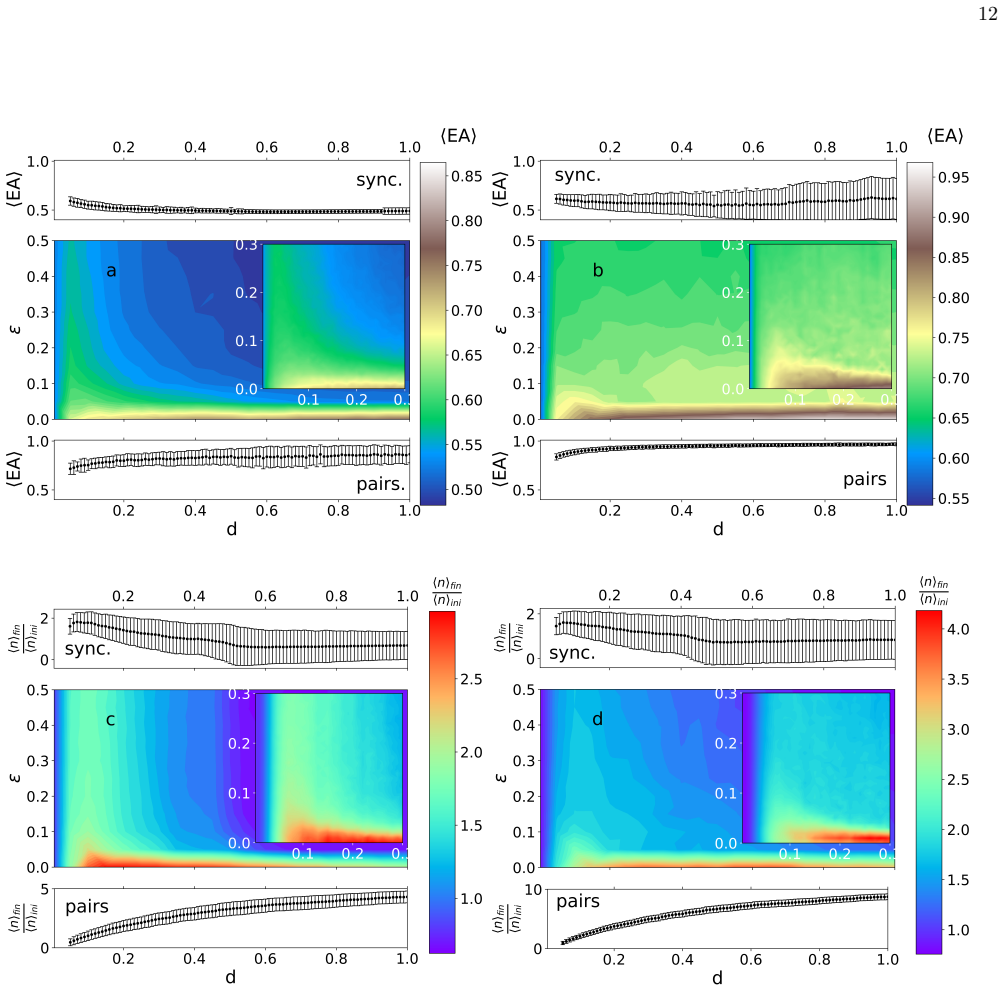
Phase diagram d-ϵ We present the results for two values of the step lon- gitude α = 0.01, 0.5 in the range of d ∈ [0.005, 1.0] and ϵ ∈ [0, 0.5], and compare them to those obtained for the synchronized and the pairwise cases (8). We first ana- lyze the phase diagrams for the average final values of the emotional arousal and the ratio between initial and fi...
-
[8]
The vertical band on the left corresponds to d < 0.02, marking the percolation transition (see Sec. II). In this region, the dynamics have a minimal ef- fect due to the small confidence interval, resulting in a highly fragmented situation with small opin- ion groups scattered across the O-EA plane. Both magnitudes, ⟨EA⟩, and ⟨n⟩f in, remain unchanged from...
Show all 43 references
-
[9]
However, there are discrepancies in the shape of the figures for high d
The brown region (panel a) and red region (panel b) corresponding to d >0.02 and low ϵ. However, there are discrepancies in the shape of the figures for high d. While ⟨EA⟩ increases monotonically with d, the behavior of the ratio of strongly con- nected components varies
-
[10]
where people form opinions and make decisions. This work aims to contribute to that effort by presenting a technological tool that can serve as both an experimen- tal device for calibrating the model and a technological aid for deliberative processes (see Appendix D). The main...
-
[11]
However, in all these formulations, communication regimes are external to the opinion dynamics and must be specified a priori
a generalization that interpolates between these ex- tremes is proposed, showing that communication regimes strongly affect opinion dynamics. However, in all these formulations, communication regimes are external to the opinion dynamics and must be specified a priori. Our appr...
2024 arXiv
-
[12]
Here ⟨EA⟩ is approximately equal to the initial value of 0.5
The upper-right area represents the consensus re- gion, where ⟨EA⟩ and ⟨n⟩f in≤ 1. Here ⟨EA⟩ is approximately equal to the initial value of 0.5. The reason why ⟨n⟩f incan be smaller than one is that strongly connected components can merge, contrar- ily to the weakly connected ...
-
[13]
This zone exhibits a relative maximum along the ϵ axis at around d ≈ 0.05, just above the per- colation threshold
The transition region, colored in green in both pan- els. This zone exhibits a relative maximum along the ϵ axis at around d ≈ 0.05, just above the per- colation threshold. In this region, both ⟨EA⟩ and ⟨clusters⟩f inaldecrease with increasing ϵ towards a saturation value that...
-
[14]
The system behaviors when varying α and ϵ are more straightforward, but the correlation between the final ⟨EA⟩ and ⟨n⟩f in/⟨n⟩ini hold for all the parameter range explored
Phase diagram α-ϵ We examine the range of α ∈ [0.005, 0.5], since smaller or larger step longitudes are not interesting from a social point of view, and α >0.5 would not be comparable with the classical bounded confidence model. The system behaviors when varying α and ϵ are mo...
-
[15]
This aligns with the re- gion where the system tends to converge towards a bi- partisan outcome more frequently
Low α For smaller step lengths α, the average polarization exhibits a distinct peak around d = 0 .4 across all syn- chronization factors ϵ > 0.1. This aligns with the re- gion where the system tends to converge towards a bi- partisan outcome more frequently. Notably, this peak...
-
[16]
For instance, taking the vertical line d = 0 .6 (Fig
High α For large step length, polarization presents a differ- ent behavior, especially noticeable for low ϵ and high d, where it exhibits greater values compared to scenarios with smaller α. For instance, taking the vertical line d = 0 .6 (Fig. 11 (b)), we observe a peak at ϵ ...
-
[17]
This cor- relation becomes clearer when we compare Figures 4 and
Polarization peak As observed, the system’s global polarization peak strongly correlates with the bipartisan peak. This cor- relation becomes clearer when we compare Figures 4 and
-
[18]
When α increases, heightened fluctuations and disrup- tions in clusters lead to a scenario where N no longer influences the average total polarization at low ϵ
With low α, an increase in agent density sharpens this transition, as is typical in second-order transitions. When α increases, heightened fluctuations and disrup- tions in clusters lead to a scenario where N no longer influences the average total polarization at low ϵ. More- ...
-
[19]
ERDF A way of making Europe,
Polarization per outcome α When examining average polarization levels based on outcomes (Fig. 13), the average polarization ⟨P ⟩ in- creases proportionally with the basal confidence bound d in scenarios where the system fragments into 3 or 4 clusters, in the same way the syste...
-
[20]
T. M. Liggett, Stochastic interacting systems: contact, voter and exclusion processes , Vol. 324 (springer science & Business Media, 2013)
2013
-
[21]
Lorenz, International Journal of Modern Physics C 18, 1819 (2007)
J. Lorenz, International Journal of Modern Physics C 18, 1819 (2007)
2007
-
[22]
Castellano, S
C. Castellano, S. Fortunato, and V. Loreto, Rev. Mod. Phys. 81, 591–646 (2009)
2009
-
[23]
Hegselmann and U
R. Hegselmann and U. Krause, J. Artif. Soc. Soc. Simul. 5, 2 (2002)
2002
-
[24]
Carpentras, Review of Artificial Societies and Social Simulations (2023)
D. Carpentras, Review of Artificial Societies and Social Simulations (2023)
2023
-
[25]
Sobkowicz, Journal of Artificial Societies and Social Simulation 12, 11 (2009)
P. Sobkowicz, Journal of Artificial Societies and Social Simulation 12, 11 (2009)
2009
-
[26]
Helbing, S
D. Helbing, S. Mahajan, R. H. Fricker, A. Musso, C. I. Hausladen, C. Carissimo, D. Carpentras, E. Stockinger, 17 J. A. Sanchez-Vaquerizo, J. C. Yang, et al. , Journal of Computational Science 71, 102061 (2023)
2023
-
[27]
X. E. Barandiaran, A. Calleja-L´ opez, A. Monterde, and C. Romero, Decidim, a Technopolitical Network for Par- ticipatory Democracy: Philosophy, Practice and Auton- omy of a Collective Platform in the Age of Digital Intel- ligence (Springer Nature Switzerland, 2024)
2024
-
[28]
Urbig, J
D. Urbig, J. Lorenz, and H. Herzberg, Journal of Artifi- cial Societies and Social Simulation 11, 4 (2008)
2008
-
[29]
Consensus formation in the def- fuant model of opinion dynamics,
J. Veefkind Castell´ o, “Consensus formation in the def- fuant model of opinion dynamics,” (2022), bachelor’s thesis
2022
-
[30]
Piedrahita, J
P. Piedrahita, J. Borge-Holthoefer, Y. Moreno, and A. Arenas, Europhysics letters 104, 48004 (2013)
2013
-
[31]
Schweitzer, T
F. Schweitzer, T. Krivachy, and D. Garcia, Complexity 2020, 1 (2020)
2020
-
[32]
Sobkowicz, Front
P. Sobkowicz, Front. Phys. 3, 17 (2015)
2015
-
[33]
Sobkowicz, PLoS One (2012)
P. Sobkowicz, PLoS One (2012)
2012
-
[34]
Colaiori, C
F. Colaiori, C. Castellano, F. Caccioli, and P. Vivo, J. Stat. Mech. Theory Exp. 2016, 033401 (2016)
2016
-
[35]
Prignano, O
L. Prignano, O. Sagarra, and A. D ´ ıaz-Guilera, Physical review letters 110, 114101 (2013)
2013
-
[36]
Bottani, Phys
S. Bottani, Phys. Rev. E 54, 2334 (1996)
1996
-
[37]
Mobilia, A
M. Mobilia, A. Petersen, and S. Redner, Journal of Statistical Mechanics: Theory and Experiment 2007, P08029 (2007)
2007
-
[38]
While it is preferable to use therm opinion group to refer to a group of people that share a point of view, and the therm cluster to refer to agents with the same value of the variable opinion in the model, in this work we use the two therms interchangeably
-
[39]
G´ omez-Serrano, C
J. G´ omez-Serrano, C. Graham, and J.-Y. Le Boudec, Mathematical Models and Methods in Applied Sciences 22, 1150007 (2012)
2012
-
[40]
X. E. Barandiaran, A. Calleja-L´ opez, and E. Cozzo, Frontiers in Psychology 11, 1549 (2020)
2020
-
[41]
J. M. Esteban and D. Ray, Econometrica 62, 819 (1994)
1994
-
[42]
U. Kan, M. Feng, and M. A. Porter, Journal of Complex Networks 11, 415 (2023)
2023
-
[43]
Appendix A: The algorithm Algorithm 1Performs an agent-based simulation using the broadcasting bounded confidence model with emotional arousal and synchronization dynamics
Https://github.com/Dialoguem/telegram-bot. Appendix A: The algorithm Algorithm 1Performs an agent-based simulation using the broadcasting bounded confidence model with emotional arousal and synchronization dynamics. Require: Number of agents N . A length step α, a basal confid...
Reviewed August 12, 2026 · model on record in the stance chip above.
Discussion (0). Continue with ORCID to comment.