REVIEW 3 major objections 5 minor 22 references
Global and Local Attention-Based Transformer for Hyperspectral Image Change Detection
T0 review · 3 major / 5 minor · reviewed 2026-08-12 · deepseek-v4-flash
Pith's one-line read GLAFormer pairs global and local attention to beat prior hyperspectral change-detection methods on all three test datasets, the paper reports.
desk verdict A sensible transformer variant for HSI change detection with consistent ablations, but the superiority claim rests on an undocumented comparison protocol and single-run results. read the letter →
The pith
A machine-rendered reading of the paper's core claim, the machinery that carries it, and where it could break.
The reading
What carries the argument
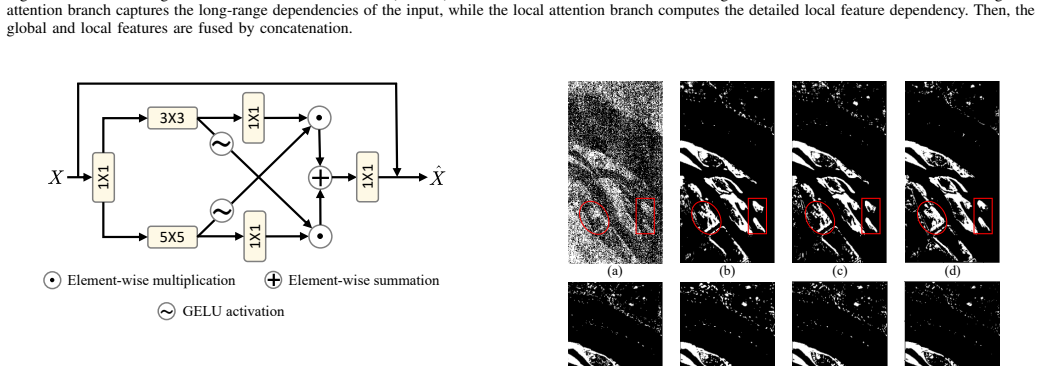
The load-bearing object is the global and local attention module (GLAM), which splits input feature channels into two branches after reshaping the feature map into 3x3 non-overlapping windows. The local branch applies self-attention inside each window, encoding high-frequency detail, while the global branch average-pools each window and applies attention using queries from the full-resolution feature map, encoding low-frequency structure; the two outputs are concatenated. A second mechanism, the cross-gated feed-forward network (CGFN), runs two parallel paths with different kernel-size convolutions and gates the features of each path with the other before an element-wise sum and a residual connection.
What would settle it
Retrain the baselines, especially GTMSiam, on the same patches, split, optimizer, and settings across multiple random seeds; if the 0.70-1.58% overall accuracy and 0.78-4.42% Kappa gaps shrink to within seed noise, GLAFormer's claimed superiority would not hold.
Extended reading notes
Core claim
The central claim is that replacing standard multi-head self-attention and feed-forward networks in a vision Transformer with a global-local attention split plus a cross-gated feed-forward network yields consistently better change-detection accuracy on three benchmark hyperspectral datasets. On the River, Farmland, and Hermiston datasets, the authors report overall accuracies of 97.81%, 98.95%, and 97.23% and Kappa coefficients of 83.72%, 97.14%, and 91.68%, each above every compared method. The ablation study shows that removing either the GLAM or the CGFN lowers accuracy, so both modules contribute to the reported improvement.
Load-bearing premise
The comparison is fair and representative: every baseline is trained and evaluated under the same protocol, and the single reported run for each method reflects its typical performance.
Editorial extensions
If this is right
- On the three datasets tested, GLAFormer is reported as the new best method by overall accuracy and Kappa coefficient.
- The global-local split lets a single Transformer block capture both long-range spatial-spectral context and fine local boundaries, which matters for small or irregular changed regions.
- The cross-gating path is attributed with reducing false alarms in noisy change maps, as seen qualitatively in the Hermiston results.
- Both GLAM and CGFN are presented as replacements for standard attention and feed-forward components inside a Transformer block, so they can be used with the rest of the architecture unchanged.
Reading between the lines
- The reported margins over GTMSiam (0.70-1.58% in overall accuracy and 0.78-4.42% in Kappa) are small enough that repeated-trial evaluation with confidence intervals would clarify whether the gains are stable across random seeds.
- The same GLAM and CGFN blocks could be tested in other hyperspectral tasks such as classification or segmentation, where global context and local detail both matter, to see if the gains generalize beyond change detection.
- Because the global branch uses full-resolution queries against pooled keys, one could ablate the pooling factor to test how sensitive the method is to the ratio between local and global receptive fields.
- All three datasets come from the same Hyperion sensor, so testing on airborne or other satellite hyperspectral data would probe the method's generality across sensors and acquisition conditions.
Editorial analysis
A structured set of objections, weighed in public.
Referee Report
Summary. The paper proposes GLAFormer, a Transformer architecture for hyperspectral image change detection. The two main components are a global-and-local attention module (GLAM), which splits attention heads between window-based local attention and pooled global attention, and a cross-gated feed-forward network (CGFN), which uses parallel depth-wise convolutions and element-wise gating to enhance nonlinear feature transformation. The method is evaluated on three Hyperion datasets (River, Farmland, Hermiston) with OA and Kappa as metrics, and ablation experiments compare the full model against a basic Transformer and two variants. The paper reports that GLAFormer outperforms seven existing methods on all three datasets, with the largest gains over the strongest baseline GTMSiam.
Significance. If the reported results are reproducible and the comparison is fair, GLAFormer is a competitive contribution to HSI change detection, combining known elements (local window attention, pooled global attention, gating in feed-forward networks) in a coherent way. The paper makes its source code publicly available, which is a practical strength. However, the central claim of consistent superiority is entirely empirical and rests on a single comparison table without statistical support. The architectural novelty is incremental rather than fundamental, so the significance of the paper depends on whether the empirical claims survive a controlled comparison.
major comments (3)
- [Section III-A and Table I] The comparison protocol for the baselines is not documented. Section III-A specifies the patch size, training/validation split, optimizer, learning rate, batch size, and number of epochs only for GLAFormer. It is not stated whether IR-MAD, SSA-SiamNet, SSCNN-S, CDFormer, SSTFormer, CSDBF, and GTMSiam were retrained under exactly the same protocol or whether their numbers were taken from the original papers, which may have used different patch sizes, splits, or training budgets. Without this information, Table I is not a controlled comparison and the statement in Section III-B that the proposed method 'consistently outperforms' the compared methods is not fully supported.
- [Table I and Section III-B] Each entry in Table I is a single run with no error bars, standard deviations, or significance tests. The smallest reported advantage over the strongest baseline is River, with +0.70% OA and +0.78% Kappa. With only 3% of samples used for training, random split variation and seed variation can plausibly produce differences of this magnitude. The authors should report results over multiple seeds (or at least multiple random splits), include standard deviations, and where possible apply a paired significance test such as McNemar's test. Without this, the superiority claim over GTMSiam is not statistically established.
- [Section III-C and Table II] The ablation text states that 'GLAFormer and its variants beat the Basic Transformer in all cases,' but Table II contradicts this: on the River dataset, GLAFormer w/o GLAM achieves 97.17% OA, which is lower than the Basic Transformer's 97.19% OA. The conclusion that both GLAM and CGFN are necessary is therefore not supported as stated. The authors should correct this statement and discuss the negative or marginal contribution of GLAM on the River dataset, preferably with repeated trials to determine whether the differences are meaningful.
minor comments (5)
- [Section III-A] The text says 'six state-of-the-art models are selected for comparison' but then lists seven methods (IR-MAD, SSA-SiamNet, SSCNN-S, CDFormer, SSTFormer, CSDBF, GTMSiam). Please correct the count.
- [Section II-A, Eq. (2)] The description of the global attention branch says that queries Ql are taken from the original feature map, but the preceding paragraph states that input features are split along the channel dimension before entering the global and local branches. Please clarify how Ql is obtained after channel splitting and confirm that the dimensions in Eq. (2) are consistent.
- [Table I and Figures 4-6] There are minor naming inconsistencies: the table header lists 'IR-MDA' while the text and references use 'IR-MAD,' and the figure captions use 'CDFomer' while the text uses 'CDFormer.' Please unify the naming.
- [Section III-B] The sentence 'This signifies an accuracy boost of over 20% in regions that were challenging for previous models to identify' appears to interpret a Kappa improvement as a region-level accuracy improvement, which is not directly justified. Please either remove or rephrase this claim with supporting evidence.
- [Abstract and Section IV] The abstract states that the source code is available at a GitHub URL, while Section IV says the codes 'will be released.' Please clarify the current availability status.
Circularity Check
No circularity: the paper's claims are empirical evaluations on held-out test data with an architecture trained from scratch; no analytic derivation reduces to its inputs.
full rationale
GLAFormer is an empirical pattern-recognition paper. The proposed modules (GLAM, CGFN) are defined directly from input feature maps via attention, pooling, convolutions, and gating (Eqs. 1-5), with no parameter fitted to the reported test metrics and no quantity 'predicted' that was used as a training target. The central superiority claim (Section III-B, Table I) is tested on held-out samples (3% training / 2% validation / 95% testing split), so the reported OA/Kappa values are not forced by construction. The ablation study (Table II) compares against a Basic Transformer and variants on the same held-out protocol, again providing independent empirical evidence for the module contributions. The only self-citations are to datasets or earlier methods (e.g., refs. [6], [16] involving co-author Qian Du), and they are not load-bearing: the River dataset is an external benchmark and no uniqueness theorem or analytical result is imported from the authors' prior work. Skeptical concerns about baseline retraining protocol, single-run results, and small margins are validity/robustness issues, not circularity. Thus the derivation chain is self-contained and no circular step is present.
Assumptions & free parameters
free parameters (10)
- patch_size =
9x9
- embedding_dim =
256
- num_blocks =
4
- num_heads =
8
- local_window_size =
3x3
- learning_rate =
0.0006
- batch_size =
128
- epochs =
100
- training_ratio =
3%
- validation_ratio =
2%
assumptions (3)
- domain assumption The ground-truth change maps for the River, Farmland, and Hermiston datasets are accurate and registered to the input images.
- domain assumption All compared methods are trained and evaluated under the same protocol (patch size, train/validation/test split, optimizer settings).
- domain assumption OA and Kappa coefficient are sufficient to establish practical superiority in change detection.
Cite this review
Pith. "Pith review of Global and Local Attention-Based Transformer for Hyperspectral Image Change Detection." pith.science (2026). https://pith.science/paper/PI7NKY7A
@misc{pith2026241114109,
  author       = {Pith},
  title        = {Pith review of: Global and Local Attention-Based Transformer for Hyperspectral Image Change Detection},
  year         = {2026},
  howpublished = {\url{https://pith.science/paper/PI7NKY7A}},
  note         = {Machine review of arXiv:2411.14109}
}
read the original abstract
Recently Transformer-based hyperspectral image (HSI) change detection methods have shown remarkable performance. Nevertheless, existing attention mechanisms in Transformers have limitations in local feature representation. To address this issue, we propose Global and Local Attention-based Transformer (GLAFormer), which incorporates a global and local attention module (GLAM) to combine high-frequency and low-frequency signals. Furthermore, we introduce a cross-gating mechanism, called cross-gated feed-forward network (CGFN), to emphasize salient features and suppress noise interference. Specifically, the GLAM splits attention heads into global and local attention components to capture comprehensive spatial-spectral features. The global attention component employs global attention on downsampled feature maps to capture low-frequency information, while the local attention component focuses on high-frequency details using non-overlapping window-based local attention. The CGFN enhances the feature representation via convolutions and cross-gating mechanism in parallel paths. The proposed GLAFormer is evaluated on three HSI datasets. The results demonstrate its superiority over state-of-the-art HSI change detection methods. The source code of GLAFormer is available at \url{https://github.com/summitgao/GLAFormer}.
Figures


Figures from the paper (2 more)


Reference graph
Works this paper leans on
-
[1]
CDFormer: A hyperspectral image change detection method based on Transformer encoders,
J. Ding, X. Li, and L. Zhao, “CDFormer: A hyperspectral image change detection method based on Transformer encoders,”IEEE Geoscience and Remote Sensing Letters , vol. 19, pp. 1–5, 2022
work page 2022
-
[2]
Detection of initial damage in Norway spruce canopies using hyperspectral airborne data,
P. K. E. Campbell, B. N. Rock, M. E. Martin, C. D. Neefus, J. R. Irons, E. M. Middleton, and J. Albrechtova, “Detection of initial damage in Norway spruce canopies using hyperspectral airborne data,” International Journal of Remote Sensing , vol. 25, no. 24, pp. 5557–5584, 2004
work page 2004
-
[3]
S. Liu, D. Marinelli, L. Bruzzone, and F. Bovolo, “A review of change detection in multitemporal hyperspectral images: Current techniques, applications, and challenges,” IEEE Geoscience and Remote Sensing Magazine, vol. 7, no. 2, pp. 140–158, 2019
work page 2019
-
[4]
J. Yuan, S. Wang, C. Wu, and Y . Xu, “Fine-grained classification of ur- ban functional zones and landscape pattern analysis using hyperspectral satellite imagery: A case study of Wuhan,” IEEE Journal of Selected Topics in Applied Earth Observations and Remote Sensing , vol. 15, pp. 3972–3991, 2022
work page 2022
-
[5]
F. Bovolo and L. Bruzzone, “A theoretical framework for unsupervised change detection based on change vector analysis in the polar domain,” IEEE Transactions on Geoscience and Remote Sensing , vol. 45, no. 1, pp. 218–236, 2007
work page 2007
-
[6]
Z. Hou, W. Li, R. Tao, and Q. Du, “Three-order Tucker decomposition and reconstruction detector for unsupervised hyperspectral change de- tection,” IEEE Journal of Selected Topics in Applied Earth Observations and Remote Sensing , vol. 14, pp. 6194–6205, 2021
work page 2021
-
[7]
Pixel-based and object-oriented change detection analysis using high-resolution imagery,
I. Niemeyer and M. J. Canty, “Pixel-based and object-oriented change detection analysis using high-resolution imagery,” in Proceedings 25th Symposium on Safeguards and Nuclear Material Management , 2003, pp. 2133–2136
work page 2003
-
[8]
A. A. Nielsen, “The regularized iteratively reweighted mad method for change detection in multi-and hyperspectral data,” IEEE Transactions on Image processing , vol. 16, no. 2, pp. 463–478, 2007
work page 2007
Show all 22 references
-
[9]
Hyperspectral change detection: An ex- perimental comparative study,
M. Hasanlou and S. T. Seydi, “Hyperspectral change detection: An ex- perimental comparative study,”International Journal of Remote Sensing , vol. 39, no. 20, pp. 7029–7083, 2018
2018
-
[10]
Gradient-based learning applied to document recognition,
Y . Lecun, L. Bottou, Y . Bengio, and P. Haffner, “Gradient-based learning applied to document recognition,” Proceedings of the IEEE , vol. 86, no. 11, pp. 2278–2324, 1998
1998
-
[11]
Unsupervised deep change vector analysis for multiple-change detection in VHR images,
S. Saha, F. Bovolo, and L. Bruzzone, “Unsupervised deep change vector analysis for multiple-change detection in VHR images,” IEEE Transactions on Geoscience and Remote Sensing , vol. 57, no. 6, pp. 3677–3693, 2019
2019
-
[12]
An image is worth 16x16 words: Transformers for image recognition at scale,
A. Dosovitskiy, L. Beyer, A. Kolesnikov, D. Weissenborn, X. Zhai, T. Unterthiner, M. Dehghani, M. Minderer, G. Heigold, S. Gelly et al. , “An image is worth 16x16 words: Transformers for image recognition at scale,” in Proceedings of International Conference on Learning Repres...
2021
-
[13]
End-to-end object detection with Transformers,
N. Carion, F. Massa, G. Synnaeve, N. Usunier, A. Kirillov, and S. Zagoruyko, “End-to-end object detection with Transformers,” in Proceedings of European Conference on Computer Vision (ECCV) , 2020, pp. 213–229
2020
-
[14]
CSANet: Cross-temporal interaction symmetric attention network for hyperspectral image change detection,
R. Song, W. Ni, W. Cheng, and X. Wang, “CSANet: Cross-temporal interaction symmetric attention network for hyperspectral image change detection,” IEEE Geoscience and Remote Sensing Letters , vol. 19, pp. 1–5, 2022
2022
-
[15]
VTC-LFC: Vision Transformer compression with low-frequency components,
Z. Wang, H. Luo, P. Wang, F. Ding, F. Wang, and H. Li, “VTC-LFC: Vision Transformer compression with low-frequency components,” in Proceedings of Advances in Neural Information Processing Systems (NeurIPS), vol. 35, 2022, pp. 13 974–13 988
2022
-
[16]
GETNET: A general end-to-end 2-D CNN framework for hyperspectral image change detection,
Q. Wang, Z. Yuan, Q. Du, and X. Li, “GETNET: A general end-to-end 2-D CNN framework for hyperspectral image change detection,” IEEE Transactions on Geoscience and Remote Sensing , vol. 57, no. 1, pp. 3–13, 2018
2018
-
[17]
Semi-supervised change detection method for multi-temporal hyperspectral images,
Y . Yuan, H. Lv, and X. Lu, “Semi-supervised change detection method for multi-temporal hyperspectral images,” Neurocomputing, vol. 148, pp. 363–375, 2015
2015
-
[18]
Ssa-siamnet: Spectral–spatial-wise attention-based siamese network for hyperspectral image change detection,
L. Wang, L. Wang, Q. Wang, and P. M. Atkinson, “Ssa-siamnet: Spectral–spatial-wise attention-based siamese network for hyperspectral image change detection,” IEEE Transactions on Geoscience and Remote Sensing, vol. 60, pp. 1–18, 2021
2021
-
[19]
SSCNN-S: A spectral-spatial convolution neural network with Siamese architecture for change detection,
T. Zhan, B. Song, Y . Xu, M. Wan, X. Wang, G. Yang, and Z. Wu, “SSCNN-S: A spectral-spatial convolution neural network with Siamese architecture for change detection,” Remote Sensing, vol. 13, no. 5, 2021
2021
-
[20]
Spectral-spatial-temporal Transformers for hyperspectral image change detection,
Y . Wang, D. Hong, J. Sha, L. Gao, L. Liu, Y . Zhang, and X. Rong, “Spectral-spatial-temporal Transformers for hyperspectral image change detection,” IEEE Transactions on Geoscience and Remote Sensing , vol. 60, pp. 1–14, 2022
2022
-
[21]
CSDBF: Dual-branch frame- work based on temporal–spatial joint graph attention with complement strategy for hyperspectral image change detection,
X. Wang, K. Zhao, X. Zhao, and S. Li, “CSDBF: Dual-branch frame- work based on temporal–spatial joint graph attention with complement strategy for hyperspectral image change detection,” IEEE Transactions on Geoscience and Remote Sensing , vol. 60, pp. 1–18, 2022
2022
-
[22]
GTMSiam: Gated transmitting-based multiscale siamese network for hyperspectral image change detection,
X. Wang and K. Zhao, “GTMSiam: Gated transmitting-based multiscale siamese network for hyperspectral image change detection,” IEEE Geo- science and Remote Sensing Letters , vol. 20, pp. 1–5, 2023
2023
Reviewed August 12, 2026 · model on record in the stance chip above.
Discussion (0). Continue with ORCID to comment.