REVIEW 5 major objections 4 minor 22 references
The Quantum Bruhat Graph for $\widehat{SL}_2$ and Double Affine Demazure Products
T0 review · 5 major / 4 minor · reviewed 2026-08-12 · deepseek-v4-flash
Pith's one-line read In type $\widehat{SL}_2$, a quantum-Bruhat-graph formula defines an associative Demazure product on the double affine Weyl semigroup for level greater than one.
desk verdict A serious and mostly careful construction of a Demazure product for the double affine Weyl semigroup in type \hat{SL}_2; the level > 1 results look right, but the load-bearing classification of length-positive sets deserves independent verification. read the letter →
The pith
A machine-rendered reading of the paper's core claim, the machinery that carries it, and where it could break.
The reading
What carries the argument
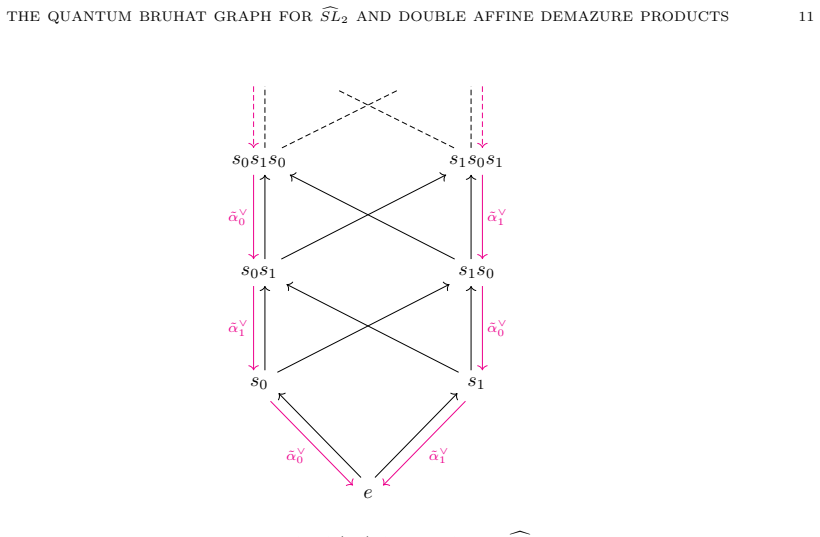
The object carrying the argument is the quantum Bruhat graph $\mathrm{QBG}(W)$ of the affine Weyl group $W$ of type $\widehat{SL}_2$: vertices are Weyl-group elements, Bruhat (upward) edges have weight $0$, and quantum (downward) edges carry coroot weights. The companion notion is the length-positive set $LP(x)$, the elements $v \in W$ for which a certain length functional is nonnegative on all positive roots. The paper's classification of $LP(x)$ for level $>0$—each set has between one and three elements, is connected by vertical edges, and lies entirely on one side of the infinite dihedral group—is what makes the distance-minimising pairs $M_{x,y}$ small enough to analyse. Path independence is proved by showing all shortest paths between two vertices have equal total weight; associativity is then reduced to equality of Weyl and coweight components, checked case by case over these small length-positive sets.
What would settle it
Compute, for any triple of level-one elements whose length-positive sets have size three, the two triple products $(x*y)*z$ and $x*(y*z)$; a difference in either the Weyl or coweight component would disprove associativity in the stated range. Alternatively, exhibit two shortest paths in $\mathrm{QBG}(W)$ for $\widehat{SL}_2$ between the same vertices with different total weights; that would disprove path independence and the well-definedness of the product.
Extended reading notes
Core claim
The central claim is that the quantum-Bruhat-graph formula for the affine Demazure product extends to the double affine setting in type $\widehat{SL}_2$. For $x = w_x\varepsilon^{\mu_x}$ and $y = w_y\varepsilon^{\mu_y}$ one chooses length-positive elements $u \in LP(x)$, $v \in LP(y)$ that minimise the graph distance $d(u \Rightarrow w_y v)$, fixes a shortest path $p$, and defines $x*y = w_x u v^{-1}\varepsilon^{v u^{-1}\mu_x + \mu_y - v\,\mathrm{wt}(p)}$. The paper shows the result does not depend on the choice of pair or path, that the operation is associative for level greater than one, and that $\ell(x*y) = \ell(x)+\ell(y)$ holds exactly when $\ell(xy) = \ell(x)+\ell(y)$, in which case $x*y = xy$. The same formula reproduces the known $q=0$ Hecke products in the two examples computed from the Kac-Moody affine Hecke algebra.
Load-bearing premise
The proof rests on the completeness of the classification of length-positive sets in type $\widehat{SL}_2$ at positive level: every such set has at most three elements, is connected by vertical edges, and is entirely one-sided. If that classification missed any element, both independence of choices and associativity would be in question.
Editorial extensions
If this is right
- One can speak of a Demazure product on $W_{\mathcal{T}}$ in type $\widehat{SL}_2$: the operation is single-valued for non-zero level and associative for level greater than one.
- The length-additivity theorem gives a practical test: to decide whether $x*y$ equals $xy$, check whether $\ell(xy)=\ell(x)+\ell(y)$; this connects the combinatorial product to inversion-set intersections in the affine root system.
- The $q=0$ term of products in the Kac-Moody affine Hecke algebra can in principle be read off from quantum-Bruhat-graph shortest paths, matching the two known Hecke computations.
- For level-one elements with three length-positive elements, associativity is conjectured but not established; any proof must handle those larger sets.
- The proof that shortest paths have equal weights upgrades a property known in finite Weyl groups to affine type $\widehat{SL}_2$.
Reading between the lines
- If the classification of length-positive sets remains finite in other affine types, the same shortest-path formula is a natural candidate for a Demazure product on $W_{\mathcal{T}}$ there; nothing in the definition is special to $\widehat{SL}_2$ except the classification itself.
- The association between non-length-additivity and non-empty intersections of inversion sets may give an independent characterisation of when Demazure products differ from ordinary products, with possible implications for affine Deligne-Lusztig varieties.
- A computer search over level-one elements with three length-positive elements could test associativity in the unresolved case; the paper states that no counterexample was found.
Editorial analysis
A structured set of objections, weighed in public.
Referee Report
Summary. The paper proposes a combinatorial definition of the Demazure product on the double affine Weyl semigroup W_T by generalizing Schremmer's quantum-Bruhat-graph formula. The focus is type SL2-hat, where the author proves path-weight independence for QBG(W), describes the length-positive sets LP(x), proves independence of the generalised product from the chosen distance-minimising pair, and establishes associativity for elements of level greater than one. The paper also proves, conditionally on well-definedness, a general length-additivity criterion relating ell(x*y), ell(xy), and the distance in QBG(W), and it verifies two examples against Hecke-algebra computations of Muthiah and Puskás.
Significance. If the results are correct, this gives the first explicit combinatorial construction of a Demazure-type product on the double affine Weyl semigroup in a non-trivial example, matching the conjectural q=0 Hecke-algebra behaviour. The conditional results in Section 6 are elegant and would be useful for future general-type work. The paper is strengthened by explicit worked examples with a genuine external check (Section 7), and by the fact that the main independence and associativity theorems are reduced to finite, enumerable graph data. The main weakness is that several load-bearing steps are justified by diagram inspection or by terse case-analysis assertions rather than by complete written arguments.
major comments (5)
- [§3.6, Prop. 3.5 and §4.1, Prop. 4.2] The proof of Prop. 4.2 is presented as an immediate consequence of Cor. 3.7 and Cor. 3.8, but those corollaries do not by themselves imply that LP(x) is always one-sided. Cor. 3.7 permits any connected triple, and Cor. 3.8 excludes only the particular triple {s1,e,s0}; it does not address other connected triples of mixed side, nor does it address mixed-side two-element sets. Since Prop. 4.2 is used to justify the case split in Thm. 4.7 and is imported into the associativity proof, this is load-bearing; please replace the one-line deduction with an explicit enumeration of the possibilities allowed by Prop. 3.5.
- [§4.2, Thm. 4.4] In the proof of Thm. 4.4, the case where u,v are not same-sided and u≰v is handled by asserting that a shortest path consists of vertical downwards edges and one upwards diagonal edge, and that shifting the diagonal edge preserves weight; this is justified only by inspection of Fig. 2. This statement is used to define wt(u⇒v), which enters Definition 2.5 and every subsequent independence result. Please give a closed-form formula for d(u⇒v) and wt(u⇒v) in terms of an explicit parametrization of W, or a fully verified case analysis, and apply the same standard to the 'clear from Fig. 2' steps in Thm. 4.6 and Thm. 4.10.
- [§4.3, Thm. 4.7 (|LP|=3 case)] In the proof of Thm. 4.7, the final case |M_{x,y}|=3 asserts that the constancy of φ1 and φ2 proved for the two-pair configuration in Fig. 3 also holds for the three-pair configuration {(u,v),(us_i,vs_i),(us_i s_j,vs_i s_j)}, where u,v are opposite-sided and ell(v)=ell(u)+1. This does not follow from the displayed calculation without checking that the hypotheses of the Fig. 3 configuration apply to each adjacent pair. Please provide the explicit computation of φ2 for all three pairs in this configuration.
- [§4.4, Thm. 4.10] The proof of Thm. 4.10 contains several unproved assertions that are essential: the claim that the weights of a shortest path alternate and hence c1∈{0,±1}; the claim that if |Inv(r0^{-1})|>1 then the classical parts of α~_i and s_i(α~_j) differ by a sign; the selection of β~ with ⟨wt(u⇒wyv),β~⟩=-2; and the deductions 'from the diagram' about the signs of uβ~ and wyvβ~. Thm. 4.10 is used to identify LP(x*y) with M^y_{x,y}, which is needed in Prop. 5.1 and therefore in the associativity proof. Please replace these steps with explicit arguments or a verified exhaustive check.
- [§5.3, Prop. 5.4 and Prop. 5.5] The proof of Prop. 5.4 relies on a four-picture diagram and the assertion that 'this exhausts all possible cases, as any other arrangement will violate either uniqueness of distance-minimising elements or the minimality itself'; Prop. 5.5 is dismissed as analogous. Since the values η2 and η3, including the sign of the exceptional terms, are what make the lattice-component identity η1=η2+η3 hold, this is load-bearing for Thm. 5.6. Please provide a complete case table with the defining inequalities of each case, or supply a machine-checked enumeration.
minor comments (4)
- [§3.2, Eq. (3.8)] The notation {1,2,...,⌊(l-1)/2⌋} is awkward when l=2, since the set is empty; please clarify by saying that no element arises from this case when the upper bound is less than 1.
- [§3.6, Cor. 3.6] The sentence 'If j=±(l-1)/2, then we are guaranteed a length positive element from case 2' is only meaningful for odd l; for even l the condition is vacuous, and this should be stated explicitly.
- [§3.5, Prop. 3.2] The proof uses the identity Inv(v^{-1}) = -v Inv(v) with a reference to [Hum90] but without a precise location; please add a specific citation or a one-line derivation.
- [§7.2] In the final line of Section 7.2, the conversion from s1τ^{-α∨} to s0 would be easier to follow if the relation s0 = s1τ^{-α∨} were recalled explicitly.
Circularity Check
No significant circularity: the new product is defined explicitly, and well-definedness and associativity are proved internally from the LP classification and quantum Bruhat graph lemmas.
full rationale
The paper's central object is introduced by an explicit definition (Definition 2.5, Eq. 2.4) rather than claimed as an external consequence, and the main theorems concern well-definedness and associativity of that definition. The load-bearing ingredients are proved internally: the classification of length-positive sets (Prop. 3.5, Cor. 3.6–3.8, Prop. 4.2), the quantum Bruhat graph path-weight identity (Thm. 4.4), and the unique-distance-minimizer results (Thm. 4.6). Schremmer's finite-type theorem [Sch24, Thm. 5.11] is used only as a finite-type benchmark, not as a double-affine input. There are no fitted parameters, no predictions derived from a subset of data, and no self-citation chain: the cited works [MP24, Sch24, Wel19, MO19] are by other authors. Section 7 checks the construction against the Muthiah–Puskás Hecke algebra examples, which is external grounding rather than a circular input. The paper also honestly flags its gaps: Remark 5.7 states that level-one associativity remains conjectural, and Section 6 explicitly assumes well-definedness and notes that weight well-definedness in general type is not yet proved. These are correctness and scope limitations, not circularity reductions; no equation in the paper is equivalent to its own input by construction.
Assumptions & free parameters
assumptions (5)
- domain assumption The quantum Bruhat graph QBG(W) for the affine Weyl group of type SL2-hat has the edge description of Prop. 4.1: upward edges are Bruhat covers, downward edges are quantum edges only along simple affine roots, with weights as shown in Fig. 2.
- standard math Postnikov's theorem (Prop 2.3, [Pos05]): in finite Weyl groups, shortest paths in QBG have equal weight; the paper extends this to the affine case in Thm 4.4.
- domain assumption The Tits cone description (Prop 2.8, [Kac90]): W_T = W ⋉ T with T = {λ + mδ + lΛ0 | l > 0} ∪ Zδ, and the level function on elements.
- standard math The Muthiah-Orr length function ℓ(x, α) = ⟨α, μ⟩ + Φ+(α) - Φ+(wα) and its basic properties, including ℓ(z, -α) = -ℓ(z, α) and Φ+(-α) = 1 - Φ+(α).
- standard math Muthiah-Puskás inversion-set formula for length: ℓ(xy) = ℓ(x) + ℓ(y) - 2|Inv(x) ∩ Inv(y^{-1})| (Prop 6.6, [MP24] Thm 5.4).
Cite this review
Pith. "Pith review of The Quantum Bruhat Graph for $\widehat{SL}_2$ and Double Affine Demazure Products." pith.science (2026). https://pith.science/paper/N7GLJSGB
@misc{pith2026241114170,
  author       = {Pith},
  title        = {Pith review of: The Quantum Bruhat Graph for $\widehatSL_2$ and Double Affine Demazure Products},
  year         = {2026},
  howpublished = {\url{https://pith.science/paper/N7GLJSGB}},
  note         = {Machine review of arXiv:2411.14170}
}
abstract
We investigate the Demazure product in a double affine setting. Work by Muthiah and Pusk\'as gives a conjectural way to define this in terms of the $q=0$ specialisation of these Hecke algebras. We instead take a different approach generalising work by Felix Schremmer, who gave an equivalent formula for the (single) affine Demazure product in terms of the quantum Bruhat graph. We focus on type $\widehat{SL}_2$, where we prove that the quantum Bruhat graph of this type satisfies some nice properties, which allows us to construct a well-defined associative Demazure product for the double affine Weyl semigroup $W_{\mathcal{T}}$ (for level greater than one). We give results regarding the Demazure product and Muthiah and Orr's length function for $W_{\mathcal{T}}$, and we verify that our proposal matches specific examples computed by Muthiah and Pusk\'as using the Kac-Moody affine Hecke algebra
Figures


Figures from the paper (1 more)

Reference graph
Works this paper leans on
-
[1]
" write newline "" before.all 'output.state := FUNCTION output.nonempty.mrnumber duplicate missing pop "" 'skip if duplicate empty 'pop " " swap * " " * write if FUNCTION fin.entry add.period write mrnumber output.nonempty.mrnumber newline INTEGERS nameptr namesleft numnames FUNCTION format.language language empty "" " (" language * ")" * if FUNCTION form...
-
[2]
Francesco Brenti, Sergey Fomin, and Alexander Postnikov, Mixed Bruhat Operators and Yang-Baxter Equations for Weyl Groups , International Mathematics Research Notices 1999 (1998), 419--441
work page 1998
-
[3]
A. Braverman, D. Kazhdan, and M. Patnaik, Iwahori–Hecke algebras for p-adic loop groups , Inventiones mathematicae 204 (2016), 347 -- 442
work page 2016
-
[4]
Nicole Bardy-Panse, Stéphane Gaussent, and Guy Rousseau, Iwahori-Hecke algebras for Kac-Moody groups over local fields , Pacific J. Math. 285 (2016), no. 1, 1--61
work page 2016
-
[5]
Michel Demazure, Invariants symétriques entiers des groupes de Weyl et torsion , Inventiones mathematicae 21 (1973), 287--302
work page 1973
-
[6]
Xuhua He, A subalgebra of 0-Hecke algebra , Journal of Algebra 322 (2009), no. 11, 4030--4039
work page 2009
-
[7]
Xuhua He, Affine Deligne-Lusztig varieties associated with generic Newton points , arXiv:2107.14461 (2021)
work page Pith review arXiv 2021
-
[8]
Xuhua He and Sian Nie, Demazure product of the affine Weyl groups , arXiv:2112.06376 (2021)
work page Pith review arXiv 2021
Show all 22 references
-
[9]
Auguste Hebert and Paul Philippe, Quantum roots for Kac-Moody root systems and finiteness properties of the Kac-Moody affine Bruhat order , arXiv:2405.12559 (2024)
2024 arXiv
-
[10]
Humphreys, Reflection Groups and Coxeter Groups , Cambridge Studies in Advanced Mathematics, Cambridge University Press, 1990
James E. Humphreys, Reflection Groups and Coxeter Groups , Cambridge Studies in Advanced Mathematics, Cambridge University Press, 1990
1990
-
[11]
Kac, Infinite-Dimensional Lie Algebras , 3 ed., Cambridge University Press, 1990
Victor G. Kac, Infinite-Dimensional Lie Algebras , 3 ed., Cambridge University Press, 1990
1990
-
[12]
Cristian Lenart, Satoshi Naito, Daisuke Sagaki, Anne Schilling, and Mark Shimozono, A Uniform Model for Kirillov–Reshetikhin Crystals I: Lifting the Parabolic Quantum Bruhat Graph , International Mathematics Research Notices 7 (2015), 1848--1901
2015
-
[13]
Alcove Model, Path Model, and P=X , International Mathematics Research Notices 14 (2017), 4259--4319
Cristian Lenart, Satoshi Naito, Daisuke Sagaki, Anne Schilling, and Mark Shimozono, A Uniform Model for Kirillov–Reshetikhin Crystals II. Alcove Model, Path Model, and P=X , International Mathematics Research Notices 14 (2017), 4259--4319
2017
-
[14]
3, 451 -- 502
Elizabeth Milićević, Maximal Newton Points and the Quantum Bruhat Graph , Michigan Mathematical Journal 70 (2021), no. 3, 451 -- 502
2021
-
[15]
2, 197--216 (en)
Dinakar Muthiah and Daniel Orr, On the double-affine Bruhat order: the =1 conjecture and classification of covers in ADE type , Algebraic Combinatorics 2 (2019), no. 2, 197--216 (en). 3934828
2019
-
[16]
Dinakar Muthiah and Anna Puskás, Pursuing Coxeter theory for Kac-Moody affine Hecke algebras , arXiv:2406.14447 (2024)
2024 arXiv
-
[17]
Dinakar Muthiah, On Iwahori-Hecke Algebras for p-adic Loop Groups: Double Coset Basis and Bruhat Order , American Journal of Mathematics 140 (2018), no. 1, pp. 221--244
2018
-
[18]
Paul Philippe, Grading of Affine Weyl Semi-groups of Kac-Moody Type , arXiv:2306.04514 (2024)
2024 arXiv
-
[19]
3, 699--709
Alexander Postnikov, Quantum Bruhat Graph and Schubert Polynomials , Proceedings of the American Mathematical Society 133 (2005), no. 3, 699--709
2005
-
[20]
Felix Schremmer , Generic Newton points and cordial elements , arXiv:2205.02039 (2023)
2023 arXiv
-
[21]
12, Cambridge University Press, 2024, p
Felix Schremmer, Affine Bruhat order and Demazure products , Forum of Mathematics, Sigma, vol. 12, Cambridge University Press, 2024, p. e53
2024
-
[22]
Amanda Welch, Double Affine Bruhat Order , Phd thesis, Virginia Tech, 2019
2019
Reviewed August 12, 2026 · model on record in the stance chip above.
Discussion (0). Continue with ORCID to comment.