REVIEW 4 major objections 5 minor 1 cited by
Nodal sets and continuity of eigenfunctions of Kre\u{\i}-Feller operators
T0 review · 4 major / 5 minor · reviewed 2026-08-12 · deepseek-v4-flash
Pith's one-line read Every continuous eigenfunction of a Krein-Feller operator has a nodal set dividing the domain into at least 2 and at most $n+r-1$ subdomains, and eigenfunctions are continuous where the classical Green function exists.
desk verdict A plausible and useful extension of Courant's theorem to Krein-Feller operators, but the upper-bound proof has a genuine gap (test functions missing the form domain) that needs fixing before acceptance. read the letter →
The pith
A machine-rendered reading of the paper's core claim, the machinery that carries it, and where it could break.
The reading
What carries the argument
The object is the Krein-Feller operator $\Delta_\mu$, defined as the self-adjoint operator associated with the closed Dirichlet form $E(u,v)=\int_\Omega \nabla u\cdot\nabla v\,dx$ on a subspace of $H_0^1(\Omega)$ identified with $L^2(\Omega,\mu)$; the measure $\mu$ appears only in the mass term, so the operator is a Laplacian whose mass distribution is $\mu$. The carrying mechanism for the nodal theorem is the maximum principle for continuous $\mu$-subharmonic functions (Theorem 3.4), proved by mollifying $u$, expressing the Laplacian integral through the distributional identity $\int_\Omega\nabla u\cdot\nabla\varphi\,dx=\int_\Omega(\Delta_\mu u)\varphi\,d\mu$, and using sphere averages to show an interior maximum forces $u$ to be constant. The counting argument uses the Rayleigh quotient $R_\mu(u)=\int_\Omega|\nabla u|^2\,dx/\int_\Omega|u|^2\,d\mu$ and the variational characterization of eigenvalues: test functions supported on the nodal subdomains, with coefficients chosen to be $L^2(\Omega,\mu)$-orthogonal to the first $m-1$ eigenfunctions, force $\lambda_m\leq\lambda_n<\lambda_{n+r}$, giving $m\leq n+r-1$. For continuity, the Green operator $G_\mu f(x)=\int_\Omega G(x,y)f(y)\,d\mu(y)$, built from the classical Green function, inverts $-\Delta_\mu$; continuity of $G$ on $\Omega\times\Omega$ and its vanishing at Lipschitz boundaries give continuity of eigenfunctions.
What would settle it
Compute, for a self-similar measure $\mu$ on a square with $\dim_\infty(\mu)\in(d-2,d)$, both sides of the identity in Proposition 3.2 using a known eigenfunction such as the one in Example 6.1; if the $\epsilon\to0$ limit of $\int_{B_r(x)}\Delta(\eta_\epsilon*u)\,\mathrm{d}y$ differs from $\int_{B_r(x)}\Delta_\mu u\,\mathrm{d}\mu$ for some ball, Proposition 3.2 is false and the proof of Theorem 3.4 breaks.
Extended reading notes
Core claim
The central claim is Theorem 1.1: for a bounded domain $\Omega\subset\mathbb{R}^d$ and a finite positive Borel measure $\mu$ supported in $\overline{\Omega}$ with $\dim_\infty(\mu)>d-2$, any continuous eigenfunction $u_n$ of the Dirichlet problem $-\Delta_\mu u=\lambda u$ with $u=0$ on $\partial\Omega$ has nodal set $Z_\mu(u_n)=\{x\in\Omega: u_n(x)=0\}$ that divides $\Omega$ into at least 2 and at most $n+r-1$ connected subdomains, where $r$ is the multiplicity of $\lambda_n$. The first eigenfunction is nonzero throughout $\Omega$, and a corollary is that $\lambda_1$ is simple. The companion Theorem 1.2 asserts that on bounded domains admitting the classical Green function, eigenfunctions of $\Delta_\mu$ are continuous on $\Omega$, and on domains with Lipschitz boundary the continuity extends to the closure. The proof of the nodal bound rests on a maximum principle for continuous $\mu$-subharmonic functions: a nonconstant continuous function with $\Delta_\mu u\geq 0$ cannot attain its maximum in the interior.
Load-bearing premise
The load-bearing premise is that the mollification identity in Proposition 3.2 holds for every measure with $\dim_\infty(\mu)>d-2$; the limit passage as $\epsilon\to0$ is asserted without a full dominated-convergence argument, and if it fails for some allowed measure, the maximum principle—and with it the nodal upper bound—would collapse.
Editorial extensions
If this is right
- The first eigenvalue $\lambda_1$ is simple, and its eigenfunction never vanishes inside $\Omega$.
- For simple eigenvalues ($r=1$), the nodal set of the $n$-th eigenfunction divides $\Omega$ into at most $n$ subdomains, recovering the classical bound in the measure-weighted setting.
- On any bounded domain where the classical Green function exists, every eigenfunction of $\Delta_\mu$ is continuous, so the nodal set is a pointwise-defined object and not just an almost-everywhere one.
- If $\Omega$ has Lipschitz boundary, eigenfunctions are continuous on the closure $\overline{\Omega}$ and vanish on $\partial\Omega$.
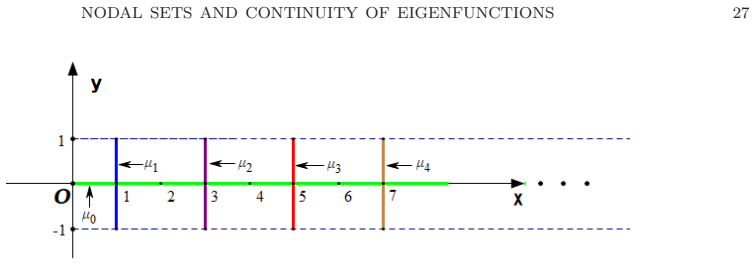
- The constructed examples show that for singular measures in $\mathbb{R}^2$, such as sums of line Lebesgue measures along the coordinate axes, there are continuous eigenfunctions whose nodal lines divide the domain into $n$ subdomains.
Reading between the lines
- The paper does not address whether $n+r-1$ is sharp for singular measures; constructing eigenfunctions with exactly $n+r-1$ nodal domains for a measure with multiplicity $r>1$ would settle that.
- The proof structure suggests the nodal-counting argument needs only the maximum principle and the variational characterization, not the particular form of $\Delta_\mu$; the same two ingredients might give nodal bounds for other measure-defined or nonlocal Dirichlet forms whenever a mollification identity analogous to Proposition 3.2 holds.
- If the mollification limit in Proposition 3.2 fails for some measure with $\dim_\infty(\mu)>d-2$, the theorem could still be true, but the paper's proof would need a different smoothing argument; this is testable by computing the limit explicitly for a self-similar measure with known eigenfunctions.
- The continuity result indicates that, under the measure-Poincaré condition, eigenfunctions inherit regularity from the classical Green function; an analogous statement for the heat semigroup would connect nodal structure to the vanishing of heat-flow solutions.
Editorial analysis
A structured set of objections, weighed in public.
Referee Report
Summary. This paper studies Krein–Feller operators Δ_μ on bounded domains Ω ⊂ R^d, where μ is a finite positive Borel measure supported in Ω and satisfies the lower L^∞-dimension condition dim_∞(μ) > d−2. The main results are: (Theorem 1.1) if u_n is a continuous λ_n-eigenfunction of (1.2), then the nodal set Z_μ(u_n) divides Ω into at least 2 and at most n+r−1 subdomains, where r is the multiplicity of λ_n; and (Theorem 1.2) the eigenfunctions are continuous on Ω whenever the classical Green function exists, with continuity up to the boundary under a Lipschitz boundary assumption. The paper develops supporting tools in Sections 3–5: a maximum principle for continuous μ-subharmonic functions proved via mollifiers, a variational characterization of eigenvalues (Lemma 4.1), estimates for the Green operator, and a boundary-continuity argument. Section 6 provides explicit two-dimensional examples for measures supported on lines. The claimed theorems are plausible and would be a natural generalization of the classical Courant nodal domain theorem and the Gladwell–Zhu multiplicity improvement, but the manuscript currently contains several load-bearing gaps, most importantly an unjustified application of the variational lemma to functions that are not shown to lie in the form domain.
Significance. If the gaps are repaired, the results would be a substantial and useful extension of the Courant nodal domain theorem to Laplace operators defined by measures, a class relevant to fractal media and inhomogeneous mass distributions. The paper is parameter-free in its main claims and builds on the published theory of [25]; the examples in Section 6 are concrete and computable, and they usefully illustrate the new phenomena for singular measures. The maximum-principle approach for continuous μ-subharmonic functions is appropriate. However, the central variational step in Theorem 1.1 currently rests on an unproved lemma and on form-domain membership that is never verified; the continuity theorem has a nontrivial gap in the boundedness proof of the Green operator. The significance of the paper depends on repairing these points.
major comments (4)
- [Section 4, proof of Theorem 1.1] The variational step is applied to functions that are not shown to belong to Dom(E)=N⊥. In part (a), after defining u+ and u−, the quotient R_μ(|u1|) is computed and Lemma 4.1 is used to conclude that |u1| is an eigenfunction; in part (b), the functions w_j = u_n χ_{Ω_j} and their linear combination w in Eq. (4.5) are used in the same way. Lemma 4.1 is stated only for u∈Dom(E), and Section 2 defines Dom(E)=N⊥, the H^1_0-orthogonal complement of N={v: I(v)=0 in L²(Ω,μ)}. For a measure μ supported on a lower-dimensional set, a function τ∈N is zero μ-a.e. but need not have zero trace on the internal boundary ∂Ω_j, so ⟨w_j,τ⟩_{H¹}=∫_{Ω_j}∇u_n·∇τ dx + ∫_{Ω_j}u_n τ dx need not vanish. Thus w_j and w may lie outside Dom(E), and the inequality λ_m≤R_μ(w) is not licensed by Lemma 4.1. In addition, w_j = u_n χ_{Ω_j} is not automatically in H^1_0(Ω) for an arbitrary nodal set, so even the H^1 computation of R_μ(w) needs justification. This gap affects both the no-node conclusion for u1 and the upper bound m≤n+r−1.
- [Lemma 4.1, Section 4] Lemma 4.1, the variational characterization of all eigenvalues, is central to the proof of Theorem 1.1 but its proof is omitted ("Proof. Omit."). The authors say it follows as in [14, Theorem 1.3], but the precise adaptation to the present normalized form domain and to the chosen multiplicity conventions should be supplied. Since every application of Lemma 4.1 is load-bearing, a complete proof, or a precise statement with a full proof from the literature, must be included. The omission of the proof of Lemma 3.7 (Weyl's lemma) is acceptable because that lemma is standard, but Lemma 4.1 is specific to this setting and cannot be left as an unattributed exercise.
- [Proposition 3.2 and Theorem 3.4, Section 3] The maximum principle relies on the identity lim_{ε→0} ∫_{B_r(z)} Δ(ũ_ε|Ω) dx = ∫_{B_r(z)} Δ_μu dμ. The proof of Proposition 3.2 applies [25, Proposition 2.2] to the mollified test function η_ε(x−·) and then uses Fubini; these steps should be stated with the necessary integrability guarantees, because Δ_μu is only in L²(Ω,μ). More importantly, in the proof of Theorem 3.4 the parameter ε_t is chosen after r is fixed, but the monotonicity of φ_{ε_t}(r)+tr in r requires the same ε_t to work for an interval of r-values; as written, no uniformity in r is established. The maximum principle is used to prove that u1 has no zeros and that un changes sign, so this proof must be made rigorous.
- [Proposition 5.2, Section 5] The proof that G_μf is bounded in the case d≥3 does not establish convergence as m→∞. To control ∫_{|x−y|<1} |x−y|^{-(d−2)} |f²−f_m²| dμ, the authors split into dyadic annuli and for each N choose m_N such that the sum is bounded by ∑ 2^{-k}; letting N→∞ only gives a bound along the sequence m_N, not the asserted lim_{m→∞}. Moreover, the argument uses the boundedness of G_μf² before it is proved. Since the boundedness of G_μf is used in Theorem 1.2 for the continuity proof, this gap needs to be repaired, for example by a dominated-convergence argument after first establishing ∫_Ω G(x,·) f² dμ < ∞ directly.
minor comments (5)
- [Section 5, Theorem 1.2 proof] The statement that "G(x, y) is continuous on Ω × Ω" is inaccurate: the Green function has a singularity on the diagonal and is continuous on (Ω × Ω) minus the diagonal. The proof's f1/f2 splitting handles this, but the statement should be corrected.
- [Section 4 and 5] There are several typographical and linguistic slips: "subdomians" in the proof of Theorem 1.1(b), "Possion equation" in Section 5, "Theorm 4.1.2" in Remark 5.1, and inconsistent hyphenation of "Hölder". These should be corrected.
- [Section 6, Examples 6.2 and 6.3] The proofs of Examples 6.2 and 6.3 are omitted with the remark that they follow the method of Example 6.1. Since these examples are illustrative rather than load-bearing, this is acceptable, but the text should say explicitly that the details are omitted as analogous to Example 6.1.
- [Section 6, Example 6.1] The sentence "u has no nodal points in Ω, hence it is a first eigenfunction" needs a short justification: a positive eigenfunction with eigenvalue 2 cannot be orthogonal in L²(Ω,μ) to a positive first eigenfunction with eigenvalue λ1<2, so indeed λ1=2. As written, the implication is not immediate.
- [Section 5, outline before Theorem 1.2] The outline states that the authors "use condition (5.5) and the dominated convergence theorem to prove that G_μu is continuous on sufficiently small r-balls covering ∂Ω", but the actual proof in Step 2 uses Proposition 5.3 and a finite cover argument; the outline should be aligned with the proof.
Circularity Check
There is no significant circularity: the nodal and continuity theorems use standard variational and maximum-principle machinery, and the cited prior results are independent of the target claims.
full rationale
On inspection, the derivation chain contains no circular step. The eigenvalues and eigenfunctions are defined by the form (E, Dom(E)=N⊥) and the distributional identity (2.4) from [25]; no parameter is fitted to any eigenvalue, and no prediction is constructed from the data used to define the operator. Theorem 1.1(a) follows from the maximum principle, whose proof reduces via mollification to the independent distributional identity in [25, Proposition 2.2]. Theorem 1.1(b) uses the standard min-max characterization in Lemma 4.1; its proof is omitted and attributed to [14], but the lemma is a parameter-free spectral fact whose assumptions (MPI, dim∞(μ)>d−2) do not include the nodal theorem being proved, so the self-citation is not a circular reduction. Theorem 1.2 similarly uses the Green operator inverse of −Δμ from [25, Theorem 1.3]; that is background spectral theory, not the target result. Flagged for completeness: Lemma 3.7, Lemma 4.1, and Examples 6.2–6.3 have omitted proofs, and the proof of Theorem 1.1(b) does not explicitly verify that the truncated functions w_j and w lie in Dom(E)=N⊥ before applying Lemma 4.1. These are expositional and correctness gaps, not reductions of the conclusion to an input, and therefore do not raise the circularity score.
Assumptions & free parameters
assumptions (3)
- domain assumption The measure mu satisfies the measure Poincare inequality (MPI), which is guaranteed by dim_infty(mu) > d-2.
- ad hoc to paper The identity integral_{B_r(z)} Delta(tilde u_epsilon|Omega)(x) dx -> integral_{B_r(z)} Delta_mu u(x) dmu(x) as epsilon->0 (Proposition 3.2).
- domain assumption The classical Green function G(x,y) exists on Omega, is symmetric, continuous on Omega times Omega, and satisfies the boundary limit condition (5.3) when Omega has Lipschitz boundary.
Cite this review
Pith. "Pith review of Nodal sets and continuity of eigenfunctions of Kre\u{\i}-Feller operators." pith.science (2026). https://pith.science/paper/NYX3IZ7K
@misc{pith2026241114173,
  author       = {Pith},
  title        = {Pith review of: Nodal sets and continuity of eigenfunctions of Kre\u\i-Feller operators},
  year         = {2026},
  howpublished = {\url{https://pith.science/paper/NYX3IZ7K}},
  note         = {Machine review of arXiv:2411.14173}
}
abstract
Let $\mu$ be a compactly supported positive finite Borel measure on $\R^{d}$. Let $0<\lambda_{1}\leq\lambda_{2}\leq\ldots$ be eigenvalues of the Kre$\breve{{\i}}$n-Feller operator $\Delta_{\mu}$. We prove that, on a bounded domain, the nodal set of a continuous $\lambda_{n}$-eigenfunction of a Kre$\breve{{\i}}$n-Feller operator divides the domain into at least 2 and at most $n+r-1$ subdomains, where $r$ is the multiplicity of $\lambda_{n}$. This work generalizes the nodal set theorem of the classical Laplace operator to Kre$\breve{{\i}}$n-Feller operators on bounded domains. We also prove that on bounded domains on which the classical Green function exists, the eigenfunctions of a Kre$\breve{{\i}}$n-Feller operator are continuous.
Figures


Figures from the paper (1 more)

Forward citations
Cited by 1 Pith paper
-
Nodal sets and continuity of eigenfunctions of Krein-Feller operators on Riemannian manifolds
Eigenfunctions of Krein-Feller operators on bounded domains of Riemannian manifolds satisfy the Courant nodal bound and are continuous under mild dimension conditions.
Reference graph
Works this paper leans on
-
[25]
Hu, K.-S
J. Hu, K.-S. Lau and S.-M. Ngai, Laplace operators related to self-similar measures on Rd, J. Funct. Anal. 239 (2006), 542–565
2006
-
[1]
R. A. Adams and J. J. F. Fournier, Sobolev Spaces, Pure Appl. Math. (Amst.), vol. 140, Else- vier/Academic Press, Amsterdam, 2003
work page 2003
-
[2]
Alessandrini, Nodal lines of eigenfunctions of fixed membrane problem in general convex do- mains, Comment
G. Alessandrini, Nodal lines of eigenfunctions of fixed membrane problem in general convex do- mains, Comment. Math. Helv. 69 (1994), 142–154
1994
-
[3]
Alessandrini, On Courant’s nodal domain theorem, Forum Math
G. Alessandrini, On Courant’s nodal domain theorem, Forum Math. 10 (1998), 521–532
1998
-
[4]
D. H. Armitage and S. J. Gardiner, Classical Potential Theory, Springer Monogr. Math. Springer- Verlag London, Ltd., London, 2001
work page 2001
-
[5]
R. F. Bass, Probabilistic Techniques in Analysis, Probab. Appl. (N. Y.), Springer-Verlag, New York, 1995
work page 1995
-
[6]
E. J. Beltrami, Another proof of Weyl’s lemma, SIAM Rev. 10 (1968), 212–213
work page 1968
-
[7]
E. J. Bird, S.-M. Ngai and A. Teplyaev, Fractal Laplacians on the unit interval, Ann. Sci. Math. Qu´ebec 27 (2003), 135–168
work page 2003
Show all 54 references
-
[8]
J. F.-C. Chan, S.-M. Ngai and A. Teplyaev, One-dimensional wave equations defined by fractal Laplacians, J. Anal. Math. 127 (2015), 219–246
2015
-
[9]
Chen and S.-M
J. Chen and S.-M. Ngai. Eigenvalues and eigenfunctions of one-dimensional fractal Laplacians defined by iterated function systems with overlaps, J. Math. Anal. Appl. 364 (2010), 222–241
2010
-
[10]
Courant and D
R. Courant and D. Hilbert, Methods of Mathematical Physics , vol. I, Interscience Publishers, Inc., New York, 1953
1953
-
[11]
Courant and D
R. Courant and D. Hilbert, Methods of Mathematical Physics, vol. II, Partial Differential Equations, Wiley, New York, 1989. 28 S.-M. NGAI, M.-K. ZHANG, AND W.-Q. ZHAO
1989
-
[12]
E. B. Davies, Spectral Theory and Differential Operators , Cambridge Stud. Adv. Math., vol. 42, Cambridge Univ. Press, Cambridge, 1995
1995
-
[13]
Deng and S.-M
D.-W. Deng and S.-M. Ngai, Eigenvalue estimates for Laplacians on measure spaces, J. Funct. Anal. 268 (2015), 2231–2260
2015
-
[14]
Deng and S.-M
D.-W. Deng and S.-M. Ngai, Estimates for sums and gaps of eigenvalues of Laplacians on measure spaces, Proc. Roy. Soc. Edinburgh Sect. A 151 (2021), 842–861
2021
-
[15]
J. L. Doob, Classical Potential Theory and Its Probabilistic Counterpart , Springer-Verlag, Berlin,
-
[16]
L. C. Evans, Partial Differential Equations , vol. 19, Grad. Stud. Math., American Mathematical Society, Providence, RI, 2010
2010
-
[17]
Feller, Generalized second order differential operators and their lateral conditions, Illinois J
W. Feller, Generalized second order differential operators and their lateral conditions, Illinois J. Math. 1 (1957), 459–504
1957
-
[18]
Freiberg, Analytical properties of measure geometric Kre ˘ ın-Feller-operators on the real line, Math
U. Freiberg, Analytical properties of measure geometric Kre ˘ ın-Feller-operators on the real line, Math. Nachr. 260 (2003), 34–47
2003
-
[19]
Freiberg, Refinement of the spectral asymptotics of generalized Kre ˘ ın Feller operators, Forum Math
U. Freiberg, Refinement of the spectral asymptotics of generalized Kre ˘ ın Feller operators, Forum Math. 23 (2011), 427–445
2011
-
[20]
Freiberg and M
U. Freiberg and M. Z¨ ahle, Harmonic calculus on fractal—a measure geometric approach,I, Potential Anal. 16 (2002), 265–277
2002
-
[21]
G ˚ arding, On a lemma by H
L. G ˚ arding, On a lemma by H. Weyl,Kungl. Fysiografiska S¨ allskapets i Lund F¨ orhandlingar [Proc. Roy. Physiog. Soc. Lund] 20 (1950), 250–253
1950
-
[22]
G. M. L. Gladwell and H. Zhu, Courant’s nodal line theorem and its discrete counterparts, Quart. J. Mech. Appl. Math. 55 (2002), 1–15
2002
-
[23]
Grubb, Distributions and Operators, Grad
G. Grubb, Distributions and Operators, Grad. Texts in Math., vol. 252, Springer, New York, 2009
2009
-
[24]
Q. Gu, J. Hu and S.-M. Ngai, Geometry of self-similar measures on intervals with overlaps and applications to sub-Gaussian heat kernel estimates, Commun. Pure Appl. Anal. 19 (2020), 641–676
2020
-
[26]
Jost, Partial Differential Equations , Grad
J. Jost, Partial Differential Equations , Grad. Texts in Math., vol. 214, Springer, New York, 2013
2013
-
[27]
I. S. Kac and M. G. Kre ˘ ın, Criteria for the discreteness of the spectrum of a singular string, Izv. Vysˇs. U ˇcebn. Zaved. Matematika (1958), 136–153
1958
-
[28]
Kesseb¨ ohmer and A
M. Kesseb¨ ohmer and A. Niemann, Spectral dimensions of Kre ˘ ın-Feller operators and Lq-specta, Adv. Math. 399 (2022), 108253
2022
-
[29]
Kesseb¨ ohmer and A
M. Kesseb¨ ohmer and A. Niemann, Spectral dimensions of Kre ˘ ın-Feller operators in higher dimen- sions, arXiv: 2202.05247 (2022)
2022 arXiv
-
[30]
M. G. Kre ˘ ın, On a generalization of investigations of Stieltjes, Doklady Akad. Nauk SSSR(N.S.) 87 (1952), 881–884
1952
-
[31]
Lin, On the second eigenfunctions of the Laplacian in R2, Comm
C.-S. Lin, On the second eigenfunctions of the Laplacian in R2, Comm. Math. Phys. 111 (1987), 161–166
1987
-
[32]
Logunov, Nodal sets of Laplace eigenfunctions: proof of Nadirashvili’s conjecture and of the lower bound in Yau’s conjecture, Ann
A. Logunov, Nodal sets of Laplace eigenfunctions: proof of Nadirashvili’s conjecture and of the lower bound in Yau’s conjecture, Ann. of Math.(2) 187 (2018), 241–262
2018
-
[33]
H. P. Mckean and D. B. Ray, Spectral distribution of differential operator,Duke Math. J. 29 (1962), 281–292. NODAL SETS AND CONTINUITY OF EIGENFUNCTIONS 29
1962
-
[34]
McLean, Strongly elliptic systems and boundary integral equations, Cambridge University Press, Cambridge, 2000
W. McLean, Strongly elliptic systems and boundary integral equations, Cambridge University Press, Cambridge, 2000
2000
-
[35]
Medkov´ a,The Laplace Equation , Springer, Cham, 2018
D. Medkov´ a,The Laplace Equation , Springer, Cham, 2018
2018
-
[36]
A. D. Melas, On the nodal line of the second eigenfunction of the Laplacian in R2, J. Differential Geom. 35 (1992), 255–263
1992
-
[37]
Naimark and M
K. Naimark and M. Solomyak, On the eigenvalue behaviour for a class of operators related to self-similar measures on Rd, C. R. Acad. Sci. Paris S´ er. I Math. 319 (1994), 837–842
1994
-
[38]
Naimark and M
K. Naimark and M. Solomyak, The eigenvalue behaviour for the boundary value problems related to self-similar measures on Rd, Math. Res. Lett. 2 (1995), 279–298
1995
-
[39]
Ngai, Spectral asymptotics of Laplacians associated with one-dimensional iterated function systems with overlaps, Canad
S.-M. Ngai, Spectral asymptotics of Laplacians associated with one-dimensional iterated function systems with overlaps, Canad. J. Math. 63 (2011), 648–688
2011
-
[40]
S.-M. Ngai, W. Tang, and Y. Y. Xie, Spectral asymptotics of one-dimensional fractal Laplacians in the absence of second-order identities, Discrete Contin. Dyn. Syst. 38 (2018), 1849–1887
2018
-
[41]
Ngai and Y
S.-M. Ngai and Y. Y. Xie, Spectral asymptotics of Laplacians related to one-dimensional graph- directed self-similar measures with overlaps, Ark. Mat. 58 (2020), 393–435
2020
-
[42]
Ngai and Y
S.-M. Ngai and Y. Y. Xie, Spectral asymptotics of Laplacians associated with a class of higher- dimensional graph-directed self-similar measures, Nonlinearity 34 (2021), 5375–5398
2021
-
[43]
L. E. Payne, Isoperimetric inequalities and their applications, SIAM Rev. 9 (1967), 453–488
1967
-
[44]
L. E. Payne, On two conjectures in the fixed membrane eigenvalue problem, Z. Angew. Math. Phys. 24 (1973), 721–729
1973
-
[45]
J. P. Pinasco and C. Scarola, Eigenvalue bounds and spectral asymptotics for fractal Laplacians, J. Fractal Geom. 6 (2019), 109–126
2019
-
[46]
J. P. Pinasco and C. Scarola, A nodal inverse problem for measure geometric Laplacians, Commun. Nonlinear Sci. Numer. Simul. 94 (2021), 105542
2021
-
[47]
Pleijel, Remarks on courant’s nodal line theorem, Comm
˚A. Pleijel, Remarks on courant’s nodal line theorem, Comm. Pure Appl. Math. 9 (1956), 543–550
1956
-
[48]
H. L. Royden, Real Analysis, Macmillan Publishing Company, New York, 1988
1988
-
[49]
Sasane, A Friendly Approach to Functional Analysis , Essent
A. Sasane, A Friendly Approach to Functional Analysis , Essent. Textb. Math., World Scientific Publishing Co. Pte. Ltd., Hackensack, NJ, 2017
2017
-
[50]
W. A. Strauss, Partial Differential Equations , John Wiley and Sons, Ltd., Chichester, 2008
2008
-
[51]
R. S. Strichartz, Self-similar measures and their Fourier transforms III, Indiana Univ. Math. J. 42 (1993), 367–411
1993
-
[52]
Tang and S.-M
W. Tang and S.-M. Ngai, Heat equations defined by a class of self-similar measures with overlaps, Fractals 30 (2022), 2250073
2022
-
[53]
Weyl, The method of orthogonal projection in potential theory,Duke Math
H. Weyl, The method of orthogonal projection in potential theory,Duke Math. J. 7 (1940), 411–444. 30 S.-M. NGAI, M.-K. ZHANG, AND W.-Q. ZHAO Key Laboratory of High Performance Computing and Stochastic Information Processing (HPCSIP) (Ministry of Education of China), College of...
1940
-
[2001]
Reprint of the 1984 edition
1984
Reviewed August 12, 2026 · model on record in the stance chip above.
Discussion (0). Continue with ORCID to comment.