REVIEW 4 major objections 5 minor 25 references
Generative AI-enabled Digital Twins for 6G-enhanced Smart Cities
T0 review · 4 major / 5 minor · reviewed 2026-08-12 · deepseek-v4-flash
Pith's one-line read Generative AI digital twins, steered by a KPI-weighting objective, can generate differentiated what-if scenarios for 6G smart-city networks, with simulations reporting 38% more stable throughput and 98% scenario accuracy.
desk verdict Potentially useful integration of LLMs into DT scenario generation, but the headline numbers are not backed by a defined accuracy metric or a clear throughput comparison. read the letter →
The pith
A machine-rendered reading of the paper's core claim, the machinery that carries it, and where it could break.
The reading
What carries the argument
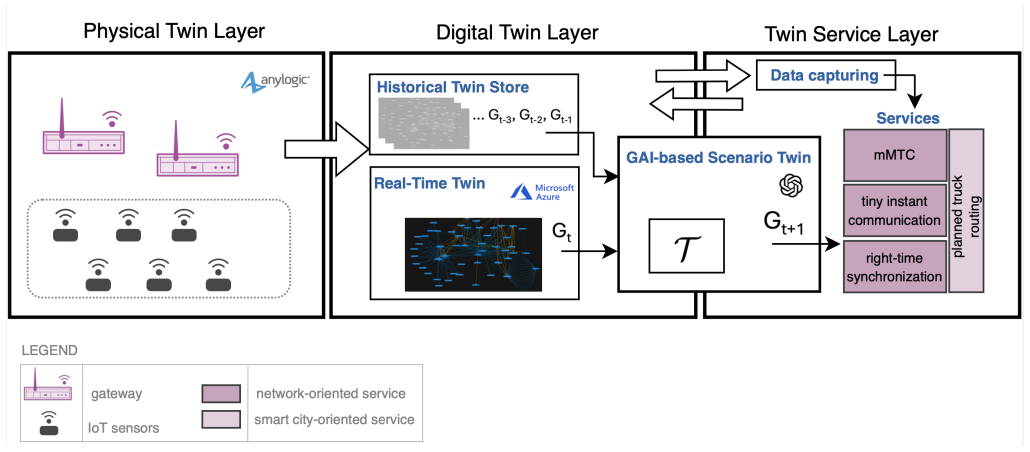
The load-bearing mechanism is the optimization objective $O = \sum_i w_i T_i$, where $T_i$ are the calculated KPI values and $w_i$ are weights assigned by a prioritization function $p(w_x, w_y)$. The function gives larger weights to the KPI pairs that matter for the scenario---density with packet deadline when $D > D_{\text{th}}$, latency with packet deadline when $L < L_{\text{th}}$, and density with buffer size when $A > A_{\text{th}}$---and assigns random weights when no prioritization applies. This formula is fed into the generative-AI scenario-twin module together with historical and real-time twins; the model then outputs the next-state network topology, which the Twin Service Layer uses to evaluate massive connectivity, tiny instant communication, right-time synchronization, and planned truck routing services.
What would settle it
Run the same generated scenario twins against a held-out set of physical network traces that were not used in twinning, and compare the generated KPI distributions (throughput, latency, deadline misses) with measured values; if the 98% scenario accuracy does not survive when accuracy is defined as predictive error on unseen data, the central claim would be refuted. A second decisive check is to repeat the high-density scenario with equal or random weights while keeping every other setting identical: if the 38% throughput-stability gain disappears, the gain is an artifact of the scenario definitions rather than the prioritization formula.
Extended reading notes
Core claim
The central discovery is that scenario differentiation can be encoded as a weighted-sum objective over four key performance indicators---device density $\rho$, packet deadlines $d$, latency $l$, and buffer size $\alpha$---with weights chosen by a prioritization rule that reacts to thresholds on density, latency, and accuracy. Feeding this objective, together with historical twins and real-time twins, to a generative language model produces scenario twins that match the requested scenario closely enough that network throughput is 38% more stable under high device density than a baseline scenario with random weights, and the generated scenario accuracy reaches 98%. In the paper's own framing, the same mechanism lets right-time synchronization and truck-routing services be tested on generated topologies before deployment.
Load-bearing premise
The argument rests on the assumption that the weighted-sum objective with hand-picked thresholds ($D_{\text{th}} = 50$, $L_{\text{th}} = 0.9$ ms, $A_{\text{th}} = 97\%$) and the prioritization rules is a faithful model of what differentiates network scenarios, and that the reported 98% accuracy measures how well generated scenarios predict real network behavior rather than how closely they repeat the thresholds fed into the model.
Editorial extensions
If this is right
- Network operators could test high-density, low-latency, or synchronization-critical scenarios on generated twins before touching the live network, avoiding the disruptions that direct adaptive control can cause.
- If the 38% throughput-stability result holds, KPI-prioritized scenario generation is a practical lever for managing massive connectivity in dense IoT topologies.
- The reported 98% scenario accuracy suggests that combining historical twins, real-time twins, and generative-AI scenario twins gives better what-if coverage than using either data source alone.
- The same twin service layer can evaluate smart-city applications such as truck routing alongside network-oriented services, so infrastructure and city-service planning can share one scenario-generation pipeline.
Reading between the lines
- The accuracy metric as described appears to compare generated scenarios against the requested thresholds, so the 98% figure is best read as prompt-compliance accuracy; a stronger test would define accuracy as the match between generated topologies and held-out physical measurements.
- The hand-picked thresholds and prioritization rules could be learned from historical KPI data; a natural extension is to replace the fixed prioritization function with a learned weight policy and compare the stability gains.
- Because the throughput comparison pits prioritized weights against random weights, an ablation that varies only the weight-assignment rule would isolate the prioritization effect from the scenario-definition effect.
- A direct head-to-head between the LLM-based scenario twin and tabular generative models such as CTGAN on the same four services would clarify when LLM-based generation is worth its computational cost.
Editorial analysis
A structured set of objections, weighed in public.
Referee Report
Summary. The paper proposes a generative AI-enabled digital twin framework for 6G-enhanced smart cities. The framework layers a physical twin (AnyLogic simulation), a digital twin layer (Azure Digital Twins with real-time and historical stores), and a twin service layer offering mMTC, tiny-instant communication, right-time synchronization, and truck-routing services. A KPI-based optimization formula (Eqs. 1-7) differentiates three scenarios (base, high device density, synchronization-oriented) and is fed to ChatGPT to generate 'scenario twins.' The evaluation reports a 38% more stable network throughput under high device density and a 98% scenario accuracy, claimed to surpass baselines.
Significance. If the central claims were substantiated, the idea of using an LLM together with a KPI-prioritization objective to generate what-if scenario twins for network digital twins would be a useful contribution to the 6G management toolbox. The paper gives a clear architectural description (physical layer, digital twin layer, service layer) and an interesting combination of Azure Digital Twins, historical data stores, and ChatGPT-generated scenarios. However, the current evaluation does not define the accuracy metric, the throughput comparison builds the expected outcome into the scenario definitions, and no code, data, or statistical analysis is provided; the headline results are therefore not established.
major comments (4)
- [Section IV, Fig. 3] The 'scenario accuracy' metric is never defined, and the reported 98% appears to be a convergence target rather than a measure of fidelity to the physical twin. The experiment sets A_th=97% as an input, runs twinning rounds, and states that performing one more twinning round would produce 100% accuracy. This indicates the metric measures prompt compliance with the requested threshold, not agreement between the generated twin and independently measured ground-truth network behavior. No formula, ground-truth dataset, or comparison of generated KPI values (density, latency, deadline, buffer) against measured values is provided. This circular evaluation cannot support the claim that the framework 'surpasses the baselines.'
- [Section IV, Fig. 2 and Section III.B.3] The 38% throughput improvement is partly built into the scenario definitions. Scenario-2 prioritizes KPI weights via the proposed optimization formula, while Scenario-1 uses random weights, and the comparison is between these two scenarios under high device density. The improvement may reflect the hand-crafted weight prioritization rather than the generative AI-enabled twin framework. Additionally, 'stability' is not defined, and no error bars or confidence intervals are shown for the throughput results, despite Table I listing a 95% confidence interval.
- [Section III.B.3, Eqs. (1)-(7)] The optimization formula relies on free parameters and hand-picked thresholds (D_th=50, L_th=0.9ms, A_th=97%) without any sensitivity analysis. Since this formula is the central novelty, the absence of an ablation study or any examination of threshold and weight choices leaves open whether the reported 38% and 98% values are robust or artifacts of the specific parameter settings.
- [Section IV, Experimental Setup] The paper provides no code, data, seed values, run counts, or statistical analysis, and the 'traditional simulation method' baseline is not described beyond a passing reference. This prevents independent verification of the headline claims and undermines the reproducibility of the results.
minor comments (5)
- [Abstract] The phrase 'we fed this formula to the generative AI' should be in present or general tense for a framework description; also 'historical twins' and 'real-time twins' are used without formal definitions at that point.
- [Table I] The headers 'DT H, LT H, AT H' use inconsistent notation with the text's D_th, L_th, A_th; unify the subscripts and formatting.
- [Section III.B.3] The conditions in Eq. (1) use D, L, A and Dth, Lth, Ath, but the table lists DT H, LT H, AT H; the notation should be consistent throughout.
- [References] References [17] and [20] are the same paper (Tao et al., 'Wireless network digital twin for 6g: Generative ai as a key enabler'); replace one with a different citation or remove the duplicate.
- [Table I and Section IV] The 'twinning rate' of 0.8 is never defined; clarify what the twinning rate represents and how it is applied in the twinning rounds.
Circularity Check
The 98% scenario-accuracy claim reduces to a self-imposed convergence target: A_th=97% is fed into the optimization/generation loop, and the reported accuracy is the loop's stopping value, not a comparison against ground-truth physical twin data.
-
self definitional
[Section IV, accuracy experiment around Fig. 3; see also Table I and Eq. (1)]
"Here, we decide the total number of performed twining rounds by observing the scenario accuracy value. If we desire to see 100% accuracy, then we can perform one more twinning round. ... Finally, the proposed twin generation method reaches 98% accuracy levels at the end of the twining rounds."
The accuracy value is not defined as agreement with independently measured physical-twin data; 'scenario accuracy' is the degree to which the generated scenario satisfies the desired system requirements. The target A_th=97% is an input (Table I) to the same optimization formula (Eq. 1-3) that drives the generative AI. The authors stop twinning once the observed accuracy reaches the desired level ('If we desire to see 100% accuracy, then we can perform one more twinning round'), so the reported 98% is a stopping criterion/convergence value of the generation loop, not a predictive result.
full rationale
The central circularity is confined to the scenario-accuracy headline. Equations (1)-(7) form a proposed objective, not a derived empirical law, but that alone need not be circular. The accuracy experiment, however, feeds A_th=97% into the system and then reports a 98% 'scenario accuracy' as evidence, with the number of twinning rounds chosen by observing that same accuracy value. Without an accuracy formula or ground-truth comparison, the result measures prompt compliance, not twin fidelity. I do not score the throughput claim as demonstrated circularity: the paper compares a prioritized scenario against a random-weight baseline, which is a weak comparison, but no equation shows the 38% gain is equal to the objective by construction, and 'stability' is undefined. The self-citations to prior work [5], [26] support service implementations but are not load-bearing for the main claim. Overall, one core 'prediction' reduces to its input, so the paper is partially circular (6), not wholly so.
Assumptions & free parameters
free parameters (6)
- D_th (device density threshold) =
50 devices/m^2
- L_th (latency threshold) =
0.9 ms
- A_th (accuracy threshold) =
97%
- Twinning rate =
0.8
- Number of twinning rounds =
12
- KPI weights w_rho, w_d, w_l, w_alpha =
random in Scenario-1, prioritized in others
assumptions (6)
- standard math Weighted sum optimization with sum-to-one weights is a valid formulation for scenario differentiation
- domain assumption AnyLogic simulation faithfully represents a physical IoT sensor network
- domain assumption Azure Digital Twins and Azure Data Explorer accurately mirror physical entities and history
- domain assumption ChatGPT can interpret the KPI formula and generate valid simulation configurations
- domain assumption The four KPI metrics (density, packet deadline, latency, buffer size) are sufficient to differentiate 6G smart city scenarios
- ad hoc to paper Threshold values D_th, L_th, A_th correctly separate the three scenario types
invented entities (1)
-
Scenario twin
Cite this review
Pith. "Pith review of Generative AI-enabled Digital Twins for 6G-enhanced Smart Cities." pith.science (2026). https://pith.science/paper/K6U5YTLZ
@misc{pith2026241114222,
  author       = {Pith},
  title        = {Pith review of: Generative AI-enabled Digital Twins for 6G-enhanced Smart Cities},
  year         = {2026},
  howpublished = {\url{https://pith.science/paper/K6U5YTLZ}},
  note         = {Machine review of arXiv:2411.14222}
}
read the original abstract
6G networks are envisioned to enable a wide range of applications, such as autonomous vehicles and smart cities. However, this rapid expansion of network topologies makes the management of 6G wireless networks more complex and leads to performance degradation. Even though state-of-the-art applications on network services are providing promising results, they also risk disrupting the network's performance. To overcome this, the services have to leverage what-if implementations covering a variety of scenarios. At this point, traditional simulations fall short of encompassing the dynamism and complexity of a physical network. To overcome these challenges, we propose the Generative AI-based Digital Twins. For this, we derive an optimization formula to differentiate different network scenarios by considering the specific key performance indicators (KPIs) for wireless networks. Then, we fed this formula to the generative AI with the historical twins and real-time twins to start generating the desired topologies. To evaluate the performance, we implement network and smart-city-oriented services, namely massive connectivity, tiny instant communication, right-time synchronization, and truck path routes. The simulation results reveal that our approach can achieve 38% more stable network throughput in high device density scenarios. Furthermore, the generated scenario accuracy is able to reach up to 98% level, surpassing the baselines.
Figures


Reference graph
Works this paper leans on
-
[2]
C. Tunc, T. X. Tran, and K. Joshi, “Digital Twins for Beyond 5G,” in AI in Wireless for Beyond 5G Networks , 1st ed. CRC Press, 2024, pp. 169–190
work page 2024
-
[3]
Age of twin (aot): A new digital twin qualifier for 6g ecosystem,
K. Duran, M. ¨Ozdem, T. Hoang, T. Q. Duong, and B. Canberk, “Age of twin (aot): A new digital twin qualifier for 6g ecosystem,” IEEE Internet of Things Magazine , vol. 6, no. 4, pp. 138–143, 2023
2023
-
[4]
Y . Li, X. Jian, K. Yu, N. Kumar, and S. Cai, “Theoretical performance analysis of distributed queue for massive machine type communications: Throughput, latency, energy consumption,” IEEE Transactions on Net- work and Service Management , vol. 19, no. 2, pp. 818–828, 2022
work page 2022
-
[5]
6g-enabled dtaas (digi- tal twin as a service) for decarbonized cities,
K. Duran, E. Ak, G. Yurdakul, and B. Canberk, “6g-enabled dtaas (digi- tal twin as a service) for decarbonized cities,” in2023 IEEE International Conference on Communications Workshops (ICC Workshops) , 2023, pp. 421–426
work page 2023
-
[6]
H. Viswanathan and P. E. Mogensen, “Communications in the 6g era,” IEEE Access , vol. 8, pp. 57 063–57 074, 2020
work page 2020
-
[7]
R. Venanzi, L. Foschini, P. Bellavista, B. Kantarci, and C. Stefanelli, “Fog-driven context-aware architecture for node discovery and energy saving strategy for internet of things environments,” IEEE Access, vol. 7, pp. 134 173–134 186, 2019
work page 2019
-
[8]
M. Schluse and J. Rossmann, “From simulation to experimentable digital twins: Simulation-based development and operation of complex technical systems,” in 2016 IEEE International Symposium on Systems Engineering (ISSE) , 2016, pp. 1–6
work page 2016
-
[9]
Empowering 6g communication systems with digital twin technology: A comprehensive survey,
N. P. Kuruvatti, M. A. Habibi, S. Partani, B. Han, A. Fellan, and H. D. Schotten, “Empowering 6g communication systems with digital twin technology: A comprehensive survey,” IEEE Access , vol. 10, pp. 112 158–112 186, 2022
work page 2022
Show all 25 references
-
[10]
Digital twin: Enabling technologies, challenges and open research,
A. Fuller, Z. Fan, C. Day, and C. Barlow, “Digital twin: Enabling technologies, challenges and open research,” IEEE Access , vol. 8, pp. 108 952–108 971, 2020
2020
-
[11]
Ai in energy digital twining: A reinforcement learning-based adaptive digital twin model for green cities,
L. V . Cakir, K. Duran, C. Thomson, M. Broadbent, and B. Canberk, “Ai in energy digital twining: A reinforcement learning-based adaptive digital twin model for green cities,” arXiv preprint arXiv:2401.16449 , 2024
2024 arXiv
-
[12]
Graph theoretical approach for automated ip lifecycle management in telco networks,
K. Duran, B. Karanlik, and B. Canberk, “Graph theoretical approach for automated ip lifecycle management in telco networks,” Wiley Int J Network Mgmt , vol. 31, no. 4, e2138, 2021
2021
-
[13]
Smart city digital twins,
N. Mohammadi and J. E. Taylor, “Smart city digital twins,” in 2017 IEEE Symposium Series on Computational Intelligence (SSCI) , 2017, pp. 1–5
2017
-
[14]
Kubetwin: A digital twin framework for kubernetes deployments at scale,
D. Borsatti, W. Cerroni, L. Foschini, G. Ya Grabarnik, L. Manca, F. Poltronieri, D. Scotece, L. Shwartz, C. Stefanelli, M. Tortonesi, and M. Zaccarini, “Kubetwin: A digital twin framework for kubernetes deployments at scale,” IEEE Transactions on Network and Service Management...
2024
-
[15]
Dantalion: Digital twinning the computing continuum,
S. Laso, L. Mart ´ın, J. L. Herrera, J. Gal ´an-Jim´enez, J. Berrocal, and J. M. Murillo, “Dantalion: Digital twinning the computing continuum,” in 2023 IEEE Globecom Workshops (GC Wkshps) , 2023, pp. 1303–1306
2023
-
[16]
Digital twin- native ai-driven service architecture for industrial networks,
K. Duran, M. Broadbent, G. Yurdakul, and B. Canberk, “Digital twin- native ai-driven service architecture for industrial networks,” in 2023 IEEE Globecom Workshops (GC Wkshps) , 2023, pp. 1297–1302
2023
-
[18]
At the dawn of generative ai era: A tutorial- cum-survey on new frontiers in 6g wireless intelligence,
A. Celik and A. M. Eltawil, “At the dawn of generative ai era: A tutorial- cum-survey on new frontiers in 6g wireless intelligence,” IEEE Open Journal of the Communications Society , vol. 5, pp. 2433–2489, 2024
2024
-
[19]
What-if analysis framework for digital twins in 6g wireless network management,
E. Ak, B. Canberk, V . Sharma, O. A. Dobre, and T. Q. Duong, “What-if analysis framework for digital twins in 6g wireless network management,” 2024. [Online]. Available: https: //arxiv.org/abs/2404.11394
2024 arXiv
-
[20]
Wireless network digital twin for 6g: Generative ai as a key enabler,
Z. Tao, W. Xu, Y . Huang, X. Wang, and X. You, “Wireless network digital twin for 6g: Generative ai as a key enabler,” IEEE Wireless Communications, vol. 31, no. 4, pp. 24–31, 2024
2024
-
[21]
Generation of asset administration shell with large language model agents: Toward semantic interoperability in digital twins in the context of industry 4.0,
Y . Xia, Z. Xiao, N. Jazdi, and M. Weyrich, “Generation of asset administration shell with large language model agents: Toward semantic interoperability in digital twins in the context of industry 4.0,” IEEE Access, vol. 12, pp. 84 863–84 877, 2024
2024
-
[22]
An llm-based digital twin for optimizing human-in-the loop systems,
H. Yang, M. Siew, and C. Joe-Wong, “An llm-based digital twin for optimizing human-in-the loop systems,” 2024. [Online]. Available: http://arxiv.org/abs/2403.16809
2024 arXiv
-
[23]
Azure digital twins
“Azure digital twins.” [Online]. Available: https://learn.microsoft.com/ en-gb/azure/digital-twins/
-
[24]
Digital Twin Enriched Green Topology Discovery for Next Generation Core Networks,
K. Duran and B. Canberk, “Digital Twin Enriched Green Topology Discovery for Next Generation Core Networks,” IEEE Transactions on Green Communications and Networking , vol. 7, no. 4, pp. 1946–1956, 2023
1946
-
[25]
Spatio- temporal estimation for interference management in femtocell net- works,
D. M. Gutierrez-Estevez, B. Canberk, and I. F. Akyildiz, “Spatio- temporal estimation for interference management in femtocell net- works,” in 2012 IEEE 23rd International Symposium on Personal, Indoor and Mobile Radio Communications - (PIMRC) , 2012, pp. 1137– 1142
2012
-
[26]
T6conf: Digital twin networking framework for ipv6-enabled net-zero smart cities,
E. Ak, K. Duran, O. A. Dobre, T. Q. Duong, and B. Canberk, “T6conf: Digital twin networking framework for ipv6-enabled net-zero smart cities,” IEEE Communications Magazine, vol. 61, no. 3, pp. 36–42, 2023
2023
-
[27]
Anylogic restfull api
“Anylogic restfull api.” [Online]. Available: https://anylogic.help/cloud/ api/rest.html
Reviewed August 12, 2026 · model on record in the stance chip above.
Discussion (0). Continue with ORCID to comment.