REVIEW 3 major objections 5 minor 59 references
Approximate Constrained Lumping of Chemical Reaction Networks
T0 review · 3 major / 5 minor · reviewed 2026-08-12 · deepseek-v4-flash
Pith's one-line read Relaxing exact lumping gives provably bounded approximations of ODE models.
desk verdict Solid incremental extension of exact CLUE to approximate lumping with an O(epsilon) error bound and a tolerance heuristic; the bound is credible, but Theorem 3 understates the domain condition for the reduced trajectory. read the letter →
The pith
A machine-rendered reading of the paper's core claim, the machinery that carries it, and where it could break.
The reading
What carries the argument
The operative device is the deviation functional dev_L(f,x) = ||Lf(\bar{L}Lx) - Lf(x)||_2, which compares the original dynamics to the dynamics evaluated after projecting onto the row space of L; exact lumping is the zero set of this functional. Algorithm 4 operationalizes it: with an orthonormal L (so \bar{L} = L^T), it forms π_i = rJ_i L^T L and only grows L when the residual rJ_i - π_i exceeds ε, appending the normalized residual as a new row. This keeps L orthonormal, keeps the observable rows inside rowsp(L), and, via the spanning representation J(x) = Σ_i J_i μ_i(x), converts a symbolic invariance check into finitely many numerical checks. The proof engine is a Grönwall-type inequality that turns the pointwise deviation bound into the exponential-in-time error bound of Theorem 3.
What would settle it
Take a rational ODE model where the reduced trajectory crosses a pole of f within the simulation horizon, run Algorithm 4, simulate the reduced system, and compute max_t ||e(t)||; if the deviation dev_L(f, \bar{L}y(t)) grows without bound and the error exceeds the Theorem 3 bound, the compactness assumption is violated and the O(ε) guarantee does not hold.
Extended reading notes
Core claim
The central claim is that near-lumpability can be made quantitative. Given a full-rank matrix L, the deviation dev_L(f,x) = ||Lf(\bar{L}Lx) - Lf(x)||_2 measures how far L is from being an exact lumping at state x; exact lumping is exactly the case where this deviation is identically zero. An approximate (S,T,η)-lumping requires the deviation along all trajectories of interest to stay below η, and Theorem 3 bounds the observable error e(t) = y(t) - Lx(t) by η times the factor (1/(C||L||_2||\bar{L}||_2))($e^{{C||L||_2||\bar{L}}$||_2 T} - 1), with C the Lipschitz constant of f on a compact set containing the trajectories. Algorithm 4 constructs such an L by orthonormal row addition: starting from the observable rows, it appends the normalized residual rJ_i - (rJ_i)L^T L whenever its norm exceeds a numerical tolerance ε, and Theorem 5 shows the resulting L has deviation η = O(√m C' C K ε). The paper argues this is a polynomial-time approximate constrained lumping with an error guarantee proportional to the tolerance, covering rational and polynomial models alike.
Load-bearing premise
The error bound requires both the original trajectory and its projection onto the lumping subspace to stay inside a compact region where the dynamics are analytic and Lipschitz; for rational models this can fail when a denominator vanishes along the reduced trajectory, and the paper only checks this after the fact.
Editorial extensions
If this is right
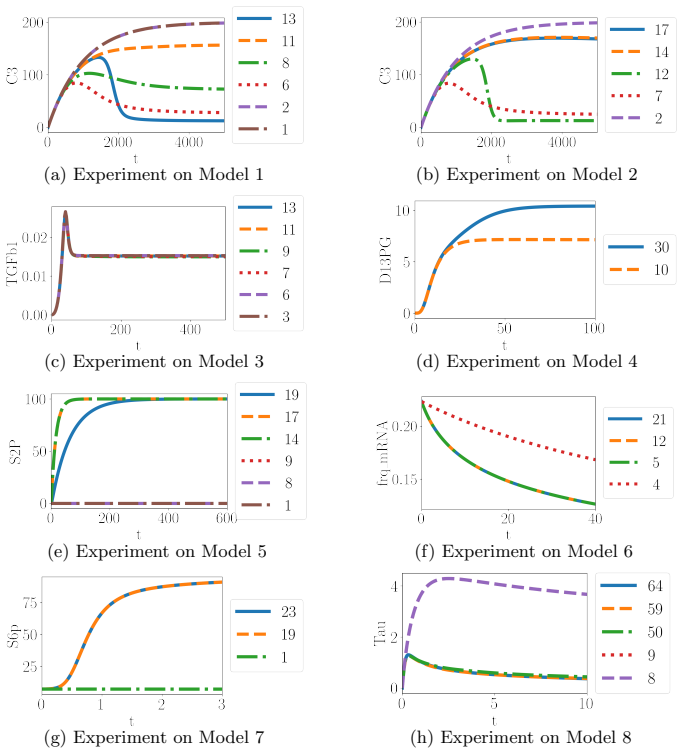
- Models with no exact lumping can still be reduced: on several benchmark models, approximate reductions were obtained where exact lumping was impossible or much coarser.
- The reduced size can be chosen by the user: the binary-search heuristic finds the largest tolerance whose reduced model stays below a target size, and the error remains O(ε).
- Rational models arising from Hill and Michaelis-Menten kinetics are covered, not just polynomial systems, extending the earlier polynomial-only version.
- The method runs in polynomial time and scales to a 1032-variable multisite phosphorylation model, reducing it to a handful of species with small error.
- Exact lumping is recovered in the limit ε → 0, so the method is a strict generalization that never does worse than the exact approach.
Reading between the lines
- The continuous tolerance knob could be repurposed for parameter-sensitivity analysis: one could estimate how much uncertainty in kinetic parameters a reduced model can absorb before the O(ε) error guarantee degrades, a direction the paper mentions as future work.
- For rational models, the compactness assumption is the real bottleneck; the authors only verify post hoc that denominators vanish only for negative states. A checkable sufficient condition, such as positivity preservation of the projected trajectory, would make the method usable without prior simulation.
- The exponential-in-time factor in the bound means the O(ε) guarantee is most meaningful over finite horizons; extending to steady-state or long-time statements would likely require additional dissipativity or contraction assumptions.
- The ε_max normalization from Lemma 1 gives a dimensionless difficulty index for reduction across models, though the paper does not develop that comparison explicitly.
Editorial analysis
A structured set of objections, weighed in public.
Referee Report
Summary. The paper proposes approximate constrained lumping for systems of ODEs with analytic right-hand sides, relaxing exact linear lumping through a tolerance parameter ε. For a user-specified observable subspace, Algorithm 4 computes a lumping matrix in polynomial time by adding rows only when a Jacobian-related vector is more than ε away from the current row space. The central theoretical claim is that the difference between the original observable and the observable of the reduced model is O(ε) (Theorems 3 and 5). A heuristic (Algorithm 5) selects ε by binary search to meet a target reduced size. The approach is evaluated on eight literature models (polynomial and rational) and on a scalable multisite phosphorylation model, reporting significantly smaller reductions than exact lumping at acceptable errors.
Significance. If the theoretical claims are correct, this is a useful contribution: it gives a polynomial-time algorithm for approximate model reduction with a provable, user-tunable error bound, extending the exact-lumping tool CLUE to rational and other analytic systems. The experimental evaluation is a genuine strength: it covers both polynomial and rational models from the literature, reports reduced sizes and errors, and the implementation is provided in a public repository. The idea of selecting ε by a size-based binary search is practical and likely to interest the systems-biology modelling community. However, the central error-bound theorem has a domain-assumption gap, and the pseudocode of the heuristic algorithm is internally inconsistent, so the manuscript needs substantial revision before the claims are fully supported.
major comments (3)
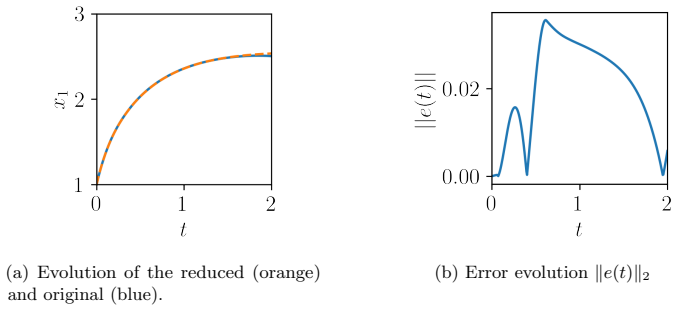
- [Algorithm 5, Section 3.3] The error bound in Theorem 3 is not justified because the proof of Proposition 1 bounds ∥Lf(\bar{L}y) − Lf(\bar{L}Lx)∥ by C∥L∥∥\bar{L}∥∥e(t)∥ using a Lipschitz constant of f on Ω, but the theorem assumes only x(t) and \bar{L}Lx(t) lie in Ω, not the reduced trajectory \bar{L}y(t). For rational f, \bar{L}y(t) can leave Ω or reach a denominator zero even when x(t) and \bar{L}Lx(t) stay in a safe compact set, in which case the reduced system is undefined and the error bound is false. A concrete example is \dot{x}_1 = 1/(1−x_1−x_2), \dot{x}_2 = −10, L = [1 0], x(0) = (0.5, 0), where the original solution is well-defined on [0,0.2] but the reduced equation \dot{y}_1 = 1/(1−y_1) blows up at t ≈ 0.125. Section 4.1's post hoc check ('the denominators of rational f(x) vanished only for negative values of x') only verifies x and \bar{L}Lx, not \bar{L}y. The same domain-tracking issue appears in Proposition 2, where the mean-value argument evaluates f at points v+x_R that are not guaranteed to lie in Ω. The theorem and its proof must either assume \bar{L}y(t) ∈ Ω (and explain how this can be verified or guaranteed), or state the error bound as conditional on the reduced solution remaining in the domain.
- [Section 3.3, before Algorithm 5] The pseudocode of Algorithm 5 is inconsistent with the surrounding text and with Example 9. With mmin = nrows(L_{εmin}) (the size at ε=0, i.e., the exact-lumping size) and mmax = nrows(L_{εmax}) (the minimal size at maximal tolerance), the branch 'if m∗ < mmin then return εmin' returns ε=0 whenever the target size is smaller than the exact size, which is precisely the case where an approximate reduction is needed. For Model 2, mmin=17, m∗=11, this branch fires and returns the exact lumping of size 17, contradicting Example 9 and the reported reduction to size 7. The branches appear to have the roles of mmin and mmax swapped, and the comparison directions also seem to be reversed relative to the goal of finding the smallest ε with size ≤ m∗. This needs to be corrected and the example rechecked.
- [Theorem 3 statement] The assertion that 'the size of a reduced model decreases monotonically with ε' is load-bearing for Algorithm 5's binary search, but no proof or reference is provided. Monotonicity is not immediate for an iterative greedy algorithm like Algorithm 4, because adding a row early can enlarge the row space and reduce later projection distances, potentially causing a smaller threshold to block rows that a larger threshold would add. Without a proof, the binary search may return a value of ε that does not correspond to the intended reduced size. Please provide a formal proof or a counterexample; if the property does not hold in general, the heuristic should be presented as a heuristic with no correctness guarantee and the experiments should be re-evaluated under that caveat.
minor comments (5)
- [Theorem 3 statement] The sentence 'Here, C is the Lipschitz constant of f over the set of initial conditions S' is not well-formed, since f's argument is a state, not an initial condition. It should say 'the Lipschitz constant of f on Ω' (or on a suitable set containing the trajectories).
- [Proposition 3 and Theorem 5] The notation J_i is used both for the coefficient matrices in the decomposition J(x)=Σ J_i μ_i(x) and for the spanning matrices returned by Algorithm 1 (which are sampled Jacobian evaluations). This makes statements like 'all rows s of L J_i' ambiguous. Please use distinct notation, e.g., B_i for the coefficient matrices and Â_i for the sampled basis.
- [Section 3.3, text before Algorithm 5] The text says 'we want to obtain the smallest ε whose induced size is below the cutoff size' while the earlier description says 'find the largest ε such that the reduced model's size m_ε satisfies m_ε ≤ m∗'. These are contradictory; please align the wording with the intended meaning (smallest ε that achieves the size target).
- [Section 1] Several references are incomplete or malformed in the extracted text, including '45? ?', '[16? ]', and '[ ? ]' in the related-work paragraph. Please ensure all citations are properly resolved.
- [Section 4.1, Table 2] For Model 5, the rows with reduced sizes 9, 8, and 1 report eRel(T)=1.00E+00, i.e., 100% relative error. The text explains that aggressive reductions collapse the dynamics, but the table could explicitly mark these as failed reductions to avoid confusion with the low-error rows.
Circularity Check
No circularity: the O(ε) error bound is derived analytically from the user-chosen algorithm threshold, not from a fitted parameter or a self-citation chain.
full rationale
The central claim is that approximate constrained lumping produces an output error of order ε. That claim rests on Theorem 3 and Theorem 5. Theorem 5's proof (via Propositions 2 and 3) bounds the deviation dev_L(f,x(t)) by a constant times the algorithmic tolerance ε, using the fact that Algorithm 4 only accepts rows whose residual ||rJ_i − rJ_i P_L||_2 is at most ε plus a boundedness argument for the coefficient functions µ_i(x). This is a genuine sensitivity estimate, not a definition of ε as the deviation. Theorem 3 then applies a Grönwall-type argument to convert a deviation bound into an error bound on e(t) = y(t) − Lx(t); the error is not set equal to the tolerance by construction. The heuristic in Section 3.3 chooses ε by binary search over the reduced-model size m*, not by fitting to observed output errors, so no fitted input is renamed as a prediction. The paper does rely on prior results [24, Lemma 1] and [35] for the invariant-subspace characterization of exact lumping and for sampling a basis of V_J; some of those authors overlap with the current paper, but those are parameter-free mathematical/algorithmic characterization results whose assumptions do not include the target error bound, so they are independent support rather than circular load-bearing. The most serious challenge, the unstated requirement in Theorem 3 that the reduced trajectory \bar{L}y(t) remain in the compact set Ω where f is Lipschitz, is a soundness or correctness gap—particularly for rational drifts whose denominators can vanish—not a circular derivation. The paper itself partially acknowledges this in Section 4.1 by checking denominators only post hoc, but that admission concerns assumption satisfaction, not equivalence-by-construction. Therefore no significant circularity is present; the score is 0.
Assumptions & free parameters
free parameters (1)
- Lumping tolerance epsilon =
per-model via Algorithm 5 (e.g., 4.24E-04 to 6.00E+07 in experiments)
assumptions (4)
- domain assumption J(x) can be decomposed as sum_i J_i mu_i(x) with analytic and bounded mu_i on Omega
- domain assumption Sampled matrices from Algorithm 1 span the full vector space VJ almost surely
- domain assumption Reachable set and its projection onto rowsp(L) remain in a compact set Omega where f is analytic and Lipschitz
- ad hoc to paper Reduced model size is monotonically non-increasing in epsilon
Cite this review
Pith. "Pith review of Approximate Constrained Lumping of Chemical Reaction Networks." pith.science (2026). https://pith.science/paper/WHBEOWUT
@misc{pith2026241114242,
  author       = {Pith},
  title        = {Pith review of: Approximate Constrained Lumping of Chemical Reaction Networks},
  year         = {2026},
  howpublished = {\url{https://pith.science/paper/WHBEOWUT}},
  note         = {Machine review of arXiv:2411.14242}
}
abstract
Gaining insights from realistic dynamical models of biochemical systems can be challenging given their large number of state variables. Model reduction techniques can mitigate this by decreasing complexity by mapping the model onto a lower-dimensional state space. Exact constrained lumping identifies reductions as linear combinations of the original state variables in systems of nonlinear ordinary differential equations, preserving specific user-defined output variables without error. However, exact reductions can be too stringent in practice, as model parameters are often uncertain or imprecise -- a particularly relevant problem for biochemical systems. We propose approximate constrained lumping. It allows for a relaxation of exactness within a given tolerance parameter $\varepsilon$, while still working in polynomial time. We prove that the accuracy, i.e., the difference between the output variables in the original and reduced model, is in the order of $\varepsilon$. Furthermore, we provide a heuristic algorithm to find the smallest $\varepsilon$ for a given maximum allowable size of the lumped system. Our method is applied to several models from the literature, resulting in coarser aggregations than exact lumping while still capturing the dynamics of the original system accurately.
Figures


Figures from the paper (5 more)


Reference graph
Works this paper leans on
- [1]
-
[2]
Complexity reduc- tion preserving dynamical behavior of biochemical networks
Mochamad Apri, Maarten de Gee, and Jaap Molenaar. Complexity reduc- tion preserving dynamical behavior of biochemical networks. Journal of Theoretical Biology, 304(0):16–26, 2012
work page 2012
-
[3]
How to deal with parameters for whole-cell modelling
Ann Babtie and Michael Stumpf. How to deal with parameters for whole-cell modelling. J. of The Royal Society Interface , 14(133):20170237, 2017
work page 2017
-
[4]
Giorgio Bacci, Giovanni Bacci, Kim G. Larsen, and Radu Mardare. On-the- fly exact computation of bisimilarity distances. In Nir Piterman and Scott A. Smolka, editors, TACAS, volume 7795 of Lecture Notes in Computer Science, pages 1–15, 2013
work page 2013
-
[5]
Detecting attractors in biological models with uncertain parameters
Jiri Barnat, Nikola Benes, Lubos Brim, Martin Demko, Matej Hajnal, Samuel Pastva, and David Safr´ anek. Detecting attractors in biological models with uncertain parameters. In J´ erˆ ome Feret and Heinz Koeppl, editors,CMSB, volume 10545 of Lecture Notes in Computer Science , pages 40–56. Springer, 2017
work page 2017
-
[6]
M. L. Blinov, J. R. Faeder, B. Goldstein, and W. S. Hlavacek. BioNet- Gen: software for rule-based modeling of signal transduction based on the interactions of molecular domains. Bioinformatics, 20(17):3289–3291, 2004
work page 2004
-
[7]
Nikolay M. Borisov, Alexander S. Chistopolsky, James R. Faeder, and Boris N. Kholodenko. Domain-Oriented Reduction of Rule-Based Network Models. IET systems biology , 2(5):342–351, September 2008
work page 2008
-
[8]
Cecilia Br¨ annmark, Elin Nyman, Siri Fagerholm, Linn´ ea Bergenholm, Eva- Maria Ekstrand, Gunnar Cedersund, and Peter Str ˚ alfors. Insulin signaling in type 2 diabetes: experimental and modeling analyses reveal mechanisms of insulin resistance in human adipocytes. The Journal of Biological Chemistry , 288(14):9867–9880, April 2013
work page 2013
Show all 59 references
-
[9]
Abstraction of markov population dynamics via generative adversarial nets
Francesca Cairoli, Ginevra Carbone, and Luca Bortolussi. Abstraction of markov population dynamics via generative adversarial nets. In Eugenio Cinquemani and Lo ¨ ıc Paulev´ e, editors,CMSB, volume 12881, pages 19–35, 2021
2021
-
[10]
From processes to odes by chemistry
Luca Cardelli. From processes to odes by chemistry. In Giorgio Ausiello, Juhani Karhum¨ aki, Giancarlo Mauri, and Luke Ong, editors, Fifth Ifip International Conference On Theoretical Computer Science – Tcs 2008 , 2008
2008
-
[11]
Exact maximal re- duction of stochastic reaction networks by species lumping
Luca Cardelli, Isabel Cristina P´ erez-Verona, Mirco Tribastone, Max Tschaikowski, Andrea Vandin, and Tabea Waizmann. Exact maximal re- duction of stochastic reaction networks by species lumping. Bioinform., 37(15):2175–2182, 2021
2021
-
[12]
Forward and backward bisimulations for chemical reaction networks
Luca Cardelli, Mirco Tribastone, Max Tschaikowski, and Andrea Vandin. Forward and backward bisimulations for chemical reaction networks. In CONCUR, pages 226–239, 2015
2015
-
[13]
Comparing chemical reaction networks: A categorical and algorithmic per- spective
Luca Cardelli, Mirco Tribastone, Max Tschaikowski, and Andrea Vandin. Comparing chemical reaction networks: A categorical and algorithmic per- spective. In Martin Grohe, Eric Koskinen, and Natarajan Shankar, editors, Proceedings of the 31st Annual ACM/IEEE Symposium on Logic i...
2016
-
[14]
ERODE: A Tool for the Evaluation and Reduction of Ordinary Differen- tial Equations
Luca Cardelli, Mirco Tribastone, Max Tschaikowski, and Andrea Vandin. ERODE: A Tool for the Evaluation and Reduction of Ordinary Differen- tial Equations. In Axel Legay and Tiziana Margaria, editors, Tools and Algorithms for the Construction and Analysis of Systems , Lecture N...
2017
-
[15]
Maximal aggregation of polynomial dynamical systems
Luca Cardelli, Mirco Tribastone, Max Tschaikowski, and Andrea Vandin. Maximal aggregation of polynomial dynamical systems. PNAS, 114(38):10029–10034, 2017
2017
-
[16]
Guaranteed error bounds on approximate model abstractions through reach- ability analysis
Luca Cardelli, Mirco Tribastone, Max Tschaikowski, and Andrea Vandin. Guaranteed error bounds on approximate model abstractions through reach- ability analysis. In Annabelle McIver and Andr´ as Horv´ ath, editors,Quanti- tative Evaluation of Systems - 15th International Confer...
2018
-
[17]
Symbolic computation of differential equivalences
Luca Cardelli, Mirco Tribastone, Max Tschaikowski, and Andrea Vandin. Symbolic computation of differential equivalences. Theoretical Computer Science, 777:132–154, 2019
2019
-
[18]
Henzinger, Jan Kret ´ ınsk´ y, and Tatjana Petrov
Przemyslaw Daca, Thomas A. Henzinger, Jan Kret ´ ınsk´ y, and Tatjana Petrov. Linear distances between markov chains. In Jos´ ee Desharnais and Radha Jagadeesan, editors, CONCUR, volume 59 of LIPIcs, pages 20:1–20:15, 2016
2016
-
[19]
Internal coarse-graining of molecular systems
J´ erˆ ome Feret, Vincent Danos, Jean Krivine, Russ Harmer, and Walter Fontana. Internal coarse-graining of molecular systems. PNAS, 106(16):6453– 6458, 2009
2009
-
[20]
Multisite protein phosphorylation makes a good threshold but can be a poor switch
Jeremy Gunawardena. Multisite protein phosphorylation makes a good threshold but can be a poor switch. PNAS, 102(41):14617–14622, 2005
2005
-
[21]
Abstraction-based segmental simulation of chemical reaction networks
Martin Helfrich, Milan Ceska, Jan Kret ´ ınsk´ y, and Stefan Marticek. Abstraction-based segmental simulation of chemical reaction networks. In Ion Petre and Andrei Paun, editors, CMSB, volume 13447, pages 41–60, 2022
2022
-
[22]
Stochastic Process Algebras: From Individuals to Populations.The Computer Journal, 55(7):866– 881, 2011
Jane Hillston, Mirco Tribastone, and Stephen Gilmore. Stochastic Process Algebras: From Individuals to Populations.The Computer Journal, 55(7):866– 881, 2011
2011
-
[23]
Lumpability of fluid models with heterogeneous agent types
Giulio Iacobelli and Mirco Tribastone. Lumpability of fluid models with heterogeneous agent types. In 2013 43rd Annual IEEE/IFIP International Conference on Dependable Systems and Networks (DSN) , pages 1–11, June
2013
-
[24]
Exact linear reduction for rational dynamical systems
Antonio Jim´ enez-Pastor, Joshua Paul Jacob, and Gleb Pogudin. Exact linear reduction for rational dynamical systems. In Computational Methods in Systems Biology, pages 198–216. Springer International Publishing, 2022
2022
-
[25]
Larsen and Arne Skou
Kim G. Larsen and Arne Skou. Bisimulation through probabilistic testing. Inf. Comput. , 94(1):1–28, 1991
1991
-
[26]
Mathematical model- ing identifies inhibitors of apoptosis as mediators of positive feedback and bistability
Stefan Legewie, Nils Bl¨ uthgen, and Hanspeter Herzel. Mathematical model- ing identifies inhibitors of apoptosis as mediators of positive feedback and bistability. PLoS computational biology, 2(9):e120, September 2006
2006
-
[27]
Approximate Constrained Lumping of Polynomial Differential Equations
Alexander Leguizamon-Robayo, Antonio Jim´ enez-Pastor, Micro Tribastone, Max Tschaikowski, and Andrea Vandin. Approximate Constrained Lumping of Polynomial Differential Equations. In Jun Pang and Joachim Niehren, edi- tors, Computational Methods in Systems Biology , Lecture No...
2023
-
[28]
BioMod- els Database: An enhanced, curated and annotated resource for published quantitative kinetic models
Chen Li, Marco Donizelli, Nicolas Rodriguez, Harish Dharuri, Lukas Endler, Vijayalakshmi Chelliah, Lu Li, Enuo He, Arnaud Henry, Melanie Stefan, Jacky Snoep, Michael Hucka, Nicolas Le Nov` ere, and Camille Laibe. BioMod- els Database: An enhanced, curated and annotated resourc...
2010
-
[29]
A general analysis of exact lumping in chemical kinetics
Genyuan Li and Herschel Rabitz. A general analysis of exact lumping in chemical kinetics. Chemical Engineering Science, 44(6):1413–1430, 1989
1989
-
[30]
A general analysis of approximate lumping in chemical kinetics
Genyuan Li and Herschel Rabitz. A general analysis of approximate lumping in chemical kinetics. Chemical Engineering Science, 45(4):977–1002, 1990
1990
-
[31]
New approaches to determination of constrained lumping schemes for a reaction system in the whole composition space
Genyuan Li and Herschel Rabitz. New approaches to determination of constrained lumping schemes for a reaction system in the whole composition space. Chemical Engineering Science, 46(1):95–111, 1991
1991
-
[32]
ODEbase: A repository of ODE systems for systems biology
Christoph L¨ uders, Thomas Sturm, and Ovidiu Radulescu. ODEbase: A repository of ODE systems for systems biology. Bioinformatics Advances, 2(1), April 2022. vbac027
2022
-
[33]
Williams, Clifford J
Fangping Mu, Robert F. Williams, Clifford J. Unkefer, Pat J. Unkefer, James R. Faeder, and William S. Hlavacek. Carbon-fate maps for metabolic reactions. Bioinformatics (Oxford, England) , 23(23):3193–3199, December 2007
2007
-
[34]
Okino and M
M. Okino and M. Mavrovouniotis. Simplification of mathematical models of chemical reaction systems. Chemical Reviews, 2(98):391–408, 1998
1998
-
[35]
CLUE: exact maximal reduction of kinetic models by constrained lumping of differential equations
Alexey Ovchinnikov, Isabel P´ erez Verona, Gleb Pogudin, and Mirco Trib- astone. CLUE: exact maximal reduction of kinetic models by constrained lumping of differential equations. Bioinformatics, 37(12):1732–1738, June 2021
2021
-
[36]
A large-scale assessment of exact model reduction in the BioModels repository
Isabel Cristina P´ erez-Verona, Mirco Tribastone, and Andrea Vandin. A large-scale assessment of exact model reduction in the BioModels repository. In Computational Methods in Systems Biology , pages 248–265. Springer International Publishing, 2019
2019
-
[37]
Proctor, Delphine Boche, Douglas A
Carole J. Proctor, Delphine Boche, Douglas A. Gray, and James A. R. Nicoll. Investigating interventions in Alzheimer’s disease with computer simulation models. PloS One , 8(9):e73631, 2013
2013
-
[38]
Reduction of dynamical biochemical reactions networks in computational biology
Ovidiu Radulescu, Alexander N Gorban, Andrei Zinovyev, and Vincent Noel. Reduction of dynamical biochemical reactions networks in computational biology. Frontiers in genetics, 3:131, 2012
2012
-
[39]
Automated deep abstractions for stochastic chemical reaction networks
Denis Repin and Tatjana Petrov. Automated deep abstractions for stochastic chemical reaction networks. Inf. Comput. , 281:104788, 2021
2021
-
[40]
Principles of Mathematical Analysis
Walter Rudin. Principles of Mathematical Analysis . McGraw-Hill, 1976
1976
-
[41]
Multisite protein phosphorylation — from molecular mechanisms to kinetic models
Carlos Salazar and Thomas H¨ ofer. Multisite protein phosphorylation — from molecular mechanisms to kinetic models. FEBS Journal, 276(12):3177–3198, 2009
2009
-
[42]
Com- plexity reduction of biochemical rate expressions
Henning Schmidt, Mads Madsen, Sune Danø, and Gunnar Cedersund. Com- plexity reduction of biochemical rate expressions. Bioinformatics, 24(6):848– 854, 2008
2008
-
[43]
Segel and M
L.A. Segel and M. Slemrod. The quasi-steady-state assumption: A case study in perturbation. SIAM Review, 31(3):446–477, 1989
1989
-
[44]
Efficient modeling, simulation and coarse-graining of biological complexity with NFsim
Michael Sneddon, James Faeder, and Thierry Emonet. Efficient modeling, simulation and coarse-graining of biological complexity with NFsim. Nature methods, 8(2):177, 2011
2011
-
[45]
Methods of model reduction for large-scale biological systems: A survey of current methods and trends
Thomas Snowden, Piet van der Graaf, and Marcus Tindall. Methods of model reduction for large-scale biological systems: A survey of current methods and trends. Bulletin of Mathematical Biology , 79(7):1449–1486, 2017
2017
-
[46]
A method for zooming of nonlinear models of biochemical systems
Mikael Sunnaker, Gunnar Cedersund, and Mats Jirstrand. A method for zooming of nonlinear models of biochemical systems. BMC Systems Biology , 5(1):140, 2011
2011
-
[47]
Egac: A genetic algorithm to compare chemical reaction networks
Stefano Tognazzi, Mirco Tribastone, Max Tschaikowski, and Andrea Vandin. Egac: A genetic algorithm to compare chemical reaction networks. In GECCO, GECCO ’17, pages 833–840, 2017
2017
-
[48]
Tomlin, Genyuan Li, Herschel Rabitz, and J´ anos T´ oth
Alison S. Tomlin, Genyuan Li, Herschel Rabitz, and J´ anos T´ oth. The Effect of Lumping and Expanding on Kinetic Differential Equations. SIAM Journal on Applied Mathematics, 57(6):1531–1556, December 1997. Publisher: Society for Industrial and Applied Mathematics
1997
-
[49]
Behavioral relations in a process algebra for variants
Mirco Tribastone. Behavioral relations in a process algebra for variants. In Stefania Gnesi, Alessandro Fantechi, Patrick Heymans, Julia Rubin, Krzysztof Czarnecki, and Deepak Dhungana, editors, SPLC, pages 82–91. ACM, 2014
2014
-
[50]
Rule- based modelling of biological systems using regulated rewriting
Matej Troj´ ak, David Safr´ anek, Samuel Pastva, and Lubos Brim. Rule- based modelling of biological systems using regulated rewriting. Biosyst., 225:104843, 2023
2023
-
[51]
Exact fluid lumpability in marko- vian process algebra
Max Tschaikowski and Mirco Tribastone. Exact fluid lumpability in marko- vian process algebra. Theoretical Computer Science, 538:140–166, 2014
2014
-
[52]
Approximate reduction of hetero- geneous nonlinear models with differential hulls
Max Tschaikowski and Mirco Tribastone. Approximate reduction of hetero- geneous nonlinear models with differential hulls. IEEE TAC, 2016
2016
-
[53]
Spatial fluid limits for stochastic mobile networks
Max Tschaikowski and Mirco Tribastone. Spatial fluid limits for stochastic mobile networks. Perform. Evaluation , 109:52–76, 2017
2017
-
[54]
Hunt, Christian Heintzen, Susan K
Yu-Yao Tseng, Suzanne M. Hunt, Christian Heintzen, Susan K. Crosthwaite, and Jean-Marc Schwartz. Comprehensive modelling of the Neurospora circadian clock and its temperature compensation. PLoS computational biology, 8(3):e1002437, 2012
2012
-
[55]
Con- servation analysis of large biochemical networks
Ravishankar Vallabhajosyula, Vijay Chickarmane, and Herbert Sauro. Con- servation analysis of large biochemical networks. Bioinformatics, 22(3):346– 353, 2005
2005
-
[56]
White, Sourav S
Lakshmi Venkatraman, Ser-Mien Chia, Balakrishnan Chakrapani Narmada, Jacob K. White, Sourav S. Bhowmick, C. Forbes Dewey, Peter T. So, Lisa Tucker-Kellogg, and Hanry Yu. Plasmin triggers a switch-like decrease in thrombospondin-dependent activation of TGF- β1. Biophysical Jour...
2012
-
[57]
Eberhard O. Voit. Biochemical systems theory: A review. ISRN Biomathe- matics, 2013:53, 2013
2013
-
[58]
PID control of biochemical reaction networks
Max Whitby, Luca Cardelli, Marta Kwiatkowska, Luca Laurenti, Mirco Tribastone, and Max Tschaikowski. PID control of biochemical reaction networks. IEEE Trans. Autom. Control. , 67(2):1023–1030, 2022
2022
-
[59]
Sensoria patterns: Augmenting service engineering with formal anal- ysis, transformation and dynamicity
Martin Wirsing, Matthias H¨ olzl, Lucia Acciai, Federico Banti, Allan Clark, Alessandro Fantechi, Stephen Gilmore, Stefania Gnesi, L´ aszl´ o G¨ onczy, Nora Koch, Alessandro Lapadula, Philip Mayer, Franco Mazzanti, Rosario Pugliese, Andreas Schroeder, Francesco Tiezzi, Mirco T...
2008
Reviewed August 12, 2026 · model on record in the stance chip above.
Discussion (0). Continue with ORCID to comment.