REVIEW 3 major objections 8 minor 56 references
Revisiting the BE99 method for the study of outflowing gas in protostellar jets
T0 review · 3 major / 8 minor · reviewed 2026-08-12 · deepseek-v4-flash
Pith's one-line read The paper argues that the standard six-line BE99 diagnostic underestimates electron density in dense jet gas by roughly a factor of ten, and that a multi-line extension recovers the true conditions.
desk verdict Useful methodological extension of BE99 with a genuinely new timescale result, but the headline Par Lup 3-4 density claim is not yet anchored because the driving [S II] ratios are internally inconsistent and the excitation model omits H-atom collisions. read the letter →
The pith
A machine-rendered reading of the paper's core claim, the machinery that carries it, and where it could break.
The reading
What carries the argument
The central object is the BE99 diagnostic diagram: stripes in the ($x_e$, $T_e$) plane drawn from ratios of forbidden lines, generated by a five-level collisional-excitation model that shares the ionisation network of the original method. The paper's machinery is a time-dependent reaction network of hydrogen, oxygen, nitrogen, and sulphur, including charge exchange, collisional ionisation, and radiative or dielectronic recombination, integrated until equilibrium, with synthetic spectra reddened and fed back into the BE99 stripes. This same network is extended with O$^{2+}$, N$^{2+}$, S$^{2+}$, and S$^{3+}$ for higher ionisation fractions, and the five-level model supplies emissivities for lines from 3500 to 11000 Å. The load-bearing piece is the consistency check this enables: if all stripes cross in one place, the assumed equilibrium and extinction are consistent; if they do not, as for Par Lup 3-4, the classical result is suspect and a multi-line grid fit is used instead.
What would settle it
Measure the [O II] 3726/3729 doublet and the [O I] 5577 line in Par Lup 3-4 with deeper spectroscopy: densities near 50,000 cm$^{-3}$ and an absent 5577 line would support the quenching story, while densities near the classical 4,000 cm$^{-3}$ or a detected 5577 line would refute it.
Extended reading notes
Core claim
In the classical BE99 diagram, three observed line ratios OI/NII, OI/SII, and NII/SII each trace a stripe in the ($x_e$, $T_e$) plane, and their common overlap is taken as the gas state. The paper's central discovery is that this overlap is not a reliable check: the three classical stripes always meet even when the gas is out of equilibrium or extinction is misjudged, and adding one extra stripe from [N I] 5198+5200 to the Par Lup 3-4 data makes the stripes fail to intersect. Using a grid of five-level excitation models and fitting all observed lines at once, the authors obtain $n_e = 45\,000$\,--\,$53\,000$ cm$^{-3}$, $T_e = 7\,600$\,--\,$8\,000$ K, and $x_e = 0.027$\,--\,$0.036$, which they state substantially differ from the classical BE99 values. The explanation offered is quenching of the optical [S II] lines in the high-density gas, which makes the classical method underestimate the electron density by roughly an order of magnitude. For the higher-excitation proplyd 244-440, the extended method recovers the ionisation fraction $x_e = 0.58 \pm 0.05$ at knot E3 from [S II], [O I], and [O II] ratios even though [N II] is unavailable.
Load-bearing premise
The analysis stands on the atomic model's predicted line ratios being accurate, because both the stripe test and the multi-line fit would shift if the rate coefficients, critical densities, or missing hydrogen-atom collisions were wrong.
Editorial extensions
If this is right
- Any BE99 result obtained in a jet knot with densities near or above the critical density of the optical [S II] lines should be checked against another density diagnostic before being trusted.
- Observers can now add stripes from [N I] 5198+5200, [S II] 4068+4076, [O II] 3726/3729, and near-infrared [S II] and [N I] lines to the same ($x_e$, $T_e$) diagram; failure of the stripes to overlap flags bad extinction, non-equilibrium gas, or an inconsistent parameter set.
- The equilibrium assumption is safer than previously thought: in the tested models the BE99 method converges within about 3 years, well before the hydrogen recombination time, even when the full chemical equilibrium is far off.
- The extension to higher ionisation states lets the method work on high-excitation objects where [N II] is missing, as demonstrated by the ionisation fraction derived for Proplyd 244-440.
- For Par Lup 3-4 the multi-line fit implies an electron density about six times higher and a temperature about three times lower than previously reported, so outflow models built on the older BE99 values would need to be re-evaluated.
Reading between the lines
- The same stripe-overlap test could serve as a cheap validation step for archival X-Shooter and MUSE spectra: if the classical three stripes overlap but an extra stripe does not, no parameter set from the six-line method should be quoted without a caveat.
- The factor-of-ten density bias implies that published jet surveys that used BE99 in dense knots may have systematically underestimated electron densities, and with them the ionisation fractions and mass-flux estimates that depend on those densities.
- Because the blue [O II] 3726/3729 doublet has a critical density comparable to the optical [S II] lines, the paper's own caveat suggests that in the very densest gas near the source none of the optical BE99-type diagnostics are usable; near-infrared [Fe II] or [S II] 1.03 μm ratios would be the natural test.
- The unresolved [S II] blue-versus-near-infrared inconsistency in Par Lup 3-4 points to a calibration or excitation effect beyond extinction; a cross-check with a different instrument would settle whether the blue [S II] lines are over-luminous or the near-infrared ones under-luminous.
Editorial analysis
A structured set of objections, weighed in public.
Referee Report
Summary. The manuscript revisits the BE99 diagnostic method (Bacciotti & Eislöffel 1999), which derives electron density ne, electron temperature Te, and hydrogen ionisation fraction xe in protostellar jets from three forbidden-line ratios. The authors (i) integrate the BE99 ionisation network in the time domain and conclude that the BE99 method converges on timescales shorter than the hydrogen recombination time even before the reaction equilibrium is reached; (ii) propose extensions ('BE99e', 'BE99e+') that add blue and near-infrared line ratios and higher ionisation states; and (iii) apply the scheme to two objects. For the low-excitation outflow Par Lup 3-4, the classical method yields ne ≈ 4.3×10^3 cm^-3, Te ≈ 3.1×10^4 K, xe ≈ 3×10^-3, while a multi-line excitation-model fit yields ne ≈ 4.5–5.3×10^4 cm^-3, Te ≈ 7.6–8.0×10^3 K, xe ≈ 0.027–0.036; the paper concludes that the classical BE99 method underestimates ne by roughly an order of magnitude because the optical [S II] lines are quenched at high density. For the 244-440 Proplyd, the extended diagram gives xe = 0.58 ± 0.05 at knot E3 without using [N II] lines.
Significance. If the factor-of-ten claim holds, it is a genuinely important result: the overlapping-stripe solution of the BE99 method is widely used as the adopted gas state, and Par Lup 3-4 would be a documented counterexample in dense gas near the driving source. The paper has real strengths that should be credited. The reaction network and complete atomic data are tabulated in the appendices, making the calculations reproducible; the 192-model convergence study (Section 2.6) is systematic; the argument against the hot classical solution based on the [O I]λ5577 non-detection is sharp and falsifiable; and the Par Lup 3-4 non-overlap of the stripes is an observational result, not an artifact of synthetic spectra, so the core of the method critique is not circular. The BE99e extension is practical for X-Shooter/MUSE-era data. The weakness is that the quantitative Par Lup 3-4 parameters rest on a five-level, electron-collision-only excitation model and on a flux set that the authors themselves find internally inconsistent; as argued in the major comments, the factor-of-ten magnitude is plausible but not yet secured.
major comments (3)
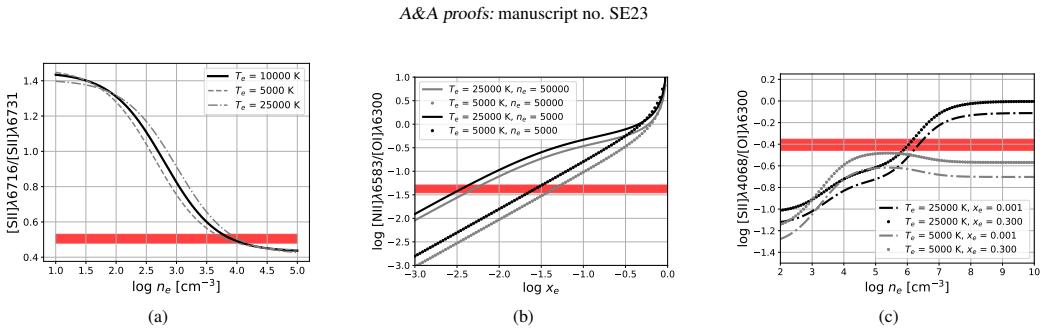
- [Sections 6.2.2 and 6.2.6; Tables A.5 and A.8; Eq. (51)] The multi-line fit that produces the headline parameters is performed on a flux set that the authors themselves flag as internally inconsistent, and the reported fit quality is contradicted by the paper's own atomic data. In the five-level model, [S II]λ4068.6 and [S II]λ10320.5 share the upper level 2Po3/2, so with the A-values of Table A.5 their emissivity ratio is the fixed branching ratio A(4068.6)E(4068.6)/A(10320.5)E(10320.5) ≈ 3.1 at every grid point. The observed ratio in Table A.8 is 39.48/6.06 ≈ 6.5, a residual of ≈0.32 dex, i.e., about 5σ at the quoted errors, which no (ne, Te, xe) can remove. Consequently, the statement in Section 6.2.6 that 'all observed lines are consistent with the best excitation model within 10%' cannot be correct, and the quoted parameters (ne ≈ 45,000–53,000 cm^-3, Te = 7,600–8,000 K, xe ≈ 0.027–0.036) are at least partly a least-squares compromise that absorbs the UVB/NIR inconsistency described in Section 6.2.2. Testing non-zero extinction cannot fix this either, since the observed ratio exceeds the intrinsic branching ratio and would require negative AV. The density result is plausibly anchored by the UVB/VIS ratios ([S II]λ6716/λ6731 ≈ 0.50, [S II]λ4068/λ4076 ≈ 3.6, [S II]λ4068/(λ6716+λ6731) ≈ 1.5), which are mutually consistent and agree with W14; the problem is the global fit's quality claim and the derived Te and xe, which absorb the unmodelable NIR ratios. The authors should either resolve the calibration problem (e.g., telluric correction near 1.03 μm, independent UVB–NIR flux verification) or show explicitly that the fitted parameters are unchanged when the offending ratios are excluded.
- [Section 5.2; Appendix A (Eqs. A.40–A.41); Eq. (22)] The headline parameters are derived from an excitation model that includes only electron-impact collisions, but at the fitted conditions (ne ≈ 5×10^4 cm^-3, xe ≈ 0.03), Eq. (22) gives n(H0) ≈ 1.6×10^6 cm^-3. With neutral hydrogen this abundant, H0-impact excitation is likely comparable to or dominant over electron-impact excitation for several fitted lines (notably [O I] and [N I], whose upper states have known H-collision channels), even for rate coefficients near 10^-10 cm^3 s^-1. Section 5.2 concedes that the missing H-atom collisions affect line emissivities 'to an unknown amount', and no such collisions appear in the five-level model of Appendix A. Because the same model sets the positions of the BE99e stripes and defines the multi-line fit, the derived Te and xe, and hence the normalisation of the density comparison with the classical BE99 result, rest on an acknowledged but unquantified approximation. A sensitivity test (e.g., adding H-collision rates of plausible magnitude and re-fitting, or at least estimating the effect on the [O I] and [N I] lines) is required before the BE99 bias can be attributed specifically to [S II] quenching.
- [Sections 6.2.4–6.2.6; Eq. (25); Fig. 2] The fitted multi-line solution is in tension with the paper's treatment of equilibrium. Eq. (25) and Fig. 2 give xeq_e ≈ 3–4×10^-4 at Te = 7,600–8,000 K, whereas the best fit has xe ≈ 0.027–0.036 at the same temperature, about two orders of magnitude above the reaction-equilibrium value. Section 6.2.6 nevertheless rules out non-equilibrium as the cause of the stripe mismatch ('neither extinction nor non-equilibrium effects are likely responsible'), and Section 6.2.4 argues that the gas 'should have had enough time to stay close enough to the equilibrium'. If the gas were close to the BE99 equilibrium, the fitted xe at Te ≈ 7,800 K should be near 4×10^-4; if the observed ratios genuinely require xe ≈ 0.03 at low Te, then the gas is far from that equilibrium, and non-equilibrium is a live alternative (or additional) explanation for the classical BE99 bias. The dynamical-age estimate of ≈2 yr in Section 6.2.4 is also shorter than the fiducial convergence time τBE ≈ 3 yr of Section 2.6 (with the 192-model spread extending to ≈32 yr), so the timescale argument does not clearly exclude this possibility. The attribution of the BE99 failure to quenching alone is therefore not uniquely supported and should be discussed explicitly.
minor comments (8)
- [Abstract; Section 1] 'We aim to extent the BE99 method' should read 'extend'.
- [Abstract; Section 7] The abstract and conclusions state that 'the BE99 equilibrium is reached faster than the hydrogen recombination time', which contradicts the quantitative example in Section 2.5 (τeq ≈ 8×10^4 yr against τrec ≈ 200 yr for HH34 knot J). This should be reworded to refer explicitly to the BE99-method convergence time τBE introduced in Section 2.6.
- [Section 3.1] 'a visual extinction ABE V in Eq. 3' should refer to Eq. (30), the reddening relation; Eq. (3) is a charge-exchange reaction.
- [Table A.8] The line labels '[OvII]λ7320' and '[SvIII]λ9530' are typos for [O II] and [S III].
- [Section 6.2.6] The quoted parameter ranges (ne ≈ 45,000–53,000 cm^-3, Te = 7,600–8,000 K, xe ≈ 0.027–0.036) are not derived from any stated statistical criterion: the grid spacings are Δne = 100 cm^-3, ΔTe = 100 K, Δxe = 0.001, and no ΔC threshold for Eq. (51), confidence region, or error propagation from Table A.8 is given. The ranges should be defined or stated as approximate.
- [Section 6.2.4] The claim that the Par Lup 3-4 gas 'should have had enough time to stay close enough to the equilibrium' is not quantified; given the ≈2 yr dynamical age computed in the same paragraph and the fiducial τBE ≈ 3 yr of Section 2.6, the authors should provide a τBE estimate at the fitted ne ≈ 5×10^4 cm^-3.
- [Sections 3.2 and Appendix C] The synthetic demonstrations (Figs. A.3–A.7) generate the spectra with the same model that is then used to interpret them, so the overlap of stripes in the equilibrium snapshots is in part a self-consistency check; the manuscript should state this explicitly for the extended diagrams, as it does implicitly for the classic stripes.
- [Section 5.2] 'may not be accessible able to any BE99 method' contains a typo ('accessible able').
Circularity Check
No significant circularity: the Par Lup 3-4 and 244-440 claims are anchored in observed line fluxes; the only self-referential element is the synthetic-spectra consistency test, which is not load-bearing.
-
self definitional
[Section 2.6 and Section 3.2, Figs. 3-4, A.3-A.7]
"These (model-dependent) synthetic spectra can be used as input for the (model-independent) BE99 method. ... In the equilibrium state all stripes cross in one location in the (xe, Te)-space measuring the true gas conditions, if the spectra are correctly dereddened."
The synthetic spectra are generated from the same five-level excitation model (Appendix A) whose line-ratio tables define the BE99/BE99e stripes. At the generating (ne, Te, xe) point, every modelled line ratio equals the corresponding theoretical ratio by construction, so all stripes necessarily intersect there. The simulation therefore demonstrates internal consistency of the model rather than an independent test of the method. The paper labels these spectra 'model-dependent' while calling BE99 'model-independent,' and this is the only self-referential element. It is not load-bearing for the observational applications, which use external measured fluxes from Par Lup 3-4 and 244-440.
full rationale
The paper's central derivation is not circular. The time-dependent ODE network (Section 2, Appendix A) is integrated independently and yields the equilibrium ionisation fractions used in the BE99 relations; the extension to BE99e/e+ adds line ratios from the same excitation model without invoking any new fitted parameter. For Par Lup 3-4, the key result is a genuine observational falsification: the classical BE99 stripes and the added [N I]5198+5200 stripe do not overlap in the (xe, Te) diagram, and this non-overlap cannot be removed by any tested extinction value. The multi-line fit (Section 6.2.6) minimizes Eq. 51 against the observed fluxes, so the quoted ne = 45,000-53,000 cm^-3, Te = 7,600-8,000 K, and xe = 0.027-0.036 are estimates from data, not inputs. The comparison with W14's BE99-derived values is a comparison between two model interpretations of the same data, not a prediction of one from the other. The self-citations (Bacciotti & Eislöffel 1999; Bacciotti et al. 1995) provide the method being tested, and the paper argues against its uncritical application, so the self-citation is not load-bearing. The acknowledged limitations (missing hydrogen-atom collisions in Section 5.2, the inconsistent Miller line ratios in Section 6.2.2) are important correctness risks that could shift the fitted parameters, but they do not make the derivation circular. The only mildly self-referential element is the synthetic-spectra overlap test, which is a model-consistency check and is not used to validate the model against external data; hence the score is 2 rather than 0.
Assumptions & free parameters
free parameters (2)
- x_eq fit parameters A, B, T0, C =
A=0.9785, B=8.778e-4, T0=12000 K, C=-2.1762
- tau_eq scaling constant and exponent =
10 yr and 145528 K
assumptions (4)
- domain assumption The gas is isothermal and only collisional ionisation, radiative/dielectronic recombination, and charge exchange with hydrogen are relevant; photoionisation is neglected.
- domain assumption Collisions with neutral hydrogen atoms are negligible for the level population and ionisation balance.
- domain assumption Solar elemental abundances from Asplund et al. (2009) apply to the jet gas.
- domain assumption The five-level atomic model with the adopted collisional strengths and Einstein coefficients is sufficient to compute the relevant line emissivities.
Cite this review
Pith. "Pith review of Revisiting the BE99 method for the study of outflowing gas in protostellar jets." pith.science (2026). https://pith.science/paper/JAWI7JOD
@misc{pith2026241114253,
  author       = {Pith},
  title        = {Pith review of: Revisiting the BE99 method for the study of outflowing gas in protostellar jets},
  year         = {2026},
  howpublished = {\url{https://pith.science/paper/JAWI7JOD}},
  note         = {Machine review of arXiv:2411.14253}
}
abstract
An established method measuring the hydrogen ionisation fraction in shock excited gas is the BE99 method, which utilises six bright forbidden emission lines of [SII]6716, 6731, [NII]6548, 6583, and [OI]6300, 6363. We aim to extent the BE99 method by including more emission lines in the blue and near-infrared part of the spectrum ($\lambda$ = 3500-11000A), and considering higher hydrogen ionisation fractions ($x_e > 0.3$). In addition, we investigate how a non-equilibrium state of the gas and the presence of extinction influence the BE99 technique. We find that plenty additional emission line ratios can in principle be exploited as extended curves (or stripes) in the ($x_e, T_e$)-diagram. If the BE99 equilibrium is reached and extinction is corrected for, all stripes overlap in one location in the ($x_e, T_e$)-diagram indicating the existing gas parameters. The application to the Par Lup 3-4 outflow shows that the classical BE99 lines together with the [NI]5198+5200 lines do not meet in one locationin the ($x_e, T_e$)-diagram. This indicates that the gas parameters derived from the classical BE99 method are not fully consistent with other observed line ratios. A multi-line approach is necessary to determine the gas parameters. From our analysis we derive $n_e \sim$ 45 000 cm^-3 - 53000 cm^-3 , $T_e$ = 7600K - 8000K, and $x_e \sim$ 0.027 - 0.036 for the Par Lup 3-4 outflow. For the 244-440 Proplyd we were able to use the line ratios of [SII]6716+6731, [OI]6300+6363, and [OII]7320, 7330 in the BE99 diagram to estimate the ionisation fraction at knot E3 ($x_e = 0.58 \pm 0.05$). In conclusion, exploiting new line ratios reveals more insights on the state of the gas. Our analysis indicates, however, that a multi-line approach is more robust in deriving gas parameters, especially for high density gas.
Figures


Figures from the paper (6 more)



Reference graph
Works this paper leans on
-
[1]
, " * write output.state after.block = add.period write newline
ENTRY address archiveprefix author booktitle chapter edition editor howpublished institution eprint journal key month note number organization pages publisher school series title type volume year label extra.label sort.label short.list INTEGERS output.state before.all mid.sentence after.sentence after.block FUNCTION init.state.consts #0 'before.all := #1 ...
-
[2]
write newline
" write newline "" before.all 'output.state := FUNCTION n.dashify 't := "" t empty not t #1 #1 substring "-" = t #1 #2 substring "--" = not "--" * t #2 global.max substring 't := t #1 #1 substring "-" = "-" * t #2 global.max substring 't := while if t #1 #1 substring * t #2 global.max substring 't := if while FUNCTION word.in bbl.in " " * FUNCTION format....
-
[3]
Aggarwal , K. M. & Keenan , F. P. 1999, , 123, 311
work page 1999
-
[4]
J., & Scott , P
Asplund , M., Grevesse , N., Sauval , A. J., & Scott , P. 2009, , 47, 481
2009
- [5]
- [6]
-
[7]
Bacciotti , F., Whelan , E. T., Alcal \'a , J. M., et al. 2011, , 737, L26
work page 2011
- [8]
Show all 56 references
-
[9]
& Reipurth , B
Bally , J. & Reipurth , B. 2001, , 546, 299
2001
-
[10]
Bautista , M. A. 1999, , 527, 474
1999
-
[11]
A., Clayton , G
Cardelli , J. A., Clayton , G. C., & Mathis , J. S. 1989, in Interstellar Dust, ed. L. J. Allamandola & A. G. G. M. Tielens , Vol. 135, 5--10
1989
-
[12]
2008, , 689, 1112
Coffey , D., Bacciotti , F., & Podio , L. 2008, , 689, 1112
2008
-
[13]
Dopita , M. A. & Sutherland , R. S. 2003, Astrophysics of the diffuse universe
2003
-
[14]
Draine , B. T. 2011, Physics of the Interstellar and Intergalactic Medium
2011
-
[15]
2018, , 868, 28
Fang , M., Pascucci , I., Edwards , S., et al. 2018, , 868, 28
2018
-
[16]
J., Henney , W
Ferland , G. J., Henney , W. J., O'Dell , C. R., et al. 2012, , 757, 79
2012
-
[17]
P., Cabrit , S., et al
Frank , A., Ray , T. P., Cabrit , S., et al. 2014, in Protostars and Planets VI, ed. H. Beuther , R. S. Klessen , C. P. Dullemond , & T. Henning , 451--474
2014
-
[18]
M., et al
Freudling , W., Romaniello , M., Bramich , D. M., et al. 2013, , 559, A96
2013
-
[19]
2015, , 814, 52
Giannini , T., Antoniucci , S., Nisini , B., Bacciotti , F., & Podio , L. 2015, , 814, 52
2015
-
[20]
2013, , 778, 71
Giannini , T., Nisini , B., Antoniucci , S., et al. 2013, , 778, 71
2013
-
[21]
2019, , 631, A44
Giannini , T., Nisini , B., Antoniucci , S., et al. 2019, , 631, A44
2019
-
[22]
2011, , 735, 90
Gorti , U., Hollenbach , D., Najita , J., & Pascucci , I. 2011, , 735, 90
2011
-
[23]
& Morse , J
Hartigan , P. & Morse , J. 2007, , 660, 426
2007
-
[24]
A., & Raymond , J
Hartigan , P., Morse , J. A., & Raymond , J. 1994, , 436, 125
1994
-
[25]
& McKee , C
Hollenbach , D. & McKee , C. F. 1989, , 342, 306
1989
-
[26]
Hudson , C. E. & Bell , K. L. 2005, , 430, 725
2005
-
[27]
Kingdon , J. B. & Ferland , G. J. 1996, , 106, 205
1996
-
[28]
F., Whelan , E
Kirwan , A., Manara , C. F., Whelan , E. T., et al. 2023, , 673, A166
2023
-
[29]
J., Ferland , G
Kisielius , R., Storey , P. J., Ferland , G. J., & Keenan , F. P. 2009, , 397, 903
2009
-
[30]
& Monsignori Fossi , B
Landini , M. & Monsignori Fossi , B. C. 1990, , 82, 229
1990
-
[31]
2014, , 565, A110
Maurri , L., Bacciotti , F., Podio , L., et al. 2014, , 565, A110
2014
-
[32]
E., Henney , W
M \'e ndez-Delgado , J. E., Henney , W. J., Esteban , C., et al. 2021, , 918, 27
2021
-
[33]
Miller , J. S. 1968, , 154, L57
1968
-
[34]
M., et al
Natta , A., Testi , L., Alcal \'a , J. M., et al. 2014, , 569, A5
2014
-
[35]
2020, , 904, L27
Nemer , A., Goodman , J., & Wang , L. 2020, , 904, L27
2020
-
[36]
2005, , 441, 159
Nisini , B., Bacciotti , F., Giannini , T., et al. 2005, , 441, 159
2005
-
[37]
2024, , 683, A116
Nisini , B., Gangi , M., Giannini , T., et al. 2024, , 683, A116
2024
-
[38]
& Storey , P
Nussbaumer , H. & Storey , P. J. 1983, , 126, 75
1983
-
[39]
Osterbrock , D. E. & Ferland , G. J. 2006, Astrophysics of gaseous nebulae and active galactic nuclei
2006
-
[40]
2023, in Astronomical Society of the Pacific Conference Series, Vol
Pascucci , I., Cabrit , S., Edwards , S., et al. 2023, in Astronomical Society of the Pacific Conference Series, Vol. 534, Protostars and Planets VII, ed. S. Inutsuka , Y. Aikawa , T. Muto , K. Tomida , & M. Tamura , 567
2023
-
[41]
1990, , 231, 499
Pequignot , D. 1990, , 231, 499
1990
-
[42]
1991, , 251, 680
Pequignot , D., Petitjean , P., & Boisson , C. 1991, , 251, 680
1991
-
[43]
2006, , 456, 189
Podio , L., Bacciotti , F., Nisini , B., et al. 2006, , 456, 189
2006
-
[44]
2009, , 506, 779
Podio , L., Medves , S., Bacciotti , F., Eisl \"o ffel , J., & Ray , T. 2009, , 506, 779
2009
-
[45]
2007, in Protostars and Planets V, ed
Ray , T., Dougados , C., Bacciotti , F., Eisl \"o ffel , J., & Chrysostomou , A. 2007, in Protostars and Planets V, ed. B. Reipurth , D. Jewitt , & K. Keil , 231
2007
-
[46]
& Whelan , E
Riaz , B. & Whelan , E. T. 2015, , 815, L31
2015
-
[47]
2013, , 772, 60
Rigliaco , E., Pascucci , I., Gorti , U., Edwards , S., & Hollenbach , D. 2013, , 772, 60
2013
-
[48]
2020, , 640, A13
Santamar \' a-Miranda , A., de Gregorio-Monsalvo , I., Hu \'e lamo , N., et al. 2020, , 640, A13
2020
-
[49]
C., Schultz , D
Stancil , P. C., Schultz , D. R., Kimura , M., et al. 1999, , 140, 225
1999
-
[50]
Tayal , S. S. 2006, , 163, 207
2006
-
[51]
Tayal , S. S. 2007, , 171, 331
2007
-
[52]
Tayal , S. S. & Gupta , G. P. 1999, , 526, 544
1999
-
[53]
Tayal , S. S. & Zatsarinny , O. 2010, , 188, 32
2010
-
[54]
van Dokkum , P. G. 2001, , 113, 1420
2001
-
[55]
E., et al
Virtanen, P., Gommers, R., Oliphant, T. E., et al. 2020, Nature Methods, 17, 261
2020
-
[56]
T., Bonito , R., Antoniucci , S., et al
Whelan , E. T., Bonito , R., Antoniucci , S., et al. 2014, , 565, A80
2014
Reviewed August 12, 2026 · model on record in the stance chip above.
Discussion (0). Continue with ORCID to comment.