REVIEW 3 major objections 6 minor 37 references
Limitations of the Generalized Pareto Distribution-based estimators for the local dimension
T0 review · 3 major / 6 minor · reviewed 2026-08-12 · deepseek-v4-flash
Pith's one-line read This paper demonstrates that the standard GPD-based local dimension estimator fails when the invariant measure is not regularly varying, which is the norm for singular measures on non-integer-dimensional sets.
desk verdict A likely correct and practically important caution about GPD-based local dimensions, but the Cantor proof is not clean and the numerical evidence has a sampling caveat. read the letter →
The pith
A machine-rendered reading of the paper's core claim, the machinery that carries it, and where it could break.
The reading
What carries the argument
The load-bearing object is the regular variation property of the invariant measure, written $\mu(B_{br}(\zeta))/\mu(B_r(\zeta)) \to b^\gamma$ as $r \to 0$ for every $0<b\le 1$; when it holds, $\gamma$ equals the local dimension. The paper's main diagnostic is the finite-radius ratio $R(r)=\mu(B_{r/2}(\zeta))/\mu(B_r(\zeta))$, which should converge to $2^{-\Delta_\zeta}$ if the measure is regularly varying. By computing $R(r)$ from the closest recurrences of a trajectory to $\zeta$, the paper turns an abstract measure property into a testable curve for each system and links its oscillations to the geometry of the attractor at successive scales. A second mechanism is the cluster-length interpretation of the extremal index $\theta$, which the paper uses to show that index-based estimates from fixed-step samples of continuous flows cannot be compared across sampling frequencies or trajectory lengths.
What would settle it
Run the EBD algorithm on the Hénon attractor with trajectory lengths spanning at least three orders of magnitude and thresholds $q=0.98$, $0.99$, and $0.995$ at a fixed set of reference points; if the estimated local dimension is the same across all these choices at small radii, the central claim that the lack of regular variation makes estimates resolution dependent is wrong.
Extended reading notes
Core claim
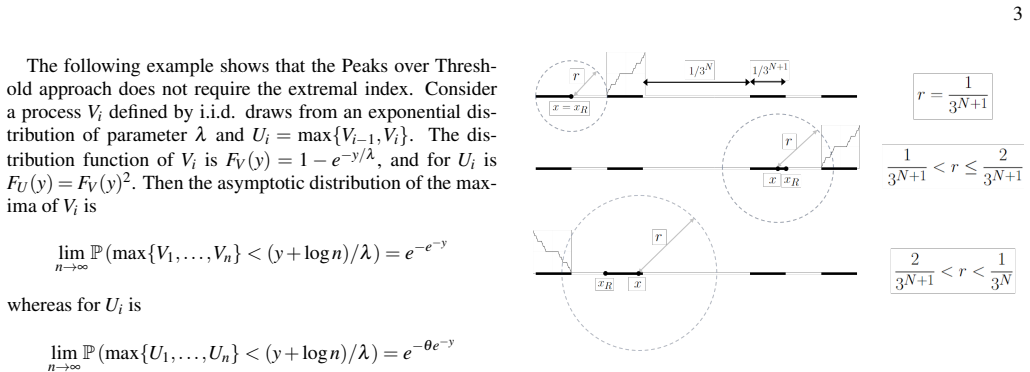
On the paper's own terms, the central discovery is a mismatch between a theorem and its users: the GPD/exceedance derivation gives an exponential law with rate the local dimension only when the invariant measure is regularly varying, and this property is not a harmless technicality. For the middle-third Cantor set with the (1/2,1/2) Bernoulli measure the paper proves that the ratio $\mu(B_{r/2}(\zeta))/\mu(B_r(\zeta))$ never converges to the required limit; for the Hénon map, the solenoid, Lorenz 63, and Lorenz 96 it gives numerical evidence that the same ratio oscillates at all small scales, with the solenoid showing synchronized oscillations for every reference point because of uniform hyperbolicity. A fat Cantor set of positive Lebesgue measure and dimension one is regularly varying and works, isolating measure-theoretic scaling rather than topological roughness as the deciding factor. The paper also argues that the common index-based estimator of the extremal index is ambiguous for continuous flows sampled at fixed time steps: its output depends on sampling frequency, trajectory length, and threshold, and rescaling by the time step does not restore comparability.
Load-bearing premise
The load-bearing premise is that the 5,000 closest returns of a finite orbit to a reference point are effectively independent and dense enough to faithfully sample the measure of the ball of radius $r$ around $\zeta$ at every radius; the paper itself notes the method may be sensitive to the order of the data.
Editorial extensions
If this is right
- EBD outputs for a single reference point should not be read as a unique local dimension: for Hénon, Lorenz 63, and the solenoid the estimate oscillates as the radius shrinks, so changing the threshold or the data length can change the answer.
- The average of many EBD estimates can be close to the true information dimension even when each estimate is invalid, so agreement with other dimension estimates is not evidence that the method's assumptions hold.
- For discrete systems, the extremal index does not appear in the peaks-over-threshold limit and equals one for almost every point except a measure-zero set of special points, so including it in a GPD fit lacks mathematical justification in the paper's account.
- For continuous systems sampled at fixed time steps, extremal-index estimates depend on sampling frequency, trajectory length, and quantile, and renormalizing by the time step does not yield a time-independent cluster duration.
- Regular variation, not chaos or fractal topology by itself, is the deciding condition: a fat Cantor set with positive Lebesgue measure works, while zero-measure non-integer-dimensional supports generally do not.
Reading between the lines
- A testable extension to real data: before reporting a GPD local dimension, plot $R(r)$ over at least two decades of radii; the paper's results predict that many published estimates fail to show a plateau, but this has not been checked systematically on climate data.
- The solenoid approximation in the appendix suggests a structural diagnostic: in uniformly hyperbolic attractors, $R(r)$ oscillations should synchronize across reference points at radii spaced by powers of the contraction factor $a$, so synchronized oscillations in data would signal geometric, not statistical, failure of regular variation.
- The fat Cantor example suggests a possible fix: instead of assuming regular variation, one could model the slowly varying factor $l(r)$ explicitly and estimate the local dimension from the oscillation pattern of $R(r)$; whether this recovers stable values on Hénon or Lorenz attractors remains untested.
Editorial analysis
A structured set of objections, weighed in public.
Referee Report
Summary. The paper investigates the mathematical assumptions behind the Generalized Pareto Distribution-based (GPD) estimator of the local dimension, which the authors call the Exceedance-Based Dimension (EBD) algorithm. It argues that the EBD algorithm requires, in addition to ergodicity and stationarity, the existence of the local dimension almost everywhere and regular variation of the invariant measure. The central claim is that singular measures supported on sets of non-integer dimension are typically not regularly varying, so that EBD estimates become resolution dependent. Section III.A attempts to prove non-regular variation for the (1/2,1/2) Bernoulli measure on the middle-third Cantor set; Sections III.B–III.D present numerical evidence for the fat Cantor set, the Hénon map, and the solenoid, and Section IV discusses the ambiguity of index-based extremal index estimators for continuous-time processes sampled at fixed time steps. The paper concludes that the EBD algorithm should not be applied without additional checks and that the extremal index should not be included in the GPD exceedance distribution.
Significance. The manuscript addresses a practically important and timely question: the GPD-based local dimension estimator is widely used in climate and dynamical-systems applications, and a demonstration that its output can be resolution dependent would be a significant cautionary result. The paper has several concrete strengths: the exact dimension of the solenoid is known and the approximation in Appendix B is validated against it over 16 orders of magnitude; the code and data are publicly available; and the discussion of the extremal index in the peaks-over-threshold framework, including the worked example in Section II, is instructive. If the analytic and numerical evidence is brought to the required standard, the paper would be a valuable contribution. However, the central analytic proof in Section III.A is incomplete as written, and the numerical evidence for the non-regularity of the Hénon, Lorenz, and solenoid measures rests on an uncontrolled sampling proxy.
major comments (3)
- [Section III.A, Eq. (5)] The proof that the (1/2,1/2) Bernoulli measure on the middle-third Cantor set is not regularly varying is incomplete as written. The b=1/2 construction with r=2/3^{N+1} yields ratio 1 only when ζ is an endpoint in the specific configuration described; the assertion that such radii “can be found for any point ζ ∈ C∞” is not proved and is not a consequence of the displayed ball-measure formula. The b=1/3 calculation, if the self-similarity ratio µ(B_{r/3}(ζ))/µ(B_r(ζ)) = 1/2 is accepted, is exactly the regular-variation value b^{log2/log3} and therefore by itself supports Eq. (5) with γ = log2/log3 rather than refuting it; the contradiction requires a second sequence of radii with a different limiting ratio for the same ζ, and the text does not supply such a sequence for a fixed generic ζ. Since this is the only analytic demonstration of non-regular variation, the central claim needs a corrected proof (for example, using the ternary structure to show that for a typical ζ the ratio for b=1/2 along r=3^{-n} does not converge to 2^{-γ}).
- [Section III.D and Appendix B] The statement that the solenoid provides a “counterexample” to the claim in Ref. 23 is an overstatement. The evidence is the numerical evaluation of the approximate formula (B3), which rests on three simplifying assumptions (uniform measure along branches, straight branches, and total length 2π) whose error is not quantified. The fact that the slope of the approximate log-measure plot matches the known Hausdorff dimension over 16 orders of magnitude is a useful validation of the approximation, but it does not prove that the true invariant measure of the solenoid is not regularly varying. The authors should either prove a rigorous lower bound on the oscillations of µ_S(B_{r/2}(ζ))/µ_S(B_r(ζ)) using the exact solenoid dynamics, or describe the result as numerical evidence that challenges the applicability of Ref. 23.
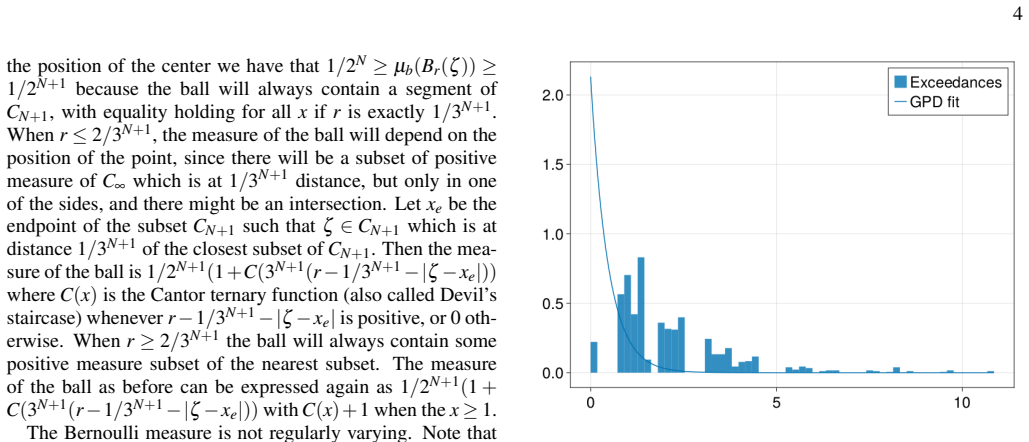
- [Section III.B and Figures 3–5] The numerical computation of R(r) = µ(B_{r/2}(ζ))/µ(B_r(ζ)) by retaining the 5000 closest recurrences of a single finite orbit and treating them as samples of the invariant measure is an uncontrolled approximation; the paper itself notes that the method “might be sensitive to the order in which the data is distributed.” No convergence check with respect to trajectory length is reported, and the 1000-point averages in Figures 5 and 8 do not by themselves rule out finite-sample bias. Consequently, the observed oscillations for Hénon, Lorenz 63, and Lorenz 96, and the claim in Section V that no singular measure on a non-integer-dimensional attractor was regularly varying, are not fully established. The authors should add a finite-sample robustness test (for example, varying the number of recurrences and comparing with direct Monte Carlo estimates of µ(B_r)) or temper the conclusions.
minor comments (6)
- [Section III.A] The displayed ratio formula has a missing closing parenthesis in µ(B_r(ζ)), and the preceding sentence contains a grammatical typo: “The measure of ball a radius r.”
- [Section III.A] The Cantor ternary function C(·) is used in the ball-measure formula but is never defined; please define it.
- [Section III.B] The phrase “a nowhere dense set of isolated points” is contradictory for a Cantor set; the intended meaning is presumably “a nowhere dense set with no isolated points.”
- [Figure 1] The figure caption contains the informal instruction “(Change x for ζ in figure)”; please remove it and make the notation consistent.
- [Section III.D] The statement that for Axiom A systems the local dimension is constant µ-a.e. and equal to the Hausdorff dimension needs a qualifier (for example, for the SRB measure); as written it is too broad.
- [Appendix B] The notation P_{φ_k} and the definition of the Poincaré section would benefit from a short explanatory paragraph or a diagram; the current derivation is dense.
Circularity Check
No significant circularity: the paper's central claims are benchmarked against independent known dimensions and its analytical arguments do not presuppose the conclusions.
full rationale
The paper's central derivation (Section II) is self-contained: it starts from the definition of local dimension (Eq. 4), defines regular variation (Eq. 5), and derives the exponential excess law (Eq. 7). The conclusion that EBD requires regular variation, and that its failure makes estimates resolution dependent, follows from these definitions rather than being assumed. The Cantor-set analysis (Section III.A) attempts an independent mathematical demonstration of non-regular variation for the (1/2,1/2) Bernoulli measure; even if the asserted b=1/3 self-similarity identity is not fully justified for every point and radius (the skeptic's correctness concern), that would be a gap in a proof, not circularity, because the asserted identity is not the same as the paper's target conclusion. The numerical sections compare EBD and R(r) estimates against independent benchmarks: log2/log3 for the Cantor set, 1.26 +/- 0.02 for Hénon from Grassberger [22], exact Hausdorff dimension 1 - log2/log a for the solenoid, and 2.06 +/- 0.01 for Lorenz 63 from Grassberger-Procaccia [21]. These known values are used as external references, not fitted inputs. The solenoid approximation (Appendix B) is stated as a set of explicit simplifications and is validated by matching the exact dimension rather than by tuning to the observed oscillations. The self-citations ([8], [19], [32]) provide a review, a book, and code for the correlation estimator; the correlation estimator itself is defined in Appendix A and attributed to Grassberger-Procaccia, so none of these citations carries the central argument. The paper's own caveats (e.g., Hénon-Heiles is 'not very conclusive', the recurrence proxy 'might be sensitive to the order in which the data is distributed', and the solenoid approximation does not quantify error) concern numerical robustness and mathematical rigor, not circular use of target results. No equation reduces by construction to a fitted parameter or to a self-citation.
Assumptions & free parameters
free parameters (2)
- threshold quantile q =
0.99 (fixed); 1 - 1/sqrt(tl/dt) (varying)
- sampling interval dt =
varied across runs; e.g., 0.0198 in length experiments
assumptions (4)
- domain assumption Invariant measures exist and orbits sample them ergodically for the numerical systems
- ad hoc to paper The exact formula for the Bernoulli measure of balls on the middle-third Cantor set in Section III.A is correct
- ad hoc to paper The simplified solenoid model in Appendix B (uniform measure along straight branches, total length 2π) accurately approximates µ_S at small scales
- standard math Background extreme value theory: GPD limit requires regular variation and the excess distribution tends to exponential with parameter 1/Δ
Cite this review
Pith. "Pith review of Limitations of the Generalized Pareto Distribution-based estimators for the local dimension." pith.science (2026). https://pith.science/paper/ASTXVA7C
@misc{pith2026241114297,
  author       = {Pith},
  title        = {Pith review of: Limitations of the Generalized Pareto Distribution-based estimators for the local dimension},
  year         = {2026},
  howpublished = {\url{https://pith.science/paper/ASTXVA7C}},
  note         = {Machine review of arXiv:2411.14297}
}
read the original abstract
Two dynamical indicators, the local dimension and the extremal index, used to quantify persistence in phase space have been developed and applied to different data across various disciplines. These are computed using the asymptotic limit of exceedances over a threshold, which turns to be a Generalized Pareto Distribution in many cases. However the derivation of the asymptotic distribution requires mathematical properties which are not present even in highly idealized dynamical systems, and unlikely to be present in real data. Here we examine in detail issues that arise when estimating these quantities for some known dynamical systems with a particular focus on how the geometry of an invariant set can affect the regularly varying properties of the invariant measure. We demonstrate that singular measures supported on sets of non-integer dimension are typically not regularly varying and that the absence of regular variation makes the estimates resolution dependent. We show as well that the most common extremal index estimation method is ambiguous for continuous time processes sampled at fixed time steps, which is an underlying assumption in its application to data.
Figures

Figures from the paper (6 more)


Reference graph
Works this paper leans on
-
[1]
merlin.mbs aapmrev4-1.bst 2010-07-25 4.21a (PWD, AO, DPC) hacked
FUNCTION id.bst "merlin.mbs aapmrev4-1.bst 2010-07-25 4.21a (PWD, AO, DPC) hacked" ENTRY address archive archivePrefix author bookaddress booktitle chapter collaboration doi edition editor eid eprint howpublished institution isbn issn journal key language month note number organization pages primaryClass publisher school SLACcitation series title translat...
2010
-
[2]
merlin.mbs aipauth4-1.bst 2010-07-25 4.21a (PWD, AO, DPC) hacked
FUNCTION id.bst "merlin.mbs aipauth4-1.bst 2010-07-25 4.21a (PWD, AO, DPC) hacked" ENTRY address archive archivePrefix author bookaddress booktitle chapter collaboration doi edition editor eid eprint howpublished institution isbn issn journal key language month note number organization pages primaryClass publisher school SLACcitation series title translat...
2010
-
[3]
merlin.mbs aipnum4-1.bst 2010-07-25 4.21a (PWD, AO, DPC) hacked
FUNCTION id.bst "merlin.mbs aipnum4-1.bst 2010-07-25 4.21a (PWD, AO, DPC) hacked" ENTRY address archive archivePrefix author bookaddress booktitle chapter collaboration doi edition editor eid eprint howpublished institution isbn issn journal key language month note number organization pages primaryClass publisher school SLACcitation series title translati...
2010
-
[4]
merlin.mbs apsrev4-1.bst 2010-07-25 4.21a (PWD, AO, DPC) hacked
FUNCTION id.bst "merlin.mbs apsrev4-1.bst 2010-07-25 4.21a (PWD, AO, DPC) hacked" ENTRY address archive archivePrefix author bookaddress booktitle chapter collaboration doi edition editor eid eprint howpublished institution isbn issn journal key language month note number organization pages primaryClass publisher school SLACcitation series title translati...
2010
-
[5]
merlin.mbs apsrmp4-1.bst 2010-07-25 4.21a (PWD, AO, DPC) hacked
FUNCTION id.bst "merlin.mbs apsrmp4-1.bst 2010-07-25 4.21a (PWD, AO, DPC) hacked" ENTRY address archive archivePrefix author bookaddress booktitle chapter collaboration doi edition editor eid eprint howpublished institution isbn issn journal key language month note number organization pages primaryClass publisher school SLACcitation series title translati...
2010
-
[6]
author author T. Alberti , author M. Anzidei , author D. Faranda , author A. Vecchio , author M. Favaro , \ and\ author A. Papa ,\ title title Dynamical diagnostic of extreme events in venice lagoon and their mitigation with the mose , \ @noop journal journal Scientific Reports \ volume 13 ,\ pages 10475 ( year 2023 ) NoStop
work page 2023
-
[7]
author author D. Faranda , author G. Messori , \ and\ author P. Yiou ,\ title title Dynamical proxies of north atlantic predictability and extremes , \ @noop journal journal Scientific reports \ volume 7 ,\ pages 1--10 ( year 2017 ) NoStop
work page 2017
-
[8]
author author D. Faranda , author G. Messori , author M. C. \ Alvarez-Castro , \ and\ author P. Yiou ,\ title title Dynamical properties and extremes of northern hemisphere climate fields over the past 60 years , \ @noop journal journal Nonlinear Processes in Geophysics \ volume 24 ,\ pages 713--725 ( year 2017 ) NoStop
work page 2017
Show all 37 references
-
[9]
Faranda , author G
author author D. Faranda , author G. Messori , \ and\ author P. Yiou ,\ title title Diagnosing concurrent drivers of weather extremes: application to warm and cold days in north america , \ @noop journal journal Climate Dynamics \ volume 54 ,\ pages 2187--2201 ( year 2020 ) NoStop
2020
-
[10]
Hochman , author P
author author A. Hochman , author P. Alpert , author T. Harpaz , author H. Saaroni , \ and\ author G. Messori ,\ title title A new dynamical systems perspective on atmospheric predictability: Eastern mediterranean weather regimes as a case study , \ @noop journal journal Scien...
2019
-
[11]
Messori , author R
author author G. Messori , author R. Caballero , \ and\ author D. Faranda ,\ title title A dynamical systems approach to studying midlatitude weather extremes , \ @noop journal journal Geophysical Research Letters \ volume 44 ,\ pages 3346--3354 ( year 2017 ) NoStop
2017
-
[12]
Rodrigues , author M
author author D. Rodrigues , author M. C. \ Alvarez-Castro , author G. Messori , author P. Yiou , author Y. Robin , \ and\ author D. Faranda ,\ title title Dynamical properties of the north atlantic atmospheric circulation in the past 150 years in cmip5 models and the 20crv2c ...
2018
-
[13]
Datseris , author I
author author G. Datseris , author I. Kottlarz , author A. P. \ Braun , \ and\ author U. Parlitz ,\ title title Estimating fractal dimensions: A comparative review and open source implementations , \ @noop journal journal Chaos: An Interdisciplinary Journal of Nonlinear Scienc...
2023
-
[14]
author author A. C. M. \ Freitas , author J. M. \ Freitas , \ and\ author M. Todd ,\ title title The extremal index, hitting time statistics and periodicity , \ @noop journal journal Advances in Mathematics \ volume 231 ,\ pages 2626--2665 ( year 2012 ) NoStop
2012
-
[15]
author author A. C. M. \ Freitas , author J. M. \ Freitas , \ and\ author M. Todd ,\ title title Speed of convergence for laws of rare events and escape rates , \ @noop journal journal Stochastic Processes and their Applications \ volume 125 ,\ pages 1653--1687 ( year 2015 ) NoStop
2015
-
[16]
Faranda , author V
author author D. Faranda , author V. Lucarini , author G. Turchetti , \ and\ author S. Vaienti ,\ title title Generalized extreme value distribution parameters as dynamical indicators of stability , \ @noop journal journal International Journal of Bifurcation and Chaos \ volum...
2012
-
[17]
Lucarini , author D
author author V. Lucarini , author D. Faranda , author G. Turchetti , \ and\ author S. Vaienti ,\ title title Extreme value theory for singular measures , \ @noop journal journal Chaos: An Interdisciplinary Journal of Nonlinear Science \ volume 22 ( year 2012 ) NoStop
2012
-
[18]
Faranda , author V
author author D. Faranda , author V. Lucarini , author G. Turchetti , \ and\ author S. Vaienti ,\ title title Numerical convergence of the block-maxima approach to the generalized extreme value distribution , \ @noop journal journal Journal of statistical physics \ volume 145 ...
2011
-
[19]
Faranda \ and\ author S
author author D. Faranda \ and\ author S. Vaienti ,\ title title Extreme value laws for dynamical systems under observational noise , \ @noop journal journal Physica D: Nonlinear Phenomena \ volume 280 ,\ pages 86--94 ( year 2014 ) NoStop
2014
-
[20]
Lucarini , author D
author author V. Lucarini , author D. Faranda , author J. Wouters , \ and\ author T. Kuna ,\ title title Towards a general theory of extremes for observables of chaotic dynamical systems , \ @noop journal journal Journal of statistical physics \ volume 154 ,\ pages 723--750 ( ...
2014
-
[21]
Lucarini , author D
author author V. Lucarini , author D. Faranda , \ and\ author J. Wouters ,\ title title Universal behaviour of extreme value statistics for selected observables of dynamical systems , \ @noop journal journal Journal of statistical physics \ volume 147 ,\ pages 63--73 ( year 20...
2012
-
[22]
Ott ,\ @noop title Chaos in dynamical systems \ ( publisher Cambridge university press ,\ year 2002 ) NoStop
author author E. Ott ,\ @noop title Chaos in dynamical systems \ ( publisher Cambridge university press ,\ year 2002 ) NoStop
2002
-
[23]
author author N. R. \ Moloney , author D. Faranda , \ and\ author Y. Sato ,\ title title An overview of the extremal index , \ @noop journal journal Chaos: An Interdisciplinary Journal of Nonlinear Science \ volume 29 ,\ pages 022101 ( year 2019 ) NoStop
2019
-
[24]
Lucarini , author D
author author V. Lucarini , author D. Faranda , author J. M. M. \ de Freitas , author M. Holland , author T. Kuna , author M. Nicol , author M. Todd , author S. Vaienti , et al. ,\ @noop title Extremes and recurrence in dynamical systems \ ( publisher John Wiley & Sons ,\ year...
2016
-
[25]
Falconer ,\ @noop title Fractal geometry: mathematical foundations and applications \ ( publisher John Wiley & Sons ,\ year 2007 ) NoStop
author author K. Falconer ,\ @noop title Fractal geometry: mathematical foundations and applications \ ( publisher John Wiley & Sons ,\ year 2007 ) NoStop
2007
-
[26]
Grassberger \ and\ author I
author author P. Grassberger \ and\ author I. Procaccia ,\ title title Characterization of strange attractors , \ @noop journal journal Physical review letters \ volume 50 ,\ pages 346 ( year 1983 ) NoStop
1983
-
[27]
Grassberger ,\ title title Generalized dimensions of strange attractors , \ @noop journal journal Physics Letters A \ volume 97 ,\ pages 227--230 ( year 1983 ) NoStop
author author P. Grassberger ,\ title title Generalized dimensions of strange attractors , \ @noop journal journal Physics Letters A \ volume 97 ,\ pages 227--230 ( year 1983 ) NoStop
1983
-
[28]
Pons , author G
author author F. Pons , author G. Messori , \ and\ author D. Faranda ,\ title title Statistical performance of local attractor dimension estimators in non-axiom a dynamical systems , \ @noop journal journal Chaos: An Interdisciplinary Journal of Nonlinear Science \ volume 33 (...
2023
-
[29]
\ Young ,\ title title Dimension, entropy and lyapunov exponents , \ @noop journal journal Ergodic theory and dynamical systems \ volume 2 ,\ pages 109--124 ( year 1982 ) NoStop
author author L.-S. \ Young ,\ title title Dimension, entropy and lyapunov exponents , \ @noop journal journal Ergodic theory and dynamical systems \ volume 2 ,\ pages 109--124 ( year 1982 ) NoStop
1982
-
[30]
Barreira \ and\ author K
author author L. Barreira \ and\ author K. Gelfert ,\ title title Dimension estimates in smooth dynamics: a survey of recent results , \ @noop journal journal Ergodic Theory and Dynamical Systems \ volume 31 ,\ pages 641--671 ( year 2011 ) NoStop
2011
-
[31]
Barreira \ and\ author B
author author L. Barreira \ and\ author B. Saussol ,\ title title Hausdorff dimension of measures via poincar \'e recurrence , \ @noop journal journal Communications in Mathematical Physics \ volume 219 ,\ pages 443--463 ( year 2001 ) NoStop
2001
-
[32]
Fasen ,\ title title Extremes of continuous--time processes
author author V. Fasen ,\ title title Extremes of continuous--time processes. \ in\ @noop booktitle Handbook of Financial Time Series \ ( publisher Springer ,\ year 2009 )\ pp.\ pages 653--667 NoStop
2009
-
[33]
S \"u veges ,\ title title Likelihood estimation of the extremal index , \ @noop journal journal Extremes \ volume 10 ,\ pages 41--55 ( year 2007 ) NoStop
author author M. S \"u veges ,\ title title Likelihood estimation of the extremal index , \ @noop journal journal Extremes \ volume 10 ,\ pages 41--55 ( year 2007 ) NoStop
2007
-
[34]
author author L. Zhang ,\ title title Borel--cantelli lemmas and extreme value theory for geometric lorenz models , \ @noop journal journal Nonlinearity \ volume 29 ,\ pages 232 ( year 2015 ) NoStop
2015
-
[35]
Barrio , author F
author author R. Barrio , author F. Blesa , \ and\ author S. Serrano ,\ title title Fractal structures in the h \'e non-heiles hamiltonian , \ @noop journal journal Europhysics Letters \ volume 82 ,\ pages 10003 ( year 2008 ) NoStop
2008
-
[36]
Grebogi , author E
author author C. Grebogi , author E. Ott , author S. Pelikan , \ and\ author J. A. \ Yorke ,\ title title Strange attractors that are not chaotic , \ @noop journal journal Physica D: Nonlinear Phenomena \ volume 13 ,\ pages 261--268 ( year 1984 ) NoStop
1984
-
[37]
del Amo \ and\ author G
author author I. del Amo \ and\ author G. Datseris ,\ https://github.com/PythagoreanCult/FractalDimensionsQ title Fractaldimensionsq , \ ( year 2024 ) NoStop
2024
Reviewed August 12, 2026 · model on record in the stance chip above.
Discussion (0). Continue with ORCID to comment.