REVIEW 4 major objections 4 minor 20 references
Optimal Transcoding Preset Selection for Live Video Streaming
T0 review · 4 major / 4 minor · reviewed 2026-08-12 · deepseek-v4-flash
Pith's one-line read Choosing a transcoding preset and bitrate per video segment, using predicted rate-distortion curves, minimizes total distortion under bitrate and time constraints.
desk verdict The joint ILP formulation is a real contribution, but the headline PSNR and BD-rate gains rest on an evaluation that may be circular and is definitely in-sample. read the letter →
The pith
A machine-rendered reading of the paper's core claim, the machinery that carries it, and where it could break.
The reading
What carries the argument
The load-bearing object is the centroid rate-distortion curve: each video segment is assigned by an SVM classifier (polynomial kernel, 73% accuracy) to one of six R-D clusters, and the fitted centroid curve of that cluster supplies the distortion value $D_{ij}$ for every candidate preset $p$ and bitrate $r$. Transcoding times $T_{ij}$ come from per-preset LightGBM regressors with roughly 2% mean absolute percentage error. An integer linear program then chooses one definition $(p,r)$ per segment, using binary variables $x_{ij}$ and constraints on total bitrate and total transcoding time, to minimize summed distortion. The CBC branch-and-cut solver is used because the problem must be solved within the live-streaming time budget.
What would settle it
Run the ILP on the same 877 six-segment sequences with two sets of distortion coefficients: the predicted cluster centroids used in the paper, and each segment's measured R-D curves. If the measured-curve solution yields average PSNR substantially higher than the predicted-centroid solution, or if the predicted solution's actual encoded PSNR falls well short of the reported 9.45 dB improvement, then the learned R-D prediction, not the optimization, is carrying the reported gain.
Extended reading notes
Core claim
The central claim is that the joint selection of preset and bitrate for a sequence of video segments can be posed as an integer linear program and solved in real time, provided the objective coefficients come from learned predictions rather than exhaustive encoding. The paper's specific result is that assigning each two-second segment the preset/bitrate pair that minimizes predicted distortion, under a total bitrate cap of 30000 kbps and a transcoding-time cap of 11 seconds, yields 9.45 dB higher average PSNR than encoding every segment with the veryfast preset at 5000 kbps, and 5.92 dB over the fast preset. A follow-up comparison varying the bitrate cap produces a BD-rate of -49.60%, meaning the optimized selection needs roughly half the bitrate of the veryfast baseline to reach the same average PSNR. The paper presents this as an extension of prior work that predicted transcoding time, adding R-D classification and ILP-based assignment.
Load-bearing premise
The claim rests on the fitted centroid R-D curve of a segment's predicted cluster being a faithful estimate of that segment's true distortion at every preset and bitrate, so that the ILP's chosen preset/bitrate pairs are near-optimal even when the SVM's 73% class assignment is wrong.
Editorial extensions
If this is right
- Live transcoders can shift from fixed presets to per-segment preset/bitrate selection using only header and metadata features, with no pre-encoding pass.
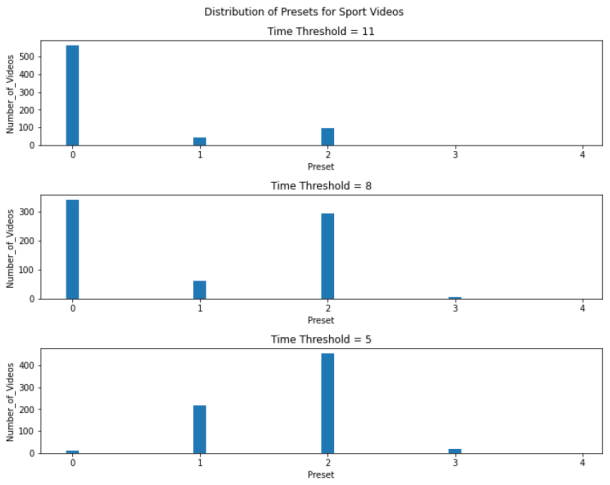
- Content complexity drives preset allocation: under tight time caps, simpler content keeps higher-quality presets while complex content moves to faster presets, as shown by the music versus sports distributions.
- The same total bitrate budget buys about 1.5 dB higher PSNR per segment with optimized selection than with Twitch's veryfast default.
- The BD-rate result implies that, at matched quality, the optimized selection consumes roughly half the bitrate of the fixed veryfast configuration.
- Prediction and optimization costs (0.02 seconds each) are small relative to the two-second segment duration, so the approach fits a real-time budget.
Reading between the lines
- The 9.45 dB gain is computed against predicted cluster centroids, not measured per-segment R-D curves; an oracle comparison would likely show a smaller gain, with the 73% classifier accuracy setting an upper bound on prediction quality.
- The formulation is codec-agnostic: retraining the features and R-D clusters for HEVC or AV1 could transfer the same ILP pipeline to other codecs.
- Because cluster centroids are static, the framework could drift on live streams whose content changes; an online cluster-refinement or anomaly detector is a natural extension.
- The approach could be combined with resolution selection (bitrate ladders) by expanding the definition set from (preset, bitrate) to (preset, bitrate, resolution).
Editorial analysis
A structured set of objections, weighed in public.
Referee Report
Summary. This paper proposes a three-stage framework for live video transcoding: extract lightweight features from ingested video segments, predict per-preset transcoding time with LightGBM regressors and predict an R-D cluster label with an SVM, and then solve an integer linear program that selects a (preset, bitrate) pair for each segment to minimize total distortion subject to total bitrate and transcoding time constraints. The method is evaluated on the YouTube UGC dataset (165 videos, 877 two-second chunks, 10 bitrates x 5 presets). The authors report that the ILP selection improves average PSNR by 9.45 dB over a veryfast 5000 kbps baseline and 5.92 dB over a fast baseline, and a BD-rate reduction of -49.60% versus the veryfast baseline.
Significance. If the reported gains were obtained from measured PSNR on held-out content, the paper would make a useful practical contribution: the problem is relevant, the ILP formulation is standard, and the decomposition into predicted R-D classes and predicted transcoding times is a reasonable way to avoid exhaustive encoding. The use of the public UGC dataset and the explicit treatment of both bitrate and time constraints are strengths. The transcoding-time predictor is assessed with cross-validation and reports small MAPE values. However, the central quality-gain claim is not yet established because the evaluation protocol leaves open the possibility that the ILP is scored on the same predicted R-D curves used to optimize, and because the optimization evaluation is not performed on a held-out set.
major comments (4)
- [Section IV-F and Section III-C.2] The reported +9.45 dB and +5.92 dB PSNR gains are ambiguous because the text does not state whether the PSNR of the ILP-selected options is measured from actual transcodes or taken from the same cluster-centroid R-D curves used as D_ij in the ILP objective. Section III-C.2 says that once the SVM assigns a class, "its centroid R-D curve determines its rate and distortion characteristics," and Section IV-F says only that "the sum of PSNR, transcoding time, and bitrate for the selected options for each segment is recorded." If the latter values come from the centroid curves, then the optimization is scored on its own surrogate, and the reported gain does not demonstrate real quality improvement. The authors must state the evaluation protocol explicitly and, ideally, report both predicted and measured PSNR.
- [Section IV-B and Section IV-F] The ILP evaluation draws random six-chunk sequences from the same 877-chunk pool used to fit the K-means centroids and train the SVM, with no held-out split described. Section IV-B says the dataset is used to train the regression, clustering, and classification models, and Section IV-F then applies the ILP to chunks drawn from that same pool. This makes the headline PSNR and BD-rate numbers a training-set evaluation and overstates generalization to new live-stream content. A held-out evaluation, or nested cross-validation, with measured PSNR is required.
- [Section III-C and Section III-D] The central surrogate assumption, that a segment's cluster-centroid fitted R-D curve accurately represents its true distortion at every preset and bitrate, is not validated. With the reported SVM accuracy of 73%, the effect of misclassification and within-cluster R-D variance on the ILP solution is unknown. The authors should include an oracle experiment comparing the ILP solution obtained from predicted cluster centroids with the ILP solution obtained from true per-segment measured R-D curves, reporting the resulting difference in measured PSNR and BD-rate.
- [Section IV-G] The BD-rate comparison of -49.60% needs the same clarification as the main PSNR result: are the R-D points for the ILP method measured or predicted? The text says the PSNR of the encoded segments was recorded, but it does not specify whether the encoding was actually performed for each selected configuration or whether stored/predicted values were used. The description should also clarify how the bitrate threshold is applied to the baseline2 method in each BD-rate point, so that both methods are compared under the same constraint structure.
minor comments (4)
- [Throughout] There are several typos and duplicated elements, e.g., "efficient" in the problem statement, "tabel" in Section IV-D, "the performs presolving" in Section III-D, and a duplicated "Fig. 9" caption in Section IV-G; these should be corrected.
- [Section III-A] The claim that the features are embedded in the header and metadata and that extracting them "incurs no extra processing time" is not fully supported; motion-vector and QP features require parsing the encoded stream, and the paper should specify the extraction cost or cite a reference that quantifies it.
- [Table V] The table caption should explicitly define baseline1 and baseline2, since the text introduces them several paragraphs earlier and the current caption is not self-contained.
- [Section V] The conclusion refers to "linear programming" while the method is integer linear programming; the terminology should be consistent throughout the paper.
Circularity Check
No significant circularity: the ILP evaluation is consistent with measured data, and self-citations are not load-bearing.
full rationale
The claimed derivation chain is not circular on the evidence quoted in the paper. The R-D prediction stage fits cluster centroids to measured R-D curves and uses those centroids as the D_ij values in the ILP objective, but the evaluation stage reports PSNR and BD-rate from the stored/recorded transcoding results for the selected options (Section IV-F: 'the sum of PSNR, transcoding time, and bitrate for the selected options for each segment is recorded'; Section IV-G: 'the PSNR of the encoded segments with these two configurations was recorded'). Because the dataset generation section states that all videos were transcode at all target bitrates and presets with time and R-D stored, the reported gains are not identical by construction to the fitted centroid curves. Self-citations to prior works [2] and [16] provide component methods (time regressors, clustering/curve fitting), but the paper independently validates time prediction (Tables II-III, Figure 5) and SVM classification (Table IV), so the central ILP claim does not reduce to an unverified self-citation. The paper could have been more explicit about whether the evaluation PSNR was measured or predicted, but absent a quoted equation or table showing that the same predicted D_ij values are reused as the reported outcome, no specific circular reduction can be exhibited. Consequently, no circularity step meets the required evidentiary standard.
Assumptions & free parameters
free parameters (3)
- K (number of R-D clusters) =
6
- SVM kernel and hyperparameters =
polynomial kernel, degree 2
- Cluster centroid R-D curve fitting coefficients =
not reported
assumptions (3)
- domain assumption Header/metadata and motion features are sufficient to predict R-D class and transcoding time.
- domain assumption Each segment's R-D behavior is well represented by its cluster centroid curve for every preset.
- domain assumption Target bitrates can be summed to enforce the bandwidth constraint.
Cite this review
Pith. "Pith review of Optimal Transcoding Preset Selection for Live Video Streaming." pith.science (2026). https://pith.science/paper/6F2JP5TM
@misc{pith2026241114613,
  author       = {Pith},
  title        = {Pith review of: Optimal Transcoding Preset Selection for Live Video Streaming},
  year         = {2026},
  howpublished = {\url{https://pith.science/paper/6F2JP5TM}},
  note         = {Machine review of arXiv:2411.14613}
}
read the original abstract
In today's digital landscape, video content dominates internet traffic, underscoring the need for efficient video processing to support seamless live streaming experiences on platforms like YouTube Live, Twitch, and Facebook Live. This paper introduces a comprehensive framework designed to optimize video transcoding parameters, with a specific focus on preset and bitrate selection to minimize distortion while respecting constraints on bitrate and transcoding time. The framework comprises three main steps: feature extraction, prediction, and optimization. It leverages extracted features to predict transcoding time and rate-distortion, employing both supervised and unsupervised methods. By utilizing integer linear programming, it identifies the optimal sequence of presets and bitrates for video segments, ensuring real-time application feasibility under set constraints. The results demonstrate the framework's effectiveness in enhancing video quality for live streaming, maintaining high standards of video delivery while managing computational resources efficiently. This optimization approach meets the evolving demands of video delivery by offering a solution for real-time transcoding optimization. Evaluation using the User Generated Content dataset showed an average PSNR improvement of 1.5 dB over the default Twitch configuration, highlighting significant PSNR gains. Additionally, subsequent experiments demonstrated a BD-rate reduction of -49.60%, reinforcing the framework's superior performance over Twitch's default configuration.
Figures


Figures from the paper (7 more)


Reference graph
Works this paper leans on
-
[2]
High-Quality Live Video Streaming via Transcoding Time Prediction and Preset Selection
Z. N. Shahre -Babak, N. Karimi, K. Rapaka, T. Amara, S. Samavi, and S. Shirani, “High -quality live video streaming via transcoding time prediction and preset selection,” arXiv preprint arXiv:2312.05348, 2023
work page Pith review arXiv 2023
-
[16]
A Parametric Rate-Distortion Model for Video Transcoding
M. Jamali, N. Karimi, S. Samavi, and S. Shirani, “A parametric rate-distortion model for video transcoding,” arXiv preprint arXiv:2404.09029, 2024. 23
work page Pith review arXiv 2024
-
[1]
Dvc: An end -to-end deep video compression framework,
G. Lu, W. Ouyang, D. Xu, X. Zhang, C. Cai, and Z. Gao, “Dvc: An end -to-end deep video compression framework,” in Proceedings of the IEEE/CVF Conference on Computer Vision and Pattern Recognition, 2019, pp. 11 006 –11 015
work page 2019
-
[3]
Rate -distortion methods for image and video compression,
A. Ortega and K. Ramchandran, “Rate -distortion methods for image and video compression,” IEEE Signal processing magazine, vol. 15, no. 6, pp. 23 –50, 1998
work page 1998
-
[4]
Youtube ugc dataset for video compression research
Y. Wang, S. Inguva, and B. Adsumilli, “Youtube ugc dataset for video compression research.” IEEE, 2019, pp. 1–5
work page 2019
-
[5]
Optimal Transcoding Resolution Prediction for Efficient Per-Title Bitrate Ladder Estimation
J. Yang, M. Guo, S. Zhao, J. Li, and L. Zhang, “Optimal transcoding resolution prediction for efficient per-title bitrate ladder estimation,” arXiv preprint arXiv:2401.04405, 2024
work page Pith review arXiv 2024
-
[6]
Video transcoding optimization based on input perceptual quality,
Y. Wang, H. Talebi, F. Yang, J. G. Yim, N. Birkbeck, B. Adsumilli, and P. Milanfar, “Video transcoding optimization based on input perceptual quality,” in Applications of Digital Image Processing XLIII, vol. 11510. SPIE, 2020, pp. 201 –211
-
[7]
Optimizing immersive video coding configurations using deep learning: a case study on tmiv,
C.-F. Hsu, T.-H. Hung, and C.-H. Hsu, “Optimizing immersive video coding configurations using deep learning: a case study on tmiv,” ACM Transactions on Multimedia Computing, Communications, and Applications (TOMM), vol. 18, no. 1, pp. 1 –25, 2022
work page 2022
Show all 20 references
-
[8]
Complexity-oriented per-shot video coding optimization,
H. Zhong, J. Xu, C. Zhu, D. Feng, and L. Song, “Complexity-oriented per-shot video coding optimization,” in 2022 IEEE International Conference on Multimedia and Expo (ICME). IEEE, 2022, pp. 1 –6
2022
-
[9]
Bjøntegaard delta (bd): A tutorial overview of the metric, evolution, challenges, and recommendations,
N. Barman, M. G. Martini, and Y. Reznik, “Bjøntegaard delta (bd): A tutorial overview of the metric, evolution, challenges, and recommendations,” arXiv preprint arXiv:2401.04039, 2024
2024 arXiv
-
[10]
Video super-resolution for optimized bitrate and green online streaming,
V. V. Menon, P. T. Rajendran, A. Premkumar, B. Bross, and D. Marpe, “Video super-resolution for optimized bitrate and green online streaming,” arXiv preprint arXiv:2402.03513, 2024
2024 arXiv
-
[11]
Optimizing video streaming for sustainability and quality: The role of preset selection in per-title encoding,
H. Amirpour, V. V. Menon, S. Afzal, R. Prodan, and C. Timmerer, “Optimizing video streaming for sustainability and quality: The role of preset selection in per-title encoding,” in 2023 IEEE International Conference on Multimedia and Expo (ICME). IEEE, 2023, pp. 1679 –1684
2023
-
[12]
Complexity-based consistent-quality encoding in the cloud,
J. De Cock, Z. Li, M. Manohara, and A. Aaron, “Complexity-based consistent-quality encoding in the cloud,” in 2016 IEEE International Conference on Image Processing (ICIP). IEEE, 2016, pp. 1484 –1488
2016
-
[13]
Optimized transcoding for large scale adaptive streaming using playback statistics,
C. Chen, Y.-C. Lin, S. Benting, and A. Kokaram, “Optimized transcoding for large scale adaptive streaming using playback statistics,” in 2018 25th IEEE International Conference on Image Processing (ICIP). IEEE, 2018, pp. 3269 –3273
2018
-
[14]
R. E. Bellman and S. E. Dreyfus, Applied dynamic programming. Princeton university press, 2015, vol. 2050
2015
-
[15]
Image quality assessment: from error visibility to structural similarity,
Z. Wang, A. C. Bovik, H. R. Sheikh, and E. P. Simoncelli, “Image quality assessment: from error visibility to structural similarity,” IEEE transactions on image processing, vol. 13, no. 4, pp. 600 –612, 2004
2004
-
[17]
Cbc user guide,
J. Forrest and R. Lougee-Heimer, “Cbc user guide,” in Emerging theory, methods, and applications. INFORMS, 2005, pp. 257 –277
2005
-
[18]
Coin -or: an open-source library for optimization,
M. J. Saltzman, “Coin -or: an open-source library for optimization,” Programming languages and systems in computational economics and finance, pp. 3 –32, 2002
2002
-
[19]
Adapool: Exponential adaptive pooling for information-retaining downsampling,
A. Stergiou and R. Poppe, “Adapool: Exponential adaptive pooling for information-retaining downsampling,” IEEETransactions on Image Processing, vol. 32, pp. 251 –266, 2022
2022
-
[20]
Lightgbm: A highly efficient gradient boosting decision tree,
G. Ke, Q. Meng, T. Finley, T. Wang, W. Chen, W. Ma, Q. Ye, and T.-Y. Liu, “Lightgbm: A highly efficient gradient boosting decision tree,” Advances in neural information processing systems, vol. 30, 2017
2017
Reviewed August 12, 2026 · model on record in the stance chip above.
Discussion (0). Continue with ORCID to comment.