REVIEW 3 major objections 5 minor 29 references
Automatic Inference of Relational Object Invariants
T0 review · 3 major / 5 minor · reviewed 2026-08-12 · deepseek-v4-flash
Pith's one-line read The paper shows that isolating the most recently used object in a per-bank cache lets an abstract interpreter infer relational object invariants such as buffer length not exceeding capacity, and that the resulting domain outperforms the…
desk verdict The MRU-cache idea is good and the evaluation is solid, but the printed cacheSync equations have the used flag inverted, which breaks the soundness argument as written. read the letter →
The pith
A machine-rendered reading of the paper's core claim, the machinery that carries it, and where it could break.
The reading
What carries the argument
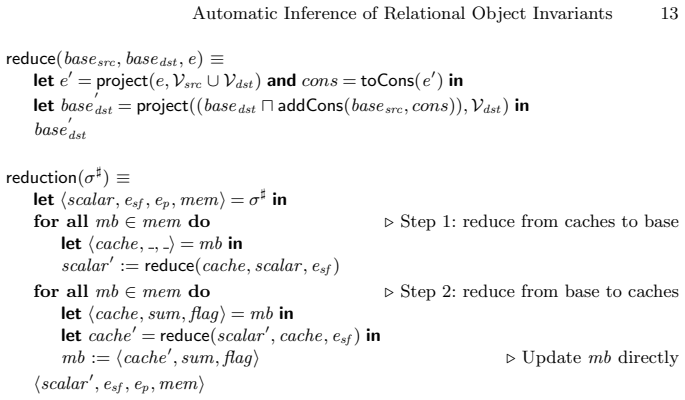
The load-bearing mechanism is the pair of operations pack♯ and unpack♯, driven by the cacheSync♯ function on every load or store. When a dereferenced pointer does not alias the cached object, cacheSync♯ flushes the dirty cache into the bank's summary object (pack♯), copies the summary into the cache as the new MRU object (unpack♯), and records the pointer-equality cachebase ≈ ptrbase in the equality domain. This isolates every field update to the single concrete object, so numerical invariants like len <= cap are maintained in the summary even while the cached object is temporarily out of invariant. A bidirectional domain reduction uses the field-scalar equalities (e.g., len ≈ i and cap ≈ sz) to refine the cache from scalar facts and vice versa, which is what lets the analysis discover the relational invariant in the first place.
What would settle it
Run the analysis on a set of programs whose memory safety is independently checked by a bounded model checker with a large unwinding bound; any assertion that the analysis proves safe but the checker finds a counterexample for would refute the central claim. More directly, search for a program whose reachable states under the recent-use memory model differ from those under the standard C memory model—for example, via an aliased write that a cache flush overwrites in one model but not the other.
Extended reading notes
Core claim
The central discovery is that recency of use, not recency of allocation, is the right axis for precise heap abstraction. The paper defines RUMM, in which memory is partitioned into banks, each bank holds its objects in a storage region and has a cache that contains at most one object—the most recently used one. All accesses go through the cache: on a miss, the current cache object is 'packed' back into the summary that stands for all objects in the bank, and the newly addressed object is 'unpacked' from that summary. Because the cache holds a single concrete object, writes to it are strong updates that cannot weaken the summary's invariants. The resulting MRUD abstract domain, a reduced product of numerical and equality sub-domains over scalars and fields, therefore infers object invariants such as len <= cap that are broken transiently during a series of field updates, and the evaluation shows it proves all assertions in a small benchmark suite while outperforming the prior summarization domain by two orders of magnitude on average run time.
Load-bearing premise
The load-bearing premise is that the recent-use memory model, with its per-bank cache and storage, faithfully preserves all reachable states of the standard C memory model, so that invariants proved under RUMM transfer to the real program.
Editorial extensions
If this is right
- Assertions that require relational object invariants—like the len <= cap check that recency-based and prior summarization-based analyses both fail to prove—become provable in the same abstract-interpretation pipeline.
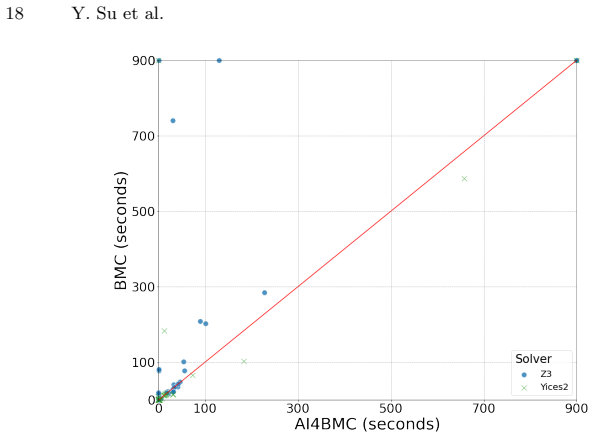
- Pre-processing with the new domain can discharge a majority of memory-safety assertions before loop unrolling, reducing the work left for a bounded model checker and cutting end-to-end verification time in the majority of evaluated tasks.
- The composite design makes the analysis scalable: because each memory bank is represented by small separate difference-bound matrices, joins are cheap, and the domain reports on average a 76x speedup (up to 81x without reduction) over the single-DBM summarization domain on 114 programs.
- The technique is parameterized by numerical domain, so it can be instantiated with Zones, Octagons, or richer domains; the observed precision limits are tied to the expressiveness of those domains and to unsupported string-length tracking.
Reading between the lines
- The MRU/cache idea could be applied to other clients besides object invariants, such as typestate or shape properties, by choosing a different abstract domain for the cache and the summary; the pack/unpack discipline is largely domain-agnostic.
- The claimed compatibility between RUMM and the standard C memory model suggests that a mechanized bisimulation proof would be a natural next step, since the paper's soundness argument is asserted rather than fully demonstrated.
- Precision could likely be improved beyond the reported results by making the summary non-uniform—for example, by also partitioning summarized objects by recency of allocation, which the paper hints at as a possible combination with extensions of recency abstraction.
- The reported speedup is measured with Zones/Octagons and a heuristic reduction strategy, so a reader should expect different ratios with polyhedral or non-relational numerical domains.
Editorial analysis
A structured set of objections, weighed in public.
Referee Report
Summary. The paper introduces RUMM, a concrete memory model that partitions memory into banks and gives each bank an MRU cache, and MRUD, an abstract domain that represents the cached object exactly while summarizing the rest of the bank. The intended contribution is to enable strong updates to the active object without weakening summarized invariants, thereby inferring relational object invariants such as length <= capacity. The paper defines concrete and abstract transfer functions, a reduction procedure, an implementation in Crab, and an experimental comparison against Crab's summarization domain, Mopsa with recency, and a bounded-model-checking pipeline. The central claim is that MRUD is both more precise and dramatically more scalable than the state of the art.
Significance. If the approach were sound, it would be a valuable contribution to heap abstraction for relational properties: the MRU-cache idea is a natural extension of recency abstraction, and the modular composite domain design is plausible for scalability. The paper provides a public implementation and benchmarks, which is a strength. However, the central claim depends on the correctness of the RUMM semantics and of the MRUD abstraction; the manuscript does not provide a soundness proof, and the formal semantics as printed is internally inconsistent with the paper's own motivating example.
major comments (3)
- [Section 3, Fig. 6 (and Fig. 11)] The guard of cacheSync in Fig. 6 is `¬used ∧ ptrbase ≠ cachebase`. Since Section 3 defines `used` as 'indicating the cache is active', the guard is false for every access after the first one (once `used` becomes `true`), so the cache is never flushed or refreshed on a miss. This contradicts the execution shown in Fig. 4b, where a second object is loaded into the cache even though `used` is `true` at step (1). Concretely, the trace `store(&A,len,1); store(&B,len,2)` leaves `B` untouched and writes `A.len=2`. The abstract `cacheSync♯` in Fig. 11 inherits the same inverted condition, so the analysis can update a stale cached object and discharge assertions about the wrong object (e.g., the Fig. 1 example would update the obsolete `p` object rather than `ary[0]`). This is a load-bearing error: it breaks the claimed bisimulation in Section 3 and the soundness of the abstract semantics.
- [Section 4, soundness paragraph] The paper explicitly omits the soundness proof of the abstract semantics ('We omit it here since the abstraction is straightforward') and only asserts the bisimulation between RUMM and CMM via two informal reasons in Section 3. Given that the concrete semantics as printed is incorrect (previous comment), the omitted proof cannot be treated as a routine detail. The authors need to provide a rigorous bisimulation proof for RUMM vs CMM and a soundness or Galois-connection argument for the MRUD abstraction, covering the pack/unpack and flushCache operations. Without this, the experimental claims in Section 6 do not establish that the tool proves true assertions.
- [Appendix A, Fig. 19] The helper `flushCache♯` returns `mb` unchanged when `used` is true. Since the domain operations (Fig. 18) call `flushCache♯` specifically to clear each bank's cache before the pairwise lattice operations, the cache remains dirty and active during joins and widening, contrary to the intended semantics described in the text. This is another instance of the inverted `used` condition and should be corrected together with `cacheSync` and `cacheSync♯`.
minor comments (5)
- [Fig. 12 caption] The caption contains a typo: 'after the first iteration opf the loop' should read 'of the loop'.
- [Abstract vs. Section 6] The abstract reports a '75X faster' speedup, while Section 6 reports an average of '76x' for the OPT configuration; these numbers should be made consistent.
- [Sections 4 and 5] The text refers to 'the extended version of the paper' for the full domain operations and the equality domain details, but no link or reference is given for that version; the material should be included or clearly referenced.
- [Table 1] The column headers 'safe warn safe warn' make it difficult to tell which domain each pair of columns belongs to; a clearer layout is needed.
- [Section 1, paragraph on Mopsa] The sentence 'Mopsa with recency does not prove the assertion on line 20, since the inferred invariant is len >0 ∧ cap >1' is confusing because the invariant does not imply len <= cap; it would be clearer to state explicitly that the inferred invariant is too weak to prove the assertion.
Circularity Check
No significant circularity: RUMM/MRUD is defined from its own concrete semantics and evaluated on external benchmarks; self-citations are infrastructural, not load-bearing.
full rationale
The derivation chain is self-contained. Section 3 defines RUMM concretely (Figs. 5-6) and Section 4 derives the abstract transfer functions from that concrete semantics (Figs. 10-11); no parameter is fitted to the benchmarks and no result is defined in terms of the target invariant. The scalability claim is measured on 114 programs including GNU Coreutils, and the case study uses AWS-based tasks, so the headline results are not forced by construction. The paper cites the authors' own CRAB [14] and SeaBMC [26], but only as implementation infrastructure and comparison baseline, not as justification for the central semantic claim. The 7 precision benchmarks are authored by the same group and mirror the motivating examples, but they are used as test inputs, not as fitted data; this is at most a weak evaluation-selection concern, not circularity. The paper explicitly omits the soundness proof ("We omit it here since the abstraction is straightforward", Section 4) and asserts rather than proves a bisimulation between RUMM and CMM (Section 3); these are missing-support/correctness gaps, not circular reductions. A separate noted inconsistency in Fig. 6's cacheSync guard (`\neg used \land ptrbase \neq cachebase`) would, if real, be a soundness bug in the printed semantics, but it does not make the derivation circular.
Assumptions & free parameters
assumptions (5)
- standard math Abstract interpretation framework and standard numeric domains (Zones/Octagons) are sound.
- domain assumption CrabIR is an adequate IR and the C-to-CrabIR compilation with SeaDsa preserves the relevant heap structure.
- ad hoc to paper RUMM is bisimilar to the standard C memory model.
- ad hoc to paper The abstract pack/unpack operations soundly approximate concrete flush/refresh.
- domain assumption Heap objects in the same memory bank can be merged into one summary object without losing the invariants of interest.
invented entities (3)
-
Recent-use memory model (RUMM) with per-bank cache and storage
-
MRUD abstract domain (reduced product with equality domains)
-
MRU cache and summary object with pack/unpack operations
Cite this review
Pith. "Pith review of Automatic Inference of Relational Object Invariants." pith.science (2026). https://pith.science/paper/Q2RVQPFP
@misc{pith2026241114735,
  author       = {Pith},
  title        = {Pith review of: Automatic Inference of Relational Object Invariants},
  year         = {2026},
  howpublished = {\url{https://pith.science/paper/Q2RVQPFP}},
  note         = {Machine review of arXiv:2411.14735}
}
read the original abstract
Relational object invariants (or representation invariants) are relational properties held by the fields of a (memory) object throughout its lifetime. For example, the length of a buffer never exceeds its capacity. Automatic inference of these invariants is particularly challenging because they are often broken temporarily during field updates. In this paper, we present an Abstract Interpretation-based solution to infer object invariants. Our key insight is a new object abstraction for memory objects, where memory is divided into multiple memory banks, each containing several objects. Within each bank, the objects are further abstracted by separating the most recently used (MRU) object, represented precisely with strong updates, while the rest are summarized. For an effective implementation of this approach, we introduce a new composite abstract domain, which forms a reduced product of numerical and equality sub-domains. This design efficiently expresses relationships between a small number of variables (e.g., fields of the same abstract object). We implement the new domain in the CRAB abstract interpreter and evaluate it on several benchmarks for memory safety. We show that our approach is significantly more scalable for relational properties than the existing implementation of CRAB. For evaluating precision, we have integrated our analysis as a pre-processing step to SEABMC bounded model checker, and show that it is effective at both discharging assertions during pre-processing, and significantly improving the run-time of SEABMC.
Figures


Figures from the paper (15 more)






Reference graph
Works this paper leans on
-
[1]
Balakrishnan, G., Reps, T.W.: Recency-abstraction for heap-allocated storage. In: Yi, K. (ed.) Static Analysis, 13th International Symposium, SAS 2006, Seoul, Korea, August 29-31, 2006, Proceedings. Lecture Notes in Computer Science, vol. 4134, pp. 221–239. Springer (2006). https://doi.org/10.1007/11823230_15, https://doi.org/10.1007/11823230_15 Automatic...
-
[3]
Blanchet, B., Cousot, P., Cousot, R., Feret, J., Mauborgne, L., Min´ e, A., Monniaux, D., Rival, X.: A static analyzer for large safety-critical software. In: Cytron, R., Gupta, R. (eds.) Proceedings of the ACM SIGPLAN 2003 Conference on Program- ming Language Design and Implementation 2003, San Diego, California, USA, June 9-11, 2003. pp. 196–207. ACM (2...
-
[4]
Chang, B.E., Leino, K.R.M.: Inferring object invariants: Extended abstract. In: Cortesi, A., Logozzo, F. (eds.) Proceedings of the First International Workshop on Abstract Interpretation of Object-oriented Languages, AIOOL@VMCAI 2005, Paris, France, January 21, 2005. Electronic Notes in Theoretical Computer Science, vol. 131, pp. 63–74. Elsevier (2005). h...
-
[5]
Chase, D.R., Wegman, M.N., Zadeck, F.K.: Analysis of pointers and structures. In: Fischer, B.N. (ed.) Proceedings of the ACM SIGPLAN’90 Conference on Pro- gramming Language Design and Implementation (PLDI), White Plains, New York, USA, June 20-22, 1990. pp. 296–310. ACM (1990). https://doi.org/10.1145/93 542.93585, https://doi.org/10.1145/93542.93585
-
[6]
In: Aho, A.V., Zilles, S.N., Rosen, B.K
Cousot, P., Cousot, R.: Systematic design of program analysis frameworks. In: Aho, A.V., Zilles, S.N., Rosen, B.K. (eds.) Conference Record of the Sixth Annual ACM Symposium on Principles of Programming Languages, San Antonio, Texas, USA, January 1979. pp. 269–282. ACM Press (1979). https://doi.org/10.1145/5677 52.567778, https://doi.org/10.1145/567752.567778
-
[7]
Cousot, P., Cousot, R., Feret, J., Mauborgne, L., Min´ e, A., Monniaux, D., Rival, X.: Combination of abstractions in the astr´ ee static analyzer. In: Okada, M., Satoh, I. (eds.) Advances in Computer Science - ASIAN 2006. Secure Software and Related Issues, 11th Asian Computing Science Conference, Tokyo, Japan, December 6-8, 2006, Revised Selected Papers...
-
[8]
Cousot, P., Cousot, R., Mauborgne, L.: The reduced product of abstract domains and the combination of decision procedures. In: Hofmann, M. (ed.) Foundations of Software Science and Computational Structures - 14th International Conference, FOSSACS 2011, Held as Part of the Joint European Conferences on Theory and Practice of Software, ETAPS 2011, Saarbr¨ u...
work page 2011
-
[9]
Dutertre, B.: Yices 2.2. In: Biere, A., Bloem, R. (eds.) Computer Aided Verification - 26th International Conference, CA V 2014, Held as Part of the Vienna Summer of Logic, VSL 2014, Vienna, Austria, July 18-22, 2014. Proceedings. Lecture Notes in Computer Science, vol. 8559, pp. 737–744. Springer (2014).https://doi.org/10.1 007/978-3-319-08867-9_49 , htt...
Show all 29 references
-
[10]
In: Rival, X
Gange, G., Navas, J.A., Schachte, P., Søndergaard, H., Stuckey, P.J.: Exploit- ing sparsity in difference-bound matrices. In: Rival, X. (ed.) Static Analysis - 23rd International Symposium, SAS 2016, Edinburgh, UK, September 8-10, 22 Y. Su et al. 2016, Proceedings. Lecture Not...
2016 doi
-
[11]
GNU Project: Gnu core utilities official page, https://www.gnu.org/software/c oreutils/
-
[12]
In: Jensen, K., Podelski, A
Gopan, D., DiMaio, F., Dor, N., Reps, T.W., Sagiv, S.: Numeric domains with summarized dimensions. In: Jensen, K., Podelski, A. (eds.) Tools and Algo- rithms for the Construction and Analysis of Systems, 10th International Con- ference, TACAS 2004, Held as Part of the Joint Eu...
2004
-
[13]
In: Lodaya, K., Mahajan, M
Gulwani, S., Tiwari, A., Necula, G.C.: Join algorithms for the theory of unin- terpreted functions. In: Lodaya, K., Mahajan, M. (eds.) FSTTCS 2004: Founda- tions of Software Technology and Theoretical Computer Science, 24th International Conference, Chennai, India, December 16...
2004 doi
-
[14]
In: Bloem, R., Dimitrova, R., Fan, C., Sharygina, N
Gurfinkel, A., Navas, J.A.: Abstract interpretation of LL VM with a region-based memory model. In: Bloem, R., Dimitrova, R., Fan, C., Sharygina, N. (eds.) Software Verification - 13th International Conference, VSTTE 2021, New Haven, CT, USA, October 18-19, 2021, and 14th Inter...
2021 doi
-
[15]
In: American Fed- eration of Information Processing Societies: 1982 National Computer Conference, 7-10 June, 1982, Houston, Texas, USA
Huston, B.: Single-chip microcomputers can be easy to program. In: American Fed- eration of Information Processing Societies: 1982 National Computer Conference, 7-10 June, 1982, Houston, Texas, USA. AFIPS Conference Proceedings, vol. 51, pp. 85–93. AFIPS Press (1982). https://...
1982
-
[16]
In: Podelski, A
Journault, M., Min´ e, A., Ouadjaout, A.: Modular static analysis of string ma- nipulations in C programs. In: Podelski, A. (ed.) Static Analysis - 25th Interna- tional Symposium, SAS 2018, Freiburg, Germany, August 29-31, 2018, Proceed- ings. Lecture Notes in Computer Science...
2018 doi
-
[17]
In: Eiter, T., Sands, D
Kahsai, T., Kersten, R., R¨ ummer, P., Sch¨ af, M.: Quantified heap invariants for object-oriented programs. In: Eiter, T., Sands, D. (eds.) LPAR-21, 21st Inter- national Conference on Logic for Programming, Artificial Intelligence and Rea- soning, Maun, Botswana, May 7-12, 20...
2017 doi
-
[18]
Acta Informatica 6, 133–151 (1976)
Karr, M.: Affine relationships among variables of a program. Acta Informatica 6, 133–151 (1976). https://doi.org/10.1007/BF00268497 , https://doi.org/10.1 007/BF00268497
1976 doi
-
[19]
In: Sarkar, V., Hall, M.W
Lattner, C., Adve, V.S.: Automatic pool allocation: improving performance by controlling data structure layout in the heap. In: Sarkar, V., Hall, M.W. (eds.) Proceedings of the ACM SIGPLAN 2005 Conference on Programming Language Design and Implementation, Chicago, IL, USA, Jun...
2005
-
[20]
Prentice-Hall, Inc., USA (1997)
Meyer, B.: Object-oriented software construction (2nd ed.). Prentice-Hall, Inc., USA (1997)
1997
-
[21]
In: Danvy, O., Filinski, A
Min´ e, A.: A new numerical abstract domain based on difference-bound matrices. In: Danvy, O., Filinski, A. (eds.) Programs as Data Objects, Second Symposium, PADO 2001, Aarhus, Denmark, May 21-23, 2001, Proceedings. Lecture Notes in Computer Science, vol. 2053, pp. 155–172. S...
2001 doi
-
[22]
In: Burd, E., Aiken, P., Koschke, R
Min´ e, A.: The octagon abstract domain. In: Burd, E., Aiken, P., Koschke, R. (eds.) Proceedings of the Eighth Working Conference on Reverse Engineering, WCRE’01, Stuttgart, Germany, October 2-5, 2001. p. 310. IEEE Computer Society (2001). https://doi.org/10.1109/WCRE.2001.957...
2001
-
[23]
In: Sankara- narayanan, S., Sharygina, N
Monat, R., Ouadjaout, A., Min´ e, A.: Mopsa-c: Modular domains and relational abstract interpretation for C programs (competition contribution). In: Sankara- narayanan, S., Sharygina, N. (eds.) Tools and Algorithms for the Construction and Analysis of Systems - 29th Internatio...
2023
-
[24]
In: Ramakrishnan, C.R., Rehof, J
de Moura, L.M., Bjørner, N.S.: Z3: an efficient SMT solver. In: Ramakrishnan, C.R., Rehof, J. (eds.) Tools and Algorithms for the Construction and Analysis of Systems, 14th International Conference, TACAS 2008, Held as Part of the Joint Eu- ropean Conferences on Theory and Pra...
2008 doi
-
[25]
In: Notes of the ACM SIGPLAN Workshop on ML
Okasaki, C., Gill, A.: Fast mergeable integer maps. In: Notes of the ACM SIGPLAN Workshop on ML. pp. 77–86 (1998)
1998
-
[26]
In: Griggio, A., Rungta, N
Priya, S., Su, Y., Bao, Y., Zhou, X., Vizel, Y., Gurfinkel, A.: Bounded model checking for LL VM. In: Griggio, A., Rungta, N. (eds.) 22nd Formal Methods in Computer-Aided Design, FMCAD 2022, Trento, Italy, October 17-21, 2022. pp. 214–224. IEEE (2022). https://doi.org/10.34727...
2022 doi
-
[27]
In: Hermenegildo, M.V., Palsberg, J
Rondon, P.M., Kawaguchi, M., Jhala, R.: Low-level liquid types. In: Hermenegildo, M.V., Palsberg, J. (eds.) Proceedings of the 37th ACM SIGPLAN-SIGACT Sym- posium on Principles of Programming Languages, POPL 2010, Madrid, Spain, January 17-23, 2010. pp. 131–144. ACM (2010). ht...
2010
-
[28]
In: M¨ uller-Olm, M., Seidl, H
Toubhans, A., Chang, B.E., Rival, X.: An abstract domain combinator for sepa- rately conjoining memory abstractions. In: M¨ uller-Olm, M., Seidl, H. (eds.) Static Analysis - 21st International Symposium, SAS 2014, Munich, Germany, Septem- ber 11-13, 2014. Proceedings. Lecture ...
2014 doi
-
[30]
18: Generic algorithm for the lattice operations
≡ let ⟨scalar1, esf 1, ep 1, mem 1⟩ = σ♯ 1 in let ⟨scalar2, esf 2, ep 2, mem 2⟩ = σ♯ 2 in for allmb1 ∈ mem 1 do mb1 := flushCache♯(mb1) ▷ Update mb1 directly for allmb2 ∈ mem 2 do mb2 := flushCache♯(mb2) ▷ Update mb2 directly ⟨scalar1 op♯ scalar2, esf 1 op♯ esf 2, ep 1 op♯ ep ...
-
[529]
https://doi.org/10.1007/978- 3- 540- 24730- 2_38 , https://doi.org/10.1007/978-3-540-24730-2_38
Springer (2004). https://doi.org/10.1007/978- 3- 540- 24730- 2_38 , https://doi.org/10.1007/978-3-540-24730-2_38
2004 doi
Reviewed August 12, 2026 · model on record in the stance chip above.
Discussion (0). Continue with ORCID to comment.