REVIEW 2 major objections 7 minor 47 references
Scalable Wavelength Arbitration for Microring-based DWDM Transceivers
T0 review · 2 major / 7 minor · reviewed 2026-08-12 · deepseek-v4-flash
Pith's one-line read Wavelength arbitration can run without any absolute wavelength information: a relation-search and single-step matching scheme achieves near-perfect agreement with the ideal wavelength-aware model, outperforming the sequential tuning…
desk verdict Strong systems paper with a genuinely useful arbitration algorithm, but the headline 'near-perfect alignment' claim is partly a byproduct of CAFP being a joint probability rather than a conditional one. read the letter →
The pith
A machine-rendered reading of the paper's core claim, the machinery that carries it, and where it could break.
The reading
What carries the argument
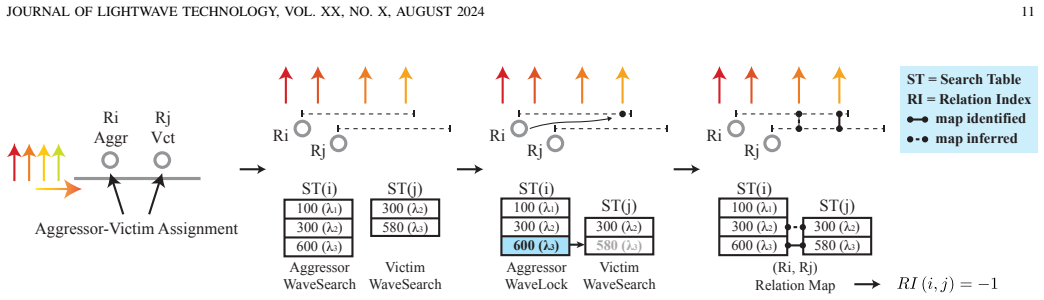
The load-bearing mechanism is the microring relation search, which converts a global assignment problem into local pairwise comparisons that need no absolute wavelength knowledge. Because light on the shared waveguide bus encounters microrings in a fixed physical order, an upstream microring can act as an aggressor: it locks to one of the peaks in its wavelength-search table, and the downstream victim's search shows that same wavelength masked. The offset between the aggressor's chosen entry and the victim's masked entry defines the relation index $RI(i,j)$, which vertically aligns the two microrings' search tables. Monotonic thermal tuning and a shared free-spectral-range periodicity let the algorithm infer the whole alignment from that single masked entry, so only $N_{ch}$ relation searches are needed instead of one per pair. The matching phase arranges the offset search tables into a lock allocation table and assigns each microring its lock target in a single pass, grouping microrings when a relation search returns no index; when grouping occurs, the first and last microrings of each group take the first and last entries of their search tables, which the paper proves by contradiction matches what the ideal wavelength-aware model would do.
What would settle it
Run the record phase on a tested microring row whose adjacent rings have anti-correlated resonance offsets, or a thermal gradient that mimics one: if the masked-entry inference produces a wrong relation index, the measured conditional failure probability will rise far above the simulated near-zero value at the same tuning range. A sharper check is to sweep the free-spectral-range mismatch between two adjacent rings until their search tables alias wavelengths differently; the point at which the inferred $RI(i,j)$ is off by one marks exactly where the paper's inference assumption breaks.
Extended reading notes
Core claim
The paper's core claim is that microring initialization is an arbitration problem that can be split cleanly into a policy layer and an algorithm layer, and that the algorithm layer can operate with no absolute wavelength information at all. It defines three policies by spectral ordering enforcement, Lock-to-Deterministic (LtD), Lock-to-Cyclic (LtC), and Lock-to-Any (LtA), and evaluates them with an ideal wavelength-aware model that measures arbitration failure at the policy level. The algorithm layer implements LtC through two phases: a record phase in which consecutive microring pairs perform relation searches, where one microring locks to a wavelength that masks the corresponding entry in the partner's search table and yields a relation index aligning the two tables, and a matching phase in which Single-Step Matching offsets all search tables by their relation indices into a lock allocation table and assigns every microring a unique laser wavelength in one pass. The paper reports that this scheme, and its variation-tolerant variant VT-RS/SSM, achieves near-perfect alignment with the ideal model, with conditional failure probability near zero across most of the sweep, while outperforming the sequential tuning baseline across the swept parameter space and under both natural and permuted spectral orderings.
Load-bearing premise
The simulations assume post-fabrication laser and microring variations are independent uniform distributions with hand-selected half-ranges, and that tuner behavior is monotonic with a consistent free-spectral-range periodicity across the row, so one masked wavelength entry reveals the full relation map; if real chips show correlated variations or thermal crosstalk, the reported near-zero conditional failure probabilities may not transfer to hardware.
Editorial extensions
If this is right
- Transceiver initialization no longer needs any absolute wavelength measurement or global arbiter; the same per-microring search and lock circuits plus a digital matching pass can assign every ring a unique laser tone.
- Lock-to-Cyclic enforcement lets the row absorb global laser and microring offsets as a cyclic shift, so the tuning range requirement stays near the grid span rather than growing with the offset, with the minimum tuning range saturating as local variation covers the free spectral range.
- The conditional failure metric separates algorithmic quality from policy feasibility, so total failure probability can be budgeted as the sum of the policy-level AFP and the algorithm-level CAFP, enabling yield analysis at each layer.
- In the swept design space, VT-RS/SSM keeps near-zero conditional failure probability even at 5% FSR variation and 20% tuning-range variation, a regime where the sequential tuning baseline fails frequently.
- The scheme works for arbitrary target spectral orderings, not just the natural ordering, so designers can permute ring placements for crosstalk or thermal reasons without changing the arbitration algorithm.
Reading between the lines
- If the scheme transfers to hardware, the arbitration circuitry is identical for every channel, per-ring search and lock loops plus a small matching pass, so per-lane initialization cost could stay roughly flat as DWDM counts scale toward 32 channels, provided thermal crosstalk during the record phase is contained.
- A testable by-product is that the algorithm's failure probability should rise sharply when the ring free spectral range is under-designed below $N_{ch}\times\lambda_{gS}$; that sensitivity could double as a cheap on-chip FSR screening test before full arbitration is run.
- The policy ladder suggests an unstated intermediate option, enforcement that allows only mirrored (reversed) orderings rather than all cyclic shifts, which might cancel a different class of global offsets while keeping remapping cost below full cyclic reordering.
- Running the same record and matching procedure on a receiver row with the inverse target ordering could let a transmitter-receiver pair line up their lane orderings without any bit shuffling, an extension the paper leaves open.
Editorial analysis
A structured set of objections, weighed in public.
Referee Report
Summary. This paper addresses the problem of initializing microring-based DWDM transceivers by introducing the concept of wavelength arbitration. It proposes three arbitration policies—Lock-to-Deterministic, Lock-to-Cyclic, and Lock-to-Any—and a hierarchical evaluation framework that separates policy-level failures from algorithm-level failures using two metrics, AFP and CAFP. The main algorithmic contribution is a wavelength-oblivious relation-search and single-step-matching scheme (RS/SSM) for the LtC policy, together with a variation-tolerant variant (VT-RS/SSM). The paper reports Monte Carlo simulations (10,000 trials) showing that the proposed schemes outperform sequential tuning and approximate the ideal wavelength-aware model, with simulator code made publicly available. The fundamental definitions are coherent and the simulation methodology is transparent, but the CAFP metric is not actually a conditional probability as it is defined, which confounds the paper's central 'near-perfect alignment' claim.
Significance. If the central claim holds, the paper makes a useful contribution to silicon-photonics DWDM transceiver initialization. The separation of policy (spectral-ordering enforcement) from algorithm (wavelength-oblivious arbitration) is a clean abstraction, and the O(Nch) relation-search construction is an appealing way to avoid requiring global wavelength information. Strengths include the publicly released simulator, the explicit hierarchical decomposition of failure modes, and the transparency about modeling limitations such as the zeroth-order σrLV bound and the exclusion of thermal crosstalk. The policy-level scaling analysis in Section IV is informative. However, the headline quantity CAFP is defined in Eq. (6) as a joint probability, not a conditional one, so the absolute claim that VT-RS/SSM 'achieves near-perfect alignment with the ideal model' is not yet supported as stated. The issue is readily fixable by also reporting the direct conditional failure rate or by restricting the claim to the policy-success region, which is why my recommendation is major revision rather than rejection.
major comments (2)
- [III-B, Eq. (6)] The metric named 'Conditional Arbitration Failure Probability' is not a conditional probability as it is defined and computed. Eq. (6) states CAFP = P_alg|succ(fail) P(succ), and Section III-B explains that the denominator is the total number of trials, not the number of trials in which ideal arbitration succeeds. The quantity is therefore P(alg fail ∩ ideal succ), a joint probability. The surrounding prose, however, describes CAFP as 'the likelihood of arbitration failure at the algorithmic level when the ideal wavelength-aware arbitration model of the corresponding policy succeeds.' This mismatch is load-bearing: in the low-tuning-range/high-σrLV corner, P(succ) is near zero (see Fig. 4(b)), so CAFP can be small even when the algorithm fails in every case where the ideal policy succeeds. The abstract and Section V-D use low CAFP to support the 'near-perfect alignment' claim. I ask the authors to recompute and report the direct conditional probability P(alg fail | ideal succ), or to relabel CAFP as a joint probability and adjust the alignment claims accordingly.
- [V-D, Fig. 14] The shmoo plots in Fig. 14 conflate two different causes of white (low-CAFP) regions: algorithmic agreement with the ideal policy, and policy-level failure where the ideal arbitration itself succeeds rarely or never. The text acknowledges that low CAFP at high σrLV and small tuning range is 'due to policy-level failures,' but the same plots are then cited as evidence that RS/SSM and VT-RS/SSM 'closely approximates the ideal LtC arbitration.' Because both the proposed schemes and the sequential baseline are scaled by the same P(succ), the relative comparison is not necessarily invalid, but the absolute alignment claim is confounded. I recommend plotting the conditional failure probability over trials where ideal arbitration succeeds, or overlaying the AFP = 0 contour so that the policy-success region is clearly visible.
minor comments (7)
- [II-C, Eq. (3)] In the paragraph after Eq. (3), the text says 'σgO is derived as the sum of σlGV and σlLV'; from the definitions in Table I it should be σlGV and σrGV (laser global plus microring global).
- [V-D] The sentence 'Fig. 14 shows the CAFP across different local resonance variations (σlLV)' should refer to σrLV, the microring local resonance variation, matching the axis label and Section IV.
- [Table I] The table entry for ¯λTR reads '¯λT R –1 Tuning range mean' with a stray '–1'; please state units (nm) and clarify that σTR is a percentage of λ̄TR.
- [Fig. 14] The color scale maps all values below 1e-4 to the same white, so 'white' regions include small nonzero CAFP values; annotating the threshold or using contours would make the shmoo easier to interpret.
- [V-C] The correctness argument for the RI = ϕ matching strategy is a brief contradiction sketch; a formal statement would make the matching-phase claim easier to verify, especially for readers interested in generalizing the algorithm.
- [Fig. 7] The legend in Fig. 7 uses 'LtC-P/N' while Table II defines the configuration as 'LtC-P/P'; please check and correct this inconsistency.
- [V-D] The 'scalable' wording goes beyond the demonstrated Nch=8 algorithm experiments; Section IV provides policy-level results at Nch=16, but the algorithm evaluation is limited to the default 8-channel configuration, so the abstract should either be softened or supplemented with an Nch=16 algorithm experiment.
Circularity Check
No significant circularity: the proposed arbitration algorithms are evaluated against an independently defined ideal benchmark, with parameters from external specifications and literature; only a minor statistical-labeling caveat remains.
full rationale
The paper's derivation chain is a simulation-based comparison rather than a fitted prediction. The ideal wavelength-aware arbitration model is defined in Section III-A as a benchmark for policy evaluation, and the wavelength-oblivious algorithms (RS/SSM, VT-RS/SSM) are evaluated by CAFP against this benchmark using independently sourced parameters (CW-WDM MSA for laser grid/local variation, literature for FSR and process variation; Table I). No parameter is calibrated to the CAFP/AFP outcomes, and no result is asserted by construction: the algorithm can and does fail (nonzero CAFP in Figs. 14 and 16), and the paper explicitly attributes low-CAFP regions to policy-level failures ('This occurs due to policy-level failures, which are not captured by CAFP'). The 'ideal model' is not a fitted target but a stated specification of correct spectral ordering, so 'near-perfect alignment' is a measured simulation outcome, not a definitional identity. The only caveat is terminological: Section III-B calls CAFP a 'conditional' probability while Eq. (6) defines it as Palg|succ(fail)P(succ), a joint quantity divided by total trials; in low-yield regions the absolute CAFP shmoo can therefore understate the true conditional algorithm-failure rate. This is a metric-interpretation concern, not a circular derivation, and it does not affect the relative comparison against sequential tuning, which is scaled by the same P(succ). Self-citations (e.g., [22] for barrel-shifting and tuning-range intuition) are contextual and backed by the paper's own Fig. 4; they are not load-bearing in a uniqueness or ansatz sense. Overall: no significant circularity.
Assumptions & free parameters
free parameters (7)
- Microring local resonance variation half-range (σrLV) =
2.24 nm (2 × λgS)
- Grid offset variation (σgO) =
15 nm
- Laser local variation (σlLV) =
25% of λgS (0.28 nm)
- Microring blue-shift fabrication bias (λrB) =
4.48 nm
- Microring FSR mean (λ̄FSR) =
8.96 nm (Nch × λgS)
- Microring tuning range variation (σTR) =
10%
- Microring FSR variation (σFSR) =
1%
assumptions (5)
- domain assumption Post-fabrication laser and microring variations follow independent uniform distributions with half-range σ, with global variations combined by linear sum.
- domain assumption Arbitration can be fully analyzed in the wavelength domain; circuit dynamics, thermal crosstalk, and electrical-optical interface details can be ignored.
- domain assumption Microring tuning is monotonic in wavelength and resonance periodicity is consistent enough across microrings and FSRs to infer the full relation map from one masked search-table entry.
- domain assumption Light propagation precedence makes the physically earlier microring an aggressor that can lock to a wavelength and mask the corresponding search-table entry of the downstream victim.
- domain assumption The policy-level ideal model is a valid benchmark for what arbitration should achieve.
Cite this review
Pith. "Pith review of Scalable Wavelength Arbitration for Microring-based DWDM Transceivers." pith.science (2026). https://pith.science/paper/PTW33DXN
@misc{pith2026241114810,
  author       = {Pith},
  title        = {Pith review of: Scalable Wavelength Arbitration for Microring-based DWDM Transceivers},
  year         = {2026},
  howpublished = {\url{https://pith.science/paper/PTW33DXN}},
  note         = {Machine review of arXiv:2411.14810}
}
read the original abstract
This paper introduces the concept of autonomous microring arbitration, or wavelength arbitration, to address the challenge of multi-microring initialization in microring-based Dense-Wavelength-Division-Multiplexed (DWDM) transceivers. This arbitration is inherently policy-driven, defining critical system characteristics such as the spectral ordering of microrings. Furthermore, to facilitate large-scale deployment, the arbitration algorithms must operate independently of specific wavelength information and be resilient to system variability. Addressing these complexities requires a holistic approach that encompasses the entire system, from device-level variabilities to the transceiver electrical-to-optical interface - this system-wide perspective is the focus of this paper. To support efficient analysis, we develop a hierarchical framework incorporating an ideal, wavelength-aware arbitration model to examine arbitration failures at both the policy and algorithmic levels. The effectiveness of this approach is demonstrated in two ways: by analyzing the robustness of each policy in relation to device variabilities, and by developing an algorithm that achieves near-perfect alignment with the ideal model, offering superior robustness compared to the traditional sequential tuning method. The simulator code used in this paper is available at https://github.com/wdmsim/wdm-simulator.
Figures


Figures from the paper (13 more)




Reference graph
Works this paper leans on
-
[1]
Teraphy: A chiplet technology for low-power, high-bandwidth in-package optical i/o,
M. Wade, E. Anderson, S. Ardalan, P. Bhargava, S. Buchbinder, M. L. Davenport, J. Fini, H. Lu, C. Li, R. Meade et al., “Teraphy: A chiplet technology for low-power, high-bandwidth in-package optical i/o,” IEEE Micro, vol. 40, no. 2, pp. 63–71, 2020
work page 2020
-
[2]
D. Liang, S. Srinivasan, G. Kurczveil, B. Tossoun, S. Cheung, Y . Yuan, A. Descos, Y . Hu, Z. Huang, P. Sun et al. , “An energy-efficient and bandwidth-scalable dwdm heterogeneous silicon photonics integration platform,” IEEE Journal of Selected Topics in Quantum Electronics , vol. 28, no. 6: High Density Integr. Multipurpose Photon. Circ., pp. 1–19, 2022
work page 2022
-
[3]
8- λ × 50 gbps/ λ heterogeneously integrated si-ph dwdm transmitter,
C. S. Levy, Z. Xuan, J. Sharma, D. Huang, R. Kumar, C. Ma, G.-L. Su, S. Liu, J. Kim, X. Wu et al. , “8- λ × 50 gbps/ λ heterogeneously integrated si-ph dwdm transmitter,”IEEE Journal of Solid-State Circuits, 2024
work page 2024
-
[4]
Z. Xuan, G. Balamurugan, D. Huang, R. Kumar, J. Sharma, C. Levy, J. Kim, C. Ma, G.-L. Su, S. Liu et al. , “A 256 gbps heterogeneously integrated silicon photonic microring-based dwdm receiver suitable for in-package optical i/o,” in 2023 IEEE Symposium on VLSI Technology and Circuits (VLSI Technology and Circuits) . IEEE, 2023, pp. 1–2
work page 2023
-
[5]
Silicon photonics chip i/o for ultra high-bandwidth and energy-efficient die-to-die connectivity,
Y . Wang, S. Wang, R. Parsons, A. Novick, V . Gopal, K. Jang, A. Rizzo, C.-P. Chiu, K. Hosseini, T. T. Hoang et al., “Silicon photonics chip i/o for ultra high-bandwidth and energy-efficient die-to-die connectivity,” in 2024 IEEE Custom Integrated Circuits Conference (CICC) . IEEE, 2024, pp. 1–8
work page 2024
-
[6]
P.-H. Chang, A. Samanta, P. Yan, M. Fu, Y . Zhang, M. B. On, A. Kumar, H. Kang, I.-M. Yi, D. Annabattuni et al. , “A 3d integrated energy-efficient transceiver realized by direct bond interconnect of co- designed 12 nm finfet and silicon photonic integrated circuits,” Journal of Lightwave Technology, vol. 41, no. 21, pp. 6741–6755, 2023
work page 2023
-
[7]
C. Sun, C.-H. O. Chen, G. Kurian, L. Wei, J. Miller, A. Agarwal, L.- S. Peh, and V . Stojanovic, “Dsent-a tool connecting emerging photonics with electronics for opto-electronic networks-on-chip modeling,” in2012 IEEE/ACM Sixth International Symposium on Networks-on-Chip. IEEE, 2012, pp. 201–210
work page 2012
-
[8]
Beyond cpo: A motivation and approach for bringing optics onto the silicon interposer,
B. G. Lee, N. Nedovic, T. H. Greer, and C. T. Gray, “Beyond cpo: A motivation and approach for bringing optics onto the silicon interposer,” Journal of Lightwave Technology, vol. 41, no. 4, pp. 1152–1162, 2023
work page 2023
Show all 47 references
-
[9]
Methodology for device, circuit and architecture level co-design and optimization of dense wavelength division multiplexing links,
N. Nedovic, “Methodology for device, circuit and architecture level co-design and optimization of dense wavelength division multiplexing links,” in CLEO 2023. Optica Publishing Group, 2023, p. AM1Q.2. [Online]. Available: https://opg.optica.org/abstract.cfm?URI= CLEO AT-2023-AM1Q.2
2023
-
[10]
Multivariable tuning control of photonic integrated circuits,
J. C. Mak and J. K. Poon, “Multivariable tuning control of photonic integrated circuits,” Journal of Lightwave Technology , vol. 35, no. 9, pp. 1531–1541, 2017
2017
-
[11]
A 45 nm cmos- soi monolithic photonics platform with bit-statistics-based resonant microring thermal tuning,
C. Sun, M. Wade, M. Georgas, S. Lin, L. Alloatti, B. Moss, R. Kumar, A. H. Atabaki, F. Pavanello, J. M. Shainline et al. , “A 45 nm cmos- soi monolithic photonics platform with bit-statistics-based resonant microring thermal tuning,” IEEE Journal of Solid-State Circuits, vol. ...
2016
-
[12]
Silicon photonic transceiver circuits with microring resonator bias-based wavelength stabilization in 65 nm cmos,
C. Li, R. Bai, A. Shafik, E. Z. Tabasy, B. Wang, G. Tang, C. Ma, C.- H. Chen, Z. Peng, M. Fiorentino et al. , “Silicon photonic transceiver circuits with microring resonator bias-based wavelength stabilization in 65 nm cmos,” IEEE journal of solid-state circuits , vol. 49, no....
2014
-
[13]
Power handling of silicon microring modulators,
M. de Cea, A. H. Atabaki, and R. J. Ram, “Power handling of silicon microring modulators,” Opt. Express , vol. 27, no. 17, pp. 24 274–24 285, Aug 2019. [Online]. Available: https://opg.optica.org/ oe/abstract.cfm?URI=oe-27-17-24274 JOURNAL OF LIGHTW A VE TECHNOLOGY , VOL. XX, ...
2019
-
[14]
Wavelength locking and thermally stabilizing microring resonators using dithering signals,
K. Padmaraju, D. F. Logan, T. Shiraishi, J. J. Ackert, A. P. Knights, and K. Bergman, “Wavelength locking and thermally stabilizing microring resonators using dithering signals,” Journal of Lightwave Technology , vol. 32, no. 3, pp. 505–512, 2014
2014
-
[15]
Self-stabilized 50 gb/s silicon photonic microring modulator using a power-independent and calibration-free control loop,
V . Grimaldi, F. Zanetto, F. Toso, I. Roumpos, T. Chrysostomidis, A. Perino, M. Petrini, F. Morichetti, A. Melloni, N. Pleros, M. Moralis- Pegios, K. Vyrsokinos, G. Ferrari, and M. Sampietro, “Self-stabilized 50 gb/s silicon photonic microring modulator using a power-independe...
2023
-
[16]
A 3-d-integrated silicon photonic microring- based 112-gb/s pam-4 transmitter with nonlinear equalization and ther- mal control,
H. Li, G. Balamurugan, T. Kim, M. N. Sakib, R. Kumar, H. Rong, J. Jaussi, and B. Casper, “A 3-d-integrated silicon photonic microring- based 112-gb/s pam-4 transmitter with nonlinear equalization and ther- mal control,” IEEE Journal of Solid-State Circuits , vol. 56, no. 1, pp...
2021
-
[17]
Automated tuning and channel selection for cascaded micro-ring resonators,
M. Hattink, Z. Zhu, and K. Bergman, “Automated tuning and channel selection for cascaded micro-ring resonators,” in Metro and Data Center Optical Networks and Short-Reach Links III , vol. 11308. SPIE, 2020, pp. 160–168
2020
-
[18]
Streamlined archi- tecture for thermal control and stabilization of cascaded dwdm micro- ring filters bus,
M. Hattink, L. Y . Dai, Z. Zhu, and K. Bergman, “Streamlined archi- tecture for thermal control and stabilization of cascaded dwdm micro- ring filters bus,” in Optical Fiber Communication Conference . Optica Publishing Group, 2022, pp. W2A–2
2022
-
[19]
Simultaneous wavelength locking of microring modulator array with a single monitoring signal,
P. Dong, R. Gatdula, K. Kim, J. H. Sinsky, A. Melikyan, Y .-K. Chen, G. De Valicourt, and J. Lee, “Simultaneous wavelength locking of microring modulator array with a single monitoring signal,” Optics express, vol. 25, no. 14, pp. 16 040–16 046, 2017
2017
-
[20]
An electronic-photonic converged adaptive-tuning-step pipelined time-division-multiplexing control scheme for fast and scalable wavelength locking of micro-rings,
Z. Wang, D. Ming, Y . Wang, K. X. Wang, X. Xiao, X. Zhang, and M. Tan, “An electronic-photonic converged adaptive-tuning-step pipelined time-division-multiplexing control scheme for fast and scalable wavelength locking of micro-rings,” Journal of Lightwave Technology , vol. 40...
2022
-
[21]
A 4-λ× 28-gb/s/λ silicon ring-resonator-based wdm receiver with a reconfigurable temperature controller,
H.-K. Kim, J.-H. Lee, M. Kim, Y . Jo, S. Lischke, C. Mai, L. Zimmer- mann, and W.-Y . Choi, “A 4-λ× 28-gb/s/λ silicon ring-resonator-based wdm receiver with a reconfigurable temperature controller,” Journal of Lightwave Technology, vol. 42, no. 7, pp. 2296–2302, 2024
2024
-
[22]
Addressing link-level design tradeoffs for integrated photonic interconnects,
M. Georgas, J. Leu, B. Moss, C. Sun, and V . Stojanovi ´c, “Addressing link-level design tradeoffs for integrated photonic interconnects,” in2011 IEEE Custom Integrated Circuits Conference (CICC) . IEEE, 2011, pp. 1–8
2011
-
[23]
Ex- ploiting cmos manufacturing to reduce tuning requirements for resonant optical devices,
A. V . Krishnamoorthy, X. Zheng, G. Li, J. Yao, T. Pinguet, A. Mekis, H. Thacker, I. Shubin, Y . Luo, K. Raj, and J. E. Cunningham, “Ex- ploiting cmos manufacturing to reduce tuning requirements for resonant optical devices,” IEEE Photonics Journal , vol. 3, no. 3, pp. 567–579, 2011
2011
-
[24]
Energy efficiency and yield optimization for optical interconnects via transceiver grouping,
Y . Wang, P. Sun, J. Hulme, M. A. Seyedi, M. Fiorentino, R. G. Beausoleil, and K.-T. Cheng, “Energy efficiency and yield optimization for optical interconnects via transceiver grouping,” Journal of Lightwave Technology, vol. 39, no. 6, pp. 1567–1578, 2021
2021
-
[25]
Energy-efficient channel alignment of dwdm silicon photonic transceivers,
Y . Wang, M. A. Seyedi, R. Wu, J. Hulme, M. Fiorentino, R. G. Beausoleil, and K.-T. Cheng, “Energy-efficient channel alignment of dwdm silicon photonic transceivers,” in 2018 Design, Automation & Test in Europe Conference & Exhibition (DATE) . IEEE, 2018, pp. 601–604
2018
-
[26]
Pairing of microring-based silicon photonic transceivers for tuning power optimization,
R. Wu, M. A. Seyedi, Y . Wang, J. Hulme, M. Fiorentino, R. G. Beau- soleil, and K.-T. Cheng, “Pairing of microring-based silicon photonic transceivers for tuning power optimization,” in2018 23rd Asia and South Pacific Design Automation Conference (ASP-DAC) . IEEE, 2018, pp. 135–140
2018
-
[27]
System on a package innovations with universal chiplet interconnect express (ucie) interconnect,
D. D. Sharma, “System on a package innovations with universal chiplet interconnect express (ucie) interconnect,” IEEE Micro , vol. 43, no. 2, pp. 76–85, 2023
2023
-
[28]
Crosstalk penalty in microring-based silicon photonic interconnect systems,
M. Bahadori, S. Rumley, H. Jayatilleka, K. Murray, N. A. Jaeger, L. Chrostowski, S. Shekhar, and K. Bergman, “Crosstalk penalty in microring-based silicon photonic interconnect systems,” Journal of Lightwave Technology, vol. 34, no. 17, pp. 4043–4052, 2016
2016
-
[29]
CW-WDM MSA Technical Specifications Rev 1.0,
CW-WDM MSA, “CW-WDM MSA Technical Specifications Rev 1.0,” CW-WDM MSA, https://cw-wdm.org/, Technical Specifications, 2020, accessed: June 25, 2024
2020
-
[30]
Variation-aware methods and models for silicon photonic design-for-manufacturability,
D. S. Boning, S. I. El-Henawy, and Z. Zhang, “Variation-aware methods and models for silicon photonic design-for-manufacturability,” Journal of Lightwave Technology, vol. 40, no. 6, pp. 1776–1783, 2022
2022
-
[31]
Performance prediction for silicon photonics integrated circuits with layout-dependent correlated manufacturing variability,
Z. Lu, J. Jhoja, J. Klein, X. Wang, A. Liu, J. Flueckiger, J. Pond, and L. Chrostowski, “Performance prediction for silicon photonics integrated circuits with layout-dependent correlated manufacturing variability,” Optics express, vol. 25, no. 9, pp. 9712–9733, 2017
2017
-
[32]
Characterization and applications of spatial variation models for silicon microring-based optical transceivers,
Y . Wang, J. Hulme, P. Sun, M. Jain, M. A. Seyedi, M. Fiorentino, R. G. Beausoleil, and K.-T. Cheng, “Characterization and applications of spatial variation models for silicon microring-based optical transceivers,” in 2020 57th ACM/IEEE Design Automation Conference (DAC). IEEE...
2020
-
[33]
Statistical behavioral models of silicon ring resonators at a commercial cmos foundry,
P. Sun, J. Hulme, T. Van Vaerenbergh, J. Rhim, C. Baudot, F. Boeuf, N. Vulliet, A. Seyedi, M. Fiorentino, and R. G. Beausoleil, “Statistical behavioral models of silicon ring resonators at a commercial cmos foundry,” IEEE Journal of Selected Topics in Quantum Electronics , vol...
2020
-
[34]
Sensitivity analysis and uncer- tainty mitigation of photonic integrated circuits,
A. Waqas, D. Melati, and A. Melloni, “Sensitivity analysis and uncer- tainty mitigation of photonic integrated circuits,” Journal of Lightwave Technology, vol. 35, no. 17, pp. 3713–3721, 2017
2017
-
[35]
Silicon photonic microring resonators: A comprehensive design-space exploration and optimization under fabrication-process variations,
A. Mirza, F. Sunny, P. Walsh, K. Hassan, S. Pasricha, and M. Nikdast, “Silicon photonic microring resonators: A comprehensive design-space exploration and optimization under fabrication-process variations,” IEEE Transactions on Computer-Aided Design of Integrated Circuits and ...
2022
-
[36]
An uncooled cw-wdm msa compliant multi-wavelength laser source operating from 15-100oc for wdm cmos applications,
M. N. Sysak, R. Roucka, S. Liu, C. Li, F. Luna, J. Frey, M. Raval, C. Zhang, L.-F. Yang, M. Wade et al. , “An uncooled cw-wdm msa compliant multi-wavelength laser source operating from 15-100oc for wdm cmos applications,” in Optical Interconnects XXII , vol. 12007. SPIE, 2022,...
2022
-
[37]
8-channel hybrid iii-v/silicon dfb laser array with highly uniform 200 ghz spacing and power,
D. Huang, R. Kumar, X. Wu, K. N. Nguyen, G.-L. Su, M. Sakib, C. Ma, J. Heck, and H. Rong, “8-channel hybrid iii-v/silicon dfb laser array with highly uniform 200 ghz spacing and power,” in 2021 27th International Semiconductor Laser Conference (ISLC) . IEEE, 2021, pp. 1–2
2021
-
[38]
16-channel integrated multi-wavelength dfb lasers with 200 ghz channel spacing,
X. Wang, R. Kumar, D. Huang, G.-L. Su, X. Wu, S. Liu, and H. Rong, “16-channel integrated multi-wavelength dfb lasers with 200 ghz channel spacing,” in Novel In-Plane Semiconductor Lasers XXIII , vol. 12905. SPIE, 2024, pp. 99–104
2024
-
[39]
Multi-wavelength dfb laser with high mode stability and uniform spacing for optical i/o technology,
J. Zhao, Z. Sun, Y . Zhang, Z. Wang, R. Xiao, Z. Yang, K. Tang, W. Sun, Z. Xu, Y . Maet al., “Multi-wavelength dfb laser with high mode stability and uniform spacing for optical i/o technology,” Journal of Lightwave Technology, 2024
2024
-
[40]
Subnanometer linewidth uniformity in silicon nanophotonic waveguide devices using cmos fabrication technology,
S. K. Selvaraja, W. Bogaerts, P. Dumon, D. Van Thourhout, and R. Baets, “Subnanometer linewidth uniformity in silicon nanophotonic waveguide devices using cmos fabrication technology,” IEEE Journal of Selected Topics in Quantum Electronics , vol. 16, no. 1, pp. 316–324, 2010
2010
-
[41]
Experimental analysis of adiabatic silicon photonic microring res- onators under process variations,
A. Mirza, R. E. Gloekler, J. Thompson, S. Pasricha, and M. Nikdsast, “Experimental analysis of adiabatic silicon photonic microring res- onators under process variations,” IEEE Photonics Technology Letters , 2024
2024
-
[42]
Impact of fabrication non-uniformity on chip-scale silicon pho- tonic integrated circuits,
L. Chrostowski, X. Wang, J. Flueckiger, Y . Wu, Y . Wang, and S. T. Fard, “Impact of fabrication non-uniformity on chip-scale silicon pho- tonic integrated circuits,” in Optical Fiber Communication Conference . Optica Publishing Group, 2014, pp. Th2A–37
2014
-
[43]
Scaling comb-driven resonator-based dwdm silicon photonic links to multi-tb/s in the multi-fsr regime,
A. James, A. Novick, A. Rizzo, R. Parsons, K. Jang, M. Hattink, and K. Bergman, “Scaling comb-driven resonator-based dwdm silicon photonic links to multi-tb/s in the multi-fsr regime,” Optica, vol. 10, no. 7, pp. 832–840, Jul 2023. [Online]. Available: https://opg.optica.org/o...
2023
-
[44]
Thermal modelling of silicon photonic ring modulator with substrate undercut,
D. Coenen, H. Oprins, Y . Ban, F. Ferraro, M. Pantouvaki, J. Van Camp- enhout, and I. De Wolf, “Thermal modelling of silicon photonic ring modulator with substrate undercut,” Journal of Lightwave Technology , vol. 40, no. 13, pp. 4357–4363, 2022
2022
-
[45]
Scalable architecture for sub-pj/b multi-tbps comb-driven dwdm silicon photonic transceiver,
Y . Wang, A. Novick, R. Parsons, S. Wang, K. Jang, A. James, M. Hat- tink, V . Gopal, A. Rizzo, C.-P. Chiu et al. , “Scalable architecture for sub-pj/b multi-tbps comb-driven dwdm silicon photonic transceiver,” in Next-Generation Optical Communication: Components, Sub-Systems,...
2023
-
[46]
Error-free operation of a polarization- insensitive 4λ x 25 gbps silicon photonic wdm receiver with closed-loop thermal stabilization of si microrings,
D. Y . Lee, X. Zheng, J. Yao, Y . Luo, J.-H. Lee, S. Lin, H. Thacker, J. Bovington, I. Shubin, S. S. Djordjevic, J. E. Cunningham, K. Raj, and A. V . Krishnamoorthy, “Error-free operation of a polarization- insensitive 4λ x 25 gbps silicon photonic wdm receiver with clo...
2016
-
[47]
Canceling thermal cross-talk effects in photonic integrated circuits,
M. Milanizadeh, D. Aguiar, A. Melloni, and F. Morichetti, “Canceling thermal cross-talk effects in photonic integrated circuits,” Journal of Lightwave Technology, vol. 37, no. 4, pp. 1325–1332, 2019. JOURNAL OF LIGHTW A VE TECHNOLOGY , VOL. XX, NO. X, AUGUST 2024 18 Sunjin Cho...
2019
Reviewed August 12, 2026 · model on record in the stance chip above.
Discussion (0). Continue with ORCID to comment.