REVIEW 3 major objections 5 minor 85 references
Alignment of Blue/Green and Red Early-type Galaxies with Large-scale Filaments Reveals Distinct Evolutionary Pathways
T0 review · 3 major / 5 minor · reviewed 2026-08-12 · deepseek-v4-flash
Pith's one-line read Red early-type galaxies point along cosmic filaments; blue and green early-type galaxies do not, suggesting they formed by different routes.
desk verdict A carefully controlled new null result for blue/green ETG alignment, worth a serious referee, but the 'distinct pathways' title overshoots the data. read the letter →
The pith
A machine-rendered reading of the paper's core claim, the machinery that carries it, and where it could break.
The reading
What carries the argument
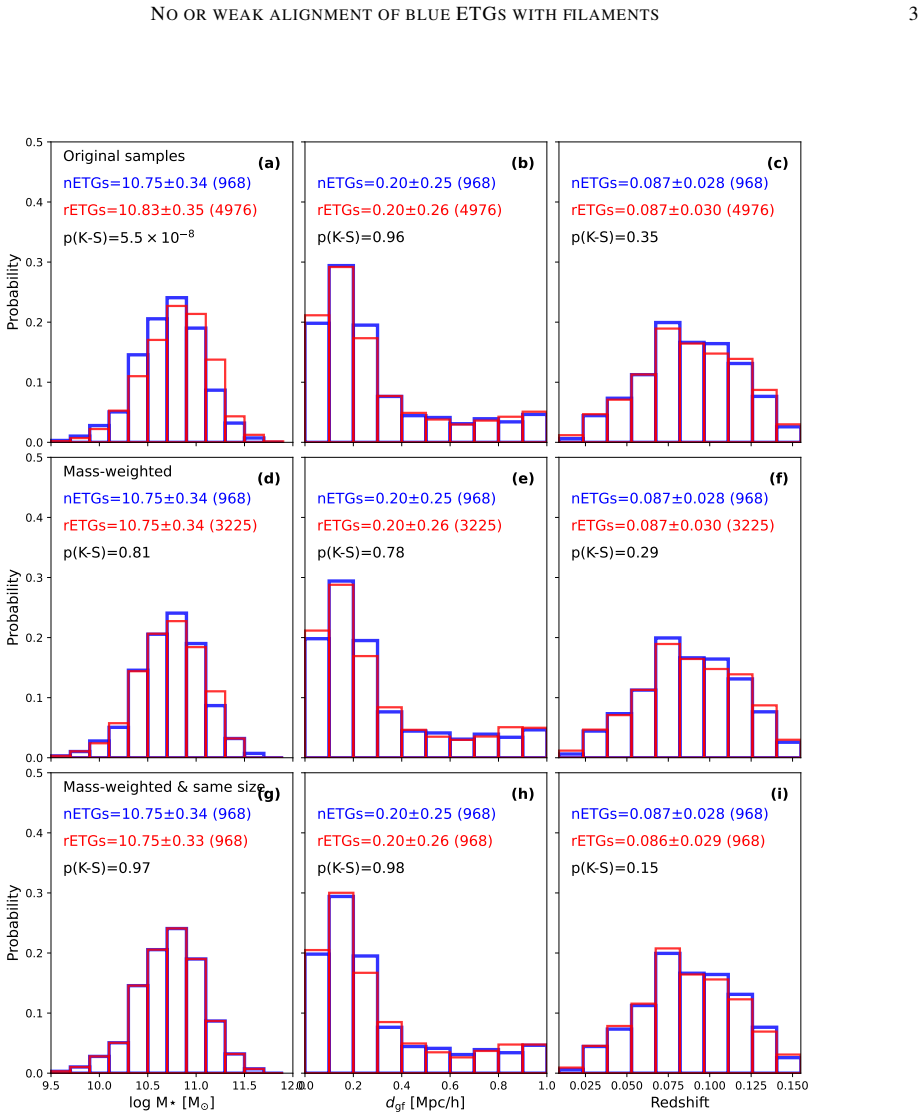
The central object is the alignment statistic $I(\theta)=N_{0-45}/N_{45-90}$, the ratio of early-type galaxies whose major axis lies within $45^\circ$ of the filament spine to those lying farther away; a uniform distribution gives $I(\theta)\simeq 1$, and values above $1$ signal alignment. To make the comparison fair, the paper builds a mass-weighting control that resamples red early-type galaxies to match the stellar-mass distribution of the non-red sample, then repeats the comparison with equal sample sizes. It also checks that stellar mass, distance to the filament, and redshift are statistically indistinguishable between the two samples, and it tests the angle distributions against uniformity and against each other with Kolmogorov--Smirnov tests. This machinery is what supports the claim that the alignment difference is intrinsic to the color division rather than an artifact of sample properties.
What would settle it
Re-measuring the major axes of the same non-red early-type galaxies from higher-resolution imaging, then recomputing the alignment statistic with the same filament catalog, would settle the claim: a significant excess of angles below $45^\circ$ would overturn the null result, while a distribution consistent with $I(\theta)=1$ at high significance would confirm it.
Extended reading notes
Core claim
The central discovery is a statistically distinct alignment behavior between red and non-red early-type galaxies. For red galaxies the ratio statistic $I(\theta)=N_{0-45}/N_{45-90}$ is $1.30 \pm 0.05$, meaning substantially more galaxies lie within $0^\circ$--$45^\circ$ of the filament direction than within $45^\circ$--$90^\circ$, with a Kolmogorov--Smirnov $p \sim 10^{-8}$ against a uniform distribution. Non-red galaxies give $I(\theta)=1.07 \pm 0.08$, consistent with a uniform distribution ($p=0.13$). A two-sample test comparing the two angle distributions gives $p \simeq 0.003$. The difference persists after weighting the red sample to match the non-red sample's stellar-mass distribution and after matching the two sample sizes, so it is not attributable to differences in mass, distance to the filament spine, redshift, or sampling size. The paper therefore claims that the filament-alignment signal previously attributed to early-type galaxies as a class is carried almost entirely by red, quiescent galaxies, while non-red early-type galaxies appear essentially unaligned.
Load-bearing premise
The whole comparison assumes the survey's fitted position angle reliably captures the true direction of each non-red early-type galaxy; if those galaxies are too irregular for the fit, noise could wash out a real alignment.
Editorial extensions
If this is right
- Any future alignment study of early-type galaxies in filaments must treat red and non-red galaxies separately, because the known filament-alignment signal is driven almost entirely by the red population.
- Non-red early-type galaxies cannot simply be red galaxies caught before they turn red; if they were, they would have inherited the same aligned orientations.
- The preferred formation route for red early-type galaxies is merger-driven assembly along the filament spine, while non-red early-type galaxies likely formed through disk instability, gas-rich random mergers, or recent transformations that reset their orientation.
- If expanded samples confirm that non-red early-type galaxies are unaligned, current models for how these galaxies form and evolve will need revision.
Reading between the lines
- An untested gradient may exist: if green-valley galaxies in the sample are closer to the red sequence, they might show an intermediate alignment strength that the current sample size cannot resolve.
- Alignment statistics could be used as a rough clock for morphological reset: a galaxy's orientation memory may encode how recently its last major merger or quenching event occurred.
- The same color-selected comparison could be applied to star-forming disk galaxies, where blue disks might show a different spin-alignment pattern than red spheroids; finding an opposite pattern would sharpen the evolutionary interpretation.
Editorial analysis
A structured set of objections, weighed in public.
Referee Report
Summary. The paper uses SDSS data and the Tempel et al. (2014) filament catalog to measure the alignment of the major axes of red and non-red early-type galaxies (ETGs) with their host filaments. Selecting central ETGs with M*>1e9.5 Msun and distances dgf<=1 Mpc/h, the authors report that red ETGs show significant alignment (I(theta)=1.30+/-0.05, K-S p~1e-8 in the mass-weighted sample), while non-red (blue/green) ETGs show no significant alignment (I(theta)=1.07+/-0.08, p=0.13), with a two-sample K-S p~0.003. They interpret this difference as evidence for distinct evolutionary pathways for red and non-red ETGs.
Significance. If the differential alignment signal is robust, this is a valuable empirical constraint on galaxy formation: it extends filament-alignment studies to blue/green ETGs and suggests that their recent assembly histories differ from those of quiescent red ETGs. The analysis is carefully controlled in several respects: the authors apply mass weighting, match sample sizes, use K-S tests to quantify both the alignment and the null result, and report bootstrap uncertainties. However, the central conclusion rests on the assumption that the SDSS photoObj.deVPhi_r parameter reliably traces the intrinsic major axis for non-red ETGs, a population that is plausibly less regular than red ETGs. That assumption is not validated in the manuscript, and the overstatement of the null result in the abstract and discussion further weakens the interpretation.
major comments (3)
- [Section 2] The claim that nETGs show no alignment is load-bearing for the paper, but the only justification for the position-angle estimator is the statement that photoObj.deVPhi_r is 'a reliable metric for elliptical galaxies with de Vaucouleurs R1/4 surface brightness profile'. Non-red ETGs are, by construction, bluer and are expected to be less regular (disky, patchy, or recently disturbed); for such galaxies a forced single de Vaucouleurs fit can produce noisy or biased position angles. If PA scatter is larger for nETGs than for rETGs, the measured I(theta) will be compressed toward unity, producing exactly the observed null. The authors should provide an independent validation of deVPhi_r for nETGs: for example, compare it with alternative position-angle measurements (isophotal ellipse fits, 2D light-profile models such as GALFIT, or visual classifications) on matched subsamples, and show that the PA uncertainty distribution is comparable between nETGs and rETGs. Without this, the differential result is not secure.
- [Abstract and Section 4] The wording 'no significant alignment signal' in the abstract and 'absence of alignment' in Section 4 overstates the evidence. A K-S p-value of 0.13 against uniform means the nETG data are consistent with no alignment, but they cannot establish that alignment is absent; the current I(theta)=1.07+/-0.08 is also consistent with a weak alignment of roughly 1.2 or lower. The authors themselves acknowledge this in Section 4 ('does not entirely rule out the possibility of a weak alignment'). The abstract and summary should be rephrased to 'no significant alignment detected' and, ideally, an upper limit or confidence interval on I(theta) for nETGs should be reported.
- [Section 4] The robustness checks are asserted but not presented. The text claims that the alignment patterns remain unchanged when selecting with photoObj.deV ABr>0.7, ABr>0.6, M*>1e10 Msun, or M*>1e10.5 Msun, but no I(theta) values, K-S p-values, or two-sample p-values are given for these cases. Since these checks are part of the evidence that the rETG/nETG difference is not an artifact of sample-selection thresholds, the corresponding numerical results should be provided in a table or appendix.
minor comments (5)
- [Section 2, Eq. (2)] The quantity n'_rETG,i defined in Eq. (2) is generally non-integer (since w and max(w) are real numbers), but the text says galaxies are 'randomly selected' according to this number. Please clarify how fractional selection is implemented (e.g., rounding, Poisson sampling, or weighted resampling), because this affects the effective sample size and the interpretation of the reported N=3225.
- [Figure 3 and Section 3] The two-sample K-S p-value of 0.003 is not extremely small, and the paper tests multiple thresholds and sample constructions. Please state whether the reported p-values are raw or corrected for multiple comparisons, and if corrected, describe the procedure.
- [Section 2] The 'non-red' category combines blue and green galaxies. If green ETGs behave differently from blue ETGs (e.g., green ETGs may be transitional), the combined sample could dilute a real alignment signal. A split into blue and green subsamples, or at least a comment on their relative alignment strengths, would strengthen the interpretation.
- [Title page] The received/revised line 'Revised tomorrow; Accepted the day after tomorrow' is not appropriate for a journal submission and should be removed. There are also typos: 'classfied' in the Introduction, 'Acedemy' in the affiliation, 'wavelengh' in the Acknowledgments, and 'W A VES' spacing for WAVES.
- [References] The Troxel & Ishak (2014) reference is cited as arXiv:1047.6990; the correct identifier is arXiv:1407.6990. Please check all arXiv identifiers and journal page numbers for consistency.
Circularity Check
No circularity: the alignment statistic is measured directly from observed position angles and filament orientations, with no fitted parameter or self-citation chain producing the central result.
full rationale
The central measurement is direct: galaxy position angles come from SDSS photoObj.deVPhi_r, filament spine orientations come from the Tempel et al. (2014) catalog, the angle theta is defined geometrically in the plane of the sky, and I(theta) is computed as a ratio of counts in two angle bins. No parameter is fitted to the alignment data. The color division uses the Papastergis et al. (2013) boundary, the stellar mass estimates use Bell et al. (2003), and the mass-weighting procedure is an explicit control that does not alter the qualitative result. The only self-citations, Rong et al. (2019, 2024), are used to define I(theta), which is a standard count-ratio statistic rather than a prior alignment claim imported as evidence. The rETG alignment is also compared with external results, such as Tempel et al. (2013). The interpretation of distinct evolutionary pathways is speculative discussion rather than a derived, falsifiable prediction of the measurement pipeline. The concern that photoObj.deVPhi_r may be less reliable for blue/green early-type galaxies is a possible data-quality limitation that could affect the physical conclusion, but it is not circular reasoning: the analysis does not assume the nETG null result at any step. The paper is therefore self-contained as a measurement and contains no circular derivation.
Assumptions & free parameters
free parameters (4)
- Stellar mass threshold =
M* > 10^9.5 Msun
- Filament distance threshold =
dgf <= 1.0 Mpc/h
- Axis ratio threshold =
deV ABr > 0.8 galaxies removed
- Color boundary =
g-i = -0.0571(Mr+24)+1.25
assumptions (5)
- domain assumption The Tempel et al. (2014) filament catalog correctly identifies large-scale filaments and their spine orientations.
- domain assumption The SDSS photoObj.deVPhi_r parameter reliably measures the position angle of the major axis for ETGs.
- domain assumption The Bell et al. (2003) mass-to-light relation provides accurate stellar masses.
- domain assumption The Papastergis et al. (2013) color boundary separates red and non-red ETGs in a physically meaningful way.
- domain assumption Projected alignment angles statistically represent 3D alignments without sample-dependent bias.
Cite this review
Pith. "Pith review of Alignment of Blue/Green and Red Early-type Galaxies with Large-scale Filaments Reveals Distinct Evolutionary Pathways." pith.science (2026). https://pith.science/paper/3VUCE3ZN
@misc{pith2026241114885,
  author       = {Pith},
  title        = {Pith review of: Alignment of Blue/Green and Red Early-type Galaxies with Large-scale Filaments Reveals Distinct Evolutionary Pathways},
  year         = {2026},
  howpublished = {\url{https://pith.science/paper/3VUCE3ZN}},
  note         = {Machine review of arXiv:2411.14885}
}
read the original abstract
We investigate the alignment of non-red early-type galaxies (ETGs) with blue or green colors within large-scale filaments and compare this alignment pattern with that of red ETGs. Our analysis reveals a significant alignment of the major axes of red ETGs with the orientations of their host cosmic filaments, consistent with prior research. In contrast, non-red ETGs show no significant alignment signal. This divergence in alignment behavior between non-red and red ETGs plausibly suggests distinct evolutionary pathways for non-red and red ETGs.
Figures


Reference graph
Works this paper leans on
-
[1]
, " * write output.state after.block = add.period write newline
ENTRY address archivePrefix author booktitle chapter doi edition editor eprint howpublished institution journal key month note number organization pages publisher school series title misctitle type volume year version url label extra.label sort.label short.list INTEGERS output.state before.all mid.sentence after.sentence after.block FUNCTION init.state.co...
-
[2]
write newline
" write newline "" before.all 'output.state := FUNCTION format.doi doi empty "" "doi:" doi * if FUNCTION format.url url empty "" new.block "" url * "" * if FUNCTION format.eprint eprint empty "" archivePrefix empty "" archivePrefix ":" * if eprint field.or.null * if FUNCTION format.pid eprint empty format.doi format.eprint if FUNCTION n.dashify 't := "" t...
-
[3]
acknowledgments ... acknowledgments
thebibliography [1] 20pt to REFERENCES 6pt =0pt 10pt plus 3pt =0pt =0pt =1pt plus 1pt =0pt =0pt -12pt =13pt plus 1pt =20pt =13pt plus 1pt \@M =10000 =-1.0em =0pt =0pt 0pt =0pt =1.0em @enumiv\@empty 10000 10000 `\.\@m \@noitemerr \@latex@warning Empty `thebibliography' environment \@ifnextchar \@reference \@latexerr Missing key on reference command Each re...
2017
-
[4]
thebibliography [1] 20pt to REFERENCES 6pt =0pt -12pt 10pt plus 3pt =0pt =0pt =1pt plus 1pt =0pt =0pt -12pt =13pt plus 1pt =20pt =13pt plus 1pt \@M =10000 =-1.0em =0pt =0pt 0pt =0pt =1.0em @enumiv\@empty 10000 10000 `\.\@m \@noitemerr \@latex@warning Empty `thebibliography' environment \@ifnextchar \@reference \@latexerr Missing key on reference command E...
-
[5]
2011, ApJS, 193, 29
Aihara, H., Allende Prieto, C., An, D., et al. 2011, ApJS, 193, 29
2011
-
[6]
2015, A&A, 578A, 110
Argudo-Fern\'andez, M., et al. 2015, A&A, 578A, 110
2015
-
[7]
P., Nichol, R
Bamford, S. P., Nichol, R. C., Baldry, I. K., et al. 2009, MNRAS, 393, 1324
2009
- [8]
Show all 85 references
-
[9]
F., McIntosh, D
Bell, E. F., McIntosh, D. H., Katz, N., Weinberg, M. D. 2003, , 149, 289
2003
-
[10]
Brinchmann, J., Charlot, S., White, S. D. M., Tremonti, C., Kauffmann, G., Heckman, T., Brinkmann, J. 2004, , 351, 1151
2004
-
[11]
Carleton, T., Errani, R., Cooper, M., Kaplinghat, M., Pe\ narrubia, J. Guo, Y. 2019, , 485, 382
2019
-
[12]
2019, MNRAS, 485, 2492
Chen, Y.-C., Ho, S., Blazek, J., He, S., Mandelbaum, R., Melchior, P., Singh, S. 2019, MNRAS, 485, 2492
2019
-
[13]
D., Dolgachev, V
Chernin, A. D., Dolgachev, V. P., Domozhilova, L. M. 2000, MNRAS, 319,851
2000
-
[14]
Codis, S., Pichon, C., Devriendt, J., Slyz, A., Pogosyan, D., Dubois, Y., Sousbie, T., 2012, MNRAS, 427, 3320
2012
-
[15]
V., O'Mill, A
Costa-Duarte, M. V., O'Mill, A. L., Duplancic, F., Sodr\'e, L., Lambas, D. G. 2016, MNRAS, 459, 2539
2016
-
[16]
Coutts A., 1996, MNRAS, 278, 87
1996
-
[17]
1948, Ann
de Vaucouleurs, G. 1948, Ann. d'Ap., 11, 247
1948
-
[18]
2009, , 699, 948
Deng, X.-F., He, J.-Z., Wu, P., Ding, Y.-P. 2009, , 699, 948
2009
-
[19]
Donoso, E., O'Mill, A., & Lambas, D. G. 2006, MNRAS, 369, 479
2006
-
[20]
P., Liske, J., Davies, L
Driver, S. P., Liske, J., Davies, L. J. M., et al. 2019, The Messenger, 175, 46
2019
-
[21]
2014, MNRAS, 444, 1453
Dubois, Y., Pichon, C., Welker, C., et al. 2014, MNRAS, 444, 1453
2014
-
[22]
Duplancic, F., D\'avila-Kurb\'an, F., Coldwell, G. V. 2020, MNRAS, 493. 1818
2020
-
[23]
G., O'Mill, A
Duplancic, F., Alonso, S., Lambas, D. G., O'Mill, A. L., 2015, MNRAS, 447, 1399
2015
-
[24]
L., Lambas, D
Duplancic, F., O'Mill, A. L., Lambas, D. G., Sodr\'e, L., Alonso, S., 2013, MNRAS, 433, 354
2013
-
[25]
Faltenbacher, A., Li, C., Simon, W. D. M., Jing, Y.-P., Mao, S.-D., Wang, J. 2009, Research in Astron. Astrophys., 9, 41
2009
-
[26]
Feng, S., Shao, Z.-Y., Shen, S.-Y., Argudo-Fern\'andez, M., Wu, H., Lam, M.-I., Yang, M., Yuan, F.-T 2015, Research in Astronomy and Astrophysics, 16, 72
2015
-
[27]
Ganeshaiah Veena, P., Cautun, M., Tempel, E., van de Weygaert, R., Frenk, C. S. 2019, MNRAS, 487, 1607
2019
-
[28]
2017, A&, 598A, 45
George, K. 2017, A&, 598A, 45
2017
-
[29]
M., M\'endez-Hern\'andez, H., Aceves, H., Olgu\'in, L
Hern\'andez-Toledo, H. M., M\'endez-Hern\'andez, H., Aceves, H., Olgu\'in, L. 2011, AJ, 141, 74
2011
-
[30]
M., Seljak U., 2004, Phys
Hirata C. M., Seljak U., 2004, Phys. Rev. D, 70, 063526
2004
-
[31]
J., 2010, ApJ, 720, 1483
Hung L.-W., Ba \ n ados E., De Propris R., West M. J., 2010, ApJ, 720, 1483
2010
-
[32]
G., Saurer, W
Kitzbichler, M. G., Saurer, W. 2003, ApJ, 590, L9
2003
-
[33]
2013, Secular Evolution of Galaxies, by Jes\'us Falc\'on-Barroso, and Johan H
Kormendy, J. 2013, Secular Evolution of Galaxies, by Jes\'us Falc\'on-Barroso, and Johan H. Knapen, Cambridge, UK: Cambridge University Press, 2013, p.1
2013
-
[34]
Kang X., Wang P., 2015, ApJ, 813, 6
2015
-
[35]
2021, MNRAS, 504, 4626
Kraljic, K., et al. 2021, MNRAS, 504, 4626
2021
-
[36]
2015, MNRAS, 446, 2744
Laigle, C., et al. 2015, MNRAS, 446, 2744
2015
-
[37]
2015, ApJ, 799, 212
Lee, J., Choi, Y.-Y. 2015, ApJ, 799, 212
2015
-
[38]
P., Faltenbacher, A., Wang, J
Li, C., Jing, Y. P., Faltenbacher, A., Wang, J. 2013, ApJL, 770, L12
2013
-
[39]
2024, , 974, 238
Li, F., Wang, E., Zhu, M., et al. 2024, , 974, 238
2024
-
[40]
I., Hoffman, Y., Steinmetz, M., Gottl\"ober, S., Knebe, A., Hess, S., 2013, ApJ, 766, L15
Libeskind, N. I., Hoffman, Y., Steinmetz, M., Gottl\"ober, S., Knebe, A., Hess, S., 2013, ApJ, 766, L15
2013
-
[41]
J., Tempel, E., Saar, E
Liivam\"agi, L. J., Tempel, E., Saar, E. 2012, A&A, 539, A80
2012
-
[42]
H., & Dekel, A
Maller, A. H., & Dekel, A. 2002, MNRAS, 335, 487
2002
-
[43]
Merluzzi, P. et al. 2015, , 446, 803
2015
-
[44]
2019, Comput
Nelson, D., Springel, V., Pillepich, A., et al. 2019, Comput. Astrophys. Cosmol., 6, 2
2019
-
[45]
J., Kuchner, U., Gray, M
O'Kane, C. J., Kuchner, U., Gray, M. E., Arag\'on-Salamanca, A. 2024, , 534, 1682
2024
-
[46]
L., Duplancic, F., Garc\'ia Lambas, D., Valotto, C., Sodr\'e, L
O'Mill, A. L., Duplancic, F., Garc\'ia Lambas, D., Valotto, C., Sodr\'e, L. 2012, MNRAS, 421, 1897
2012
-
[47]
P., Rodr\'iguez-Puebla, A., Jones, M
Papastergis, E., Giovanelli, R., Haynes, M. P., Rodr\'iguez-Puebla, A., Jones, M. G. 2013, , 776, 43
2013
-
[48]
J., Kuhn, J
Pereira, M. J., Kuhn, J. R. 2005, , 627L, 21
2005
-
[49]
Plionis M., Basilakos S., 2002, MNRAS, 329, L47
2002
-
[50]
J., Bryan, G
Pereira, M. J., Bryan, G. L., Gill, S. P. D. 2008, , 672, 825
2008
-
[51]
Plionis M., Benoist C., Maurogordato S., Ferrari, C., Basilakos, S., 2003, ApJ, 594, 144
2003
-
[52]
Primack, J. R. 2024, Annual Review of Nuclear and Particle Science, 74, 173
2024
-
[53]
2024, , 531L, 9
Rong, Y., Shen, J., Hua, Z. 2024, , 531L, 9
2024
-
[54]
2016, MNRAS, 455, 2267
Rong, Y., Liu, Y., Zhang, S.-N. 2016, MNRAS, 455, 2267
2016
-
[55]
E., Tempel, E., Puzia, T
Rong, Y., Mancera Pi\ na, P. E., Tempel, E., Puzia, T. H., De Rijcke, S. 2020, MNRAS, 498, L72
2020
-
[56]
H., et al
Rong, Y., Puzia, T. H., et al. 2019, ApJ, 883, 56
2019
-
[57]
2015a, MNRAS, 451, 2536
Rong, Y., Yi, S.-X., Zhang, S.-N., Tu, H. 2015a, MNRAS, 451, 2536
-
[58]
2015b, MNRAS, 453, 1577
Rong, Y., Zhang, S.-N., Liao, J.-Y. 2015b, MNRAS, 453, 1577
-
[59]
D., et al
Schneider, M. D., et al. 2013, MNRAS, 433, 2727
2013
-
[60]
S., Dubinski, J., Yee, H
Taranu, D. S., Dubinski, J., Yee, H. K. C. 2013, ApJ, 778, 61
2013
-
[61]
A., Ali, G
Tawfeek, A. A., Ali, G. B., Takey, A., Awad, Z., Hayman, Z. M. 2019, MNRAS, 482, 2627
2019
-
[62]
N., 2011, MNRAS, 418, 1587
Taylor, E. N., 2011, MNRAS, 418, 1587
2011
-
[63]
2023, The Messenger, 190, 46
Taylor, E.N., et al. 2023, The Messenger, 190, 46
2023
-
[64]
Tempel, E., Guo, Q., Kipper, R., Libeskind, N. I. 2015, MNRAS, 450, 2727
2015
-
[65]
Tempel, E., Libeskind, N. I. 2013, ApJ, 775, L42
2013
-
[66]
S., Mart\'inez, V
Tempel, E., Stoica, R. S., Mart\'inez, V. J., Liivam\"agi, L. J., Castellan, G., Saar, E., 2014, MNRAS, 438, 3465
2014
-
[67]
S., Saar, E
Tempel, E., Stoica, R. S., Saar, E. 2013, MNRAS, 428, 1827
2013
-
[68]
2015, A&A, 576, L5
Tempel, E., Tamm, A. 2015, A&A, 576, L5
2015
-
[69]
J., 2012, A&A, 540, A106
Tempel, E., Tago, E., Liivam\"agi, L. J., 2012, A&A, 540, A106
2012
-
[70]
Tempel, E., et al., 2014b, A&A, 566, A1
-
[71]
L., Richards, J
Tojeiro, R., Masters, K. L., Richards, J. 2013, , 432, 359
2013
-
[72]
V., Chernin, A
Trofimov, A. V., Chernin, A. D. 1995, AZh, 72, 308
1995
-
[73]
A., Ishak M., 2014, preprint arXiv:1047.6990
Troxel M. A., Ishak M., 2014, preprint arXiv:1047.6990
2014
-
[74]
C., 1998, ApJ, 507, 601
van den Bosch, F. C., 1998, ApJ, 507, 601
1998
-
[75]
2023, A&A, 670, A63
V\'asquez-Bustos, P., Argudo-Fernandez, M., Grajales-Medina, D., Duarte Puertas, S., Verley, S. 2023, A&A, 670, A63
2023
-
[76]
I., Tempel, E., Pawlowski, M
Wang, P., Libeskind, N. I., Tempel, E., Pawlowski, M. S., Kang, X., Guo, Q. 2020, ApJ, 900, 129
2020
-
[77]
2017, 468, L123
Wang P., Kang X. 2017, 468, L123
2017
-
[78]
I., 2018, ApJ, 866, 138
Wang P., Guo Q., Kang X., Libeskind N. I., 2018, ApJ, 866, 138
2018
-
[79]
Wang P., Kang X., 2018, MNRAS, 473, 1562
2018
-
[80]
2024, , 532, 4604
Wang, W., Wang, P., Guo, H., et al. 2024, , 532, 4604
2024
-
[81]
S., 1984, A&A, 138, 253
Wesson P. S., 1984, A&A, 138, 253
1984
-
[82]
J., 1994, MNRAS, 268, 79
West M. J., 1994, MNRAS, 268, 79
1994
-
[83]
2016, ApJS, 225, 11
Yagi, M., Koda, J., Komiyama, Y., Yamanoi, H. 2016, ApJS, 225, 11
2016
-
[84]
2015, ApJ, 798, 17
Zhang, Y., Yang, X., Wang, H., et al. 2015, ApJ, 798, 17
2015
-
[85]
J., van den Bosch, F
Zhang, Y., Yang, X., Wang, H., Wang, L., Mo, H. J., van den Bosch, F. C. 2013, ApJ, 779, 160
2013
Reviewed August 12, 2026 · model on record in the stance chip above.
Discussion (0). Continue with ORCID to comment.