REVIEW 3 major objections 6 minor 6 references
The 1D nonlocal Fisher-KPP equation with a top hat kernel. Part 3. The effect of perturbations in the kernel
T0 review · 3 major / 6 minor · reviewed 2026-08-12 · deepseek-v4-flash
Pith's one-line read A small kernel tweak stays benign at ordinary diffusion but rewires periodic states into one-, three- and five-peak branches at very small diffusion.
desk verdict A genuinely useful regular/singular dichotomy for kernel perturbations in nonlocal Fisher-KPP, but Theorem 3 is stated more broadly than what is actually proved and the most striking claims rest on unreproduced numerics. read the letter →
The pith
A machine-rendered reading of the paper's core claim, the machinery that carries it, and where it could break.
The reading
What carries the argument
The load-bearing machinery is the reduction of the singular regime to the nonlinear nonlocal boundary value problem [NBVP] on the core interval $[-a(\lambda),a(\lambda)]$: the steady profile satisfies $\mathfrak u''+\mathfrak u(\mathfrak C-\bar D^{-1}\bar J(\mathfrak u))=0$ with Dirichlet conditions at the edges, evenness and positivity, and normalization $\int \mathfrak u\,dy=1$, where $\mathfrak C$ is an unknown mass constant. The problem is put in one-to-one correspondence with a Sturm-Liouville eigenvalue problem [SL(I,a)] and a fixed-point equation in $\ell^1$, so Schauder's theorem gives existence and a principal solution branch; WKB analysis in the limits $I\to\pm\infty$, $a\to0^+$ and $a\to(1/4)^-$ yields the hump and delta-function structures and the critical curve $a_c(\bar D)$. Numerically, the rescaled equation $W=\log u$ is used to resolve the exponentially small tail where the secondary bifurcations nucleate.
What would settle it
Perform a higher-order matched-asymptotic calculation of the edge layer and exponentially small tail for one admissible kernel perturbation and check whether the Dirichlet condition at $x=\pm a(\lambda)$ survives at leading order; a leading-order correction leaking through the edge layer would invalidate the reduction to [NBVP] and the secondary-bifurcation network built on it.
Extended reading notes
Core claim
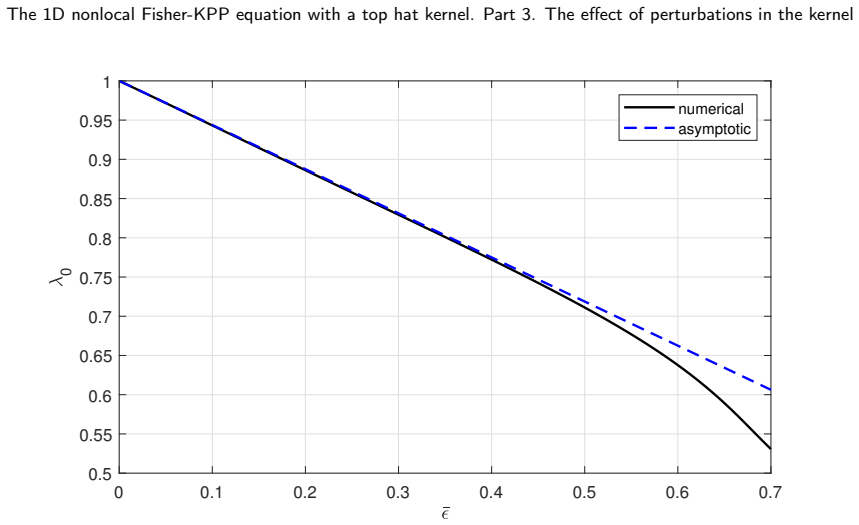
The central discovery is that robustness of the top-hat dynamics depends on the relative size of $D$ and the kernel perturbation. For admissible $\bar\phi\in K(\mathbb R)$ with small $\|\bar\phi\|_1^m$ and $D=O(1)$, the equilibrium states, dispersion relation, neutral curve and the unique even positive periodic steady state in each tongue are all regular perturbations, with displacement of order $D^{-1}\|\bar\phi\|_1^m$. When $D=O(\|\bar\phi\|_1^m)$, the paper constructs a reduced nonlinear nonlocal boundary value problem on the core region $[-a(\lambda),a(\lambda)]$, $a(\lambda)=(\lambda-1/2)/2$, with Dirichlet conditions and an integral normalization, and proves via a Schauder fixed-point argument that at least one $O(1)$ singularly perturbed periodic steady state exists on a principal branch. For the perturbation $\epsilon\cos(2\pi x)$ concentrated at the centre of the kernel support, the principal branch undergoes hump splitting and, for wavelengths $\lambda\in(3/4,\lambda_0(\epsilon))$, secondary fold bifurcations connect the one-peak branch to three- and five-peak branches; for the inverted perturbation concentrated at the edges, no secondary bifurcations occur on the main parameter range and the core focuses to a single Gaussian-type spike. Direct numerical solution of the full boundary value problem confirms the predicted bifurcation network and the stability exchanges.
Load-bearing premise
The singular-perturbation conclusions rest on the assumption that the perturbed periodic steady state keeps the same two-region shape as in the top-hat case: an $O(1)$ core on $[-a(\lambda),a(\lambda)]$ with Dirichlet conditions at the edges, an exponentially small tail outside, and a thin edge layer of thickness $O(\|\bar\phi\|_1^{1/4})$ matching the two regions, and this matching is verified only informally.
Editorial extensions
If this is right
- The linearised stability of $u=0$ is identical to the top-hat case for every admissible perturbation, and the neutral curve for $u=1$ moves by at most $O(\|\bar\phi\|_1^m)$, so the stability conjectures [P1] and [P2] from part 1 remain valid uniformly in $D>0$ for small perturbations.
- Crossing into the boundary region $\Omega_-=\Omega_1\cap\{D=O(\|\bar\phi\|_1^m)\}$, every admissible perturbation produces at least one singularly perturbed positive periodic steady state of $O(1)$ size, with a principal branch that continues the regular branch from $\Omega_+$.
- For the positive cosine-type perturbation with small $\epsilon$, the one-peak branch develops two humps as $\bar D$ decreases and, for wavelengths $\lambda\in(3/4,\lambda_0(\epsilon))$, folds and connects to three- and five-peak branches, creating a window with coexisting stable states of wavelength $\lambda$ and $\lambda/3$.
- For the negative cosine-type perturbation the principal branch has no secondary bifurcations on the main parameter range, and the core profile focuses to a single central Gaussian-type spike as $\bar D\to0$, preserving the top-hat evolutionary mechanism that selects wavelength close to $1/2$.
- Direct evolution simulations show the front dynamics remains close to the unperturbed case even when $D=O(\epsilon)$; the complex bifurcation network is engaged only when initial data select wavelengths in $(3/4,\lambda_0(\epsilon))$.
Reading between the lines
- A testable extension: the threshold $\lambda=3/4$ for secondary bifurcations comes from requiring the kernel support to span four spikes; repeating the numerical continuation with other admissible kernels should shift that threshold monotonically with support width.
- The authors leave implicit that the $O(1)$ changes driving the bifurcations occur in the exponentially small tail, invisible in $u$ but visible in $\log u$; observational probes of such patterns should measure log-density or spectral quantities rather than raw density.
- A likely generalisation of the positive/negative classification is that any symmetric perturbation concentrating nonlocal weight near the origin promotes hump splitting, while concentrating weight near the kernel edges suppresses it; this can be checked with a one-parameter family of shifted symmetric perturbations.
- The regular-to-singular switch at $D\sim\|\bar\phi\|_1^m$ suggests a scaling principle: however small the kernel's fine structure, it becomes controlling once the diffusion length is comparable to the kernel's $L^1$ magnitude.
Editorial analysis
A structured set of objections, weighed in public.
Referee Report
Summary. The paper analyses the 1D nonlocal Fisher-KPP equation with a top-hat kernel perturbed by an admissible kernel perturbation φ̄ of small norm ||φ̄||_1^m. It claims that for D of order 1 the dynamics and periodic steady states are regular perturbations of the top-hat case (Theorems 1 and 2), whereas for D of order ||φ̄||_1^m the problem is singularly perturbed, leading to O(1) changes in the profile and, for certain perturbations, a network of secondary bifurcations connecting one-, three- and five-peak branches (Theorem 3, Section 4). For two specific cosine perturbations φ_+ and φ_- the core reduction is solved explicitly via a scalar Sturm-Liouville problem, giving hump-splitting and spike-formation regimes, and numerical continuations of the full problem are reported. The paper also presents numerical evolution results indicating that the wave-selection mechanism near wavelength 1/2 is robust.
Significance. If the analytic claims are made to match the proofs, the paper gives a useful and concrete picture of when kernel perturbations are regular and when they become singular: the regular/singular dichotomy at D=O(1) versus D=O(||φ̄||) is a natural and nontrivial extension of the top-hat analysis. The explicit scalar reductions, the threshold values D*≈5.22×10^{-3} and a_c(D), the parabolic-cylinder condition (192), and the comparison of [NBVP] and [FPP] profiles in Figure 6 are concrete, falsifiable predictions. The logarithmic reformulation (217) for the numerical work is also sensible. However, several theorem statements currently go beyond what is proved, and the numerical evidence for the main bifurcation network is not accompanied by code, data, or error control.
major comments (3)
- [§3.2.1, Theorem 3; Remark 1; end of §3] Theorem 3 states that for each (λ,D) in Ω_-(φ) there is a positive periodic steady state of [FPP] which is a singular perturbation of the top-hat state. The proof, however, establishes only existence of a solution to the reduced core problem [NBVP] via Schauder's theorem (equations (102)-(104)), and the matching to the exponentially small tail is deferred: Remark 1 and the end of §3 state that the two-region form (67) may fail once the [NBVP] solution has a two-humped core. For the positive perturbation φ_+, two-humped cores occur precisely on {0<D<D*, a_c(D)<a<1/4} (§3.2.3), and this is exactly the regime used for the secondary-bifurcation network in Section 4. Thus Theorem 3's existence assertion is not supported by the proof on the parameter set where the paper's main singular-perturbation conclusion is used. The theorem should either be restricted to the single-hump regime or the matching argument must be supplied.
- [§3.1, Eqs. (18)-(40), Theorem 2] Theorem 2 asserts existence and uniqueness of a positive periodic steady state in Ω_+(φ) together with an O(D^{-1}||φ̄||_1^m) sup-norm bound. What is actually constructed is the first-order correction F_p via the eigenfunction expansion (39)-(40), after which the text says only 'This formally confirms...'. No fixed-point, contraction, or implicit-function argument is given to show that the full nonlinear problem has a solution within o(||φ̄||_1^m) of the unperturbed state, nor is the claimed uniformity over Ω_+(φ) established. The theorem should be proved, or explicitly labelled as a formal asymptotic construction.
- [§3.2.1, Eqs. (107)-(110)] The claim that the singular principal branch is 'the natural continuation' of the regular branch (Theorem 3) is justified only by comparing the asymptotic forms (109) and (110) and invoking the Van Dyke matching principle. No rigorous error bounds or matching theorem are given, and in the two-hump regime the underlying ansatz (67) is admitted to fail (Remark 1; end of §3). The continuation statement should therefore be qualified as formal, or proved under an explicit single-hump condition.
minor comments (6)
- [Throughout] There are several typos that should be corrected: 'perurbation' (Section 1), 'arbitrarilly' (Section 1), 'exponentaialy' and 'principle' (end of Section 3), and 'ration' (Section 6).
- [References] The manuscript repeatedly refers to (NM) (for example in Sections 1 and 3) but the reference list contains only [1]-[5]; the companion paper must be cited or its results summarised in a way that does not require the reader to have access to an unpublished manuscript.
- [§3.2.1] The remark numbering is inconsistent: the text introduces 'Remark 1' at the start of §3.2.1 but later refers to 'Remark 3.1'; please harmonize the numbering.
- [§4] The numerical continuation results underlying Figures 7-12 are described in detail but no code, data, or grid-dependence checks are provided; for reproducibility, please include the numerical parameters (tolerances, grid sizes, continuation step sizes) and ideally deposit the code or the data.
- [Figures 7 and 9] The labels in the bifurcation diagrams (for example '1133357', '1 3357', '1 357') are difficult to read; please redraw the figures with clearer branch labels and a legend explaining the peak counts.
- [Eq. (221)] The formula a_R(D,ε) = 1/4 - (1/4)(16πD ± 1)ε + O(ε^2) should be checked for a sign error: the definition of ̄D and the convention for the plus/minus sign should be stated in the caption or immediately before the formula.
Circularity Check
No significant circularity: corrections, singular scalings, and bifurcation parameters are computed from derived equations; prior top-hat results are used as external base states, and the tail-matching caveat is an acknowledged proof gap, not a circular step.
full rationale
The paper's derivation chain is not circular. Section 2 computes the perturbed dispersion relation omega = omega_T + phi_hat(k) directly from the linearized equation (5) and bounds the deviation in terms of ||phi||_1^m without fitting; the neutral-curve displacement O(||phi||_m^1) is a consequence of (13), not an input. In Section 3.1 the regular perturbation ansatz (18) leads to a definite linear BVP [NSP]; the correction F_p is obtained from an eigenfunction expansion with coefficients c_r = -b_r/mu_r, not chosen to match any later output. The small-D reduction [BVP] and the singular core problem [NBVP] are derived by term-balancing from the unperturbed solution (41)-(43) imported from (NB); D*, a_c(D), and D_min are roots of derived equations (195), (197) and of the continuation calculation, and are then compared with numerical solutions of [FPP] as a check, not used as fit parameters. The self-citations to (NB) supply the unperturbed top-hat periodic state and its exponential-tail structure: these are parameter-free prior results with stated assumptions that do not include the perturbed-kernel target, so under the review rules they count as legitimate independent support rather than load-bearing circular self-citation. The paper itself flags the only real limitation: Remark 1 and the end of Section 3 state that tail matching is verified only when the [NBVP] core solution is single-humped, and that a well-developed two-hump structure can make the assumed form (67) fail, so the existence theorem's proof does not cover the secondary-bifurcation regime. That is a proof-completeness gap, not a reduction of the predictions to the inputs. No fitted input is relabelled as a prediction, and no conclusion is equationally identical to an assumption by construction.
Assumptions & free parameters
assumptions (6)
- standard math Sturm-Liouville theory for [SL(I,a)]: existence, uniqueness, continuous dependence of principal eigenvalue and eigenfunction on I in l^1 and a in (0,1/4).
- standard math Gohberg-Krein spectral theory for weakly perturbed self-adjoint operators on the lambda-periodic space, giving discrete spectrum and basis properties of L and its adjoint L*.
- standard math Schauder fixed point theorem in l^1.
- domain assumption Small-D asymptotic structure of the unperturbed top-hat periodic steady state F_p, equations (41)-(43) from (NB): O(1) cosine core on [-a,a], exponentially small tails, edge layers of thickness O(D^{1/4}).
- domain assumption Asymptotic matching (Van Dyke) yields true approximations of solutions; the exponentially-small region can be constructed and matched for the perturbed kernel.
- domain assumption Well-posedness and basic qualitative properties of (IBVP)_p carry over unchanged from (IBVP) in (NB).
Cite this review
Pith. "Pith review of The 1D nonlocal Fisher-KPP equation with a top hat kernel. Part 3. The effect of perturbations in the kernel." pith.science (2026). https://pith.science/paper/FZXWZ4PL
@misc{pith2026241115054,
  author       = {Pith},
  title        = {Pith review of: The 1D nonlocal Fisher-KPP equation with a top hat kernel. Part 3. The effect of perturbations in the kernel},
  year         = {2026},
  howpublished = {\url{https://pith.science/paper/FZXWZ4PL}},
  note         = {Machine review of arXiv:2411.15054}
}
abstract
In the third part of this series of papers, we address the same Cauchy problem that was considered in part 1, namely the nonlocal Fisher-KPP equation in one spatial dimension, $u_t = D u_{xx} + u(1-\phi_T*u)$, where $\phi_T*u$ is a spatial convolution with the top hat kernel, $\phi_T(y) \equiv H\left(\frac{1}{4}-y^2\right)$, except that now we include a specified perturbation to this kernel, which we denote as $\overline{\phi}:\mathbb{R}\to \mathbb{R}$. Thus the top hat kernel $\phi_T$ is now replaced by the perturbed kernel $\phi:\mathbb{R} \to \mathbb{R}$, where $\phi(x) = \phi_T(x) + \overline{\phi}(x)~~\forall~~x\in \mathbb{R}$. When the magnitude of the kernel perturbation is small in a suitable norm, the situation is shown to be generally a regular perturbation problem when the diffusivity $D$ is formally of O(1) or larger. However when $D$ becomes small, and in particular, of the same order as the magnitude of the perturbation to the kernel, this becomes a strongly singular perturbation problem, with considerable changes in overall structure. This situation is uncovered in detail In terms of its generic interest, the model forms a natural extension to the classical Fisher-KPP model, with the introduction of the simplest possible nonlocal effect into the saturation term. Nonlocal reaction-diffusion models arise naturally in a variety of (frequently biological or ecological) contexts, and as such it is of fundamental interest to examine its properties in detail, and to compare and contrast these with the well known properties of the classical Fisher-KPP model.
Figures


Figures from the paper (11 more)




Reference graph
Works this paper leans on
-
[1]
write newline
" write newline "" before.all 'output.state := FUNCTION n.dashify 't := "" t empty not t #1 #1 substring "-" = t #1 #2 substring "--" = not "--" * t #2 global.max substring 't := t #1 #1 substring "-" = "-" * t #2 global.max substring 't := while if t #1 #1 substring * t #2 global.max substring 't := if while FUNCTION word.in bbl.in ":" * " " * FUNCTION f...
-
[2]
E. A. Coddington and N. Levinson. Theory of Ordinary Differential Equations . McGraw-Hill, New York, 1955
work page 1955
-
[3]
I. C. Gohberg and M. G. Krein. Introduction to the Theory of Linear Non-Self-Adjoint Operators . American Mathematical Society, Providence, RI, 1969
work page 1969
-
[4]
L. V Kantorovich and G. P. Akilov. Functional Analysis . Pergamon, 1982
work page 1982
-
[5]
A. C. King, J. Billingham, and S. R. Otto. Differential Equations: Linear, Nonlinear, Ordinary, Partial . Cambridge University Press, 2003
work page 2003
-
[6]
The evolution problem for the 1d nonlocal fisher-kpp equation with a top hat kernel
David John Needham, John Billingham, Nikolaos Michael Ladas, and John Meyer. The evolution problem for the 1d nonlocal fisher-kpp equation with a top hat kernel. part 1. the cauchy problem on the real line. European Journal of Applied Mathematics , page 1–36, 2024
work page 2024
Reviewed August 12, 2026 · model on record in the stance chip above.
Discussion (0). Continue with ORCID to comment.