REVIEW 5 major objections 4 minor 21 references
Covertness in the Near Field: Maximizing the Covert Region with FDA
T0 review · 5 major / 4 minor · reviewed 2026-08-12 · deepseek-v4-flash
Pith's one-line read Frequency-diverse arrays shrink the area where a warden can detect near-field covert signals.
desk verdict Qualitatively useful paper on FDA shrinking the near-field covert region, but the ellipse-based optimization rests on unvalidated local approximations. read the letter →
The pith
A machine-rendered reading of the paper's core claim, the machinery that carries it, and where it could break.
The reading
What carries the argument
The load-bearing object is the beampattern correlation between the legitimate user Bob and a warden Willie, $B(r,\theta; \mathbf{f}_\Delta)$ in Eq. (17), which governs the threshold equation for covertness. Expanding the cosine in that equation to second order turns the boundary set into a rotated ellipse with coefficients $g_1(\mathbf{f}_\Delta)$, $g_2(\mathbf{f}_\Delta)$, and $g_3(\mathbf{f}_\Delta)$ and area $S_{\mathrm{ellipse}}(\mathbf{f}_\Delta)$ given in Eq. (27). The optimization in Eq. (28) maximizes the denominator of that area formula over the per-antenna frequency offsets, which is what lets the design shape the non-covert region.
What would settle it
Evaluate Eq. (19) exactly on a dense grid of warden positions around Bob without the second-order Taylor expansion, and compare the true boundary with the ellipse from Eq. (23) at the Sec. V parameters (e.g., $N=64$, $F_\Delta = 1$ MHz, $r_b = 7.0711$ m, $\theta_b = 45^\circ$); a substantial mismatch would invalidate the area-based comparisons and the optimized frequency offsets.
Extended reading notes
Core claim
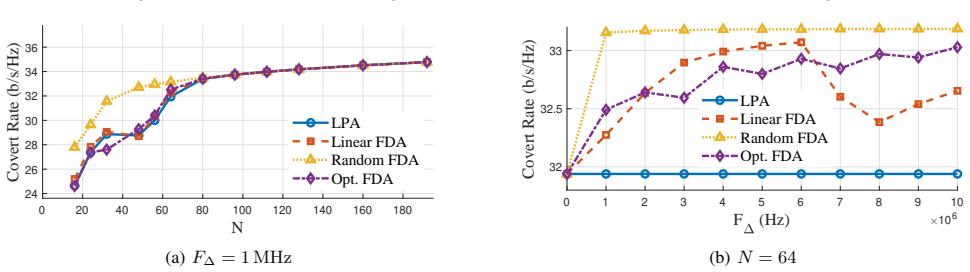
The central claim is that in near-field covert communication, the region inside which a warden can reliably detect the transmission is not fixed by the array geometry alone but can be shrunk by choosing frequency offsets across the array. For a given covertness threshold, the boundary where the beampattern power equals the threshold is approximated as a rotated ellipse, with coefficients that depend on the frequency offset vector. The paper derives the ellipse area as a function of the offsets and poses the minimization of that area as an optimization over the frequency increments. Simulation over a grid of warden positions shows that linear, random, and optimized FDA all reduce the non-covert area relative to a conventional phased array, with the random scheme performing best and with larger arrays and larger frequency increments further shrinking the vulnerable region.
Load-bearing premise
The area formula relies on a second-order Taylor expansion of the cosine in Eq. (20), which is accurate only for small phase differences close to Bob, while the covertness threshold may put the boundary far from Bob; if that approximation fails, the optimized area and the quantitative comparisons are unsupported.
Editorial extensions
If this is right
- If the ellipse-area result holds, designers can compute the vulnerable region in closed form for any FDA frequency profile, without a brute-force grid search over warden positions.
- The optimization in (28) gives a concrete design rule: choose frequency offsets to maximize $g_1 g_3 - g_2^2$, which directly shrinks the non-covert area.
- The numerical trends imply that moving to larger arrays and larger frequency increments improves covertness by reducing energy leakage, at the cost of bandwidth and hardware complexity.
- Random FDA provides a simple, parameter-light way to approach the gains of optimization, since random offsets decorrelate the Alice–Bob and Alice–Willie channels.
Reading between the lines
- The same ellipse approximation could be used to design FDA profiles that place the vulnerable region asymmetrically, e.g., away from directions where wardens are more likely, by adding a position-dependent weight to the area objective.
- The Taylor-expansion step suggests the area formula will be most reliable for small covertness thresholds, where the boundary stays close to Bob; practitioners should verify with exact search before relying on the formula at low thresholds.
- Because random FDA performs best in simulation, a testable extension is to analyze its performance theoretically, e.g., the expected non-covert area under random offsets, rather than optimizing a single realization.
Editorial analysis
A structured set of objections, weighed in public.
Referee Report
Summary. The manuscript studies covert communication in the near field of a multi-antenna transmitter. It defines a non-covert region as the set of warden positions where the normalized received energy exceeds a detection threshold q derived from the KL-divergence criterion. It analyzes conventional LPA, linear FDA, random FDA, and an optimized FDA whose frequency offsets are chosen to minimize an analytic ellipse approximation of the non-covert region. Numerical results show that FDA schemes, especially random FDA, shrink the non-covert area and improve the average covert rate as the number of antennas N and the frequency increment F_Delta grow.
Significance. The problem is timely, and the qualitative observation that distance-angle-dependent near-field beampatterns can shape the covert region is interesting. The paper contributes a clean system model and a broad numerical comparison across N and F_Delta, and the random FDA scheme is simple and potentially practical. The strengths are the systematic simulation setup and the explicit geometric objective of minimizing the non-covert region. However, the analytic core used for area computation and optimization relies on an unvalidated Taylor/ellipse approximation, and the channel normalization appears inconsistent; the quantitative gains therefore need additional support.
major comments (5)
- [Sec. IV, Eqs. (20)-(23)] The derivation replaces cos(z_n - z_m) with 1 - (z_n - z_m)^2/2 in Eq. (20b). This is accurate only when all phase differences are small, i.e., near Bob, but the boundary at threshold q can lie far from Bob; Figs. 1-2 show non-covert regions extending tens of meters. The paper never quantifies the error of this approximation against the exact boundary equation (19). Since Eq. (27) and the optimization objective (28) are built on this approximation, the quantitative area comparisons and the optimized-FDA design need a validation study, e.g., comparing Eq. (27) with numerical integration of the exact boundary over the parameter ranges of Figs. 3-4.
- [Sec. IV, Eqs. (20)-(21), (27)] The variable qtilde = q / (beta^2(r_w) beta^2(r_b)) is not constant along the boundary because beta(r_w) is proportional to 1/r_w, so the right-hand side 2N^2(1 - qtilde) in Eq. (21) depends on r_w. Eq. (23) is therefore not a fixed ellipse with a constant right-hand side, and the closed-form area formula in Eq. (27) does not follow directly. The authors should either solve the exact implicit equation or state and justify a specific constant evaluation point r_w and check its validity against the exact boundary.
- [Sec. II, Eq. (3) vs. Sec. IV, Eqs. (17)-(19)] The channel normalization in Eq. (3) is inconsistent with the beampattern expression in Eq. (17). With h_i as defined in Eq. (3), ||h_b|| = beta_b / sqrt(N), and the quantity |h_w^H w|^2 appearing in the covertness condition (12) is proportional to beta_w^2 |Sigma|^2 / N^3, whereas Eq. (17) uses beta_w^2 beta_b^2 |Sigma|^2 / N^2. The mismatch is a factor of N beta_b^2, which is distance- and frequency-dependent, so the threshold q used in Eqs. (19)-(20) is not the same physical threshold as in Eq. (12). This needs to be corrected before the area and rate numbers can be trusted.
- [Sec. IV, Eqs. (23) and (27)] Eq. (23) is written in polar increments (Delta r, Delta theta), not in physical Cartesian coordinates. The physical area element is r dr dtheta, so the ellipse area in the (Delta r, Delta theta) plane is not the physical non-covert area; a Jacobian factor r_b (and curvature corrections) is missing from Eq. (27). Independently, for a quadratic g1 u^2 + g2 u v + g3 v^2 = C, the area in the (u,v) plane is pi C / sqrt(g1 g3 - g2^2/4), which differs from the denominator sqrt(g1 g3 - g2^2) used in Eq. (27). These corrections also change the optimization objective in Eq. (28).
- [Sec. V, Figs. 3-4] The text does not state whether the non-covert areas plotted in Fig. 3 are computed from the analytic ellipse formula (27) or by counting grid points satisfying the exact condition (19). This distinction is important because the analytic formula is subject to the concerns above. The authors should explicitly report the simulation method and, if the analytic formula is used, verify it against the exact grid-based boundary over the plotted parameter ranges.
minor comments (4)
- [Sec. IV, first paragraph] The sentence about minimizing the area of the 'covert region' should read 'non-covert region' for consistency with Eq. (12) and Sec. V.
- [Sec. IV, Eq. (20)] 'Euler's Theorem' should be 'Euler's formula', and the step using the double sum to obtain the cosine expression should be stated explicitly.
- [Sec. V, Figs. 1-2] The threshold is set to 10% of Bob's received energy 'by adjusting the parameters sigma_w^2, P_t, epsilon, L'; since these parameters also determine q in Eq. (12), the text should state the actual parameter values used and confirm that they are not chosen post hoc to force the comparison.
- [Sec. III, Eq. (16)] For the random FDA, the continuous uniform random variable k_n and the resulting random realization should be described more precisely, including how many random realizations are averaged in Figs. 3-4.
Circularity Check
No circularity: the non-covert region analysis is a direct analytical derivation from the covertness threshold and channel model, with no fitted quantity renamed as a prediction.
full rationale
The paper's derivation chain is self-contained. The covertness condition (12) follows from the KL divergence bound and defines q as a fixed threshold from system parameters. The boundary condition (18)-(19) equates the beampattern (17), derived from the near-field channel model (1)-(3), to q. The elliptical approximation (20)-(23) is a second-order Taylor expansion of the cosine, and the area formula (27) and optimization (28) follow algebraically from that approximation; no parameter is fitted to the data that the paper later 'predicts'. The numerical results in Sec. V are evaluated on a spatial grid with a threshold defined as 10% of Bob's received energy, independent of the analytical ellipse, so the reported areas are not forced by construction. The only self-citations (refs. [5] and [10]) appear in the introduction as contextual prior work and are not load-bearing for the new derivation. The r_w-dependence of qtilde in Eq. (20) and the small-angle validity of the Taylor expansion are approximation-accuracy concerns, not circular dependencies.
Assumptions & free parameters
free parameters (1)
- Covertness threshold q (set to 10% of Bob's received energy) =
10% of Pt |h_b^H w|^2
assumptions (5)
- domain assumption Fresnel approximation of the near-field channel (Eq. 2)
- ad hoc to paper The boundary of the covert region is an ellipse (Eq. 18-23)
- domain assumption Willie uses an optimal hypothesis test with KL divergence bound D(P0||P1) <= 2 epsilon^2
- domain assumption MRT beamforming w = h_b / ||h_b||
- domain assumption Alice has perfect knowledge of Bob's location and Alice-Bob channel, while Willie's location is unknown
Cite this review
Pith. "Pith review of Covertness in the Near Field: Maximizing the Covert Region with FDA." pith.science (2026). https://pith.science/paper/LATTRVEE
@misc{pith2026241115305,
  author       = {Pith},
  title        = {Pith review of: Covertness in the Near Field: Maximizing the Covert Region with FDA},
  year         = {2026},
  howpublished = {\url{https://pith.science/paper/LATTRVEE}},
  note         = {Machine review of arXiv:2411.15305}
}
read the original abstract
Covert communication in wireless networks ensures that transmissions remain undetectable to adversaries, making it a potential enabler for privacy and security in sensitive applications. However, to meet the high performance and connectivity demands of sixth-generation (6G) networks, future wireless systems will require larger antenna arrays, higher operating frequencies, and advanced antenna architectures. This shift changes the propagation model from far-field planar-wave to near-field spherical-wave which necessitates a redesign of existing covert communication systems. Unlike far-field beamforming, which relies only on direction, near-field beamforming depends on both distance and direction, providing additional degrees of freedom for system design. In this paper, we aim to utilize those freedoms by proposing near-field Frequency Diverse Array (FDA)-based transmission strategies that manipulate the beampattern in both distance and angle, thereby establishing a non-covert region around the legitimate user. Our approach takes advantage of near-field properties and FDA technology to significantly reduce the area vulnerable to detection by adversaries while maintaining covert communication with the legitimate receiver. Numerical simulations show that our methods outperform conventional phased arrays by shrinking the non-covert region and allowing the covert region to expand as the number of antennas increases.
Figures


Figures from the paper (1 more)
Reference graph
Works this paper leans on
-
[1]
Near-field comm unica- tions: What will be different?
Y . Liu, J. Xu, Z. Wang, X. Mu, and L. Hanzo, “Near-field comm unica- tions: What will be different?” arXiv:2303.04003, 2023
arXiv 2023
-
[2]
Ne ar-field communications: A tutorial review,
Y . Liu, Z. Wang, J. Xu, C. Ouyang, X. Mu, and R. Schober, “Ne ar-field communications: A tutorial review,” IEEE open j. Commun. Soc. , 2023
work page 2023
-
[3]
Limits of reliabl e communi- cation with low probability of detection on AWGN channels,
B. A. Bash, D. Goeckel, and D. Towsley, “Limits of reliabl e communi- cation with low probability of detection on AWGN channels,” IEEE J. Sel. Areas Commun. , vol. 31, no. 9, pp. 1921–1930, 2013
work page 1921
-
[4]
X. Chen, W. Sun, C. Xing, N. Zhao, Y . Chen, F. R. Y u, and A. Na l- lanathan, “Multi-antenna covert communication via full-d uplex jamming against a warden with uncertain locations,” IEEE Trans. Wirel. Commun., vol. 20, no. 8, pp. 5467–5480, 2021
work page 2021
-
[5]
Under who se umbrella: The collaborative benefits of RS and RIS in covert communicat ions,
F. Lotfi, K. Weinberger, S. Roth, and A. Sezgin, “Under who se umbrella: The collaborative benefits of RS and RIS in covert communicat ions,” in Proc. IEEE 24th Int. W orkshop Signal Process. Advances in Wi rel. Commun. (SPAWC), 2023, pp. 241–245
work page 2023
-
[6]
On covert communicat ion with noise uncertainty,
B. He, S. Y an, X. Zhou, and V . K. Lau, “On covert communicat ion with noise uncertainty,” IEEE Wirel. Commun. Lett. , vol. 21, no. 4, pp. 941–944, 2017
work page 2017
-
[7]
Covert communication in fading channels under channel uncertainty,
K. Shahzad, X. Zhou, and S. Y an, “Covert communication in fading channels under channel uncertainty,” in Proc. IEEE V eh. Technol. Conf. (VTC Spring) , 2017, pp. 1–5
work page 2017
-
[8]
Achie ving covert wireless communications using a full-duplex receiver,
K. Shahzad, X. Zhou, S. Y an, J. Hu, F. Shu, and J. Li, “Achie ving covert wireless communications using a full-duplex receiver,” IEEE Trans. Wirel. Commun., vol. 17, no. 12, pp. 8517–8530, 2018
work page 2018
Show all 21 references
-
[9]
Covert wireless communication with artificial noise generation,
R. Soltani, D. Goeckel, D. Towsley, B. A. Bash, and S. Guha , “Covert wireless communication with artificial noise generation,” IEEE Trans. Wirel. Commun., vol. 17, no. 11, pp. 7252–7267, 2018
2018
-
[10]
Enhancing the secrecy rat e with direction-range focusing with FDA and RIS,
C. Li, S. Roth, and A. Sezgin, “Enhancing the secrecy rat e with direction-range focusing with FDA and RIS,” 2024. [Online] . Available: https://arxiv.org/abs/2401.15154
2024 arXiv
-
[11]
Covert mmWave communica tion when the warden locates in the beam direction,
R. Ma, W. Y ang, J. Hu, and X. Lu, “Covert mmWave communica tion when the warden locates in the beam direction,” IEEE Wirel. Commun. Lett., vol. 11, no. 12, pp. 2595–2599, 2022
2022
-
[12]
Distan ce-angle beamforming for covert communications via frequency diver se array: Toward two-dimensional covertness,
Y . Zhang, Y . Zhang, J. Wang, S. Xiao, and W. Tang, “Distan ce-angle beamforming for covert communications via frequency diver se array: Toward two-dimensional covertness,” IEEE Trans. Wirel. Commun. , vol. 22, no. 12, pp. 8559–8574, 2023
2023
-
[13]
Covert wirel ess communication with random frequency diverse array,
L. Li, Z. Chen, R. Chen, L. Y ang, and S. Y an, “Covert wirel ess communication with random frequency diverse array,” IEEE Trans. V eh. Technol., 2023
2023
-
[14]
FDA-aided covert communication against multiple wardens,
Z. Cheng, J. Si, Z. Li, T. Wang, L. Guan, and N. Al-Dhahir, “FDA-aided covert communication against multiple wardens,” IEEE Wirel. Commun. Lett., 2024
2024
-
[15]
R obust beamfocusing for FDA-aided near-field covert communicatio ns with uncertain location,
Y . Zhang, Y . Zhang, J. Wang, S. Xiao, W. Ni, and W. Tang, “R obust beamfocusing for FDA-aided near-field covert communicatio ns with uncertain location,” in ICC W orkshops, 2023, pp. 1349–1354
2023
-
[16]
Min imizing vulnerable region for near-field covert communication,
J. Hu, Y . Zhou, H. Zheng, Y . Chen, F. Shu, and J. Wang, “Min imizing vulnerable region for near-field covert communication,” IEEE Trans. V eh. Technol., 2024
2024
-
[17]
Fraunhofer and fresnel d istances: Unified derivation for aperture antennas,
K. T. Selvan and R. Janaswamy, “Fraunhofer and fresnel d istances: Unified derivation for aperture antennas,” IEEE Antennas Propag. Mag. , vol. 59, no. 4, pp. 12–15, 2017
2017
-
[18]
Beam focusing for near-field multiuser MIMO communi cations,
H. Zhang, N. Shlezinger, F. Guidi, D. Dardari, M. F. Iman i, and Y . C. Eldar, “Beam focusing for near-field multiuser MIMO communi cations,” IEEE Trans. Wirel. Commun. , vol. 21, no. 9, pp. 7476–7490, 2022
2022
-
[19]
Channel codin g rate in the finite blocklength regime,
Y . Polyanskiy, H. V . Poor, and S. V erd´ u, “Channel codin g rate in the finite blocklength regime,” IEEE Trans. Inf. Theory , vol. 56, no. 5, pp. 2307–2359, 2010
2010
-
[20]
General focusing beamforme r for FDA: Mathematical model and resolution analysis,
Y . Ma, P . Wei, and H. Zhang, “General focusing beamforme r for FDA: Mathematical model and resolution analysis,” IEEE Trans. Antennas Propag., vol. 67, no. 5, pp. 3089–3100, 2019
2019
-
[21]
An analytical ra nge-angle dependent beam focusing model for terahertz linear antenna array,
L. Li, H. Li, Z. Chen, W. Chen, and S. Li, “An analytical ra nge-angle dependent beam focusing model for terahertz linear antenna array,” IEEE Wirel. Commun. Lett. , vol. 11, no. 9, pp. 1870–1874, 2022
2022
Reviewed August 12, 2026 · model on record in the stance chip above.
Discussion (0). Continue with ORCID to comment.