REVIEW 3 major objections 6 minor 33 references
A p<0.0001 detection of CMB cooling in galactic halos and its possible relation to dark matter
T0 review · 3 major / 6 minor · reviewed 2026-08-12 · deepseek-v4-flash
Pith's one-line read Planck CMB temperatures dip around nearby spiral galaxies at 5.7σ, the paper argues.
desk verdict A statistically careful re-analysis of the group's earlier CMB-cold-spot claim, but the headline significance omits the by-eye choice of filament areas and the 0.2 Mpc bin from the look-elsewhere correction, so the title's p<0.0001 is not established. read the letter →
The pith
A machine-rendered reading of the paper's core claim, the machinery that carries it, and where it could break.
The reading
What carries the argument
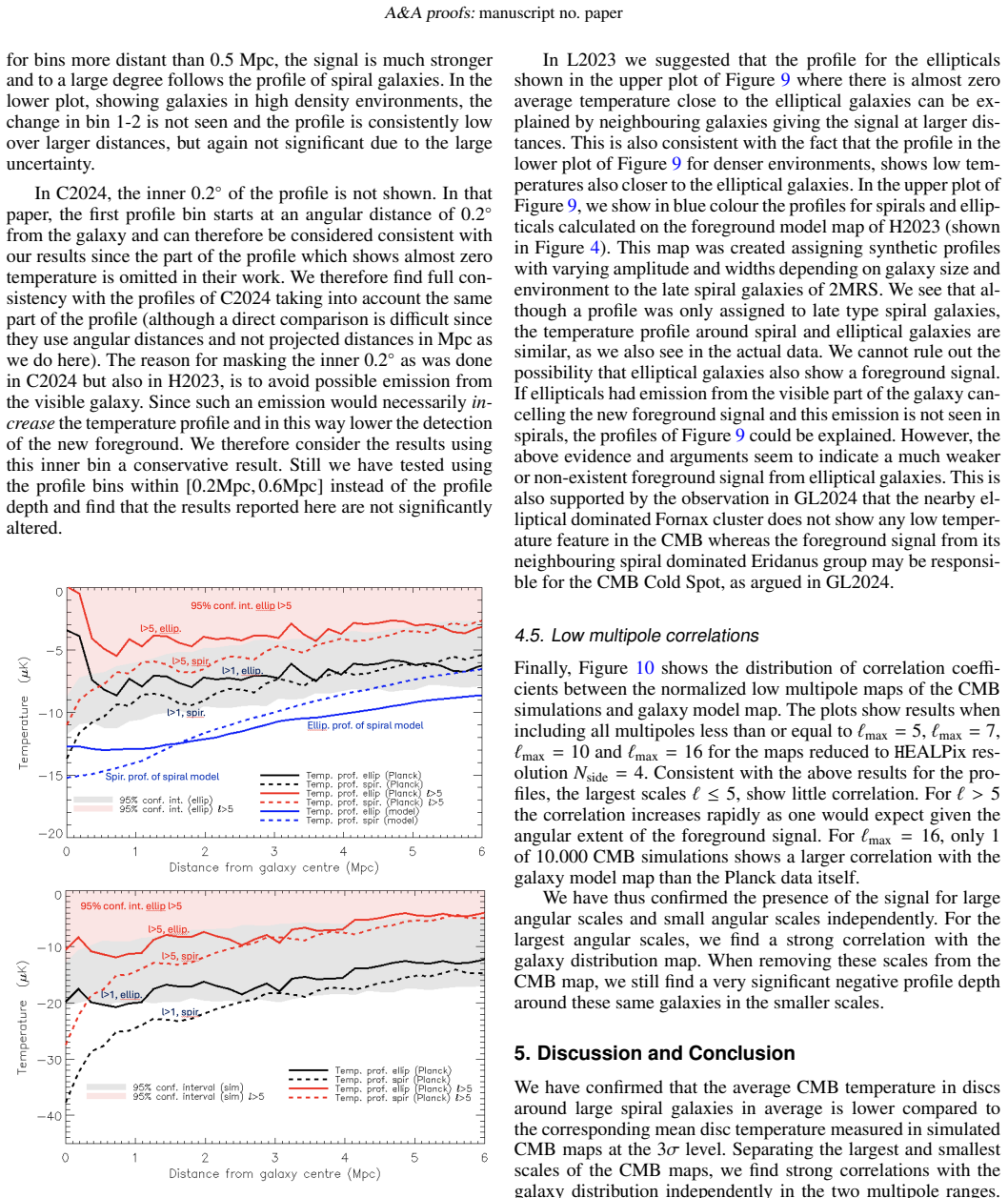
The central statistic is the 'profile depth': the mean CMB temperature in the innermost disc of radius 0.2 Mpc around a galaxy, averaged over a chosen galaxy sample. This single number replaces the full radial temperature profile, avoiding correlated bins, and is compared between the Planck data and sets of simulated Planck-like CMB maps (up to 10,000 for the SMICA-cleaned maps). Significance is calibrated by the fraction of simulations with a more negative profile depth. To control the look-elsewhere effect, the authors repeat the sample optimization inside each simulation—varying galaxy size, morphological type, maximum redshift, environment, and multipole cut—and compare the data's best deviation with the distribution of best deviations in simulations. For the low-multipole analysis, the machinery is a correlation coefficient between normalized multipole maps of the CMB and a simple foreground model map of the nearby galaxy distribution, computed up to ℓmax=16.
What would settle it
Repeat the analysis as a blind search: for each of the 10,000 simulated maps, scan over all three-region definitions (centers and radii), profile-bin radii from about 0.1 to 0.5 Mpc, galaxy size and redshift cuts, morphological types, and multipole cuts, and keep only the single most extreme profile depth per simulation. If the Planck data's maximum over this full search space is not more extreme than 99.99% of the simulated maxima, the claimed p<0.0001 detection is not established.
Extended reading notes
Core claim
The paper's central claim is that the CMB temperature within the inner parts of galactic halos is not what the standard model predicts. Defining 'profile depth' as the mean CMB temperature in a 0.2 Mpc disc around each galaxy, the authors find that late-type spirals larger than 8.5 kpc and closer than z=0.02, particularly those in the three densest nearby filament regions, sit in a consistently negative temperature depression of about -27 µK once low multipoles are removed. None of 10,000 ΛCDM simulations reproduces this, and the significance stays at 3-4σ when the choice of galaxy type, size, redshift, environment, and multipole cut is optimized separately for every simulation. The same profile depth is nearly identical across frequencies from 41 to 217 GHz, consistent with a blackbody-shaped decrement, while elliptical galaxies show no significant inner signal. The authors conclude that a new CMB foreground component tied to spiral galaxies and their surroundings exists and that a physical interaction mechanism, possibly involving dark matter or intergalactic magnetic fields, should be sought.
Load-bearing premise
The assumed statistical model treats the three dense-filament regions A, B, and C—their centers and radii—and the 0.2 Mpc profile-bin radius as fixed rather than as degrees of freedom searched over; the look-elsewhere correction accounts for galaxy sample parameters but not for these by-eye choices.
Editorial extensions
If this is right
- A real halo-scale CMB foreground would change how the lowest CMB multipoles are interpreted, since part of the decrement survives down to ℓ>1024 while another part lives on scales ℓ<16.
- The temperature decrement must be included in future measurements of cosmological parameters from low multipoles and CMB anomalies.
- The lack of a significant inner decrement around elliptical galaxies points to a mechanism tied to spiral properties such as rotation or magnetic fields.
- Frequency independence from 41 to 217 GHz constrains any photon–dark-matter interaction to preserve the blackbody spectrum in the microwave band.
- The same statistic can be applied to the CMB Cold Spot and other reported anomalies, potentially explaining them by nearby large spiral groups.
Reading between the lines
- A natural next test is to measure the same 0.2 Mpc profile depth in polarization maps; if the decrement comes from scattering or conversion of photons in magnetized halos, a polarization signature should accompany it.
- The by-eye selection of regions A, B, and C is an unaccounted trial factor; a fully blind scan over region geometry could reduce the global significance below the reported 3-4σ post-correction level.
- If rotation or magnetic fields are the trigger, the decrement should be stronger for high-spin or high-magnetization spirals matched in mass and environment; this is not tested in the paper.
- Correlating the decrement with Faraday rotation measures or dispersion measures of the halos would discriminate between plasma and particle-conversion explanations.
Editorial analysis
A structured set of objections, weighed in public.
Referee Report
Summary. This paper reports a significant detection of a CMB temperature decrement in the inner 0.2 Mpc discs around large late-type spiral galaxies in three dense filament regions (A, B, C) selected from the 2MRS galaxy distribution. Using Planck SMICA and other foreground-cleaned maps against 10,000 simulated CMB maps, the authors find that the mean profile depth for the optimal galaxy sample is lower than in any simulation (empirical p<1e-4, quoted as 5.7 after Gaussian conversion), with reduced significance (3-4) after a look-elsewhere correction over galaxy sample parameters (size, type, redshift, inside/outside the regions, multipole cut). They also report a 99.99% correlation between the largest angular scales (l<16) of the Planck CMB and a model galaxy map. The authors interpret the signal as evidence for a new CMB foreground, possibly due to photon-dark-matter interactions in magnetized halos, and argue against known foregrounds via frequency consistency tests across Planck and WMAP.
Significance. If the detection is correct, it would be a major discovery: a kiloparsec-to-megaparsec-scale CMB temperature decrement around galaxies that is absent in Lambda-CDM simulations, implying new physics or an unidentified astrophysical foreground. The paper's strengths are its extensive simulation-based calibration (10,000 SMICA simulations; 600-1000 for other methods), an explicit look-elsewhere correction over many sample choices, multipole filtering, consistency across four foreground-cleaned maps and two experiments, and the frequency-flatness test. The central weakness is that the look-elsewhere correction does not include the data-informed selection of the three filament regions or the profile-bin radius, so the reported p-values are conditional on these choices. A modest trial factor of order 10 would shift the headline p from <1e-4 to ~1e-3, which is why the region-selection issue is the load-bearing point for the paper's main claim.
major comments (3)
- [Section 3.2 and Section 5; Figures 5-7] The look-elsewhere correction is incomplete because the three filament areas A, B, C and the 0.2 Mpc profile-bin radius were chosen by eye from the observed galaxy density field, and these choices are not randomized in the null distribution. The stability check in Section 5 (shifting the radii by +/-5 degrees keeps the significance above 5 sigma) is a local test, not a correction for the number of alternative region configurations that could have been selected; the null maximization in Figures 5-7 varies galaxy sample parameters but keeps the regions fixed. Since a modest trial factor of order 10 would shift the empirical p from <1e-4 to ~1e-3, the title's p<0.0001 and the claimed 3-4 sigma LEE-corrected detection are not established. Please either (i) perform a simulation-based LEE in which the filament-region selection procedure is applied independently to each simulation, or (ii) provide a quantitative upper bound on the number of independent region configurations and apply it to the reported p-values. The strong dependence on the Cold Spot region (Section 4.1), where excluding it reduces the total significance from 5.7 sigma to 4.4 sigma, further illustrates that the region definitions are data-informed and cannot be treated as fixed in the null.
- [Section 4.5 and Figure 10] The low-multipole correlation claim ('more correlated with the distribution of nearby galaxies than 99.99% of simulated CMB maps') is computed with a fixed galaxy model map built from a pre-selected population of large late-type spirals (Section 3.3), and the null simulations use the same model map. The paper does not apply a look-elsewhere correction for the choice of galaxy sample, model profile radius, or tracer population, nor does it maximize over l_max within each simulation. As a result, the reported 1/10,000 p-value is conditional on these fixed choices and is not directly comparable to the profile-depth LEE-corrected significances. Please quantify the trial factor for the model-map parameter choices or demonstrate that the correlation is insensitive to them.
- [Section 4.1 and Table 1] The total significance depends strongly on one of the three regions: excluding galaxies within 10 degrees of the CMB Cold Spot reduces the total significance from 5.7 sigma to 4.4 sigma. Because the Cold Spot has been previously associated with this same foreground by the authors (GL2024) and the regions are chosen by eye, the contribution of this region to the headline significance should be treated as a data-informed selection in the look-elsewhere calculation, not as an independent confirmation. The paper discloses this dependence, but it does not include the Cold Spot prior in the LEE, so the reported 5.7 sigma is not a blind detection.
minor comments (6)
- [Section 1 and throughout] Typos and formatting: 'Our aim her is' should be 'Our aim here is'; '10.000' should be '10,000'; 'look-elsewhere-e ffect' should be 'look-elsewhere effect' in Section 3.2 and elsewhere; and the footnote marker in Section 2 for the 2MRS catalogue is misplaced after '1'.
- [Table 1] The notation '8/104' is ambiguous; please write '8/10^4' or '8/10,000' to avoid confusion with the integer 104. The same notation appears in Figures 3, 5, 6, 7, 8, and 10.
- [Section 4.1 and Table 1] The sigma values in parentheses are standard-deviation units from the simulation distribution, not empirical tail probabilities; the paper should state explicitly that the empirical p-value is the quoted fraction (e.g., 0/10,000 gives p<1e-4 one-sided) and that the Gaussian conversion (e.g., 5.7 sigma) is an extrapolation beyond the directly resolvable tail.
- [Section 4.3] Grammar and clarity: 'an averaged y-parameter' should be 'an average y-parameter'; also fix any spacing issues such as 'theSEVEM' in the same section.
- [Section 3.3] The chi-square minimization for estimating a_lm is described with an unnumbered equation and dense notation; a brief derivation or a reference to a standard pseudo-a_lm estimator would improve reproducibility.
- [Section 5] In the sentence 'We cannot exclude that the signal is also present in less dense areas, a weaker signal could be confused by the CMB fluctuations themselves.', insert 'as' or use a semicolon to fix the comma splice.
Circularity Check
No construction-level circularity; central detection is an empirical benchmark against 10,000 LCDM simulations, with a trial-factor caveat on by-eye region selection.
full rationale
The central claim is an empirical measurement: profile depths and low-multipole correlations are computed from Planck maps and 2MRS galaxy positions, then compared with the distribution in 10,000 LCDM simulations. No equation in the paper constructs the output from the input; the profile depth is a direct average of CMB temperatures, and the look-elsewhere procedure re-optimizes galaxy-sample parameters separately for each simulation, which is a legitimate Monte Carlo null. The H2023 foreground model map is a self-cited construction whose properties are 'partially based on observed properties of the foreground' (Section 2), and it is used to visualize dense galaxy regions and as a fixed template for the low-multipole correlation; however, the regions A, B and C are defined by the 2MRS galaxy density field, and the correlation is amplitude-normalized, so the central detection does not reduce to the model. The paper itself flags the main limitation: Section 5 states that 'the exact position and radius of these three circles were chosen by-eye,' and Section 3.1 says the 0.2 Mpc profile bin was chosen because the strongest signal is expected there; only a local +/-5 degree stability check is given, so the look-elsewhere correction does not randomize these data-informed choices. That is a trial-factor or selection-effect concern that could overstate the headline significance, but it is not a circularity in the construction-level sense: the null distribution is built from independent simulations and the detection statistic is not derived from the fitted model.
Assumptions & free parameters
free parameters (5)
- profile-bin radius =
0.2 Mpc
- minimum galaxy radius =
8.5 kpc
- maximum redshift =
0.02 (data optimum 0.019)
- area A/B/C centers and radii =
(290,40) r=35; (340,-25) r=30; (170,-45) r=40
- low-multipole cut =
l > 5 for the headline 5.7 sigma
assumptions (3)
- domain assumption Planck foreground-cleaned maps (SMICA, SEVEM, NILC, Commander) faithfully represent the CMB on the angular scales used.
- domain assumption The 10,000 SMICA simulations and other simulation sets are an unbiased null for the distribution of profile depths.
- domain assumption DisPerSE filament detection with persistence 4 sigma correctly identifies cosmic filaments and the K-band luminosity density traces the relevant environment.
invented entities (1)
-
Unknown CMB foreground component (new foreground)
Cite this review
Pith. "Pith review of A p<0.0001 detection of CMB cooling in galactic halos and its possible relation to dark matter." pith.science (2026). https://pith.science/paper/V7L63QJ4
@misc{pith2026241115307,
  author       = {Pith},
  title        = {Pith review of: A p<0.0001 detection of CMB cooling in galactic halos and its possible relation to dark matter},
  year         = {2026},
  howpublished = {\url{https://pith.science/paper/V7L63QJ4}},
  note         = {Machine review of arXiv:2411.15307}
}
abstract
We confirm at the $5.7\sigma$ level previous studies reporting Cosmic Microwave Background (CMB) temperatures being significantly lower around nearby spiral galaxies than expected in the $\Lambda$CDM model. Results from our earlier work was disputed in a recent paper, but in that paper, areas far beyond the galactic halos were included in the analysis while the neighborhood of the galaxies where the main signal is seen was disregarded. Here we limit the study to pixels well within the galactic halos, focus on galaxies in dense cosmic filaments and improve on signal-to-noise compared to previous studies. The average CMB temperature in discs around these galaxies is always much lower in Planck data than in any of the 10.000 Planck-like CMB simulations. Even when correcting for the look-elsewhere-effect, the detection is still at the $3-4\sigma$ level. We further show that the largest scales ($\ell<16$) of the Planck CMB fluctuations are more correlated with the distribution of nearby galaxies than $99.99\%$ of simulated CMB maps. We argue that the existence of a new CMB foreground cannot be ignored and a physical interaction mechanism, possibly involving dark matter, as well as linked to intergalactic magnetic fields, should be sought.
Figures


Figures from the paper (7 more)



Reference graph
Works this paper leans on
- [1]
- [2]
- [3]
-
[4]
Brax, P., van de Bruck, C., Davis, A.C., Mota D.F. & Shaw, D.J. 2007, Phys.Rev.D76:085010
work page 2007
-
[5]
Chandran, Remazeilles, M & Barreiro, R.B. 2023, MNRAS, 526, 5682
work page 2023
-
[6]
Cruz M., Mart´ınez-Gonz´alez, E., Gimeno-Amo, C., Kavanagh B. J. and Tucci M. 2024, preprint, arXiv:2407.17599
arXiv 2024
- [7]
- [8]
Show all 33 references
-
[9]
et al 2020, MNRAS, 495, 4542
Duckworth , C. et al 2020, MNRAS, 495, 4542
2020
-
[10]
Eskilt, J. R. et al. 2023, A&A 679, A144
2023
-
[11]
& Gazta \ n aga , E
Fosalba, P. & Gazta \ n aga , E. 2021, MNRAS, 504, 5840
2021
-
[12]
Langer , M
Gal \'a rraga-Espinosa , D. Langer , M. and Aghanim , N. 2022, A&A, 661, A115
2022
-
[13]
K., Toscano, F., Luparello, H
Garcia Lambas, D., Hansen, F. K., Toscano, F., Luparello, H. & Boero, E. F. 2024, A&A, 681, A2
2024
-
[14]
Górski, K. M. et al. 2005, ApJ, 622, 759
2005
-
[15]
K., Boero, E
Hansen, F. K., Boero, E. F., Luparello, H. E. & Garcia Lambas, D. 2023, A&A Letters, 675, L7
2023
-
[16]
2012, ApJS, 199, 2
Huchra et al. 2012, ApJS, 199, 2
2012
-
[17]
& Macri, L.M 2020, MNRAS, 497, 2954
Lambert T.S., Kraan-Korteweg, R.C., Jarrett, T.H. & Macri, L.M 2020, MNRAS, 497, 2954
2020
-
[18]
E, Boero, E
Luparello, H. E, Boero, E. F., Lares, M., Sánchez, A. G. & Lambas, D. G. 2023, MNRAS, 518, 5643
2023
-
[19]
and Douspis , M
Malavasi, N., Aghanim , N., Tanimura , H., Bonjean , V. and Douspis , M. 2020, A&A, 634, A30
2020
-
[20]
and Bonjean , V
Malavasi, N., Aghanim , N., Douspis , M., Tanimura , H. and Bonjean , V. 2020, A&A, 642, A19
2020
-
[21]
& Mukherjee, S
Metha, H. & Mukherjee, S. 2024, JCAP 09 (2024) 037
2024
-
[22]
& Johnson, M
Mondino, C., Pîrvu, D., Huang, H. & Johnson, M. C, 2024, JCAP, 10, 107
2024
-
[23]
Planck Collaboration, 2014, Planck Results 2013 XV, A&A, 571, A15
2014
-
[24]
Planck Collaboration, 2020, Planck Results 2018 I, A&A, 641, A1
2020
-
[25]
Planck Collaboration, 2020, Planck Results 2018 IV, A&A, 641, A4
2020
-
[26]
Planck Collaboration, 2020, Planck Results 2018 VII, A&A, 641, A7
2020
-
[27]
Planck Collaboration, 2020, Planck Intermediate Results LVII, A&A, 643, A42
2020
-
[28]
& Sigl, G
Schlederer, M. & Sigl, G. 2016, JCAP 01 (2016) 038
2016
-
[29]
2011, MNRAS, 414, 350
Sousbie, T. 2011, MNRAS, 414, 350
2011
-
[30]
and Kawahara , H
Sousbie, T., Pichon , C. and Kawahara , H. 2011, MNRAS, 414, 384
2011
-
[31]
Toscano, F. et al. 2024, accepted for publication in PRD, arXiv:2410.24026
2024 arXiv
-
[32]
B., Sanz, J
Vielva, P., Martinez-Gonzalez, E., Barreiro, R. B., Sanz, J. L, & Cayon, L. 2004, ApJ, 609, 22
2004
-
[33]
& Lai, D
Wang, C. & Lai, D. 2016, JCAP 06 (2016) 006
2016
Reviewed August 12, 2026 · model on record in the stance chip above.
Discussion (0). Continue with ORCID to comment.