REVIEW 3 major objections 6 minor 1 cited by
Edge zeta function and closed cycles in the standard non-uniform complex from $\operatorname{PGL}_3$
T0 review · 3 major / 6 minor · reviewed 2026-08-12 · deepseek-v4-flash
Pith's one-line read This paper proves an exact rational formula for the edge zeta function of the standard non-uniform quotient complex of the PGL(3) Bruhat–Tits building by the lattice PGL(3,F_q[t]), and derives from it a closed weighted count of closed…
desk verdict A genuinely new computation of an edge zeta function for a non-compact PGL3 quotient, with a repairable gap in the determinant-limit step. read the letter →
The pith
A machine-rendered reading of the paper's core claim, the machinery that carries it, and where it could break.
The reading
What carries the argument
The engine of the proof is the operator $T_k$ on the vector space formally spanned by the oriented type-$k$ edges of $\Gamma\setminus\mathcal{B}$, with matrix entries $w(e,e')$ counting the number of lifts of $e'$ that continue a lift of $e$ along a geodesic without forming a chamber. A trace computation identifies $Z_{\Gamma,k}(u)^{-1}$ with $\det(I-u^kT_k)$. The determinant is evaluated by truncating the complex to the subcomplex $X_k$ of vertices with $n\le k$, applying block Gaussian elimination to the finite matrix $I-uT_{1,k}$, and taking the limit in a specific order; the recurrence for the Schur-complement blocks $B_{k,\ell}(u)$ produces $(1-q^3u^3)(1-q^6u^3)/(1-q^4u^3)^2$ for type 1 and the same expression in $u^2$ for type 2.
What would settle it
For $q=2$, enumerate all type-1 admissible cycles of length 3 in the quotient using the weight diagram of Section 3 and compute $\sum_c w(c)\ell(c_0)$; the formula predicts 120, so any other value would disprove the rational zeta formula. The same check can be done by computing $\operatorname{Tr}(T_1^3)$ directly from the operator.
Extended reading notes
Core claim
The central claim is that for $\Gamma=\operatorname{PGL}(3,\mathbb{F}_q[t])$, the edge zeta function is given by $$Z_\Gamma($q^{{-s}}$)=\frac{(1-$q^{{4-3s}}$)^2(1-$q^{{4-6s}}$)^2}{(1-$q^{{3-3s}}$)(1-$q^{{6-3s}}$)(1-$q^{{3-6s}}$)(1-$q^{{6-6s}}$)}$$ and converges for $\operatorname{Re}(s)>2$. The proof goes through the type-$k$ edge zeta functions $Z_{\Gamma,k}(q^{-s})=1/\det(I-q^{-sk}T_k)$, where $T_k$ is the weighted adjacency operator on oriented type-$k$ edges of the quotient. The determinant is evaluated by truncating the infinite complex in a horizontal direction, computing the finite determinants with a block-matrix recurrence, and taking the limit; type 2 is handled by the same computation with $u$ replaced by $u^2$. The same calculation yields the weighted closed-cycle count $N_m=3q^{6r}-6q^{4r}+3q^{3r}$ for $m=3r$ and $N_m=0$ otherwise.
Load-bearing premise
The load-bearing premise is that the determinant of the infinite operator $I-uT_1$ is the limit of the determinants of the finite truncated operators $I-uT_{1,k}$; the paper states this limit in Section 5.2 without proving the interchange, and the convergence lemma it proves covers only traces of powers of $T_k$, not determinants.
Editorial extensions
If this is right
- The exact closed-cycle count follows directly: a geodesic cycle of type 1 contributes only when its geometric length is a multiple of 3, with $N_{3r}=3q^{6r}-6q^{4r}+3q^{3r}$.
- The Euler product over primitive geodesic cycles converges in the half-plane $\operatorname{Re}(s)>2$, giving a well-defined zeta function for this non-compact quotient.
- The full edge zeta function is the product of two identical rational factors, one for each edge type, confirming the type-1/type-2 symmetry of the building.
- The determinant formula extends the Bass–Ihara relation to an infinite weighted complex in higher rank, where the operator $T_k$ is traceable although the complex is non-compact.
Reading between the lines
- If the truncation-limit computation is as robust as it appears, the same 'truncate in one direction, take Schur complements, then let the truncation grow' scheme should yield rational edge zeta functions for other non-cocompact lattices in $\operatorname{PGL}_n$ that admit a finitely described fundamental domain.
- The count $N_m=0$ for $m$ not divisible by 3 is strong enough to test by direct enumeration of admissible cycles in the finite truncated graphs for small $q$; a single mismatch would localize exactly where the infinite-determinant limit fails.
- A natural next step, already anticipated in the paper's closing remarks, is to define a chamber zeta function for this infinite quotient and test whether the edge-chamber zeta identity proved for finite complexes survives in the infinite setting.
Editorial analysis
A structured set of objections, weighed in public.
Referee Report
Summary. This paper defines a geometric edge zeta function for the non-uniform quotient X = PGL(3,F_q[t])\PGL(3,F_q((t^{-1})))/PGL(3,F_q[[t^{-1}]]) and computes it explicitly. The main theorem (Theorem 1.1) states that for Γ = PGL(3,F_q[t]), the zeta function Z_Γ(q^{-s}) converges for Re s > 2 and equals the rational function (1 - q^{4-3s})^2(1 - q^{4-6s})^2 / ((1 - q^{3-3s})(1 - q^{6-3s})(1 - q^{3-6s})(1 - q^{6-6s})). The proof proceeds by introducing truncated subcomplexes X_k, computing det(I - uT_{1,k}) by finite block-matrix manipulations, passing to k → ∞, and then using a symmetry to handle the type-2 operator. A corollary gives the weighted count of closed type-1 cycles: N_m = 3q^{6r} - 6q^{4r} + 3q^{3r} if m = 3r and 0 otherwise.
Significance. If the main formula is correct, this is a significant new result: it provides the first explicit rational zeta function for a non-compact higher-rank building quotient and a concrete cycle-counting statement, extending the finite-complex results of Kang–Li and the tree-lattice zeta functions of Deitmar–Kang. The computation is self-contained in the sense that the determinant formula is derived rather than assumed, and no parameters are fitted to the answer. The final expression is internally consistent with the log-derivative computation in the proof of Corollary 5.2. The principal weaknesses are the unproved interchange of truncation limits and the unproved type-2 symmetry; both are local and appear repairable within the scope of the paper.
major comments (3)
- [Section 5.2, Eq. (5.3)] The equality det(I − uT_1) = lim_{k→∞} det A'_k(u), where det A'_k(u) = lim_{N→∞} det M_{k,N}(u), is asserted without a theorem justifying either the N-limit or the k-limit for determinants of infinite operators. Lemma 4.4 establishes only that the series ∑ u^n T^n/n converges weakly and that T^n is traceable; it does not show that the truncated operators T_{1,k} converge to T_1 in a topology that preserves Fredholm determinants, nor that the two limits commute. Since formula (5.3), Theorem 5.1, and Corollary 5.2 are exact consequences of this limit interchange, the gap is load-bearing. A natural repair is to prove that every type-1 closed admissible cycle of length m is contained in X_k for all k ≥ m, so that Tr(T_{1,k}^m) = Tr(T_1^m) for k ≥ m, and then to pass coefficient-wise through det(I − uT) = exp(−∑_m Tr(T^m)u^m/m).
- [Section 5.3] The sentence 'Under the definition of T2,k on Yk, the matrix representation of I − uT2,k coincides with I − uT1,k' is stated without proof. The type-2 factor of the zeta function, and therefore the full product formula in Theorem 1.1, depend on this identification. The paper should provide an explicit bijection between the edge sets E_1(X_k) and E_2(Y_k) (or a direct comparison of the matrices) to justify this claim.
- [Section 4.3, Lemma 4.4] The proof of Lemma 4.4 asserts that there is α > 0 such that the series −∑_{n≥1} q^{-sn} T_k^n/n converges weakly and is traceable for |q^{-s}| < α, but no estimate on the growth of Tr(T_k^n) is given. Lemma 3.2 shows finiteness for each fixed n, not an exponential bound, and the positivity argument permits reordering sums but does not by itself imply convergence of the series. Since Proposition 4.5 and the subsequent determinant computations rely on this convergence, the lemma needs a proof or a reference for the required bound.
minor comments (6)
- [Abstract and Introduction] There are several typos that should be corrected: 'trunction', 'on e of', 'disceterete', 'weigthed', and 'postive'.
- [Corollary 5.2] The displayed formula reads N_m = 3q^{2r} − 6q^{4/3 r} + 3q^r if m = 3r, which is inconsistent with the proof just below it and with the abstract, both of which give N_m = 3q^{6r} − 6q^{4r} + 3q^{3r}.
- [Section 5.3] The phrase 'the operator T2,k on the set of oriented edges of color 1 in Yk' should presumably read 'type 2' rather than 'color 1'.
- [References] Reference [CM94] contains the garbled string 'W. M/suppress Lotkowski'; the author name should be corrected to W. Mlotkowski.
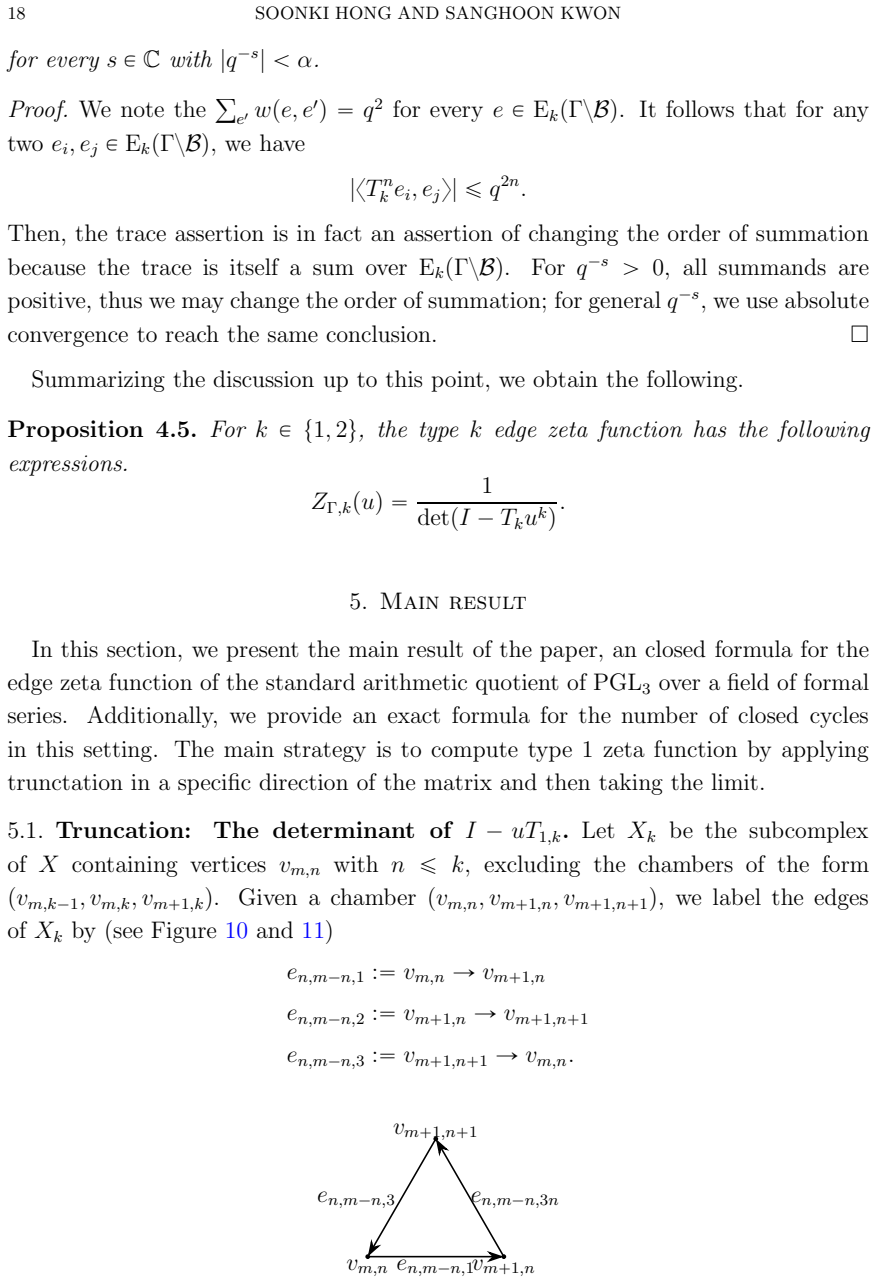
- [Figure 10] The label 'en,m−n,3n' appears to be a typo for 'en,m−n,3'.
- [Section 4.2] The definition of T2 is written as 'T2e = ∑_{e2→e1} w(e,e1)e1', which is confusing; the summation should be over same-type edges e' with s(e') = t(e), as in the definition of T1.
Circularity Check
No significant circularity; the zeta formula is derived from a self-contained trace/determinant computation, with only an ancillary self-citation that is not load-bearing.
full rationale
The paper's central result is not circular. The zeta function is defined as an Euler product over prime cycles, and the determinant identity Z_{Γ,k}(u)^{-1}=exp(Tr(log(1-uT_k))) is derived, not assumed, from the trace formula Tr(T_k^n)=Σ_{ℓ(c)=n} w(c)ℓ(c_0) in Lemma 4.2 and Proposition 4.3. The final rational expression is obtained by an explicit truncated-matrix computation in Sections 5.1 and 5.2, with no fitted parameters and no input data. The one self-citation, Lemma 3.1 citing [HK24], is not load-bearing: the lemma is established by reference to the external reduction theory of Prasad [Pr03], and the prior work by the present authors is used only as a 'see also' for the fundamental domain, not as the source of the zeta formula. The truncation-limit interchange det(I-uT_1)=lim_k det A'_k(u) is asserted without a full proof of convergence of Fredholm determinants; this is a genuine analysis gap that could affect the validity of Theorem 5.1, but it is a correctness or convergence issue, not a circularity: the desired formula is not built into the definition of the truncated determinants or into any fitted parameter. The type-2 determinant is reduced to type 1 by an asserted symmetry, which is a mathematical claim requiring verification rather than a circular definition. Therefore the appropriate circularity score is minimal.
Assumptions & free parameters
assumptions (4)
- domain assumption Standard structure theory of Bruhat-Tits buildings for PGL3 over a local field, including the classification of vertices, edges, and apartments (Section 2).
- domain assumption Lemma 2.2, cited from Cartwright-Lotkowski [CM94], that there are q^2 geodesic extensions of a finite type-1 geodesic segment.
- domain assumption Lemma 3.1 on the reduction theory / fundamental domain for PGL(3,F_q[t]), cited from Prasad [Pr03] and the authors' previous paper [HK24].
- domain assumption The trace-class convergence framework for infinite matrices (Section 4.3), i.e., that the operators T_k are traceable and the determinant can be expressed via the trace of log.
Cite this review
Pith. "Pith review of Edge zeta function and closed cycles in the standard non-uniform complex from $\operatorname{PGL}_3$." pith.science (2026). https://pith.science/paper/CD3XUMBX
@misc{pith2026241115489,
  author       = {Pith},
  title        = {Pith review of: Edge zeta function and closed cycles in the standard non-uniform complex from $\operatornamePGL_3$},
  year         = {2026},
  howpublished = {\url{https://pith.science/paper/CD3XUMBX}},
  note         = {Machine review of arXiv:2411.15489}
}
abstract
In this paper, we define the edge zeta function of weighted complex. We also present the formula for the edge zeta function of the standard non-uniform complex $\operatorname{PGL}(3,\mathbb{F}_q[t])\backslash\operatorname{PGL}(3,\mathbb{F}_q(\!(t^{-1})\!))/\operatorname{PGL}(3,\mathbb{F}_q[\![t^{-1}]\!])$, arising from the group $\operatorname{PGL}_3$, as a rational function. Applying trunction in a specific direction is one of the main ingredient. As a result, we obtain the exact formula for the number of closed cycles coming from geodesics in the building.
Figures


Figures from the paper (10 more)




Forward citations
Cited by 1 Pith paper
-
Vertex volumes, lattice-minima tails, and height zeta functions for the standard arithmetic quotient of $\operatorname{PGL}_d$
Dominant-sector coordinates give a closed vertex volume for Γ\PGL_d, sharp α∈L^r iff r<d cusp tails of order T^{-d}, and a rational height zeta with simple pole at s=d.
Reference graph
Works this paper leans on
-
[1]
Bass, The Ihara-Selberg zeta function of a tree lattice, Internat
H. Bass, The Ihara-Selberg zeta function of a tree lattice, Internat. J. Math. 3 (1992) 717-797
work page 1992
- [2]
-
[3]
Clair, Zeta functions of graphs with Z -actions , J
B. Clair, Zeta functions of graphs with Z -actions , J. Combin. Theory Ser. B 99 (2009), 48-61
work page 2009
-
[4]
D. I. Cartwright and W. MŁotkowski, Harmonic analysis for groups acting on triangle buildings, Journal of the Australian Mathematical Society 56, (1994) 345-383
work page 1994
-
[5]
B. Clair and S. M.-Sharghi, Zeta functions of discrete groups acting on trees, J. Algebra 237 (2001), 591-620
work page 2001
-
[6]
Deitmar, Lefschetz formulae for p -adic groups, Chinese Ann
A. Deitmar, Lefschetz formulae for p -adic groups, Chinese Ann. Math. Ser. B. 28 (2007) 463-474
work page 2007
-
[7]
A. Deitmar and J. Hoffman, The Ihara-Selberg zeta function for PGL _3 and Hecke operators , Int. J. Math. 17 (2006) 143-155
work page 2006
-
[8]
A. Deitmar and M.-H. Kang, Geometric zeta functions for higher rank p -adic groups, Illinois Journal of Mathematics 58 (2014) 719-738
work page 2014
Show all 71 references
-
[9]
Deitmar and M.-H
A. Deitmar and M.-H. Kang, Tree-lattice zeta functions and class numbers, Michigan Math. J. 67 (2018) 617-645
2018
-
[10]
Deitmar, M.-H
A. Deitmar, M.-H. Kang, and R. McCallum, Building lattices and zeta functions, Adv. Geom. 20 (2020) 249-272
2020
-
[11]
Golubev and O
K. Golubev and O. Parzanchevski, Spectrum and combinatorics of two-dimensional Ramanujan complexes, Israel Journal of Mathematics 230(2), (2019) 583–612
2019
-
[12]
R. I. Grigorchuk-A. \' Z uk, The Ihara zeta functions of infinite graphs, the KNS spectral measure and integrable maps, Random walks and geometry, (2004) 141-180
2004
-
[13]
Hong and S
S. Hong and S. Kwon, Spectrum of the weight adjacency operator on a non-uniform arithmetic quotient of PGL _3 , Combinatorics and Number Theory 13 (2024) 103-122
2024
-
[14]
Ihara, Discrete subgroups of PL (2, k_ P ) , In: Algebraic Groups and Discontinuous Subgroups (Proc
Y. Ihara, Discrete subgroups of PL (2, k_ P ) , In: Algebraic Groups and Discontinuous Subgroups (Proc. Sympos. Pure Math., Boulder, Colo., 1965), 272–278, Amer. Math. Soc. 1966. MR0205952 Zbl 0261.20029
1965
-
[15]
Kang, Riemann hypothesis and strongly Ramanujan complexes from GL _n , J
M.-H. Kang, Riemann hypothesis and strongly Ramanujan complexes from GL _n , J. Number Theory 161 (2016) 281-297
2016
-
[16]
Kang and W.-C
M.-H. Kang and W.-C. W. Li, Zeta functions of complexes arising from PGL (3) , Advances in Mathematics 256, (2014) 46-103
2014
-
[17]
Kang, W.-C
M.-H. Kang, W.-C. W. Li and C.-J Wang, The zeta function of complexes from PGL (3) : A representation-theoretic approach , Israel Journal of Mathematics 177 (2010) 335-348
2010
-
[18]
Kang, W.-C
M.-H. Kang, W.-C. W. Li and C.-J Wang, Zeta and L-functions of finite quotients of apartments and buildings, Israel Journal of Mathematics 228 (2018) 79-117
2018
-
[19]
Kwon, Transition probability of a discrete geodesic flow on the standard non-uniform quotient of PGL _3 , Bull
S. Kwon, Transition probability of a discrete geodesic flow on the standard non-uniform quotient of PGL _3 , Bull. Korean Math. Soc. 61 (2024) 825-835
2024
-
[20]
D. Lenz, F. Pogorzelski, and M. Schmidt, The Ihara zeta function for infinite graphs, Trans. Amer. Math. Soc. 371 (2019) 5687-5729
2019
-
[21]
Lubotzky, B
A. Lubotzky, B. Samuels and U. Vishne, Ramanujan complexes of type A _d , Israel J. Math. 149 (2005) 267-299
2005
-
[22]
Lubetzky, A
E. Lubetzky, A. Lubotzky and O. Parzanchevski, Random walks on Ramanujan complexes and digraphs, J. Eur. Math. Soc. 22 (2020) 3441-3466
2020
-
[23]
Mozes, Actions of Cartan subgroups, Israel J
S. Mozes, Actions of Cartan subgroups, Israel J. Math. 90 (1995) 253-294
1995
-
[24]
Paulin, Groupes géométriquement finis d’automorphismes d’arbres et approximation diophantienne dans les arbres, Manuscripta Mathematica 113 (2004) 1-23
F. Paulin, Groupes géométriquement finis d’automorphismes d’arbres et approximation diophantienne dans les arbres, Manuscripta Mathematica 113 (2004) 1-23
2004
-
[25]
Prasad, Reduction theory for a rational function field, Proceedings of the Indian Academny of Sciences-Mathematical Sciences 113 (2003) 153-163
A. Prasad, Reduction theory for a rational function field, Proceedings of the Indian Academny of Sciences-Mathematical Sciences 113 (2003) 153-163
2003
-
[26]
Scheja, On zeta functions of arithmetically defined graphs, Finite Fields Appl
O. Scheja, On zeta functions of arithmetically defined graphs, Finite Fields Appl. 5 (1999) 314-343
1999
-
[27]
Serre, Trees, Springer Monographs in Mathematics (2003)
J.-P. Serre, Trees, Springer Monographs in Mathematics (2003)
2003
-
[28]
Terras, Zeta functions of graphs: a stroll through the garden, Cambridge Studies in Advanced Mathematics, Vol
A. Terras, Zeta functions of graphs: a stroll through the garden, Cambridge Studies in Advanced Mathematics, Vol. 128, Cambridge University Press, Cambridge (2011), xii+239 pp
2011
-
[29]
Athreya, A
J. Athreya, A. Ghosh and A. Prasad, Ultrametric logarithm laws II, Monatsh Math 167 (2012), 333-356
2012
-
[30]
Athreya, A
J. Athreya, A. Parrish and J. Tseng, Ergodic theory and Diophantine approximation for linear forms and translation surfaces, [arxiv: 1401.4148v2]
-
[31]
Bass, Covering theory for graphs of groups, Journal of Pure and Applied Algebra, 89 (1993), 3-47
H. Bass, Covering theory for graphs of groups, Journal of Pure and Applied Algebra, 89 (1993), 3-47
1993
-
[32]
Bass, The Ihara-Selberg zeta function of a tree lattice, Intl
H. Bass, The Ihara-Selberg zeta function of a tree lattice, Intl. J. Math., 3 (1992), 717-797
1992
-
[33]
Bass and R
H. Bass and R. Kulkarni, Uniform tree lattices, Journal of Americal Mathematical Society 3 (1990), 843-902
1990
-
[34]
Bass and A
H. Bass and A. Lubotzky: Tree lattices,
-
[35]
Broise-Alamichel, J
A. Broise-Alamichel, J. Parkkonen, and F. Paulin, Equidistribution and counting under equilibrium states in negatively curved spaces and graphs of groups. Applications to non-Archmedean Diophantine approximation, Progress in Mathematics 329, Birkhäuser
-
[36]
Dodson, S
M. Dodson, S. Kristensen and J. Levesley, A quantitative Khintchine-Groshev type theorem over a field of formal series, Indag. Math. (N.S) 16 (2005), 171-177
2005
-
[37]
Ghosh, Metric Diophantine approximation over a local field of positive characteristic, J
A. Ghosh, Metric Diophantine approximation over a local field of positive characteristic, J. Number Theory 124 (2007), 454-469
2007
-
[38]
Kleinbock and G
D. Kleinbock and G. Margulis, On effective equidistribution of expanding translates of certain orbits in the space of lattices, Number theory, analysis and geometry, 385-396, Springer, New York, 2012
2012
-
[39]
Kleinbock, R
D. Kleinbock, R. Shi and B. Weiss, Pointwise equidistribution with an error rate and with respect to unbounded functions, [arXiv: 1505.06717v2]
-
[40]
Kleinbock and G
D. Kleinbock and G. Tomanov, Flows on S -arithmetic homogeneous spaces and applications to metric Diophantine approximation, Coom. Math. Helv. 82 (2007), 519-581
2007
-
[41]
Mohammadi, Measures invariant under horospherical subgroups in positive characteristic, J
A. Mohammadi, Measures invariant under horospherical subgroups in positive characteristic, J. Mod. Dynamics 5 (2011), 237-254
2011
-
[42]
Oh, Uniform pointwise bounds for matrix coefficients of unitary representations and applications to Kazhdan constants, Duke Math
H. Oh, Uniform pointwise bounds for matrix coefficients of unitary representations and applications to Kazhdan constants, Duke Math. J. 113 (2002), 133–192
2002
-
[43]
Athreya, A
J. Athreya, A. Ghosh and A. Prasad: Ultrametric logarithm laws, II, Monatsh. Math. 167 (2012), 333–356
2012
-
[44]
Broise-Alamichel and F
A. Broise-Alamichel and F. Paulin: Sur le codage du flot géodésique dans un arbre, Ann. Fac. Sci. Toulouse 16 (2007), 477-527
2007
-
[45]
Blach\` e re, P
S. Blach\` e re, P. Ha\" i ssinsky and P. Mathieu: Harmonic measures versus quasiconformal measures for hyperbolic groups, Ann. Sci. \' E c. Norm. Sup\' e r. 44 (2011) 683-721
2011
-
[46]
Borthwick, Distribution of resonances for hyperbolic surfaces, Exp
D. Borthwick, Distribution of resonances for hyperbolic surfaces, Exp. Math. 23 (2014), 25–45
2014
-
[47]
Borthwick: Spectral theory of infinite-area hyperbolic surfaces, Progress in Mathematics 256, Birkhauser (2007)
D. Borthwick: Spectral theory of infinite-area hyperbolic surfaces, Progress in Mathematics 256, Birkhauser (2007)
2007
-
[48]
Broise-Alamichel, J
A. Broise-Alamichel, J. Parkkonen and F. Paulin: Equidistribution and counting under equilibrium states in negatively curved spaces and graphs of groups. Applications to nun-Archimedean Diophantine approximation, preprint, [arXiv:1612.06717]
-
[49]
Coulon, F
R. Coulon, F. Dal'Bo and A. Sambusetti, Growth gap in hyperbolic groups and amenability, preprint, [arXiv:1709:07287]
-
[50]
Deitmar: Ihara zeta functions of infinite weighted graphs, Siam J
A. Deitmar: Ihara zeta functions of infinite weighted graphs, Siam J. Discrete Math. Vol. 29 (2015), 2100-2216
2015
-
[51]
Hashimoto, Zeta functions of finite graphs and representations of p -adic groups, Automorphic forms and geometry of arithmetic varieties
K. Hashimoto, Zeta functions of finite graphs and representations of p -adic groups, Automorphic forms and geometry of arithmetic varieties. 15 (1989), 211-280
1989
-
[52]
Y, Ihara, On discrete subgroups of the two by two projective linear group over p -adic fields, J. Math. Soc. Japan. 18 (1966), 219-235
1966
-
[53]
Kotani and T
M. Kotani and T. Sunada, Zeta functions of finite graphs, J. Math. Sci. Univ. Tokyo 7 (2000), 7-25
2000
-
[54]
Koyama, Selberg zeta functions and Ruelle operators for function fields, Proc
S. Koyama, Selberg zeta functions and Ruelle operators for function fields, Proc. Japan Acad., 67 (1991) 255-259
1991
-
[55]
Kwon and S
S. Kwon and S. Lee, Ihara zeta function of finite graphs with circuit rank two, Korean J. of Math, 28 (2020), 123-136
2020
-
[56]
Lubotzky, Lattices in rank one Lie groups over local fields, Geom
A. Lubotzky, Lattices in rank one Lie groups over local fields, Geom. and Func. Anal. 1 (1991), 405-431
1991
-
[57]
Morgenstern, Ramanujan diagrams, SIAM J
M. Morgenstern, Ramanujan diagrams, SIAM J. Discrete Math. 7 (1994), 560–570
1994
-
[58]
Nagoshi, Selberg zeta functions over function fields, Journal of Number Theory 90 (2001), 207-238
H. Nagoshi, Selberg zeta functions over function fields, Journal of Number Theory 90 (2001), 207-238
2001
-
[59]
Northshield, Cogrowth of regular graphs, Proceeding of the American Mathematical Society, 116 (1992), 203-205
S. Northshield, Cogrowth of regular graphs, Proceeding of the American Mathematical Society, 116 (1992), 203-205
1992
-
[60]
Northshield, Cogrowth of arbitrary graphs, Random Walks and Geometry, Proceedings of a Workshop at the Erwin Schr\" o dinger Institute, Edited by V
S. Northshield, Cogrowth of arbitrary graphs, Random Walks and Geometry, Proceedings of a Workshop at the Erwin Schr\" o dinger Institute, Edited by V. A. Kaimanovich (2001), 501-514
2001
-
[61]
Paulin, On the critical exponent of a discrete group of hyperbolic isometries, Differential Geometry and its Applications 7 (1997), 231-236
F. Paulin, On the critical exponent of a discrete group of hyperbolic isometries, Differential Geometry and its Applications 7 (1997), 231-236
1997
-
[62]
Paulin, Groupes géométriquement finis d’automorphismes d’arbres et approximation diophantienne dans les arbres, Manuscr
F. Paulin, Groupes géométriquement finis d’automorphismes d’arbres et approximation diophantienne dans les arbres, Manuscr. Math. 113(1) (2004), 1–23
2004
-
[63]
Selberg, Harmonic analysis and discontinuous groups on weakly symmetric Riemannian surfaces with applications to Dirichlet series, J
A. Selberg, Harmonic analysis and discontinuous groups on weakly symmetric Riemannian surfaces with applications to Dirichlet series, J. Ind. Math. Soc. 20 (1956) 47-87
1956
-
[64]
Pollicott: Limiting distributions for geodesics excursions on the modular surface, Spectral analysis in geometry and number theory, Contemp
M. Pollicott: Limiting distributions for geodesics excursions on the modular surface, Spectral analysis in geometry and number theory, Contemp. Math. 484 (2009), 177–185
2009
-
[65]
Parkkonen and F
J. Parkkonen and F. Paulin: Skinning measures in negative curvature and equidistribution of equidistant submanifolds, Ergodic Theory and Dynamical Systems 34 (2014), 1310-1342
2014
-
[66]
Paulin, M
F. Paulin, M. Pollicott and B. Schapira: Equilibrium states in negative curvature, Astérisque 373, Soc. Math. France (2015)
2015
-
[67]
R\" u er: Effectivity of uniqueness of the maximal entropy measure on p -adic homogeneous spaces, Ergodic Theory & Dynam
R. R\" u er: Effectivity of uniqueness of the maximal entropy measure on p -adic homogeneous spaces, Ergodic Theory & Dynam. Sys. 36 (2016), 1972-1988
2016
-
[68]
Quint: Mesures de Patterson-Sullivan en rang supérieur, [Patterson-Sullivan measures in higher rank] Geom
J. Quint: Mesures de Patterson-Sullivan en rang supérieur, [Patterson-Sullivan measures in higher rank] Geom. Funct. Anal. 12 (2002), 776–809
2002
-
[69]
H. M. Stark and A. A. Terras, Zeta functions of finite graphs and coverings, Advances in MAthematics 121 (1996), 124-165
1996
-
[70]
Sunada, L-functions in geometry and some applications, Curvature and topology of Riemannian manifolds (Katata, 1985), Lecture Notes in Math., vol
T. Sunada, L-functions in geometry and some applications, Curvature and topology of Riemannian manifolds (Katata, 1985), Lecture Notes in Math., vol. 1201, Springer, Berlin (1986), 266-284
1986
-
[71]
Terras and D
A. Terras and D. Wallace: Selberg's trace formula on the k -regular tree and applications, Int. J. Math. Math. Sci. 8 (2003), 501-526
2003
Reviewed August 12, 2026 · model on record in the stance chip above.
Discussion (0). Continue with ORCID to comment.