REVIEW 2 major objections 5 minor 2 cited by
On the long-range order of the Spectre tilings
T0 review · 2 major / 5 minor · reviewed 2026-08-12 · deepseek-v4-flash
Pith's one-line read The paper proves that the chiral Spectre monotile, and every tiling in its 2-parameter family, has pure-point spectrum—the sharpest possible long-range order—with explicit Bragg peak positions coming from a hidden model set.
desk verdict Spectre paper is genuinely new and likely correct, but the pure-point proof leans on an unproved window-area assertion that should be addressed before publication. read the letter →
The pith
A machine-rendered reading of the paper's core claim, the machinery that carries it, and where it could break.
The reading
What carries the argument
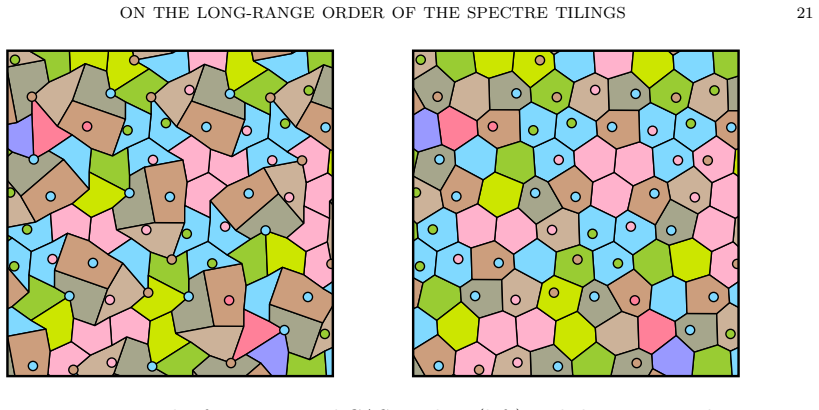
The load-bearing object is the CASPr (Cut-And-Symmetrically-Project) tiling, a self-similar representative of the Spectre family whose squared inflation scales all edge vectors by the algebraic number $\lambda = 4+\sqrt{15}$. Its control points are chosen to lie in one translation orbit of the return module $L$, a non-principal ideal of the order $\mathbb{Z}[\xi,\lambda]$ with $\xi = e^{2\pi i/6}$; embedding $L$ together with its Galois conjugate into $\mathbb{C}^2$ defines the cut-and-project lattice. The deciding identity is the density equality $\rho_1 = A/V = \rho_2$: the area $A$ of the window system divided by the unit-cell volume $V = 3645$ must equal the true control-point density $\rho_2$ obtained from the Perron–Frobenius frequencies of the tile inflation. When it holds, the five subwindows are disjoint up to measure zero, turning the colored control points into a full-density regular model set—a set cut from the lattice by a window in internal space—and forcing pure-point diffraction.
What would settle it
Sample the internal-space projections of control points from a large CASPr patch by the chaos game, numerically compute the total area covered by the five subwindows, and compare with the asserted value $|31+4(\xi-\lambda)-\lambda\xi|^2$; if the areas differ beyond numerical error, or if the measured control-point density deviates from $(8-\lambda)\sqrt{3}/54$, Theorem 9 would be refuted.
Extended reading notes
Core claim
The central discovery is that the control points of the CASPr tiling comprise a full-density subset of a 5-color regular model set, as stated in Theorem 9. The proof works by embedding the tiling's return module into a 4-dimensional total space via its Galois conjugate, producing a cut-and-project lattice with unit-cell volume $3645$, and by showing that the total area of the five Rauzy-fractal windows gives a control-point density $\rho_1 = (8-\lambda)\sqrt{3}/54$ that exactly matches the true density $\rho_2$ computed from the tile-inflation frequencies. This equality forces the five subwindows to be disjoint up to measure zero, which is precisely the condition under which a cut-and-project set is a regular model set and has pure-point diffraction. Since the original Spectre tiling is mutually locally derivable from a reprojection of these control points (Corollary 11), it shares the same pure-point dynamical spectrum with continuously representable eigenfunctions, as do all Spectre-like tilings.
Load-bearing premise
The load-bearing premise is that the window area equals $|d|^2$ with $d = 31+4(\xi-\lambda)-\lambda\xi$, a value asserted by inspection; if the area differed, the density equality $\rho_1=\rho_2$ would fail and the pure-point conclusion would not follow from this argument.
Editorial extensions
If this is right
- Every Spectre-like tiling, including the original chiral monotile, has pure-point dynamical spectrum with continuous eigenfunctions and pure-point diffraction.
- The Fourier module, the set of all Bragg peak positions, is explicitly computed as $L^\circledast = \pi_{\mathrm{int}}(L^*)$ and is identical for the whole family; only the peak intensities vary as the projection direction changes.
- Changing the edge-length ratio $(a:b)$ from $1:1$ (Spectre) to any nearby value, or even to $\sqrt{3}:1$ (Hat–Turtle), changes the tiling only by a topological conjugacy up to rotation and rescaling, so the whole family is dynamically one system.
- The first Čech cohomology of the Spectre tiling space is $\mathbb{C}^4$, as small as it can be, which leaves no room for shape changes that alter the dynamics.
- The Spectre tiling is mutually locally derivable from a 5-color Meyer set, placing a single-tile aperiodic monotile inside the classical model-set framework.
Reading between the lines
- The same certificate—build a self-similar representative, embed its return module as a lattice, and match the window density to the inflation density—looks directly applicable to other hierarchical tilings and monotiles with algebraic inflation factors, turning pure-point verification into a routine calculation.
- Since the density equality is the only unverified step, a short computer-assisted proof of the window's triangular-lattice fundamental-domain property would close the gap; this is a concrete, bounded task.
- The apparent uniformity of the boundary Hausdorff dimension suggests the five subwindows form a self-similar system with a single contraction ratio; if verified, the dimension formula would follow from an exact iterated-function-system relation rather than from orbit-separation estimates.
- The emergence of a non-principal ideal as the return module, and of its dual as the Fourier module, points toward the class number of the underlying field obstructing any one-colour model-set description of the Spectre—a prediction that could be tested by attempting a single-window cut-and-project construction.
Editorial analysis
A structured set of objections, weighed in public.
Referee Report
Summary. This paper studies the translation dynamics of the Spectre aperiodic monotile and its deformation family. The authors compute the first and second Čech cohomology of the Spectre tiling space, introduce a self-similar representative called CASPr, construct a cut-and-project scheme for its control points, and prove via a density comparison that the control points form a regular 5-color model set. From this they derive pure-point diffraction and dynamical spectrum for CASPr, and then argue via reprojection and MLD arguments that the original Spectre tiling, and indeed all Spectre-like tilings, share these properties.
Significance. If the proof is completed, this is a major result: it establishes the strongest form of long-range order for the chiral Spectre monotile and for the whole deformation family, showing that the earlier results for the Hat family extend to this truly chiral setting. The paper contains substantial explicit computational content: the boundary and substitution matrices, edge vectors, return-module generators, and a density equality with explicit numerical values. The density equality is an elegant internal consistency check. However, the proof currently rests in part on an unverified and partially misprinted window-area assertion, so the main theorem is not yet fully established as written.
major comments (2)
- [Section 5, density computation before Theorem 9] The window area A is asserted with the phrase "one can convince oneself that the window is a fundamental domain of a triangular lattice, with a generating vector d = 31 + 4(ξ − λ) − λξ". This assertion is load-bearing: it enters ρ1 = A/V, and the equality ρ1 = ρ2 is what upgrades the control points to a regular model set in Theorem 9. No derivation or reproducible computation is supplied. Moreover, the displayed chain A = |d|² = (135√3/2)(8−λ) cannot be right as written: a direct calculation gives |d|² = 135(8−λ), so the correct first equality must be A = (√3/2)|d|², with the factor √3/2 coming from the fundamental cell of the triangular lattice. Please correct the formula and provide a rigorous derivation of the fundamental-domain property, for example by giving the vertices of the window or an exact algebraic check of the lattice and the window decomposition.
- [Section 4, border-forcing paragraph] The proof that the CASPr inflation forces the border is a visual inspection of Figure 6, expressed as "As one can see ... This proves". This property is load-bearing because it justifies replacing the collared Anderson–Putnam complex by the simplified uncollared complex used in Theorem 1. Please make the verification explicit, for instance by listing all edge identifications and their neighborhoods after one and two inflation steps, or by providing the relevant data in a supplementary file.
minor comments (5)
- [Section 5] The equation for the window area should be corrected from A = |d|² to A = (√3/2)|d|², as noted in the major comment; the numerical value used later is consistent with the corrected formula.
- [Section 5] The phrase "one can convince oneself" is not appropriate for a central computational assertion; please replace it with a reference to an appendix, a supplementary file, or a short proof.
- [Section 6] The statement that "up to MLD equivalence, the set of tilings that are topologically conjugate to CASPr is a connected 4-dimensional family" is asserted without proof; a brief justification would help the reader follow the dimension-counting argument.
- [Section 3] The cohomology computation is summarized representation by representation, but the ranks and eigenvalue calculations are not shown in detail; a table collecting the ranks of ∂1 and ∂2 and the substitution eigenvalues for each representation would improve verifiability.
- [Throughout] There are several small typos, including "homeormophic" in the proof of Theorem 5 and "Univeristy" in the affiliation line; these should be corrected in the final version.
Circularity Check
No significant circularity; the pure-point proof rests on an external density criterion and an independent, though underived, window-area observation.
full rationale
The paper's derivation chain is self-contained against external benchmarks. The cohomology computation (Section 3) is an explicit Anderson–Putnam calculation from displayed matrices, with border-forcing verified from the inflation figure rather than imported from the authors' prior Hat work. Theorem 9's pure-point conclusion is anchored to the Baake–Lenz density criterion [8]: the true control-point density rho2 is computed explicitly from the Perron–Frobenius frequency vector and the self-similar tile areas, while rho1 is computed from the CPS unit-cell volume V = 3645 and the window area A. The only soft step is Section 5's assertion 'one can convince oneself that the window is a fundamental domain of a triangular lattice, with a generating vector d = 31 + 4(ξ − λ) − λξ, which gives a window area of A = |d|^2 = 135√3/2 (8 − λ)': this is an unverified geometric/numeric claim, and if A had been fitted to force rho1 = rho2 the proof would indeed be circular. However, the text presents A as an independent observation about the window, and no displayed equation reduces rho1 to rho2 by construction. The self-citations are not load-bearing: [5] is used as a template for Theorems 4–5, but the Spectre cohomology is computed in this paper rather than assumed from [5]. The generalized overlap algorithm [22,3] is cited as a prior independent verification that the paper says could also be proved in retrospect by the density argument. Under the rule that circularity requires an exhibited reduction, no circular step is identified; the window-area gap is a rigor/correctness concern, not a circularity.
Assumptions & free parameters
assumptions (3)
- standard math Anderson-Putnam theorem: for a primitive substitution tiling that forces its border, the Cech cohomology of the tiling space is the direct limit of the cohomology of the Anderson-Putnam complex under the substitution map.
- domain assumption The CASPr inflation (the square of the edge inflation M*_1 M_1 applied to the nine meta-tiles) forces the border.
- standard math Baake-Lenz criterion: if a translation-bounded measure's autocorrelation is matched by a regular model set density, the diffraction is pure point; and the window system produced by the lifting has the stated area A.
Cite this review
Pith. "Pith review of On the long-range order of the Spectre tilings." pith.science (2026). https://pith.science/paper/JY62K5YX
@misc{pith2026241115503,
  author       = {Pith},
  title        = {Pith review of: On the long-range order of the Spectre tilings},
  year         = {2026},
  howpublished = {\url{https://pith.science/paper/JY62K5YX}},
  note         = {Machine review of arXiv:2411.15503}
}
abstract
The Spectre is an aperiodic monotile for the Euclidean plane that is truly chiral in the sense that it tiles the plane without any need for a reflected tile. The topological and dynamical properties of the Spectre tilings are very similar to those of the Hat tilings. Specifically, the Spectre sits within a complex $2$-dimensional family of tilings, most of which involve two shapes rather than one. All tilings in the family give topologically conjugate dynamics, up to an overall rescaling and rotation. They all have pure point dynamical spectrum with continuous eigenfunctions and may be obtained from a $4:2$ dimensional cut-and-project scheme with regular windows of Rauzy fractal type. The diffraction measure of any Spectre tiling is pure point as well. For fixed scale and orientation, varying the shapes is MLD equivalent to merely varying the projection direction. These properties all follow from the first \v{C}ech cohomology being as small as it possibly could be, leaving no room for shape changes that alter the dynamics.
Figures


Figures from the paper (8 more)


Forward citations
Cited by 2 Pith papers
-
Quantum error-correcting codes from aperiodic monotiles: the Hat and the Spectre
The Hat and Spectre aperiodic monotiles define erasure-correcting quantum codes with two local-indistinguishability sectors; under SE(2) the Hat retains a superselected chirality bit while the Spectre's label is gauged away.
-
Quasilattices of the Spectre monotile
Decorating every Spectre tile with the same point yields a wide variety of non-periodic quasilattices, including sparse, clustered, and near-hexagonal examples.
Reference graph
Works this paper leans on
-
[1]
An alternative proof for an aperiodic monotile
S. Akiyama and Y. Araki, An alternative proof for an aperiodic monotile, preprint (2023); arXiv:2307.12322
work page Pith review arXiv 2023
-
[2]
J.E. Anderson and I.F. Putnam, Topological invariants for substitution tilings and their associated C ∗- algebras, Ergod. Th. Dynam. Syst. 18 (1998) 509–537. 22 MICHAEL BAAKE, FRANZ G ¨AHLER, JAN MAZ ´A ˇC, AND LORENZO SADUN
work page 1998
-
[3]
Algorithm for determining pure pointedness of self-affine tilings
S. Akiyama and J.-Y. Lee, Algorithm for determining pure pointedness of self-affine tilings, Adv. Math. 226 (2011) 2855–2883; arXiv:1003.2898
work page Pith review arXiv 2011
- [4]
- [5]
- [6]
-
[7]
Baake and U
M. Baake and U. Grimm, Aperiodic Order. Vol. 1: A Mathematical Invitation , Cambridge University Press, Cambridge (2013)
2013
-
[8]
M. Baake and D. Lenz, Dynamical systems on translation bounded measures: Pure point dynamical and diffraction spectra, Ergod. Th. & Dynam. Syst. 24 (2004) 1867–1893; arXiv:math.DS/0302061
Show all 23 references
-
[9]
Clark and L
A. Clark and L. Sadun, When shape matters, Ergod. Th. Dynam. Syst. 26 (2006) 69–86; arXiv:math.DS/0306214
2006
-
[10]
Elton, An ergodic theorem for iterated maps, Ergod
J.H. Elton, An ergodic theorem for iterated maps, Ergod. Th. & Dynam. Syst. 7 (1987) 481–488
1987
-
[11]
Frank and L
N.P. Frank and L. Sadun, Fusion: a general framework for hierarchical tilings of Rd, Geom. Dedicata 171 (2014) 149–186
2014
-
[12]
Greither, On the two generator problem for the ideals of a one-dimensional ring, J
C. Greither, On the two generator problem for the ideals of a one-dimensional ring, J. Pure Appl. Alg. 24 (1982) 265–276
1982
-
[13]
Julien and L
A. Julien and L. Sadun, Tiling deformations, cohomology, and orbit equivalence of tiling spaces. Ann. H. Poincar´ e19 (2018) 3053–3088
2018
-
[14]
Kellendonk, Noncommutative geometry of tilings and gap labelling, Rev
J. Kellendonk, Noncommutative geometry of tilings and gap labelling, Rev. Math. Phys. 7 (1995) 1133– 1180; arXiv:cond-mat/9403065
1995 arXiv
-
[15]
Maz´ aˇ c,Fractal and Statistical Phenomena in Aperiodic Order , PhD thesis, Bielefeld University, in preparation (2024)
J. Maz´ aˇ c,Fractal and Statistical Phenomena in Aperiodic Order , PhD thesis, Bielefeld University, in preparation (2024)
2024
-
[16]
Moody, Uniform distribution in model sets, Can
R.V. Moody, Uniform distribution in model sets, Can. Math. Bull. 45 (2002) 123–130
2002
-
[17]
Sadun, Topology of Tiling Spaces, Amer
L. Sadun, Topology of Tiling Spaces, Amer. Math. Society, Providence, RI (2008)
2008
-
[18]
Smith, J.S
D. Smith, J.S. Myers, C.S. Kaplan and C. Goodman-Strauss, An aperiodic monotile, Combin. Th. 4 (2024) 6:1–90; arXiv:2303.10798
2024 arXiv
-
[19]
Smith, J.S
D. Smith, J.S. Myers, C.S. Kaplan and C. Goodman-Strauss, A chiral aperiodic monotile, Combin. Th. 4 (2024) 13:1–25; arXiv:2305.17743
2024 arXiv
-
[20]
Smith, Turtles, Hats and Spectres: Aperiodic structures on a Rhombic tiling, preprint (2024); arXiv:2403.01911
J. Smith, Turtles, Hats and Spectres: Aperiodic structures on a Rhombic tiling, preprint (2024); arXiv:2403.01911
2024 arXiv
-
[21]
Socolar and J.M
J.E.S. Socolar and J.M. Taylor, An aperiodic hexagonal tile, J. Comb. Theory A 118 (2011) 2207–2231; arXiv:1003.4279
2011 arXiv
-
[22]
Solomyak, Dynamics of self-similar tilings, Ergod
B. Solomyak, Dynamics of self-similar tilings, Ergod. Th. Dynam. Syst. 17 (1997) 695–738 and Ergod. Th. Dynam. Syst. 19 (1999) 1685 (erratum)
1997
-
[23]
The LMFDB Collaboration, The L-functions and Modular Forms Database , https://www.lmfdb.org, 2024. F akult¨at f¨ur Mathematik, Universit¨at Bielefeld, Postfach 100131, 33501 Bielefeld, Germany Email address : {mbaake,gaehler,jmazac}@math.uni-bielefeld.de Department of Mathemat...
2024
Reviewed August 12, 2026 · model on record in the stance chip above.
Discussion (0). Continue with ORCID to comment.