REVIEW 3 major objections 6 minor 56 references
On the Existence of Long-Period Decayless Oscillations in Short Active Region Loops
T0 review · 3 major / 6 minor · reviewed 2026-08-12 · deepseek-v4-flash
Pith's one-line read This paper reports 105 decayless kink oscillations in short active-region loops (4–49 Mm), 82 with periods above 50 s and up to 467 s, and argues they form a separate branch in the loop-length–period relation.
desk verdict A genuinely new sample of long-period decayless oscillations in short active-region loops, with a plausible central claim that needs a robustness pass on the one-cycle detections before the population and the 'separate branch' interpretation are taken as established. read the letter →
The pith
A machine-rendered reading of the paper's core claim, the machinery that carries it, and where it could break.
The reading
What carries the argument
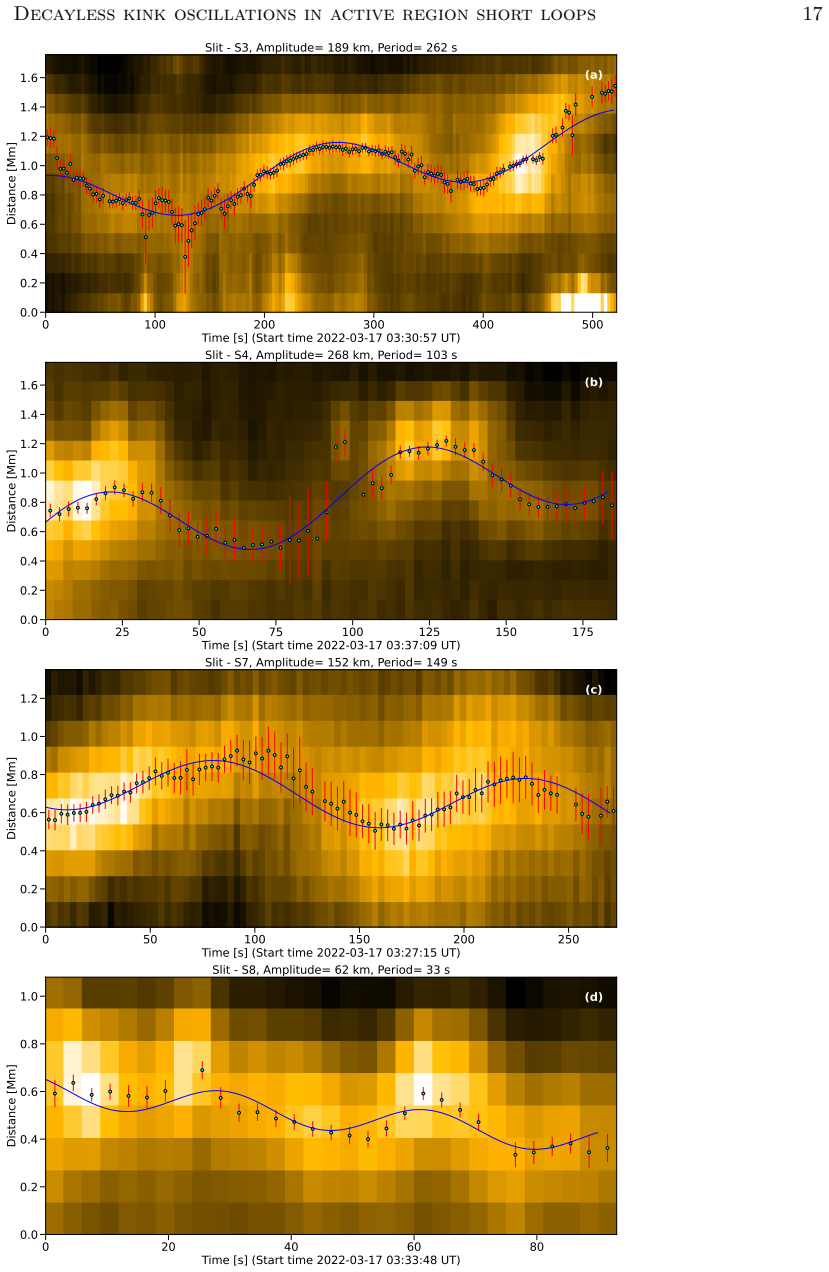
The carrying objects are decayless kink oscillations, defined here as transverse coronal-loop displacements that show no notable amplitude decay over more than two cycles. They are measured by placing artificial slits across a loop in EUI images, fitting a Gaussian to the loop's intensity profile at each time step to track its centroid, and fitting the centroid time series with a sinusoid plus a linear trend; loop length is estimated from footpoint positions under a semicircular assumption, with an assumed roughly 40% uncertainty. The theoretical anchor is the standing kink mode relation $C_k = 2L/P$, and its conversion to magnetic field via $B = C_k \sqrt{\frac{1+\zeta}{2}}\sqrt{\mu_0 \rho_i}$, which the paper applies cautiously. The decisive observational tool is the loop-length–period diagram: long loops define a strong correlation, while the short-loop branch reported here occupies long periods at small lengths. The paper also uses cross-correlation between oscillation signals at two slit positions to measure phase lag, finding $0\pm0.01$ s and $0\pm0.02$ s, and uses a kink-speed cutoff to show the length–period correlation strengthens when the slowest events are removed.
What would settle it
Re-run the detection on the same EUI time series requiring at least three full cycles and a significance threshold against red noise using a wavelet or Lomb-Scargle periodogram; if most events with periods above about 200 s fail, the separate branch and the null length–period correlation would not survive. A secondary check would test whether the longest-period events repeat coherently in a second time window on the same loop.
Extended reading notes
Core claim
The central claim is that long-period decayless kink oscillations exist in short active-region loops. Using time-distance maps from 3 s cadence EUI data, the authors measure 105 oscillations in loops with lengths 4.1–49 Mm; 82 of these have periods above 50 s, the average period is $151\pm107$ s, and the longest detected period is 467 s. In the loop-length–period plane these short-loop points do not follow the linear scaling established for loops of hundreds of Mm; the correlation is $0.07\pm0.10$, and a kink-speed cutoff analysis shows that only events with kink speeds above about 400 km/s recover a length–period correlation near 0.7. The zero phase lag measured at two loop positions leaves standing waves a viable interpretation, but the absence of a length–period correlation suggests that many of these oscillations are not fundamental standing kink modes and that the observed period may instead reflect the driver. This extends the earlier study of the same first dataset, which had only sampled periods up to 185 s and reported a correlation of 0.98. From the standing-kink assumption the authors derive kink speeds with a mean of 471 km/s and magnetic fields with a mean of 6.3 G, often lower than previous active-region estimates, and they caution that coronal seismology in short loops is unreliable until the wave mode is identified.
Load-bearing premise
The load-bearing premise is that the sinusoid fits with only one to two visible cycles—about 40% of the sample, including the longest periods (200–467 s) in roughly 500 s windows—are genuine oscillations rather than artifacts of dynamic loops or background intensity fluctuations.
Editorial extensions
If this is right
- Short active-region loops contain a population of long-period decayless oscillations (50–467 s), so censoring periods above 200 s—as earlier short-loop studies did—removes most of the events and distorts the perceived length–period relation.
- The flat length–period relation implies that for short loops the period is not a reliable proxy for loop length, and vice versa; standing-kink seismology estimates of magnetic field and kink speed from these oscillations are therefore uncertain.
- The period distribution in the short-period regime differs between active regions and quiet Sun/coronal holes, pointing to different excitation mechanisms in different coronal regions.
- Zero phase lag between slit positions keeps standing waves viable, so the conclusion is not that these oscillations are definitely propagating or driven, but that a mixture of wave modes is likely.
- If the long periods reflect p-mode-like footpoint driving, then decayless oscillations in short loops could be used to study how photospheric drivers couple to coronal structures.
Reading between the lines
- The paper's own kink-speed cutoff test (correlation rises to roughly 0.7 when only events with $C_k>400$ km/s are kept) implies a testable partition: the sample is likely a mixture of true standing kink modes and other motions, and the 'long-period branch' may be dominated by the non-kink component.
- A coordinated observation that compares the oscillation period in each short loop with the local photospheric p-mode power would test the driver hypothesis directly; the paper does not perform this comparison.
- The assumed 40% error in loop length, plus the 3 s cadence and sub-pixel Gaussian centroiding, set a floor on how strongly a true length–period correlation could be detected, so the null correlation by itself cannot rule out a steep underlying scaling.
- If long periods are driven, the energy flux carried by these oscillations should be computed from the driver's velocity amplitude and the loop's inertia rather than from the standing-mode formula, which would change estimates of decayless oscillations' contribution to coronal heating in active regions.
Editorial analysis
A structured set of objections, weighed in public.
Referee Report
Summary. The paper analyzes 105 transverse oscillations in short (4-49 Mm) active-region loops observed by the Extreme Ultraviolet Imager (EUI) on Solar Orbiter in two datasets. The authors fit the loop-centroid time series with a sinusoid plus a linear trend (Eq. 1), measure loop lengths from manual footpoint identification, and report periods ranging from 23 to 467 s, of which 82 are classified as 'long-period' (>50 s). They find no significant correlation between loop length and period (cc = 0.07), identify a separate branch in the loop-length vs. period diagram for short loops, derive low kink speeds and magnetic field strengths using standing-kink seismology (Eqs. 2-3), and compare period distributions across active regions, quiet Sun, and coronal holes. The central claim is the existence of long-period decayless kink oscillations in short active-region loops, with implications for the wave mode and driving mechanism of decayless oscillations.
Significance. If the period and amplitude estimates are reliable, the paper makes a valuable contribution: it significantly enlarges the sample of decayless oscillations in short active-region loops, extends the observed period range beyond 200 s (which earlier work on the same dataset excluded), and challenges the simple standing-kink scaling by reporting a distinct branch in the L-P diagram. The high-cadence EUI data and the availability of the parameter table online (GitHub link in Section 4) are strengths, as is the explicit discussion of alternative wave modes and non-wave interpretations in Section 4.3. The principal risk is that the longest-period events, which define the new branch, are fitted with only 1-1.5 cycles in short EUI time series, so the existence claim rests on the reliability of those fits.
major comments (3)
- [Section 3, Eq. (1), Table 2, Appendix Fig. 11] The long-period detections that anchor the central claim are fit with a sinusoid plus a linear trend over windows containing only 1-2 cycles. For example, Table 2 entries 71 (P=467±7 s), 78 (P=404±9 s), 14 (P=421±16 s), and 37 (P=434±6 s) have observation windows of roughly 500-700 s, i.e., about 1-1.5 periods. With only one full period, the sinusoid term in Eq. (1) is degenerate with a slow background drift, and the fit alone does not establish that the signal is a periodic oscillation. The paper itself states in Section 3 that 40% of the 105 events have between 1 and 2 cycles, so this concern is not limited to a few outliers. I request a quantitative robustness check: either a red-noise significance test (e.g., Monte Carlo generation of a linear trend plus noise on the same time sampling, comparing the fitted long-period power to the null distribution) or a minimum-cycle criterion (≥2, preferably ≥3) for an event to enter the long-period sample. Without such a test, the 82-event count and the separate branch in Figure 5 are not adequately supported.
- [Section 4.1, Figure 5] The claimed separate branch in the loop-length vs. period diagram is defined largely by the long-period events with P>200 s and L<50 Mm (Figure 5, current-work points). If those events are manifestations of background variability or loop interactions rather than true oscillations, the branch inference collapses. The paper should also quantify the selection effects: the EUI time series are much shorter than the AIA sequences that produced the long-loop branch, so the number of observable cycles for a given period differs strongly between datasets. A comparison of detection biases (e.g., the number of cycles available as a function of period and window length for each instrument) would help demonstrate that the separate branch is not an artifact of combining heterogeneous datasets.
- [Section 3, title and abstract] The title and abstract characterize all 105 events as 'decayless,' but the paper only asserts in Section 3 that oscillations with more than two cycles do not show notable decay, without a quantitative measure. For the 40% of events with 1-2 cycles, a decayless status cannot in principle be assessed. Please provide a quantitative decay statistic (e.g., the amplitude ratio between the first and second half of the time series, or a fit with an exponential damping term compared to a constant-amplitude fit) for all events, or explicitly restrict the term 'decayless' to a subsample with ≥3 cycles and revise the title and abstract accordingly. This is important because the claim of 'decayless' behavior is a central part of the paper's contribution.
minor comments (6)
- [Section 4.5, Figure 10] The text states that 'The period distribution in quiet Sun and coronal holes significantly differ from each other in the region of short periods (<50 s)', but Figure 10 compares the combined quiet Sun and coronal hole distribution with the active region distribution. Please clarify whether the statement refers to a direct QS vs. CH comparison or to the combined sample, and report the statistical test used (e.g., a KS test).
- [Figure 5 caption] The caption says that filled triangles represent oscillations in quiet Sun regions, while the text and the legend imply that the triangles also include coronal holes. Please make the caption consistent with the text.
- [Table 2] Several entries report zero uncertainty in the period (e.g., entry 10, '25 ± 0'), which likely reflects rounding to the nearest second. Please use a minimum uncertainty floor (e.g., 0.5 s) or report one more decimal place so that the uncertainties are not shown as exactly zero.
- [Section 3] The sentence 'The slit positions for the first dataset are approximately similar to the slit locations used in the study of Li & Long (2023)' is ambiguous: it is unclear whether the slits were placed independently on the same loops or at identical coordinates. Please specify the degree of overlap.
- [Section 2, Table 1] Table 1 lists the field of view in Mm² and the plate scale in km; the units are inconsistent with the common practice of giving the plate scale in km/pixel. Please add the pixel size or specify the plate scale unit explicitly.
- [Section 4.4, Eq. (3)] In Eq. (3), the notation 'ρ_i em' appears malformed; it should presumably be ρ_i (the loop density) and μ_0 (the vacuum permeability). Please correct the typesetting.
Circularity Check
Self-contained observational analysis; no fitted or self-cited quantity is recycled into a prediction.
full rationale
The paper is an observational statistical study of decayless kink oscillations in short active-region loops. The central quantities—period, amplitude, and loop length—are measured from EUI image sequences via Gaussian fitting of loop centroids and a sinusoid-plus-linear-trend fit (Eq. 1), and the derived quantities (velocity amplitude, kink speed, magnetic field) follow standard formulas (V = 2πA/P, Ck = 2L/P, B = Ck√((1+ζ)/2 μ0 ρ_i)) with explicitly stated, externally supplied assumptions (ζ = 1/3, ρ_i = 1.67×10⁻¹² kg m⁻³). No target parameter is fitted from a subset of the data and then reported as a prediction; the 'long-period' category is a threshold at 50 s applied after measurement, not an input that forces the result. Self-citations to Shrivastav et al. 2024a/2024b and Petrova et al. 2023 provide context, parameter assumptions, or earlier quiet-Sun/coronal-hole comparisons, but the existence claim for the 82 long-period events rests on the new EUI measurements and is externally falsifiable. The caveats about oscillations with only 1–2 cycles are statistical and interpretive concerns, not circularity. No equation in the derivation chain reduces to its own input by construction.
Assumptions & free parameters
free parameters (3)
- Period threshold for short/long classification =
50 s
- Kink speed cutoff =
400 km/s
- Loop length error estimate =
40% of loop length
assumptions (3)
- domain assumption Semicircular loop geometry: L = πR
- domain assumption Coronal loop density ρ_i = 1.67e-12 kg/m^3 and density contrast ζ = 1/3
- domain assumption The observed transverse displacements are kink oscillations
Cite this review
Pith. "Pith review of On the Existence of Long-Period Decayless Oscillations in Short Active Region Loops." pith.science (2026). https://pith.science/paper/WEV3FNS2
@misc{pith2026241115646,
  author       = {Pith},
  title        = {Pith review of: On the Existence of Long-Period Decayless Oscillations in Short Active Region Loops},
  year         = {2026},
  howpublished = {\url{https://pith.science/paper/WEV3FNS2}},
  note         = {Machine review of arXiv:2411.15646}
}
read the original abstract
Decayless kink oscillations, characterized by their lack of decay in amplitude, have been detected in coronal loops of varying scales in active regions, quiet Sun and coronal holes. Short-period (< 50 s) decayless oscillations have been detected in short loops (< 50 Mm) within active regions. Nevertheless, long-period decayless oscillations in these loops remain relatively unexplored and crucial for understanding the wave modes and excitation mechanisms of decayless oscillations. We present the statistical analysis of decayless oscillations from two active regions observed by the Extreme Ultraviolet Imager (EUI) onboard Solar Orbiter. The average loop length and period of the detected oscillations are 19 Mm and 151 seconds, respectively. We find 82 long-period and 23 short-period oscillations in these loops. We do not obtain a significant correlation between loop length and period. We discuss the possibility of different wave modes in short loops, although standing waves can not be excluded from possible wave modes. Furthermore, a different branch exists for active region short loops in the loop length vs period relation, similar to decayless waves in short loops in quiet Sun and coronal holes. The magnetic fields derived from MHD seismology, based on standing kink modes, show lower values for multiple oscillations compared to previous estimates for long loops in active regions. Additionally, the comparison of period distributions in short loops across different coronal regions indicates that different excitation mechanisms may trigger short-period kink oscillations in active regions compared to the quiet Sun and coronal holes.
Figures


Figures from the paper (9 more)


Reference graph
Works this paper leans on
-
[1]
, " * write output.state after.block = add.period write newline
ENTRY address archivePrefix author booktitle chapter doi edition editor eprint howpublished institution journal key month number organization pages publisher school series title misctitle type volume year version url label extra.label sort.label short.list INTEGERS output.state before.all mid.sentence after.sentence after.block FUNCTION init.state.consts ...
-
[2]
write newline
" write newline "" before.all 'output.state := FUNCTION format.url url empty "" new.block "" url * "" * if FUNCTION format.eprint eprint empty "" archivePrefix empty "" archivePrefix "arXiv" = new.block " " eprint * " " * new.block " " eprint * " " * if if if FUNCTION format.doi doi empty "" " " doi * " " * if FUNCTION format.pid doi empty eprint empty ur...
-
[3]
^sPz]v*@CZ. vfU_Z0A95 J/_ڴ*Kk( *٥ Kywx & Z; #Y)J [X s 1 L ryUU2E,< K8 ) J) ̘*K \.z J 35B;b q5Ӭ FD 4&튀n 3']y ڙ ER < 3VVp b^ 5@
thebibliography [1] 20pt to REFERENCES 6pt =0pt -12pt 10pt plus 3pt =0pt =0pt =1pt plus 1pt =0pt =0pt -12pt =13pt plus 1pt =20pt =13pt plus 1pt \@M =10000 =-1.0em =0pt =0pt 0pt =0pt =1.0em @enumiv\@empty 10000 10000 `\.\@m \@noitemerr \@latex@warning Empty `thebibliography' environment \@ifnextchar \@reference \@latexerr Missing key on reference command E...
2021
-
[4]
N., Van Doorsselaere , T., & Nakariakov , V
Afanasyev , A. N., Van Doorsselaere , T., & Nakariakov , V. M. 2020, , 633, L8, 10.1051/0004-6361/201937187
-
[5]
Anfinogentov , S., & Nakariakov , V. M. 2016, , 291, 3251, 10.1007/s11207-016-1013-z
-
[6]
Anfinogentov , S., Nistic \`o , G., & Nakariakov , V. M. 2013, , 560, A107, 10.1051/0004-6361/201322094
-
[7]
Anfinogentov , S. A., & Nakariakov , V. M. 2019, , 884, L40, 10.3847/2041-8213/ab4792
-
[8]
Anfinogentov , S. A., Nakariakov , V. M., & Nistic \`o , G. 2015, , 583, A136, 10.1051/0004-6361/201526195
Show all 56 references
-
[9]
A., Pascoe , D
Duckenfield , T., Anfinogentov , S. A., Pascoe , D. J., & Nakariakov , V. M. 2018, , 854, L5, 10.3847/2041-8213/aaaaeb
2018 doi
- [10]
-
[11]
Gao , Y., Guo , M., Van Doorsselaere , T., Tian , H., & Skirvin , S. J. 2023, , 955, 73, 10.3847/1538-4357/acf454
2023 doi
-
[12]
2024, , 681, L4, 10.1051/0004-6361/202348702
Gao , Y., Hou , Z., Van Doorsselaere , T., & Guo , M. 2024, , 681, L4, 10.1051/0004-6361/202348702
2024 doi
-
[13]
2022, , 930, 55, 10.3847/1538-4357/ac62cf
Gao , Y., Tian , H., Van Doorsselaere , T., & Chen , Y. 2022, , 930, 55, 10.3847/1538-4357/ac62cf
2022 doi
-
[14]
R., Nistic \`o , G., Nakariakov , V
Goddard , C. R., Nistic \`o , G., Nakariakov , V. M., & Zimovets , I. V. 2016, , 585, A137, 10.1051/0004-6361/201527341
2016 doi
-
[15]
2019, , 870, 55, 10.3847/1538-4357/aaf1d0
Guo , M., Van Doorsselaere , T., Karampelas , K., et al. 2019, , 870, 55, 10.3847/1538-4357/aaf1d0
2019 doi
-
[16]
2020, , 897, L35, 10.3847/2041-8213/ab9f38
Karampelas , K., & Van Doorsselaere , T. 2020, , 897, L35, 10.3847/2041-8213/ab9f38
2020 doi
-
[17]
2024, , 681, L6, 10.1051/0004-6361/202348144
---. 2024, , 681, L6, 10.1051/0004-6361/202348144
2024 doi
-
[18]
2017, , 604, A130, 10.1051/0004-6361/201730598
Karampelas , K., Van Doorsselaere , T., & Antolin , P. 2017, , 604, A130, 10.1051/0004-6361/201730598
2017 doi
-
[19]
2023, SolO/EUI Data Release 6.0 2023-01, https://doi.org/10.24414/z818-4163
Kraaikamp , E., Gissot , S., Stegen , K., et al. 2023, SolO/EUI Data Release 6.0 2023-01, https://doi.org/10.24414/z818-4163
2023 doi
-
[20]
R., Title, A
Lemen, J. R., Title, A. M., Akin, D. J., et al. 2012, , 275, 17, 10.1007/978-1-4614-3673-7_3
2012 doi
-
[21]
2023 a , , 675, A169, 10.1051/0004-6361/202245812
Li , D., Bai , X., Tian , H., et al. 2023 a , , 675, A169, 10.1051/0004-6361/202245812
2023 doi
-
[22]
Li , D., & Long , D. M. 2023, , 944, 8, 10.3847/1538-4357/acacf4
2023 doi
-
[23]
2023 b , , 680, L15, 10.1051/0004-6361/202348075
Li , D., Li , Z., Shi , F., et al. 2023 b , , 680, L15, 10.1051/0004-6361/202348075
2023 doi
-
[24]
2023, , 952, L15, 10.3847/2041-8213/ace423
Lim , D., Van Doorsselaere , T., Berghmans , D., et al. 2023, , 952, L15, 10.3847/2041-8213/ace423
2023 doi
-
[25]
2024, , 689, A16, 10.1051/0004-6361/202450433
Lim , D., Van Doorsselaere , T., Berghmans , D., & Petrova , E. 2024, , 689, A16, 10.1051/0004-6361/202450433
2024 doi
-
[26]
2024, , 527, 5741, 10.1093/mnras/stad3527
Lopin , I., & Nagorny , I. 2024, , 527, 5741, 10.1093/mnras/stad3527
2024 doi
-
[27]
2021, , 652, L3, 10.1051/0004-6361/202141542
Mandal , S., Tian , H., & Peter , H. 2021, , 652, L3, 10.1051/0004-6361/202141542
2021 doi
-
[28]
P., Antolin , P., et al
Mandal , S., Chitta , L. P., Antolin , P., et al. 2022, , 666, L2, 10.1051/0004-6361/202244403
2022 doi
-
[29]
2014, , 289, 2945, 10.1007/s11207-014-0523-9
Morgan , H., & Druckm \"u ller , M. 2014, , 289, 2945, 10.1007/s11207-014-0523-9
2014 doi
-
[30]
J., & McLaughlin , J
Morton , R. J., & McLaughlin , J. A. 2013, , 553, L10, 10.1051/0004-6361/201321465
2013 doi
-
[31]
2014, , 789, 105, 10.1088/0004-637X/789/2/105
---. 2014, , 789, 105, 10.1088/0004-637X/789/2/105
2014 doi
-
[32]
M \"u ller , D., St. Cyr , O. C., Zouganelis , I., et al. 2020, , 642, A1, 10.1051/0004-6361/202038467
2020 doi
-
[33]
M., Anfinogentov , S
Nakariakov , V. M., Anfinogentov , S. A., Nistic \`o , G., & Lee , D. H. 2016, , 591, L5, 10.1051/0004-6361/201628850
2016 doi
-
[34]
M., & Ofman , L
Nakariakov , V. M., & Ofman , L. 2001, , 372, L53, 10.1051/0004-6361:20010607
2001 doi
-
[35]
M., Ofman , L., Deluca , E
Nakariakov , V. M., Ofman , L., Deluca , E. E., Roberts , B., & Davila , J. M. 1999, Science, 285, 862, 10.1126/science.285.5429.862
1999 doi
-
[36]
M., Anfinogentov , S
Nakariakov , V. M., Anfinogentov , S. A., Antolin , P., et al. 2021, , 217, 73, 10.1007/s11214-021-00847-2
2021 doi
-
[37]
V., Nakariakov , V
Nechaeva , A., Zimovets , I. V., Nakariakov , V. M., & Goddard , C. R. 2019, , 241, 31, 10.3847/1538-4365/ab0e86
2019 doi
-
[38]
M., & Verwichte , E
Nistic \`o , G., Nakariakov , V. M., & Verwichte , E. 2013, , 552, A57, 10.1051/0004-6361/201220676
2013 doi
-
[39]
2015, , 801, L2, 10.1088/2041-8205/801/1/L2
Pant , V., Datta , A., & Banerjee , D. 2015, , 801, L2, 10.1088/2041-8205/801/1/L2
2015 doi
-
[40]
J., Goddard , C
Pascoe , D. J., Goddard , C. R., Nistic \`o , G., Anfinogentov , S., & Nakariakov , V. M. 2016, , 589, A136, 10.1051/0004-6361/201628255
2016 doi
-
[41]
2023, , 946, 36, 10.3847/1538-4357/acb26a
Petrova , E., Magyar , N., Van Doorsselaere , T., & Berghmans , D. 2023, , 946, 36, 10.3847/1538-4357/acb26a
2023 doi
-
[42]
2020, , 642, A8, 10.1051/0004-6361/201936663
Rochus , P., Auch \`e re , F., Berghmans , D., et al. 2020, , 642, A8, 10.1051/0004-6361/201936663
2020 doi
-
[43]
S., & Petrukhin , N
Ruderman , M. S., & Petrukhin , N. S. 2021, , 501, 3017, 10.1093/mnras/staa3816
2021 doi
-
[44]
J., Title , A
Schrijver , C. J., Title , A. M., Berger , T. E., et al. 1999, , 187, 261, 10.1023/A:1005194519642
1999 doi
-
[45]
2021, , 908, 233, 10.3847/1538-4357/abda54
Shi , M., Van Doorsselaere , T., Guo , M., et al. 2021, , 908, 233, 10.3847/1538-4357/abda54
2021 doi
-
[46]
K., Pant , V., & Antolin , P
Shrivastav , A. K., Pant , V., & Antolin , P. 2024 a , , 689, A295, 10.1051/0004-6361/202449677
2024 doi
-
[47]
K., Pant , V., Berghmans , D., et al
Shrivastav , A. K., Pant , V., Berghmans , D., et al. 2024 b , , 685, A36, 10.1051/0004-6361/202346670
2024 doi
-
[48]
W., Wang , T., et al
Tian , H., McIntosh , S. W., Wang , T., et al. 2012, , 759, 144, 10.1088/0004-637X/759/2/144
2012 doi
-
[49]
K., Antolin , P., et al
Van Doorsselaere , T., Srivastava , A. K., Antolin , P., et al. 2020, , 216, 140, 10.1007/s11214-020-00770-y
2020 doi
-
[50]
M., & Su , Y
Wang , T., Ofman , L., Davila , J. M., & Su , Y. 2012, , 751, L27, 10.1088/2041-8205/751/2/L27
2012 doi
-
[51]
2023, Nature Astronomy, 7, 856, 10.1038/s41550-023-01973-3
Yuan , D., Fu , L., Cao , W., et al. 2023, Nature Astronomy, 7, 856, 10.1038/s41550-023-01973-3
2023 doi
-
[52]
M., Chen , J
Zhang , Q. M., Chen , J. L., Li , S. T., Lu , L., & Li , D. 2022, , 297, 18, 10.1007/s11207-022-01952-3
2022 doi
-
[53]
J., Nakariakov , V
Zhong , S., Duckenfield , T. J., Nakariakov , V. M., & Anfinogentov , S. A. 2021, , 296, 135, 10.1007/s11207-021-01870-w
2021 doi
-
[54]
M., Kolotkov , D
Zhong , S., Nakariakov , V. M., Kolotkov , D. Y., & Anfinogentov , S. A. 2022 a , , 513, 1834, 10.1093/mnras/stac1014
2022 doi
-
[55]
M., Kolotkov , D
Zhong , S., Nakariakov , V. M., Kolotkov , D. Y., Verbeeck , C., & Berghmans , D. 2022 b , , 516, 5989, 10.1093/mnras/stac2545
2022 doi
- [56]
Reviewed August 12, 2026 · model on record in the stance chip above.
Discussion (0). Continue with ORCID to comment.