REVIEW 3 major objections 4 minor 14 references
3-uniform monotone paths and multicolor Ramsey numbers
T0 review · 3 major / 4 minor · reviewed 2026-08-12 · deepseek-v4-flash
Pith's one-line read This note proves that the multicolor triangle Ramsey number r(3;n) and the ordered-hypergraph Ramsey number R(P_{n+2},J_n) are within a 4^n factor of each other, making the exponential-growth question for r(3;n) equivalent to a…
desk verdict New equivalence between r(3;n) and hypergraph Ramsey for a new family, but the upper bound rests on an unproved and mis-indexed claim. read the letter →
The pith
A machine-rendered reading of the paper's core claim, the machinery that carries it, and where it could break.
The reading
What carries the argument
The proof uses two constructions. For the lower bound, given an n-coloring χ of pairs with no monochromatic triangle, color a triple (u,v,w) red if χ(u,v) < χ(v,w) and blue otherwise; a red P_{n+2} would require an increasing chain of n+1 colors, and the absence of a blue member of J_n is shown by an induction on the largest jump vertex that produces a monochromatic triangle in an auxiliary graph. For the upper bound, the proof fixes a specific hypergraph I_n ∈ J_n on vertices [2n+1] with edges consisting of all consecutive triples plus the three jump-pattern triples, and defines for every pair (u,v) an integer α(u,v) (the length of the longest red monotone path ending at the pair) and β(u,v) (the length of a certain alternating red/blue sequence). The pair (α(u,v), β(u,v)) lies in a downward-closed subset D(v) ⊂ [n]^2, and the number of such subsets is binomial(2n,n) ≤ 4^n, so pigeonhole produces r(3;n) vertices with the same D(v); a monochromatic triangle under α then extends a β-sequence and gives a contradiction.
What would settle it
For a small n such as n=2 or n=3, directly search over red/blue colorings of the complete ordered 3-uniform hypergraph on more than 4^n·r(3;n) vertices and check whether every coloring avoiding a red P_{n+2} still contains a blue copy of I_n; a counterexample would refute the upper bound. Also check the internal consistency of I_n by listing its edges for i=n, since the triple (2n, 2n+1, 2n+3) lies outside the declared vertex set [2n+1].
Extended reading notes
Core claim
The central claim, Theorem 1.3, is that for every positive integer n, r(3;n) ≤ R(P_{n+2}, J_n) ≤ 4^n · r(3;n). Here P_{n+2} is the ordered 3-uniform monotone path on n+2 vertices whose edges are the consecutive triples, and J_n is the collection of ordered 3-uniform hypergraphs that contain all consecutive triples and admit a set of n jump vertices satisfying Conditions (0)–(2), namely no consecutive or endpoint jumps, two specified jump triples, and a closure condition on consecutive jumps. The left inequality comes from converting any n-coloring of pairs with no monochromatic triangle into a red/blue coloring of triples, and the right inequality comes from a counting argument on downward-closed sets associated to each vertex. The paper concludes that whether r(3;n) is exponential in Θ(n) is equivalent to whether R(P_{n+2}, J_n) is exponential in Θ(n).
Load-bearing premise
The upper-bound argument stands on the asserted but unproved step that if the auxiliary parameter β(u,v) exceeds n then a blue copy of I_n is forced; because the definition of I_n as written also appears to involve vertices outside its declared vertex set, that step is not yet established.
Editorial extensions
If this is right
- If R(P_{n+2}, J_n) is super-exponential in n, then so is r(3;n), settling the old question negatively; if R(P_{n+2}, J_n) is exponential, then r(3;n) is exponential, settling it positively.
- By Corollary 1.4, r(3;n) ≤ R(P_{n+2}, P^4_{3n}), so the question reduces to the Ramsey number of a monotone path against a fourth-power path.
- By Theorem 3.1, the same argument gives r(m;n) ≤ R(P_{n+2}, P^{m+1}_{mn}) for all m, n ≥ 3, extending the equivalence from triangles to larger cliques.
- The proof shows that to prove r(3;n) is super-exponential, it suffices to prove R(P_n, I_n) is super-exponential for the single explicit hypergraph I_n defined in the upper-bound proof.
- Any improvement in the counting of downward-closed subsets would directly improve the factor 4^n in the upper bound, since that factor comes entirely from that counting step.
Reading between the lines
- The paper leaves implicit that the equivalence is not merely suggestive but mathematically two-sided; any method that bounds R(P_{n+2}, J_n) from above or below immediately transfers to r(3;n), up to the factor 4^n.
- A natural next step, not taken here, is to enumerate downward-closed subsets more sharply or to exploit the special structure of J_n to reduce the 4^n factor; this would strengthen the correspondence without changing the proof architecture.
- For small n such as n=2 or n=3, a direct computation of R(P_{n+2}, J_n) could test the asserted but unproved step that a large β-value forces a blue I_n, since the relevant hypergraphs are small enough to search.
- The authors' concluding remark suggests an alternative route: instead of proving exponentiality of R(P_n, J_n), one might look inside n-colored complete graphs for families of non-increasing triples that become monotone paths after a suitable ordering, reframing the problem as a structural graph-theory question.
Editorial analysis
A structured set of objections, weighed in public.
Referee Report
Summary. The paper introduces a family J_n of ordered 3-uniform hypergraphs called monotone paths with n jumps and claims Theorem 1.3: r(3;n) ≤ R(P_{n+2}, J_n) ≤ 4^n · r(3;n). The lower bound is proved by translating an n-coloring of pairs avoiding monochromatic triangles into a red/blue coloring of K_N^{(3)} with no red P_{n+2} and no blue member of J_n. The upper bound uses auxiliary functions α and β, a counting argument over downward-closed subsets of [n]^2, and a pigeonhole step to bound N by 4^n · r(3;n). The paper concludes that the exponentiality of r(3;n) is equivalent to that of R(P_{n+2}, J_n).
Significance. If Theorem 1.3 is correct, it provides a new and potentially fruitful translation of a famous 100-year-old problem of Erdős into a hypergraph Ramsey question. The lower-bound construction is elegant and elementary, and the upper-bound counting via downward-closed sets is a nice application of known ideas of Moshkovitz–Shapira and Chvátal–Komlós. The paper is concise and mostly well written. However, the proof as written contains substantial gaps in both the lower and upper bound arguments, and the claimed equivalence is not established without substantial repair.
major comments (3)
- [Section 2, lower bound] The claim “It is easy to check that H' ∈ J_{n-1}” is false in general. For example, let H be the ordered 3-uniform hypergraph on vertex set [7] whose edge set consists of all consecutive triples together with (1,2,4), (2,4,5), (3,4,6), (4,6,7), and (2,4,6). Taking J = {3,5}, one checks that H satisfies conditions (0)–(2) and hence H ∈ J_2. With w = 5 the largest jump, the induced subhypergraph H' on vertices {1,2,3,4} has only the candidate jump 3, but the edge (2,4,5) required by condition (1) for that jump is absent because vertex 5 is not in H'. Thus H' ∉ J_1, and the induction hypothesis cannot be applied. This invalidates the proof of the lower bound r(3;n) ≤ R(P_{n+2}, J_n).
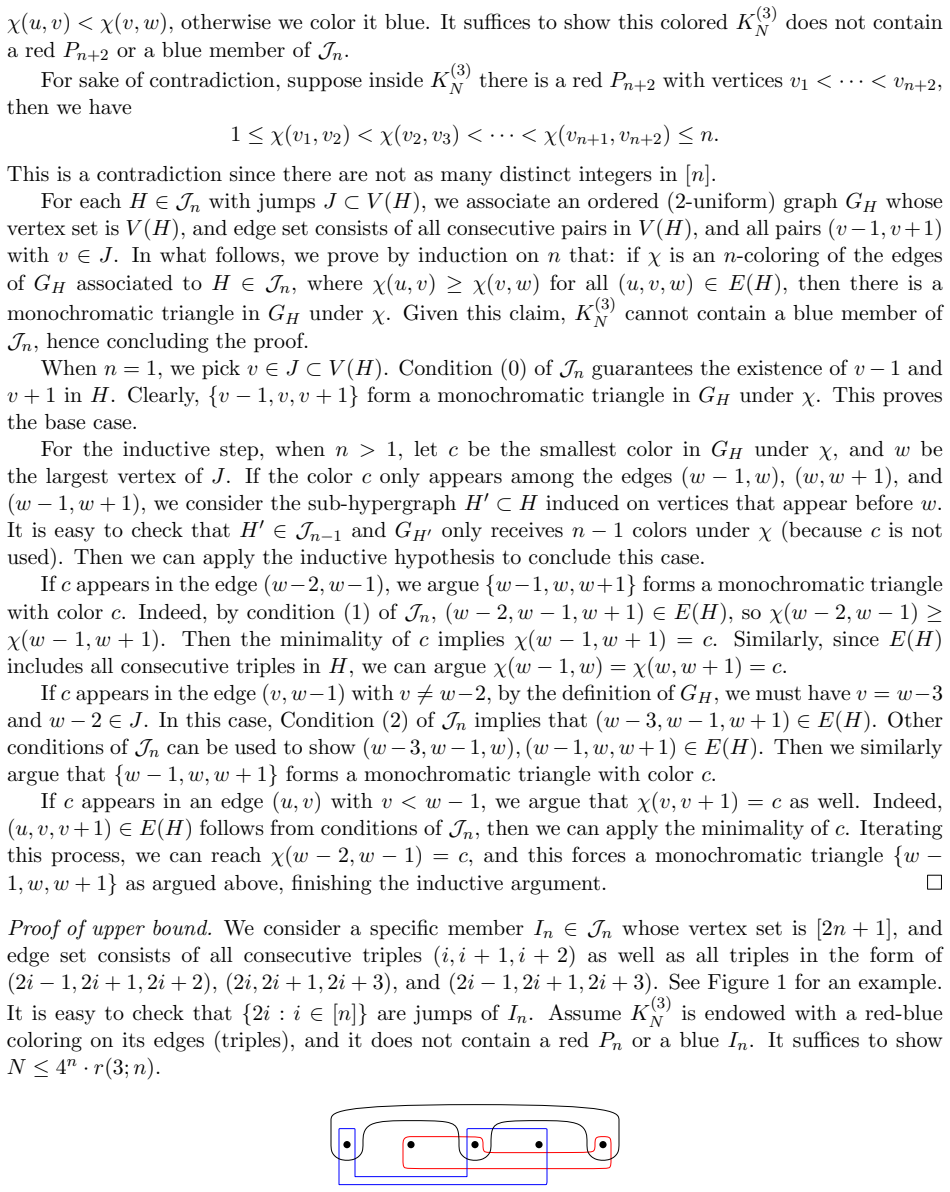
- [Section 2, upper bound, definition of I_n] The hypergraph I_n is declared to be a member of J_n on vertex set [2n+1], but as written it is not well defined. The edge list contains (2n, 2n+1, 2n+3) and (2n−1, 2n+1, 2n+3), whose largest vertex is 2n+3, outside the stated vertex set. Moreover, condition (1) for the jump 2n requires the edge (2n−2, 2n−1, 2n+1), which is not listed. Therefore I_n as defined is not a member of J_n, and the subsequent argument about forcing a blue I_n does not, as written, bear on the Ramsey number R(P_{n+2}, J_n).
- [Section 2, upper bound, β definition and the missing check] The proof's central step is the assertion “Using this fact we can check that β(u,v) > n would force a blue I_n.” No proof of this assertion is given, and it is the entire justification for the bound β(u,v) ≤ n, which is needed to define D(v) ⊂ [n]^2 and to obtain the 4^n bound. This is not a routine detail: it requires a construction mapping the witnessing sequence v_1 < ... < v_{2ℓ−1} to a copy of I_n and a verification that all required triples are blue using the inequality α(x,y) ≥ α(y,z). In addition, the definition of β is not self-contained: with a sequence v_1 < ... < v_{2ℓ−1}, the displayed condition references vertices v_{2i+2} and v_{2i+3} for values of i near ℓ that lie outside the sequence. Until the construction is supplied and the indexing is corrected, the upper bound R(P_{n+2}, J_n) ≤ 4^n · r(3;n) is unsupported.
minor comments (4)
- [Section 2, upper bound, first paragraph] The proof says the coloring contains no red P_n, but the theorem requires no red P_{n+2}. Since the α bound only needs the absence of P_{n+2}, this is likely a typo; it should be corrected to P_{n+2} throughout the upper-bound proof.
- [Section 2, definition of β] The range of the index i in the displayed condition for β should be made explicit (for example, i = 1, ..., ℓ−1 with all referenced indices lying within the sequence), so that the definition is unambiguous.
- [Throughout] The expression “4n” should be “4^n” in the abstract, Theorem 1.3, and the upper-bound proof; the intended power is clear from the context but the missing superscript is a persistent typo.
- [Section 2, upper bound, final argument] In the sentence “regard α as an n-coloring of pairs of S,” it would be clearer to specify the induced coloring of unordered pairs via (x,y) ↦ α(min{x,y}, max{x,y}).
Circularity Check
No circularity: the two-sided bound is proved from independent definitions and uses r(3;n) as an external benchmark, not as a consequence.
full rationale
The paper's main relation r(3;n) ≤ R(P_{n+2}, J_n) ≤ 4^n·r(3;n) is a pair of genuine inequalities connecting a classical quantity to a newly defined hypergraph Ramsey number. Neither direction defines its target in terms of its input. The lower bound starts from an n-coloring of pairs avoiding monochromatic triangles (guaranteed by the definition of r(3;n)) and constructs a red/blue coloring of triples; the absence of red P_{n+2} and of every blue member of J_n is then shown by a self-contained induction on n, not by invoking the result being proved. The upper bound assumes a coloring with no red P_n and no blue I_n, defines α and β from the coloring, bounds α,β ≤ n through a direct (though tersely justified) check that β>n would force a blue I_n, counts downward-closed sets by integer partitions, and then uses r(3;n) only as an external pigeonhole guarantee that some n-coloring of pairs on r(3;n) vertices has a monochromatic triangle. That is using the classical Ramsey number as an input, the opposite of circularity. The only self-citations are [10] and [11] to Mubayi–Suk, both given as inspiration or pointers in the introduction and concluding remarks; the proofs themselves are carried out in the paper and do not rest on those citations. The tersely stated check 'Using this fact we can check that β(u,v) > n would force a blue I_n' is a completeness/correctness gap, not a circular step: even if the check were missing or wrong, Theorem 1.3 would be unsupported, not tautological. Accordingly, no circular step can be exhibited, and the appropriate score is 0.
Assumptions & free parameters
assumptions (3)
- standard math Pigeonhole principle
- standard math The number of downsets (order ideals) in the poset [n] × [n] is at most C(2n,n) ≤ 4^n
- domain assumption Definition of the family J_n and the specific member I_n
invented entities (2)
-
J_n, the collection of monotone paths with n jumps
-
I_n, a specific member of J_n on [2n+1]
Cite this review
Pith. "Pith review of 3-uniform monotone paths and multicolor Ramsey numbers." pith.science (2026). https://pith.science/paper/BVD3OYOE
@misc{pith2026241115649,
  author       = {Pith},
  title        = {Pith review of: 3-uniform monotone paths and multicolor Ramsey numbers},
  year         = {2026},
  howpublished = {\url{https://pith.science/paper/BVD3OYOE}},
  note         = {Machine review of arXiv:2411.15649}
}
abstract
The monotone path $P_{n+2}$ is an ordered 3-uniform hypergraph whose vertex set has size $n+2$ and edge set consists of all consecutive triples. In this note, we consider the collection $\mathcal{J}_n$ of ordered 3-uniform hypergraphs named monotone paths with $n$ jumps, and we prove the following relation \begin{equation*} r(3;n) \leq R(P_{n+2},\mathcal{J}_n) \leq 4^n \cdot r(3;n), \end{equation*} where $r(3;n)$ is the multicolor Ramsey number for triangles and $R(P_{n+2},\mathcal{J}_n)$ is the hypergraph Ramsey number for $P_{n+2}$ versus any member of $\mathcal{J}_n$. In particular, whether $r(3;n)$ is exponential, which is a very old problem of Erd\H{o}s, is equivalent to whether $R(P_{n+2},\mathcal{J}_n)$ is exponential.
Figures
Reference graph
Works this paper leans on
-
[7]
H. Fredricksen and M. M. Sweet. Symmetric sum-free partitions and lower bounds for Schur numbers. Electronic Journal of Combinatorics, 7:#R32, 2000
work page 2000
-
[1]
H. L. Abbott and L. Moser. Sum-free sets of integers. Acta Arithmetica, 11:393–396, 1966
work page 1966
-
[2]
F. Chung and R. Graham. Erd˝ os on graphs: His legacy of unsolved problems. AK Peters/CRC Press, 1998
work page 1998
-
[3]
F. R. K. Chung. On the Ramsey numbers N(3, 3,. . . 3; 2). Discrete Mathematics, 5(4):317–321, 1973
work page 1973
-
[4]
V. Chv´ atal and J. Koml´ os. Some combinatorial theorems on monotonicity. Canadian Mathematical Bulletin, 14(2):151–157, 1971
work page 1971
-
[5]
D. Conlon and A. Ferber. Lower bounds for multicolor Ramsey numbers. Advances in Mathematics, 378:107528, 2021
work page 2021
-
[6]
Erd˝ os and G
P. Erd˝ os and G. Szekeres. A combinatorial problem in geometry. Compositio Mathematica, 2:463–470, 1935
1935
-
[8]
L. Gishboliner, Z. Jin, and B. Sudakov. Ramsey problems for monotone paths in graphs and hypergraphs. Combinatorica, 44:103922, 2024
work page 2024
Show all 14 references
-
[9]
Moshkovitz and A
G. Moshkovitz and A. Shapira. Ramsey theory, integer partitions and a new proof of the Erd˝ os–Szekeres theorem. Advances in Mathematics, 262:1107–1129, 2014
2014
-
[10]
Mubayi and A
D. Mubayi and A. Suk. Off-diagonal hypergraph Ramsey numbers. Journal of Combinatorial Theory, Series B, 125:168–177, 2017
2017
-
[11]
Mubayi and A
D. Mubayi and A. Suk. Ramsey numbers of cliques versus monotone paths. European Journal of Combinatorics, 118:103922, 2024
2024
-
[12]
F. P. Ramsey. On a problem of formal logic. Proceedings of the London Mathematical Society, s2-30(1):264–286, 1930
1930
-
[13]
I. Schur. ¨Uber die Kongruenz xm + ym = zm mod p. Jahresbericht der Deutschen Mathematiker-Vereinigung, 25:114–116, 1916
1916
-
[14]
Xiaodong, X
X. Xiaodong, X. Zheng, G. Exoo, and S. Radziszowski. Constructive lower bounds on classical multicolor Ramsey Numbers. Electronic Journal of Combinatorics, 11.1:#R35, 2004. 5
2004
Reviewed August 12, 2026 · model on record in the stance chip above.
Discussion (0). Continue with ORCID to comment.