REVIEW 4 major objections 5 minor 77 references
How Media Competition Fuels the Spread of Misinformation
T0 review · 4 major / 5 minor · reviewed 2026-08-12 · deepseek-v4-flash
Pith's one-line read This paper argues that competition between ideologically opposed groups of news sources rationally produces misinformation-heavy strategies for hyper-partisan outlets, public polarization, and a misinformation arms race.
desk verdict A novel and honest model of media competition and misinformation, but its central empirical claim rests on an assumed radicalization objective and a qualitative fit — worth serious peer review, with major revision required. read the letter →
The pith
A machine-rendered reading of the paper's core claim, the machinery that carries it, and where it could break.
The reading
What carries the argument
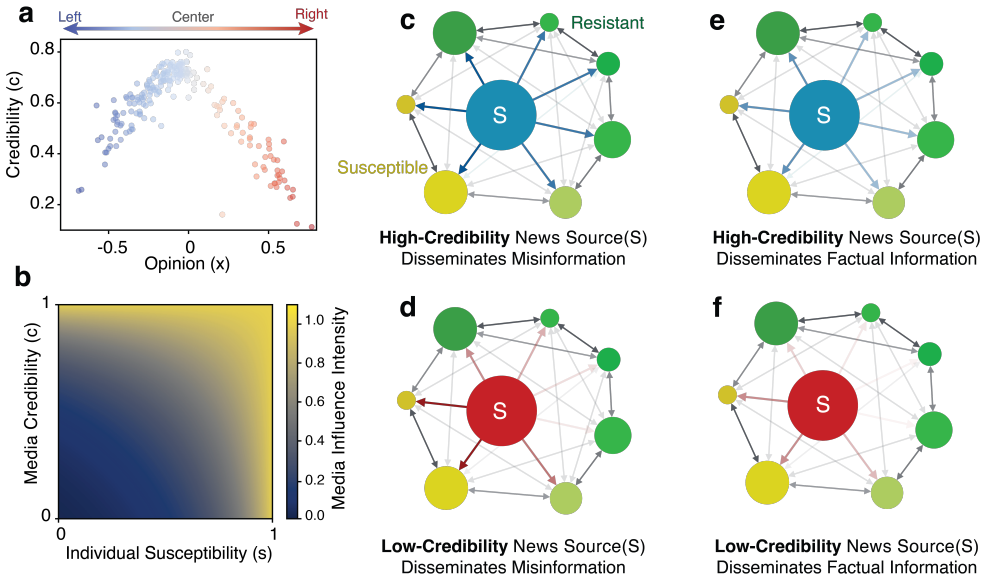
The central object is a zero-sum sequential game coupling two dynamic processes. Source credibility evolves as a convex combination of past credibility and the current factual-or-misinformation action, $c_{t+1} = \lambda c_t + (1-\lambda) a_t$, and individual opinions evolve under social influence (an exponential-decay homophily kernel) plus media influence, whose multiplier $\psi(r,c,a,s) = \exp[-\hat{\kappa}(1+\eta a)(1+\zeta(1-c)(1-s)) r]$ encodes the attention gain from misinformation ($\eta$) and the credibility penalty ($\zeta$). The solution concept is the quantal response equilibrium of this entropy-regularized game, which captures bounded rationality; the equilibria are computed with the extragradient method on an empirically estimated payoff matrix. The running reward $r(x_t,c_t) = -\sum_i \sin(\frac{\pi}{2} x_i^t)^5$ is what makes the game zero-sum and encodes the assumption that players seek to radicalize public opinion toward their own pole while treating swing voters as undesirable.
What would settle it
Replace the reward in Eq. (6) with an audience-reach proxy, such as the total number of influenced individuals regardless of opinion, keep every other equation and parameter fixed, and recompute the quantal response equilibrium; if hyper-partisan sources no longer disseminate the most misinformation, the paper's explanation of real-world misinformation rests entirely on the radicalization objective rather than on competition itself.
Extended reading notes
Core claim
The paper's central discovery is that competition for public influence between two ideologically opposed coalitions of news sources has quantal-response equilibria in which the optimal strategy for hyper-partisan sources is to disseminate misinformation often, while centrist sources preserve credibility by sharing mostly factual content. This equilibrium pattern matches the credibility-by-bias distribution observed in real-world news-source ratings without any curve fitting: it emerges from the structural incentives of the game. The same equilibria show that misinformation polarizes the opinion distribution into echo chambers, and that deviations by one player—such as increasing misinformation output—are met by the opposing player's optimal response of also increasing misinformation, producing a reciprocal arms race. The model also predicts a phase transition: if the short-term attention gain from misinformation is reduced enough, or the long-term credibility penalty increased, the equilibrium flips, depolarizing the community but sharply raising average misinformation exposure because centrist sources then become the main misinformation spreaders.
Load-bearing premise
The load-bearing premise is the reward function, which assumes media players maximize the ideological radicalization of the public (via $r(x_t,c_t)=-\sum_i \sin(\frac{\pi}{2} x_i^t)^5$) rather than audience reach, advertising revenue, or per-source credibility.
Editorial extensions
If this is right
- Reducing the short-term engagement payoff of misinformation—for example by debunking from within the same partisan community—is predicted to be more effective at depolarizing public opinion and lowering exposure than merely increasing penalties on source credibility.
- A single low-credibility source can disrupt the equilibrium and trigger a system-wide escalation: the opposing coalition's optimal response is to increase its own misinformation output, producing a lose-lose outcome for both sides.
- Improving community media literacy (lowering susceptibility) tends to depolarize, but pushing susceptibility too low can flip the equilibrium into a phase where centrist sources become the main misinformation spreaders and average exposure spikes.
- As players become more rational (approaching Nash equilibrium), the equilibrium becomes more polarized, implying that misinformation-heavy hyper-partisan strategies are calculated responses to the competitive landscape rather than mistakes.
Reading between the lines
- If the radicalization reward were replaced by a profit- or reach-maximizing objective, the qualitative results might change substantially; comparing those equilibria would reveal how much of the misinformation outcome is driven by the assumed payoff versus the structure of competition.
- The arms-race prediction implies a testable natural experiment: if one outlet's misinformation output exogenously increases (for example, after a credibility-rating event), competitors' misinformation rates should subsequently rise; if they do not, the equilibrium response mechanism is incomplete.
- The model assumes susceptibility is fixed, but psychological evidence of an illusory-truth effect suggests exposure to misinformation can itself raise susceptibility; incorporating that feedback would likely strengthen the self-reinforcing spread and could shift the phase-transition threshold.
Editorial analysis
A structured set of objections, weighed in public.
Referee Report
Summary. The manuscript proposes a computational game-theoretic model of news-source competition. Two coalitions ('left' and 'right') choose, at each time step, whether each source under their control disseminates factual news or misinformation. Source credibility evolves according to Eq. (1), individual opinions by the stochastic social-media interaction in Eq. (2), and media influence by Eq. (3). The competition is formulated as a zero-sum sequential game (Eq. 5) with the running reward in Eq. (6), which rewards moving public opinion to the ideological extremes. The authors solve for quantal response equilibria numerically, first with a complete action space and then with a restricted set of strategy profiles (Fig. 4e), and report that equilibrium play reproduces the Ad Fontes-style credibility-bias relation, that misinformation polarizes opinion and creates echo chambers, that one player's increased misinformation leads the opponent to increase misinformation as well, and that sensitivity analysis identifies possible interventions.
Significance. Conditional on the modeling assumptions, the paper offers an integrative framework and produces falsifiable comparative statics, such as phase transitions in the misinformation gain η and credibility gain ξ, and monotone effects of rationality τ. The use of quantal response equilibrium to model bounded rationality is appropriate for the problem, and the authors are transparent about the local-solution limitation of their function approximation. If the central mechanism were robust, the paper would be a useful proof of concept that competitive equilibria can rationalize hyper-partisan misinformation. However, the headline empirical claim is only qualitative, the core mechanism is substantially encoded in the payoff, and the numerical results are not accompanied by code, data, or convergence diagnostics. The significance as a statement about real media competition is therefore not yet established.
major comments (4)
- [Equilibrium Concept, Eq. (6)] The reward function r(xt,ct) = -Σ_i sin((π/2)x_i^t)^5 assumes that media players seek to radicalize public opinion: it is maximized at the extremes and minimized at the center, and the text explicitly says swing voters are undesirable and ϑ=5 is chosen to make centrist opinions low-reward. This radicalization-seeking objective is asserted rather than derived from observed media-firm goals such as audience size, advertising revenue, or credibility maximization. Since Eq. (5) is zero-sum and Eq. (6) is the only payoff, the results that equilibrium play involves misinformation, polarization, and an arms race are largely consequences of this assumed objective. The central claim that competition fuels misinformation therefore requires either an empirical defense of Eq. (6) or a robustness analysis with alternative, empirically grounded objectives.
- [Results, Fig. 4] The claimed reproduction of the real-world credibility-bias distribution is qualitative and partly built into the action set. The complete-action equilibrium in Fig. 4(a) produces sharp credibility transitions, and the authors concede that this result is 'contrary to the real-world credibility distributions'; they then introduce the limited action set in Fig. 4(e). The nine profiles in Fig. 4(e) are hand-selected strategy profiles that already have a smooth credibility-bias shape, so the equilibrium selecting among them cannot be presented as independent evidence that the model reproduces Fig. 1(a). No goodness-of-fit statistic, error bar, or comparison to a null model is provided. As it stands, the abstract's claim that 'the resulting equilibria for this game reproduce the credibility-bias distribution' is not supported by the evidence.
- [Results, Fig. 5] The game in Eq. (5) is symmetric between the two players: the payoff depends only on the opinion vector and not on which player controls which sources. A symmetric zero-sum game cannot endogenously generate a systematic difference in misinformation policies between the two parties without an explicit symmetry-breaking mechanism such as asymmetric initial conditions, asymmetric susceptibility, or asymmetric action sets. The paper nevertheless suggests that its findings explain the partisan imbalance in misinformation exposure documented by Mosleh and Rand. This inference is unsupported without such a mechanism or a clear statement of what breaks the symmetry in the simulations.
- [Quantal Response Equilibrium and Results] The central equilibrium results are numerical but not reproducible from the manuscript. The value function is approximated with function approximation, the payoff matrix is estimated empirically through 200 simulations, and the extragradient method is used; however, the paper provides no code, data, hyperparameter ranges, random seeds, or convergence diagnostics. Figure 7 further states that increasing τ makes the quantal response equilibrium computation unstable, and the text notes that function approximation methods typically find local solutions. The assertion that the reported equilibrium is stable is therefore not verifiable from the material supplied. Given that the paper's main conclusions rest on these computations, this is a load-bearing gap.
minor comments (5)
- [Eq. (3)] The parameter for credibility gain is written as ζ in Eq. (3) but as ξ in the surrounding text and in later sensitivity analysis; this inconsistency should be fixed throughout.
- [Eq. (6)] The reward is written as r(xt,ct), but the right-hand side depends only on xt, not on ct; either remove the unused argument or define the dependence.
- [Eq. (8)] The notation R(qt) is introduced without definition; it should be connected to the running reward defined in Eq. (6) or defined explicitly.
- [Information Structure and Equilibrium Concept] The text says that player R controls sources with ym < 0, which duplicates the definition of player L; the second occurrence should presumably read ym > 0.
- [Throughout] There are several typos and stylistic errors, including 'influnced', 'also remains also', and inconsistent subfigure references in the Figure 2 caption; a careful proofread is needed.
Circularity Check
No significant circularity: the headline results are computed consequences of an explicit radicalization objective, not restatements of the inputs.
full rationale
The paper's derivation chain is self-contained. The reward function in Eq (6) is an explicit modeling premise: players are assumed to maximize radicalized public opinion. This premise is strong and may be empirically contestable, but it is not a hidden restatement of the conclusions. The equilibrium, best-response, and sensitivity results are computed from the stated model via Eqs (8)-(10) and numerical simulation, not fitted to the real-world data. The comparison to Fig 1(a) is an external validation; the unrestricted equilibrium already yields the central-sources-higher-credibility trend, and the limited action set in Fig 4(e) is introduced as a tractability and realism simplification, not shown to encode the target credibility-bias distribution. Self-citations (refs 10, 13, 14, 15, 20) are background or prior technical tools and are not load-bearing for the central claim. The concern that the radicalization objective drives the misinformation and polarization conclusions is a premise-strength or external-validity issue, not a circularity: the model does not define 'competition' as 'misinformation spread' nor equate any fitted parameter with a headline prediction. Therefore no circular step is exhibited.
Assumptions & free parameters
free parameters (7)
- eta (misinformation gain) =
1
- xi (credibility gain) =
2
- beta1, beta2 (susceptibility distribution shape) =
3, 2
- kappa, kappa_hat (homophily coefficients) =
20, 5
- h, sigma (influence amplitude and noise) =
h=0.1, sigma=0.1*sqrt(h)
- lambda (community memory parameter) =
not specified
- gamma (discount factor) =
not specified
assumptions (5)
- ad hoc to paper Media players maximize radicalization of public opinion and devalue swing voters, via r(x) in Eq (6).
- domain assumption Individuals are influenced by news based only on source credibility and their own susceptibility, not on the content of the news.
- domain assumption Credibility evolves as a convex combination of past credibility and current factualness, starting at perfect credibility 1 (Eq 1).
- domain assumption Competition is zero-sum between two coordinated team players, each controlling half of the sources.
- standard math Quantal response equilibrium with entropy regularization is the solution concept (Eqs 8-10).
Cite this review
Pith. "Pith review of How Media Competition Fuels the Spread of Misinformation." pith.science (2026). https://pith.science/paper/OBIAFDPD
@misc{pith2026241115677,
  author       = {Pith},
  title        = {Pith review of: How Media Competition Fuels the Spread of Misinformation},
  year         = {2026},
  howpublished = {\url{https://pith.science/paper/OBIAFDPD}},
  note         = {Machine review of arXiv:2411.15677}
}
read the original abstract
Competition among news sources may encourage some sources to share fake news and misinformation to influence the public. While sharing misinformation may lead to a short-term gain in audience engagement, it may damage the reputation of these sources, resulting in a loss of audience. To understand the rationale behind sharing misinformation, we model the competition as a zero-sum sequential game, where each news source influences individuals based on its credibility-how trustworthy the public perceives it-and the individual's opinion and susceptibility. In this game, news sources can decide whether to share factual information to enhance their credibility or disseminate misinformation for greater immediate attention at the cost of losing credibility. We employ the quantal response equilibrium concept, which accounts for the bounded rationality of human decision-making, allowing for imperfect or probabilistic choices. Our analysis shows that the resulting equilibria for this game reproduce the credibility-bias distribution observed in real-world news sources, with hyper-partisan sources more likely to spread misinformation than centrist ones. It further illustrates that disseminating misinformation can polarize the public. Notably, our model reveals that when one player increases misinformation dissemination, the other player is likely to follow, exacerbating the spread of misinformation. We conclude by discussing potential strategies to mitigate the spread of fake news and promote a more factual and reliable information landscape.
Figures


Figures from the paper (5 more)


Reference graph
Works this paper leans on
- [1]
-
[2]
Graves, L. & Wells, C. From information availability to factual accountability. Journalism truth an age social media 39–57 (2019)
work page 2019
-
[3]
Posetti, J. & Matthews, A. A short guide to the history of ‘fake news’ and disinformation. Int. Cent. for Journalists 7, 2018–07 (2018)
work page 2018
-
[4]
Tsfati, Y .et al. Causes and consequences of mainstream media dissemination of fake news: literature review and synthesis. Annals Int. Commun. Assoc. 44, 157–173 (2020)
work page 2020
-
[5]
Aïmeur, E., Amri, S. & Brassard, G. Fake news, disinformation and misinformation in social media: a review. Soc. Netw. Analysis Min. 13, 30 (2023)
work page 2023
-
[6]
Ognyanova, K., Lazer, D., Robertson, R. E. & Wilson, C. Misinformation in action: Fake news exposure is linked to lower trust in media, higher trust in government when your side is in power. Harv. Kennedy Sch. Misinformation Rev. (2020)
work page 2020
-
[7]
Ecker, U. K. et al. The psychological drivers of misinformation belief and its resistance to correction. Nat. Rev. Psychol. 1, 13–29 (2022)
work page 2022
-
[8]
Chen, X. & Sin, S.-C. J. ‘misinformation? what of it?’motivations and individual differences in misinformation sharing on social media. Proc. Am. Soc. for Inf. Sci. Technol.50, 1–4 (2013)
work page 2013
Show all 77 references
-
[9]
& Musolesi, M
De Domenico, M., Lima, A., Mougel, P. & Musolesi, M. The anatomy of a scientific rumor. Sci. reports 3, 2980 (2013)
2013
-
[10]
E., Amini, A., Marculescu, R
Bayiz, Y . E., Amini, A., Marculescu, R. & Topcu, U. Susceptibility of communities against low-credibility content in social news websites. arXiv preprint arXiv:2403.10705 (2024)
2024 arXiv
-
[11]
Wu, L., Morstatter, F., Carley, K. M. & Liu, H. Misinformation in social media: definition, manipulation, and detection. ACM SIGKDD explorations newsletter 21, 80–90 (2019)
2019
-
[12]
Kumar, K. K. & Geethakumari, G. Detecting misinformation in online social networks using cognitive psychology. Human-centric Comput. Inf. Sci. 4, 14 (2014)
2014
-
[13]
Amini, A., Bayiz, Y . E. & Topcu, U. Control of misinformation with safety and engagement guarantees. In2024 American Control Conference (ACC), 151–158 (IEEE, 2024)
2024
-
[14]
E., Amini, A., Munir, M
Ram, A., Bayiz, Y . E., Amini, A., Munir, M. & Marculescu, R. Credirag: Network-augmented credibility-based retrieval for misinformation detection in reddit. arXiv preprint arXiv:2410.12061 (2024)
2024 arXiv
-
[15]
Bayiz, Y . E. & Topcu, U. Optimization-based countering of misinformation on social networks. In2024 American Control Conference (ACC), 135–142 (IEEE, 2024)
2024
-
[16]
& Van Der Linden, S
Lewandowsky, S. & Van Der Linden, S. Countering misinformation and fake news through inoculation and prebunking. Eur. Rev. Soc. Psychol. 32, 348–384 (2021)
2021
-
[17]
& Suiter, J
Roozenbeek, J., Culloty, E. & Suiter, J. Countering misinformation. Eur. Psychol. (2023)
2023
-
[18]
S., Jones, C
Chan, M.-p. S., Jones, C. R., Hall Jamieson, K. & Albarracín, D. Debunking: A meta-analysis of the psychological efficacy of messages countering misinformation. Psychol. science 28, 1531–1546 (2017)
2017
-
[19]
& Rathje, S
Altay, S., Berriche, M., Heuer, H., Farkas, J. & Rathje, S. A survey of expert views on misinformation: Definitions, determinants, solutions, and future of the field. Harv. Kennedy Sch. Misinformation Rev. 4, 1–34 (2023)
2023
-
[20]
Bayiz, Y . E. & Topcu, U. Prebunking design as a defense mechanism against misinformation propagation on social networks. arXiv preprint arXiv:2311.14200 (2023)
2023 arXiv
-
[21]
& Chaganti, R
Vemprala, N., Gudigantala, N. & Chaganti, R. Debunking misinformation using a game theoretic approach. In AMCIS (2021). 16/18
2021
-
[22]
& Rasmussen, A
Van der Graaf, A., Otjes, S. & Rasmussen, A. Weapon of the weak? the social media landscape of interest groups. Eur. journal communication 31, 120–135 (2016)
2016
-
[23]
Del Vicario, M. et al. The spreading of misinformation online. Proc. national academy Sci. 113, 554–559 (2016)
2016
-
[24]
& ParandehGheibi, A
Acemoglu, D., Ozdaglar, A. & ParandehGheibi, A. Spread of (mis) information in social networks. Games Econ. Behav. 70, 194–227 (2010)
2010
-
[25]
& Ozdaglar, A
Acemoglu, D. & Ozdaglar, A. Opinion dynamics and learning in social networks. Dyn. Games Appl. 1, 3–49 (2011)
2011
-
[26]
Kurvers, R. H. et al. Strategic disinformation outperforms honesty in competition for social influence. Iscience 24 (2021)
2021
-
[27]
post-truth
Lewandowsky, S., Ecker, U. K. & Cook, J. Beyond misinformation: Understanding and coping with the “post-truth” era. J. applied research memory cognition 6, 353–369 (2017)
2017
-
[28]
The effects of news source credibility and fact-checker credibility on users’ beliefs and intentions regarding online misinformation
Bhattacherjee, A. The effects of news source credibility and fact-checker credibility on users’ beliefs and intentions regarding online misinformation. J. Electron. Bus. & Digit. Econ. 1, 24–33 (2022)
2022
-
[29]
Misinformation: susceptibility, spread, and interventions to immunize the public
Van Der Linden, S. Misinformation: susceptibility, spread, and interventions to immunize the public. Nat. medicine 28, 460–467 (2022)
2022
-
[30]
Media failures in the age of trump.The Polit
Pickard, V . Media failures in the age of trump.The Polit. Econ. Commun. 4, 118–122 (2016)
2016
-
[31]
& Montag, C
Sindermann, C., Cooper, A. & Montag, C. A short review on susceptibility to falling for fake political news. Curr. Opin. Psychol. 36, 44–48 (2020)
2020
-
[32]
& Rand, D
Pennycook, G. & Rand, D. G. The psychology of fake news. Trends Cogn. Sci. 25, 388–402, DOI: https://doi.org/10.1016/ j.tics.2021.02.007 (2021)
2021
-
[33]
Lasser, J. et al. Social media sharing of low-quality news sources by political elites. PNAS nexus 1, pgac186 (2022)
2022
-
[34]
& Rand, D
Mosleh, M. & Rand, D. G. Measuring exposure to misinformation from political elites on twitter. nature communications 13, 7144 (2022)
2022
-
[35]
Roozenbeek, J. et al. Susceptibility to misinformation about covid-19 around the world. Royal Soc. open science 7, 201199 (2020)
2020
-
[36]
Kouzy, R. et al. Coronavirus goes viral: quantifying the covid-19 misinformation epidemic on twitter. Cureus 12 (2020)
2020
-
[37]
& Gentzkow, M
Allcott, H. & Gentzkow, M. Social media and fake news in the 2016 election. J. economic perspectives 31, 211–236 (2017)
2017
-
[38]
& Reifler, J
Guess, A., Nyhan, B. & Reifler, J. Selective exposure to misinformation: Evidence from the consumption of fake news during the 2016 us presidential campaign. Eur. Res. Counc. 9, 4 (2018)
2018
-
[39]
& Tirole, J
Fudenberg, D. & Tirole, J. Game theory (MIT press, 1991)
1991
-
[40]
& Wang, J
Yang, Y . & Wang, J. An overview of multi-agent reinforcement learning from game theoretical perspective.arXiv preprint arXiv:2011.00583 (2020)
2020 arXiv
-
[41]
& Lee, K
V o, N. & Lee, K. The rise of guardians: Fact-checking url recommendation to combat fake news. InThe 41st international ACM SIGIR conference on research & development in information retrieval, 275–284 (2018)
2018
-
[42]
& Bou-Ammar, H
Grau-Moya, J., Leibfried, F. & Bou-Ammar, H. Balancing two-player stochastic games with soft q-learning. arXiv preprint arXiv:1802.03216 (2018)
2018 arXiv
-
[43]
& Siderius, J
Acemoglu, D., Ozdaglar, A. & Siderius, J. A model of online misinformation. Rev. Econ. Stud. rdad111 (2023)
2023
-
[44]
& Song, L
Aridor, G., Jiménez-Durán, R., Levy, R. & Song, L. The economics of social media. SSRN (2024)
2024
-
[45]
& Fasoulakis, M
Varsos, C., Flouris, G., Bitsaki, M. & Fasoulakis, M. A study of misinformation games. In PRICAI 2021: Trends in Artificial Intelligence: 18th Pacific Rim International Conference on Artificial Intelligence, PRICAI 2021, Hanoi, Vietnam, November 8–12, 2021, Proceedings, Part I...
2021
-
[46]
& Van der Linden, S
Roozenbeek, J. & Van der Linden, S. The fake news game: actively inoculating against the risk of misinformation. J. risk research 22, 570–580 (2019)
2019
-
[47]
Holley, R. A. & Liggett, T. M. Ergodic theorems for weakly interacting infinite systems and the voter model. The annals probability 643–663 (1975)
1975
-
[48]
DeGroot, M. H. Reaching a consensus. J. Am. Stat. association 69, 118–121 (1974)
1974
-
[49]
Friedkin, N. E. & Johnsen, E. C. Social positions in influence networks. Soc. networks 19, 209–222 (1997). 17/18
1997
-
[50]
Hegselmann, R., Krause, U. et al. Opinion dynamics and bounded confidence models, analysis, and simulation. J. artificial societies social simulation 5 (2002)
2002
-
[51]
& Schütte, C
Helfmann, L., Djurdjevac Conrad, N., Lorenz-Spreen, P. & Schütte, C. Modelling opinion dynamics under the impact of influencer and media strategies. Sci. Reports 13, 19375 (2023)
2023
-
[52]
& Zha, Q
Lang, N., Wang, L. & Zha, Q. Opinion dynamics in social networks under competition: the role of influencing factors in consensus-reaching. Royal Soc. Open Sci. 9, 211732 (2022)
2022
-
[53]
& Scala, A
Quattrociocchi, W., Caldarelli, G. & Scala, A. Opinion dynamics on interacting networks: media competition and social influence. Sci. reports 4, 4938 (2014)
2014
-
[54]
& Venel, X
Mandel, A. & Venel, X. Dynamic competition over social networks. Eur. J. Oper. Res. 280, 597–608 (2020)
2020
-
[55]
P., Yan, G., Thai, M
Nguyen, N. P., Yan, G., Thai, M. T. & Eidenbenz, S. Containment of misinformation spread in online social networks. In Proceedings of the 4th Annual ACM Web Science Conference, 213–222 (2012)
2012
-
[56]
& Barber, S
Hassan, A. & Barber, S. J. The effects of repetition frequency on the illusory truth effect. Cogn. research: principles implications 6, 38 (2021)
2021
-
[57]
K., Brashier, N
Fazio, L. K., Brashier, N. M., Payne, B. K. & Marsh, E. J. Knowledge does not protect against illusory truth.J. experimental psychology: general 144, 993 (2015)
2015
-
[58]
& Sharot, T
Vellani, V ., Zheng, S., Ercelik, D. & Sharot, T. The illusory truth effect leads to the spread of misinformation.Cognition 236, 105421 (2023)
2023
-
[59]
J., Flanagin, A
Metzger, M. J., Flanagin, A. J. & Medders, R. B. Social and heuristic approaches to credibility evaluation online. J. communication 60, 413–439 (2010)
2010
-
[60]
& Adali, S
Horne, B. & Adali, S. This just in: Fake news packs a lot in title, uses simpler, repetitive content in text body, more similar to satire than real news. In Proceedings of the international AAAI conference on web and social media, vol. 11, 759–766 (2017)
2017
-
[61]
& Cappella, J
Tsfati, Y . & Cappella, J. N. Do people watch what they do not trust? exploring the association between news media skepticism and exposure. Commun. research 30, 504–529 (2003)
2003
-
[62]
& Helbing, D
Mäs, M., Flache, A. & Helbing, D. Individualization as driving force of clustering phenomena in humans. PLoS computational biology 6, e1000959 (2010)
2010
-
[63]
The news and public opinion: Media effects on civic life (Polity, 2011)
McCombs, M. The news and public opinion: Media effects on civic life (Polity, 2011)
2011
-
[64]
The opinion factor: The effects of opinionated news on information processing and attitude change
Feldman, L. The opinion factor: The effects of opinionated news on information processing and attitude change. Polit. Commun. 28, 163–181 (2011)
2011
-
[65]
Keppo, J., Kim, M. J. & Zhang, X. Learning manipulation through information dissemination. Oper. Res. 70, 3490–3510 (2022)
2022
-
[66]
A., Janczyk, M., Dale, R
Pfister, R., Schwarz, K. A., Janczyk, M., Dale, R. & Freeman, J. B. Good things peak in pairs: a note on the bimodality coefficient. Front. psychology 4, 700 (2013)
2013
-
[67]
& Selten, R
Gigerenzer, G. & Selten, R. Rethinking rationality (2001)
2001
-
[68]
Evans, J. S. B. & Over, D. E. Rationality and reasoning (Psychology Press, 2013)
2013
-
[69]
McKelvey, R. D. & Palfrey, T. R. Quantal response equilibria for normal form games. Games economic behavior 10, 6–38 (1995)
1995
-
[70]
McKelvey, R. D. & Palfrey, T. R. Quantal response equilibria for extensive form games.Exp. economics 1, 9–41 (1998)
1998
-
[71]
Amos, B. et al. Differentiable optimization-based modeling for machine learning. Ph. D. thesis (2019)
2019
-
[72]
& Chi, Y
Cen, S., Wei, Y . & Chi, Y . Fast policy extragradient methods for competitive games with entropy regularization.Adv. Neural Inf. Process. Syst. 34, 27952–27964 (2021)
2021
-
[73]
& McCrain, J
Kim, E., Lelkes, Y . & McCrain, J. Measuring dynamic media bias.Proc. Natl. Acad. Sci. 119, e2202197119 (2022)
2022
-
[74]
& Nilsson, T
Diaz Ruiz, C. & Nilsson, T. Disinformation and echo chambers: how disinformation circulates on social media through identity-driven controversies. J. public policy & marketing 42, 18–35 (2023)
2023
-
[75]
& Glaisyer, T
Graves, L. & Glaisyer, T. The fact-checking universe in spring 2012. New Am. (2012)
2012
-
[76]
Plaisance, P. L. The concept of media accountability reconsidered. J. Mass Media Ethics 15, 257–268 (2000)
2000
-
[77]
From media self-regulation to ‘crowd-criticism’: Media accountability in the digital age
Fengler, S. From media self-regulation to ‘crowd-criticism’: Media accountability in the digital age. Cent. Eur. J. Commun. 5, 175–189 (2012). 18/18
2012
Reviewed August 12, 2026 · model on record in the stance chip above.
Discussion (0). Continue with ORCID to comment.