REVIEW 3 major objections 5 minor 31 references
On the metric dimension of the character degree graph of a solvable group
T0 review · 3 major / 5 minor · reviewed 2026-08-12 · deepseek-v4-flash
Pith's one-line read This paper proves exact formulas for the metric dimension of character degree graphs of finite solvable groups in four structural classes, and shows that two related invariants coincide for Fitting-height-2 graphs.
desk verdict Theorem 4.2 is false — the proposed resolving set fails for two K1,2 stars — and Theorem 3.5 has gaps, though the regular and two-clique results are sound. read the letter →
The pith
A machine-rendered reading of the paper's core claim, the machinery that carries it, and where it could break.
The reading
What carries the argument
The machinery is the Lewis partition of a Fitting-height-2 character degree graph: the vertex set splits into universal vertices $U$, a set $X$, and a set $Y$, so that in the complement the edges are stars with centers in $Y$ and leaves in $X$. The proof counts twin classes, where twins are vertices with identical neighborhoods (possibly except each other), since two twins cannot both be absent from a resolving set. The candidate set $W_0$ takes all but one vertex from each twin class, leaving out at most one universal vertex and at most one leaf from each multi-leaf star. For diameter-3 graphs, the Sass partition $\rho_1\cup\rho_2\cup\rho_3\cup\rho_4$ plays the same role, and the cited structural result says $\rho_2$ is a singleton when a cut vertex is present.
What would settle it
Compute the metric dimension of the connected Lewis graph whose complement is two two-leaf stars $K_{1,2}$ with one universal vertex added. In that graph the candidate $W_0$ consisting of the universal vertex and one leaf from each star leaves two omitted leaves whose distance to every member of $W_0$ is 1; checking whether any other 2-vertex set resolves the graph would settle whether the formula $n_1+n_2-s-1$ remains correct.
Extended reading notes
Core claim
The central claim is that metric dimension of $\Delta(G)$ is controlled by the same partition structures already used to classify character degree graphs. For a Lewis graph, the graph attached to a solvable group of Fitting height 2, the paper proves that $\dim(\Gamma)=n_1+n_2-s-1$ when $n_1>0$ and $\dim(\Gamma)=n_2-s$ when $n_1=0$, with the parameters taken from the characterization of Fitting-height-2 graphs. The same twin-based argument shows $b(\Gamma)=\dim(\Gamma)=\operatorname{adim}(\Gamma)$ for these graphs. For the other classes, the paper establishes $\dim(\Delta(G))=n/2$ for non-complete regular graphs on $n$ vertices, $\dim(\Delta(G))=n-3$ for diameter-2 graphs made of two cliques joined through a cut vertex, and $\dim(\Delta(G))=n-3$ or $n-4$ for diameter-3 graphs with a cut vertex according as the first part of the Sass partition is a singleton or larger.
Load-bearing premise
The Fitting-height-2 formula rests on the premise that twin equivalence classes are the only obstruction to resolving a vertex set, so that leaving exactly one vertex out of every twin class always yields a resolving set.
Editorial extensions
If this is right
- For any solvable group of Fitting height 2, the metric dimension can be computed directly from the Lewis parameters $n_1,n_2,s$, with no further search.
- For these groups, base size, metric dimension, and adjacency dimension are equal, so any algorithm bounding one bounds all three.
- Regular character degree graphs of even order $n$ have metric dimension $n/2$, confirming the earlier existence result with an exact invariant.
- Diameter-3 character degree graphs with a cut vertex have dimension determined by whether the first Sass layer is a singleton, so the cut-vertex structure controls resolvability.
- The twin-class argument gives a general sufficient condition: any connected graph whose every vertex belongs to a twin class has $b=\dim=\operatorname{adim}=n-r$ with $r$ the number of twin classes.
Reading between the lines
- Because the Lewis-graph formula depends only on $n_1,n_2,s$, one could enumerate all Lewis graphs on small vertex sets and computationally verify Theorem 4.2, which would either confirm the constructive proof or expose the graphs where the candidate $W_0$ is not resolving.
- The equality of the three invariants for Fitting-height-2 graphs suggests testing whether the same twin-class collapse controls these invariants for other solvable groups whose character degree graphs have small twin quotients.
- For diameter-3 graphs, the split between $n-3$ and $n-4$ mirrors the difference between one and several primes in the first Sass layer; a natural extension is to ask whether the same dichotomy appears for adjacency dimension.
Editorial analysis
A structured set of objections, weighed in public.
Referee Report
Summary. The manuscript studies the metric dimension (and the related base size and adjacency dimension) of the prime character degree graph Δ(G) of a finite solvable group. It announces formulas for four families: (n−2)-regular graphs, diameter-2 non-block graphs of the form K_{n−m−1} − v − K_m, diameter-3 graphs with a cut vertex, and graphs of groups of Fitting height 2 (Lewis graphs). The proofs combine known classification results of Lewis, Wolf–Manz–Willems, and others with elementary metric-dimension arguments. I evaluated the reader's concern about Theorem 4.2 and found it correct; I additionally found a counterexample to Theorem 3.4. The paper is clearly written and some auxiliary results, such as Theorem 5.5 and Proposition 5.6, are sound, but two of the four principal formulas are false as stated. I did not find a comparable defect in Theorem 3.5: the uniform-distance assertions used there follow from the structure in Remark 2.5 together with the diameter-3 partition.
Significance. If the announced formulas were correct, the paper would give a useful graph-theoretic toolkit for character degree graphs, and the connection between base size, metric dimension, and adjacency dimension for Fitting-height-2 groups would be an interesting contribution. The paper also has genuine virtues: the twin-class argument in Theorem 5.5 is elegant, the use of Lewis's theorem to reduce Fitting-height-2 graphs to complement-stars is natural, and the examples are mostly helpful. However, the central claims in Theorems 3.4 and 4.2 are false, and Theorem 5.8 is invalidated along with Theorem 4.2. Since these are the paper's main results, the contribution in its current form is not reliable.
major comments (3)
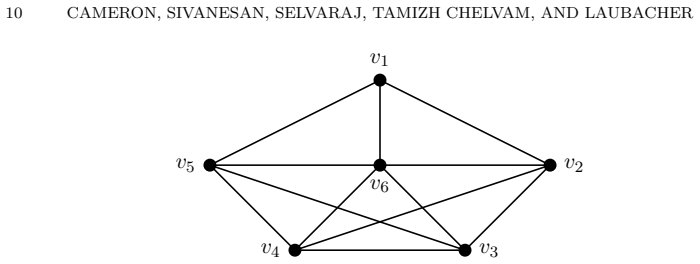
- [Section 4, Theorem 4.2] The formula in Theorem 4.2 is false. Take the Lewis graph with n1=0, n2=4, n3=2 whose complement is two disjoint K1,2 stars, with centers y1,y2 and leaves {x1,x2},{x3,x4}. The theorem gives dim = n2 − s = 4 − 2 = 2. But no two-vertex set resolves: if the two selected vertices lie in X, the two omitted leaves have the same distance vector; if a star center is selected instead, two leaves still collide (for example, with W={y1,y2}, x1 and x2 both have representation (2,1), and with W={x1,y1}, x3 and x4 both have (1,1)). The set {x1,x2,x3} does resolve, so dim = 3. This graph satisfies Lewis's criterion in Theorem 4.1, hence it is Δ(G) for a solvable group of Fitting height 2. The flaw is in the paragraph beginning 'However, it is straightforward to check...': the proposed set W0 contains leaves and universal vertices but no star centers, so two omitted leaves from different stars are both adjacent to every vertex of W0 and have identical all-ones representations. Moreover, the paper's own Example 4.3 contradicts the theorem: its parameters n1=1, n2=3, n3=2 force s=1, so Theorem 4.2 would predict dim=2, while the example asserts that {v4,v5,v6} is a minimum resolving set of size 3.
- [Section 3, Theorem 3.4] The formula dim = n − 3 in Theorem 3.4 is false for m=1. Let Γ have vertices a,b,v,c with edges ab, av, bv, vc. This is the graph K2 − v − K1 with n=4,m=1, so it is within the theorem's hypotheses. It also satisfies Lewis's criterion with X={a,b}, Y={c}, U={v}, so it is a character degree graph of a solvable group of Fitting height 2. But dim(Γ)=2: no one-vertex set resolves, because {v} gives distance 1 to a,b,c, {a} gives distance 1 to both b and v, and {c} gives distance 2 to both a and b, while {a,c} has representations a=(0,2), b=(1,2), v=(1,1), c=(2,0). The proposed resolving set W=V∖{v1,v_{m+1},v_n} has size n−3=1 in this case and fails, because the cut vertex and the vertex of K_{n−m−1} omitted from W have the same representation; for m=1 and any n≥4 the same collision occurs. The theorem therefore needs an additional hypothesis, and the proof does not supply a correct resolving set in the m=1 case.
- [Section 5, Theorem 5.8] The asserted equality b(Δ(G)) = dim(Δ(G)) = adim(Δ(G)) for all Fitting-height-2 groups is false. For the two-star Lewis graph from the first major comment, the automorphism group is S2×S2, so a base must contain one vertex from each twin pair, and {x1,x3} is a base; hence b = 2. But dim = 3 as shown above, and since the graph has diameter 2, adim = dim = 3. Thus the three invariants are not equal. The proof of Theorem 5.8 relies directly on the incorrect dimension computation in Theorem 4.2.
minor comments (5)
- [Section 3, Theorem 3.4 proof] The notation switches between W and W1 in the proof; the vectors labelled r(v1|W1), r(v_{m+1}|W1), and r(v_n|W1) should refer to the same set W used in the claim. This makes the argument hard to follow.
- [Section 5, Theorem 5.8] The statement should read b(Δ(G)) = dim(Δ(G)) = adim(Δ(G)); the closing parenthesis is missing after 'b(Δ(G)'.
- [Section 5, Proposition 5.6] The phrase 'both equal to n/2' should be 'all three invariants equal to n/2', since three quantities are being compared.
- [Section 5, Theorem 5.5 proof] In the proof, 'adim(S) ≤ n − r' should be 'adim(Γ) ≤ n − r'.
- [Sections 4 and 5] Theorems 4.2 and 5.8 do not explicitly assume Γ is connected, but metric dimension and adjacency dimension are normally defined only for connected graphs; Lewis graphs can be disconnected (for example, n1=0, n2=2, n3=1), so a connectedness hypothesis should be stated.
Circularity Check
No circularity: the metric-dimension results are derived from external graph and group theorems; the flawed upper-bound proof in Theorem 4.2 is a correctness error, not a circular reduction.
full rationale
I walked each load-bearing step of the paper. Theorem 3.1 is deferred to Proposition 5.6, which uses the external theorem [26, Theorem A] (Morresi Zuccari) to identify non-complete regular character degree graphs as (n-2)-regular, observes that the complement is a 1-factor, and applies the paper's own general twin-class result Theorem 5.5. No fitted quantity is relabeled as a prediction, and no self-citation carries the argument. Theorem 3.4 uses the external block-structure result [11, Lemma 2.7] and then gives a direct resolving-set proof. Theorem 3.5 uses the external cut-vertex structure theorem [14, Theorem 10] and Lewis-Meng [23, Lemma 2.1], followed by a direct construction of resolving sets and lower-bound cases. Theorem 4.2 uses Lewis's external characterization [21, Theorem A] to define Lewis graphs; the lower bound is a standard twin argument and the upper bound is an attempted direct verification that W0 resolves. That verification is in fact wrong, as the reader's take notes, but being wrong is not the same as being circular: the claim is not assumed in order to prove itself. Theorem 5.8 inherits the error from Theorem 4.2, but again the dependency is one-directional, not a reduction of the conclusion to its own input. The only self-citation of note is [30], used in Example 3.2 to assert that a given 4-regular graph is a character degree graph; that existence fact is not load-bearing for the metric-dimension formulas, which proceed from the group-theoretic graph structure regardless of which specific group realizes it. No ansatz is smuggled in via citation, no uniqueness theorem is imported from the present authors, and no known result is merely renamed. Accordingly, the correct finding is no significant circularity, score 0.
Assumptions & free parameters
assumptions (5)
- domain assumption A non-complete regular character degree graph of a solvable group on n vertices is (n-2)-regular.
- domain assumption The structure theorem of Hafezieh et al. classifies connected character degree graphs with a cut vertex.
- domain assumption Lewis's Theorem A characterizes character degree graphs of Fitting-height-2 groups by the two-clique partition condition.
- domain assumption Character degree graphs of solvable groups have diameter at most 3.
- standard math Chartrand et al. results on metric dimension of complete graphs, paths, cycles, and n-2 graphs.
Cite this review
Pith. "Pith review of On the metric dimension of the character degree graph of a solvable group." pith.science (2026). https://pith.science/paper/CZ3Q7LS2
@misc{pith2026241115794,
  author       = {Pith},
  title        = {Pith review of: On the metric dimension of the character degree graph of a solvable group},
  year         = {2026},
  howpublished = {\url{https://pith.science/paper/CZ3Q7LS2}},
  note         = {Machine review of arXiv:2411.15794}
}
abstract
Let $G$ be a finite solvable group and let $\Delta(G)$ be the character degree graph of $G$. In this paper, we obtain the metric dimension of certain character degree graphs. Specifically, we calculate the metric dimension for a regular character degree graph, a character degree graph with a diameter of $2$ that is not a block, a character degree graph with a diameter of $3$ that also has a cut vertex and a character degree graph with Fitting height $2.$ We also consider two related parameters, base size and adjacency dimension, and their relation to metric dimension for character degree graphs of solvable groups.
Figures


Figures from the paper (2 more)

Reference graph
Works this paper leans on
-
[1]
Babai, On the complexity of canonical labeling of strongly regular graphs, SIAM J
L. Babai, On the complexity of canonical labeling of strongly regular graphs, SIAM J. Comput. 9 (1980), 212–216
work page 1980
-
[2]
Babai, On the order of uniprimitive permutation groups , Ann
L. Babai, On the order of uniprimitive permutation groups , Ann. Math. 113 (1981), 553–568
work page 1981
-
[3]
Robert F. Bailey and Peter J. Cameron, Base size, metric dimension, and other invariants of groups and graphs , Bull. London Math. Soc. 43 (2011), 209–242
work page 2011
-
[4]
Sergio Bermudo, Jos´ e M. Rodr ´ ıguez, Juan A. Rodr ´ ıguez-Vel´ azquez and Jos´ e M. Sigarreta, The adjacency dimension of graphs , Ars Mathematica Contemporanea 22 (2022), #P3.02
work page 2022
-
[5]
M. W. Bissler and J. Laubacher, Classifying families of character degree graphs of solvabl e groups, Int. J. Group Theory 8 (2019), no. 4, 37–46
work page 2019
-
[6]
M. W. Bissler, J. Laubacher, and M. L. Lewis, Classifying character degree graphs with six vertices, Beitr. Algebra Geom. 60 (2019), 499–511
work page 2019
-
[7]
J. A. Bondy and U. S. R. Murty, Graph Theory, Grad. Texts in Math., vol. 244, Springer, New York, 2008
work page 2008
-
[8]
D. L. Boutin, Identifying graph automorphisms using determining sets , Electron. J. Com- bin. 13 (2006), #R78
work page 2006
Show all 31 references
-
[9]
Chartrand, L
G. Chartrand, L. Eroh, M. A. Johnson, and O. R. Oellermann , Resolvability in graphs and the metric dimension of a graph , Discrete Appl. Math. 105 (2000), 99–113
2000
-
[10]
DeGroot, J
S. DeGroot, J. Laubacher, and M. Medwid, On prime character degree graphs occurring within a family of graphs (ii) , Comm. Algebra 50 (2022), no. 8, 3307–3319
2022
-
[11]
Ebrahimi, A
M. Ebrahimi, A. Iranmanesh, and M. A. Hosseinzadeh, Hamiltonian character graphs , J. Algebra 428 (2015), no. 6, 54–66
2015
-
[12]
Erwin and F
D. Erwin and F. Harary, Destroying automorphisms by fixing nodes , Discrete Math. 306 (2006), 3244–3252
2006
-
[13]
Fijavˇ z and B
G. Fijavˇ z and B. Mohar, Rigidity and separation indices of Paley graphs , Discrete Math. 289 (2004), 157–161
2004
-
[14]
Hafezieh, M
R. Hafezieh, M. A. Hosseinzadeh, S. Hossein-Zadeh, and A. Iranmanesh, On cut vertices and eigenvalues of character graphs of solvable groups , Discrete Appl. Math. 303 (2021), 86–93
2021
-
[15]
Hall Jr., The Theory of Groups , Macmillan, New York, 1959
M. Hall Jr., The Theory of Groups , Macmillan, New York, 1959
1959
-
[16]
Harary and R
F. Harary and R. A. Melter, On the metric dimension of a graph , Ars Combin. 2 (1976), 191–195
1976
-
[17]
312 (2012), 3349–3356
Mohsen Jannesari and Behnaz Omoomi, The metric dimension of the lexicographic prod- uct of graphs , Discrete Math. 312 (2012), 3349–3356
2012
-
[18]
Laubacher and M
J. Laubacher and M. Medwid, On prime character degree graphs occurring within a family of graphs, Comm. Algebra 49 (2021), no. 4, 1534–1547
2021
-
[19]
M. L. Lewis, Solvable groups with character degree graphs having 5 verti ces and diameter 3, Comm. Algebra 30 (2002), 5485–5503. METRIC DIMENSION OF CHARACTER DEGREE GRAPHS 13
2002
-
[20]
M. L. Lewis, A solvable group whose character degree graph has diameter 3 , Proc. Amer. Math. Soc. 130 (2002), no. 3, 625–630
2002
-
[21]
M. L. Lewis, Character degree graphs of solvable groups of fitting height 2, Canad. Math. Bull. 49 (2006), no. 1, 127–133
2006
-
[22]
M. L. Lewis, An overview of graphs associated with character degrees and conjugacy class sizes in finite groups , Rocky Mountain J. Math. 38 (2008), no. 1, 175–211
2008
-
[23]
M. L. Lewis and Q. Meng, Solvable groups whose prime divisor character degree graph s are 1-connected, Monatsh. Math. 190 (2019), 541–548
2019
-
[24]
Manz, Degree problems II: π -separable character degrees, Comm
O. Manz, Degree problems II: π -separable character degrees, Comm. Algebra 13 (1985), 2421–2431
1985
-
[25]
O. Manz, R. Staszewski, and W. Willems, On the number of components of a graph related to character degrees, Proc. Amer. Math. Soc. 103 (1988), no. 1, 3137
1988
-
[26]
C. P. Morresi Zuccari, Regular character degree graphs , J. Algebra 411 (2014), 215–224
2014
-
[27]
Pirzada and R
S. Pirzada and R. Raja, On the metric dimension of a zero-divisor graph , Comm. Algebra 45 (2016), no. 4, 1399–1408
2016
-
[28]
C. B. Sass, Character degree graphs of solvable groups with diameter th ree, J. Group Theory 19 (2016), no. 6, 1097–1127
2016
-
[29]
C. C. Sims, Determining the conjugacy classes of a permutation group , Computers in algebra and number theory (eds G. Birkhoff and M. Hall, Jr.), A merican Mathematical Society, Providence, RI, 1971, 191–195
1971
-
[30]
Sivanesan, C
G. Sivanesan, C. Selvaraj, and T. Tamizh Chelvam, Eulerian character degree graphs of solvable groups, AKCE Int. J. Graphs Combin. 21 (2024), no. 2, 161–166
2024
-
[31]
Th. R. Wolf, O. Manz, and W. Willems, The diameter of the character degree graph , J. Reine Angew. Math. 402 (1989), 181198. School of Mathematics and Statistics, University of St Andr ews, North Haugh St Andrews, Fife, KY16 9SS, U.K.,ORCID:0000-0003-3130-95 05 Email address :...
1989
Reviewed August 12, 2026 · model on record in the stance chip above.
Discussion (0). Continue with ORCID to comment.