REVIEW 4 major objections 6 minor 83 references
Nitrogen-Vacancy Color Centers in Nanodiamonds as Reference Single-Photon Emitters
T0 review · 4 major / 6 minor · reviewed 2026-08-12 · deepseek-v4-flash
Pith's one-line read Nanodiamonds containing single nitrogen-vacancy centers can serve as portable reference single-photon emitters, with one registered emitter reproducing its saturation count rate to within 3% across two laboratories.
desk verdict A useful proof-of-principle for registered NV- reference emitters, but the 3% repeatability is within-lab only; the cross-lab portability claim is softer than the abstract implies. read the letter →
The pith
A machine-rendered reading of the paper's core claim, the machinery that carries it, and where it could break.
The reading
What carries the argument
The load-bearing object is the count-rate saturation curve, modeled as $C(P) = k_\infty P/(P+P_{\rm sat}) + bP$, where $P$ is the pump power at the sample, $k_\infty$ is the maximum observable count rate at infinite power, $P_{\rm sat}$ is the power at half that rate, and $b$ accounts for background. Fitting this curve and then operating at $0.8\,P_{\rm sat}$ is the mechanism that transfers excitation conditions between apparatus: at the same fraction of saturation, the emitter sees nominally the same absorbed photon flux even when collection optics differ. The second-order correlation function $g^{(2)}(t)$, fitted with a three-level model, supplies the single-photon purity check, and fiducial markers on the substrate make the same physical nanodiamond findable across laboratories.
What would settle it
Take the same registered nanodiamond to a third laboratory with a different objective and beam profile, run the 80%-of-saturation protocol, and check whether the normalized saturation curve and the count rate at 80% saturation still overlap with the original data; a deviation beyond the reported 3% repeatability would falsify the standardization claim. A faster in-house test is to rotate the sample or deliberately change the beam profile at one site and see whether the normalized saturation curve changes.
Extended reading notes
Core claim
The central claim is that the saturation curve of a single NV$^-$ center in a nanodiamond can standardize excitation conditions across different experimental setups. The protocol fits each emitter's count rate versus pump power to a saturation model and then pumps the emitter at 80% of its fitted saturation power; at that operating point the center is excited at the same rate regardless of collection efficiency, beam profile, or objective. When one registered nanodiamond was remeasured at a second laboratory over three months, its count rate at that operating point varied by only 3%, and its $g^{(2)}(0)$ remained consistent, confirming single-photon emission. The measured ratio of saturation count rates between the two laboratories was 0.32, which the paper interprets as a system throughput correction that can be applied to quantitative comparisons of other emitters.
Load-bearing premise
The protocol assumes that pumping at 80% of the fitted saturation power reproduces identical internal excitation conditions across different setups, meaning the normalized saturation curve is unaffected by changes in beam shape, polarization, or collection geometry; this invariance was demonstrated for only one emitter.
Editorial extensions
If this is right
- If the protocol holds, any laboratory with a confocal microscope can establish its own single-photon count-rate reference by screening local nanodiamonds, without shipping a custom sample.
- The ratio of saturation count rates between two setups gives a correction factor for photon throughput, enabling quantitative comparison of emission rates of other single-photon sources measured in different labs.
- A registered nanodiamond can be re-measured over months with no observed photodamage, so it can serve as a durable transfer standard for detector calibration and inter-laboratory comparisons.
- Because the emitter is tested at the same point on its saturation curve rather than at an arbitrary pump power, the $g^{(2)}(0)$ values become comparable across systems.
Reading between the lines
- Editorial inference: the 3% repeatability is demonstrated for one emitter only, so the key open question is whether the normalized saturation curve is invariant across arbitrary beam profiles, polarizations, and collection geometries; this can be tested by deliberately perturbing each condition.
- Editorial inference: because the fitted $P_{\rm sat}$ changed by roughly a factor of two across repeat sessions while the saturation count rate stayed stable, the protocol depends on re-fitting $P_{\rm sat}$ every session rather than on an absolute power calibration.
- Editorial inference: the same operate-at-a-fixed-fraction-of-saturation trick could in principle transfer to other saturable single-photon emitters, such as quantum dots or defects in hexagonal boron nitride, creating a family of portable references rather than a single defect type.
- Editorial inference: widespread adoption would benefit from an open registry of registered emitters with fiducial coordinates and measured saturation curves, so laboratories could compare against the same physical object.
Editorial analysis
A structured set of objections, weighed in public.
Referee Report
Summary. The paper proposes that nanodiamonds hosting single NV− color centers can act as portable reference single-photon emitters, enabling reproduction of identical internal excitation conditions across different laboratories by pumping at 80% of the fitted saturation power. The authors screen thousands of emitters, select six candidates, and remeasure them at a second laboratory. They confirm four as single emitters at the second site and report that one emitter (#B) shows a 3% standard deviation in saturation count rate over three measurement sessions at UoM. They also derive cross-laboratory ratios for count rate and saturation power and argue that these ratios allow quantitative comparison of single-photon emission data across systems.
Significance. The paper addresses a genuine metrological gap: the lack of reproducible, transferable references for single-photon emission characterization. The experimental effort is substantial, with registered fiducials, two independent setups, long-term stability checks, and openly available data and analysis code. The demonstration that normalized saturation curves and g(2)(t) shapes can overlap across laboratories for one emitter is a valuable proof-of-concept. However, the statistical basis is thin: only one of six candidates proved repeatable, and the 3% repeatability figure is a same-laboratory statistic. If the claims are appropriately scoped, this is a useful contribution, but as written the portability claim exceeds what the data show.
major comments (4)
- [§3, Table 1] The central quantitative claim of "3% standard deviation in count rate at saturation" is computed from three UoM measurement sessions on emitter #B (I∞ = 52(1), 50(1), 53(2) kcps). It is not a cross-laboratory repeatability. The only NPL–UoM comparison for #B shows a large absolute offset: I∞ = 94(5) kcps at NPL versus 52(1) kcps at UoM, and I80 = 43(4) versus 23(1) kcps. The text attributes this to system throughput, but no independent calibration (e.g., a second reference emitter, a calibrated detector transfer, or measurement with identical collection optics) establishes that the emitter itself contributed nothing to the offset. The paper should state explicitly that the 3% repeatability is same-laboratory only, and temper the abstract and conclusion claims of portability accordingly.
- [§3, Eq. (1), Fig. S7] The protocol's core assumption is that setting pump power to 80% of the fitted saturation power produces identical internal excitation conditions across systems. The only supporting evidence is the overlapping normalized NV− saturation components for #B in Fig. S7. However, the fitted P_sat for #B varies from 43(2) to 89(5) µW across the three UoM sessions (Table 1), a factor of about two, and the normalization procedure removes the very parameter that would indicate changes in excitation rate. Moreover, Eq. (1) models the background as a strictly linear term cP; the validity of this model at high pump powers is not independently verified (e.g., against a nonlinear background or a power-dependent NV0 contribution). Demonstrating the standardization on additional emitters with different orientations, and with independent beam-profile characterization, is needed to support the claimed general reliability of the 0.8·P_sat rule.
- [Abstract and §4 (Conclusion)] The conclusion states that the cross-site calibration "shows that it is possible to use locally identified single NV- centers as a single-photon reference which is portable, stable and robust," and the abstract describes the nanodiamonds as "reliable, stable and robust reference sources." Of the six candidates, only four were confirmed to contain single emitters at UoM and only one (#B) showed repeatable results by the paper's own criteria. The body acknowledges this inefficiency (Section 3), but the abstract and conclusion do not. The claims should be rescaled to a proof-of-concept demonstration: a 1-in-6 success rate indicates a screening limitation that must be reported in the headline claims, and the conclusion should clearly distinguish same-laboratory repeatability (established for one emitter) from cross-laboratory portability (not established absolutely).
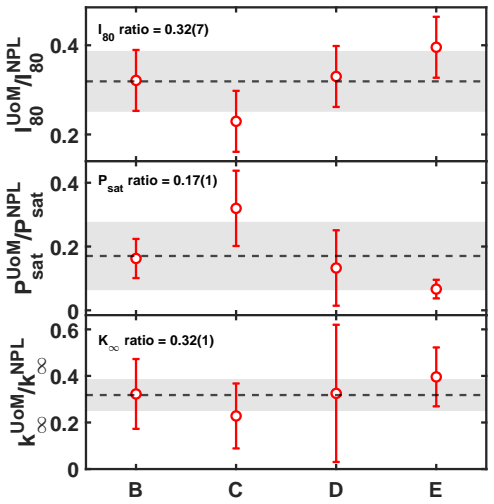
- [Fig. 3 and Supplementary §7] The mean cross-laboratory ratios I80(UoM)/I80(NPL) = 0.32(7) and Psat(UoM)/Psat(NPL) = 0.17(1) are computed from emitters #B, #C, #D, and #E. The supplementary material states that #D and #E were pumped above 0.8·P_sat at UoM to achieve sufficient SNR for g(2)(t) acquisition. Their saturation parameters were therefore measured at a different point on the saturation curve, which can bias both the count-rate ratio and the saturation-power ratio, as the authors themselves note for the bunching shoulder behavior. The throughput calibration ratio should be recomputed using only emitters measured under the stated protocol (#B and #C), or the size of the bias introduced by #D and #E should be quantified.
minor comments (6)
- [Abstract] The abstract uses "accounting for measurement conditions" while the introduction and text say "controlling for experimental conditions"; the terminology should be made consistent.
- [Eq. (2)] The parameters A, B, τ_ab, and τ_bunch in Eq. (2) are not all explicitly defined in the text following the equation; please define each symbol in a sentence.
- [Introduction] There is a typographical error in the phrase "T wo fluorescent charge states" where a line break splits "Two"; please fix.
- [Fig. 1 caption] In the Fig. 1(b) caption, the x-axis is described as "scaled from 0 to 12 /u1D443/u1D460/u1D44E/u1D461" but the symbol does not render correctly; it should read "0 to 12·P_sat" or similar, and the same issue appears in the supplementary figure captions.
- [Supplementary Table S1] Item 11 is listed as "Olympus UPLFLN 60X Objective, Edmund Optics"; please verify whether the objective is an Olympus part or an Edmund Optics part, as the current listing mixes manufacturers.
- [Data Availability] The data availability statement gives a Figshare DOI and a GitHub repository; please check that the repository contains the analysis scripts needed to reproduce Table 1 and Fig. 3, since those are the quantitative basis of the repeatability claim.
Circularity Check
One self-definitional normalization step; the central repeatability and cross-lab measurements remain direct and non-circular.
-
self definitional
[Section 3, Eq. (1) and Fig. 1(b); Supplement Sec. 5, Fig. S7]
"C(P)=I∞P/(P+Psat)+cP ... FIG. 1(b) shows by setting pump power to 80% of Psat, we ensure that the NV− center is excited at the same rate at UoM as at NPL. ... NV saturation curves (dashed-dot) normalized to respective I_sat values closely overlap, supporting that the NV center is independently probed under the same excitation conditions."
Under Eq. (1), the NV-emission component is I∞P/(P+Psat). After the paper's own normalization—dividing by I∞ and rescaling the power axis by Psat, as stated in Fig. 1(b): 'x-axes are scaled from 0 to 12 Psat'—this component becomes (P/Psat)/(1+P/Psat), a parameter-free universal curve. Therefore the 'closely overlap' of the fitted dashed-dot components in Fig. S7 is guaranteed by the fitting function for any center obeying Eq. (1); it is not an independent empirical test that identical internal excitation conditions are reproduced. Likewise I(0.8Psat)=0.444I∞+0.8cPsat is an algebraic consequence of the same fit, so using the overlap as support for identical excitation is self-definitional.
full rationale
The central claim—that a registered NV− nanodiamond can serve as a portable reference single-photon emitter—rests on direct measurements: the 3% repeatability in saturation count rate over three UoM sessions (I∞ = 52, 50, 53 kcps in Table 1), the stable g(2)(0) values, and the three-month photostability. The saturation model Eq. (1) and the three-level g(2) model Eq. (2) are taken from external literature (Rodiek et al.; Berthel et al.), not from the authors' prior work. The cross-laboratory I80 and I∞ ratios quantify system throughput rather than being predictions forced by the fitted parameters in a hidden way. The only circular element is the normalized saturation-curve overlap used as supporting evidence for 'same excitation conditions': after normalizing by the fitted I∞ and rescaling by the fitted Psat, the NV component of Eq. (1) is identically (P/Psat)/(1+P/Psat), so overlap is built into the model rather than empirically demonstrated. Because this is a supporting illustration and not the sole basis of the reference-standard claim, the overall circularity score is low.
Assumptions & free parameters
free parameters (3)
- P_sat (saturation pump power) =
390(60) µW (NPL1); 43(2), 60(2), 89(5) µW (UoM1-3)
- I_inf (count rate at infinite pump power) =
94(5) kcps (NPL1); 52(1), 50(1), 53(2) kcps (UoM1-3)
- c (linear background coefficient) =
not reported numerically in main text
assumptions (4)
- domain assumption NV- centers in milled nanodiamonds are photostable with no photobleaching or intermittency over months
- domain assumption The count-rate saturation model C(P) = I_inf P/(P + P_sat) + cP (Eq. 1) fully describes NV- emission under 532 nm pumping
- ad hoc to paper Pumping at 0.8 P_sat produces identical internal excitation conditions across different experimental systems
- domain assumption The three-level model of Eq. (2) correctly describes the measured g(2)(t) including antibunching and bunching
Cite this review
Pith. "Pith review of Nitrogen-Vacancy Color Centers in Nanodiamonds as Reference Single-Photon Emitters." pith.science (2026). https://pith.science/paper/FF7JW5VF
@misc{pith2026241115991,
  author       = {Pith},
  title        = {Pith review of: Nitrogen-Vacancy Color Centers in Nanodiamonds as Reference Single-Photon Emitters},
  year         = {2026},
  howpublished = {\url{https://pith.science/paper/FF7JW5VF}},
  note         = {Machine review of arXiv:2411.15991}
}
abstract
Quantitative and reproducible optical characterization of single quantum emitters is crucial for quantum photonic materials research, yet controlling for experimental conditions remains challenging due to a lack of an established reference standard. We propose nanodiamonds containing single nitrogen vacancy (NV$^{-}$) color centers as reliable, stable and robust sources of single-photon emission. We select 4 potential reference emitter candidates from a study of thousands of NV$^{-}$ centers. Candidates were remeasured at a second laboratory, correlating optical pump power and NV$^{-}$ center emission intensity at saturation in addition to corresponding $g^{(2)}(0)$ values. A reference nanodiamond is demonstrated to control for experimental conditions, with reproducible and reliable single-photon emission, as a model for a new single-photon emitter reference standard.
Figures


Reference graph
Works this paper leans on
-
[1]
FIDUCIALL Y MARKED SUBSTRATES Identifying specific single objects with sizes of the order of microns to hundreds of nanometers is extremely difficult without reference markers that are invariant under rotation, translation and reflection. This can be achieved using a QR code system for machine readable referencing or human-readable markers as shown in this e...
-
[2]
Bright semiconductor single-photon sources pumped by heterogeneously integrated micropillar lasers with electrical injections,
X. Li, S. Liu, Y . Wei, et al., “Bright semiconductor single-photon sources pumped by heterogeneously integrated micropillar lasers with electrical injections,” Light. Sci. & Appl. 12, 65 (2023)
2023
-
[3]
Large-scale photonic natural language processing,
C. M. Valensise, I. Grecco, D. Pierangeli, and C. Conti, “Large-scale photonic natural language processing,” Photonics Res. 10, 2846 (2022)
2022
-
[4]
Single-photon emission in telecommunication band from an InAs quantum dot grown on InP with molecular-beam epitaxy,
X. Liu, K. Akahane, N. A. Jahan, et al., “Single-photon emission in telecommunication band from an InAs quantum dot grown on InP with molecular-beam epitaxy,” Appl. Phys. Lett. 103, 061114 (2013)
2013
-
[5]
Quantum key distribution with entangled photons generated on demand by a quantum dot,
F. B. Basset, M. Valeri, E. Roccia, et al., “Quantum key distribution with entangled photons generated on demand by a quantum dot,” Sci. Adv. 7, 6379 (2021)
work page 2021
-
[6]
Manipulating Single-Photon Emission from Point Defects in Diamond and Silicon Carbide,
M. E. Bathen and L. Vines, “Manipulating Single-Photon Emission from Point Defects in Diamond and Silicon Carbide,” Adv. Quantum Technol. 4, 2100003 (2021)
work page 2021
-
[7]
Quantum interference of identical photons from remote GaAs quantum dots,
L. Zhai, G. N. Nguyen, C. Spinnler, et al., “Quantum interference of identical photons from remote GaAs quantum dots,” Nat. Nanotechnol. 2022 17:8 17, 829–833 (2022)
work page 2022
-
[8]
Laser writing of spin defects in nanophotonic cavities,
A. M. Day, J. R. Dietz, M. Sutula, et al., “Laser writing of spin defects in nanophotonic cavities,” Nat. Mater. 22, 696–702 (2023)
work page 2023
Show all 83 references
-
[9]
Heterogeneous integration of spin–photon interfaces with a CMOS platform,
L. Li, L. D. Santis, I. B. W. Harris, et al., “Heterogeneous integration of spin–photon interfaces with a CMOS platform,” Nature 630, 70–76 (2024)
2024
-
[10]
Long spin coherence times of nitrogen vacancy centers in milled nanodiamonds,
B. D. Wood, G. A. Stimpson, J. E. March, et al., “Long spin coherence times of nitrogen vacancy centers in milled nanodiamonds,” Phys. Rev. B 105, 205401 (2022)
2022
-
[11]
Highly stable and pure single-photon emission with 250 ps optical coherence times in InP colloidal quantum dots,
A. H. Proppe, D. B. Berkinsky, H. Zhu, et al., “Highly stable and pure single-photon emission with 250 ps optical coherence times in InP colloidal quantum dots,” Nat. Nanotechnol. 2023 18:9 18, 993–999 (2023)
2023
-
[12]
Purification of Single Photons from Room-Temperature Quantum Dots,
S.-W . Feng, C.- Y . Cheng, C.- Y . Wei,et al., “Purification of Single Photons from Room-Temperature Quantum Dots,” Phys. Rev. Lett. 119, 143601 (2017)
2017
-
[13]
Bright single-photon sources in bottom-up tailored nanowires,
M. E. Reimer, G. Bulgarini, N. Akopian, et al., “Bright single-photon sources in bottom-up tailored nanowires,” Nat. Commun. 2012 3:1 3, 1–6 (2012)
2012
-
[14]
Optically bright quantum dots in single nanowires,
M. T. Borgström, V . Zwiller, E. Müller, and A. Imamoglu, “Optically bright quantum dots in single nanowires,” Nano Lett. 5, 1439–1443 (2005)
2005
-
[15]
Self-assembled quantum dots in a nanowire system for quantum photonics,
M. Heiss, Y . Fontana, A. Gustafsson, et al. , “Self-assembled quantum dots in a nanowire system for quantum photonics,” Nat. Mater. 12, 439–444 (2013)
2013
-
[16]
Control of single photon emitters in semiconductor nanowires by surface acoustic waves,
S. Lazić, A. Hernández-Mínguez, and P . V . Santos, “Control of single photon emitters in semiconductor nanowires by surface acoustic waves,” Semicond. Sci. Technol. 32, 084002 (2017)
2017
-
[17]
Crystal Phase Quantum Dots in the Ultrathin Core of GaAs-AlGaAs Core-Shell Nanowires,
B. Loitsch, J. Winnerl, G. Grimaldi, et al., “Crystal Phase Quantum Dots in the Ultrathin Core of GaAs-AlGaAs Core-Shell Nanowires,” Nano Lett. 15, 7544–7551 (2015)
2015
-
[18]
Colloidal quantum dots as single photon sources,
D. Nelson, S. Byun, J. Bullock, et al., “Colloidal quantum dots as single photon sources,” J. Mater. Chem. C 12, 5684–5695 (2024)
2024
-
[19]
Weakly confined organic–inorganic halide perovskite quantum dots as high-purity room-temperature single photon sources,
B. Wang, J. W. M. Lim, S. M. Loh, et al., “Weakly confined organic–inorganic halide perovskite quantum dots as high-purity room-temperature single photon sources,” ACS Nano 18, 10807–10817 (2024)
2024
-
[20]
Locally strained 2d materials: Preparation, properties, and applications,
J. Wang, L. He, Y . Zhang, et al., “Locally strained 2d materials: Preparation, properties, and applications,” Adv. Mater. 36, 2314145 (2024)
2024
-
[21]
Realization of single-photon emitters with high brightness and high stability and excellent monochromaticity,
S. Chen, C. Wang, H. Cai, et al., “Realization of single-photon emitters with high brightness and high stability and excellent monochromaticity,” Matter 7, 1106–1116 (2024)
2024
-
[22]
Activated single photon emitters and enhanced deep-level emissions in hexagonal boron nitride strain crystal,
X. Chen, X. Yue, L. Zhang, et al., “Activated single photon emitters and enhanced deep-level emissions in hexagonal boron nitride strain crystal,” Adv. Funct. Mater. 34, 2306128 (2024)
2024
-
[23]
Broadband, efficient extraction of quantum light by a photonic device comprised of a metallic nano-ring and a gold back reflector,
C. Haws, E. Perez, M. Davanco, et al. , “Broadband, efficient extraction of quantum light by a photonic device comprised of a metallic nano-ring and a gold back reflector,” Appl. Phys. Lett 120, 81103 (2022)
2022
-
[24]
Robust, tunable, and high purity triggered single photon source at room temperature using a nitrogen-vacancy defect in diamond in an open microcavity,
S. Adekanye, H.-C. Chang, D. Hunger, et al., “Robust, tunable, and high purity triggered single photon source at room temperature using a nitrogen-vacancy defect in diamond in an open microcavity,” Opt. Express, Vol. 26, Issue 6, pp. 7056-7065 26, 7056–7065 (2018)
2018
-
[25]
Quantum-enhanced measurements: Beating the standard quantum limit,
V . Giovannetti, S. Lloyd, L. Maccone, et al., “Quantum-enhanced measurements: Beating the standard quantum limit,” Phys. Rev. Lett 68, 135–174 (1992)
1992
-
[26]
Control of Quantized Spontaneous Emission from Single GaAs Quantum Dots Embedded in Huygens’ Metasurfaces,
P . P . Iyer, S. Prescott, S. Addamane,et al., “Control of Quantized Spontaneous Emission from Single GaAs Quantum Dots Embedded in Huygens’ Metasurfaces,” Nano Lett. pp. 4749–4757 (2024)
2024
-
[27]
Solid-state single-photon sources: Recent advances for novel quantum materials,
M. Esmann, S. C. Wein, and C. Antón-Solanas, “Solid-state single-photon sources: Recent advances for novel quantum materials,” Adv. Funct. Mater. 34, 2315936 (2024)
2024
-
[28]
The Quantum Theory of Optical Coherence,
R. J. Glauber, “The Quantum Theory of Optical Coherence,” Phys. Rev. 130, 2529–2539 (1963)
1963
-
[29]
Identifying and Mitigating Charge Instabilities in Shallow Diamond Nitrogen-Vacancy Centers,
D. Bluvstein, Z. Zhang, and A. C. Jayich, “Identifying and Mitigating Charge Instabilities in Shallow Diamond Nitrogen-Vacancy Centers,” Phys. Rev. Lett.122, 076101 (2019)
2019
-
[30]
The nitrogen-vacancy colour centre in diamond,
M. W. Doherty, N. B. Manson, P . Delaney,et al., “The nitrogen-vacancy colour centre in diamond,” Phys. Reports 528, 1–45 (2013)
2013
-
[31]
Experimental realization of an absolute single-photon source based on a single nitrogen vacancy center in a nanodiamond,
B. Rodiek, M. Lopez, H. Hofer, et al., “Experimental realization of an absolute single-photon source based on a single nitrogen vacancy center in a nanodiamond,” Optica 4, 71 (2017)
2017
-
[32]
Single-photon sources,
B. Lounis and M. Orrit, “Single-photon sources,” Reports on Prog. Phys. 68, 1129–1179 (2005)
2005
-
[33]
Single-photon sources and detectors,
M. D. Eisaman, J. Fan, A. Migdall, and S. V . Polyakov, “Single-photon sources and detectors,” Rev. Sci. Instruments 82, 71101 (2011)
2011
-
[34]
Photon antibunching in the fluorescence of individual color centers in diamond,
R. Brouri, A. Beveratos, J.-P . Poizat, and P . Grangier, “Photon antibunching in the fluorescence of individual color centers in diamond,” Opt. Lett. 25, 1294 (2000)
2000
-
[35]
Stable Solid-State Source of Single Photons,
C. Kurtsiefer, S. Mayer, P . Zarda, and H. Weinfurter, “Stable Solid-State Source of Single Photons,” Phys. Rev. Lett. 85, 290 (2000)
2000
-
[36]
Optimal conditions for NV-center formation in type-1b diamond studied using photoluminescence and positron annihilation spectroscopies,
J. Botsoa, T. Sauvage, M.-P . Adam,et al., “Optimal conditions for NV-center formation in type-1b diamond studied using photoluminescence and positron annihilation spectroscopies,” Phys. Rev. B 84, 125209 (2011)
2011
-
[37]
Efficient production of NV colour centres in nanodiamonds using high-energy electron irradiation,
G. Dantelle, A. Slablab, L. Rondin, et al. , “Efficient production of NV colour centres in nanodiamonds using high-energy electron irradiation,” J. Lumin. 130, 1655–1658 (2010)
2010
-
[38]
Room temperature stable single-photon source,
A. Beveratos, S. Kühn, R. Brouri, et al., “Room temperature stable single-photon source,” The Eur. Phys. J. D - At. Mol. Opt. Phys. 18, 191–196 (2002)
2002
-
[39]
Resonance Absorption by Nuclear Magnetic Moments in a Solid,
E. M. Purcell, H. C. Torrey, and R. V . Pound, “Resonance Absorption by Nuclear Magnetic Moments in a Solid,” Phys. Rev. 69, 37–38 (1946)
1946
-
[40]
Purcell effect in active diamond nanoantennas,
A. S. Zalogina, R. S. Savelev, E. V . Ushakova, et al., “Purcell effect in active diamond nanoantennas,” Nanoscale 10, 8721–8727 (2018)
2018
-
[41]
Functionality is Key: Recent Progress in the Surface Modification of Nanodiamond,
A. Krueger and D. Lang, “Functionality is Key: Recent Progress in the Surface Modification of Nanodiamond,” Adv. Funct. Mater. 22, 890–906 (2012)
2012
-
[42]
Sample fabrication and metrological characterization of single-photon emitters based on nitrogen vacancy centers in nanodiamonds,
F. Hirt, J. Christinck, H. Hofer, et al., “Sample fabrication and metrological characterization of single-photon emitters based on nitrogen vacancy centers in nanodiamonds,” Eng. Res. Express 3, 045038 (2021)
2021
-
[43]
Temperature dependence of charge conversion during nv-center relaxometry in nanodiamond,
I. Cardoso Barbosa, J. Gutsche, D. Lönard, et al., “Temperature dependence of charge conversion during nv-center relaxometry in nanodiamond,” Phys. Rev. Res. 6, 023078 (2024)
2024
-
[44]
Single photon sources for quantum radiometry: a brief review about the current state-of-the-art,
S. Kück, M. López, H. Hofer, et al., “Single photon sources for quantum radiometry: a brief review about the current state-of-the-art,” Appl. Phys. B 128, 28 (2022)
2022
-
[45]
Quantum metrology of solid-state single-photon sources using photon-number-resolving detectors,
M. von Helversen, J. Böhm, M. Schmidt, et al., “Quantum metrology of solid-state single-photon sources using photon-number-resolving detectors,” New J. Phys. 21, 035007 (2019)
2019
-
[46]
Feasibility study towards comparison of the g(2)(0) measurement in the visible range,
E. Moreva, P . Traina, R. A. Kirkwood, et al., “Feasibility study towards comparison of the g(2)(0) measurement in the visible range,” Metrologia 56, 015016 (2019)
2019
-
[47]
Single defect centres in diamond: A review,
F. Jelezko and J. Wrachtrup, “Single defect centres in diamond: A review,” Phys. Status Solidi (A) Appl. Mater. Sci. 203, 3207–3225 (2006)
2006
-
[48]
Surface modification of fluorescent nanodiamonds for biological applications,
H.-S. Jung and K. C. Neuman, “Surface modification of fluorescent nanodiamonds for biological applications,” Nanomaterials 11 (2021)
2021
-
[49]
Fluorescence lifetime control of nitrogen vacancy centers in nanodiamonds for long-term information storage,
C. Laube, R. Temme, A. Prager, et al., “Fluorescence lifetime control of nitrogen vacancy centers in nanodiamonds for long-term information storage,” ACS Nano 17, 15401–15410 (2023)
2023
-
[50]
Mass production and dynamic imaging of fluorescent nanodiamonds,
Y .-R. Chang, H.- Y . Lee, K. Chen,et al., “Mass production and dynamic imaging of fluorescent nanodiamonds,” Nat. Nanotechnol. 3, 284–288 (2008)
2008
-
[51]
Bright fluorescent nanodiamonds: No photobleaching and low cytotoxicity,
S.-J. Yu, M.-W . Kang, H.-C. Chang,et al., “Bright fluorescent nanodiamonds: No photobleaching and low cytotoxicity,” J. Am. Chem. Soc. 127, 17604–17605 (2005)
2005
-
[52]
Effect of surface chemistry on the fluorescence of detonation nanodiamonds,
P . Reineck, D. W. M. Lau, E. R. Wilson, et al. , “Effect of surface chemistry on the fluorescence of detonation nanodiamonds,” ACS Nano 11, 10924–10934 (2017)
2017
-
[53]
Photophysics of single nitrogen-vacancy centers in diamond nanocrystals,
M. Berthel, O. Mollet, G. Dantelle, et al., “Photophysics of single nitrogen-vacancy centers in diamond nanocrystals,” Phys. Rev. B - Condens. Matter Mater. Phys. 91, 035308 (2015)
2015
-
[54]
Controlling the fluorescence properties of nitrogen vacancy centers in nanodiamonds,
C. Laube, T. Oeckinghaus, J. Lehnert, et al., “Controlling the fluorescence properties of nitrogen vacancy centers in nanodiamonds,” Nanoscale 11, 1770–1783 (2019)
2019
-
[55]
Lifetime investigation of single nitrogen vacancy centres in nanodiamonds,
X. Li, J. Storteboom, S. Castelletto, et al., “Lifetime investigation of single nitrogen vacancy centres in nanodiamonds,” Opt. Express, Vol. 23, Issue 9, pp. 11327-11333 23, 11327–11333 (2015)
2015
-
[56]
Dark States of Single Nitrogen-Vacancy Centers in Diamond Unraveled by Single Shot NMR,
G. Waldherr, J. Beck, M. Steiner, et al., “Dark States of Single Nitrogen-Vacancy Centers in Diamond Unraveled by Single Shot NMR,” Phys. Rev. Lett. 106, 157601 (2011)
2011
-
[57]
Chemical control of the charge state of nitrogen-vacancy centers in diamond,
M. V . Hauf, B. Grotz, B. Naydenov, et al., “Chemical control of the charge state of nitrogen-vacancy centers in diamond,” Phys. Rev. B 83, 081304 (2011)
2011
-
[58]
Metastable dark states enable ground state depletion microscopy of nitrogen vacancy centers in diamond with diffraction-unlimited resolution,
K. Y . Han, S. K. Kim, C. Eggeling, and S. W . Hell, “Metastable dark states enable ground state depletion microscopy of nitrogen vacancy centers in diamond with diffraction-unlimited resolution,” Nano Lett. 10, 3199–3203 (2010)
2010
-
[59]
Correlation between Photons in two Coherent Beams of Light,
H. R. Brown and R. Q. T wiss, “Correlation between Photons in two Coherent Beams of Light,” Nature 177, 27–29 (1956)
1956
-
[60]
Coupling of nitrogen-vacancy centers in a nanodiamond to a silver nanocube,
S. Kumar, S. K. Andersen, and S. I. Bozhevolnyi, “Coupling of nitrogen-vacancy centers in a nanodiamond to a silver nanocube,” Opt. Mater. Express, Vol. 6, Issue 11, pp. 3394-3406 6, 3394–3406 (2016)
2016
-
[61]
Low-temperature microscopy and spectroscopy on single defect centers in diamond,
A. Dräbenstedt, L. Fleury, C. Tietz, et al., “Low-temperature microscopy and spectroscopy on single defect centers in diamond,” Phys. Rev. B 60, 11503 (1999)
1999
-
[62]
Optimum Photoluminescence Excitation and Recharging Cycle of Single Nitrogen-Vacancy Centers in Ultrapure Diamond,
K. Beha, A. Batalov, N. B. Manson, et al., “Optimum Photoluminescence Excitation and Recharging Cycle of Single Nitrogen-Vacancy Centers in Ultrapure Diamond,” Phys. Rev. Lett. 109, 097404 (2012)
2012
-
[63]
Photo-induced ionization dynamics of the nitrogen vacancy defect in diamond investigated by single-shot charge state detection,
N. Aslam, G. Waldherr, P . Neumann,et al., “Photo-induced ionization dynamics of the nitrogen vacancy defect in diamond investigated by single-shot charge state detection,” New J. Phys. 15, 013064 (2013)
2013
-
[64]
Metastable Dark States Enable Ground State Depletion Microscopy of Nitrogen Vacancy Centers in Diamond with Diffraction-Unlimited Resolution,
K. Y . Han, S. K. Kim, C. Eggeling, and S. W. Hell, “Metastable Dark States Enable Ground State Depletion Microscopy of Nitrogen Vacancy Centers in Diamond with Diffraction-Unlimited Resolution,” Nano Lett. 10, 3199–3203 (2010)
2010
-
[65]
Multiple-photon excitation of nitrogen vacancy centers in diamond,
P . Ji, R. Balili, J. Beaumariage, et al., “Multiple-photon excitation of nitrogen vacancy centers in diamond,” Phys. Rev. B 97, 134112 (2018)
2018
-
[66]
Complete determination of the orientation of NV centers with radially polarized beams,
P . R. Dolan, X. Li, J. Storteboom, and M. Gu, “Complete determination of the orientation of NV centers with radially polarized beams,” Opt. Express 22, 4379 (2014)
2014
-
[67]
Photochromism in single nitrogen-vacancy defect in diamond,
T. Gaebel, M. Domhan, C. Wittmann, et al., “Photochromism in single nitrogen-vacancy defect in diamond,” Appl. Phys. B 82, 243–246 (2006)
2006
-
[68]
A High-Resolution Versatile Focused Ion Implantation Platform for Nanoscale Engineering,
M. Adshead, M. Coke, G. Aresta, et al. , “A High-Resolution Versatile Focused Ion Implantation Platform for Nanoscale Engineering,” Adv. Eng. Mater. 25, 2300889 (2023)
2023
-
[69]
Implantation of labelled single nitrogen vacancy centers in diamond using 15N,
J. R. Rabeau, P . Reichart, G. Tamanyan, et al., “Implantation of labelled single nitrogen vacancy centers in diamond using 15N,” Appl. Phys. Lett. 88, 1–3 (2006)
2006
-
[70]
Engineering of nitrogen-vacancy color centers in high purity diamond by ion implantation and annealing,
J. O. Orwa, C. Santori, K. M. C. Fu, et al., “Engineering of nitrogen-vacancy color centers in high purity diamond by ion implantation and annealing,” J. Appl. Phys. 109, 083530 (2011)
2011
-
[71]
Coherent Optical Transitions in Implanted Nitrogen Vacancy Centers,
Y . Chu, N. de Leon, B. Shields, et al., “Coherent Optical Transitions in Implanted Nitrogen Vacancy Centers,” Nano Lett. 14, 1982–1986 (2014)
2014
-
[72]
Generation of single color centers by focused nitrogen implantation,
J. Meijer, B. Burchard, M. Domhan, et al., “Generation of single color centers by focused nitrogen implantation,” Appl. Phys. Lett. 87, 1–3 (2005)
2005
-
[73]
Large-scale optical characterization of solid-state quantum emitters,
M. Sutula, I. Christen, E. Bersin, et al., “Large-scale optical characterization of solid-state quantum emitters,” Nat. Mater. 22, 1338–1344 (2023)
2023
-
[74]
Scanning confocal optical microscopy and magnetic resonance on single defect centers,
A. Gruber, A. Dräbenstedt, C. Tietz, et al., “Scanning confocal optical microscopy and magnetic resonance on single defect centers,” Science 276, 2012–2014 (1997). Nitrogen-Vacancy Colour Centers in Nanodiamonds as Reference Single-Photon Emitters: Supplemental Document
1997
-
[75]
Broadband Dielectric Mirror, 400 - 750 nm 4 Thorlabs BB1-E02 Ø1
EXPERIMENTAL SYSTEMS A. NPL The NPL set-up is illustrated in Fig. S2, with the components listed in Table S1. B. UoM The NPL set-up is illustrated in FIG. S3, with the components listed in Table S2. The NDs were searched for manually using optical images from a confocal micros...
-
[76]
NV − CENTER IDENTIFICATION The object finding algorithm used by NPL first generates a histogram of the count rates, I, from each pixel in the 2D raster scan search (256 × 256 pixels spaced at 200 nm covering an area approximately 50 × 50 µm) , as shown by FIG. S4(a). The mode va...
-
[77]
HIGH-THROUGHPUT STATISTICS High-throughput data shown in FIGs. S5 and S6 highlight that although there are several NV − centers with g(2)(0) < 0.5, few are selected as candidates as a manual quality control step is applied after algorithmic identification of possible candidates...
-
[78]
y-values divided by respective Isat )
NORMALIZED SATURATION CURVE FOR ND #B In figure S7, the saturation curve for ND #B is normalized to I sat (i.e. y-values divided by respective Isat ). This shows the contributions from the NV emission (dashed-dot lines) overlap well, indicating that we are probing at the same p...
-
[79]
The coincidence counts were binned into a histogram and normalized by the mean maximum frequency in a 1 µs window for pulses t > |1| µs
PULSED MEASUREMENT ON ND #B To confirm the g (2)(0) value for ND #B, we measured this in the pulsed regime at room temperature using a 515 nm source pulsed at 1 MHz. The coincidence counts were binned into a histogram and normalized by the mean maximum frequency in a 1 µs windo...
-
[80]
A-F CANDIDATE g(2)(t) SIGNALS Overlayed g(2)(t) signals between UoM and NPL, showing that the appearance of g(2)(t) curves are identical when measured at the same point on the saturation curve (#A, #B, #C and #F). Samples #D and #E were pumped above 0.8 Psat at UoM, as their P...
2015
-
[81]
PL SPECTRA FOR ND #B Power-dependent photoluminescence (PL) spectra were obtained at room temperature from a Horiba ihr550 spectrometer as shown in figure S10, showing a zero phonon line at 640 nm for ND #B
-
[82]
Sample stage drift is the likely cause of decreases in observed photon counts by around 10% for UoM2 and UoM3
ND #B COUNT RATE VARIATION To assess the stability of the TTTR data acquisition, a histogram of the detected photons shown in figure S11 which shows a 5-10% variation in count rate during the course of the measurement. Sample stage drift is the likely cause of decreases in obse...
-
[83]
UOM 3 on 20/02/2024 This represents a 3 month period under which #B did not photodegrade upon successive measurements. 10. COMP ARISON TO LITERATURE VALUES AND OTHER SINGLE PHOTON EMITTERS A selection of values for g(2)(0), Psat and Isat are presented in Table S3. In particula...
2017
Reviewed August 12, 2026 · model on record in the stance chip above.
Discussion (0). Continue with ORCID to comment.