REVIEW 4 major objections 6 minor 120 references
Optically active and optically inactive radio galaxies as sub-populations of the main galaxy sample of the SDSS
T0 review · 4 major / 6 minor · reviewed 2026-08-12 · deepseek-v4-flash
Pith's one-line read The paper argues that only very-high-excitation radio galaxies have Eddington ratios above 0.01, which would mean the standard radiative-mode versus jet-mode division of radio AGN needs revision.
desk verdict Useful W(Halpha)-based radio-galaxy classification and population comparisons, but the headline Eddington-ratio claim rests on an unvalidated, BPT-dependent bolometric calibration that needs serious scrutiny. read the letter →
The pith
A machine-rendered reading of the paper's core claim, the machinery that carries it, and where it could break.
The reading
What carries the argument
The central machinery is a calibration that converts an optical spectrum into an AGN bolometric luminosity. A grid of photoionization models for AGN and H II regions is mixed in varying proportions; two polynomial surfaces, one giving the AGN fraction of H$\alpha$ and one giving $L_{\mathrm{bol}}/L_{\mathrm{H}\alpha}$ as functions of log([N ii]/H$\alpha$) and log([O iii]/H$\beta$), are fitted to the model grid. Applying the surfaces to BPT position, dividing by a covering factor of 0.65, and combining with black hole masses from velocity dispersions yields the Eddington ratios that drive the paper's conclusion. Simpler regressions from $L_{[\mathrm{O\,iii}]}$ to $L_{\mathrm{bol}}$ are also provided.
What would settle it
Measure bolometric luminosities of a sample of OPARGs with log([O iii]/Hβ)<0.8 using independent tracers such as X-ray or mid-infrared luminosity; if a substantial fraction of these objects have Eddington ratios above $10^{-2}$, the claim that only VHERGs are radiatively efficient is falsified.
Extended reading notes
Core claim
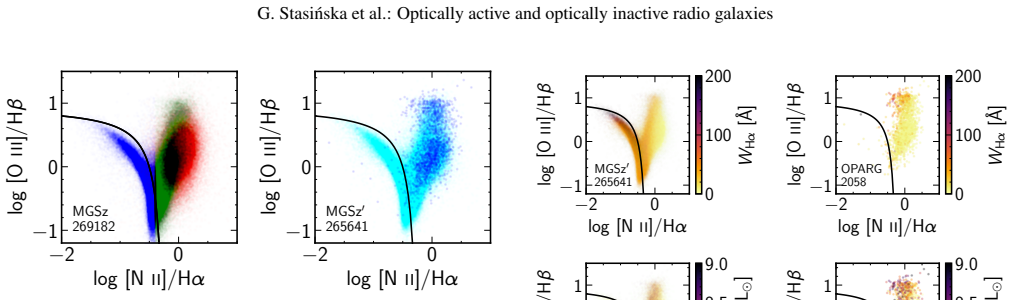
Using the W(H$\alpha$)$\ge$3 Å threshold to define optically active radio galaxies, the paper finds 2,721 OPARGs and 14,082 OPIRGs. After Malmquist correction, the radio luminosity distributions of the two classes are indistinguishable, while OPIRGs host more massive black holes and stellar masses, and OPARGs show recent star formation. Placing OPARGs on the BPT diagram reveals a distinct sub-family at the top of the AGN wing, slightly left of the main AGN sequence, with the highest [O iii]/[O ii], He ii/H$\beta$, H$\alpha$ luminosity and equivalent width, indicating a harder ionizing field and higher ionization parameter. The paper's bolometric-luminosity method, which mixes AGN and H II region photoionization models according to BPT position, yields Eddington ratios that exceed $10^{-2}$ only for these VHERGs, defined by log([O iii]/H$\beta$)$\ge$0.8. Thus most canonical HERGs fall below the threshold generally taken to mark radiatively efficient accretion, and the radiatively efficient radio-loud population is a small, high-excitation subset.
Load-bearing premise
The load-bearing premise is the model grid that turns measured line strengths into bolometric luminosity, especially the assumed covering factor of 0.65; if the true covering factor or input SEDs are systematically different, every Eddington ratio and the conclusion about which radio galaxies are radiatively efficient shifts accordingly.
Editorial extensions
If this is right
- The HERG class as usually defined contains many objects accreting below $10^{-2}$ Eddington, so surveys that select HERGs by W[O iii]$>$5 Å are not selecting radiatively efficient AGN.
- Radio luminosity alone cannot distinguish accretion modes: OPARGs and OPIRGs have indistinguishable $L_{1.4}$ distributions.
- True radiatively efficient radio-loud AGN are concentrated in a small BPT-top region, so studies of quasar-mode feedback should target VHERGs.
- The new $L_{\mathrm{bol}}$–$L_{[\mathrm{O\,iii}]}$ relations give lower bolometric luminosities than several earlier corrections, shifting Eddington-ratio estimates for type II AGN downward.
- OPARGs with recent star formation and active nuclei support cold-gas fuelling of radio AGN, tying the optically active class to gas-rich galaxies.
Reading between the lines
- If the VHERG threshold is stable, it could serve as a cheap single-diagnostic selector for radiatively efficient radio AGN in surveys without full spectral modelling.
- The same bolometric-correction machinery could be tested against X-ray or mid-infrared AGN luminosities; disagreement would reveal which model ingredient dominates.
- The paper's result suggests that the canonical $10^{-2}$ Eddington threshold, if correct, should be applied to VHERG-like objects only, so previous demographic studies of AGN accretion modes may need re-binning.
- Since VHERGs have low mechanical-to-radiative output, their jets may be produced by a different mechanism than those of OPIRGs, a prediction that high-resolution radio observations could test.
Editorial analysis
A structured set of objections, weighed in public.
Referee Report
Summary. The paper uses the ROGUE I and II radio catalogues matched to the SDSS main galaxy sample to define two classes of radio galaxies: optically inactive radio galaxies (OPIRGs, W(H-alpha)<3 A) and optically active radio galaxies (OPARGs, W(H-alpha)>=3 A). After applying Vmax completeness corrections, the authors compare stellar masses, black hole masses, radio luminosities, stellar ages, and dust properties of the two classes, and place them in the context of the full SDSS galaxy population. They then identify a subgroup of OPARGs at the top of the AGN wing of the BPT diagram, call them very-high-excitation radio galaxies (VHERGs), and compute Eddington ratios using a new photoionization-model-based bolometric calibration described in Appendix B. The central claim is that only VHERGs have Eddington ratios above 10^-2, so that only a small fraction of canonical HERGs are radiatively efficient.
Significance. If the bolometric calibration is correct, the result would challenge the standard HERG/LERG division as a proxy for radiative-mode versus jet-mode accretion and would identify the radiatively efficient population with a small BPT-selected subgroup rather than with the whole high-excitation class. The strengths of the paper include the large, visually classified ROGUE sample, the use of Vmax corrections for a magnitude-limited and flux-limited sample, the MaNGA-based check of contamination in low-W(H-alpha) galaxies, and the explicit presentation of the fitted polynomial formulae for the bolometric correction. The weakness is that the headline conclusion is conditional on an unvalidated model-dependent calibration, and the paper itself concedes in Section 10 that the conclusion holds only if the bolometric-luminosity estimates are correct. With independent validation and sensitivity tests, the result would be an important contribution; as it stands, the significance is high but provisional.
major comments (4)
- [Appendix B, Eqs. (B.3)-(B.4); Section 7.1] The central claim that only VHERGs have Eddington ratios above 10^-2 rests entirely on the calibration of Eq. (B.4), which maps the BPT coordinates to log Lmod_bol/LH-alpha, combined with the adopted covering factor of 0.65 in Section 7.1. The paper provides no external validation of this calibration against independent bolometric indicators such as X-ray or mid-infrared luminosities, and no propagated uncertainties from the model grid (SED choice, density, dust/depletion, abundances, mixing prescription, covering factor) into the Eddington ratios reported in Section 7.2 and Table 1. Because the VHERG region is located at the high-excitation end of the fitted surface, a systematic error in that part of the surface would directly change the inferred fraction of radiatively efficient radio galaxies. I request an external validation for at least a subsample and a sensitivity analysis that varies the most important model parameters, especially the covering factor and the treatment of dust.
- [Section 7.2; Appendix B, Eq. (B.4)] The VHERG class is defined by the condition log [OIII]/H-beta >= 0.8, while Eq. (B.4) assigns log Lmod_bol/LH-alpha as an increasing function of y = log [OIII]/H-beta (positive coefficients in y and y^3). The conclusion that VHERGs preferentially have high Eddington ratios is therefore partly built into the calibration: selecting objects on the same coordinate that enters the bolometric correction tends to select objects with a larger assigned Lbol for a given H-alpha luminosity. This is not a purely circular argument, because the Eddington ratio also depends on the extinction-corrected H-alpha luminosity and on MBH, but the effect should be quantified. I request a robustness test in which the Eddington ratios are recomputed with a BPT-independent bolometric correction (e.g., Lbol = 600 L[OIII] or Lbol = 3500 L[OIII]) and with an independent bolometric indicator, to show how much of the VHERG excess survives.
- [Section 4.2; Section 6; Figures 5-11] Several quantitative claims are made on the basis of visual inspection rather than statistical tests. In particular, the statement that the radio-luminosity distributions of OPARGs and OPIRGs are 'undistinguishable' (Section 4.2 and the abstract) is not supported by any two-sample test; with 16,803 objects, even small distribution differences can be highly significant, and percentile overlap is not a substitute for a Kolmogorov-Smirnov or Anderson-Darling test. Similarly, the claimed displacement of the VHERG subgroup to the left of the main AGN wing in Section 6 is not quantified. These tests are needed to establish the secondary claims and to support the interpretation that the VHERG location is special.
- [Abstract; Section 7.2; Section 10] The abstract and Section 10 state that 'Only very-high excitation radio galaxies (VHERGs) have Eddington ratios higher than 10^-2', but Section 7.2 states that 'Almost all radio galaxies with Eddington ratios lambda larger than 0.01 are at the top right of the BPT diagram.' These statements are not equivalent. The paper should quantify the fraction of objects with lambda > 0.01 that fall inside and outside the VHERG region defined by log [OIII]/H-beta >= 0.8, and align the wording of the abstract and conclusions with the actual numbers. This is directly relevant to the headline claim.
minor comments (6)
- [Section 2.3] The text contains incomplete citations, e.g., '?Best & Heckman 2012; ?' in the discussion of the DLM diagram; these should be completed.
- [Appendix B, Eq. (B.4) and Figure B.2] The notation 'Lmod_bol/LH-alpha' is ambiguous: it is not clear from the text whether the ratio is taken with respect to the AGN H-alpha luminosity or the total H-alpha luminosity after mixing with H II regions. Since the fitted formula is applied to observed total H-alpha luminosities, this point must be clarified explicitly.
- [Appendix B, Section B.2] The H II region models assume a solar-metallicity stellar population even when the nebular oxygen abundance is sub-solar or super-solar, and the mixing prescription assumes the same O/H for the AGN and H II regions. These choices should be justified and their impact on the fitted surfaces discussed.
- [Section 7.2] The black hole masses are derived from the Tremaine et al. (2002) relation using starlight stellar velocity dispersions; the paper does not discuss possible systematics from fibre-aperture effects or from the use of a different MBH-sigma relation. A brief statement of the expected systematic uncertainty would be useful.
- [Figure 19 caption] The caption contains a typo: 'OPIGRs' should be 'OPIRGs'. There are also scattered typographical issues such as 'di fferent' and 'Objets' that should be corrected during editing.
- [Appendix B, Section B.4] The statement that HOLMES do not strongly affect the bolometric luminosity is plausible but is argued qualitatively; a quantitative estimate of the HOLMES contribution for objects near W(H-alpha)=3 A would be more convincing.
Circularity Check
The headline Eddington-ratio result is partly built into the BPT-based bolometric calibration, and the OPIRG radiative-inefficiency conclusion is assumed by construction.
-
fitted input called prediction
[Section 7.1-7.2 and Appendix B.3 (Eq. B.4); VHERG definition in Section 7.2]
"The fitted coefficients for log Lmod_bol /LHα as a function of x = log [Nii]/Hα and y = log [Oiii]/Hβ are log Lmod_bol /LHα = 1.8279 + 0.9598x + 0.1025y − 0.5880x2 + 0.1639y2 + 1.5134x3 + 0.1410y3 − 0.6535xy + 1.2002x2y − 0.0656xy2. (B.4) ... In the following we call VHERGs objects for which log [Oiii]/Hβ ≥ 0.8."
Every Eddington ratio in the paper uses Lbol = Lmod_bol/0.65, and Lmod_bol/LHα is fixed by Eq. B.4 as a polynomial in the BPT coordinates. In the AGN wing this polynomial increases with y = log[OIII]/Hβ, because the y, y2 and y3 terms have positive coefficients. The VHERG class is defined by exactly that coordinate, y ≥ 0.8. Therefore the statement that almost all λ > 0.01 objects are VHERGs is not an independent empirical discovery: the bolometric correction assigns higher Lbol to high-y objects at fixed LHα, so the classification coordinate directly shapes the Eddington-ratio pattern. LHα and MBH still enter, so the relation is not a complete tautology, but the central claim is partly produced by the calibration surface rather than by the data.
-
self definitional
[Section 8, footnote 4; Section 9.3.1]
"For OPIRGs we assume that the bolometric luminosity of the AGN is zero, even if W(Hα) is not null. ... Thus the OPIRGs emission is fully consistent with a radiatively inefficient flow."
OPIRGs are defined as radio galaxies with W(Hα) < 3 Å, i.e. objects without an optical AGN signature. The paper then sets their AGN bolometric luminosity to zero before computing any Eddington-scaled quantity, and later reports that OPIRGs are consistent with radiatively inefficient flows. Removing the radiative term by definition guarantees the qualitative conclusion; the inference is a restatement of the zero-Lbol assumption, not a result measured from the data.
full rationale
The central claim that only VHERGs have Eddington ratios above 10^-2 is not fully circular: LHα and black-hole masses enter the denominator, and the bolometric calibration is anchored to an external Cloudy model grid. However, the Lbol/LHα factor that drives the result is a fitted polynomial in the same BPT coordinate (log[OIII]/Hβ) used to define VHERGs, so the high-Eddington-ratio status of VHERGs is partially imposed by construction. The paper even hedges with 'If our estimates of the bolometric luminosities are correct', which acknowledges the fragility but does not remove the construction. A second, genuine circular step is the OPIRG analysis: their Lbol is assumed to be zero by definition, which makes the later 'radiatively inefficient flow' conclusion for OPIRGs a restatement of the input. The self-citations to the ROGUE catalogues and DLM diagram are data/tools from prior work and are not load-bearing in a circular sense. Overall, partial circularity in the headline radiative-efficiency claim plus a by-construction OPIRG inference justify a score of 6.
Assumptions & free parameters
free parameters (6)
- Covering factor of the AGN ionizing source =
0.65
- AGN nebular hydrogen density =
10^3 cm^-3
- H II region nebular density =
10^2 cm^-3
- Abundance and ionization parameter grid =
O/H = 8.60, 8.80, 9.02; log U = -2.0 to -4.0
- Polynomial coefficients for eta and log Lbol/LH-alpha =
Eqs. B.3 and B.4 coefficients
- VHERG excitation threshold =
log [O III]/H-beta >= 0.8
assumptions (8)
- domain assumption Galaxies with W(H-alpha) < 3 Angstrom are ionized by HOLMES, not by an AGN.
- domain assumption The DLM diagram (Dn(4000) vs L1.4/M*) separates radio AGN from star-forming radio emitters.
- domain assumption Cloudy photoionization models with Ferland et al. (2020) SEDs, given dust and depletion prescriptions, represent the AGN narrow-line region.
- domain assumption H II regions can be represented by Starburst99 4 Myr continuous star formation with a Salpeter IMF at fixed metallicity.
- ad hoc to paper Composite AGN plus H II spectra are represented by mixing AGN and H II models with the same oxygen abundance and low-U H II models.
- domain assumption The covering factor of the ionizing source by line-emitting gas is 0.65.
- domain assumption Black hole masses follow the Tremaine et al. (2002) M_BH-sigma relation.
- domain assumption Jet mechanical luminosity follows the Cavagnolo et al. (2010) scaling L_mech = 7.3e36 (L1.4/1e24)^0.70.
Cite this review
Pith. "Pith review of Optically active and optically inactive radio galaxies as sub-populations of the main galaxy sample of the SDSS." pith.science (2026). https://pith.science/paper/ZMEIVJV4
@misc{pith2026241116006,
  author       = {Pith},
  title        = {Pith review of: Optically active and optically inactive radio galaxies as sub-populations of the main galaxy sample of the SDSS},
  year         = {2026},
  howpublished = {\url{https://pith.science/paper/ZMEIVJV4}},
  note         = {Machine review of arXiv:2411.16006}
}
read the original abstract
We use the ROGUE I and II catalogues of radio sources associated with optical galaxies to revisit the characterization of radio active galactic nuclei (AGNs) in terms of radio luminosities and properties derived from the analyses of the optical spectra of their associated galaxies. We propose a physically based classification of radio galaxies into `optically inactive' and `optically active' (OPARGs and OPIRGs). In our sample, there are 14082 OPIRGs and 2721 OPARGs.After correcting for the Malmquist bias, we compared the global properties of our two classes of radio galaxies and put them in the context of the global population of galaxies. To compare the Eddington ratios of OPARGs with those of Seyferts, we devised a method to obtain the bolometric luminosities of these objects, taking into account the contribution of young stars to the observed line emission. We provide formulae to derive bolometric luminosities from the [Oiii] luminosity. We find that the distributions of radio luminosities of OPARGs and OPIRGs are undistinguishable. On average, the black hole masses and stellar masses in OPIRGs are larger than in OPARGs. OPARGs show signs of some recent star formation. Plotting the OPARGs in the BPT diagram and comparing their distribution with that of the remaining galaxies, we find that there is a sub-family of very high excitation OPARGs at the top of the AGN wing. This group is slightly displaced towards the left of the rest of the AGN galaxies, suggesting a stronger ionizing radiation field with respect to the gas pressure. Only very-high excitation radio galaxies (VHERGs) have Eddington ratios higher than 0.01, which are canonically considered as the lower limit for the occurrence of radiative efficient accretion. If our estimates of the bolometric luminosities are correct, this means than only a small proportion of mainstream HERGs are indeed radiatively efficient.
Figures


Figures from the paper (14 more)




Reference graph
Works this paper leans on
-
[1]
N., Adelman-McCarthy , J
Abazajian , K. N., Adelman-McCarthy , J. K., Ag \"u eros , M. A., et al. 2009, , 182, 543
2009
-
[2]
2024, , 530, 1512
Aggarwal , Y. 2024, , 530, 1512
2024
-
[3]
J., Salim , S., Ellison , S
Agostino , C. J., Salim , S., Ellison , S. L., Bickley , R. W., & Faber , S. M. 2023, , 943, 174
2023
-
[4]
S., Ahumada , R., Almeida , A., et al
Aguado , D. S., Ahumada , R., Almeida , A., et al. 2019, , 240, 23
2019
-
[5]
J., & Scott , P
Asplund , M., Grevesse , N., Sauval , A. J., & Scott , P. 2009, , 47, 481
2009
-
[6]
M., Sip o cz , B
Astropy Collaboration , Price-Whelan , A. M., Sip o cz , B. M., et al. 2018, , 156, 123
2018
-
[7]
P., Tollerud , E
Astropy Collaboration , Robitaille , T. P., Tollerud , E. J., et al. 2013, , 558, A33
2013
-
[8]
K., Maeda , Y., Morris , M., et al
Baganoff , F. K., Maeda , Y., Morris , M., et al. 2003, , 591, 891
2003
Show all 120 references
-
[9]
D., Capetti , A., & Giovannini , G
Baldi , R. D., Capetti , A., & Giovannini , G. 2019, , 482, 2294
2019
-
[10]
D., Williams , D
Baldi , R. D., Williams , D. R. A., Beswick , R. J., et al. 2021, , 508, 2019
2021
-
[11]
A., Phillips , M
Baldwin , J. A., Phillips , M. M., & Terlevich , R. 1981, , 93, 5
1981
-
[12]
Best , P. N. & Heckman , T. M. 2012, , 421, 1569
2012
-
[13]
Binette , L., Zovaro , H. R. M., Villar Mart \' n , M., et al. 2024, , 684, A53
2024
-
[14]
Blandford , R. D. & Begelman , M. C. 1999, , 303, L1
1999
-
[15]
Blandford , R. D. & Payne , D. G. 1982, , 199, 883
1982
-
[16]
Blandford , R. D. & Znajek , R. L. 1977, , 179, 433
1977
-
[17]
& Charlot , S
Bruzual , G. & Charlot , S. 2003, , 344, 1000
2003
-
[18]
A., Law , D
Bundy , K., Bershady , M. A., Law , D. R., et al. 2015, , 798, 7
2015
-
[19]
2010, , 509, A6
Buttiglione , S., Capetti , A., Celotti , A., et al. 2010, , 509, A6
2010
-
[20]
2005, , 439, 935
Capetti , A., Verdoes Kleijn , G., & Chiaberge , M. 2005, , 439, 935
2005
-
[21]
A., Clayton , G
Cardelli , J. A., Clayton , G. C., & Mathis , J. S. 1989, , 345, 245
1989
-
[22]
W., McNamara , B
Cavagnolo , K. W., McNamara , B. R., Nulsen , P. E. J., et al. 2010, , 720, 1066
2010
-
[23]
2002, , 394, 791
Chiaberge , M., Capetti , A., & Celotti , A. 2002, , 394, 791
2002
-
[24]
Ching , J. H. Y., Croom , S. M., Sadler , E. M., et al. 2017, , 469, 4584
2017
-
[25]
Cid Fernandes , R., Mateus , A., Sodr \'e , L., Stasi \'n ska , G., & Gomes , J. M. 2005, , 358, 363
2005
-
[26]
M., et al
Cid Fernandes , R., Schoenell , W., Gomes , J. M., et al. 2009, in Revista Mexicana de Astronomia y Astrofisica Conference Series, Vol. 35, Revista Mexicana de Astronomia y Astrofisica Conference Series, 127--132
2009
-
[27]
2011, , 413, 1687
Cid Fernandes , R., Stasi \'n ska , G., Mateus , A., & Vale Asari , N. 2011, , 413, 1687
2011
-
[28]
S., et al
Cid Fernandes , R., Stasi \'n ska , G., Schlickmann , M. S., et al. 2010, , 403, 1036
2010
-
[29]
Condon , J. J. 1989, , 338, 13
1989
-
[30]
J., Cotton , W
Condon , J. J., Cotton , W. D., Greisen , E. W., et al. 1998, , 115, 1693
1998
-
[31]
A., Sutherland , R
Dopita , M. A., Sutherland , R. S., Nicholls , D. C., Kewley , L. J., & Vogt , F. P. A. 2013, , 208, 10
2013
-
[32]
L., Maiolino , R., Cardaci , M
Dors , O. L., Maiolino , R., Cardaci , M. V., et al. 2020, , 496, 3209
2020
-
[33]
L., Valerdi , M., Riffel , R
Dors , O. L., Valerdi , M., Riffel , R. A., et al. 2023, , 521, 1969
2023
-
[34]
Draine , B. T. 2011, , 732, 100
2011
-
[35]
J., Annis , J., Gunn , J
Eisenstein , D. J., Annis , J., Gunn , J. E., et al. 2001, , 122, 2267
2001
-
[36]
O., & Paturel , G
Ekholm , T., Baryshev , Y., Teerikorpi , P., Hanski , M. O., & Paturel , G. 2001, , 368, L17
2001
-
[37]
A., McClintock , J
Esin , A. A., McClintock , J. E., & Narayan , R. 1997, , 489, 865
1997
-
[38]
Fanaroff , B. L. & Riley , J. M. 1974, , 167, 31P
1974
-
[39]
J., Chatzikos , M., Guzm \'a n , F., et al
Ferland , G. J., Chatzikos , M., Guzm \'a n , F., et al. 2017, , 53, 385
2017
-
[40]
J., Done , C., Jin , C., Landt , H., & Ward , M
Ferland , G. J., Done , C., Jin , C., Landt , H., & Ward , M. J. 2020, , 494, 5917
2020
-
[41]
A., Dopita , M
Groves , B. A., Dopita , M. A., & Sutherland , R. S. 2004, , 153, 9
2004
-
[42]
2018, Nature Astronomy, 2, 273
Hardcastle , M. 2018, Nature Astronomy, 2, 273
2018
-
[43]
Hardcastle , M. J. & Croston , J. H. 2020, , 88, 101539
2020
-
[44]
J., Evans , D
Hardcastle , M. J., Evans , D. A., & Croston , J. H. 2007, , 376, 1849
2007
-
[45]
Heckman , T. M. 1980, , 87, 142
1980
-
[46]
Heckman , T. M. & Best , P. N. 2014, , 52, 589
2014
-
[47]
M., Kauffmann , G., Brinchmann , J., et al
Heckman , T. M., Kauffmann , G., Brinchmann , J., et al. 2004, , 613, 109
2004
-
[48]
Hine , R. G. & Longair , M. S. 1979, , 188, 111
1979
-
[49]
Huang , J., Lin , D. N. C., & Shields , G. 2023, , 525, 5702
2023
-
[50]
& Rawlings , S
Jackson , N. & Rawlings , S. 1997, , 286, 241
1997
-
[51]
Janssen , R. M. J., R \"o ttgering , H. J. A., Best , P. N., & Brinchmann , J. 2012, , 541, A62
2012
-
[52]
2005, , 625, 667
Jester , S. 2005, , 625, 667
2005
-
[53]
2012, , 425, 907
Jin , C., Ward , M., & Done , C. 2012, , 425, 907
2012
-
[54]
2018, , 864, 32
Jin , J.-J., Zhu , Y.-N., Meng , X.-M., Lei , F.-J., & Wu , H. 2018, , 864, 32
2018
-
[55]
& Heckman , T
Kauffmann , G. & Heckman , T. M. 2009, , 397, 135
2009
-
[56]
M., & Best , P
Kauffmann , G., Heckman , T. M., & Best , P. N. 2008, , 384, 953
2008
-
[57]
M., Tremonti , C., et al
Kauffmann , G., Heckman , T. M., Tremonti , C., et al. 2003, , 346, 1055
2003
-
[58]
J., Dopita , M
Kewley , L. J., Dopita , M. A., Sutherland , R. S., Heisler , C. A., & Trevena , J. 2001, , 556, 121
2001
-
[59]
2020, , 247, 53
Kozie -Wierzbowska , D., Goyal , A., & \.Z ywucka , N. 2020, , 247, 53
2020
-
[60]
& Stasi \'n ska , G
Kozie -Wierzbowska , D. & Stasi \'n ska , G. 2011, , 415, 1013
2011
-
[61]
2021, , 910, 64
Kozie -Wierzbowska , D., Vale Asari , N., Stasi \'n ska , G., et al. 2021, , 910, 64
2021
-
[62]
2017, , 228, 9
Koz owski , S. 2017, , 228, 9
2017
-
[63]
Y., Asada , K., Rao , R., et al
Kuo , C. Y., Asada , K., Rao , R., et al. 2014, , 783, L33
2014
-
[64]
A., Jenkins , C
Laing , R. A., Jenkins , C. R., Wall , J. V., & Unger , S. W. 1994, in Astronomical Society of the Pacific Conference Series, Vol. 54, The Physics of Active Galaxies, ed. G. V. Bicknell , M. A. Dopita , & P. J. Quinn , 201
1994
-
[65]
& Draine , B
Laor , A. & Draine , B. T. 1993, , 402, 441
1993
-
[66]
D., et al
Leitherer , C., Schaerer , D., Goldader , J. D., et al. 1999, , 123, 3
1999
-
[67]
2014, , 788, 71
Li , S.-L. 2014, , 788, 71
2014
-
[68]
& Begelman , M
Li , S.-L. & Begelman , M. C. 2014, , 786, 6
2014
-
[69]
& Cao , X
Li , S.-L. & Cao , X. 2012, , 753, 24
2012
-
[70]
2007, , 468, 979
Maiolino , R., Shemmer , O., Imanishi , M., et al. 2007, , 468, 979
2007
-
[71]
P., Moran , J
Marrone , D. P., Moran , J. M., Zhao , J.-H., & Rao , R. 2007, , 654, L57
2007
-
[72]
C., Tchekhovskoy , A., & Blandford , R
McKinney , J. C., Tchekhovskoy , A., & Blandford , R. D. 2012, , 423, 3083
2012
-
[73]
2006, , 447, 863
Nagao , T., Maiolino , R., & Marconi , A. 2006, , 447, 863
2006
-
[74]
V., & Abramowicz , M
Narayan , R., Igumenshchev , I. V., & Abramowicz , M. A. 2003, , 55, L69
2003
-
[75]
1998, in Theory of Black Hole Accretion Disks, ed
Narayan , R., Mahadevan , R., & Quataert , E. 1998, in Theory of Black Hole Accretion Disks, ed. M. A. Abramowicz , G. Bj \"o rnsson , & J. E. Pringle , 148--182
1998
-
[76]
& McClintock , J
Narayan , R. & McClintock , J. E. 2008, , 51, 733
2008
-
[77]
E., & Yi , I
Narayan , R., McClintock , J. E., & Yi , I. 1996, , 457, 821
1996
-
[78]
& Yi , I
Narayan , R. & Yi , I. 1994, , 428, L13
1994
-
[79]
& Yi , I
Narayan , R. & Yi , I. 1995, , 452, 710
1995
-
[80]
Nemmen , R. S. & Tchekhovskoy , A. 2015, , 449, 316
2015
-
[81]
2009, , 399, 1907
Netzer , H. 2009, , 399, 1907
2009
-
[82]
2015, , 53, 365
Netzer , H. 2015, , 53, 365
2015
-
[83]
2016, , 819, 123
Netzer , H., Lani , C., Nordon , R., et al. 2016, , 819, 123
2016
-
[84]
& Laor , A
Netzer , H. & Laor , A. 1993, , 404, L51
1993
-
[85]
M., Assef , R
Padovani , P., Alexander , D. M., Assef , R. J., et al. 2017, ArXiv e-prints
2017
-
[86]
I., et al
Padovani , P., Bonzini , M., Kellermann , K. I., et al. 2015, ArXiv e-prints
2015
-
[87]
B., Ching , J
Pracy , M. B., Ching , J. H. Y., Sadler , E. M., et al. 2016, , 460, 2
2016
-
[88]
J., et al
Prescott , M., Mauch , T., Jarvis , M. J., et al. 2016, , 457, 730
2016
-
[89]
C., Galliano , F., et al
R \'e my-Ruyer , A., Madden , S. C., Galliano , F., et al. 2014, , 563, A31
2014
-
[90]
Salpeter , E. E. 1955, , 121, 161
1955
-
[91]
1968, , 151, 393
Schmidt , M. 1968, , 151, 393
1968
-
[92]
Shakura , N. I. & Sunyaev , R. A. 1973, , 24, 337
1973
-
[93]
M., & Asari , N
Sikora , M., Stasi \'n ska , G., Kozie -Wierzbowska , D., Madejski , G. M., & Asari , N. V. 2013, , 765, 62
2013
-
[94]
L., Koss , M., & Mushotzky , R
Smith , K. L., Koss , M., & Mushotzky , R. F. 2014, , 794, 112
2014
-
[95]
A., & Malkan , M
Spinoglio , L., Fern \'a ndez-Ontiveros , J. A., & Malkan , M. A. 2024, , 964, 117
2024
-
[96]
2016, , 458, 2288
Stalevski , M., Ricci , C., Ueda , Y., et al. 2016, , 458, 2288
2016
-
[97]
Stasi \'n ska , G., Cid Fernandes , R., Mateus , A., Sodr \'e , L., & Asari , N. V. 2006, , 371, 972
2006
-
[98]
2015, , 576, A83
Stasi \'n ska , G., Izotov , Y., Morisset , C., & Guseva , N. 2015, , 576, A83
2015
-
[99]
2008, , 391, L29
Stasi \'n ska , G., Vale Asari , N., Cid Fernandes , R., et al. 2008, , 391, L29
2008
-
[100]
A., Weinberg , D
Strauss , M. A., Weinberg , D. H., Lupton , R. H., et al. 2002, , 124, 1810
2002
-
[101]
Tchekhovskoy , A., Narayan , R., & McKinney , J. C. 2011, , 418, L79
2011
-
[102]
D., Kewley , L
Thomas , A. D., Kewley , L. J., Dopita , M. A., et al. 2018, , 861, L2
2018
-
[103]
Thorne , K. S. 1974, , 191, 507
1974
-
[104]
2021, , 912, 91
Toba , Y., Ueda , Y., Gandhi , P., et al. 2021, , 912, 91
2021
-
[105]
2002, , 574, 740
Tremaine , S., Gebhardt , K., Bender , R., et al. 2002, , 574, 740
2002
-
[106]
R., Impey , C
Trump , J. R., Impey , C. D., Taniguchi , Y., et al. 2009, , 706, 797
2009
-
[107]
S., Cid Fernandes , R., et al
Vale Asari , N., Couto , G. S., Cid Fernandes , R., et al. 2019, , 489, 4721
2019
-
[108]
2016, , 460, 1739
Vale Asari , N., Stasi \'n ska , G., Morisset , C., & Cid Fernandes , R. 2016, , 460, 1739
2016
-
[109]
V \'a zquez , G. A. & Leitherer , C. 2005, , 621, 695
2005
-
[110]
D., Nowak , M
Wang , Q. D., Nowak , M. A., Markoff , S. B., et al. 2013, Science, 341, 981
2013
-
[111]
L., Becker , R
White , R. L., Becker , R. H., Helfand , D. J., & Gregg , M. D. 1997, , 475, 479
1997
-
[112]
H., Jarvis , M
Whittam , I. H., Jarvis , M. J., Hale , C. L., et al. 2022, , 516, 245
2022
-
[113]
L., Calistro Rivera , G., Best , P
Williams , W. L., Calistro Rivera , G., Best , P. N., et al. 2018, , 475, 3429
2018
-
[114]
A., Yukita , M., et al
Wong , K.-W., Irwin , J. A., Yukita , M., et al. 2011, , 736, L23
2011
-
[115]
& Blanton , M
Yan , R. & Blanton , M. R. 2012, , 747, 61
2012
-
[116]
G., Adelman , J., Anderson , Jr., J
York , D. G., Adelman , J., Anderson , Jr., J. E., et al. 2000, , 120, 1579
2000
-
[117]
& Narayan , R
Yuan , F. & Narayan , R. 2014, , 52, 529
2014
-
[118]
J., & Sutherland , R
Zhu , P., Kewley , L. J., & Sutherland , R. S. 2023, , 954, 175
2023
-
[119]
, " * write output.state after.block = add.period write newline
ENTRY address archiveprefix author booktitle chapter edition editor howpublished institution eprint journal key month note number organization pages publisher school series title type volume year label extra.label sort.label short.list INTEGERS output.state before.all mid.sent...
-
[120]
write newline
" write newline "" before.all 'output.state := FUNCTION n.dashify 't := "" t empty not t #1 #1 substring "-" = t #1 #2 substring "--" = not "--" * t #2 global.max substring 't := t #1 #1 substring "-" = "-" * t #2 global.max substring 't := while if t #1 #1 substring * t #2 gl...
Reviewed August 12, 2026 · model on record in the stance chip above.
Discussion (0). Continue with ORCID to comment.