REVIEW 4 major objections 4 minor 50 references
A priori and a posteriori error estimates of a really pressure-robust virtual element method for the incompressible Brinkman problem
T0 review · 4 major / 4 minor · reviewed 2026-08-12 · deepseek-v4-flash
Pith's one-line read A virtual element method for the incompressible Brinkman problem is proved to keep the energy-norm velocity error independent of both pressure and viscosity, with a residual error estimator that drives adaptive refinement on polygonal…
desk verdict Solid PR-VEM paper for Brinkman with a fixable a priori gap and an overstated a posteriori efficiency claim; worth refereeing after revision. read the letter →
The pith
A machine-rendered reading of the paper's core claim, the machinery that carries it, and where it could break.
The reading
What carries the argument
The load-bearing object is the divergence-preserving reconstruction operator $R_h$, defined elementwise on a regular subtriangulation of each polygon by the lowest-order H(div)-conforming space: its normal traces are matched to the virtual element's edge degrees of freedom, and it preserves the elementwise divergence of the virtual velocity. It is inserted only where the load meets the discrete test space, replacing $(f,v_h)$ by $(f,R_h v_h)$. On the discrete kernel $Z_h=\{v_h:\nabla\cdot v_h=0\}$, this yields $\nabla\cdot R_h v_h=0$, so the gradient part of the force is orthogonal to the discrete velocity space and cannot feed a $1/\nu$ term into the velocity estimate. The stabilization terms in the discrete bilinear form are chosen to satisfy the usual consistency and stability estimates, and the discrete inf-sup condition supplies the pressure estimate; the main proof of Theorem 4.1 then isolates the interpolation error and the reconstruction error. This machinery is also what makes the a posteriori estimator treatable, because the residual equation inherits the same divergence-preserving structure.
What would settle it
Solve a manufactured divergence-free problem with a large pressure component on a fixed non-convex polygonal mesh for $\nu=10^{-4},10^{-8},10^{-12}$; if the energy-norm velocity error changes measurably, or if the computed $L^2$ norm of $\nabla\cdot u_I$ for the interpolation used in Theorem 4.1 is not zero to round-off, then the claimed independence from $\nu$ and $p$ fails, and the proof's test-function step (4.2) is not valid.
Extended reading notes
Core claim
The central discovery is a really pressure-robust virtual element scheme whose velocity error in the energy norm satisfies $\|u-u_h\|_{\text{energy}} \le \hat C h$ with $\hat C$ independent of $h$, of the viscosity $\nu$, and of the continuous pressure $p$, while the pressure error is $\|p-p_h\|\le \tilde C h$ with $\tilde C$ independent of $h$. The mechanism is the reconstruction operator $R_h$: it is a piecewise divergence-preserving mapping into a lowest-order H(div)-conforming space on a subtriangulation, matched to the virtual degrees of freedom, and it is applied only to the load. Because $\nabla\cdot R_h v_h=0$ on the discrete divergence-free kernel $Z_h$, the gradient part of the load's decomposition no longer pollutes the velocity equation; this is exactly the orthogonality that the standard projection-based right-hand side destroys. The paper also proves reliability and efficiency of a residual estimator $\eta$, in the form $\nu\|u-u_h\|+\|p-p_h\|\le C_\eta\eta$ and local lower bounds, and confirms the predicted rates on non-convex and centroidal-type polygonal meshes, including high-contrast permeability examples.
Load-bearing premise
The velocity-error proof assumes that the virtual-element interpolant of the exact divergence-free solution is itself exactly divergence-free, so it lies in the discrete kernel; the paper states only approximation estimates for the interpolant and gives no separate proof of this preservation property.
Editorial extensions
If this is right
- As $\nu\to0$, the velocity error in the energy norm stays bounded and first-order in $h$, so the method is locking-free across the Darcy-to-Stokes transition.
- The discrete velocity is exactly divergence-free (since $\nabla\cdot V_h\subset Q_h$), so mass conservation holds elementwise even on coarse polygonal meshes.
- The residual estimator $\eta$ gives a computable upper bound on $\nu\|u-u_h\|+\|p-p_h\|$ and local lower bounds, allowing the adaptive loop Solve–Estimate–Mark–Refine to run on general polygonal meshes with guaranteed error control.
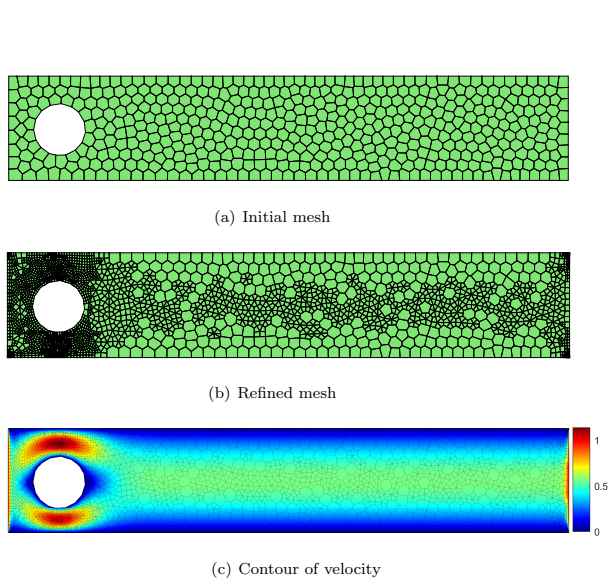
- Optimal convergence rates $O(h)$ a priori and $O(\mathrm{DOFs}^{-1/2})$ for adaptively refined meshes are observed for smooth solutions, boundary and interior layers, corner singularities, and flow past a cylinder.
Reading between the lines
- The same divergence-preserving right-hand side should transfer to other saddle-point flow formulations whose locking comes only from losing orthogonality to gradient forces, such as viscoelastic or magnetohydrodynamic models; a direct test is to apply the reconstruction to a Stokes problem with a large pressure gradient and check that no $1/\nu$ term appears.
- The reliability bound suggests a $\nu$-independent adaptive stopping criterion can be set from the pressure error plus a weighted estimator; an experiment comparing effectivity indices for $\nu=1$ and $\nu=10^{-12}$ on the same mesh sequence would make this explicit.
- The efficiency constant in Theorem 5.2 depends on $\|\kappa^{-1/2}\|_\infty$ through the stabilization bounds, so a checkerboard-permeability test with contrast above $10^6$ would probe whether the estimator remains reliable in the high-contrast regime the paper targets.
Editorial analysis
A structured set of objections, weighed in public.
Referee Report
Summary. The manuscript proposes a lowest-order virtual element method for the two-dimensional incompressible Brinkman problem. The right-hand side is discretized with a divergence-preserving Raviart-Thomas reconstruction operator, which makes the discrete velocity exactly divergence-free. The authors claim optimal a priori error estimates in which the velocity error in the energy norm is independent of both the continuous pressure and the viscosity, and they construct a residual-type a posteriori estimator with a global upper bound and a local lower bound. They also present an adaptive refinement algorithm and numerical experiments on polygonal meshes, including high-contrast permeability and singular geometries.
Significance. If the stated results are correct, the paper makes a useful contribution to pressure-robust virtual element methods for Brinkman flows on polygonal meshes: it extends divergence-preserving reconstruction ideas from Stokes-type problems to the Brinkman setting, gives explicit h-optimal rates with constants independent of ν and p in the velocity estimate, and provides an adaptive estimator with effectivity studies. The numerical section is reasonably broad, covering non-convex, Voronoi, and high-contrast permeability cases. The proof strategy is transparent and the reported experiments support the pressure-robustness claims. However, several load-bearing points in the a priori and a posteriori arguments are not justified as written.
major comments (4)
- [§4, proof of Theorem 4.1, Eq. (4.2)] The proof sets v_h = u_h - u_I and inserts this into the identity (4.2), which is asserted for arbitrary v_h in the discrete kernel Z_h. Lemma 4.1 supplies only approximation estimates and does not state or prove that the interpolant u_I is divergence-free, i.e. that u_I ∈ Z_h. The canonical VEM interpolant with matching edge-normal degrees of freedom would satisfy ∫_E div u_I = ∫_{∂E} u·n = 0, and since div v is piecewise constant for v ∈ V_h, this would imply u_I ∈ Z_h; but this property is not stated. Without it, identity (3.17) cannot be invoked at v_h = u_h - u_I, and the cancellation of the pressure term in T1 is not justified. Please add an explicit statement and proof that u_I is divergence-preserving before Eq. (4.2).
- [§4, Eq. (4.3) and constant bC in (4.6)] The bound of ν(κ^{-1}u, R_h v_h - v_h) is displayed with the norm ∥κ^{1/2}u∥. The correct Cauchy-Schwarz pairing is (κ^{-1/2}u, κ^{-1/2}(R_h v_h - v_h)), giving a bound involving ∥κ^{-1/2}u∥ and ∥κ^{-1/2}∥∞, not ∥κ^{1/2}u∥. This error propagates into the explicit constant bC in (4.1a) and (4.6). The h-dependence and the independence of ν and p would survive the correction, but the displayed formula is not correct as written.
- [§5.2, Theorem 5.2 and Abstract] Theorem 5.2 bounds only the residual sub-estimator η_r,E, not the full local estimator η_E = (η_f,E² + η_S,E² + η_r,E²)^{1/2}. The right-hand side of (5.18)/(5.23) contains η_f,E² = h_E²∥f∥²_E and η_S,E², so adding these terms to both sides yields only an inequality in which the estimator is bounded by itself together with error terms. This does not establish a local lower bound for the full estimator in terms of the discretization error alone; in particular, h_E∥f∥_E need not vanish where the discrete solution is locally accurate. Since the adaptive marking (5.24) and the numerical effectivity indices use the full η, the abstract's claim that the estimator 'provides global upper and local lower bounds for the discretization error' is not established as stated. If the data term is intended as a data-oscillation term, this should be stated explicitly and the theorem and abstract rephrased accordingly.
- [§5.2, Eqs. (5.19)-(5.21)] The efficiency proof applies the bubble-function estimates of Lemma 5.2 to the vector function θ_E = κ^{-1}Π_{0,E}u_h. This is only valid if θ_E is a polynomial on E, which requires the permeability tensor κ to be piecewise constant on the mesh. The paper never states such an assumption on κ; for a general space-dependent symmetric positive definite tensor, θ_E is not a polynomial and Lemma 5.2 does not apply. Please add the missing coefficient regularity assumption or modify the proof accordingly.
minor comments (4)
- [Abstract and §1] The phrase 'optimal priori error estimates' should be 'optimal a priori error estimates'; in the last paragraph of Section 1, 'The optimal a posteriori error estimate is derived in Section 4' should read 'a priori', since Section 4 concerns a priori estimates.
- [§5.2, Lemma 5.2, Eq. (5.16b)] The inequality in (5.16b) has a dimension mismatch: the middle expression is a norm, not a squared norm, while the left and right bounds are written with ∥p1∥_E². It should presumably be ∥p1∥_E on both sides.
- [§6.2, Example 6.4, Table 6.2] The table caption says 'the errors for a series of Voronoi meshes', but the text states the test starts from the non-convex base mesh of Fig. 6.1(a); please make the mesh description consistent.
- [§5.2, Theorem 5.2 statement] The right-hand side of (5.18) references η_f,E and η_S,E before their definitions in (5.5a)-(5.5b) are recalled; a forward reference to (5.5) would improve readability.
Circularity Check
No significant circularity: the central a priori and a posteriori estimates are derived from externally cited reconstruction and interpolation lemmas; the self-citations are background only.
full rationale
The derivation chain is self-contained against standard external results and does not reduce to its inputs. The really pressure-robust scheme (3.16) is built on the divergence-preserving reconstruction operator R_h whose key properties (3.9a)-(3.9c) are quoted from [42,46], neither of which overlaps with the present authors; Theorem 4.1 then uses Lemma 4.1 and Lemma 4.2 (classical interpolation estimates) together with the consistency and stability properties (3.12), so the velocity and pressure bounds (4.1a)-(4.1b) are genuine consequences rather than restatements of the assumptions. The a posteriori reliability and efficiency proofs (Theorems 5.1 and 5.2) are residual-type arguments built on the error equation (5.3), bubble functions, and trace estimates; no fitted parameter or data-dependent quantity is renamed as a prediction. The self-citations [13] and [45] appear only in the definition/description of the virtual element space and as motivation, not as the load-bearing support for the error estimates. Two concerns noted in the reading are correctness issues rather than circularity: the proof of Theorem 4.1 silently requires u_I to lie in the discrete kernel Z_h, and Theorem 5.2 bounds only the sub-estimator eta_r,E, leaving eta_f,E uncontrolled in the claimed efficiency bound. These are gaps in the argument, not circular reductions, so they do not raise the circularity score.
Assumptions & free parameters
assumptions (4)
- standard math Standard finite element interpolation, trace, inverse, and bubble function estimates hold on the polygonal meshes considered.
- domain assumption Assumption 3.1: the polygonal meshes are shape-regular, star-shaped with respect to a ball, and have bounded edge-to-diameter ratio.
- domain assumption Each polygon admits a subtriangulation into a fixed, bounded number of regular triangles for the Raviart-Thomas reconstruction operator.
- ad hoc to paper The VEM interpolant u_I used in the a priori proof preserves the divergence and lies in the discrete kernel Z_h when u is divergence-free.
Cite this review
Pith. "Pith review of A priori and a posteriori error estimates of a really pressure-robust virtual element method for the incompressible Brinkman problem." pith.science (2026). https://pith.science/paper/4V4AG6BN
@misc{pith2026241116067,
  author       = {Pith},
  title        = {Pith review of: A priori and a posteriori error estimates of a really pressure-robust virtual element method for the incompressible Brinkman problem},
  year         = {2026},
  howpublished = {\url{https://pith.science/paper/4V4AG6BN}},
  note         = {Machine review of arXiv:2411.16067}
}
read the original abstract
This paper presents both a priori and a posteriori error analyses for a really pressure-robust virtual element method to approximate the incompressible Brinkman problem. We construct a divergence-preserving reconstruction operator using the Raviart-Thomas element for the discretization on the right-hand side. The optimal priori error estimates are carried out, which imply the velocity error in the energy norm is independent of both the continuous pressure and the viscosity. Taking advantage of the virtual element method's ability to handle more general polygonal meshes, we implement effective mesh refinement strategies and develop a residual-type a posteriori error estimator. This estimator is proven to provide global upper and local lower bounds for the discretization error. Finally, some numerical experiments demonstrate the robustness, accuracy, reliability and efficiency of the method.
Figures


Figures from the paper (8 more)


Reference graph
Works this paper leans on
-
[40]
Two robust virtual element methods for the Brinkman equations
Gang Wang, Ying Wang, and Yinnian He. Two robust virtual element methods for the Brinkman equations. Calcolo, 58(4):49, 2021
work page 2021
-
[42]
A pressure-robust virtual element method for the Navier-Stokes problem on polygonal mesh
Ying Wang, Gang Wang, and Yue Shen. A pressure-robust virtual element method for the Navier-Stokes problem on polygonal mesh. Computers & Mathematics with Applications , 131:124–137, 2023
work page 2023
-
[21]
Derk Frerichs-Mihov and Christian Merdon. Divergence-preserving reconstructions on polygons and a really pressure- robust virtual element method for the Stokes problem. IMA Journal of Numerical Analysis , 42, 2020
work page 2020
-
[1]
Equivalent projectors for virtual element methods
Bashir Ahmad, Ahmed Alsaedi, Franco Brezzi, Lusia Donatella Marini, and Alessandro Russo. Equivalent projectors for virtual element methods. Computers & Mathematics with Applications , 66(3):376–391, 2013
work page 2013
-
[2]
Paola Francesca Antonietti, Louren¸ co Beir˜ ao da Veiga, and Gianmarco Manzini.The virtual element method and its applications, volume 31. Springer Nature, 2022
work page 2022
-
[3]
An a posteriori error estimator for a new stabilized formulation of the Brinkman problem
Tom´ as Barrios, Rommel Bustinza, Galina C Garc ´ ıa, and Mar ´ ıa Gonz´ alez. An a posteriori error estimator for a new stabilized formulation of the Brinkman problem. In Numerical Mathematics and Advanced Applications- ENUMATH 2013: Proceedings of ENUMATH 2013, the 10th European Conference on Numerical Mathematics and Advanced Applications, Lausanne, Au...
work page 2013
-
[4]
Error analysis for a mimetic discretization of the steady Stokes problem on polyhedral meshes
Lourenco Beir˜ ao da Veiga, Konstantin Lipnikov, and Gianmarco Manzini. Error analysis for a mimetic discretization of the steady Stokes problem on polyhedral meshes. SIAM Journal on Numerical Analysis , 48(4):1419–1443, 2010
work page 2010
-
[5]
Residual a posteriori error estimation for the virtual element method for elliptic problems
Lourenco Beir˜ ao da Veiga and Gianmarco Manzini. Residual a posteriori error estimation for the virtual element method for elliptic problems. ESAIM: Mathematical Modelling and Numerical Analysis , 49(2):577–599, 2015
work page 2015
Show all 50 references
-
[6]
A posteriori error estimation and adaptivity in hp virtual elements
Lourenco Beir˜ ao da Veiga, Gianmarco Manzini, and Lorenzo Mascotto. A posteriori error estimation and adaptivity in hp virtual elements. Numerische Mathematik , 143(1):139–175, 2019
2019
-
[7]
Mixed and hybrid finite element methods , volume 15
Franco Brezzi and Michel Fortin. Mixed and hybrid finite element methods , volume 15. Springer Science & Business Media, 2012
2012
-
[8]
Stabilized Crouzeix-Raviart element for the Darcy-Stokes problem
Erik Burman and Peter Hansbo. Stabilized Crouzeix-Raviart element for the Darcy-Stokes problem. Numerical Methods for Partial Differential Equations: An International Journal , 21(5):986–997, 2005
2005
-
[9]
A unified stabilized method for Stokes’ and Darcy’s equations
Erik Burman and Peter Hansbo. A unified stabilized method for Stokes’ and Darcy’s equations. Journal of Compu- tational and Applied Mathematics , 198(1):35–51, 2007
2007
-
[10]
A posteriori error estimates for the virtual element method
Andrea Cangiani, Emmanuil Georgoulis, Tristan Pryer, and Oliver Sutton. A posteriori error estimates for the virtual element method. Numerische Mathematik , 137, 12 2017
2017
-
[11]
Some error analysis on virtual element methods
Long Chen and Jianguo Huang. Some error analysis on virtual element methods. Calcolo, 55:1–23, 2018
2018
-
[12]
A divergence free weak virtual element method for the Stokes problem on polytopal meshes
Long Chen and Feng Wang. A divergence free weak virtual element method for the Stokes problem on polytopal meshes. Journal of Scientific Computing , 78:864–886, 2019
2019
-
[13]
A linearized BDF2 virtual element method for the unsteady Brinkman–Forchheimer equations with variable time step
Yanping Chen and Yu Xiong. A linearized BDF2 virtual element method for the unsteady Brinkman–Forchheimer equations with variable time step. Chaos, Solitons & Fractals, 187:115415, 2024
2024
-
[14]
A simple and effective gradient recovery scheme and a posteriori error estimator for the virtual element method (VEM)
Heng Chi, Louren¸ co Beir˜ ao da Veiga, and Glaucio H Paulino. A simple and effective gradient recovery scheme and a posteriori error estimator for the virtual element method (VEM). Computer Methods in Applied Mechanics and Engineering, 347:21–58, 2019
2019
-
[15]
Basic principles of virtual element methods
Louren¸ co Beir˜ ao da Veiga, Franco Brezzi, Andrea Cangiani, Gianmarco Manzini, Lusia Donatella Marini, and Alessan- dro Russo. Basic principles of virtual element methods. Mathematical Models and Methods in Applied Sciences , 23(01):199–214, 2013
2013
-
[16]
The virtual element method
Louren¸ co Beir˜ ao da Veiga, Franco Brezzi, Lusia Donatella Marini, and Russo Alessandro. The virtual element method. Acta Numerica, 32:123–202, 2023
2023
-
[17]
The hitchhiker’s guide to the virtual element method
Louren¸ co Beir˜ ao da Veiga, Franco Brezzi, Lusia Donatella Marini, and Alessandro Russo. The hitchhiker’s guide to the virtual element method. Mathematical models and methods in applied sciences , 24(08):1541–1573, 2014
2014
-
[18]
Vorticity-stabilized virtual elements for the Oseen equation
Louren¸ co Beir˜ ao da Veiga, Franco Dassi, and Giuseppe Vacca. Vorticity-stabilized virtual elements for the Oseen equation. Mathematical Models and Methods in Applied Sciences , 31(14):3009–3052, 2021
2021
-
[19]
Divergence free Virtual Elements for the Stokes problem on polygonal meshes
Louren¸ co Beir˜ ao da Veiga, Carlo Lovadina, and Giuseppe Vacca. Divergence free Virtual Elements for the Stokes problem on polygonal meshes. ESAIM Mathematical Modelling and Numerical Analysis , 51, 2017
2017
-
[20]
Divergence free Virtual Elements for the Stokes problem on polygonal meshes
Louren¸ co Beir˜ ao da Veiga, Carlo Lovadina, and Giuseppe Vacca. Divergence free Virtual Elements for the Stokes problem on polygonal meshes. ESAIM Mathematical Modelling and Numerical Analysis , 51:509 – 535, 10 2017
2017
-
[22]
The virtual element method for solving two-dimensional fractional cable equation on general polygonal meshes
Jixiao Guo, Yanping Chen, Jianwei Zhou, and Yunqing Huang. The virtual element method for solving two-dimensional fractional cable equation on general polygonal meshes. International Journal of Computer Mathematics , 0(0):1– 21, 2023
2023
-
[23]
Stabilized virtual element methods for the unsteady incompressible Navier–Stokes equations
Diego Irisarri and Guillermo Hauke. Stabilized virtual element methods for the unsteady incompressible Navier–Stokes equations. Calcolo, 56(4):38, 2019
2019
-
[24]
Volker John, Alexander Linke, Christian Merdon, Michael Neilan, and Leo G. Rebholz. On the divergence constraint in mixed finite element methods for incompressible flows. SIAM Review, 59(3):492–544, 2017
2017
-
[25]
A stabilized Crank-Nicolson virtual element method for the unsteady Navier- Stokes problems with high Reynolds number
Yang Li, Yanhong Bai, and Minfu Feng. A stabilized Crank-Nicolson virtual element method for the unsteady Navier- Stokes problems with high Reynolds number. Numerical Algorithms, 1:39, 2023
2023
-
[26]
A divergence-free reconstruction of the nonconforming virtual element method for 30 the Stokes problem
Xin Liu, Rui Li, and Yufeng Nie. A divergence-free reconstruction of the nonconforming virtual element method for 30 the Stokes problem. Computer Methods in Applied Mechanics and Engineering , 372:113351, 2020
2020
-
[27]
Pressure-independent velocity error estimates for (Navier-) Stokes nonconforming virtual element discretization with divergence free
Xin Liu and Yufeng Nie. Pressure-independent velocity error estimates for (Navier-) Stokes nonconforming virtual element discretization with divergence free. Numerical Algorithms, 90(2):477–506, 2022
2022
-
[28]
A posteriori error analysis and mesh adaptivity for a virtual element method solving the Stokes equations
Gianmarco Manzini and Annamaria Mazzia. A posteriori error analysis and mesh adaptivity for a virtual element method solving the Stokes equations. Mathematics and Computers in Simulation , 221:19–38, 2024
2024
-
[29]
The role of stabilization in the virtual element method: A survey
Lorenzo Mascotto. The role of stabilization in the virtual element method: A survey. Computers & Mathematics with Applications, 151:244–251, 2023
2023
-
[30]
Stability and interpolation properties for Stokes-like virtual element spaces
Jian Meng, Louren¸ co Beir˜ ao da Veiga, and Lorenzo Mascotto. Stability and interpolation properties for Stokes-like virtual element spaces. Journal of Scientific Computing , 94, 2023
2023
-
[31]
H 1-conforming virtual element method for the Laplacian eigenvalue problem in mixed form
Jian Meng, Liquan Mei, and Mingfa Fei. H 1-conforming virtual element method for the Laplacian eigenvalue problem in mixed form. Journal of Computational and Applied Mathematics , 436:115395, 2024
2024
-
[32]
A posteriori error estimates for a virtual element method for the Steklov eigenvalue problem
David Mora, Gonzalo Rivera, and Rodolfo Rodr ´ ıguez. A posteriori error estimates for a virtual element method for the Steklov eigenvalue problem. Computers & Mathematics with Applications , 74(9):2172–2190, 2017. Advances in Mathematics of Finite Elements, honoring 90th birt...
2017
-
[33]
A stable numerical algorithm for the Brinkman equations by weak Galerkin finite element methods
Lin Mu, Junping Wang, and Xiu Ye. A stable numerical algorithm for the Brinkman equations by weak Galerkin finite element methods. Journal of Computational Physics , 273:327–342, 2014
2014
-
[34]
Sequeira
Mauricio Munar and Fil´ ander A. Sequeira. A posteriori error analysis of a mixed virtual element method for a nonlinear Brinkman model of porous media flow. Computers & Mathematics with Applications , 80(5):1240–1259, 2020
2020
-
[35]
Polymesher: a general-purpose mesh generator for polygonal elements written in matlab
Cameron Talischi, Glaucio H Paulino, Anderson Pereira, and Ivan FM Menezes. Polymesher: a general-purpose mesh generator for polygonal elements written in matlab. Structural and Multidisciplinary Optimization , 45:309–328, 2012
2012
-
[36]
An H1-conforming virtual element for Darcy and Brinkman equations
Giuseppe Vacca. An H1-conforming virtual element for Darcy and Brinkman equations. Mathematical Models and Methods in Applied Sciences , 28(01):159–194, 2018
2018
-
[37]
Lowest order virtual element approximations for transient Stokes problem on polygonal meshes
N Verma and S Kumar. Lowest order virtual element approximations for transient Stokes problem on polygonal meshes. Calcolo, 58(4):48, 2021
2021
-
[38]
A pressure-robust virtual element method for the Stokes problem
Gang Wang, Lin Mu, Ying Wang, and Yinnian He. A pressure-robust virtual element method for the Stokes problem. Computer Methods in Applied Mechanics and Engineering , 382:113879, 2021
2021
-
[39]
A posteriori error estimates for the virtual element method for the Stokes problem
Gang Wang, Ying Wang, and Yinnian He. A posteriori error estimates for the virtual element method for the Stokes problem. Journal of Scientific Computing , 84, 2020
2020
-
[41]
Unconditionally optimal error estimates of linearized Crank-Nicolson virtual element methods for quasilinear parabolic problems on general polygonal meshes
Yang Wang, Huaming Yi, Xiaohong Fan, and Guanrong Li. Unconditionally optimal error estimates of linearized Crank-Nicolson virtual element methods for quasilinear parabolic problems on general polygonal meshes. ESAIM: Mathematical Modelling and Numerical Analysis , 58:881 – 92...
2024
-
[43]
An adaptive virtual element method for incompressible flow
Ying Wang, Gang Wang, and Feng Wang. An adaptive virtual element method for incompressible flow. Computers & Mathematics with Applications , 101:63–73, 2021
2021
-
[44]
Uniformly-stable finite element methods for Darcy-Stokes-Brinkman models
Xiaoping Xie, Jinchao Xu, and Guangri Xue. Uniformly-stable finite element methods for Darcy-Stokes-Brinkman models. Journal of Computational Mathematics , pages 437–455, 2008
2008
-
[45]
Divergence-free virtual element method for the Stokes equations with damping on polygonal meshes
Yu Xiong, Yanping Chen, Jianwei Zhou, and Qin Liang. Divergence-free virtual element method for the Stokes equations with damping on polygonal meshes. NUMERICAL MATHEMATICS-THEORY METHODS AND APPLICATIONS, 17(1):210–242, 2024
2024
-
[46]
A stabilizer free weak Galerkin finite element method on polytopal mesh: Part ii
Xiu Ye and Shangyou Zhang. A stabilizer free weak Galerkin finite element method on polytopal mesh: Part ii. Journal of Computational and Applied Mathematics , 394:113525, 2021
2021
-
[47]
Y. Yu. mvem: Matlab programming for virtual element methods, 2019-2022
2019
-
[48]
A new weak Galerkin finite element scheme for the Brinkman model
Qilong Zhai, Ran Zhang, and Lin Mu. A new weak Galerkin finite element scheme for the Brinkman model. Commu- nications in Computational Physics , 19(5):1409–1434, 2016
2016
-
[49]
The nonconforming virtual element method for the Darcy–Stokes problem
Jikun Zhao, Bei Zhang, Shipeng Mao, and Shaochun Chen. The nonconforming virtual element method for the Darcy–Stokes problem. Computer Methods in Applied Mechanics and Engineering , 370:113251, 2020
2020
-
[50]
The stabilized nonconforming virtual element method for the Darcy–Stokes problem
Jikun Zhao, Wenhao Zhu, Bei Zhang, and Yongqin Yang. The stabilized nonconforming virtual element method for the Darcy–Stokes problem. Communications in Nonlinear Science and Numerical Simulation , 138:108252, 2024
2024
Reviewed August 12, 2026 · model on record in the stance chip above.
Discussion (0). Continue with ORCID to comment.