REVIEW 3 major objections 5 minor 30 references
Auto-calibrated Wearable System for Load Vertical Location Estimation During Manual Lifting
T0 review · 3 major / 5 minor · reviewed 2026-08-12 · deepseek-v4-flash
Pith's one-line read Wristband-and-insole barometers estimate load height during lifting to within about 5.7 cm, roughly five times more accurately than the IMU-based wearables they are compared against.
desk verdict Genuinely new auto-calibration idea and plausible hardware, but the 5.71 cm MAE is an in-sample number until the calibration ratio and linear parameters are independently validated. read the letter →
The pith
A machine-rendered reading of the paper's core claim, the machinery that carries it, and where it could break.
The reading
What carries the argument
The mechanism is the barometer-based vertical-location estimator combined with the Known Vertical Location Update (KVLU) auto-calibration. The wristband barometer measures air pressure, and vertical displacement is recovered from pressure change via the linear relation $\mathrm{LVL} = a (P - P_{\mathrm{KVLU}}) + \mathrm{LVL}_{\mathrm{KVLU}} + b$. KVLU supplies the reference: it recognizes postures where the wrist height is estimable from body height — standing with arms vertical, and the foot-flat phase of each gait cycle during walking — by fusing insole pressure signals (which identify standing and foot flat) with wrist IMU pitch angles (which identify the vertical wrist posture). At each detected reference point, the system updates $P_{\mathrm{KVLU}}$ and the known wrist height $\mathrm{LVL}_{\mathrm{KVLU}}$, zeroing out drift errors that accumulate between calibrations. Anthropometry provides the known height: the paper computes an average wrist-height-to-body-height ratio of 0.495 from ten subjects and uses it to estimate the reference height.
What would settle it
Recompute the wrist-height ratio (and the pressure-to-height slope $a$ and intercept $b$) on a separate, held-out group of subjects, then apply the pre-registered values to a new set of lifting trials with optical motion capture as ground truth. If the resulting MAE climbs substantially above 5.71 cm (e.g., beyond, say, 8 cm), the auto-calibration's accuracy claim is not transportable. A cheaper version: run the system over an 8-hour day with the same subjects, with all calibration points disabled for the first hour, and measure how quickly drift re-accumulates; KVLU claims to remove drift errors over long periods, so error should stay near 5.71 cm throughout.
Extended reading notes
Core claim
The central claim, stated in the abstract and conclusion, is that the proposed wearable system achieves a mean absolute error of 5.71 cm in LVL measurement during lifting, with errors of 4.31 cm at ground level, 4.76 cm at knee level, 6.60 cm at waist level, and 7.22 cm at shoulder level. The authors attribute this accuracy to replacing IMU-based integration with barometric pressure as the vertical-location signal and to the KVLU method, which removes environmental drift by repeatedly updating the reference pressure $P_{\mathrm{KVLU}}$ whenever a known wrist vertical location is detected during ordinary standing and walking. They report that KVLU reference points are identified in nearly 100% of walking steps for most subjects, and that the estimated wrist height at these points has a mean absolute error between 1.47 cm and 4.38 cm across gait conditions. The authors also state that this is, to their knowledge, the only wearable LVL system with auto-calibration, and that its 5.71 cm error translates to roughly 1.73% error in lifting-risk assessment under the standard lifting equation, versus 10% and 7.6% for the 5-sensor and 17-sensor IMU baselines.
Load-bearing premise
To compute a 'known' wrist height during standing and walking, the paper uses a wrist-to-body-height ratio of 0.495 obtained from the same ten subjects whose later lifting trials are scored, and the linear pressure-to-height coefficients are never reported; if those values are adjusted to the evaluation data, the claimed 5.71 cm error would partly reflect curve fitting rather than genuine system accuracy.
Editorial extensions
If this is right
- The 5.71 cm MAE translates to roughly a 1.73% error in the lifting index of the standard occupational lifting equation, versus 7.6–10% for the IMU baselines the paper compares against.
- Nearly every walking step yields a KVLU reference point for at least one wrist, so calibration can be continuous throughout a work shift without interrupting the worker.
- Opposite-side foot-and-wrist combinations (left foot with right wrist, and vice versa) produce both more frequent and more accurate KVLU reference points, giving a concrete design rule for sensor data fusion.
- The observed systematic bias — wrist above the load at low lift heights and below the load at shoulder height — could be modeled and subtracted to lower the error further, as the paper itself notes as future work.
Reading between the lines
- A direct test of transportability would be to recompute the 0.495 wrist-to-body-height ratio on an independent subject group, fix the pressure-to-height coefficients in advance, and then measure MAE on a fresh set of lifting trials.
- The KVLU principle may generalize to other barometric wearables — for instance, fall detection or stair-climbing monitors — wherever a posture with a predictable body-segment height recurs often, though the paper does not explore those applications.
- Because the system tracks the wrist rather than the load itself, field users may need a posture-dependent correction term; the paper's own tables show wrist-to-load offsets up to about 6 cm at ground level.
- An 8-hour workplace trial with normal standing/walking cadence would reveal how quickly barometric drift returns between KVLU updates and whether the claimed long-term removal of drift errors holds outside a short laboratory session.
Editorial analysis
A structured set of objections, weighed in public.
Referee Report
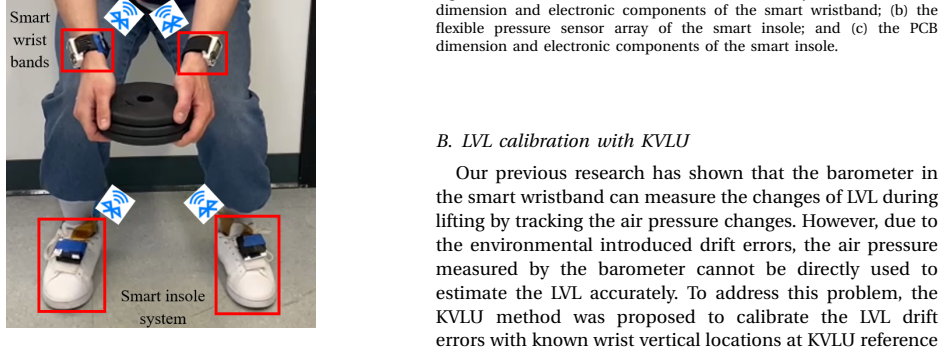
Summary. The paper proposes an unobtrusive wearable system (two smart insoles and two smart wristbands) that uses barometric pressure, IMU, and plantar pressure data to estimate the vertical location of a load (LVL) during manual lifting. To correct barometer drift, the authors introduce a Known Vertical Location Update (KVLU) calibration method that identifies reference postures during standing and walking, estimates the wrist height at those postures using an anthropometric ratio, and updates the pressure-to-height transformation. The system is evaluated on ten subjects, with a reported overall mean absolute error of 5.71 cm for LVL measurement, compared with 25 cm and 33 cm errors for IMU-based baselines. The abstract and conclusion claim that the KVLU method enables long-term, auto-calibrated LVL measurement in uncontrolled workplaces.
Significance. If the reported accuracy is independently validated, the system could be a practical, low-cost alternative to vision-based or multi-IMU motion capture for ergonomic risk assessment, particularly for NIOSH lifting-equation inputs. The contribution of an auto-calibration mechanism for barometer-based vertical tracking is conceptually appealing and relevant to wearable sensing for occupational health. The paper includes a hardware prototype, a clear experimental protocol with optical motion capture as ground truth, and quantitative comparisons to prior work. However, the central accuracy claim currently rests on an evaluation protocol that includes in-sample calibration parameters and undisclosed model coefficients, so the magnitude of the real-world benefit is not yet established.
major comments (3)
- [III.B.4, Eqs. (4)-(5)] The parameters a and b in the linear pressure-to-height model are never specified, and the text does not describe how they are determined. The central accuracy claim (MAE 5.71 cm) depends entirely on this transformation, but the reader cannot tell whether a and b are fixed physical constants (e.g., derived from the barometric formula) or fitted parameters, and if fitted, whether they were obtained from the same evaluation data. Please report the values, the calibration procedure, and any validation separate from the lifting trials.
- [IV.A.3 and Table III] The wrist-height-to-body-height ratio (0.495) used as the 'known' wrist vertical location at KVLU reference points is computed from the same ten subjects whose lifting data are later scored in Table IV. This makes the 2.04 cm standing-reference error and the subsequent 5.71 cm LVL MAE partially in-sample statistics: the calibration constant is tuned to the evaluation population. Please provide a leave-one-subject-out analysis or a separate calibration cohort to demonstrate that the reported accuracy holds for unseen users.
- [IV.B and VI] The LVL accuracy experiment in Section IV.B uses only standing-based KVLU updates between 30 discrete lifts with 5 seconds of quiet standing; walking-based KVLU and long-duration drift (e.g., the 8-hour workplace scenario mentioned in the introduction) are not evaluated. The conclusion's claim that the KVLU method 'can effectively remove drift errors in LVL measurement' over long periods is therefore not supported by the reported experiment. Either add an experiment with walking-based updates and longer continuous monitoring, or restrict the claims to the tested scenario.
minor comments (5)
- [Table IV] The overall mean in the bottom-right cell appears to be 5.72 cm rather than 5.71 cm if computed from the rounded column means; please double-check the rounding convention and report the computation to one decimal place consistently.
- [IV.A.3] The sentence describing the ratio calculation should specify the posture (standing with wrists vertical) and clarify that 0.495 is a sample mean from ten subjects, not a general anthropometric constant from the literature.
- [III.B.1, Eq. (1)] The notation in Equation (1) is inconsistent with the surrounding text ('nang l e' vs. 'n_angle' and 'T hr eshol d angle' vs. 'Threshold_angle'); please use a consistent symbol for the threshold.
- [I and III.A] The introduction states that barometers 'do not have integral drifting errors' while later acknowledging environment-induced drift; this apparent contradiction should be resolved by distinguishing integration drift from environmental pressure drift.
- [III.A] The text says the insole PCB is 'easy to be fixed on the shoelaces,' which seems inconsistent with an insole-embedded device; please verify this wording.
Circularity Check
The 'known' KVLU reference height is an in-sample anthropometric fit (0.495 x body height, averaged over the same ten subjects scored in Tables III-IV), so the 2.04 cm standing-reference MAE and the 5.71 cm LVL MAE are partly self-evaluation rather than independent accuracy.
-
fitted input called prediction
[Section III.B.3 and Section IV.A.3 (Tables II-IV; Eq. 5)]
"In this research, data collected from a group of ten subjects was used to calculate the ratio between the wrist height at the KVLU reference point and body heights. The averaged ratio across ten subjects was used for estimating the wrist vertical location at the KVLU reference point by multiplying it with the known body height. ... With the measured ground truth height of the wrist vertical location during normal standing and the body height of ten subjects, the average ratio between the wrist height and body height was calculated to be 0.495."
The calibration reference used as 'known' in Eq. 5 is LVL_KVLU = 0.495 x body_height, and the 0.495 ratio is computed from the ground-truth standing wrist heights of the same ten subjects whose standing data are then scored in Table III and whose lifting data are scored in Table IV. The 2.04 cm standing-reference MAE is therefore the in-sample residual of the fitted ratio, not a held-out accuracy, and the 5.71 cm LVL MAE inherits this fitted reference value for every subject. No leave-one-subject-out or external-cohort validation is provided, so the headline error is an in-sample statistic for the reference-height input rather than an independent estimate for new users.
full rationale
The main derivation (Eqs. 4-5: LVL = a(P - P_KVLU) + LVL_KVLU + b) is not circular in itself: the pressure-to-height relationship is physical and the lifting trials are separately ground-truthed with optical markers on the load. I do not count the undisclosed a and b as a demonstrated circular step, because the paper never states that they were fitted to the evaluation trials; that is a reproducibility gap, not a shown reduction. The demonstrated problem is the KVLU reference value: the paper explicitly derives the 0.495 wrist-height/body-height ratio from the same ten subjects whose standing and lifting data are later used to report accuracy. Consequently, Table III's 2.04 cm MAE is a training error of that ratio, and the headline 5.71 cm LVL MAE in Table IV is partly a self-evaluation of a calibrated constant rather than an independent out-of-sample result. This is partial circularity in the evaluation of the central claim, so the score is 6 rather than 8 or 10. The long-term drift-removal claim is also overstated relative to the experiment, which uses only standing KVLU updates between short lifts, but that is a scope limitation rather than a circularity and does not further raise the score.
Assumptions & free parameters
free parameters (2)
- wrist_height_to_body_height_ratio =
0.495
- linear_scale_a and offset_b =
not disclosed
assumptions (5)
- domain assumption Air pressure changes are linearly proportional to vertical travel distance over the lifting range
- ad hoc to paper Wrist pitch angle at standing and walking KVLU reference points follows a Gaussian distribution, allowing a 3-sigma threshold
- ad hoc to paper Heel and forefoot ground reaction forces during the swing phase follow Gaussian distributions
- domain assumption The average wrist-height to body-height ratio from ten subjects is representative of the general working population
- domain assumption Wrist vertical location approximates the load vertical location during lifting
Cite this review
Pith. "Pith review of Auto-calibrated Wearable System for Load Vertical Location Estimation During Manual Lifting." pith.science (2026). https://pith.science/paper/KLNDWG2B
@misc{pith2026241116097,
  author       = {Pith},
  title        = {Pith review of: Auto-calibrated Wearable System for Load Vertical Location Estimation During Manual Lifting},
  year         = {2026},
  howpublished = {\url{https://pith.science/paper/KLNDWG2B}},
  note         = {Machine review of arXiv:2411.16097}
}
read the original abstract
Lifting during manual material handling is a major cause of low-back pain (LBP). As an important risk factor that directly influences the risk of LBP, the Load vertical location (LVL) during lifting needs to be measured and controlled. However, existing solutions for LVL measurement are inefficient, inaccurate, and impractical for real-world workplace environments. To address these problems, an unobtrusive wearable system, including smart insoles and smart wristbands, was proposed to measure LVL accurately in workplace environments. Different from traditional methods which rely on Inertial Measurement Unit (IMU) and suffer from integral drifting errors over time, a novel barometer-based LVL measurement method was proposed in this study. To correct the environment-induced LVL measurement errors in the barometer-based method, a novel Known Vertical Location Update (KVLU) method was proposed. This method calibrates the measured LVL using a known wrist vertical location at known postures during frequently used daily activities such as standing and walking. The proposed wearable system achieved a mean absolute error (MAE) of 5.71 cm in LVL measurement. This result indicates that the proposed system has the potential to reliably measure LVL and assess the risk of LBP in manual lifting tasks.
Figures


Figures from the paper (5 more)


Reference graph
Works this paper leans on
-
[1]
The epidemiology of neck pain,
D. Hoy, M. Protani, R. De, and R. Buchbinder, “The epidemiology of neck pain,” Best practice & research Clinical rheumatology , vol. 24, no. 6, pp. 783–792, 2010
work page 2010
-
[2]
Ageism amplifies cost and prevalence of health conditions,
B. R. Levy, M. D. Slade, E.-S. Chang, S. Kannoth, and S.-Y. Wang, “ Ageism amplifies cost and prevalence of health conditions,” The Gerontologist, vol. 60, no. 1, pp. 174–181, 2020
work page 2020
-
[3]
Bureau of labor statistics, us department of labor,
C. P . Index, “Bureau of labor statistics, us department of labor,” Washington, DC. Available online from URL: http://data. bls. gov/cgi- bin/surveymost/(Accessed Aug. 14, 2006) , 2012
work page 2006
-
[4]
Cumulative mechanical low-back load at work is a determinant of low-back pain,
P . Coenen, I. Kingma, C. R. Boot, P . M. Bongers, and J. H. van Dieën, “Cumulative mechanical low-back load at work is a determinant of low-back pain,” Occupational and Environmental Medicine , vol. 71, no. 5, pp. 332–337, 2014
work page 2014
-
[5]
Back injuries: Nation’ s number one workplace safety problem
O. Safety, H. Administration et al. , “Back injuries: Nation’ s number one workplace safety problem.”
-
[6]
Effects of vertical lifting distance on upper-body muscle fatigue,
N. Fang, C. Zhang, and J. Lv, “Effects of vertical lifting distance on upper-body muscle fatigue,” International Journal of Environmental Research and Public Health , vol. 18, no. 10, p. 5468, 2021. 10
work page 2021
-
[7]
M. Helfenstein Junior, M. A. Goldenfum, and C. Siena, “Occupational low back pain,” Revista da Associação Médica Brasileira , vol. 56, pp. 583–589, 2010
work page 2010
-
[8]
Applications manual for the revised niosh lifting equation,
T . R. Waters, V . Putz-Anderson, and A. Garg, “ Applications manual for the revised niosh lifting equation,” 1994
work page 1994
Show all 30 references
-
[9]
Inter-rater reliability of an observation-based ergonomics assessment checklist for office workers,
M. J. Pereira, L. M. Straker, T . A. Comans, and V . Johnston, “Inter-rater reliability of an observation-based ergonomics assessment checklist for office workers,” Ergonomics, vol. 59, no. 12, pp. 1606–1612, 2016
2016
-
[10]
Risk assessment of work-related musculoskeletal disorders in construction: State-of-the-art review,
D. Wang, F . Dai, and X. Ning, “Risk assessment of work-related musculoskeletal disorders in construction: State-of-the-art review,” Journal of Construction Engineering and management , vol. 141, no. 6, p. 04015008, 2015
2015
-
[11]
Au- tomation of workplace lifting hazard assessment for musculoskele- tal injury prevention,
J. T . Spector, M. Lieblich, S. Bao, K. McQuade, and M. Hughes, “ Au- tomation of workplace lifting hazard assessment for musculoskele- tal injury prevention,” Annals of occupational and environmental medicine, vol. 26, no. 1, pp. 1–8, 2014
2014
-
[12]
Implementation of kinetic and kinematic variables in ergonomic risk assessment using motion capture simulation: A review,
M. N. H. Yunus, M. H. Jaafar, A. S. A. Mohamed, N. Z. Azraai, and M. S. Hossain, “Implementation of kinetic and kinematic variables in ergonomic risk assessment using motion capture simulation: A review,” International Journal of Environmental Research and Public Health, vol. ...
2021
-
[13]
Muscu- loskeletal disorders in construction: A review and a novel system for activity tracking with body area network,
E. Valero, A. Sivanathan, F . Bosché, and M. Abdel-Wahab, “Muscu- loskeletal disorders in construction: A review and a novel system for activity tracking with body area network,” Applied ergonomics, vol. 54, pp. 120–130, 2016
2016
-
[14]
Accuracy of estimating hand location during lifting using five wearable motion sensors,
M. S. Barim, M.-L. Lu, S. Feng, G. Hughes, M. Hayden, and D. Wer- ren, “ Accuracy of estimating hand location during lifting using five wearable motion sensors,” in Proceedings of the Human Factors and Ergonomics Society Annual Meeting , vol. 64, no. 1. SAGE Publications Sage ...
2020
-
[15]
Characterizing human box-lifting behav- ior using wearable inertial motion sensors,
S. D. Hlucny and D. Novak, “Characterizing human box-lifting behav- ior using wearable inertial motion sensors,” Sensors, vol. 20, no. 8, p. 2323, 2020
2020
-
[16]
The potential of wrist-worn barometer for measuring load vertical location in manual material lifting tasks: A pilot study,
N. Ghoreishi, F . Olugbon, J. LaCourse, S. Arthanat, D. LaRoche, and D. Chen, “The potential of wrist-worn barometer for measuring load vertical location in manual material lifting tasks: A pilot study,” in 2023 IEEE Biomedical Circuits and Systems Conference (BioCAS) , 2023
2023
-
[17]
Using barometric pressure data to recognize vertical displacement activities on smart- phones,
S. Vanini, F . Faraci, A. Ferrari, and S. Giordano, “Using barometric pressure data to recognize vertical displacement activities on smart- phones,” Computer Communications , vol. 87, pp. 37–48, 2016
2016
-
[18]
Human activity recognition method based on inertial sensor and barometer,
L. Xie, J. Tian, G. Ding, and Q. Zhao, “Human activity recognition method based on inertial sensor and barometer,” in 2018 IEEE International Symposium on Inertial Sensors and Systems (INERTIAL) . IEEE, 2018, pp. 1–4
2018
-
[19]
The mems-based baromet- ric altimeter inaccuracy and drift phenomenon,
T . Matyja, A. Kubik, and Z. Stanik, “The mems-based baromet- ric altimeter inaccuracy and drift phenomenon,” Zeszyty Naukowe. Transport/Politechnika ´Sl ˛ aska, 2022
2022
-
[20]
Ergonomic methods for assessing exposure to risk factors for work-related musculoskeletal disorders,
G. C. David, “Ergonomic methods for assessing exposure to risk factors for work-related musculoskeletal disorders,” Occupational medicine, vol. 55, no. 3, pp. 190–199, 2005
2005
-
[21]
Ergonomics risk assessment for manual material handling of ware- house activities involving high shelf and low shelf binning processes: application of marker-based motion capture,
Y. S. Zhao, M. H. Jaafar, A. S. A. Mohamed, N. Z. Azraai, and N. Amil, “Ergonomics risk assessment for manual material handling of ware- house activities involving high shelf and low shelf binning processes: application of marker-based motion capture,” Sustainability, vol. 14,...
2022
-
[22]
Comparison between low-cost marker-less and high-end marker-based motion capture systems for the computer-aided assessment of working ergonomics,
A. Patrizi, E. Pennestrì, and P . P . Valentini, “Comparison between low-cost marker-less and high-end marker-based motion capture systems for the computer-aided assessment of working ergonomics,” Ergonomics, vol. 59, no. 1, pp. 155–162, 2016
2016
-
[23]
A com- puter vision based method for 3d posture estimation of symmetrical lifting,
R. Mehrizi, X. Peng, X. Xu, S. Zhang, D. Metaxas, and K. Li, “ A com- puter vision based method for 3d posture estimation of symmetrical lifting,” Journal of biomechanics , vol. 69, pp. 40–46, 2018
2018
-
[24]
Manufacturing worker perceptions of using wearable inertial sensors for multiple work shifts,
X. Zhang, M. C. Schall Jr, H. Chen, S. Gallagher, G. A. Davis, and R. Sesek, “Manufacturing worker perceptions of using wearable inertial sensors for multiple work shifts,” Applied Ergonomics, vol. 98, p. 103579, 2022
2022
-
[25]
Risk factors iden- tification for work-related musculoskeletal disorders with wearable and connected gait analytics system,
D. Chen, J. Chen, H. Jiang, and M.-C. Huang, “Risk factors iden- tification for work-related musculoskeletal disorders with wearable and connected gait analytics system,” in 2017 IEEE/ACM International Conference on Connected Health: Applications, Systems and Engineer- ing Tec...
2017
-
[26]
Risk fac- tors identification and visualization for work-related musculoskeletal disorders with wearable and connected gait analytics system and kinect skeleton models,
D. Chen, Y. Cai, J. Cui, J. Chen, H. Jiang, and M.-C. Huang, “Risk fac- tors identification and visualization for work-related musculoskeletal disorders with wearable and connected gait analytics system and kinect skeleton models,” Smart Health , vol. 7, pp. 60–77, 2018
2018
-
[27]
Bring gait lab to everyday life: Gait analysis in terms of activities of daily living,
D. Chen, Y. Cai, X. Qian, R. Ansari, W . Xu, K.-C. Chu, and M.-C. Huang, “Bring gait lab to everyday life: Gait analysis in terms of activities of daily living,” IEEE internet of things journal , vol. 7, no. 2, pp. 1298– 1312, 2019
2019
-
[28]
Customizable pressure sensor array: Design and evaluation,
D. Chen, Y. Cai, and M.-C. Huang, “Customizable pressure sensor array: Design and evaluation,” IEEE Sensors Journal , vol. 18, no. 15, pp. 6337–6344, 2018
2018
-
[29]
Correlation of the stature to forearm length in the young adults of western indian population,
S. S. Dongre, R. B. Deokar, and S. S. Patil, “Correlation of the stature to forearm length in the young adults of western indian population,” Prof.(Dr) RK Sharma , vol. 21, no. 1, p. 1062, 2021
2021
-
[30]
Adaptive threshold based zupt for single imu enabled wearable pedestrian localization,
H. Li, H. Liu, Z. Li, C. Li, Z. Meng, N. Gao, and Z. Zhang, “ Adaptive threshold based zupt for single imu enabled wearable pedestrian localization,” IEEE Internet of Things Journal , 2023
2023
Reviewed August 12, 2026 · model on record in the stance chip above.
Discussion (0). Continue with ORCID to comment.