REVIEW 2 major objections 5 minor 62 references
Rayleigh-Taylor instability in binary fluids with miscibility gap
T0 review · 2 major / 5 minor · reviewed 2026-08-12 · deepseek-v4-flash
Pith's one-line read The paper derives a temperature-dependent dispersion relation for Rayleigh-Taylor instability in binary fluids with a miscibility gap and confirms it with phase-field simulations.
desk verdict A competent phase-field extension of RT theory to UCST binary fluids with a genuinely new r-dependent dispersion relation, but the quantitative temperature predictions rest on an unexamined empirical exponent a=0.5. read the letter →
The pith
A machine-rendered reading of the paper's core claim, the machinery that carries it, and where it could break.
The reading
What carries the argument
The machinery is a Cahn-Hilliard phase-field model with a temperature-dependent bulk free energy $f_0 = (\Lambda/\epsilon^2)(\tfrac14 |r|^a c^4 - \tfrac12 r c^2)$, where $r=(T_c-T)/T_c$ is the miscibility parameter. This free energy yields an equilibrium interface profile $c = -r^{(1-a)/2}\tanh\big((y-y_0)/(\sqrt{2}\,\epsilon/\sqrt{r})\big)$ and a surface tension $\sigma = \sigma_0 r^{(3-2a)/2}$, so both interfacial width and capillary force become functions of temperature. Linearizing the inviscid, Boussinesq momentum equation about this profile and Fourier-decomposing the perturbed interface gives the dispersion relation (4.3), the object whose predictions the simulations test.
What would settle it
Prepare a temperature-controlled cell with a single-mode perturbation between two fluids of known surface-tension scaling (for example isobutyric acid and water, with a=0.27), measure the perturbation amplitude versus time below the UCST, and compare the growth-rate exponent and threshold r_th against eq. (6.1); a mismatch in the temperature dependence of the growth rate would falsify the model.
Extended reading notes
Core claim
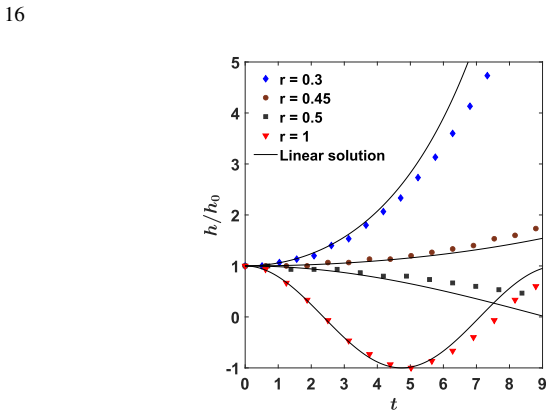
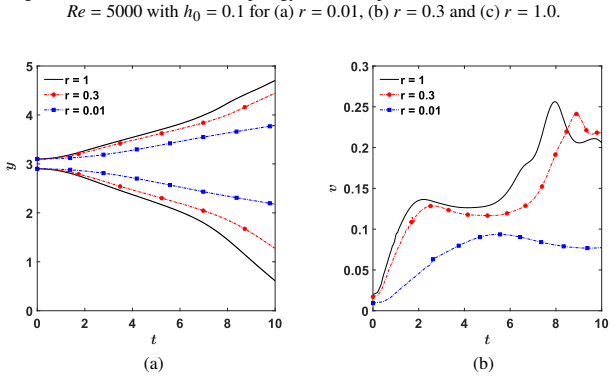
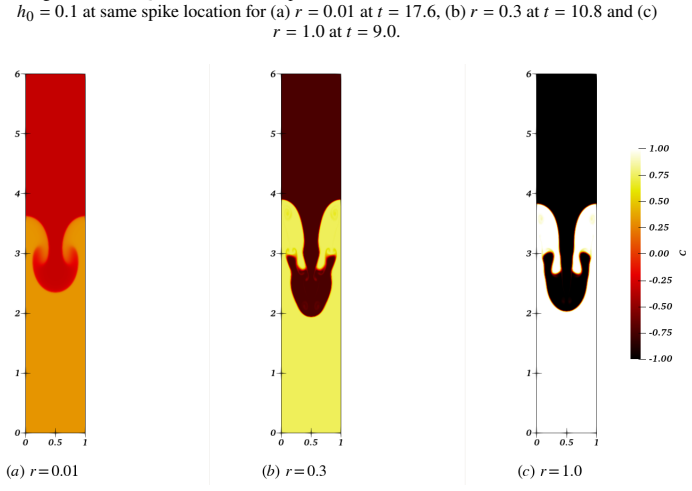
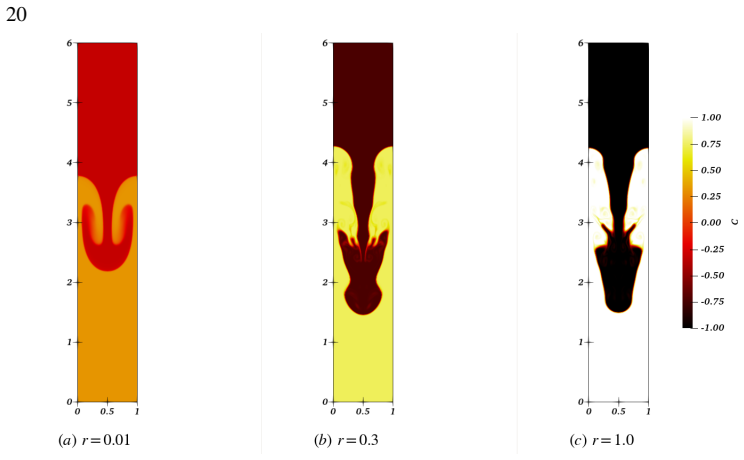
The central claim is that the dispersion relation $\alpha^2(k)=k A g r^{(1-a)/2} - k^3/(2 We_B) r^{(3-2a)/2}$ is the correct linear-theory description of single-mode Rayleigh-Taylor instability in binary fluids with a temperature-dependent miscibility gap. In the immiscible limit $r\to 1$ it reduces to the classical Rayleigh-Taylor dispersion relation, and temperature enters through powers of $r$: buoyant destabilization scales as $r^{(1-a)/2}$ while capillary stabilization scales as $r^{(3-2a)/2}$. Because $3-2a > 1-a$ for $0<a<3/2$, approaching the critical point weakens the stabilizing term faster than the destabilizing term, producing the threshold $r_{th}$ and the three observed growth-rate zones. The numerical solutions of the coupled Cahn-Hilliard-Navier-Stokes equations corroborate the inviscid linear analysis in the early stage, reproduce gravity-capillary waves and marginal stability, and at late times show Kelvin-Helmholtz rolls for $r=1$ and $r=0.3$ but not for $r=0.01$. The paper further claims that initialization out of thermodynamic equilibrium makes the temperature influence weak except when surface tension is large.
Load-bearing premise
The load-bearing premise is that the empirical exponent a, fixed at a = 0.5 throughout the simulations, correctly represents the fluid pair; every temperature exponent in the dispersion relation, threshold, and zone boundaries depends on a, and the paper gives no experimental validation or sensitivity analysis for this choice.
Editorial extensions
If this is right
- The predicted threshold $r_{th}$ fixes the temperature at which a given binary-fluid interface turns unstable; systems closer to the critical point than this threshold remain stable to small single-mode perturbations.
- The three-zone classification means that for low-Atwood, high-surface-tension pairs, approaching the UCST first destabilizes the interface, while for high-Atwood pairs it monotonically stabilizes it.
- Late-time Kelvin-Helmholtz rolls are temperature-dependent, so tuning $T$ relative to $T_c$ can suppress or promote secondary mixing without changing the prescribed density contrast.
- For fluids brought into contact out of equilibrium, the model predicts that at low surface tension the interface evolution is nearly independent of whether the system temperature lies above or below the critical point.
- Near the UCST the concentration field almost homogenizes, which reduces early growth but delays and strengthens the reacceleration phase of the falling spike.
Reading between the lines
- One testable extension the paper leaves implicit: the exponent $a$ is fixed at $0.5$ in all simulations, but real fluid pairs differ (isobutyric acid-water has $a=0.27$), so a sensitivity scan over $a$ would show how much the zone boundaries and threshold shift for a given pair.
- The same dispersion-relation structure should extend to LCST mixtures by redefining $r$ with the lower critical temperature, since the surface-tension scaling $\sigma\sim r^{(3-2a)/2}$ comes from the equilibrium free energy rather than from the RT setup itself.
- A direct experimental check would be to measure the early-time growth rate of a single-mode perturbation for a known binary pair at several temperatures below the UCST and compare the temperature exponents of the growth-rate curve with $(1-a)/2$ and $(3-2a)/2$.
- The suppression of Kelvin-Helmholtz rolls near the UCST could become a practical control knob in microfluidic extraction or droplet formation, where thermal tuning of the miscibility gap is already used.
Editorial analysis
A structured set of objections, weighed in public.
Referee Report
Summary. The paper proposes a phase-field (Cahn-Hilliard-Navier-Stokes) model for binary fluids with a temperature-dependent miscibility gap, using a quartic bulk free energy depending on the reduced temperature r=(T_c-T)/T_c and an empirical exponent a. For single-mode Rayleigh-Taylor instability the authors derive an inviscid Boussinesq dispersion relation, eq. (4.3): alpha^2(k)=k A g r^{(1-a)/2} - k^3/(2 We_B) r^{(3-2a)/2}. They use it to classify stable/unstable regions and three growth-rate zones, then solve the nonlinear CH-NS equations with an OpenFOAM-based solver. The simulations reproduce the linear threshold (r=0.475 vs r_th=0.465) in §6.1.1, benchmark the r=1 limit against Hamzehloo et al., compare configuration (2) with Lyubimova et al., and document late-time Kelvin-Helmholtz roll behaviour as a function of r.
Significance. If the temperature scalings are robust, the paper offers a useful analytic and numerical framework for RT instability in partially miscible binary fluids. The dispersion relation transparently reduces to Chandrasekhar's result at r=1, the numerical study is carefully set up with grid-independence checks and two published benchmarks, and the three-zone classification together with the observed suppression of Kelvin-Helmholtz rolls near the UCST are potentially valuable predictions. The main caveat is that all quantitative temperature dependencies are controlled by the empirical exponent a, which is fixed at a=0.5 without sensitivity analysis or experimental calibration for the fluids simulated; the numerical agreement with the linear theory then tests internal consistency rather than external predictive accuracy.
major comments (2)
- [§6.1, eqs. (6.1)-(6.2), figs 7-8] The central quantitative claims - the threshold r_th, the growth-rate scaling, and the zone boundaries in fig. 8(b) - all depend on the empirical exponent a through the factors r^{(1-a)/2} and r^{(3-2a)/2}, yet a is fixed at 0.5 for every simulation with no sensitivity analysis. The only experimentally calibrated value cited in the paper (May & Maher 1991 for isobutyric acid-water) gives a=0.27, i.e. a surface-tension exponent (3-2a)/2 = 1.23 rather than 1.0. For the test case of §6.1.1 (A=0.1, We=100, k=2π), eq. (6.2) changes r_th from 0.465 to 0.515, an 11% shift; the near-critical capillary term r^{(3-2a)/2} changes from r to r^{1.23}. Because the numerical simulations and the linear theory use the same free energy and the same a, the reported 2.15% agreement in §6.1.1 validates the internal consistency of the solver with the linear theory, not the predictive accuracy for a real binary fluid. Please add a sensitivity study over a, calibrate a for the fluids considered, or explicitly restrict the quantitative predictions to a model fluid with a=0.5.
- [§5.3 and §6.1.1] External validation is limited to the immiscible limit r=1 (against Hamzehloo et al.) and to configuration (2) (against Lyubimova et al.); there is no independent benchmark in the partially miscible regime 0<r<1, where the temperature-dependent terms are active. The claim that the simulations corroborate the linear threshold is therefore not an independent test of the model's temperature dependence. Please add at least one quantitative check in the partial-miscibility regime - for example, a comparison with measured surface tension versus temperature for a specific fluid pair, or with a published miscible-RT experiment - or state clearly that the r-dependent predictions are model predictions to be tested.
minor comments (5)
- [Abstract/§1] The phrase 'reformulate the reformulate the governing equations' contains a duplicated word and should be corrected.
- [Appendix A] The integration constant Z in the derivation of the equilibrium profile appears to be missing factors: from eqs (A 2)-(A 3) one obtains Z = (Lambda/(4 epsilon^2)) r^{2-a}, but the text as printed reads as if Z were simply (1/4) epsilon^2 r^{2-a}.
- [§6.1.2] The sentence 'The growth behaviour demonstrates week dependence on We' should read 'weak dependence'.
- [Manuscript text] Editorial template placeholders such as 'Focus on Fluids articles must not exceed this page length' and 'Rapids articles must not exceed this page length' appear in the text and should be removed before submission.
- [Appendix B] The step from eq. (B 5) to the dispersion relation (B 7) is compressed; since eq. (4.3) is the central analytical result, please expand the Fourier-transform step or give a clear pointer to the supplementary material where it is performed.
Circularity Check
No circularity: the dispersion relation and the numerical simulations share the same openly empirical free-energy model, so their mutual agreement is an internal consistency check, not a fitted prediction or a self-citation-forced result.
full rationale
The paper's derivation chain is self-contained in the sense required by the circularity test. Equation (4.3) is obtained by linearizing the inviscid Boussinesq form of the same Cahn-Hilliard-Navier-Stokes model used in the simulations, so the 2.15% threshold agreement in Sec. 6.1.1 is a code-versus-theory verification rather than an externally falsifiable prediction. That is not circularity: no parameter is fitted to the RT data, the r=1 limit is benchmarked against the independent DNS results of Hamzehloo et al., and the r-dependent exponents originate from an explicitly empirical free-energy ansatz whose coefficient a is stated to be experimentally determined (with the IBW value a=0.27 quoted from May & Maher). The authors' choice to fix a=0.5 in all simulations without a sensitivity analysis weakens the quantitative robustness of the temperature-dependent claims and should be addressed as a correctness or uncertainty issue, but it does not make any equation reduce to its own input. The self-citations to Bestehorn et al. and Borcia et al. supply the phase-field modeling framework, which is a normal incremental use of prior published work and is not invoked as a uniqueness theorem or as a substitute for the new dispersion-relation derivation. Therefore no specific circular step can be exhibited, and the appropriate finding is no significant circularity.
Assumptions & free parameters
free parameters (3)
- a (empirical miscibility exponent) =
0.5 (chosen; 0.27 for isobutyric acid-water)
- Cahn number Cn =
0.01
- mobility coefficient gamma (dimensionless M) =
gamma = 0.01 eps^2 (from Jamshidi et al. 2019)
assumptions (5)
- domain assumption The Boussinesq approximation is valid for the linear stability analysis, so variable density enters only through the Atwood-number-weighted buoyancy term.
- ad hoc to paper The quartic free energy with empirical exponent a, f0 = (Lambda/eps^2)(1/4|r|^a c^4 - 1/2 r c^2), adequately represents a UCST binary fluid over the whole miscibility gap.
- domain assumption The system is isothermal and r remains fixed during evolution in configuration 1.
- ad hoc to paper The Korteweg stress term 3/(2*sqrt(2)) * 1/(We Cn) * (|r|^a c^3 - r c - Cn^2 nabla^2 c) * nabla c correctly captures capillary forces at all r, including r < 0.
- standard math The Fourier-transform step from Celani et al. (2009), relating the vertically integrated interfacial velocity to k and omega, remains valid in the binary-fluid setting.
Cite this review
Pith. "Pith review of Rayleigh-Taylor instability in binary fluids with miscibility gap." pith.science (2026). https://pith.science/paper/EYDFC5FR
@misc{pith2026241116292,
  author       = {Pith},
  title        = {Pith review of: Rayleigh-Taylor instability in binary fluids with miscibility gap},
  year         = {2026},
  howpublished = {\url{https://pith.science/paper/EYDFC5FR}},
  note         = {Machine review of arXiv:2411.16292}
}
read the original abstract
A novel phase field method is proposed to model the continuous transition of binary fluids exhibiting temperature sensitive miscibility gap, from immiscible state to miscible state via partially miscible states. The model is employed to investigate the isothermal single-mode Rayleigh-Taylor (RT) instability for binary fluids as the system temperature is varied. Assuming potential flow and utilizing Boussinesq approximation, we derived the dispersion relation for gravity-capillary waves and the RT instability. The study reveals the early-stage growth characteristics of the interfacial perturbation. Three zones with distinct qualitative behaviour for the growth rate are identified as a function of Atwood number and Weber Number. Subsequently, Boussinesq approximation is relaxed to obtain coupled Cahn-Hilliard-Navier-Stokes equations to perform numerical simulations. The results from the numerical simulations corroborate the findings from the dispersion relation at early-stages. Further investigation of the late-time dynamics for viscous fluid pair reveal the tortuous topology presumed by the interface. The emanation of secondary instability in form of Kelvin-Helmholtz rolls is observed. The formation of Kelvin-Helmholtz rolls is found to be dependent on the system temperature. Finally, we present the effect of the slow nature of diffusion process.
Figures


Figures from the paper (18 more)







Reference graph
Works this paper leans on
-
[1]
, " * write output.state after.block = add.period write newline
ENTRY address author booktitle chapter edition editor howpublished institution journal key month note number organization pages publisher school series title type volume year eprint label extra.label sort.label short.list INTEGERS output.state before.all mid.sentence after.sentence after.block FUNCTION init.state.consts #0 'before.all := #1 'mid.sentence ...
-
[2]
write newline
" write newline "" before.all 'output.state := FUNCTION n.dashify 't := "" t empty not t #1 #1 substring "-" = t #1 #2 substring "--" = not "--" * t #2 global.max substring 't := t #1 #1 substring "-" = "-" * t #2 global.max substring 't := while if t #1 #1 substring * t #2 global.max substring 't := if while FUNCTION word.in bbl.in capitalize " " * FUNCT...
-
[3]
Bagheri, M. , Stumpf, B. , Roisman, I.V. , Dadvand, A. , Worner, M. & Marschall, H. 2022 A unified finite volume framework for phase-field simulations of an arbitrary number of fluid phases . Can.\ J.\ Chem.\ Eng 100 , 2291--2308
work page 2022
-
[4]
Bell, J.B. , Day, M.S. , Rendleman, C.A. , Woosely, S.E. & Zingale, M. 2004 Direct numerical simulations of type Ia supernovae flames. II. The Rayleigh-Taylor instability . Astrophysical Journal 608 , 883--906
work page 2004
-
[5]
Bellman, R. & Pennington, R.H. 1954 Effects of surface tension and viscosity on Taylor instability . Quart.\ Appl.\ Math. 12 , 151--162
work page 1954
-
[6]
Bestehorn, M. , Sharma, D. , Borcia, R. & Amiroudine, S. 2021 Faraday instability of binary miscible/immiscible fluids with phase field approach . Phys.\ Rev.\ Fluids 6 , 064002
work page 2021
-
[7]
Borcia, R. , Borcia, I.D. , Bestehorn, M. , Sharma, D. & Amiroudine, S. 2022 Phase field modeling in liquid binary mixtures: Isothermal and nonisothermal problems . Phys.\ Rev.\ Fluids 7 , 064005
work page 2022
-
[8]
Cahn, J.W. & Hilliard, J.E. 1958 Free energy of a non-uniform system. I. Interfacial free energy . J. Chem.\ Phys. 28 , 258
work page 1958
Show all 62 references
-
[9]
& Hilliard, J.E
Cahn, J.W. & Hilliard, J.E. 1959 Free energy of a non-uniform system. III. Nucleation in a two-component incompressible fluid . J. Chem.\ Phys. 31 , 688
1959
-
[10]
, Mazzino, A
Celani, A. , Mazzino, A. , Muratore-Ginanneschi, P. & Vozella, L. 2009 Phase-field model for the Rayleigh-Taylor instability of immiscible fluids . J. Fluid Mech. 622 , 115--134
2009
-
[11]
1961 Hydrodynamic and Hydromagnetic stability\/
Chandrasekhar, S. 1961 Hydrodynamic and Hydromagnetic stability\/ . Dover
1961
-
[12]
, Chen, B
Chen, C. , Chen, B. , Shi, L. , Yi, Y. & Wang, Y. 2015 Numerical study on Rayleigh-Taylor instabilities in the lightning return stroke . Phys. Plasmas 22 , 092902
2015
-
[13]
& Tankin, R.S
Cole, R.L. & Tankin, R.S. 1973 Experimental study of Taylor instability . Phys. Fluids 16 , 1810--1815
1973
-
[14]
& Dimotakis, P.E
Cook, A.W. & Dimotakis, P.E. 2001 Transition stages of the Rayleigh-Taylor instability between miscible fluids . J. Fluid Mech. 443 , 69--99
2001
-
[15]
, Spelt, P.D.M
Ding, H. , Spelt, P.D.M. & Shu, C. 2007 Diffuse interface model for incompressible two-phase flows with large density ratios . J. Comput.\ Phys. 226 , 2078--2095
2007
-
[16]
& Ashgriz, N
Elgowainy, A. & Ashgriz, N. 1997 The Rayleigh-Taylor instability of viscous fluid layers . Phys. Fluids 9 , 1635--1649
1997
-
[17]
, Chang, C.T
Emmons, H.W. , Chang, C.T. & Watson, B.C. 1960 Taylor instability of finite surface waves . J. Fluid Mech. 7 , 177--193
1960
-
[18]
2017 Review of vortex identification methods
Epps, B.P. 2017 Review of vortex identification methods . AIAA SciTech Forum pp. 2017--0989
2017
-
[19]
& Péric, M
Ferziger, J.H. & Péric, M. 2002 Computational methods for fluid dynamics\/ , 3rd edn. Springer
2002
-
[20]
, Amstad, E
Fornerod, M.J. , Amstad, E. & Guldin, S. 2020 Microfluidics of binary liquid mixtures with temperature-dependent miscibility . Mol.\ Syst.\ Des.\ Eng. 5 , 358
2020
-
[21]
& Landau, L.D
Ginzburg, V.L. & Landau, L.D. 1950 On the thoery of super-conductivity . Zh. Eksp. Teor. Fiz. 20 , 1064
1950
-
[22]
2002 Analytical model of non-linear, single-mode classical Rayleigh-Taylor instability at arbitrary Atwood numbers
Goncharov, V.N. 2002 Analytical model of non-linear, single-mode classical Rayleigh-Taylor instability at arbitrary Atwood numbers . Phys.\ Rev.\ L 88 , 134502 (1--4)
2002
-
[23]
& others 2011 Point design targets, specifications and requirements for the 2010 ignition campaign on the National ignition facility
Haan, S. & others 2011 Point design targets, specifications and requirements for the 2010 ignition campaign on the National ignition facility . Phys. Plasmas 18 , 051001
2011
-
[24]
, Bartholomew, P
Hamzehloo, A. , Bartholomew, P. & Laizet, S. 2021 Direct numerical simulations of incompressible Rayleigh-Taylor instabilites at low and medium Atwood numbers . Phys. Fluids 33 , 054114
2021
-
[25]
& Nichols, B.D
Hirt, C.W. & Nichols, B.D. 1981 Volume of fluid (VOF) method for the dynamics of free boundaries . J. Comput.\ Phys. 39 , 201--225
1981
-
[26]
, Zhang, Y.-S
Hu, Z.-X. , Zhang, Y.-S. , Tian, B. , He, Z. & Li, L. 2019 Effect of viscosity on two-dimensional single-mode Rayleigh-Taylor instability during and after the reacceleration stage . Phys. Fluids 31 , 104108
2019
-
[27]
1985 Solutions of the implicitly discretized fluid flow equations by operator-splitting
Issa, R.I. 1985 Solutions of the implicitly discretized fluid flow equations by operator-splitting . J. Comput.\ Phys. 62 , 40--65
1985
-
[28]
1999 Calculation of two-phase Navier-Stokes flows using Phase-Field modeling
Jacqmin, D. 1999 Calculation of two-phase Navier-Stokes flows using Phase-Field modeling . J. Comput.\ Phys. 155 , 96--127
1999
-
[29]
, Heimel, H
Jamshidi, F. , Heimel, H. , Hasert, M. , Cai, X. , Deutschmann, O. , Marschall, H. & Worner, M. 2019 On suitability of phase-field and algebraic volume-of-fluid OpenFOAM solvers for gas-liquid microfluidic applications . Comput.\ Phys.\ Commun. 236 , 72--85
2019
-
[30]
, Weller, H.G
Jasak, H. , Weller, H.G. & Gosman, A.D. 1999 High resolution NVD differencing scheme for arbitrarily unstructured meshes . Int.\ J.\ Numer.\ Meth.\ Fluids 31 , 431--449
1999
-
[31]
1990 Fluid dynamics of two miscible liquids with slow diffusion and Korteweg stresses
Joseph, D.D. 1990 Fluid dynamics of two miscible liquids with slow diffusion and Korteweg stresses . Eur.\ J.\ Mech.\ B/Fluids 9(6) , 565--596
1990
-
[32]
, Saita, S
Kohno, Y. , Saita, S. , Murata, K. , Nakamura, N. & Ohno, H. 2011 Extraction of proteins with temperature sensitive and reversible phase change of ionic liquid/water mixture . Polym.\ Chem. 2 , 862--867
2011
-
[33]
& Cohen, I.M
Kundu, P.K. & Cohen, I.M. 2001 Fluid Mechanics\/ , 2nd edn. Academic
2001
-
[34]
1950 The instability of liquid surfaces when accelerated in a direction perpendicular to their planes
Lewis, D.J. 1950 The instability of liquid surfaces when accelerated in a direction perpendicular to their planes. II . Proc.\ R.\ Soc.\ Lond.\ A 202 , 81--96
1950
-
[35]
, Vorobev, A
Lyubimova, T. , Vorobev, A. & Prokopev, S. 2019 Rayleigh-Taylor instability of a miscible interface in a confined domain . Phys. Fluids 31 , 014104
2019
-
[36]
, Picano, F
Magaletti, F. , Picano, F. , Chinappi, M. , Marino, L. & Casciola, C.M. 2013 The sharp-interface limit of the Cahn-Hilliard/Navier-Stokes model for binary fluids . J. Fluid Mech. 714 , 95--126
2013
-
[37]
, Wang, Q
Mao, Y. , Wang, Q. , Xing, C. & Yang, L. 2024 On the dynamical Rayleigh-Taylor instability of 2D inviscid geophysical flows with geostropic balance . Physica D: Nonlinear Phenomena 461 , 134109
2024
-
[38]
, Strong, E.F
Marthelot, J. , Strong, E.F. , Reis, P.M. & Brun, P.T. 2018 Designing soft materials with interfacial instabilities in liquid films . Nat Commun 9 , 4477
2018
-
[39]
& Maher, J.V
May, S.E. & Maher, J.V. 1991 Capillary-wave relaxation for a meniscus between miscible liquids . Phys.\ Rev.\ Lett. 67 , 15
1991
-
[40]
& Zemach, C
Menikoff, R. & Zemach, C. 1983 Rayleigh-Taylor instability and the use of conformal maps for ideal fluid flow . J. Comput.\ Phys. 51 , 28--64
1983
-
[41]
, Mangani, L
Moukalled, F. , Mangani, L. & Darwish, M. 2016 The finite volume methods in computational fluid dynamics\/ , 1st edn. Springer
2016
-
[42]
& Pozrikidis, C
Newhouse, L.A. & Pozrikidis, C. 1990 The Rayleigh-Taylor instability of a viscous liquid layer resting on a plane wall . J. Fluid Mech. 217 , 615--638
1990
-
[43]
& Spalding, D.B
Patankar, S.V. & Spalding, D.B. 1972 A calculation procedure for heat, mass and momentum transfer in three dimensional parabolic flows . Int.\ J.\ Heat Mass Transfer 15 , 1787--1806
1972
-
[44]
, Radhakrishnan, A.N.P
Patel, M. , Radhakrishnan, A.N.P. , Bescher, L. , Hunter-Sellars, E. , Schmidt-Hansberg, B. , Amstad, E. , Ibsen, S. & Guldin, S. 2021 Temperature-induced liquid crystal microdroplet formation in a partially miscible liquid mixture . Soft Matter 17 , 947
2021
-
[45]
, Dimonte, G
Ramprabhu, P. , Dimonte, G. , Woodward, P. , Fryer, C. , Rockefeller, G. , Muthuraman, K. , Lin, P.H. & Jayaraj, J. 2012 The late-time dynamics of single-mode Rayleigh-Taylor instability . Phys. Fluids 24 , 074107
2012
-
[46]
, Dimonte, G
Ramprabhu, P. , Dimonte, G. , Young, Y.N. , Calder, A.C. & Fryxell, B. 2006 Limits of the potential flow approach to the single-mode Rayleigh-Taylor problem . Phys.\ Rev.\ E 74 , 066308
2006
-
[47]
, Meiburg, E
Ravichandran, S. , Meiburg, E. & Govindarajan, R. 2020 Mammatus clous formation by settling and evaporation . J. Fluid Mech. 899 , A27
2020
-
[48]
1882 Investigation of the character of the equlibrium of an incompressible heavy fluid of variable density
Rayleigh, L. 1882 Investigation of the character of the equlibrium of an incompressible heavy fluid of variable density . Proc.\ Lond.\ Math.\ Soc. 1 , 170--177
-
[49]
1984 Experimental investigation of turbulent mixing by Rayleigh-Taylor instability
Read, K.I. 1984 Experimental investigation of turbulent mixing by Rayleigh-Taylor instability . Physica D: Nonlinear Phenomena 12 , 45--58
1984
-
[50]
2006 Thermo- and pH-responsive polymers in drug delivery
Schmaljohann, D. 2006 Thermo- and pH-responsive polymers in drug delivery . Adv.\ Drug Deliv.\ Rev. 58 , 1655--1670
2006
-
[51]
1984 An overview of Rayleigh-Taylor instability
Sharp, D.H. 1984 An overview of Rayleigh-Taylor instability . Physica D: Nonlinear Phenomena 12 , 3--18
1984
-
[52]
1984 High resolution schemes using flux limiters for hyperbolic conservation laws
Sweby, P.K. 1984 High resolution schemes using flux limiters for hyperbolic conservation laws . SIAM J.\ Numer.\ Anal. 21 , 995--1011
1984
-
[53]
1950 The instability of liquid surfaces when accelerated in a direction perpendicular to their planes
Taylor, G.I. 1950 The instability of liquid surfaces when accelerated in a direction perpendicular to their planes. I . Proc.\ R.\ Soc.\ Lond.\ A 201 , 192--196
1950
-
[54]
1988 Numerical simulations of the Rayleigh-Taylor instability
Tryggvason, G. 1988 Numerical simulations of the Rayleigh-Taylor instability . J. Comput. Phys. 75 , 253--282
1988
-
[55]
1992 Bi-CGSTAB: A Fast and Smoothly Converging Variant of Bi-CG for Solution of Non-Symmetric Linear Systems
Van-Der-Vorst, H.A. 1992 Bi-CGSTAB: A Fast and Smoothly Converging Variant of Bi-CG for Solution of Non-Symmetric Linear Systems . SIAM J.\ Sci.\ Stat.\ Comput. 13(2) , 631--344
1992
-
[56]
, Silva, F.A
Ventura, S.P.M. , Silva, F.A. , Quental, M.V. , Freire, D. Mondal M.G. & Coutinho, J.A.P. 2017 Ionic-liquid-mediated extraction and separation processes for bioactive compounds: Past, present and future trends . Chem. Rev. 117 , 6984--7052
2017
-
[57]
2010 Boussinesq approximation of the Cahn-Hilliard-Navier-Stokes equations
Vorobev, A. 2010 Boussinesq approximation of the Cahn-Hilliard-Navier-Stokes equations . Phys.\ Rev.\ E 82 , 056312
2010
-
[58]
, Niederhaus, C.E
Waddell, J.T. , Niederhaus, C.E. & Jacobs, J.W. 2001 Experimental study of Rayleigh-Taylor instability: Low Atwood number liquid systems with single mode initial perturbations . Phys. Fluids 13 , 1263--1273
2001
-
[59]
& Jacobs, J.W
Wilkinson, J.P. & Jacobs, J.W. 2007 Experimental study of single-mode three-dimensional Rayleigh-Taylor instability . Phys. Fluids 19 , 124102
2007
-
[60]
, Tufo, H
Young, Y.N. , Tufo, H. , Dubey, A. & Rosner, R. 2001 On the miscible Rayleigh-Taylor instability: two and three dimesions . J. Fluid Mech. 447 , 377--408
2001
-
[61]
1984 Numerical simulation of turbulent mixing by Rayleigh-Taylor instability
Youngs, D.L. 1984 Numerical simulation of turbulent mixing by Rayleigh-Taylor instability . Physica D: Nonlinear Phenomena, 12 , 32--44
1984
-
[62]
, Feng, J.J
Yue, P. , Feng, J.J. , Liu, C. & Shen, J. 2004 A diffuse-interface method for simulating two-phase flows of complex fluids . J. Fluid Mech. 515 , 293--317
2004
Reviewed August 12, 2026 · model on record in the stance chip above.
Discussion (0). Continue with ORCID to comment.