REVIEW 3 major objections 6 minor 24 references
From CISC to RISC: language-model guided assembly transpilation
T0 review · 3 major / 6 minor · reviewed 2026-08-12 · deepseek-v4-flash
Pith's one-line read This paper claims a 1.3B-parameter language model can transpile x86 assembly into executable ARM/RISC-V assembly with 79.25% and 88.68% functional accuracy, and that the transpiled ARM64 code beats Rosetta 2 on an M2 by 1.73x speed, 2.41x…
desk verdict A credible new empirical result in LLM-based assembly transpilation, with functional verification as the main strength; the headline accuracy needs a contamination audit and the case study needs more detail before the numbers are fully trusted. read the letter →
The pith
A machine-rendered reading of the paper's core claim, the machinery that carries it, and where it could break.
The reading
What carries the argument
The central machinery is a fine-tuned autoregressive language model that learns the conditional distribution $\mathrm{P}(Y \mid X)$ over assembly tokens, where $X$ is x86 assembly and $Y$ is ARM or RISC-V assembly. The model is trained on paired outputs from compiling 500,000 C programs to x86 and ARMv5, which supplies the CISC/RISC correspondence, and an extended tokenizer keeps frequently used opcodes and register names as single tokens so the model can track them across the translation. The load-bearing evaluation is functional rather than syntactic: generated assembly is assembled and executed against unit tests in an emulator, so accuracy is measured by whether the program behaves correctly.
What would settle it
A fuzzy-duplicate search comparing the 164 HumanEval C functions against the training corpus, for example by hashing tokens of the compiled assembly or using a clone detector, would settle the claim. Finding even a few benchmark programs in the training data would make the reported accuracies look like memorization; re-running evaluation on a fresh, never-seen set of C functions with unit tests would test generalization directly.
Extended reading notes
Core claim
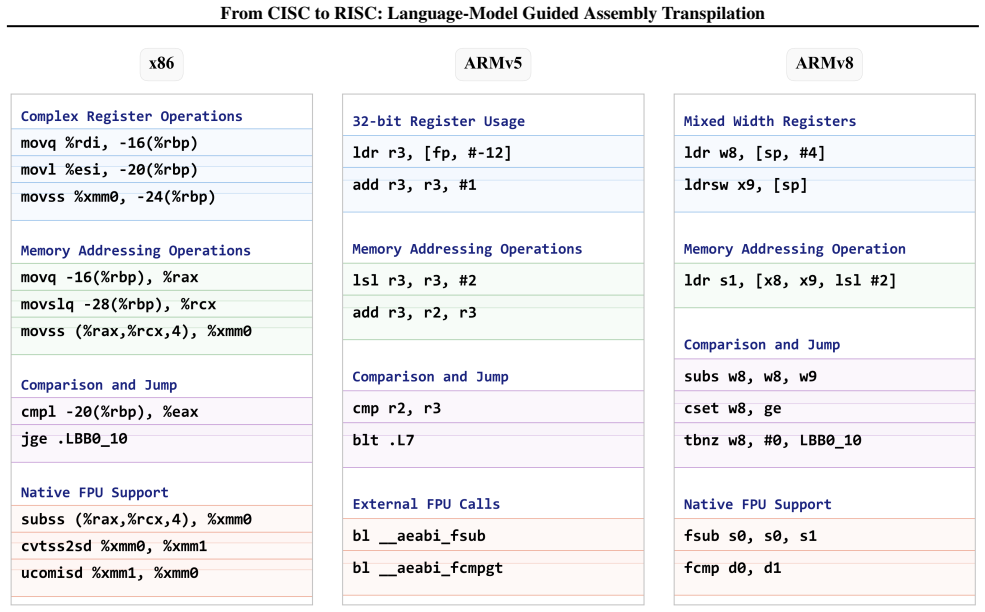
The paper's central discovery is that direct x86-to-ARM assembly transpilation is a learnable mapping, not a rule-engineering problem. By fine-tuning a 1.3B-parameter code language model on hundreds of thousands of C programs compiled into paired x86 and ARM assembly, and by extending the tokenizer so that opcodes and register names stay as single tokens, the authors obtain a model that generates ARM assembly preserving functional behavior on 79.25% of the benchmark programs and 88.68% for RISC-V64. They further show that correct outputs are not mere copies of ground truth: the generated code often differs syntactically yet still passes the same unit tests, with variations such as different register allocation, reordered commutative operands, and instruction consolidation. In the ARMv8 case study, the transpiled code, compiled natively, runs faster and uses less memory and energy than Rosetta 2's dynamic translation, suggesting one-time transpilation can beat virtualization.
Load-bearing premise
The reported accuracies assume that none of the 164 HumanEval evaluation programs, or close variants, appeared in the 500,000 GitHub-sourced C programs used for training, because the paper reports no decontamination check.
Editorial extensions
If this is right
- Legacy x86 binaries whose assembly is available could be converted once into ARM or RISC-V assembly and then natively compiled, eliminating the per-run translation overhead of emulators.
- Quantized versions at int8 and int4 precision retain most of the accuracy, so the transpiler can plausibly run on CPUs and resource-constrained devices without a GPU.
- On Apple hardware, the transpiled code beats Rosetta 2 on speed, memory, and energy in the tested programs, suggesting that one-time offline transpilation can outperform dynamic translation where a pre-pass is feasible.
- The same recipe extends to a second RISC target, RISC-V64, with higher accuracy, indicating the approach transfers across target ISAs rather than being hand-tuned to ARM.
- Smaller task-specific models outperform much larger general-purpose code models on this benchmark, implying that fine-tuning and tokenization matter more than raw model size for assembly transpilation.
Reading between the lines
- Editorial extension: HumanEval functions are short and compile to small assembly functions, so the 79.25% and 88.68% accuracies are likely an upper bound for large real-world binaries; a natural next test is accuracy on multi-thousand-instruction functions.
- Editorial extension: Because the training recipe only needs paired compilations, the same method could be retargeted to other ISA pairs, for instance x86 to PowerPC or MIPS, without changing the architecture of the approach.
- Editorial extension: The speedup over Rosetta 2 stems from replacing runtime translation with a one-time offline translation, so the performance and energy advantage could widen on long-running static workloads, although the paper does not measure that directly.
Editorial analysis
A structured set of objections, weighed in public.
Referee Report
Summary. The paper proposes CRT, a fine-tuned 1.3B-parameter DeepSeek-Coder model that translates x86 assembly to ARMv5 and RISC-V64 assembly. Training pairs are generated by compiling 500k AnghaBench C programs with gcc and cross-compilers at -O0, and evaluation uses the 164 HumanEval C problems from LLM4Decompile, with functional correctness checked by executing the generated assembly under QEMU against unit tests. The authors report 79.25% ARMv5 and 88.68% RISC-V64 test accuracy, and on an Apple M2 Pro report that ARMv8-transpiled code achieves a 1.73x speedup, 2.41x memory efficiency, and 1.47x energy efficiency over Rosetta 2. The paper also documents tokenizer extensions, quantization studies, and an analysis of syntactic versus semantic equivalence classes.
Significance. If the results are clean, this is a solid demonstration that a small fine-tuned LLM can perform CISC-to-RISC assembly translation with functional correctness, and the QEMU-based execution oracle is a considerably stronger signal than syntactic matching alone. The public release of code, models, training data, and benchmarks is also a concrete strength. The ARMv8 case study, although under-specified, addresses a practically relevant deployment setting. The main significance of the paper depends on two fixable points: documented train/eval decontamination and clarity about which programs enter the Rosetta performance comparison. With those provided, the paper would be a useful contribution to LLM-for-code and binary-translation research.
major comments (3)
- [§4.1, §4.3, Tables 2–3] The paper reports the 79.25% ARMv5 and 88.68% RISC-V64 accuracies as evidence that CRT generalizes, but no decontamination step is described between the 500k AnghaBench training programs and the 164 HumanEval evaluation problems. Both corpora originate from public GitHub C code, and HumanEval is widely redistributed, so exact or near-duplicate source functions may appear in AnghaBench. Because the model is fine-tuned for two epochs on compiled x86/ARM pairs, even a few duplicated evaluation programs would allow memorization and inflate the measured accuracy. The 98.81% line coverage reported in §4.3 addresses test-suite thoroughness, not train/eval separation. The authors should report an overlap audit at both the C-source level and the compiled-assembly level, and should report all headline accuracies on the guaranteed-disjoint subset.
- [§7.1–7.2, Table 4, Figure 5] The Apple M2 case study is under-specified in a way that affects the headline deployment claims. Table 4 gives the ARMv8-trained model a functional accuracy of 75.0% (123/164), and Figure 5 shows that 23 programs fail only on the M2, yet §7.2 reports aggregate 1.73x speedup, 2.41x memory efficiency, and 1.47x energy efficiency with no statement of which programs were included in the geometric means. If the performance ratios are computed only over programs that CRT transpiled correctly while Rosetta ran all programs, the comparison is selection-biased. The authors should state the inclusion criterion, report the performance per program or at least for correct and incorrect subsets, and clarify that the abstract's 79.25% refers to the ARMv5 model rather than the ARMv8 model used in deployment.
- [§4.2, §4.4] The functional-correctness metric is the load-bearing measurement, but the evaluation procedure is not fully reproducible from the text. The paper does not specify how the generated ARM assembly is linked with the HumanEval test harness, how non-assembling or non-linking outputs are counted, whether a timeout is used under QEMU, and whether the ground-truth ARM program is compiled with the same flags and linker configuration. These details are necessary to interpret the accuracy numbers and to allow independent replication. I ask the authors to provide the exact evaluation pipeline (compile, link, QEMU invocation, pass/fail criterion) in the main text or an appendix.
minor comments (6)
- [Abstract and §1] The abstract reports 88.68% accuracy for RISC-V64 while the contribution list in §1 reports 88.69%; these numbers should be made consistent.
- [§7.1] The text says the case study uses a model 'trained on ARMv8', but the methodology in §4.1 only describes ARMv5 cross-compilation; please describe the ARMv8 training set, flags, and epochs explicitly.
- [Tables 2 and 3] The comparison with GPT-4o, DeepSeekCoder2-16B, and Yi-Coder-9B lacks the prompting protocol and decoding settings; without this information, the '9.8x accuracy' claim overstates the significance of the comparison.
- [§4.3 and Abstract] Calling the 164-problem HumanEval C suite a 'comprehensive test suite' is an overstatement; the authors should either add more diverse benchmarks or soften the wording.
- [Figure 4] In the manuscript text, Figure 4 appears as a sequence of unicode placeholders rather than readable axis labels; please ensure the actual PDF contains legible figures and captions.
- [§3.2] The statement that 500k samples correspond to 8 billion tokens is not obviously consistent with the reported average of 13k tokens per sample; please clarify whether the count includes both source and target assembly tokens.
Circularity Check
No circularity: headline accuracies are externally measured on HumanEval; self-cited GUESS & SKETCH is a baseline, not a load-bearing premise.
full rationale
CRT's central claims are empirical: a fine-tuned 1.3B model is scored by executing its generated ARM/RISC-V assembly against HumanEval test cases under QEMU, and M2 performance is measured against Rosetta. No equation defines the prediction in terms of the fitted parameters, and no fitted parameter is renamed as a prediction. The only author-overlapping citation is Lee et al. (GUESS & SKETCH), used as prior-work baseline and motivation for the BART alignment experiment; the headline results come from DeepSeek-Coder with a custom tokenizer and do not depend on that citation. The train/evaluation pipeline does share the same gcc -O0 compilation flow, and the paper reports no decontamination between AnghaBench and HumanEval; that is a potential validity threat (memorization rather than generalization), but it is a data-separation issue, not a circular derivation. The ARMv5 versus ARMv8 accuracy difference and Rosetta comparison are measurements with stated setups. I find no circular step reducible by construction or self-citation.
Assumptions & free parameters
free parameters (5)
- beam size =
not stated for main results
- training data size =
500k AnghaBench programs
- optimization level =
-O0
- quantization level =
int8 or int4 in deployment
- context window =
16k tokens
assumptions (4)
- domain assumption Training on compiler-generated assembly pairs from identical C source yields a general x86-to-ARM transpilation function.
- domain assumption The HumanEval evaluation set is disjoint from the AnghaBench training set.
- domain assumption Passing HumanEval unit tests under QEMU is a sufficient oracle for transpilation correctness.
- domain assumption QEMU faithfully emulates ARMv5 and RISC-V64 for the evaluated programs.
Cite this review
Pith. "Pith review of From CISC to RISC: language-model guided assembly transpilation." pith.science (2026). https://pith.science/paper/G5C6XJRS
@misc{pith2026241116341,
  author       = {Pith},
  title        = {Pith review of: From CISC to RISC: language-model guided assembly transpilation},
  year         = {2026},
  howpublished = {\url{https://pith.science/paper/G5C6XJRS}},
  note         = {Machine review of arXiv:2411.16341}
}
abstract
The transition from x86 to ARM architecture is becoming increasingly common across various domains, primarily driven by ARM's energy efficiency and improved performance across traditional sectors. However, this ISA shift poses significant challenges, mainly due to the extensive legacy ecosystem of x86 software and lack of portability across proprietary ecosystems and software stacks. This paper introduces CRT, a lightweight LLM-based transpiler that automatically converts x86 assembly to ARM assembly. Our approach bridges the fundamental architectural gap between x86's CISC-based and ARM's RISC-based computing paradigms while preserving program semantics and optimizing performance. We evaluate CRT on diverse real-world applications, achieving 79.25% translation accuracy from x86 to ARMv5 on our comprehensive test suite, and an 88.68% accuracy from x86 to RISC-V. In practical deployments on Apple M2 hardware (ARMv8), our transpiled code achieves 1.73$\times$ speedup compared to Apple's Rosetta 2 virtualization engine, while delivering 2.41$\times$ memory efficiency and 1.47$\times$ better energy consumption. Through testing and analysis, we show that CRT successfully navigates the CISC/RISC divide and generates correctly executable RISC code despite machine ``language'' barriers. We release our code, models, training datasets, and benchmarks at: \url{https://ahmedheakl.github.io/asm2asm/}.
Figures


Figures from the paper (3 more)


Reference graph
Works this paper leans on
-
[5]
Da Silva, A. F., Kind, B. C., de Souza Magalh ˜aes, J. W., Rocha, J. N., Guimaraes, B. C. F., and Pereira, F. M. Q. Anghabench: A suite with one million compilable c benchmarks for code-size reduction. In 2021 IEEE/ACM International Symposium on Code Generation and Optimization (CGO), pp. 378–390. IEEE,
work page 2021
-
[9]
URL https://www.grandviewresearch.com/in dustry-analysis/arm-based-servers-mar ket-report. (n.d.). Guo, D., Zhu, Q., Yang, D., Xie, Z., Dong, K., Zhang, W., Chen, G., Bi, X., Wu, Y ., Li, Y ., et al. Deepseek- coder: When the large language model meets programming–the rise of code intelligence. arXiv preprint arXiv:2401.14196,
-
[10]
Degpt: Optimizing decompiler output with llm
Hu, P., Liang, R., and Chen, K. Degpt: Optimizing decompiler output with llm. In Proceedings 2024 Network and Distributed System Security Symposium (2024). https://api. semanticscholar. org/CorpusID , volume 267622140,
work page 2024
-
[11]
Kalra, D. S. and Barkeshli, M. Why warmup the learning rate? underlying mechanisms and improvements. arXiv preprint arXiv:2406.09405,
-
[13]
Unsupervised translation of programming languages
Lachaux, M.-A., Roziere, B., Chanussot, L., and Lample, G. Unsupervised translation of programming languages. arXiv preprint arXiv:2006.03511,
arXiv 2006
-
[14]
Lamy-Poirier, J. Layered gradient accumulation and mod- ular pipeline parallelism: fast and efficient training of large language models. arXiv preprint arXiv:2106.02679,
-
[16]
Lewis, M. Bart: Denoising sequence-to-sequence pre- training for natural language generation, translation, and comprehension. arXiv preprint arXiv:1910.13461,
arXiv 1910
-
[18]
Decoupled weight decay regularization
Loshchilov, I. Decoupled weight decay regularization. arXiv preprint arXiv:1711.05101,
Show all 24 references
-
[19]
W., Laure, E., Peng, I
Markidis, S., Der Chien, S. W., Laure, E., Peng, I. B., and Vetter, J. S. Nvidia tensor core programmability, perfor- mance & precision. In 2018 IEEE international parallel and distributed processing symposium workshops (IPDPSW), pp. 522–531. IEEE,
2018
-
[20]
Radcolor
Accessed: 2024-10-31. Radcolor. Radcolor/ARM-linux-gnueabi: Bleeding edge GNU gcc toolchains (cc only) built from sources with latest binutils and glibc (for arm). https://gith ub.com/radcolor/arm-linux-gnueabi , n.d. GitHub. Rahman, T. N., Khan, N., and Zaman, Z. I. Redefinin...
2024 arXiv
-
[21]
E., Adi, Y ., Liu, J., Sauvestre, R., Remez, T., et al
Roziere, B., Gehring, J., Gloeckle, F., Sootla, S., Gat, I., Tan, X. E., Adi, Y ., Liu, J., Sauvestre, R., Remez, T., et al. Code llama: Open foundation models for code. arXiv preprint arXiv:2308.12950,
-
[23]
Performance optimization for infiniband virtualization on qemu/kvm
Wei, M.-t., Lin, Y .-S., and Lee, C.-R. Performance optimization for infiniband virtualization on qemu/kvm. In 2019 IEEE International Conference on Cloud Computing Technology and Science (CloudCom) , pp. 19–26. IEEE,
2019
-
[24]
Deepseek-coder-v2: Breaking the barrier of closed-source models in code intelligence
Zhu, Q., Guo, D., Shao, Z., Yang, D., Wang, P., Xu, R., Wu, Y ., Li, Y ., Gao, H., Ma, S., et al. Deepseek-coder-v2: Breaking the barrier of closed-source models in code intelligence. arXiv preprint arXiv:2406.11931,
-
[1986]
Github - ggerganov/llama.cpp: Llm inference in c/c++
Ggerganov. Github - ggerganov/llama.cpp: Llm inference in c/c++. https://github.com/ggerganov/l lama.cpp. Accessed: 2024-10-31. Goyal, P. Accurate, large minibatch sg d: training imagenet in 1 hour. arXiv preprint arXiv:1706.02677,
2024 arXiv
-
[1997]
Feng, Z., Guo, D., Tang, D., Duan, N., Feng, X., Gong, M., Shou, L., Qin, B., Liu, T., Jiang, D., et al
URL https://doi.org/10.1145/264107.264126. Feng, Z., Guo, D., Tang, D., Duan, N., Feng, X., Gong, M., Shou, L., Qin, B., Liu, T., Jiang, D., et al. Codebert: A pre-trained model for programming and natural languages. arXiv preprint arXiv:2002.08155,
-
[2009]
Meta large language model compiler: Foundation models of compiler optimization
Cummins, C., Seeker, V ., Grubisic, D., Roziere, B., Gehring, J., Synnaeve, G., and Leather, H. Meta large language model compiler: Foundation models of compiler optimization. arXiv preprint arXiv:2407.02524,
-
[2013]
B., Chess, B., Child, R., Gray, S., Radford, A., Wu, J., and Amodei, D
Kaplan, J., McCandlish, S., Henighan, T., Brown, T. B., Chess, B., Child, R., Gray, S., Radford, A., Wu, J., and Amodei, D. Scaling laws for neural language models. arXiv preprint arXiv:2001.08361,
2001 arXiv
-
[2017]
Grand View Research. ARM-Based Servers Market Size, Share, & Trends Analysis Report By Core Type (ARM Cortex-A Core, ARM Cortex-M Core), By OS, By Processor, By Application, By Vertical, By Region, And Segment Forecasts, 2024 - 2030,
2024
-
[2019]
Deepseek-v2: A strong, economical, and efficient mixture-of-experts language model
Liu, A., Feng, B., Wang, B., Wang, B., Liu, B., Zhao, C., Dengr, C., Ruan, C., Dai, D., Guo, D., et al. Deepseek-v2: A strong, economical, and efficient mixture-of-experts language model. arXiv preprint arXiv:2405.04434,
-
[2020]
Accessed: 2024-10-31
URL https: //support.apple.com/en- us/HT211861 . Accessed: 2024-10-31. Armengol-Estap´e, J., Woodruff, J., Cummins, C., and O’Boyle, M. F. SLaDe: A Portable Small Language Model Decompiler for Optimized Assembly. In 2024 IEEE/ACM International Symposium on Code Generation and ...
2024
-
[2021]
Crafting papers on machine learning
Langley, P. Crafting papers on machine learning. In Proceedings of the 17th International Conference on Machine Learning (ICML 2000),
2000
-
[2022]
Wang, Y ., Wang, W., Joty, S., and Hoi, S. C. Codet5: Identifier-aware unified pre-trained encoder-decoder models for code understanding and generation. arXiv preprint arXiv:2109.00859,
-
[2023]
Accessed: 2024-10-31
URL https://www.cloudpanel.io/blog/arm-b ased-servers/. Accessed: 2024-10-31. Compiler, G. The gnu compiler collection. http://gcc. gnu. org/-Acesso em, 10(11):2009,
2024
-
[2024]
QEMU, a fast and portable dynamic translator
Bellard, F. QEMU, a fast and portable dynamic translator. In USENIX Annual Technical Conference, FREENIX Track, 2005a. Bellard, F. Qemu, a fast and portable dynamic translator. In USENIX Annual Technical Conference, FREENIX Track, 2005b. URL https://www.qemu.org/. Chen, M., Tw...
Reviewed August 12, 2026 · model on record in the stance chip above.
Discussion (0). Continue with ORCID to comment.