REVIEW 3 major objections 5 minor 64 references
A Framework for Consistency Models in Distributed Systems
T0 review · 3 major / 5 minor · reviewed 2026-08-12 · deepseek-v4-flash
Pith's one-line read This paper proves that in asynchronous distributed systems, every wait-free implementation of practically any data abstraction admits histories that cannot satisfy closed past, local visibility, arbitration, and monotonic visibility at…
desk verdict The CLAM proof is coherent, but the advertised scope — 'practically all' data abstractions — rests on an unproven classification; the framework itself is still a genuinely useful contribution. read the letter →
The pith
A machine-rendered reading of the paper's core claim, the machinery that carries it, and where it could break.
The reading
What carries the argument
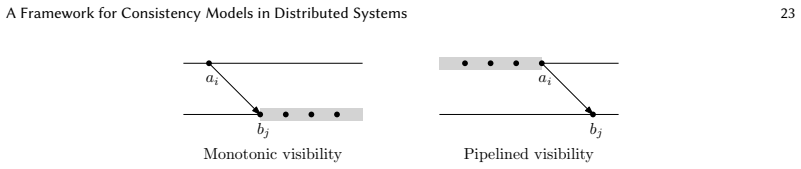
The argument turns on the notion of an irredundant pair of updates (Definition 40) and the physical realizability axiom. Two updates are irredundant when no valid execution can make one visible to the local viewers of the other, before the already-visible update, without violating result validity; examples are two increments to a counter or two enqueues to a queue. This property guarantees that 'phantom' visibility edges—edges that add no information—cannot be used to paper over the missing information flow of a partition. The physical realizability axiom ($\mathrm{vispr}$) rules out visibility that would let information travel backward along a process's program order, while still permitting cycles needed by synchronization abstractions such as barriers and consensus. Together these two ingredients force the contradiction in the CLAM proof: a partition, wait-freedom, and the four axioms combine to demand a visibility edge that irredundance says must change a query's result.
What would settle it
Exhibit a data type with an irredundant pair of updates and a wait-free implementation whose every finite two-process history—including the partition history constructed in the proof, with one update and subsequent queries per process—can be explained by a valid execution satisfying closed past, local visibility, arbitration, and monotonic visibility. A mechanical search over small such histories for a counter or queue would either produce the violating history predicted by CLAM or, if none exists, give evidence that the theorem's premise needs re-examination.
Extended reading notes
Core claim
The paper's central claim is Theorem 1 (CLAM): in an asynchronous distributed system with at least two processes, any wait-free implementation of a data abstraction with an irredundant pair of updates admits a history that no valid execution can explain while simultaneously satisfying Closed past, Local visibility, Arbitration, and Monotonic visibility. The proof isolates two processes under a partition that lasts the whole history; wait-freedom forces each process's queries to return from its own local events alone. Any execution explaining the whole history must then satisfy local visibility (each process sees its own update), arbitration (both processes order the two updates the same way), and closed past (once one process's update is visible to the other's queries, the other update must be visible too), which forces one update into the other side's visible set and breaks result validity because the updates are irredundant. Since monotonic visibility is argued to be too fundamental to sacrifice, the corollary is the CAL trilemma: closed past, arbitration, or local visibility must be forgone in any wait-free highly available system. The paper positions this as practically stronger than the CAP theorem, which only rules out linearizability for a single register; CLAM rules out a much weaker combination for almost all data types, with the single register as the identified exception.
Load-bearing premise
The theorem only covers data abstractions that have an irredundant pair of updates, and the paper does not prove a general characterization of that property; for an abstraction without such a witness history, such as the single register, CLAM simply does not apply.
Editorial extensions
If this is right
- Any partition-tolerant, always-available system using a data type with irredundant updates must, on at least one history, violate one of closed past, local visibility, or arbitration; a system that appears to satisfy all three is either not wait-free or not actually using such a data type.
- Convergent causal consistency survives the trilemma: data types with concurrent specifications, such as CRDTs, can converge without arbitration, so they can be wait-free while keeping local visibility and closed past.
- The two available ways to converge through arbitration are precisely the two families the paper defines: replay consistency, which keeps local visibility and drops closed past, and prefix consistency, which keeps closed past and drops local visibility.
- Classic axiomatic definitions of PRAM and causal memory are weaker than their intended behavior and admit physically impossible causality loops; the physical realizability axiom repairs them uniformly.
- The single register is a genuine exception: it can be wait-free and sequentially consistent, but sequential consistency for one register does not compose to memory, so the exception does not restore the CAP-era picture.
Reading between the lines
- If the theorem is right, designers of 'strongly consistent' AP data stores can use the four axioms as an audit checklist: for any finite partition history, at least one axiom must be visibly broken, and the proof predicts precisely where to look.
- A natural next step the paper leaves open is a full characterization of irredundance; one testable conjecture is that data types whose updates form a join-semilattice or have an overriding zero element are exactly those outside the theorem's reach, with the single register as the prototype.
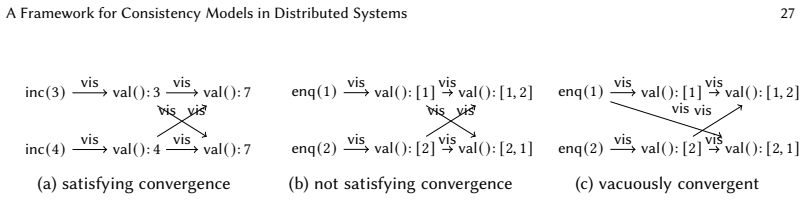
- Treating convergence as a safety property with universal quantification over executions, rather than as eventual consistency, suggests that verification tools for replicated types should check convergence against all valid executions of a history, not just one witness execution.
- An empirical check of the theorem's mechanism would be to run a wait-free counter or queue under a simulated permanent partition and track each side's query results; the recorded history should be unexplainable by any execution satisfying closed past, local visibility, arbitration, and monotonic visibility, showing concretely which axiom the system sacrifices.
Editorial analysis
A structured set of objections, weighed in public.
Referee Report
Summary. The paper presents an axiomatic, timeless framework for consistency models in asynchronous distributed systems, combining a global visibility relation with per-process serializations. It introduces well-formedness axioms (physical realizability, serialization of visibility), basic consistency axioms (monotonic visibility, local visibility, closed past), and derives serial, pipelined, causal, replay, and prefix consistency models. It defines convergence and arbitration as safety properties and proves the CLAM theorem: in asynchronous systems with at least two processes, no wait-free implementation of a data abstraction with irredundant updates can satisfy closed past, local visibility, arbitration, and monotonic visibility simultaneously, yielding the CAL trilemma. The paper also revisits PRAM and causal memory, presenting corrections to prior axiomatic specifications, and offers a taxonomy of consistency models.
Significance. If the framework and proof are accepted, this is a valuable contribution: it generalizes classic consistency frameworks in several orthogonal dimensions and provides a more refined impossibility statement than CAP for AP systems, with a short proof and a clear design-space taxonomy. The framework itself is a genuine contribution, and several parts, such as the physical realizability axiom and the treatment of convergence as a safety property, are well motivated. The main weakness is that the breadth of the central theorem is not established: the irredundance property is existential and only illustrated, so the advertised "practically all data abstractions" scope is currently a claim rather than a proved result.
major comments (3)
- [§9.1, Definition 40; §1 and Abstract] Definition 40 makes "irredundant pair" an existential property over witness histories, and the paper asserts without proof that this holds for practically all abstractions and that the single register is the only exception. Since Theorem 1 quantifies over exactly this class, the CAL trilemma inherits the unproven classification. The examples (counter, queue, set, memory) are plausible, but no syntactic criterion or general argument is given. Please add a theorem characterizing irredundance (e.g., for operations that are non-commutative or affect distinct locations) or explicitly narrow the abstract, introduction, and conclusions to the verified class.
- [§9.2, proof of Theorem 1] The proof assumes that the irredundancy witness history has exactly one update at each of two processes and one or more queries after each update, under a partition lasting the whole history. Definition 40 only guarantees existence of some witness history for a pair of updates; it does not guarantee a witness of this two-process partition shape. A lemma is needed showing that any irredundant pair has such a witness history, or Definition 40 must be reformulated to include the shape used in the proof. Without this, Theorem 1 may apply only to a subclass of the abstractions for which it is claimed.
- [§9.1, Definition 40] The term "update" is not formally defined, although the framework allows operations that are both queries and updates (e.g., dequeue or pop) and concurrent specifications. All examples of irredundant pairs are pure updates. To make the theorem's scope checkable for a given abstraction, the paper should define updates for arbitrary sequential and concurrent specifications and prove the irredundance examples, including operations with both query and update effects.
minor comments (5)
- [§9.2, Theorem 1] The proof never uses monotonic visibility, so the theorem could be stated without M (making it stronger) or the role of M in the CAL framing should be explained explicitly.
- [Definitions 26 and 27] The headings contain typos: "Seqential Consistency" and "Set-Seqential Consistency" should be "Sequential Consistency" and "Set-Sequential Consistency".
- [Figure 16] The border-color encoding for satisfied axioms (red/blue/green) is not accessible in grayscale; please add textual labels or a legend that does not rely on color alone.
- [Section 1, Introduction] The phrase "This is appealing but mat be limiting" contains a typo; it should read "may be limiting".
- [Section 6 and Table 3] The model "convergent causal consistency" appears in Table 3 and in the text without a numbered definition; please clarify whether it is defined as causality plus convergence or as serial causal consistency plus convergence.
Circularity Check
No significant circularity: the CLAM theorem is a conditional impossibility proof built on the paper's own irredundance definition, not a reduction to its inputs; the main weakness is the unsupported breadth of the 'practically all abstractions' claim, which is a scope gap rather than a circular step.
full rationale
The central derivation is not circular. Theorem 1 (CLAM) is a conditional impossibility statement: it assumes wait-freedom, a partition, and the existence of an irredundant pair of updates (Definition 40), then derives that any execution satisfying Closed past, Local visibility, Arbitration, and Monotonic visibility would need extra visibility edges across the partition, which Definition 40 then says would contradict result validity. The proof is a real derivation from the axioms and the semantic property of irredundance; it does not equate the theorem's conclusion with its hypothesis by construction. No fitted parameter is renamed as a prediction, and no load-bearing uniqueness theorem from prior work is imported. The paper does cite the author's own earlier work ([8], [9], [60]), but only for terminology, counter-implementation context, and CRDT discussion; none of these citations carries the CLAM proof. The genuine caveat is scope, not circularity: the paper asserts 'it applies to practically all abstractions, where not every operation overrides every other operation; the single register was the only counter-example we have found' (Section 9.2), but it supplies examples rather than a characterization or proof that most data abstractions have irredundant updates. That is an evidentiary and generality gap, appropriately weighed as a correctness risk, not as a circular step.
Assumptions & free parameters
assumptions (7)
- domain assumption A distributed history is a family of totally ordered per-process sequences; the next operation of a process starts only after the previous one returns.
- ad hoc to paper Operation effects are atomic: an operation is the basic unit of computation and its effects become visible as a whole.
- ad hoc to paper Physical realizability: a hb b implies not b po a.
- ad hoc to paper Serialization of visibility: a vis b_i implies a ser_i b_i.
- domain assumption Wait-free operations terminate in finite steps without depending on messages from other processes, even during a partition.
- ad hoc to paper For a data abstraction covered by CLAM, there exists an irredundancy witness history for some pair of updates.
- standard math Set-theoretic relations, transitive closure, and total orders are used as standard background.
Cite this review
Pith. "Pith review of A Framework for Consistency Models in Distributed Systems." pith.science (2026). https://pith.science/paper/X3TPHWPV
@misc{pith2026241116355,
  author       = {Pith},
  title        = {Pith review of: A Framework for Consistency Models in Distributed Systems},
  year         = {2026},
  howpublished = {\url{https://pith.science/paper/X3TPHWPV}},
  note         = {Machine review of arXiv:2411.16355}
}
read the original abstract
We define am axiomatic timeless framework for asynchronous distributed systems, together with well-formedness and consistency axioms, which unifies and generalizes the expressive power of current approaches. 1) It combines classic serialization per-process with a global visibility. 2) It defines a physical realizability well-formedness axiom to prevent physically impossible causality cycles, while allowing possible and useful visibility cycles, to allow synchronization-oriented abstractions. 3) Allows adding time-based constraints, from a logical or physical clock, either partially or totally ordered, in an optional and orthogonal way, while keeping models themselves timeless. 4) It simultaneously generalizes from memory to general abstractions, from sequential to concurrent specifications, either total or partial, and beyond serial executions. 5) Defines basic consistency axioms: monotonic visibility, local visibility, and closed past. These are satisfied by what we call serial consistency, but can be used as building blocks for novel consistency models with histories not explainable by any serial execution. 6) Revisits classic pipelined and causal consistency, revealing weaknesses in previous axiomatic models for PRAM and causal memory. 7) Introduces convergence and arbitration as safety properties for consistency models, departing from the use of eventual consistency, which conflates safety and liveness. 8) Formulates and proves the CLAM theorem for asynchronous distributed systems: any wait-free implementation of practically all data abstractions cannot simultaneously satisfy Closed past, Local visibility, Arbitration, and Monotonic visibility. While technically incomparable, the CLAM theorem is practically stronger than the CAP theorem, as it allows reasoning about the design space and possible tradeoffs in highly available partition tolerant systems.
Figures


Figures from the paper (16 more)






Reference graph
Works this paper leans on
-
[1]
Consistency Tradeoffs in Modern Distributed Database System Design: CAP is Only Part of the Story
D. Abadi. “Consistency Tradeoffs in Modern Distributed Database System Design: CAP is Only Part of the Story”. In: Computer 45.2 (2012), pp. 37–42. doi: 10.1109/MC.2012.33
-
[2]
Shared Memory Consistency Models: A Tutorial
S. V. Adve and K. Gharachorloo. “Shared Memory Consistency Models: A Tutorial”. In: Computer 29.12 (1996), pp. 66–76. doi: 10.1109/2.546611
doi:10.1109/2.546611 1996
-
[3]
Weak Ordering - A New Definition
S. V. Adve and M. D. Hill. “Weak Ordering - A New Definition”. In: Proceedings of the 17th Annual International Symposium on Computer Architecture, Seattle, W A, USA, June 1990. Ed. by J. Baer, L. Snyder, and J. R. Goodman. ACM, 1990, pp. 2–14. doi: 10.1145/325164.325100
arXiv 1990
-
[4]
The Power of Processor Consistency
M. Ahamad, R. A. Bazzi, R. John, P. Kohli, and G. Neiger. “The Power of Processor Consistency”. In: Proceedings of the 5th Annual ACM Symposium on Parallel Algorithms and Architectures, SPAA ’93, Velen, Germany, June 30 - July 2,
-
[5]
Causal Memory: Definitions, Implementation, and Programming
M. Ahamad, G. Neiger, J. E. Burns, P. Kohli, and P. W. Hutto. “Causal Memory: Definitions, Implementation, and Programming”. In: Distributed Comput. 9.1 (1995), pp. 37–49. doi: 10.1007/BF01784241
-
[6]
A formal hierarchy of weak memory models
J. Alglave. “A formal hierarchy of weak memory models”. In: Formal Methods Syst. Des. 41.2 (2012), pp. 178–210. doi: 10.1007/S10703-012-0161-5
-
[7]
Herding Cats: Modelling, Simulation, Testing, and Data Mining for Weak Memory
J. Alglave, L. Maranget, and M. Tautschnig. “Herding Cats: Modelling, Simulation, Testing, and Data Mining for Weak Memory”. In: ACM Trans. Program. Lang. Syst. 36.2 (2014), 7:1–7:74. doi: 10.1145/2627752
doi:10.1145/2627752 2014
-
[8]
Approaches to Conflict-free Replicated Data Types
P. S. Almeida. “Approaches to Conflict-free Replicated Data Types”. In: ACM Comput. Surv. 57.2 (Nov. 2024). issn: 0360-0300. doi: 10.1145/3695249
doi:10.1145/3695249 2024
Show all 64 references
-
[9]
Scalable eventually consistent counters over unreliable networks
P. S. Almeida and C. Baquero. “Scalable eventually consistent counters over unreliable networks”. In: Distributed Comput. 32.1 (2019), pp. 69–89. doi: 10.1007/s00446-017-0322-2
2019 doi
-
[10]
The network is reliable
P. Bailis and K. Kingsbury. “The network is reliable”. In: Commun. ACM 57.9 (2014), pp. 48–55. doi: 10.1145/2643130
2014 doi
-
[11]
Synchronized DSM Models
J. Bataller and J. M. Bernabéu-Aubán. “Synchronized DSM Models”. In: Euro-Par ’97 Parallel Processing, Third International Euro-Par Conference, Passau, Germany, August 26-29, 1997, Proceedings . Ed. by C. Lengauer, M. Griebl, and S. Gorlatch. Vol. 1300. Lecture Notes in Comput...
1997 doi
-
[12]
Mathematizing C++ concurrency
M. Batty, S. Owens, S. Sarkar, P. Sewell, and T. Weber. “Mathematizing C++ concurrency”. In:Proceedings of the 38th ACM SIGPLAN-SIGACT Symposium on Principles of Programming Languages, POPL 2011, Austin, TX, USA, January 26-28, 2011. Ed. by T. Ball and M. Sagiv. ACM, 2011, pp....
2011
-
[13]
An optimized conflict-free replicated set
A. Bieniusa, M. Zawirski, N. M. Preguiça, M. Shapiro, C. Baquero, V. Balegas, and S. Duarte. “An optimized conflict-free replicated set”. In: CoRR abs/1210.3368 (2012). arXiv: 1210.3368
2012 arXiv
-
[14]
Brief Announcement: Semantics of Eventually Consistent Replicated Sets
A. Bieniusa, M. Zawirski, N. M. Preguiça, M. Shapiro, C. Baquero, V. Balegas, and S. Duarte. “Brief Announcement: Semantics of Eventually Consistent Replicated Sets”. In:Distributed Computing - 26th International Symposium, DISC 2012, Salvador, Brazil, October 16-18, 2012. Pro...
2012 doi
-
[15]
Lightweigt Causal and Atomic Group Multicast
K. P. Birman, A. Schiper, and P. Stephenson. “Lightweigt Causal and Atomic Group Multicast”. In: ACM Trans. Comput. Syst. 9.3 (1991), pp. 272–314. doi: 10.1145/128738.128742
1991
-
[16]
Foundations of the C++ concurrency memory model
H. Boehm and S. V. Adve. “Foundations of the C++ concurrency memory model”. In: Proceedings of the ACM SIGPLAN 2008 Conference on Programming Language Design and Implementation, Tucson, AZ, USA, June 7-13, 2008 . Ed. by R. Gupta and S. P. Amarasinghe. ACM, 2008, pp. 68–78. doi...
2008
-
[17]
Outlawing ghosts: avoiding out-of-thin-air results
H. Boehm and B. Demsky. “Outlawing ghosts: avoiding out-of-thin-air results”. In: Proceedings of the workshop on Memory Systems Performance and Correctness, MSPC ’14, Edinburgh, United Kingdom, June 13, 2014 . Ed. by J. Singer, M. Kulkarni, and T. Harris. ACM, 2014, 7:1–7:6. d...
2014
-
[18]
On verifying causal consistency
A. Bouajjani, C. Enea, R. Guerraoui, and J. Hamza. “On verifying causal consistency”. In: Proceedings of the 44th ACM SIGPLAN Symposium on Principles of Programming Languages, POPL 2017, Paris, France, January 18-20, 2017 . Ed. by G. Castagna and A. D. Gordon. ACM, 2017, pp. 6...
2017
-
[19]
Principles of Eventual Consistency
S. Burckhardt. “Principles of Eventual Consistency”. In: Found. Trends Program. Lang. 1.1-2 (2014), pp. 1–150. doi: 10.1561/2500000011
2014 doi
-
[20]
Replicated data types: specification, verification, optimality
S. Burckhardt, A. Gotsman, H. Yang, and M. Zawirski. “Replicated data types: specification, verification, optimality”. In: The 41st Annual ACM SIGPLAN-SIGACT Symposium on Principles of Programming Languages, POPL ’14, San Diego, CA, USA, January 20-21, 2014 . Ed. by S. Jaganna...
2014
-
[21]
Unifying Concurrent Objects and Distributed Tasks: Interval-Linearizability
A. Castañeda, S. Rajsbaum, and M. Raynal. “Unifying Concurrent Objects and Distributed Tasks: Interval-Linearizability”. In: J. ACM 65.6 (2018), 45:1–45:42. doi: 10.1145/3266457
2018 doi
-
[22]
Dynamo: amazon’s highly available key-value store
G. DeCandia, D. Hastorun, M. Jampani, G. Kakulapati, A. Lakshman, A. Pilchin, S. Sivasubramanian, P. Vosshall, and W. Vogels. “Dynamo: amazon’s highly available key-value store”. In:Proceedings of the 21st ACM Symposium on Operating Systems Principles 2007, SOSP 2007, Stevenso...
2007
-
[23]
Harvest, Yield and Scalable Tolerant Systems
A. Fox and E. A. Brewer. “Harvest, Yield and Scalable Tolerant Systems”. In: Proceedings of The Seventh Workshop on Hot Topics in Operating Systems, HotOS-VII, Rio Rico, Arizona, USA, March 28-30, 1999 . Ed. by P. Druschel. IEEE Computer Society, 1999, pp. 174–178. doi: 10.110...
1999
-
[24]
Retrospective: Memory Consistency and Event Ordering in Scalable Shared-Memory Multipro- cessors
K. Gharachorloo. “Retrospective: Memory Consistency and Event Ordering in Scalable Shared-Memory Multipro- cessors”. In: 25 Years of the International Symposia on Computer Architecture (Selected Papers) . Ed. by G. S. Sohi. ACM, 1998, pp. 67–70. doi: 10.1145/285930.285957
1998
-
[25]
Information storage in a decentralized computer system
D. K. Gifford. “Information storage in a decentralized computer system”. PhD thesis. Stanford, CA, USA, 1981
1981
-
[26]
Brewer’s conjecture and the feasibility of consistent, available, partition-tolerant web services
S. Gilbert and N. A. Lynch. “Brewer’s conjecture and the feasibility of consistent, available, partition-tolerant web services”. In: SIGACT News 33.2 (2002), pp. 51–59. doi: 10.1145/564585.564601
2002
-
[27]
Monotonic Prefix Consistency in Distributed Systems
A. Girault, G. Gößler, R. Guerraoui, J. Hamza, and D. Seredinschi. “Monotonic Prefix Consistency in Distributed Systems”. In: Formal Techniques for Distributed Objects, Components, and Systems - 38th IFIP WG 6.1 International Conference, FORTE 2018, Held as Part of the 13th In...
2018
-
[28]
J. R. Goodman. Cache Consistency and Sequential Consistency . Tech. rep. TR1006. University of Wisconsin-Madison, Department of Computer Sciences, 1991
1991
-
[29]
Notes on Data Base Operating Systems
J. Gray. “Notes on Data Base Operating Systems”. In: Operating Systems, An Advanced Course . Ed. by M. J. Flynn, J. Gray, A. K. Jones, K. Lagally, H. Opderbeck, G. J. Popek, B. Randell, J. H. Saltzer, and H. Wiehle. Vol. 60. Lecture Notes in Computer Science. Springer, 1978, p...
1978 doi
-
[30]
Wait-Free Synchronization
M. Herlihy. “Wait-Free Synchronization”. In: ACM Trans. Program. Lang. Syst. 13.1 (1991), pp. 124–149. doi: 10.1145/ 114005.102808
1991
-
[31]
Linearizability: A Correctness Condition for Concurrent Objects
M. Herlihy and J. M. Wing. “Linearizability: A Correctness Condition for Concurrent Objects”. In: ACM Trans. Program. Lang. Syst. 12.3 (1990), pp. 463–492. doi: 10.1145/78969.78972
1990
-
[32]
Slow Memory: Weakening Consistency to Enchance Concurrency in Distributed Shared Memories
P. W. Hutto and M. Ahamad. “Slow Memory: Weakening Consistency to Enchance Concurrency in Distributed Shared Memories”. In: 10th International Conference on Distributed Computing Systems (ICDCS 1990), May 28 - June 1, 1990, Paris, France . IEEE Computer Society, 1990, pp. 302–...
1990
-
[33]
A Generic Specification Framework for Weakly Consistent Replicated Data Types
X. Jiang, H. Wei, and Y. Huang. “A Generic Specification Framework for Weakly Consistent Replicated Data Types”. In: International Symposium on Reliable Distributed Systems, SRDS 2020, Shanghai, China, September 21-24, 2020 . IEEE, 2020, pp. 143–154. doi: 10.1109/SRDS51746.2020.00022
2020
-
[34]
A Critique of the CAP Theorem
M. Kleppmann. “A Critique of the CAP Theorem”. In: CoRR abs/1509.05393 (2015). arXiv: 1509.05393
2015 arXiv
-
[35]
OpSets: Sequential Specifications for Replicated Datatypes (Extended Version)
M. Kleppmann, V. B. F. Gomes, D. P. Mulligan, and A. R. Beresford. “OpSets: Sequential Specifications for Replicated Datatypes (Extended Version)”. In: CoRR abs/1805.04263 (2018). arXiv: 1805.04263
2018 arXiv
-
[36]
How to Make a Multiprocessor Computer That Correctly Executes Multiprocess Programs
L. Lamport. “How to Make a Multiprocessor Computer That Correctly Executes Multiprocess Programs”. In: IEEE Trans. Computers 28.9 (1979), pp. 690–691. doi: 10.1109/TC.1979.1675439. 50 Paulo Sérgio Almeida
1979
-
[37]
Time, Clocks, and the Ordering of Events in a Distributed System
L. Lamport. “Time, Clocks, and the Ordering of Events in a Distributed System”. In: Commun. ACM 21.7 (1978), pp. 558–565. doi: 10.1145/359545.359563
1978
-
[38]
R. J. Lipton and J. S. Sandberg. PRAM: A scalable shared memory . Tech. rep. CS-TR-180-88. Princeton University, Department of Computer Science, 1988
1988
-
[39]
Mahajan, L
P. Mahajan, L. Alvisi, and M. Dahlin. Consistency, A vailability, and Convergence. Tech. rep. UTCS TR-11-22. Depart- ment of Computer Science, The University of Texas at Austin, 2011
2011
-
[40]
Space and Time
H. Minkowski. “Space and Time”. In: Space and Time: Minkowski’s Papers on Relativity . Ed. by V. Petkov. Minkowski Institute Press, Montreal, 2012
2012
-
[41]
Axioms for Memory Access in Asynchronous Hardware Systems
J. Misra. “Axioms for Memory Access in Asynchronous Hardware Systems”. In: ACM Trans. Program. Lang. Syst. 8.1 (1986), pp. 142–153. doi: 10.1145/5001.5007
1986
-
[42]
Set-Linearizability
G. Neiger. “Set-Linearizability”. In: Proceedings of the Thirteenth Annual ACM Symposium on Principles of Distributed Computing, Los Angeles, California, USA, August 14-17, 1994 . Ed. by J. H. Anderson, D. Peleg, and E. Borowsky. ACM, 1994, p. 396. doi: 10.1145/197917.198176
1994
-
[43]
Causal consistency: beyond memory
M. Perrin, A. Mostéfaoui, and C. Jard. “Causal consistency: beyond memory”. In: Proceedings of the 21st ACM SIGPLAN Symposium on Principles and Practice of Parallel Programming, PPoPP 2016, Barcelona, Spain, March 12-16,
2016
-
[44]
Update Consistency for Wait-Free Concurrent Objects
M. Perrin, A. Mostéfaoui, and C. Jard. “Update Consistency for Wait-Free Concurrent Objects”. In: 2015 IEEE International Parallel and Distributed Processing Symposium, IPDPS 2015, Hyderabad, India, May 25-29, 2015 . IEEE Computer Society, 2015, pp. 219–228. doi: 10.1109/IPDPS.2015.39
2015 doi
-
[45]
ECROs: building global scale systems from sequential code
K. D. Porre, C. Ferreira, N. M. Preguiça, and E. G. Boix. “ECROs: building global scale systems from sequential code”. In: Proc. ACM Program. Lang. 5.OOPSLA (2021), pp. 1–30. doi: 10.1145/3485484
2021 doi
-
[46]
From Causal Consistency to Sequential Consistency in Shared Memory Systems
M. Raynal and A. Schiper. “From Causal Consistency to Sequential Consistency in Shared Memory Systems”. In: Foundations of Software Technology and Theoretical Computer Science, 15th Conference, Bangalore, India, December 18-20, 1995, Proceedings . Ed. by P. S. Thiagarajan. Vol...
1995 doi
-
[47]
Replicated abstract data types: Building blocks for collaborative applications
H. Roh, M. Jeon, J. Kim, and J. Lee. “Replicated abstract data types: Building blocks for collaborative applications”. In: J. Parallel Distributed Comput. 71.3 (2011), pp. 354–368. doi: 10.1016/j.jpdc.2010.12.006
2011 doi
-
[48]
Optimistic replication
Y. Saito and M. Shapiro. “Optimistic replication”. In:ACM Comput. Surv. 37.1 (2005), pp. 42–81. doi: 10.1145/1057977. 1057980
2005 doi
-
[49]
R. Salgado. Relativity on Rotated Graph Paper . 2016. url: https://www.geogebra.org/m/HYD7hB9v
2016
-
[50]
x86-TSO: a rigorous and usable programmer’s model for x86 multiprocessors
P. Sewell, S. Sarkar, S. Owens, F. Z. Nardelli, and M. O. Myreen. “x86-TSO: a rigorous and usable programmer’s model for x86 multiprocessors”. In: Commun. ACM 53.7 (2010), pp. 89–97. doi: 10.1145/1785414.1785443
2010
-
[51]
Consistency in 3D
M. Shapiro, M. S. Ardekani, and G. Petri. “Consistency in 3D”. In: 27th International Conference on Concurrency Theory, CONCUR 2016, August 23-26, 2016, Québec City, Canada . Ed. by J. Desharnais and R. Jagadeesan. Vol. 59. LIPIcs. Schloss Dagstuhl - Leibniz-Zentrum für Inform...
2016 doi
-
[52]
Conflict-Free Replicated Data Types
M. Shapiro, N. M. Preguiça, C. Baquero, and M. Zawirski. “Conflict-Free Replicated Data Types”. In: Stabilization, Safety, and Security of Distributed Systems - 13th International Symposium, SSS 2011, Grenoble, France, October 10-12,
2011
-
[53]
A unified theory of shared memory consistency
R. C. Steinke and G. J. Nutt. “A unified theory of shared memory consistency”. In: J. ACM 51.5 (2004), pp. 800–849. doi: 10.1145/1017460.1017464
2004
-
[54]
Achieving Convergence, Causality Preservation, and Intention Preservation in Real-Time Cooperative Editing Systems
C. Sun, X. Jia, Y. Zhang, Y. Yang, and D. Chen. “Achieving Convergence, Causality Preservation, and Intention Preservation in Real-Time Cooperative Editing Systems”. In: ACM Trans. Comput. Hum. Interact. 5.1 (1998), pp. 63–
1998
-
[55]
Replicated data consistency explained through baseball
D. Terry. “Replicated data consistency explained through baseball”. In: Commun. ACM 56.12 (2013), pp. 82–89. doi: 10.1145/2500500
2013 doi
-
[56]
Session Guarantees for Weakly Consistent Replicated Data
D. B. Terry, A. J. Demers, K. Petersen, M. Spreitzer, M. Theimer, and B. B. Welch. “Session Guarantees for Weakly Consistent Replicated Data”. In: Proceedings of the Third International Conference on Parallel and Distributed Infor- mation Systems (PDIS 94), Austin, Texas, USA,...
1994
-
[57]
Managing Update Conflicts in Bayou, a Weakly Connected Replicated Storage System
D. B. Terry, M. Theimer, K. Petersen, A. J. Demers, M. Spreitzer, and C. Hauser. “Managing Update Conflicts in Bayou, a Weakly Connected Replicated Storage System”. In: Proceedings of the Fifteenth ACM Symposium on Operating System Principles, SOSP 1995, Copper Mountain Resort...
1995
-
[58]
Consistency in Non-Transactional Distributed Storage Systems
P. Viotti and M. Vukolic. “Consistency in Non-Transactional Distributed Storage Systems”. In: ACM Comput. Surv. 49.1 (2016), 19:1–19:34. doi: 10.1145/2926965
2016 doi
-
[59]
Eventually consistent
W. Vogels. “Eventually consistent”. In: Commun. ACM 52.1 (2009), pp. 40–44. doi: 10.1145/1435417.1435432. A Framework for Consistency Models in Distributed Systems 51
2009
-
[60]
An oblivious observed-reset embeddable replicated counter
M. Weidner and P. S. Almeida. “An oblivious observed-reset embeddable replicated counter”. In: PaPoC@EuroSys 2022: Proceedings of the 9th Workshop on Principles and Practice of Consistency for Distributed Data, Rennes, France, April 5 - 8, 2022. Ed. by A. Szekeres and K. C. Si...
2022
-
[108]
doi: 10.1145/274444.274447
-
[1993]
Ed. by L. Snyder. ACM, 1993, pp. 251–260. doi: 10.1145/165231.165264
1993
-
[2011]
Proceedings. Ed. by X. Défago, F. Petit, and V. Villain. Vol. 6976. Lecture Notes in Computer Science. Springer, 2011, pp. 386–400. doi: 10.1007/978-3-642-24550-3_29
2011 doi
-
[2016]
Ed. by R. Asenjo and T. Harris. ACM, 2016, 26:1–26:12. doi: 10.1145/2851141.2851170
2016
Reviewed August 12, 2026 · model on record in the stance chip above.
Discussion (0). Continue with ORCID to comment.