REVIEW 3 major objections 5 minor 29 references
Pitchfork Bifurcation In A Coupled Cell System
T0 review · 3 major / 5 minor · reviewed 2026-08-12 · deepseek-v4-flash
Pith's one-line read Positively coupled rings of pitchfork cells collapse to a single-cell bifurcation; negative coupling blocks the collapse.
desk verdict The analytic core is right, but the paper's headline 'single-cell regime' boundary is asserted from numerics with no code attached. read the letter →
The pith
A machine-rendered reading of the paper's core claim, the machinery that carries it, and where it could break.
The reading
What carries the argument
The machinery is the circulant Jacobian of the ring. For the synchronous zero state, its $k$-th eigenvalue is $\lambda_k = r + p\cos(2\pi k/n)$; the first eigenvalue to vanish fixes the pitchfork at $r=-p$, and the next pair vanishes at $r=-p\cos(2\pi/n)$. This turns the $n$-cell problem into a one-mode test: positive coupling makes the uniform $k=0$ mode the first to destabilize, which is why the synchronous states are the only stable states in the zone, while negative coupling makes higher modes destabilize first, which is why heterogeneous states appear. Ring symmetry then forces every nonsynchronous steady state to come with sign-reversed and cyclically permuted copies of identical stability.
What would settle it
For fixed $p>0$ and a ring size not covered by the reported plots, say $n=7$, compute all steady states of Eq. (3) by numerical continuation and find the smallest $r$ at which any nonsynchronous equilibrium exists; if that $r$ is strictly below $-p\cos(2\pi/n)$, or if a stable nonsynchronous state appears inside $r\leq -p\cos(2\pi/n)$, the claimed one-dimensional zone is too large.
Extended reading notes
Core claim
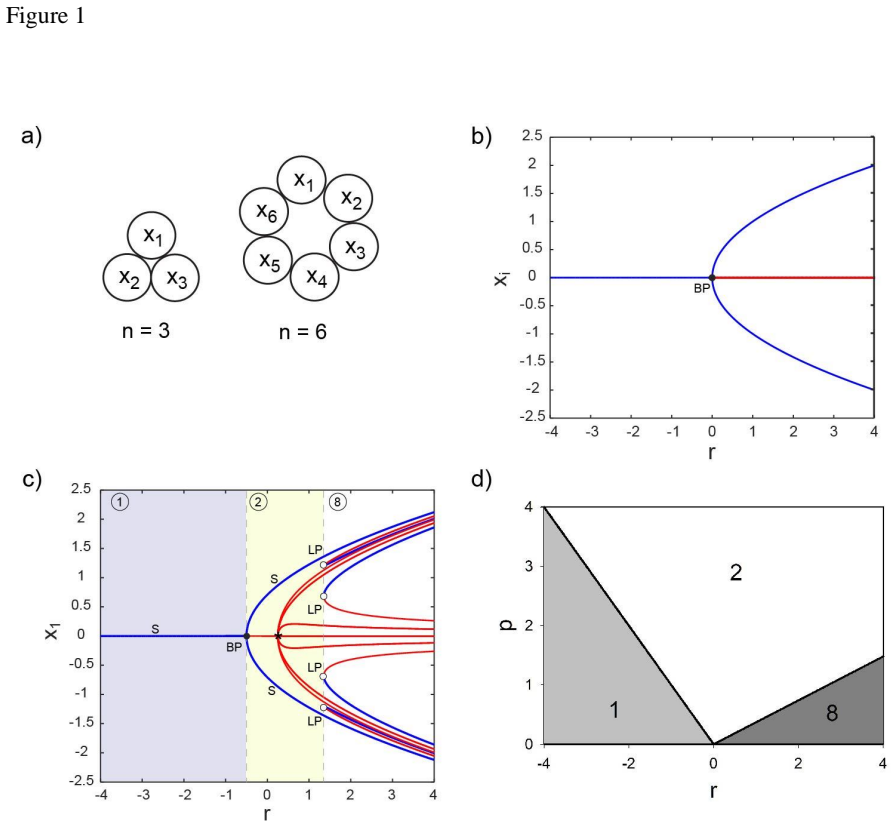
The central claim is that for $p>0$, the $n$-cell ring has a supercritical pitchfork bifurcation at $r=-p$ involving the synchronous steady states $x_i=\pm\sqrt{r+p}$, and in the parameter zone $r\leq -p\cos(2\pi/n)$ the system has only synchronous steady states. Inside this zone the coupled system is effectively the one-dimensional pitchfork $\frac{dx}{dt}=(r+p)x-x^3$, and all cells are synchronized. For $p<0$ the same synchronous branches exist, but the stability ordering is reversed: the zero state changes stability at a different point, the two nonzero branches are initially unstable, and the bifurcation is not supercritical. Nonsynchronous steady states then are not bounded by the synchronous ones, and stable heterogeneous patterns such as $(a,-a,a,-a)$ in a four-cell ring become the dominant outcomes.
Load-bearing premise
The single-cell regime is claimed to extend to $r=-p\cos(2\pi/n)$, but that boundary is supported by numerical observation rather than proof, so the claim assumes no nonsynchronous steady state appears before that mode for any ring size $n$.
Editorial extensions
If this is right
- For $p>0$ and $r\leq -p\cos(2\pi/n)$, the full $n$-cell system has the same stable steady-state count as a scalar pitchfork: one stable state before $r=-p$ and two after.
- The one-dimensional reduction lets the bifurcation point, branch stability, and response to parameter changes be read from the scalar normal form without simulating all $n$ cells.
- For $p<0$, stable heterogeneous patterns such as $(a,-a,a,-a)$ in four cells arise from the same coupling that prevents the one-dimensional reduction, making negative coupling the pattern-forming regime.
- The mutual-repressor version shows the same contrast, indicating the normal-form result survives replacement of the abstract pitchfork by a two-gene molecular circuit.
Reading between the lines
- The analytical proof in the paper excludes nonsynchronous states only for $r\leq -p$, while the claimed boundary $-p\cos(2\pi/n)$ comes from numerical observation; proving no nonsynchronous equilibrium exists between $-p$ and $-p\cos(2\pi/n)$ for all $n$ would complete the argument.
- The eigenvalue formula suggests a design principle: in any ring with diffusive-like coupling, the mode that destabilizes first decides whether synchronization survives, so coupling that stabilizes the uniform mode will generically create an effective single-cell bifurcation region.
- Extending the coupling to non-nearest neighbours would shift the boundary according to the discrete Fourier spectrum of the coupling kernel, giving a testable family of models.
- Biologically, the result sharpens the contrast between lateral induction (positive coupling), which keeps a tissue homogeneous in the synchronous zone, and lateral inhibition (negative coupling), which produces salt-and-pepper patterns.
Editorial analysis
A structured set of objections, weighed in public.
Referee Report
Summary. The paper studies a ring of n identical cells, each governed by the normal form of a supercritical pitchfork bifurcation, with linear nearest-neighbor coupling. For positive coupling p>0 the authors claim (i) a supercritical pitchfork bifurcation of the synchronous steady states at r=-p, (ii) that for r≤-p cos(2π/n) the system has only synchronous steady states, so that it effectively behaves as a one-dimensional supercritical pitchfork system, and (iii) that for negative coupling this one-dimensional regime is lost, with nonsynchronous steady states dominating. The paper also presents a second model of coupled mutual-repressor circuits and extensive numerical bifurcation diagrams for n=3,4,6.
Significance. If the central claim held as stated, the paper would provide a clean, analytically tractable example of how positive coupling can preserve single-cell bifurcation structure in a multicellular ensemble, with a precise boundary for the one-dimensional regime. The model has no fitted parameters, the choice of normal form is explicit, and the numerical exploration of stable-pattern counts is a useful catalogue. The synchronous-branch eigenvalue analysis (Eqs. (6)-(7)) and the equivariance arguments are sound. However, the central 'single-cell regime' claim rests on an unproved numerical assertion and on a flawed maximum-principle proof, so the paper in its current form does not establish the headline result as a theorem.
major comments (3)
- [§3.4, proof of property (b), around Eq. (8)] The proof that nonsynchronous steady states are bounded by the synchronous ones contains a logical error and a sign error. For a component x_j = x_h chosen as the maximum positive value in a nonsynchronous steady state, the assumptions x_{j+1} > x_j and x_{j-1} > x_j cannot both hold; by definition of a maximum, both neighbors are ≤ x_h. The inequality after Eq. (8) is therefore based on an impossible premise. Moreover, from 0 = A > B one must conclude B < 0, not B > 0 as written; hence Eq. (8), x_h[r+p-x_h^2] > 0, does not follow. The intended claim (no nonsynchronous steady states for r≤-p) is in fact true by a different argument: for a positive maximum M, the steady-state equation gives 0 = rM-M^3+p·avg ≤ M(r+p-M^2), so r+p-M^2 ≥ 0, which is impossible when r+p<0 (and forces M=0 at equality). The proof needs to be corrected; as written, the central exclusion of nonsynchronous states in the analytically proven region is not established.
- [§3.4, passage after Eq. (8)] The paper asserts 'Nonsynchronous steady states do not exist when r ≤ -p cos(2π/n)' and that this boundary is where multiple nonsynchronous steady states emerge. This statement is supported only by 'Through numerical analysis, we observed' with no proof, no reproducibility data, and no argument for general n. For every n≥3, the interval (-p, -p cos(2π/n)] is strictly larger than the provable region r≤-p (e.g., n=3 gives r≤+p/2 versus r≤-p). Since the abstract and Section 3.4 highlight this exact boundary as defining the one-dimensional regime, the central claim is not proven. The authors should either supply a proof of absence of nonsynchronous steady states in the extended interval, or explicitly relegate the extended boundary to a numerical observation and state the analytically proven regime as r≤-p.
- [§3.5, proof of property (a), around Eq. (9)] The negative-coupling proof of unboundedness of nonsynchronous states repeats the same structural problem: it assumes x_{j+1} > x_j and x_{j-1} > x_j for a maximal x_j, which is impossible. Even if the inequality direction were corrected, the conclusion x_h > r+p does not follow from x_h[r+p-x_h^2] < 0; that inequality yields x_h > sqrt(r+p), which is a different bound. This does not undermine the paper's main positive-coupling claim, but the proof of the negative-coupling qualitative statement is mathematically invalid as written and should be rewritten.
minor comments (5)
- [§3.4, Eq. (6) and surrounding text] The text says 'two eigenvalues become zero at r=-p cos(2π/n)' for k=±1; for n=4 these two eigenvalues are identical, and for n=3 likewise, but the paper should state explicitly that the two eigenvalues coincide only when n is even or when k and n-k are distinct. The wording is slightly ambiguous.
- [§3.4, proof of property (a)] The proof that the bifurcation at r=-p is a supercritical pitchfork is incomplete as written: it verifies eigenvalue crossing and existence/stability of the two new synchronous branches, but does not mention that the critical eigenvector is the synchronous mode and that all transverse modes have negative real parts in a neighborhood, nor does it compute the standard normal-form coefficient. Since the synchronous subspace is invariant, the conclusion is believable, but the proof should be made explicit.
- [§4, mutual repressor model] The claim that for positive coupling with 0≤p<1 the system 'has no nonsynchronous steady states' appears to be based entirely on numerical bifurcation diagrams (Fig. 5b,d). This statement should be qualified as numerical evidence, or the parameter range where it was verified should be stated precisely.
- [Figures] Several bifurcation diagrams (Figs. 1c, 3a, 5b, 5c) are described as having overlapping branches and invisible bifurcations, which makes them hard to read. Since the paper relies on numerical branch data, the authors should provide higher-resolution figures or separate plots of the distinct branches, and give the exact parameter values used for MatCont/Julia computations.
- [General] The manuscript would benefit from a statement of data/code availability. The numerical results that underpin the main claims (especially the boundary r=-p cos(2π/n)) cannot be verified without the code used for MatCont and DifferentialEquations.jl.
Circularity Check
No significant circularity; the coupled-system results are derived from the stated ODEs, and the one self-citation is not load-bearing.
full rationale
The pitchfork bifurcation for the n-cell ring is obtained by direct analysis of the stated equations: substituting the synchronous steady states into Eq. (3) gives alpha = 0 and alpha = +/-sqrt(r+p), and the circulant Jacobian in Eqs. (6)-(7) determines stability; no parameter is fitted and no target result is assumed. The proof in Section 3.4 that nonsynchronous states are bounded by the synchronous ones, and the exclusion of nonsynchronous states for r <= -p, are also derived from Eq. (3) rather than imported from an earlier claim. The main weakness is that the extended boundary r = -p cos(2*pi/n) for the 'single-cell regime' is asserted from numerical observation, with the text saying 'Through numerical analysis, we observed that multiple nonsynchronous steady states emerge at this position' and 'Nonsynchronous steady states do not exist when...'. This is a support and rigor concern, not circularity: the numerical observation is a check of the model equations, not an input that is later renamed as the conclusion. The only self-citation, reference [3], appears in the introduction as a general example of bifurcation-based modeling and does not carry any load-bearing derivation. Therefore no step reduces by construction to the paper's own inputs.
Assumptions & free parameters
assumptions (4)
- domain assumption Each cell's isolated dynamics is the normal form of supercritical pitchfork bifurcation, Eq. (1): dx_i/dt = r x_i - x_i^3.
- domain assumption Cell-cell coupling is linear and diffusive, proportional to the average of the two neighbors' states, Eq. (3).
- domain assumption The ring has periodic boundary conditions and all cells are identical.
- ad hoc to paper Numerical observation: nonsynchronous steady states appear at r = -p cos(2π/n) and are unstable near the branch.
Cite this review
Pith. "Pith review of Pitchfork Bifurcation In A Coupled Cell System." pith.science (2026). https://pith.science/paper/NGCGCUET
@misc{pith2026241116400,
  author       = {Pith},
  title        = {Pith review of: Pitchfork Bifurcation In A Coupled Cell System},
  year         = {2026},
  howpublished = {\url{https://pith.science/paper/NGCGCUET}},
  note         = {Machine review of arXiv:2411.16400}
}
read the original abstract
Various biological phenomena, like cell differentiation and pattern formation in multicellular organisms, are explained using the bifurcation theory. Molecular network motifs like positive feedback and mutual repressor exhibit bifurcation and are responsible for the emergence of diverse cell types. Mathematical investigations of such problems usually focus on bifurcation in a molecular network in individual cells. However, in a multicellular organism, cells interact, and intercellular interactions affect individual cell dynamics. Therefore, the bifurcation in an ensemble of cells could differ from that for a single cell. This work considers a ring of identical cells. When independent, each cell exhibits supercritical pitchfork bifurcation. Using analytical and numerical tools, we investigate the bifurcation in this ensemble when cells interact through positive and negative coupling. We show that within a specific parameter zone, an ensemble of positively coupled cells behaves like a single cell with supercritical pitchfork bifurcation. In this regime, all cells are synchronized and have the same steady state. However, this unique behaviour is lost when cells interact through negative coupling. Apart from the synchronized (or homogenous) states, cell-cell coupling leads to certain heterogeneous steady states with unique patterns. We also investigate the distribution of such heterogeneous states under positive and negative coupling.
Figures
Reference graph
Works this paper leans on
-
[1]
J. E. Ferrell, Bistability, bifurcations, and Waddington’s epigenetic landscape, Curr. Biol. 22, R458 (2012)
work page 2012
-
[2]
J. E. Ferrell, J. R. Pomerening, S. Y. Kim, N. B. Trunnell, W. Xiong, C. Y. F. Huang, and E. M. Machleder, Simple, realistic models of complex biological processes: Positive feedback and bistability in a cell fate switch and a cell cycle oscillator, FEBS Lett. 583, 3999 (2009)
work page 2009
-
[3]
V. Devaraj and B. Bose, The Mathematics of Phenotypic State Transition: Paths and Potential, J. Indian Inst. Sci. 100, 451 (2020)
work page 2020
-
[4]
S. H. Strogatz, Nonlinear Dynamics and Chaos: With Applications to Physics, Biology, Chemistry, and Engineering, 2nd ed. (CRC Press, 2015)
work page 2015
-
[5]
L. Xu, K. Zhang, and J. Wang, Exploring the mechanisms of differentiation, dedifferentiation, reprogramming and transdifferentiation, PLoS One 9, (2014)
work page 2014
- [6]
- [7]
-
[8]
S. Huang, Y.-P. Guo, G. May, and T. Enver, Bifurcation dynamics in lineage- commitment in bipotent progenitor cells., Dev. Biol. 305, 695 (2007)
work page 2007
Show all 29 references
-
[9]
C. Duff, K. Smith-Miles, L. Lopes, and T. Tian, Mathematical modelling of stem cell differentiation: The PU.1-GATA-1 interaction, J. Math. Biol. 64, 449 (2012)
2012
-
[10]
Boareto, Patterning via local cell-cell interactions in developing systems, Dev
M. Boareto, Patterning via local cell-cell interactions in developing systems, Dev. Biol. 460, 77 (2020)
2020
-
[11]
K. Pas, S. Laboy-Segarra, and J. Lee, Systems of pattern formation within developmental biology, Prog. Biophys. Mol. Biol. 167, 18 (2021)
2021
-
[12]
Golubitsky and I
M. Golubitsky and I. Stewart, Symmetry and Pattern Formation in Coupled Cell Networks, in Pattern Formation in Continuous and Coupled Systems, edited by M. 31 Golubitsky, D. Luss, and S. H. Strogatz (Springer New York, 1999), pp. 65–82
1999
-
[13]
Antoneli and I
F. Antoneli and I. Stewart, Symmetry and synchrony in coupled cell networks 1: Fixed-point spaces, Int. J. Bifurc. Chaos 16, 559 (2006)
2006
-
[14]
Golubitsky and I
M. Golubitsky and I. Stewart, The Symmetry Perspective: From Equilibrium to Chaos in Phase Space and Physical Space (Birkhäuser Basel, 2012)
2012
-
[15]
Pujals, M
E. Pujals, M. Shub, and Y. Yang, Stable and non-symmetric pitchfork bifurcations, Sci. China Math. 63, 1837 (2020)
2020
-
[16]
Dhooge, W
A. Dhooge, W. Govaerts, Y. A. Kuznetsov, H. G. E. Meijer, and B. Sautois, New features of the software MatCont for bifurcation analysis of dynamical systems, Math. Comput. Model. Dyn. Syst. 14, 147 (2008)
2008
-
[17]
Rackauckas and Q
C. Rackauckas and Q. Nie, DifferentialEquations.jl – A Performant and Feature-Rich Ecosystem for Solving Differential Equations in Julia, J. Open Res. Softw. 5, 15 (2017)
2017
-
[18]
Bezanson, A
J. Bezanson, A. Edelman, S. Karpinski, and V. B. Shah, Julia: A fresh approach to numerical computing, SIAM Rev. 59, 65 (2017)
2017
-
[19]
Schröter, P
C. Schröter, P. Rué, J. P. Mackenzie, and A. M. Arias, FGF/MAPK signaling sets the switching threshold of a bistable circuit controlling cell fate decisions in embryonic stem cells, Dev. 142, 4205 (2015)
2015
-
[20]
S. B. Nissen, M. Perera, J. M. Gonzalez, S. M. Morgani, M. H. Jensen, K. Sneppen, J. M. Brickman, and A. Trusina, Four simple rules that are sufficient to generate the mammalian blastocyst, PLoS Biol. 15, e2000737 (2017)
2017
-
[21]
Sjöqvist and E
M. Sjöqvist and E. R. Andersson, Do as I say, Not(ch) as I do: Lateral control of cell fate, Dev. Biol. 447, 58 (2019)
2019
-
[22]
Shaya and D
O. Shaya and D. Sprinzak, From Notch signaling to fine-grained patterning: Modeling meets experiments, Curr. Opin. Genet. Dev. 21, 732 (2011)
2011
-
[23]
Bocci, J
F. Bocci, J. N. Onuchic, and M. K. Jolly, Understanding the Principles of Pattern Formation Driven by Notch Signaling by Integrating Experiments and Theoretical Models, Front. Physiol. 11, 1 (2020). 32
2020
-
[24]
Negrete and A
J. Negrete and A. C. Oates, Embryonic lateral inhibition as optical modes: An analytical framework for mesoscopic pattern formation, Phys. Rev. E 99, (2019)
2019
-
[25]
Teomy, D
E. Teomy, D. A. Kessler, and H. Levine, Ordered hexagonal patterns via notch-delta signaling, Phys. Biol. 18, (2021)
2021
-
[26]
A. I. Reppas, G. Lolas, A. Deutsch, and H. Hatzikirou, The extrinsic noise effect on lateral inhibition differentiation waves, ACM Trans. Model. Comput. Simul. 26, 1 (2016)
2016
-
[27]
R. D. O’Dea and J. R. King, Multiscale analysis of pattern formation via intercellular signalling, Math. Biosci. 231, 172 (2011)
2011
-
[28]
Mukherjee and H
M. Mukherjee and H. Levine, The alternate ligand Jagged enhances the robustness of Notch signaling patterns, Soft Matter 19, 4859 (2023)
2023
-
[29]
Galizia and P
R. Galizia and P. T. Piiroinen, Regions of Reduced Dynamics in Dynamic Networks, Int. J. Bifurc. Chaos 31, 1 (2021)
2021
Reviewed August 12, 2026 · model on record in the stance chip above.
Discussion (0). Continue with ORCID to comment.