REVIEW 1 major objections 7 minor 43 references
Two-photon cooling of calcium atoms
T0 review · 1 major / 7 minor · reviewed 2026-08-12 · deepseek-v4-flash
Pith's one-line read A single 1034-nm dressing beam cools calcium atoms to 260 microkelvin in a magneto-optical trap, well below the Doppler limit, with near-100% transfer efficiency.
desk verdict A clean, useful demonstration of sub-Doppler cooling in a calcium MOT via two-photon dressing; the headline temperature is robust, though the quantitative theory comparison leans on an uncertain upper-state linewidth. read the letter →
The pith
A machine-rendered reading of the paper's core claim, the machinery that carries it, and where it could break.
The reading
What carries the argument
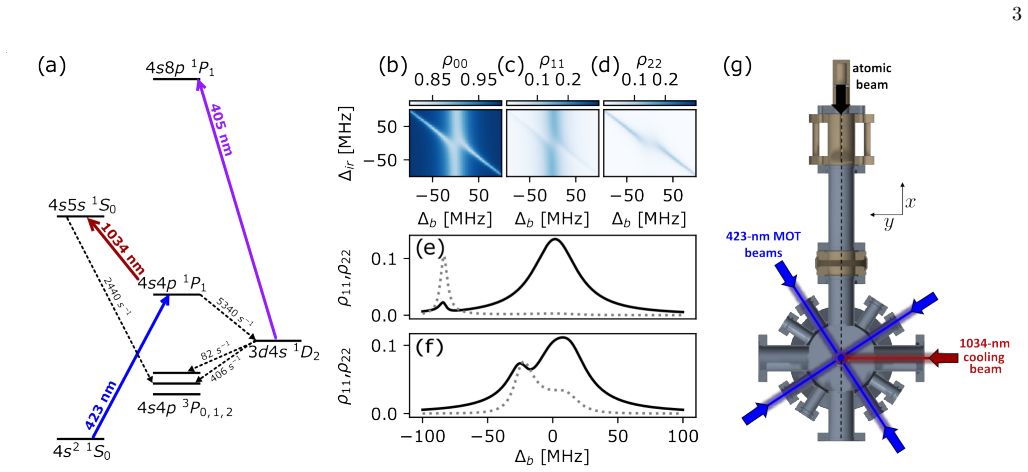
The load-bearing mechanism is the dressing of the 4s4p 1P1 state by the 1034-nm laser, which creates a narrow, asymmetric Fano absorption feature on the 423-nm cooling transition whose width is controlled by the 4s5s 1S0 state (linewidth ≈ 3.88 MHz). This turns the three-level system into an effective two-level narrow-line Doppler cooler, with the steady-state temperature given by the balance between friction and diffusion coefficients computed from a Lindblad master equation for the populations of the magnetic sub-levels of the 1P1 and 4s5s 1S0 states. The polarization of the dressing beam must satisfy angular momentum conservation with the cooling beams, which explains the measured dependence of cooling efficiency on the dressing-beam polarization angle.
What would settle it
Measure the natural linewidth of the 4s5s 1S0 state directly, for example by two-photon spectroscopy on a cold, trapped calcium sample; if it is substantially larger than 3.88 MHz, the predicted 93 μK limit and the 'no extra loss channel' claim would break down, and the 260 μK temperature would need a different explanation.
Extended reading notes
Core claim
The paper reports that adding a single 1034-nm laser beam, which couples the 4s4p 1P1 state to the 4s5s 1S0 state, turns an ordinary 423-nm calcium magneto-optical trap into a sub-Doppler cooler. Atoms are driven on the two-photon transition 4s2 1S0 → 4s5s 1S0 (via 1P1), and because the upper state has a linewidth of about 3.88 MHz (Doppler limit 93 μK) rather than the 35 MHz of the 1P1 state, the effective cooling transition is much narrower. The authors measure temperatures down to 260(30) μK along the vertical axis, about a factor of three below the 0.8 mK Doppler limit of the 1P1 state, with a transfer efficiency of 96% from the pre-cooled MOT and no measurable reduction in atom lifetime due to the dressing beam over an 800-ms cooling pulse.
Load-bearing premise
The quantitative agreement between theory and the measured temperatures presumes the natural linewidth of the 4s5s 1S0 state is about 3.88 MHz and that this state decays back into the cooling cycle roughly 10,000 times more often than it leaks to the 3P1 state.
Editorial extensions
If this is right
- A single 1034-nm beam can replace the two-stage MOT sequence for calcium, simplifying experimental setups and reducing atom loss.
- The effective linewidth of the cooling transition can be tuned by choosing the upper state and the detunings, so the method should generalize to other alkaline-earth species provided the upper state has no strong lossy decay channels.
- In optical dipole traps, where radiation pressure is not needed for confinement, the scheme should reach temperatures close to the 93 μK Doppler limit of the 4s5s 1S0 state, since the large-detuning loss limitation disappears.
- The near-100% transfer efficiency and unchanged lifetime make it a viable bridge between a first-stage broad-line MOT and a subsequent narrow-line MOT or optical potential loading.
- The observed longer lifetime of the two-photon MOT at large blue detuning indicates that the dressing beam enhances absorption of the 423-nm photons, strengthening confinement.
Reading between the lines
- Editorial inference: The reported 260 μK vertical temperature and the roughly 400 μK horizontal temperature are geometry-specific; a retro-reflected or multi-beam dressing configuration could cool isotropically and close that gap.
- Editorial inference: If the upper-state linewidth uncertainty is resolved and a higher branching ratio is confirmed, the same two-photon dressing idea could be applied to even narrower states in other alkaline-earth atoms to push toward sub-microkelvin temperatures in a single MOT.
- Editorial inference: The polarization constraint implies that the optimum dressing-beam polarization will differ for different MOT beam geometries, so the 50° angle is not a universal setting but a guide for other setups.
- Editorial inference: Combining this two-photon stage with a subsequent narrow-line cooling stage might yield microkelvin temperatures without the usual transfer losses, since the dressing beam already provides near-unit transfer between stages.
Editorial analysis
A structured set of objections, weighed in public.
Referee Report
Summary. The manuscript reports sub-Doppler cooling of 40Ca atoms in a magneto-optical trap using a two-photon transition 1S0 -> 1P1 -> 4s5s 1S0 driven by a single 1034-nm dressing beam. Time-of-flight measurements yield a minimum vertical temperature of 260(30) microkelvin at a 423-nm detuning of -3.5 Gamma_b, well below the 0.8 mK Doppler limit of the 1P1 state. The authors characterize temperature, transfer efficiency (about 96% at the coldest operating point), lifetime (1/e = 223(2) ms), and polarization dependence, and compare their data with master-equation simulations of the light forces and steady-state temperatures. They argue that the scheme provides a simpler alternative to the standard two-stage MOT sequence for alkaline-earth atoms, with close to unit transfer efficiency and no additional loss channel.
Significance. The central experimental result is robust: the 260 microkelvin temperature is a direct time-of-flight measurement and lies a factor of three below the single-photon Doppler limit, independent of the uncertain upper-state linewidth. If the quantitative comparison with theory is confirmed, the scheme offers a practical single-dressing-beam cooling method for calcium and similar alkaline-earth atoms, with potential relevance for optical-tweezer and clock experiments. Strengths of the paper include the direct temperature measurement, systematic studies of detunings and polarization, a lifetime analysis showing no loss attributable to the dressing beam, and a reproducible simulation framework based on the Lindblad master equation with literature atomic data; the conjugate-gradient optimization in Appendix B scans experimental control parameters rather than fitting outputs.
major comments (1)
- [Section II; Fig. 2(b-d); Appendix A] The theoretical curves and the quoted 93 microkelvin Doppler limit depend critically on the assumed linewidth Gamma_ir/2pi = 3.88 MHz of the 4s5s 1S0 state, which the text itself acknowledges is not well known, with several works reporting different values [26,29]. The manuscript does not quantify how the predicted temperatures in Fig. 2 and the 93 microkelvin limit would change if Gamma_ir took the alternative literature values, nor how the loss-rate estimate in Section IV depends on this parameter. Because the abstract claims 'good agreement' with simulations, please add a sensitivity analysis or uncertainty band for the theoretical curves and explicitly state the dependence of the predicted Doppler limit and the loss-rate estimate on Gamma_ir.
minor comments (7)
- [Section III] Please correct the typo 'dissapear' to 'disappear' in the description of the transient behavior of two-photon cooling.
- [Section IV] Please correct the typo 'This limitations can be overcome' to 'These limitations can be overcome'.
- [Section I] The phrase 'SW AP MOT' appears to be a typo; it should read 'SWAP MOT' as in the cited reference [35].
- [Fig. 2(a)] The color scale in Fig. 2(a) is not defined in the caption; please state explicitly that it represents the measured vertical cloud width and provide the units.
- [Section IV and Fig. 4(b)] Please clarify the comparison in Fig. 4(b) inset: are the lifetime data without the 1034-nm beam taken at the same 423-nm power and detuning conditions as the two-photon MOT data? A sentence specifying the parameter set would aid the reader.
- [Appendix A] In Eq. (1), the notation rho^{(i+ir)}_{11} and rho^{(i+ir)}_{22} is used before it is fully introduced; please define these quantities explicitly as the steady-state diagonal density-matrix elements obtained from the Lindblad master equation in the presence of the ith blue beam and the infrared beam.
- [Section III] Please provide more detail on the time-of-flight temperature extraction: the number of expansion times used, the fitting function for the cloud width, and how the quoted 30 microkelvin statistical uncertainty is obtained.
Circularity Check
No circularity: the measured temperatures are direct time-of-flight observables, and the theoretical simulation uses literature atomic parameters without fitting to the data.
full rationale
The derivation chain is not circular. The headline temperature of 260(30) microkelvin is obtained from time-of-flight expansion of the cloud, a direct measurement that does not take the linewidth of the 4s5s 1S0 state or any simulation output as input. The theoretical curves in Figs. 2-3 and Appendix B are produced by solving the Lindblad master equation (Appendix A, Eqs. 1-4) with literature values for transition linewidths, saturation intensities, and the stated experimental beam parameters; the populations rho11 and rho22 are computed, not fitted. The conjugate-gradient optimization in Appendix B varies the 1034-nm detuning and intensity for each 423-nm detuning, searching over laser control parameters rather than over the measured temperatures. The paper explicitly discloses that the upper-state linewidth Gamma_ir/2pi = 3.88 MHz from Ref. [36] is not well known and that several works report different values [26,29]; this is a parameter-uncertainty limitation that affects the quantitative theory comparison and the projected 93 microkelvin Doppler limit, but it is not a case of the prediction being equivalent to its inputs by construction. There are no load-bearing self-citations and no fitted parameter is renamed as a prediction. The central experimental demonstration of sub-Doppler cooling therefore stands independently of the theory comparison.
Assumptions & free parameters
free parameters (1)
- Upper-state linewidth Gamma_ir of 4s5s 1S0 =
3.88 MHz (literature value, not fitted here)
assumptions (4)
- domain assumption Low-saturation independent-beam radiation-pressure model
- domain assumption Literature values for the 4s5s 1S0 linewidth and decay branching ratios
- domain assumption Ballistic time-of-flight expansion measures cloud temperature
- domain assumption Atoms decaying to 3P1 are recaptured by the MOT
Cite this review
Pith. "Pith review of Two-photon cooling of calcium atoms." pith.science (2026). https://pith.science/paper/ZIOQANCJ
@misc{pith2026241116402,
  author       = {Pith},
  title        = {Pith review of: Two-photon cooling of calcium atoms},
  year         = {2026},
  howpublished = {\url{https://pith.science/paper/ZIOQANCJ}},
  note         = {Machine review of arXiv:2411.16402}
}
abstract
We demonstrate sub-Doppler cooling of calcium atoms using a two-photon transition from the ${^1}S_0$ ground state to the upper $4s5s~{^1}S_0$ state via the ${^1}P_1$ intermediate state. We achieve temperatures as low as $260~\mu\text{K}$ in a magneto-optical trap (MOT), well below the Doppler limit ($T_{\text{D}} = 0.8~\text{mK}$) of the ${^1}P_1$ state. We characterize temperature, lifetime and confinement of the MOT over a range of experimental parameters, observing no reduction in lifetime due to coupling to the higher state. We perform theoretical simulations of the cooling scheme and observe good agreement with the experimental results. The two-photon cooling scheme presented in this work provides an alternative to the standard Doppler cooling applied to alkaline-earth atoms, based on a sequence of two magneto-optical traps. The advantages of our scheme are the possibility of varying the effective linewidth of the ${^1}P_1$ state, a higher transfer efficiency (close to 100$\%$), and a more straightforward experimental implementation.
Figures


Figures from the paper (1 more)

Reference graph
Works this paper leans on
-
[36]
W. C. Magno and F. C. Cruz, Journal of Physics B: Atomic, Molecular and Optical Physics 54, 145301 (2021)
work page 2021
-
[1]
A. D. Ludlow, M. M. Boyd, J. Ye, E. Peik, and P. O. Schmidt, Rev. Mod. Phys. 87, 637 (2015)
2015
-
[2]
T. Bothwell, D. Kedar, E. Oelker, J. M. Robinson, S. L. Bromley, W. L. Tew, J. Ye, and C. J. Kennedy, Metrolo- gia 56, 065004 (2019)
work page 2019
- [3]
-
[4]
Cooper, J
A. Cooper, J. P. Covey, I. S. Madjarov, S. G. Porsev, M. S. Safronova, and M. Endres, Phys. Rev. X 8, 041055 (2018)
2018
-
[5]
M. A. Norcia, A. W. Young, and A. M. Kaufman, Phys. Rev. X 8, 041054 (2018)
work page 2018
-
[6]
C. H¨ olzl, A. G¨ otzelmann, M. Wirth, M. S. Safronova, S. Weber, and F. Meinert, Phys. Rev. Res. 5, 033093 8 (2023)
work page 2023
- [7]
Show all 43 references
-
[8]
S. Ma, A. P. Burgers, G. Liu, J. Wilson, B. Zhang, and J. D. Thompson, Phys. Rev. X 12, 021028 (2022)
2022
-
[9]
I. S. Madjarov, J. P. Covey, A. L. Shaw, J. Choi, A. Kale, A. Cooper, H. Pichler, V. Schkolnik, J. R. Williams, and M. Endres, Nature Physics 16, 857 (2020)
2020
-
[10]
Y. Wu, S. Kolkowitz, S. Puri, and J. D. Thompson, Nature Communications 13, 4657 (2022)
2022
-
[11]
Scholl, A
P. Scholl, A. L. Shaw, R. B.-S. Tsai, R. Finkelstein, J. Choi, and M. Endres, Nature 622, 273 (2023)
2023
-
[12]
S. Ma, G. Liu, P. Peng, B. Zhang, S. Jandura, J. Claes, A. P. Burgers, G. Pupillo, S. Puri, and J. D. Thompson, Nature 622, 279 (2023)
2023
-
[13]
J. T. Wilson, S. Saskin, Y. Meng, S. Ma, R. Dilip, A. P. Burgers, and J. D. Thompson, Phys. Rev. Lett. 128, 033201 (2022)
2022
-
[14]
H¨ olzl, A
C. H¨ olzl, A. G¨ otzelmann, E. Pultinevicius, M. Wirth, and F. Meinert, Phys. Rev. X 14, 021024 (2024)
2024
-
[15]
Bouillon, E
A. Bouillon, E. Marin-Bujedo, and M. G´ en´ evriez, Phys. Rev. Lett. 132, 193402 (2024)
2024
-
[16]
Lachaud, B
L. Lachaud, B. Muraz, A. Couto, J.-M. Raimond, M. Brune, and S. Gleyzes, Phys. Rev. Lett. 133, 123202 (2024)
2024
-
[17]
A. Muni, L. Lachaud, A. Couto, M. Poirier, R. C. Teix- eira, J.-M. Raimond, M. Brune, and S. Gleyzes, Nature Physics 18, 502 (2022)
2022
-
[18]
A. P. Burgers, S. Ma, S. Saskin, J. Wilson, M. A. Alarc´ on, C. H. Greene, and J. D. Thompson, PRX Quantum 3, 020326 (2022)
2022
-
[19]
Wirth, C
M. Wirth, C. H¨ olzl, A. G¨ otzelmann, E. Pultinevicius, and F. Meinert, Phys. Rev. Lett. 133, 123403 (2024)
2024
-
[20]
P. D. Lett, R. N. Watts, C. I. Westbrook, W. D. Phillips, P. L. Gould, and H. J. Metcalf, Phys. Rev. Lett. 61, 169 (1988)
1988
-
[21]
Dalibard and C
J. Dalibard and C. Cohen-Tannoudji, J. Opt. Soc. Am. B 6, 2023 (1989)
1989
-
[22]
Binnewies, G
T. Binnewies, G. Wilpers, U. Sterr, F. Riehle, J. Helm- cke, T. E. Mehlst¨ aubler, E. M. Rasel, and W. Ertmer, Phys. Rev. Lett. 87, 123002 (2001)
2001
-
[23]
E. A. Curtis, C. W. Oates, and L. Hollberg, Physical Review A 64, 031403 (2001)
2001
-
[24]
E. A. Curtis, C. W. Oates, and L. Hollberg, Journal of the Optical Society of America B 20, 977 (2003)
2003
-
[25]
Gr¨ unert and A
J. Gr¨ unert and A. Hemmerich, Physical Review A 65, 041401 (2002)
2002
-
[26]
W. C. Magno, R. L. Cavasso Filho, and F. C. Cruz, Phys. Rev. A 67, 043407 (2003)
2003
-
[27]
Malossi, S
N. Malossi, S. Damkjær, P. L. Hansen, L. B. Jacobsen, L. Kindt, S. Sauge, J. W. Thomsen, F. C. Cruz, M. Alle- grini, and E. Arimondo, Phys. Rev. A 72, 051403 (2005)
2005
-
[28]
T. E. Mehlst¨ aubler, K. Moldenhauer, M. Riedmann, N. Rehbein, J. Friebe, E. M. Rasel, and W. Ertmer, Phys. Rev. A 77, 021402 (2008)
2008
-
[29]
Mills, P
M. Mills, P. Puri, Y. Yu, A. Derevianko, C. Schneider, and E. R. Hudson, Phys. Rev. A 96, 033402 (2017)
2017
-
[30]
X. Xu, T. H. Loftus, M. J. Smith, J. L. Hall, A. Gal- lagher, and J. Ye, Physical Review A 66, 011401 (2002)
2002
-
[31]
Rehbein, T
N. Rehbein, T. E. Mehlst¨ aubler, J. Keupp, K. Molden- hauer, E. M. Rasel, W. Ertmer, A. Douillet, V. Michels, S. G. Porsev, A. Derevianko, C. Froese Fischer, G. I. Tachiev, and V. G. Pal’chikov, Physical Review A 76, 043406 (2007)
2007
-
[32]
Katori, T
H. Katori, T. Ido, Y. Isoya, and M. Kuwata-Gonokami, Phys. Rev. Lett. 82, 1116 (1999)
1999
-
[33]
Chaneli` ere, L
T. Chaneli` ere, L. He, R. Kaiser, and D. Wilkowski, The European Physical Journal D 46, 507 (2008)
2008
-
[34]
M. A. Norcia, J. R. K. Cline, J. P. Bartolotta, M. J. Holland, and J. K. Thompson, New Journal of Physics 20, 023021 (2018)
2018
-
[35]
Snigirev, A
S. Snigirev, A. J. Park, A. Heinz, I. Bloch, and S. Blatt, Phys. Rev. A 99, 063421 (2019)
2019
-
[37]
Morigi and E
G. Morigi and E. Arimondo, Phys. Rev. A 75, 051404 (2007)
2007
-
[38]
J. W. Dunn, J. W. Thomsen, C. H. Greene, and F. C. Cruz, Phys. Rev. A 76, 011401 (2007)
2007
-
[39]
Derevianko, Phys
A. Derevianko, Phys. Rev. Lett. 87, 023002 (2001)
2001
-
[40]
Wieman and T
C. Wieman and T. W. H¨ ansch, Phys. Rev. Lett.36, 1170 (1976)
1976
-
[41]
Shimada, Y
Y. Shimada, Y. Chida, N. Ohtsubo, T. Aoki, M. Takeuchi, T. Kuga, and Y. Torii, Re- view of Scientific Instruments 84, 063101 (2013), https://pubs.aip.org/aip/rsi/article- pdf/doi/10.1063/1.4808246/15967071/063101 1 online.pdf
2013 doi
-
[42]
Johansson, P
J. Johansson, P. Nation, and F. Nori, Computer Physics Communications 183, 1760 (2012)
2012
-
[43]
Virtanen, R
P. Virtanen, R. Gommers, T. E. Oliphant, M. Haber- land, T. Reddy, D. Cournapeau, E. Burovski, P. Pe- terson, W. Weckesser, J. Bright, S. J. van der Walt, M. Brett, J. Wilson, K. J. Millman, N. Mayorov, A. R. J. Nelson, E. Jones, R. Kern, E. Larson, C. J. Carey, ˙I. Po- lat, Y...
2020
Reviewed August 12, 2026 · model on record in the stance chip above.
Discussion (0). Continue with ORCID to comment.