REVIEW 3 major objections 5 minor 1 cited by
Back to the Figure-8 Stellarator
T0 review · 3 major / 5 minor · reviewed 2026-08-12 · deepseek-v4-flash
Pith's one-line read A re-imagined figure-8 stellarator is the first quasi-isodynamic design that can be built with planar racetrack coils.
desk verdict A genuinely new QI figure-8 design with planar coils, but the headline claim hangs on a coil-field omnigenity check that the paper doesn't actually perform. read the letter →
The pith
A machine-rendered reading of the paper's core claim, the machinery that carries it, and where it could break.
The reading
What carries the argument
The load-bearing object is the magnetic axis curve: a two-field-period space curve whose signed curvature has double zeros at field maxima and triple zeros at minima, and whose torsion is nearly zero. The Călugăreanu-White-Fuller relation links the axis self-linking number M to integrated torsion (twist) plus writhe; in the figure-8 limit twist vanishes and writhe carries M. This allows the first-order near-axis construction to satisfy the omnigenity solubility condition with alpha-prime approximately iota-0, keeping the elliptical cross-sections aligned with the Frenet frame. The same low torsion removes the 'twisting' term in the second-order magnetic-well expression, so only mild shaping is needed for a well.
What would settle it
Compute the effective ripple of the coil-generated field: if the coil field no longer confines trapped-particle drift orbits (large ripple) despite matching Poincare surfaces, the planar-coil QI claim fails.
Extended reading notes
Core claim
Starting from near-axis theory of QI fields, the authors construct magnetic-axis curves with two field periods, N=2, and axis helicity M=1, parameterized by an inclination angle gamma. As gamma grows, the axis approaches a planar lemniscate and its integrated torsion drops, with the Călugăreanu-White-Fuller formula showing that self-linking is carried by writhe. This 'rotation without twisting' makes the first-order boundary nearly elliptical and aligned with the signed Frenet frame, so that a vacuum magnetic well can be produced with only small second-order deformations. Optimizing one configuration (inclination 0.374pi, aspect ratio raised to 10) with planar coils yields a maximum normal field error of 5.1% and mean of 1.4%, with Poincare surfaces matching the design field. The paper claims this is the first quasi-isodynamic stellarator design admitting planar coils, and connects both the stability tendency and the coil simplicity to the low torsion of the axis.
Load-bearing premise
The coil set is assumed to keep the good magnetic-field structure of the design; the paper verifies that the surfaces line up but does not verify that the coil field still confines particles the way the design field does.
Editorial extensions
If this is right
- If the central claim holds, quasi-isodynamic stellarators no longer require complex three-dimensionally shaped coils; a two-shape planar racetrack set with 64 coils reaches 5.1% maximum field error.
- Low axis torsion can serve as a design target for future optimization, since it simultaneously reduces boundary shaping requirements and strengthens the vacuum magnetic well.
- The figure-8 configuration addresses the historical stability objection by demonstrating compatibility with a stabilizing vacuum magnetic well of 0.8% depth.
- Near-axis construction combined with a generalized Frenet-frame equilibrium solver can handle axis shapes that standard cylindrical-coordinate codes cannot, opening a broader class of exotic configurations to optimization.
Reading between the lines
- If the planar-coil result is robust, coil simplification may extend to other high-writhe configurations beyond exact figure-8s, since the mechanism is low torsion rather than the specific lemniscate shape.
- The 5.1% maximum normal field error (mean 1.4%) leaves open whether the coil field is truly omnigenous; a next step would be computing effective ripple or drift-orbit losses for the coil field directly.
- The 'rotation without twisting' principle suggests an inverse design strategy: prescribe axis writhe and minimize integrated torsion as a proxy for coil complexity, which might generalize to higher field-period numbers N>2.
- A small modular figure-8 experiment could test the coil simplicity in practice, since the planar coil shapes and modest aspect ratio make construction unusually accessible.
Editorial analysis
A structured set of objections, weighed in public.
Referee Report
Summary. This paper revisits Spitzer's figure-8 stellarator concept using modern near-axis expansion (NAE) theory and the GVEC equilibrium solver. The authors construct a family of N=2 quasi-isodynamic (QI) configurations with varying axis inclination, characterized by low torsion and high writhe, and optimize the boundary shape for a vacuum magnetic well. They report that the maximum achievable well depth increases monotonically with inclination angle, and that the QI proxy error ΔB decreases. They then present a single configuration with an aspect ratio of 10, for which they design a set of 64 planar racetrack coils using ONSET, with a maximum boundary normal field error of 5.1% and a mean error of 1.4%. They claim this is the first quasi-isodynamic stellarator design with planar coils.
Significance. If the QI property is confirmed, the result is significant: it brings together favorable stability, weak boundary shaping, and coil simplicity in a single stellarator concept, and demonstrates the utility of NAE-based construction and GVEC for non-standard topologies. The magnetic well optimization across eight cases is a concrete numerical result that supports the theoretical argument connecting low axis torsion to stability. The paper also provides a useful link between axis geometry (writhe versus twist) and coil complexity. However, the headline claim depends on QI verification that is currently incomplete.
major comments (3)
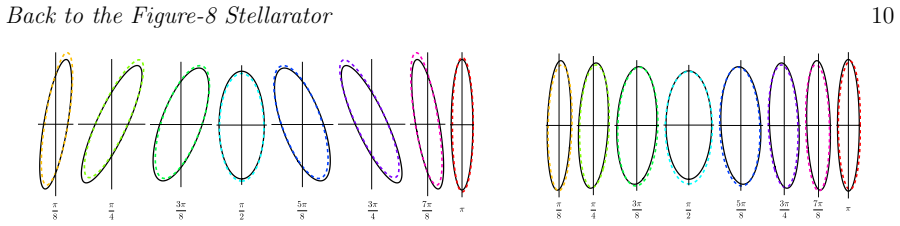
- [Sec. 5.1, Fig. 10] The quasi-isodynamic property of the coil-generated field is never assessed. The manuscript verifies only the alignment of Poincaré surfaces and reports the boundary normal field error (max 5.1%, mean 1.4%). Nested flux surfaces do not imply omnigenity: QI requires the field strength |B| to be nearly independent of the Boozer poloidal angle on each flux surface, which the Poincaré plot cannot diagnose. The 5.1% maximum error is not obviously small compared with the 30% mirror ratio and the deliberate flatness condition B_0''=0 at the minima (Sec. 2.1). Therefore, the claim that this is the first quasi-isodynamic stellarator design with planar coils is not supported by the evidence presented.
- [Secs. 3 and 4] The only QI quality metric used, ΔB, is defined as the RMS deviation of |B| from the first-order near-axis prediction (Sec. 3). This is a self-consistency check of the NAE construction rather than an independent omnigenity metric, and it is computed only for the unshaped (ν=1) boundaries (Sec. 4). The final design of Section 5 has been re-optimized for a magnetic well, so its boundary differs from the ν=1 case; no QI metric is reported for that boundary. Consequently, the QI quality of the actual design presented in Section 5, and the effect of the well optimization on QI, are unknown.
- [Abstract and Sec. 6] The priority claim 'first quasi-isodynamic stellarator design' with planar coils rests entirely on the QI verification discussed above. Since the coil field's omnigenity is not demonstrated, and the design field's QI is only characterized by the near-axis self-consistency metric for the unshaped boundary, the claim should be either revised to a more limited statement (e.g., 'first figure-8 configuration with planar coils constructed from near-axis QI theory') or supported by direct omnigenity metrics (e.g., effective ripple ε_eff, Boozer spectrum) computed for the coil-field equilibrium.
minor comments (5)
- [Sec. 5.1, text near Fig. 9] The phrase 'mean error if 1.4%' contains a typo; it should read 'mean error of 1.4%'.
- [Sec. 2.2 and Ref. [15]] The method of solving the sigma equation with elongation as input is deferred to reference [15], which is listed as 'in preparation'; this makes the construction not fully self-contained. Please clarify or include the essential equations.
- [Fig. 1 and Table 1] The table appears three times with different subsets of rows, which is redundant and confusing; consider merging into a single table with all reported quantities.
- [Sec. 5.1] The total number of coils (64 total, 16 independent) is not prominently stated in the abstract; since 'simple construction' is a headline, the coil count should be mentioned early in the paper.
- [Eq. (4) and footnote] The mirror ratio is defined in a footnote that differs from the standard definition; please define the convention used in the text to avoid ambiguity.
Circularity Check
No significant circularity: the planar-coil result is an independent constrained-optimization outcome, and the NAE-based ΔB metric is a self-consistency check rather than a fitted prediction.
full rationale
The paper's derivation chain is a forward design: the magnetic axis ansatz, the chosen B0 profile, the sigma-equation solution, and the prescribed elongation define a plasma boundary; GVEC then solves the equilibrium independently of the near-axis construction. The ΔB metric compares the GVEC field strength to the first-order NAE field B0 + εB1, so it is a consistency check of the NAE construction rather than a parameter fit renamed as a prediction. The planar-coil claim comes from NESCOIL and ONSET optimization subject to a planarity constraint; the 5.1% maximum normal-field error, the 1.4% mean error, and the Poincaré alignment in Fig. 10 are outputs of that optimization, not inputs, so the existence of a planar coil set is not forced by construction. Several enabling results are cited from the authors' prior work (near-axis QI theory, the GVEC coordinate extension), but these are published or arXiv-documented methods with stated assumptions, and they are used as tools rather than invoked as an unverified uniqueness theorem to forbid alternatives. The main weakness, that the coil field's omnigenity is not directly checked—only flux-surface alignment is shown—is a gap in support for the 'first QI stellarator with planar coils' claim, but that is a correctness risk, not circularity. Under the rule that unsupported claims and non-consensus are not circularity arguments, the score is 0.
Assumptions & free parameters
free parameters (5)
- axis torsion amplitude τ1 (or inclination angle γ) =
τ0 range 0.2935 to 0.9066, γ from 0.0786π to 0.4223π
- on-axis field strength harmonics (0.3, 0.075 in Eq. 4) =
B0 = 1 + 0.3 cos(2ℓ) + 0.075 cos(4ℓ)
- elongation profile parameters ρ0, ρ1 =
ρ0=4.5, ρ1=1.7 for the sequence; ρ1=2.3 for the coil design
- aspect ratio =
8, then increased to 10
- surface deformation control points ν =
bounded 0.9-1.1, 5x5 grid
assumptions (4)
- domain assumption Near-axis expansion (NAE) at first and second order is valid at the chosen finite aspect ratio (8-10)
- domain assumption Vacuum magnetic well (d²V/dψ²) is a sufficient proxy for the MHD stability relevant to the figure-8 design
- domain assumption The axis family with signed Frenet frame and the α(φ) choice from ref [16] yields a quasi-isodynamic field
- domain assumption GVEC equilibrium solutions with the generalized Frenet frame accurately represent the device field, and NESCOIL/ONSET coil fields are accurate
Cite this review
Pith. "Pith review of Back to the Figure-8 Stellarator." pith.science (2026). https://pith.science/paper/UHCDPUU6
@misc{pith2026241116411,
  author       = {Pith},
  title        = {Pith review of: Back to the Figure-8 Stellarator},
  year         = {2026},
  howpublished = {\url{https://pith.science/paper/UHCDPUU6}},
  note         = {Machine review of arXiv:2411.16411}
}
read the original abstract
The first stellarator design was a simple tube of plasma twisted and closed on itself in the form of a figure-8. The line of such devices, however, was quickly ended over concerns related to plasma stability. We revisit the figure-8 concept, re-imagined as a modern optimized stellarator, and find the potential for a high degree of stability, as well as exceptionally simple construction. In particular, the design that we find admits planar coils, and is the first quasi-isodynamic stellarator design to have this property. Our work is made possible by recent theoretical progress in the near-axis theory of quasi-isodynamic stellarators, combined with fundamental progress in the numerical solution of three-dimensional magnetohydrodynamic equilibria that cannot be well represented using traditional cylindrical coordinates.
Figures


Figures from the paper (6 more)


Forward citations
Cited by 1 Pith paper
-
Near-axis quasi-isodynamic database
A public database of over 800,000 near-axis quasi-isodynamic stellarator configurations with computed stability, transport, and coil-complexity proxies, plus statistical heuristics for design.
Reference graph
Works this paper leans on
-
[1]
Fusion: science, politics, and the invention of a new energy source
Bromberg JL. Fusion: science, politics, and the invention of a new energy source. Cambridge, Mass.: MIT Press; 1982
work page 1982
-
[2]
Highlights in early stellarator research at Princeton
Stix TH. Highlights in early stellarator research at Princeton. J Plasma Fusion Res SERIES. 1998;1:3-8
work page 1998
-
[3]
Preliminary Experimental Results with the Model A Stellarator
Goldman L, Spitzer Jr L. Preliminary Experimental Results with the Model A Stellarator. Princeton Univ., NJ Project Matterhorn; 1953
work page 1953
-
[4]
A Conceptual Design of the Model C Stellarator; 1956
Farber WR, Fraser JC, Grove DJ, Mills RG, Rashevsky M, Schultz MA, et al.. A Conceptual Design of the Model C Stellarator; 1956. U.S. Atomic Energy Commision Report No. NYO- 7309 (PMS-19). Available from: https://www.osti.gov/biblio/4299735
-
[5]
Problems of the stellarator as a useful power source
Spitzer Jr L, Grove D, Johnson W, Tonks L, Westendorp W. Problems of the stellarator as a useful power source. Princeton Univ., NJ Project Matterhorn; 1954
work page 1954
-
[6]
Spitzer J Lyman. The Stellarator Concept. The Physics of Fluids. 1958 07;1(4):253-64. Available from: https://doi.org/10.1063/1.1705883
-
[7]
Bishop AS. Project Sherwood; the U.S. program in controlled fusion. United States of America: Addison-Wesley Pub. Co.; 1958
work page 1958
-
[8]
GVEC: a newly developed 3D ideal MHD Galerkin variational equilibrium code; 2019
Hindenlang F, Maj O, Strumberger E, Rampp M, Sonnendr¨ ucker E. GVEC: a newly developed 3D ideal MHD Galerkin variational equilibrium code; 2019. Annual Meeting of the Simons Collaboration on Hidden Symmetries and Fusion Energy
work page 2019
Show all 53 references
-
[9]
DESC: A stellarator equilibrium solver
Dudt DW, Kolemen E. DESC: A stellarator equilibrium solver. Physics of Plasmas. 2020 Oct;27(10):102513. Available from: https://doi.org/10.1063/5.0020743
2020 doi
-
[10]
Quasi-isodynamic Stellarators
Gori S, Lotz W, N¨ uhrenberg J. Quasi-isodynamic Stellarators. Theory of Fusion Plasmas (Proc Joint Varenna-Lausanne Int Workshop). 1996:335-42. Back to the Figure-8 Stellarator 17
1996
-
[11]
Bootstrap current and neoclassical transport in quasi-isodynamic stellarators
Helander P, N¨ uhrenberg J. Bootstrap current and neoclassical transport in quasi-isodynamic stellarators. Plasma Physics and Controlled Fusion. 2009 feb;51(5):055004. Available from: https://doi.org/10.1088/0741-3335/51/5/055004
2009 doi
-
[12]
Development of quasi-isodynamic stellarators
N¨ uhrenberg J. Development of quasi-isodynamic stellarators. Plasma Physics and Controlled Fusion. 2010;52(12):124003. Available from: http://stacks.iop.org/0741-3335/52/i=12/ a=124003
2010
-
[13]
Direct construction of optimized stellarator shapes
Plunk GG, Landreman M, Helander P. Direct construction of optimized stellarator shapes. Part
-
[14]
Journal of Plasma Physics
Omnigenity near the magnetic axis. Journal of Plasma Physics. 2019;85(6):905850602
2019
-
[15]
Direct construction of stellarator symmetric N -field period magnetic configurations
Camacho Mata K, Plunk GG, Jorge R. Direct construction of stellarator symmetric N -field period magnetic configurations. Journal of Plasma Physics (to be submitted). 2022
2022
-
[16]
A geometric approach to constructing quasi-isodynamic fields; 2024
Plunk GG, et al. A geometric approach to constructing quasi-isodynamic fields; 2024. In preparation
2024
-
[17]
Near-axis description of stellarator-symmetric quasi-isodynamic stellarators to second order; 2024
Rodr ´ ıguez E, Plunk GG, Jorge R. Near-axis description of stellarator-symmetric quasi-isodynamic stellarators to second order; 2024. Available from: https://arxiv.org/abs/2409.20328
2024 arXiv
-
[18]
A generalized Frenet frame for computing MHD equilibria in stellarators
Hindenlang F, Plunk GG, Maj O. A generalized Frenet frame for computing MHD equilibria in stellarators. Plasma Physics and Controlled Fusion submitted. 2024. Available from: https://arxiv.org/abs/2410.17595
2024 arXiv
-
[19]
pyGVEC: python interface to the equilibrium solver GVEC for integration into stellarator optimization
Babin R, et al. pyGVEC: python interface to the equilibrium solver GVEC for integration into stellarator optimization. in preparation. 2024
2024
-
[20]
A single- field-period quasi-isodynamic stellarator
Jorge R, Plunk GG, Drevlak M, Landreman M, Lobsien JF, Camacho Mata K, et al. A single- field-period quasi-isodynamic stellarator. Journal of Plasma Physics. 2022;88(5):175880504
2022
-
[21]
Direct construction of optimized stellarator shapes
Landreman M, Sengupta W. Direct construction of optimized stellarator shapes. Part 1. Theory in cylindrical coordinates. Journal of Plasma Physics. 2018;84(6):905840616
2018
-
[22]
Transport and isomorphic equilibria
Boozer AH. Transport and isomorphic equilibria. The Physics of Fluids. 1983 02;26(2):496-9. Available from: https://doi.org/10.1063/1.864166
1983 doi
-
[23]
Quasi-helically symmetric toroidal stellarators
N¨ uhrenberg J, Zille R. Quasi-helically symmetric toroidal stellarators. Physics Letters A. 1988;129(2):113 117. Available from: http://www.sciencedirect.com/science/article/ pii/0375960188900801
1988
-
[24]
Necessary and sufficient conditions for quasisymmetry
Rodriguez E, Helander P, Bhattacharjee A. Necessary and sufficient conditions for quasisymmetry. Physics of Plasmas. 2020;27(6)
2020
-
[25]
Sur les courbes ` a double courbure
Frenet F. Sur les courbes ` a double courbure. Journal de math´ ematiques pures et appliqu´ ees. 1852;17:437-47
-
[26]
Differential geometry and topology of curves
Animov Y. Differential geometry and topology of curves. CRC press; 2001
2001
-
[27]
Magnetic field strength of toroidal plasma equilibria
Garren DA, Boozer AH. Magnetic field strength of toroidal plasma equilibria. Physics of Fluids B. 1991;3(10):2805-21. Available from: http://scitation.aip.org/content/aip/journal/ pofb/3/10/10.1063/1.859915
1991 doi
-
[28]
The Quasi-isodynamic Stellarator; 2023
Plunk GG. The Quasi-isodynamic Stellarator; 2023. Simons Col- laboration on Hidden Symmetries and Fusion Energy Annual Meet- ing. Available from: https://www.simonsfoundation.org/event/ simons-collaboration-on-hidden-symmetries-and-fusion-energy-annual-meeting-2023/
2023
-
[29]
Improving Frenet’s frame using Bishop’s frame
Carroll D, K¨ ose E, Sterling I. Improving Frenet’s frame using Bishop’s frame. Journal of Mathematics Research. 2013;5(4):97-106
2013
-
[30]
Stellarator symmetry
Dewar R, Hudson S. Stellarator symmetry. Physica D: Nonlinear Phenomena. 1998;112(1-2):275- 80
1998
-
[31]
Phases and phase-transitions in quasisymmetric configuration space
Rodr ´ ıguez E, Sengupta W, Bhattacharjee A. Phases and phase-transitions in quasisymmetric configuration space. Plasma Physics and Controlled Fusion. 2022;64(10):105006
2022
-
[32]
Helicity of the magnetic axes of quasi-isodynamic stellarators
Mata KC, Plunk GG. Helicity of the magnetic axes of quasi-isodynamic stellarators. Journal of Plasma Physics. 2023;89(6):905890609
2023
-
[33]
Helicity and the C˘ alug˘ areanu invariant
Moffatt HK, Ricca RL. Helicity and the C˘ alug˘ areanu invariant. Proceedings of the Royal Society of London Series A: Mathematical and Physical Sciences. 1992;439(1906):411-29
1906
-
[34]
The geometric and topological structure of holonomic knots
Fuller Jr EJ. The geometric and topological structure of holonomic knots. University of Georgia; Back to the Figure-8 Stellarator 18 1999
1999
-
[35]
The writhing number of a space curve
Fuller F. The writhing number of a space curve. Proc Natl Acad Sci. 1971;68(4):815-9
1971
-
[36]
A catalog of special plane curves
Lawrence JD. A catalog of special plane curves. Courier Corporation; 2013
2013
-
[37]
Direct construction of optimized stellarator shapes
Landreman M, Sengupta W, Plunk GG. Direct construction of optimized stellarator shapes. Part
-
[38]
Journal of Plasma Physics
Numerical quasisymmetric solutions. Journal of Plasma Physics. 2019;85(1):905850103
2019
-
[39]
Magnetohydrodynamic stability and the effects of shaping: a near-axis view for tokamaks and quasisymmetric stellarators
Rodr ´ ıguez E. Magnetohydrodynamic stability and the effects of shaping: a near-axis view for tokamaks and quasisymmetric stellarators. Journal of Plasma Physics. 2023;89(2):905890211
2023
-
[40]
Non-planar elasticae as optimal curves for the magnetic axis of stellarators
Pfefferl´ e D, Gunderson L, Hudson SR, Noakes L. Non-planar elasticae as optimal curves for the magnetic axis of stellarators. Physics of Plasmas. 2018;25(9)
2018
-
[41]
Equilibrium and stability of a toroidal magnetohydrodynamic system in the neighbourhood of a magnetic axis
Mercier C. Equilibrium and stability of a toroidal magnetohydrodynamic system in the neighbourhood of a magnetic axis. Nuclear Fusion. 1964;4(3):213. Available from: http: //stacks.iop.org/0029-5515/4/i=3/a=008
1964
-
[42]
Omnigenity and quasihelicity in helical plasma confinement systems
Cary JR, Shasharina SG. Omnigenity and quasihelicity in helical plasma confinement systems. Physics of Plasmas. 1997;4(9):3323-33. Available from: http://dx.doi.org/10.1063/1. 872473
1997 doi
-
[43]
Optimisation of stellarator equilibria with ROSE
Drevlak M, Beidler CD, Geiger J, Helander P, Turkin Y. Optimisation of stellarator equilibria with ROSE. Nuclear Fusion. 2018 nov;59(1):016010. Available from: https://dx.doi.org/ 10.1088/1741-4326/aaed50
2018 doi
-
[44]
A brief review of magnetic wells
Greene JM. A brief review of magnetic wells. Comments on Plasma Physics and Controlled Fusion. 1997;17:389-402
1997
-
[45]
ideal MHD
Freidberg JP. ideal MHD. Cambridge University Press; 2014
2014
-
[46]
Equilibrium and stability of a toroidal magnetohydrodynamic system in the neighbourhood of a magnetic axis
Mercier C. Equilibrium and stability of a toroidal magnetohydrodynamic system in the neighbourhood of a magnetic axis. Nuclear Fusion. 1964 sep;4(3):213. Available from: https: //dx.doi.org/10.1088/0029-5515/4/3/008
1964 doi
-
[47]
Magnetic well and Mercier stability of stellarators near the magnetic axis
Landreman M, Jorge R. Magnetic well and Mercier stability of stellarators near the magnetic axis. Journal of Plasma Physics. 2020;86(5):905860510
2020
-
[48]
The maximum-J property in quasi-isodynamic stellarators
Rodriguez E, Helander P, Goodman A. The maximum-J property in quasi-isodynamic stellarators. Journal of Plasma Physics. 2024;90(2):905900212
2024
-
[49]
Coil Designs for a Quasi-Axially Symmetric Stellarator
Drevlak M. Coil Designs for a Quasi-Axially Symmetric Stellarator. 20th Symposium on Fusion Technology. Association Euratom-CEA Cadarache;. p. 883
-
[50]
Solution of stellarator boundary value problems with external currents
Merkel P. Solution of stellarator boundary value problems with external currents. Nuclear Fusion. 1987;27(5):253-64
1987
-
[51]
Coils for 3d MHD equilibria
Merkel P, Drevlak M. Coils for 3d MHD equilibria. 25th EPS Conference on Controlled Fusion and Plasma Physics; 1998. p. 1745
1998
-
[52]
Differentiating the shape of stellarator coils with respect to the plasma boundary
Hudson SR, Zhu C, Pfefferl´ e D, Gunderson L. Differentiating the shape of stellarator coils with respect to the plasma boundary. Physics Letters A. 2018;382(38):2732-7. Available from: https://www.sciencedirect.com/science/article/pii/S037596011830759X
2018
-
[53]
Steepest-descent moment method for three-dimensional magnetohy- drodynamic equilibria
Hirshman SP, Whitson JC. Steepest-descent moment method for three-dimensional magnetohy- drodynamic equilibria. The Physics of Fluids. 1983;26(12):3553-68. Available from: http: //aip.scitation.org/doi/abs/10.1063/1.864116
1983 doi
Reviewed August 12, 2026 · model on record in the stance chip above.
Discussion (0). Continue with ORCID to comment.