REVIEW 4 major objections 5 minor 14 references
Persistence and bimodality of large-scale turbulent structures across a Rayleigh-Taylor layer: Impact on transport and physical modelling through two-field-conditional correlations
T0 review · 4 major / 5 minor · reviewed 2026-08-12 · deepseek-v4-flash
Pith's one-line read This paper claims that the turbulent mixing layer produced by the Rayleigh-Taylor instability is organized into two persistent large-scale populations—light fluid moving up and heavy fluid moving down—and that thresholding a space-time…
desk verdict The paper's advertised measurements do not exist in the manuscript: Section 6 is an 'In progress' placeholder, so the abstract's claims of first reference data and 40% directed energy are unsupported by the submitted text. read the letter →
The pith
A machine-rendered reading of the paper's core claim, the machinery that carries it, and where it could break.
The reading
What carries the argument
The load-bearing object is the pair of presence fields b^+ and b^- produced by thresholding a filtered vertical velocity. The filter is a convection-diffusion-relaxation equation with a Lagrangian derivative, a local relaxation rate based on dissipation and longitudinal turbulent kinetic energy, and a global diffusion length based on transverse turbulent kinetic energy; the coefficients C_omega = 1.7, C_ell = 0.15, and C_wedge = 30 are optimized to maximize a bimodality coefficient over the mixing layer. A generalized Otsu threshold then defines the two structure fields. All of the paper's conditional averages, the decomposition of the single-fluid turbulent flux into per-structure fluxes plus a directed flux, and the measured directed-energy ratio inherit their definition from this segmentation, so the filtering-and-threshold procedure is what carries the argument.
What would settle it
Run the same two-structure segmentation on a simulation at higher Atwood number or with time-dependent acceleration and check whether the optimized coefficients and the measured directed-energy ratio stay in the same range; alternatively, compare the b^+ and b^- boundaries against an independent structure-identification method, such as Lagrangian coherent structures or bubble-tracking, in the same DNS and see whether the conditional statistics survive an independent structure definition.
Extended reading notes
Core claim
The central claim is that a turbulent Rayleigh-Taylor mixing layer at low Atwood number can be decomposed, without modelling assumptions, into two complementary presence fields, here denoted b^+ and b^-, defined by thresholding a space-time filtered vertical velocity. The resulting conditionally averaged equations separate the total turbulent flux into two per-structure fluxes plus an inter-structure term, the directed flux, and the simulation shows that the structure fields extend across the entire mixing layer. The probability density function of the filtered separator field is genuinely bimodal across the layer—the bimodality coefficient drops from about 1.6 for the unfiltered velocity to about 0.55 after optimized filtering—and the directed-to-turbulent energy ratio is measured at up to about 40 percent. On this basis the paper asserts that these structure-conditioned averages provide the first known reference data for validating and calibrating two-structure RANS turbulence models.
Load-bearing premise
The entire dataset stands on the definition of the two structure fields: thresholding a filtered vertical velocity with hand-tuned parameters that the paper itself calls a somewhat ad hoc recipe, so if those fields do not correspond to real persistent physical structures, the conditional averages and the 40 percent directed-energy share are artifacts of the segmentation.
Editorial extensions
If this is right
- Two-structure RANS models can now be calibrated against directly measured conditional averages of concentration, momentum, and turbulent energies, instead of being tuned only through global growth-rate data.
- Single-fluid models that close the total turbulent flux by gradient diffusion will systematically underestimate Rayleigh-Taylor transport, because the directed contribution to the flux—about 40 percent of the turbulent energy in this simulation—is non-diffusive.
- The measured exchange terms between upward- and downward-moving structures give concrete targets for drag and entrainment closures in models such as Youngs' and 2SFK.
- The bimodality and persistence criteria used to optimize the filter provide a quantitative way to judge whether a proposed structure segmentation captures genuine large-scale organization rather than small-scale noise.
Reading between the lines
- If the segmentation is physically sound, the same filtering-and-threshold recipe could be applied to experimental image pairs such as PLIF/PIV, where particle tracking cannot easily follow persistent volumes; the conditional averages would then have an experimental counterpart to these simulation data.
- Because the method's parameters were tuned on a constant-acceleration, low-Atwood case, the 40 percent directed-energy figure may shift at finite Atwood number or under variable acceleration; measuring the ratio across those regimes would test whether two-structure modelling is the right general description.
- The paper's decomposition implies, as a direct corollary it does not itself report, that the per-structure Reynolds stresses should be much closer to isotropic than the total Reynolds stress in a Rayleigh-Taylor layer, since the directed term is purely axial; that is a testable prediction from existing simulation data.
Editorial analysis
A structured set of objections, weighed in public.
Referee Report
Summary. The manuscript develops a two-structure-field conditional-averaging framework for Rayleigh-Taylor turbulent mixing layers, defines complementary presence fields b+ and b- through Lagrangian space-time filtering of the vertical velocity, and derives exact algebraic decompositions and energy identities for the resulting conditional statistics. Part 5 presents an optimization of the filtering coefficients against a bimodality criterion, and the abstract claims that the resulting conditional averages from a low-Atwood LES provide the first reference data for calibrating two-structure RANS models, with directed-to-turbulent energy ratios up to about 40%. However, the section that is supposed to report these simulation results, Section 6, is an empty placeholder titled "In progress," and no conditional-average profiles, energy ratios, or error bars appear anywhere in the manuscript. The empirical claims in the abstract and introduction are therefore not supported by the submitted text.
Significance. If the missing measurements were supplied and the segmentation were shown to identify persistent physical structures, the framework could be a useful contribution: the algebraic derivation of the directed-flux decomposition (3.18)-(3.20) and the energy budget identities in Appendix C are internally consistent and provide a clean theoretical basis for interpreting two-structure RANS models. The paper also gives a broad and useful review of prior evidence for bimodality and directed energy in RT flows. Nevertheless, as submitted, the central deliverable is absent. The claim to provide the 'first known reference data' cannot be assessed, and the segmentation method is optimized against its own bimodality coefficient with no external validation, so even a completed Section 6 would need a convincing demonstration that the b+ and b- fields correspond to genuine structures rather than an artifact of the thresholding recipe.
major comments (4)
- [Section 6; Abstract] Section 6, titled "In progress: Two-structure field correlations from a simulated turbulent RT flow," contains no conditional-average profiles, no energy ratios, no profiles of the quantities announced in the introduction, and no error bars or data-bearing figures. The abstract nevertheless states that the measured conditional averages provide the first known reference data for two-structure RANS models and that directed-to-turbulent energy reaches up to about 40%. These are the paper's central empirical claims, and they are unsupported by the submitted text. This is a load-bearing omission, not a presentation issue.
- [Section 5.4, Eq. (5.8)] Section 5.4 reports only the optimized filter coefficients (C_omega=1.7, C_ell=0.15, C_wedge=30) and the resulting mean bimodality and interfacial-area diagnostics. None of the structure-conditioned averages announced in Section 1.2 and Section 3.7 is given. Equations (5.8) cannot by itself substantiate the abstract's quantitative claims about directed energy, and cross-references such as "as will be observed from the simulations in part 6" (Section 3.6) and "see part 6 and figure ??a" (Section 3.7) point to material that is not present.
- [Section 2.3 and Section 5.4] The definition of b+ and b- is explicitly described as "a somewhat ad hoc recipe" (Section 2.3), and the coefficients in (5.8) are optimized to maximize a bimodality coefficient (Section 5.4) without comparison to an independent structure-identification method or to the visual eduction that motivates the approach. Because all conditional averages and directed-energy quantities inherit this segmentation, the missing external validation is a genuine correctness risk for the central claim. This concern would become decisive once the missing Section 6 is supplied, and should be addressed with, for example, a comparison to alternative structure-identification methods, a test of persistence in time, or a demonstration that the resulting conditional averages are insensitive to the chosen optimization criterion.
- [Data availability statement] The data availability statement reads "The data that support the findings of this study are openly available in [repository name] at http://doi.org/[doi], reference number [reference number]." This is a template placeholder and does not provide any way to verify the claimed simulation results. If the manuscript is resubmitted with the empirical section, a complete data citation will be required.
minor comments (5)
- [Abstract] There is a typo in the abstract: "first know reference data" should be "first known reference data."
- [Section 2.3] The text contains the typo "two-structure field.s" in the paragraph following Figure 2; it should read "two-structure fields."
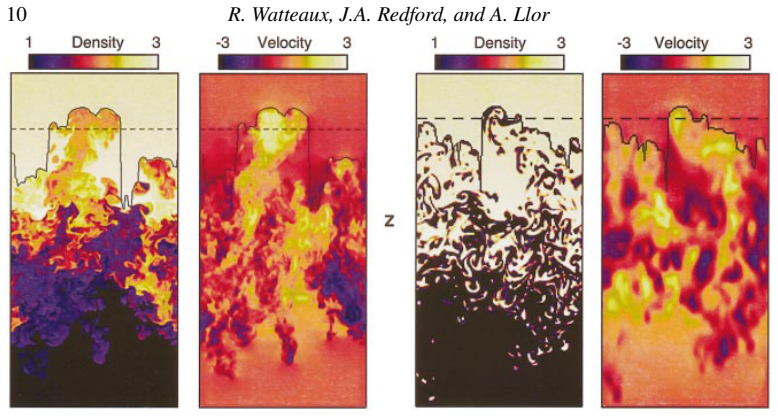
- [Figure 8 and Figure 9 captions] Several figure captions contain placeholder remarks such as "To be completed," "Old. Update.," and "Old. Replace." These must be replaced with proper descriptions before any resubmission.
- [Sections 3.7, 4.4, and 5.4] Unresolved cross-references such as "see part 6 and figure ??a" and "figure??" appear in the text; these need to be resolved once the empirical section is written.
- [Section 2.1] The phrase "Adapted from previous previous investigations" contains a duplicated word and should read "Adapted from previous investigations."
Circularity Check
Bimodality evidence is the fitted optimization objective; the central 'first reference data' section is an 'In progress' placeholder.
-
fitted input called prediction
[Section 5.3-5.4, Eqs (5.5) and (5.8)]
"An optimized bimodality is naturally expected to produce a least ambiguous segmentation of the PDF of eβ, yielding meaningful two-structure fields. ... The following optimal coefficients were used at 10243 resolution with the corresponding values of mean bimodality index and interfacial area Cω = 1.7, Cℓ = 0.15, C∧ = 30, ⟨bB⟩≈0.55, ⟨bA⟩≈15. ... The impact of filtering readily appears ... a deep valley is visible on the filtered field euz all across the TMZ height while mostly none appears on the unfiltered fields ..."
The filter coefficients Cω and Cℓ are explicitly optimized to maximize the bimodality coefficient (5.5), and Section 5.3 states that weak and strong filtering both 'display poor bimodality and an optimum can be found in between'. Thus the selected parameters are chosen precisely to make the filtered-field PDF as bimodal as possible. Section 5.4 then presents the resulting low mean value ⟨B⟩≈0.55, and the 'deep valley' in the PDF of the filtered velocity, as quantitative evidence that the segmentation captures a genuine bimodal structure. This is the objective function being reported as a discovered property: the qualitative 'discovery' of bimodality is enforced by the fitting procedure.
full rationale
The algebraic two-structure-field framework in Section 3 is self-contained: identities such as (3.18)-(3.20), the energy decompositions, and the conditional-average equations are derived from definitions, and the citations to Llor (2003, 2005) provide background rather than the proof of those identities. The empirical validation, however, has two severe problems visible in the manuscript. First, Section 6, which is promised to contain the structure-conditioned correlations from the simulated RT flow, is literally headed 'In progress: Two-structure field correlations from a simulated turbulent RT flow', and the data availability statement is an unfilled template ('[repository name] at http://doi.org/[doi]'); the abstract's 'first known reference data' and 'up to about 40%' claims are therefore unsupported in this version. That is a missing-support problem rather than a circularity, but it blocks verification of the paper's central advertised contribution. Second, the one identifiable circular step is the use of the bimodality coefficient as both the optimization target and the evidence: Section 5.3 defines B and says Cω and Cℓ control bimodality and are to be optimized; Section 5.4 reports the optimized coefficients and then presents the resulting low ⟨B⟩≈0.55 and the 'deep valley' in the filtered-velocity PDF as evidence that the segmentation captures genuine bimodality. Because the parameters were chosen to make B small, the qualitative outcome is a fitted result, not an independent confirmation. The exact value B≈0.55 is not numerically forced, so the circularity is partial; hence a score of 6 is appropriate rather than a higher score reserved for derivations equivalent to their inputs by definition.
Assumptions & free parameters
free parameters (5)
- C_omega =
1.7
- C_ell =
0.15
- C_wedge =
30
- Threshold weighting exponent q =
0.5
- kappa (shape parameter) =
0.5
assumptions (5)
- standard math Navier-Stokes and mass conservation equations describe the flow realizations.
- domain assumption Ensemble averages can be replaced by planar averages in statistically homogeneous transverse directions.
- ad hoc to paper Large-scale persistent structures exist and can be represented by two complementary presence fields b+ and b-.
- domain assumption Self-similar regime holds for 0.3 <= L <= 0.7 with linear fluid volume-fraction profiles and uniform effective mixing.
- domain assumption The simulation is a faithful DNS or LES of low-Atwood Rayleigh-Taylor turbulence despite time-dependent viscosity.
invented entities (1)
-
Persistent large-scale turbulent structures and their structure fields b+ and b-
Cite this review
Pith. "Pith review of Persistence and bimodality of large-scale turbulent structures across a Rayleigh-Taylor layer: Impact on transport and physical modelling through two-field-conditional correlations." pith.science (2026). https://pith.science/paper/KPLTYTNT
@misc{pith2026241116436,
  author       = {Pith},
  title        = {Pith review of: Persistence and bimodality of large-scale turbulent structures across a Rayleigh-Taylor layer: Impact on transport and physical modelling through two-field-conditional correlations},
  year         = {2026},
  howpublished = {\url{https://pith.science/paper/KPLTYTNT}},
  note         = {Machine review of arXiv:2411.16436}
}
read the original abstract
The distribution functions of field fluctuations of the turbulent mixing layer produced by a Rayleigh-Taylor instability (RTI) have long been hypothesized to involve bimodal effects. The present work reviews existing quantitative and qualitative evidence in support this conjecture, provides an associated theoretical framework, and measures the corresponding relevant statistical quantities on a simulation of a turbulent RTI at low Atwood number. The bimodal behaviour of fluctuations, readily observable close to the edges of the mixing zone, is less obvious within the mixing zone where indirect evidence comes from different sources, here gathered, discussed, and expanded: energy structure of buoyancy-drag equation, visual eduction from simulated RTI, two-fluid conditional analysis of energy balance, bulk non-dimensional turbulent numbers (Stokes, Knudsen, and Reynolds)... In order to carry out a bimodal analysis of the statistical quantities, two complementary indicator functions are here defined, the `light, upward moving' and `heavy downward moving' fluid zones. An adapted reconstruction is introduced here, based on the thresholding of a space- and time-filtered field (here the vertical velocity). The prescription for the two-structure-field segmentation was applied to a direct numerical simulation of an RTI and the corresponding structure-conditioned averages of the main quantities were obtained (concentrations, momentum, turbulent energies...). Notable features for turbulence understanding and modelling are then observed. The measured conditional averages provide the first know reference data for validation and calibration of so-called `two-structure' RANS turbulence models such as Youngs' (2015 Int. J. Heat Fluid Fl. 56, 233--250 and refs therein) and 2SFK (2003 Laser Part.\ Beams 21 (3), 311--315).
Figures


Figures from the paper (8 more)


Reference graph
Works this paper leans on
-
[1]
& Shvarts, D.1994 Scale invariant mixing rates of hydrodynamically unstable interfaces
Alon, U., Hecht, J., Mukamel, D. & Shvarts, D.1994 Scale invariant mixing rates of hydrodynamically unstable interfaces. Phys. Rev. Lett. 72 (18), 2867–2870. Alon, U., Hecht, J., Ofer, D. & Shvarts, D. 1995 Power laws and similarity of Rayleigh–Taylor and Richtmyer–Meshkov mixing fronts at all density ratios.Phys. Rev. Lett. 74 (4), 534–537. Andrews, M.J....
work page 1994
-
[2]
Springer, Dordrecht. Neuvazhaev, V.E.1983 Properties of a model for the turbulent mixing of the boundary between accelerated liquids differing in density. Zh. Prikl. Mekh. Tek. Fiz. 5, 81–88, [English translation 1983 J. Appl. Mech. Tech. Phys.24, 680–687]. Ng, N. 2006 Automatic thresholding for defect detection. Pattern Recogn. Lett. 27 (14), 1644–1649. ...
work page 1983
-
[6]
Springer, Berlin, Heidelberg. Phillips, S. 1955 The irrotational motion outside a free turbulent boundary.Math. Proc. Cambridge Philos. Soc. 51 (1), 220–229. Polionov, A.V. 1991 Shook induced mixing, convergence and heat conduction within the framework of heterogeneous 𝑘–𝜀 model. In Proc. of the Third Intl Workshop on the Physics of Compressible Turbulent...
work page 1955
-
[10]
SAS Institute, Cary, NC, USA. Schilling, O. & Burton, G.C. 2009 Large-Reynolds-number, intermediate-Atwood-number Rayleigh– Taylor turbulence. Part
work page 2009
-
[11]
Gradient-diffusion and scale-similarity modelling of mechanical turbulence. Tech. Rep.LLNL-JRNL-421515. Lawrence Livermore National Lab. Schilling, O. & Mueschke, N.J.2010 Analysis of turbulent transport and mixing in transitional Rayleigh– Taylor unstable flow using direct numerical simulation data.Phys. Fluids 22 (10), 105102. Schilling, O. & Mueschke, ...
work page 2010
-
[79]
Knapp, T.R.2007 Bimodality revisited
Springer, Dordrecht. Knapp, T.R.2007 Bimodality revisited. J. Mod. Appl. Stat. Meth. 6 (1), 8–20. Kokkinakis, I.W., Drikakis, D. & Youngs, D.L.2019 Modeling of Rayleigh–Taylor mixing using single- fluid models. Phys. Rev. E 99 (1), 013104. Kokkinakis, I.W., Drikakis, D. & Youngs, D.L. 2020 Two-equation and multi-fluid turbulence models for Richtmyer–Meshk...
work page 2007
-
[114]
Turbulence 89: Organized Structures and Turbulence in Fluid Mechanics
Springer. Morgan, B.E. & Wickett, M.E.2015 Three-equation model for the self-similar growth of Rayleigh-Taylor and Richtmyer-Meskov instabilities.Phys. Rev. E 91 (4), 043002. Morgan, B.E. & Wickett, M.E.2018 Two-length-scale turbulence model for self-similar buoyancy-, shock-, and shear-driven mixing. Phys. Rev. E 97 (1), 013104. Mueschke, N.J., Andrews, ...
work page 2015
-
[287]
1991 Three-dimensional numerical simulation of turbulent mixing by Rayleigh–Taylor instability
Youngs, D.L. 1991 Three-dimensional numerical simulation of turbulent mixing by Rayleigh–Taylor instability. Phys. Fluids A 3 (5), 1312–1320. Youngs, D.L. 1994 Numerical simulation of mixing by Rayleigh–Taylor and Richtmyer–Meshkov instabilities. Laser Part. Beams 12 (4), 725–750. Youngs, D.L. 1996 Representation of the molecular mixing process in a two-p...
work page 1991
Show all 14 references
-
[357]
Lumley, J.L
Springer, Berlin, Heidelberg. Lumley, J.L. 1992 Some comments on turbulence. Phys. Fluids A 4 (2). Persistence and bimodality of large-scale turbulent structures in RT 53 Mangin 1977 Pollution par instabillit ´e de Taylor. Tech. Rep. . Commissariat `a l’ ´Energie Atomique, unp...
1992
-
[392]
Youngs, D.L
Cambridge University Press. Youngs, D.L. 2009 Application of monotone integrated large eddy simulation to Rayleigh–Taylor mixing. Phil. Trans. R. Soc. A 367 (1899), 2971–2983. Youngs, D.L. 2013 The density ratio dependence of self-similar Rayleigh–Taylor mixing. Phil. Trans. R...
2003
-
[681]
Springer. Llor, A. & Bailly, P.2003 A new turbulent two-field concept for modeling Rayleigh–Taylor, Richtmyer– Meshkov and Kelvin–Helmholtz mixing layers.Laser Part. Beams 21 (3), 311–315. Llor, A., Bailly, P. & Poujade, O. 2004a Derivation of a minimal 2-fluid 2-structure and...
2003
-
[1967]
Izv. A. N. SSSR Mekhanika Zhidkosti Gaza. 2, 33–47]. Okamoto, N., Yoshimatsu, K., Schneider, K., Farge, M. & Kaneda, Y.2007 Coherent vortices in high resolution direct numerical simulation of homogeneous isotropic turbulence: A wavelet viewpoint. Phys. Fluids 19 (11). Okubo, A...
2007
-
[2012]
& Livescu, D.2010 Correcting anisotropic gradient transport of k.Flow Turbul
Ristorcelli, J.R. & Livescu, D.2010 Correcting anisotropic gradient transport of k.Flow Turbul. Combust. 85 (3–4), 443–455. Roberts, M.S. & Jacobs, J.W. 2016 The effects of forced small-wavelength, finite-bandwidth initial perturbations and miscibility on the turbulent Rayleig...
2010
-
[6932]
Youngs, D.L
Forschungzentrum Karlsruhe. Youngs, D.L. 1984 Numerical simulation of turbulent mixing by Rayleigh–Taylor instability. Physica D 12 (1–3), 32–44. Youngs, D.L. 1989 Modelling turbulent mixing by Rayleigh–Taylor instability. Physica D 37 (1–3), 270–
1984
Reviewed August 12, 2026 · model on record in the stance chip above.
Discussion (0). Continue with ORCID to comment.