REVIEW 3 major objections 5 minor 1 cited by
Detecting clusters and groups of galaxies populating the local Universe in large optical spectroscopic surveys
T0 review · 3 major / 5 minor · reviewed 2026-08-12 · deepseek-v4-flash
Pith's one-line read This paper claims that three group finders recover at least 80% of simulated galaxy groups and clusters above $10^{13}$ solar masses, with contamination below 10%, and that total stellar luminosity or mass beats velocity dispersion as a…
desk verdict A genuinely useful head-to-head benchmark of three group finders, though the headline completeness rests on a permissive matching rule that needs a sensitivity test. read the letter →
The pith
A machine-rendered reading of the paper's core claim, the machinery that carries it, and where it could break.
The reading
What carries the argument
The mechanism that carries the argument is a controlled mock experiment. A hydrodynamical cosmological simulation provides the true halo population; a lightcone (a redshift-bounded cone of mock sky) is converted into a galaxy catalogue with observed-frame magnitudes, Gaussian redshift errors of $\sigma=45\,\mathrm{km\,s^{-1}}$, stellar-mass errors of 0.2 dex, and 5% catastrophic redshift failures; and the three group finders are run on this catalogue. Their output is matched to the input halos by a cylinder defined by a projected offset of $R_{200}$ and a redshift window of $3\times10^{-3}$, with a factor-of-six mass-dominance rule used to decide which halo a detection belongs to when several fall inside. Detections are classified as primary, secondary fragments, or spurious, and these classes feed directly into the completeness and contamination numbers. The halo mass proxies are calibrated scaling relations (BCG stellar mass, total stellar mass, and $r$-band luminosity) whose logarithmic scatters are compared to those of the finders' own velocity-dispersion masses.
What would settle it
Rerun the same three finders on an independent mock and match using a stricter cylinder, for example half the virial radius and a redshift window of $10^{-3}$; if completeness at $M_{200}>10^{13}\,M_\odot$ drops below 80% or contamination rises above 10%, the headline numbers are artifacts of the matching convention rather than intrinsic properties of the finders.
Extended reading notes
Core claim
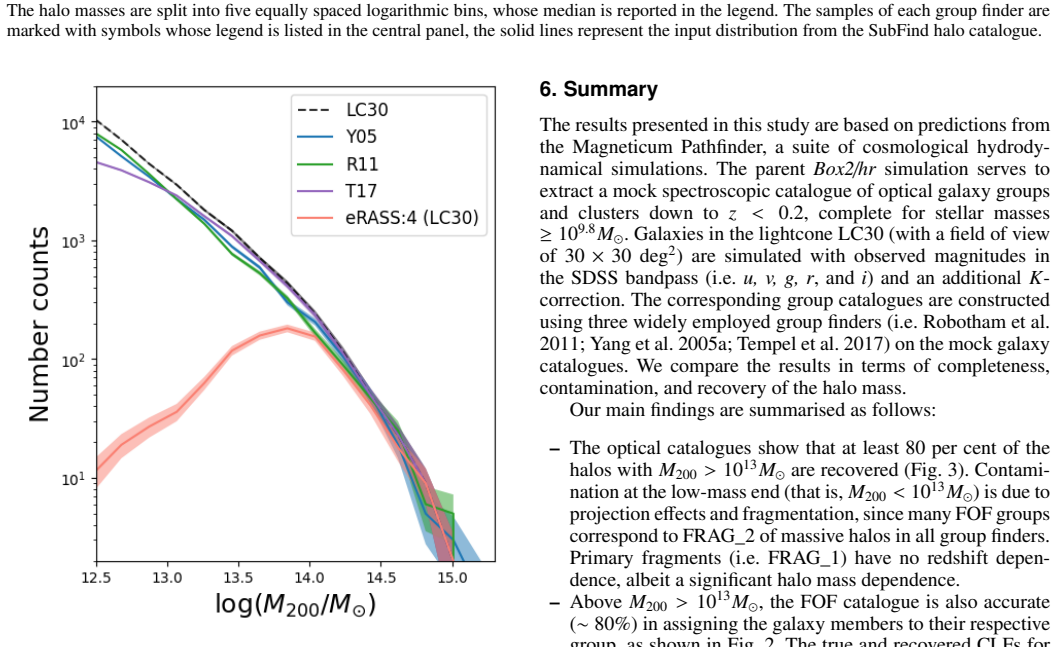
The central claim is a benchmark result, stated per group finder but holding for all three: on a simulated spectroscopic survey matching the depth and completeness of a wide local-Universe survey (redshift below 0.2, stellar masses complete above $10^{9.8}\,M_\odot$), the finders recover more than 80% of halos with $M_{200}$ above $10^{13}\,M_\odot$ and keep the fraction of spurious detections below 10% in that regime. Membership is at least 70% accurate above the group mass scale, rising further when measured by the brightest galaxies; the recovered conditional luminosity function of members matches the input halo catalogue. Because membership errors bias velocity-dispersion masses, the paper argues that the best halo mass proxy is the total stellar luminosity of the group (scatter 0.24--0.40 dex), closely followed by total stellar mass, and that using either proxy allows even low-richness groups to be kept in the catalogue. The comparison to a simulated X-ray observation of the same mock sky shows the optical catalogues are more complete at group scales, which the authors present as support for stacking X-ray data on optically selected groups.
Load-bearing premise
The completeness and contamination results depend on the paper's own matching rule, a correct detection being one within one virial radius and a redshift window of $3\times10^{-3}$ of a true halo, with the most massive halo selected when several fall in the cylinder, and this rule is not checked for sensitivity.
Editorial extensions
If this is right
- For $M_{200}>10^{13}\,M_\odot$, all three finders recover at least 80% of halos, so optically selected group catalogues can be used to probe dense environments in the local Universe.
- Contamination below $10^{13}\,M_\odot$ is dominated by interlopers and fragmentation, so low-mass groups projected near massive halos should be treated with caution.
- Velocity-dispersion masses inherit membership errors, while total stellar luminosity or total stellar mass keeps the scatter small even when not all members are recovered; the paper recommends luminosity-based masses.
- The recovered conditional luminosity function matches the input, so the finders are reliable for studying galaxy populations and evolution as a function of environment.
- Optical selection yields a more complete halo mass distribution at group scales than the X-ray selection from the same simulation, supporting X-ray stacking on optically selected samples.
Reading between the lines
- Editorial extension: the reported numbers are tied to the depth of a wide deep local-Universe survey; a direct test would rerun the same three finders on a mock of a shallower survey and measure whether completeness at $10^{13}\,M_\odot$ still holds.
- Editorial extension: the matching rule could be made probabilistic, assigning detections to halos by membership overlap rather than a six-times-dominance criterion, and the comparison would show how much of the fragmentation statistics is an artifact of the matching convention.
- Editorial extension: the luminosity-proxy result suggests a practical recipe for X-ray-era work: stack X-ray photons on optically selected groups chosen by luminosity-based masses, reaching below the X-ray detection threshold.
- Editorial extension: the alternative-mock robustness check in the appendix only re-runs one finder; extending it to the other two finders would test whether the completeness result depends on the specific simulation's stellar mass function.
Editorial analysis
A structured set of objections, weighed in public.
Referee Report
Summary. This paper benchmarks three optical group finders (Robotham et al. 2011, Yang et al. 2005, and Tempel et al. 2017) on a GAMA-like mock galaxy survey built from the Magneticum hydrodynamical simulation lightcone LC30. The authors simulate a spectroscopic galaxy sample down to z < 0.2 with stellar mass completeness M_star >= 10^9.8 M_sun, run the three finders, and compare their outputs to the SubFind halo catalogue. They report that all three finders achieve >80% completeness for halos with M200 > 10^13 M_sun, contamination below 10% in that regime, membership accuracy of at least 70% above the group scale, and that total stellar luminosity or total stellar mass are more reliable halo mass proxies than velocity dispersion. They also compare the optical catalogues with an X-ray eROSITA mock from the same simulation and check the impact of Magneticum's top-heavy GSMF using a UniverseMachine lightcone in Appendix A.
Significance. If the headline results are robust, this paper provides a useful, directly comparative calibration of three widely used group finders on the same simulation, which is valuable for interpreting current and upcoming spectroscopic surveys (SDSS, GAMA, DESI, WAVES) and for stacking eROSITA X-ray data on optically selected groups. The use of a realistic lightcone, a ground-truth SubFind halo catalogue, and an external UniverseMachine check are strengths. The authors are also transparent about several caveats, including the GSMF tension in Magneticum and the effect of membership errors on velocity-dispersion masses. However, the central quantitative claims rest on a matching rule that is not sensitivity-tested, and the mass-proxy comparison mixes an in-sample calibration with an external relation; these issues need to be addressed before the conclusions can be considered fully supported.
major comments (3)
- [Section 4.1 and Fig. 3] The definitions of completeness and contamination rely entirely on the hand-chosen matching rule: a detection is correct if its centre lies within R200 of a true halo and within dz < 3e-3, with a factor-of-six dominance criterion for multiple matches. No sensitivity analysis is provided for these parameters. The paper itself shows that the stricter DET+MEMB definition (at least 50% member-galaxy overlap, dashed lines in Fig. 3) reduces completeness at M200 > 10^13 M_sun to roughly 70%, below the headline >80% value. This indicates that the headline numbers are definition-dependent and should not be presented as absolute without demonstrating that the matching thresholds are inconsequential. I recommend reporting both definitions prominently in the abstract and adding a robustness test varying R200, the redshift window, and the dominance factor.
- [Section 4.3 and Table 2] The comparison of halo mass proxies is unfair because the total stellar mass proxy is calibrated directly on the Magneticum scaling relation, while the r-band luminosity proxy is taken from an external relation (Popesso et al. 2007). Consequently, the smaller scatter reported for luminosity in Table 2 may simply reflect that the luminosity relation is not fitted to the same simulation, whereas the stellar-mass relation absorbs Magneticum's specific scatter. To support the claim that stellar luminosity is the best proxy, both proxies should be calibrated on independent data or on the same simulation with an out-of-sample split. The in-sample nature of the stellar-mass calibration is a load-bearing issue for the central recommendation in the abstract.
- [Appendix A] The UniverseMachine check is presented as evidence that the results are robust to the Magneticum GSMF tension, but it only runs one of the three finders (R11) and only tests completeness, contamination, and the stellar-mass proxy scatter. It does not test the membership accuracy, the luminosity proxy comparison, or the fragmentation behaviour for the other two finders. Additionally, the reported velocity-dispersion scatter in the UniverseMachine test (0.71 dex) is twice that in Magneticum (0.35 dex), a major discrepancy that deserves explicit discussion rather than a one-line remark. The claim that the findings are 'robust' is therefore only partially supported.
minor comments (5)
- [Abstract and Section 2.2] The abstract states the survey is complete for M_star >= 10^9.8 M_sun, but Section 2.2 says 'no magnitude cut is applied.' Please clarify that the completeness refers to the stellar mass resolution limit of the simulation, not a survey selection.
- [Section 6, first bullet] The summary states the FOF catalogue is 'accurate (~80%)' in assigning galaxy members above 10^13 M_sun, while the abstract and Fig. 3 dashed lines indicate 70%. These numbers should be made consistent.
- [Table 1] In the last two rows, the T17 column increases from 14,185 (no FRAG_2) to 14,194 (no FRAG_2 and no SPUR_2). Since the latter is a subset of the former, this is impossible and is likely a typo; please check all entries in these rows.
- [Section 6] The summary lists SDSS bandpass as 'u, v, g, r, and i'; SDSS uses u, g, r, i, z, and the 'v' should be removed.
- [Section 4.2] The text says 'In the high mass end, contamination is mostly due to SPUR_2 sources,' but Fig. 4 shows that fragmentation also increases strongly with mass. Please clarify how SPUR_2 and FRAG_2 are distinguished in the contribution to contamination at the high-mass end.
Circularity Check
Detection benchmark is independent, but the stellar-mass/BCG halo-mass proxy comparison is partly in-sample: relations calibrated on Magneticum are evaluated against Magneticum halos in the same LC30 sample, so the quoted scatter is a fit residual rather than an out-of-sample prediction.
-
fitted input called prediction
[Section 4.3 (Halo mass proxies), Table 2 and Fig. 6]
"We extract from Magneticum the scaling relation between total stellar mass and M200 and calibrate the halo mass proxy. ... Table 2 illustrates the result for the sample of groups in LC30. ... Both metrics show that the stellar luminosity is the mass proxy with the smallest scatter, followed by the total stellar mass."
The total stellar mass and BCG stellar mass proxies are calibrated from the same Magneticum-based sample (LC30) whose SubFind M200 values are then treated as 'truth' in Table 2 and Fig. 6. The quoted scatter for these proxies (0.37-0.49 dex for total stellar mass in the summary) is therefore the residual of an in-sample fit, not an out-of-sample prediction: a relation fitted to a sample reproduces that sample with minimal scatter by construction. This calibrate-and-evaluate-on-the-same-data loop is used to conclude that luminosity and total stellar mass yield more accurate halo masses than velocity dispersion, while the velocity dispersion estimates use fixed external calibrations. The luminosity proxy uses an external Popesso et al.
full rationale
The central completeness and contamination claims are benchmarked against the independent SubFind halo catalogue, so they are not circular; the matching rule in Sect. 4.1 is hand-chosen and permissive (the paper's own DET+MEMB definition drops completeness to about 70% at M200 > 10^13 Msun), but that is a robustness/sensitivity limitation, not a definitional reduction. The UniverseMachine check in Appendix A provides an external cross-check, and the luminosity proxy is calibrated with the published Popesso et al. (2007) relation, so self-citations are not load-bearing. The one circular element is the in-sample calibration of the total stellar mass and BCG stellar mass proxies in Sect. 4.3: the relation is extracted from Magneticum and then evaluated against Magneticum halos in the same LC30 sample, making the reported scatter a fit residual. This affects the secondary claim that luminosity/mass proxies are more accurate than velocity dispersion, but the completeness and membership findings remain independent. Score 4 reflects partial circularity in one supporting claim, not in the paper's main detection benchmark.
Assumptions & free parameters
free parameters (5)
- R11 FOF linking length parameters =
2 base + 5 density contrast + 1 brightness parameters (brightness scaling set to 0 here)
- T17 linking length ratio =
radial = 10 x transversal; transversal from Tempel et al. 2014
- Y05 background level B =
10
- Mock error model parameters =
sigma_v = 45 km/s; sigma_logMstar = 0.2 dex; 5% catastrophic failures
- Matching thresholds =
R200 offset, dz = 3e-3, dominant mass ratio = 6
assumptions (4)
- domain assumption The SubFind/FOF halo catalogue from Magneticum is a faithful ground truth for the halo population.
- domain assumption The CIGALE SED fitting and K-correction step in the mock reproduces observed-frame magnitudes well enough for the finders.
- domain assumption The top-heavy GSMF of Magneticum does not bias the relative performance of the finders.
- ad hoc to paper The matching rule (within R200 and dz < 3e-3, factor-of-six dominance) is a valid definition of a correct detection.
Cite this review
Pith. "Pith review of Detecting clusters and groups of galaxies populating the local Universe in large optical spectroscopic surveys." pith.science (2026). https://pith.science/paper/JVLQL4XL
@misc{pith2026241116455,
  author       = {Pith},
  title        = {Pith review of: Detecting clusters and groups of galaxies populating the local Universe in large optical spectroscopic surveys},
  year         = {2026},
  howpublished = {\url{https://pith.science/paper/JVLQL4XL}},
  note         = {Machine review of arXiv:2411.16455}
}
abstract
Wide-field cosmological surveys provide hundreds of thousands of spectroscopically confirmed galaxy groups and clusters, valuable for tracing baryonic matter distribution. However, controlling systematics in identifying host dark matter halos and estimating their properties is crucial. We evaluate three group detection methods on a simulated dataset replicating the GAMA selection to understand systematics and selection effects. This is key for interpreting data from SDSS, GAMA, DESI, WAVES, and leveraging optical catalogues in the (X-ray) eROSITA era to quantify baryonic mass in galaxy groups. Using a lightcone from the Magneticum hydrodynamical simulation, we simulate a spectroscopic galaxy survey in the local Universe (down to $z<0.2$ and stellar mass completeness $M_{\star}\geq10^{9.8} M_{\odot}$). We assess completeness and contamination of reconstructed halo catalogues, evaluate membership accuracy, and analyse the halo mass recovery rate of group finders. All three group finders achieve high completeness ($>80\%$) at group and cluster scales, confirming optical selection's suitability for dense regions. Contamination at low masses ($M_{200}<10^{13} M_{\odot}$) arises from interlopers and fragmentation. Membership is at least 70\% accurate above the group mass scale, but inaccuracies bias halo mass estimates using galaxy velocity dispersion. Alternative proxies, like total stellar luminosity or mass, yield more accurate halo masses. The cumulative luminosity function of galaxy members matches predictions, showing the group finders' accuracy in identifying galaxy populations. These results confirm the reliability and completeness of spectroscopic catalogues produced by state-of-the-art group finders. This supports studies requiring large spectroscopic samples of galaxy groups and clusters, as well as investigations into galaxy evolution across diverse environments.
Figures


Figures from the paper (6 more)


Forward citations
Cited by 1 Pith paper
-
What's Missing in AGN Feedback? Lessons learnt from Magneticum, IllustrisTNG and Simba
No current simulation simultaneously reproduces observed halo hot-gas fractions and local galaxy star-formation/quenching demographics; strong AGN feedback overquenches, weak feedback retains too much gas.
Reference graph
Works this paper leans on
-
[1]
, " * write output.state after.block = add.period write newline
ENTRY address archiveprefix author booktitle chapter edition editor howpublished institution eprint journal key month note number organization pages publisher school series title type volume year label extra.label sort.label short.list INTEGERS output.state before.all mid.sentence after.sentence after.block FUNCTION init.state.consts #0 'before.all := #1 ...
-
[2]
write newline
" write newline "" before.all 'output.state := FUNCTION n.dashify 't := "" t empty not t #1 #1 substring "-" = t #1 #2 substring "--" = not "--" * t #2 global.max substring 't := t #1 #1 substring "-" = "-" * t #2 global.max substring 't := while if t #1 #1 substring * t #2 global.max substring 't := if while FUNCTION word.in bbl.in " " * FUNCTION format....
-
[3]
2022, Monthly Notices of the Royal Astronomical Society, 511, 4991, aDS Bibcode: 2022MNRAS.511.4991A
Andreon, S., Trinchieri, G., & Moretti, A. 2022, Monthly Notices of the Royal Astronomical Society, 511, 4991, aDS Bibcode: 2022MNRAS.511.4991A
2022
-
[4]
2020, Astronomy and Astrophysics, 642, A37, aDS Bibcode: 2020A&A...642A..37B
Bassini, L., Rasia, E., Borgani, S., et al. 2020, Astronomy and Astrophysics, 642, A37, aDS Bibcode: 2020A&A...642A..37B
2020
-
[5]
M., Murante, G., Arth, A., et al
Beck, A. M., Murante, G., Arth, A., et al. 2016, Monthly Notices of the Royal Astronomical Society, 455, 2110, aDS Bibcode: 2016MNRAS.455.2110B
2016
-
[6]
C., Flynn, K., & Gebhardt, K
Beers, T. C., Flynn, K., & Gebhardt, K. 1990, Astronomical Journal; (USA), 100
1990
-
[7]
H., Hearin, A
Behroozi, P., Wechsler, R. H., Hearin, A. P., & Conroy, C. 2019, Monthly Notices of the Royal Astronomical Society, 488, 3143, aDS Bibcode: 2019MNRAS.488.3143B
2019
-
[8]
H., Hearin, A
Behroozi, P., Wechsler, R. H., Hearin, A. P., & Conroy, C. 2023, Astrophysics Source Code Library, ascl:2302.011, aDS Bibcode: 2023ascl.soft02011B
2023
Show all 114 references
-
[9]
S., Conroy, C., & Wechsler, R
Behroozi, P. S., Conroy, C., & Wechsler, R. H. 2010, The Astrophysical Journal, 717, 379, aDS Bibcode: 2010ApJ...717..379B
2010
-
[10]
S., Wechsler, R
Behroozi, P. S., Wechsler, R. H., & Conroy, C. 2013 a , The Astrophysical Journal, 770, 57, aDS Bibcode: 2013ApJ...770...57B
2013
-
[11]
S., Wechsler, R
Behroozi, P. S., Wechsler, R. H., & Wu, H.-Y. 2013 b , The Astrophysical Journal, 762, 109, publisher: IOP ADS Bibcode: 2013ApJ...762..109B
2013
-
[12]
A., Frieman, J., Weinberg, D
Berlind, A. A., Frieman, J., Weinberg, D. H., et al. 2006, The Astrophysical Journal Supplement Series, 167, 1, publisher: IOP Publishing
2006
-
[13]
K., et al
Bernardi, M., Meert, A., Sheth, R. K., et al. 2013, Monthly Notices of the Royal Astronomical Society, 436, 697, publisher: OUP ADS Bibcode: 2013MNRAS.436..697B
2013
-
[14]
2013, Monthly Notices of the Royal Astronomical Society, 428, 1395, aDS Bibcode: 2013MNRAS.428.1395B
Biffi, V., Dolag, K., & Böhringer, H. 2013, Monthly Notices of the Royal Astronomical Society, 428, 1395, aDS Bibcode: 2013MNRAS.428.1395B
2013
-
[15]
2012, Monthly Notices of the Royal Astronomical Society, 420, 3545, aDS Bibcode: 2012MNRAS.420.3545B
Biffi, V., Dolag, K., Böhringer, H., & Lemson, G. 2012, Monthly Notices of the Royal Astronomical Society, 420, 3545, aDS Bibcode: 2012MNRAS.420.3545B
2012
-
[16]
2018, Monthly Notices of the Royal Astronomical Society, 481, 2213, aDS Bibcode: 2018MNRAS.481.2213B
Biffi, V., Dolag, K., & Merloni, A. 2018, Monthly Notices of the Royal Astronomical Society, 481, 2213, aDS Bibcode: 2018MNRAS.481.2213B
2018
-
[17]
Bryan, G. L. & Norman, M. L. 1998, The Astrophysical Journal, 495, 80, publisher: IOP ADS Bibcode: 1998ApJ...495...80B
1998
-
[18]
2003, Publications of the Astronomical Society of the Pacific, 115, 763, publisher: IOP ADS Bibcode: 2003PASP..115..763C
Chabrier, G. 2003, Publications of the Astronomical Society of the Pacific, 115, 763, publisher: IOP ADS Bibcode: 2003PASP..115..763C
2003
-
[19]
2016, The DESI Experiment Part I : Science , Targeting , and Survey Design , arXiv:1611.00036 [astro-ph]
Collaboration, D., Aghamousa, A., Aguilar, J., et al. 2016, The DESI Experiment Part I : Science , Targeting , and Survey Design , arXiv:1611.00036 [astro-ph]
2016 arXiv
-
[20]
B., Maddox, S
Colless, M., Dalton, G. B., Maddox, S. J., et al. 2001, The 2dF Galaxy Redshift Survey : Spectra and redshifts
2001
-
[21]
C., Huchra, J
Crook, A. C., Huchra, J. P., Martimbeau, N., et al. 2007, The Astrophysical Journal, 655, 790, publisher: IOP ADS Bibcode: 2007ApJ...655..790C
2007
-
[22]
P., McGee, S
Crossett, J. P., McGee, S. L., Ponman, T. J., et al. 2022, Astronomy & Astrophysics, 663, A2, arXiv:2203.14200 [astro-ph]
2022 arXiv
-
[23]
2019, Astronomy & Astrophysics, Volume 630, id
Dauser, T., Falkner, S., Lorenz, M., et al. 2019, Astronomy & Astrophysics, Volume 630, id. A66,19 pp., 630, A66
2019
-
[24]
J., Robotham, A
Davies, L. J., Robotham, A. S. G., Driver, S. P., Lagos, P., & et al. 2018, Monthly Notices of the Royal Astronomical Society, 480, 768
2018
-
[25]
2005, Nature, 433, 604, aDS Bibcode: 2005Natur.433..604D
Di Matteo, T., Springel, V., & Hernquist, L. 2005, Nature, 433, 604, aDS Bibcode: 2005Natur.433..604D
2005
-
[26]
2018, The Astrophysical Journal Supplement Series, 239, 35, publisher: IOP ADS Bibcode: 2018ApJS..239...35D
Diemer, B. 2018, The Astrophysical Journal Supplement Series, 239, 35, publisher: IOP ADS Bibcode: 2018ApJS..239...35D
2018
-
[27]
2009, Monthly Notices of the Royal Astronomical Society, 399, 497
Dolag, K., Borgani, S., Murante, G., & Springel, V. 2009, Monthly Notices of the Royal Astronomical Society, 399, 497
2009
-
[28]
2005, Monthly Notices of the Royal Astronomical Society, 364, 753, aDS Bibcode: 2005MNRAS.364..753D
Dolag, K., Vazza, F., Brunetti, G., & Tormen, G. 2005, Monthly Notices of the Royal Astronomical Society, 364, 753, aDS Bibcode: 2005MNRAS.364..753D
2005
-
[29]
1980, The Astrophysical Journal, 236, 351
Dressler, A. 1980, The Astrophysical Journal, 236, 351
1980
-
[30]
P., Bellstedt, S., Robotham, A
Driver, S. P., Bellstedt, S., Robotham, A. S. G., et al. 2022, Monthly Notices of the Royal Astronomical Society, 513, 439, aDS Bibcode: 2022MNRAS.513..439D
2022
-
[31]
P., Davies, L
Driver, S. P., Davies, L. J., Meyer, M., et al. 2016, 42, 205, conference Name: The Universe of Digital Sky Surveys Place: eprint: arXiv:1507.00676 ADS Bibcode: 2016ASSP...42..205D
2016 arXiv
-
[32]
& Mamon, G
Duarte, M. & Mamon, G. A. 2015, Monthly Notices of the Royal Astronomical Society, 453, 3848, publisher: OUP ADS Bibcode: 2015MNRAS.453.3848D
2015
-
[33]
& Zandivarez, A
Díaz-Giménez, E. & Zandivarez, A. 2015, Astronomy and Astrophysics, 578, A61, aDS Bibcode: 2015A&A...578A..61D
2015
-
[34]
R., Baugh, C
Eke, V. R., Baugh, C. M., Cole, S., et al. 2005, Monthly Notices of the Royal Astronomical Society, 362, 1233, publisher: OUP ADS Bibcode: 2005MNRAS.362.1233E
2005
-
[35]
R., Frenk, C
Eke, V. R., Frenk, C. S., Baugh, C. M., et al. 2004, Monthly Notices of the Royal Astronomical Society, 355, 769, publisher: OUP ADS Bibcode: 2004MNRAS.355..769E
2004
-
[36]
2010, Monthly Notices of the Royal Astronomical Society, 401, 1670, aDS Bibcode: 2010MNRAS.401.1670F
Fabjan, D., Borgani, S., Tornatore, L., et al. 2010, Monthly Notices of the Royal Astronomical Society, 401, 1670, aDS Bibcode: 2010MNRAS.401.1670F
2010
-
[37]
J., Huchra, J
Geller, M. J., Huchra, J. P., & de Lapparent, V. 1987, 124, 301, conference Name: Observational Cosmology ADS Bibcode: 1987IAUS..124..301G
1987
-
[38]
F., Newman, J
Gerke, B. F., Newman, J. A., Davis, M., et al. 2005, The Astrophysical Journal, 625, 6, publisher: IOP ADS Bibcode: 2005ApJ...625....6G
2005
-
[39]
2000, Astronomy and Astrophysics Supplement Series, 141, 371, aDS Bibcode: 2000A&AS..141..371G
Girardi, L., Bressan, A., Bertelli, G., & Chiosi, C. 2000, Astronomy and Astrophysics Supplement Series, 141, 371, aDS Bibcode: 2000A&AS..141..371G
2000
-
[40]
H., Zaritsky, D., & Zabludoff, A
Gonzalez, A. H., Zaritsky, D., & Zabludoff, A. I. 2007, The Astrophysical Journal, 666, 147, aDS Bibcode: 2007ApJ...666..147G
2007
-
[41]
L., Nichol, R
Gómez, P. L., Nichol, R. C., Miller, C. J., et al. 2003, The Astrophysical Journal, 584, 210
2003
-
[42]
& Madau, P
Haardt, F. & Madau, P. 2001, Modelling the UV / X -ray cosmic background with CUBA (eprint: arXiv:astro-ph/0106018), conference Name: Clusters of Galaxies and the High Redshift Universe Observed in X-rays Pages: 64 ADS Bibcode: 2001cghr.confE..64H
2001 arXiv
-
[43]
2014, MNRAS, 442, 2304, aDS Bibcode: 2014MNRAS.442.2304H
Hirschmann, M., Dolag, K., Saro, A., et al. 2014, MNRAS, 442, 2304, aDS Bibcode: 2014MNRAS.442.2304H
2014
-
[44]
& Charlot, S
Kauffmann, G. & Charlot, S. 1998, K-band luminosity function at z = 1: a powerful constraint on galaxy formation theory MNRAS
1998
-
[45]
2020, The Astrophysical Journal Supplement Series, 247, 43, aDS Bibcode: 2020ApJS..247...43K
Kluge, M., Neureiter, B., Riffeser, A., et al. 2020, The Astrophysical Journal Supplement Series, 247, 43, aDS Bibcode: 2020ApJS..247...43K
2020
-
[46]
2016, Monthly Notices of the Royal Astronomical Society, 457, 4340, publisher: OUP ADS Bibcode: 2016MNRAS.457.4340K
Klypin, A., Yepes, G., Gottlöber, S., Prada, F., & Heß, S. 2016, Monthly Notices of the Royal Astronomical Society, 457, 4340, publisher: OUP ADS Bibcode: 2016MNRAS.457.4340K
2016
-
[47]
2010, Classical and Quantum Gravity, 27, 124010, arXiv:1003.6097 [astro-ph, physics:gr-qc, physics:hep-ph, physics:hep-th]
Komatsu, E. 2010, Classical and Quantum Gravity, 27, 124010, arXiv:1003.6097 [astro-ph, physics:gr-qc, physics:hep-ph, physics:hep-th]
2010 arXiv
-
[48]
V., Vikhlinin, A
Kravtsov, A. V., Vikhlinin, A. A., & Meshcheryakov, A. V. 2018, Astronomy Letters, 44, 8, publisher: Springer ADS Bibcode: 2018AstL...44....8K
2018
-
[49]
H., Mo, H
Lim, S. H., Mo, H. J., Lu, Y., Wang, H., & Yang, X. 2017, Monthly Notices of the Royal Astronomical Society, 470, 2982, aDS Bibcode: 2017MNRAS.470.2982L
2017
-
[50]
2022, Astronomy and Astrophysics, 661, A5, aDS Bibcode: 2022A&A...661A...5L
Liu, T., Buchner, J., Nandra, K., et al. 2022, Astronomy and Astrophysics, 661, A5, aDS Bibcode: 2022A&A...661A...5L
2022
-
[51]
H., & Schellenberger, G
Lovisari, L., Reiprich, T. H., & Schellenberger, G. 2015, Astronomy & Astrophysics, 573, A118, publisher: EDP Sciences
2015
-
[52]
2016, The Astrophysical Journal, 832, 39, publisher: IOP ADS Bibcode: 2016ApJ...832...39L
Lu, Y., Yang, X., Shi, F., et al. 2016, The Astrophysical Journal, 832, 39, publisher: IOP ADS Bibcode: 2016ApJ...832...39L
2016
-
[53]
2024, Detecting Galaxy Groups and AGNs populating the local Universe in the eROSITA era, publication Title: arXiv e-prints ADS Bibcode: 2024arXiv240412719M
Marini, I., Popesso, P., Lamer, G., et al. 2024, Detecting Galaxy Groups and AGNs populating the local Universe in the eROSITA era, publication Title: arXiv e-prints ADS Bibcode: 2024arXiv240412719M
2024
-
[54]
Merchán, M. E. & Zandivarez, A. 2005, The Astrophysical Journal, 630, 759, publisher: IOP ADS Bibcode: 2005ApJ...630..759M
2005
-
[55]
2024, A&A, 682, A34, aDS Bibcode: 2024A&A...682A..34M
Merloni, A., Lamer, G., Liu, T., et al. 2024, A&A, 682, A34, aDS Bibcode: 2024A&A...682A..34M
2024
-
[56]
2012, eROSITA Science Book : Mapping the Structure of the Energetic Universe , arXiv:1209.3114 [astro-ph]
Merloni, A., Predehl, P., Becker, W., et al. 2012, eROSITA Science Book : Mapping the Structure of the Energetic Universe , arXiv:1209.3114 [astro-ph]
2012 arXiv
-
[57]
J., Nichol, R
Miller, C. J., Nichol, R. C., Reichart, D., et al. 2005, The Astronomical Journal, 130, 968, publisher: IOP ADS Bibcode: 2005AJ....130..968M
2005
-
[58]
C., & White, S
Mo, H., van den Bosch, F. C., & White, S. 2010, Galaxy Formation and Evolution , publication Title: Galaxy Formation and Evolution ADS Bibcode: 2010gfe..book.....M
2010
-
[59]
2022, Nature Astronomy, 6, 308, aDS Bibcode: 2022NatAs...6..308M
Montes, M. 2022, Nature Astronomy, 6, 308, aDS Bibcode: 2022NatAs...6..308M
2022
-
[60]
P., Naab, T., & White, S
Moster, B. P., Naab, T., & White, S. D. M. 2013, MNRAS, 428, 3121, publisher: OUP ADS Bibcode: 2013MNRAS.428.3121M
2013
-
[61]
P., Somerville, R
Moster, B. P., Somerville, R. S., Maulbetsch, C., et al. 2010, The Astrophysical Journal, 710, 903, publisher: IOP ADS Bibcode: 2010ApJ...710..903M
2010
-
[62]
Mulchaey, J. S. 2000, Annual Review of Astronomy and Astrophysics, 38, 289, aDS Bibcode: 2000ARA&A..38..289M
2000
-
[63]
A., Pearce, F
Old, L., Skibba, R. A., Pearce, F. R., et al. 2014, Monthly Notices of the Royal Astronomical Society, 441, 1513, aDS Bibcode: 2014MNRAS.441.1513O
2014
-
[64]
R., et al
Old, L., Wojtak, R., Pearce, F. R., et al. 2018, Monthly Notices of the Royal Astronomical Society, 475, 853
2018
-
[65]
D., Babul, A., Bahé, Y., Butsky, I
Oppenheimer, B. D., Babul, A., Bahé, Y., Butsky, I. S., & McCarthy, I. G. 2021, Universe, 7, 209, aDS Bibcode: 2021Univ....7..209O
2021
-
[66]
Osmond, J. P. F. & Ponman, T. J. 2004, Monthly Notices of the Royal Astronomical Society, 350, 1511, publisher: OUP ADS Bibcode: 2004MNRAS.350.1511O
2004
-
[67]
T., Mitsuishi, I., et al
Ota, N., Nguyen-Dang, N. T., Mitsuishi, I., et al. 2023, Astronomy & Astrophysics, 669, A110, arXiv:2206.09536 [astro-ph]
2023 arXiv
-
[68]
Peebles, P. J. E. 1980, The large-scale structure of the universe, publication Title: Large-Scale Structure of the Universe by Phillip James Edwin Peebles. Princeton University Press ADS Bibcode: 1980lssu.book.....P
1980
-
[69]
2018, Monthly Notices of the Royal Astronomical Society, 475, 648, aDS Bibcode: 2018MNRAS.475..648P
Pillepich, A., Nelson, D., Hernquist, L., et al. 2018, Monthly Notices of the Royal Astronomical Society, 475, 648, aDS Bibcode: 2018MNRAS.475..648P
2018
-
[70]
J., Bourner, P
Ponman, T. J., Bourner, P. D. J., Ebeling, H., & Böhringer, H. 1996, Monthly Notices of the Royal Astronomical Society, 283, 690, publisher: OUP ADS Bibcode: 1996MNRAS.283..690P
1996
-
[71]
2024 a , Monthly Notices of the Royal Astronomical Society, 527, 895, publisher: OUP ADS Bibcode: 2024MNRAS.527..895P
Popesso, P., Biviano, A., Bulbul, E., et al. 2024 a , Monthly Notices of the Royal Astronomical Society, 527, 895, publisher: OUP ADS Bibcode: 2024MNRAS.527..895P
2024
-
[72]
2007, Astronomy and Astrophysics, 464, 451, aDS Bibcode: 2007A&A...464..451P
Popesso, P., Biviano, A., Böhringer, H., & Romaniello, M. 2007, Astronomy and Astrophysics, 464, 451, aDS Bibcode: 2007A&A...464..451P
2007
-
[73]
Popesso, P., Biviano, A., Marini, I., Dolag, K., & et al. 2024 b
2024
-
[74]
Popesso, P., Marini, I., Dolag, K., Lamer, G., & et al. 2024 c
2024
-
[75]
Popesso, P., Marini, I., Lamer, G., & et al. 2024 d
2024
-
[76]
L., Ferraro, M
Ragone-Figueroa, C., Granato, G. L., Ferraro, M. E., et al. 2018, Monthly Notices of the Royal Astronomical Society, 479, 1125, aDS Bibcode: 2018MNRAS.479.1125R
2018
-
[77]
L., Murante, G., Borgani, S., & Cui, W
Ragone-Figueroa, C., Granato, G. L., Murante, G., Borgani, S., & Cui, W. 2013, Monthly Notices of the Royal Astronomical Society, 436, 1750, aDS Bibcode: 2013MNRAS.436.1750R
2013
-
[78]
2017, Galaxies, 5, 49, aDS Bibcode: 2017Galax...5...49R
Remus, R.-S., Dolag, K., & Hoffmann, T. 2017, Galaxies, 5, 49, aDS Bibcode: 2017Galax...5...49R
2017
-
[79]
Robotham, A. S. G., Norberg, P., Driver, S. P., et al. 2011, Monthly Notices of the Royal Astronomical Society, 416, 2640
2011
-
[80]
& Merchán, M
Rodriguez, F. & Merchán, M. 2020, Astronomy and Astrophysics, 636, A61, aDS Bibcode: 2020A&A...636A..61R
2020
-
[81]
2006, Monthly Notices of the Royal Astronomical Society, 373, 397, publisher: OUP ADS Bibcode: 2006MNRAS.373..397S
Saro, A., Borgani, S., Tornatore, L., et al. 2006, Monthly Notices of the Royal Astronomical Society, 373, 397, publisher: OUP ADS Bibcode: 2006MNRAS.373..397S
2006
-
[82]
J., Bazin, G., & Dolag, K
Saro, A., Mohr, J. J., Bazin, G., & Dolag, K. 2013, The Astrophysical Journal, 772, 47, aDS Bibcode: 2013ApJ...772...47S
2013
-
[83]
2017, Galaxies, 5, 41, aDS Bibcode: 2017Galax...5...41S
Schulze, F., Remus, R.-S., & Dolag, K. 2017, Galaxies, 5, 41, aDS Bibcode: 2017Galax...5...41S
2017
-
[84]
2020, Monthly Notices of the Royal Astronomical Society, 493, 3778, aDS Bibcode: 2020MNRAS.493.3778S
Schulze, F., Remus, R.-S., Dolag, K., et al. 2020, Monthly Notices of the Royal Astronomical Society, 493, 3778, aDS Bibcode: 2020MNRAS.493.3778S
2020
-
[85]
2018, Monthly Notices of the Royal Astronomical Society, 480, 4636, aDS Bibcode: 2018MNRAS.480.4636S
Schulze, F., Remus, R.-S., Dolag, K., et al. 2018, Monthly Notices of the Royal Astronomical Society, 480, 4636, aDS Bibcode: 2018MNRAS.480.4636S
2018
-
[86]
2005, Monthly Notices of the Royal Astronomical Society, 364, 1105, aDS Bibcode: 2005MNRAS.364.1105S
Springel, V. 2005, Monthly Notices of the Royal Astronomical Society, 364, 1105, aDS Bibcode: 2005MNRAS.364.1105S
2005
-
[87]
& Hernquist, L
Springel, V. & Hernquist, L. 2003, Monthly Notices of the Royal Astronomical Society, 339, 289, aDS Bibcode: 2003MNRAS.339..289S
2003
-
[88]
Springel, V., White, S. D. M., Tormen, G., & Kauffmann, G. 2001, Monthly Notices of the Royal Astronomical Society, 328, 726, conference Name: Monthly Notices of the Royal Astronomical Society
2001
-
[89]
M., Donahue, M., et al
Sun, M., Voit, G. M., Donahue, M., et al. 2009, The Astrophysical Journal, 693, 1142, aDS Bibcode: 2009ApJ...693.1142S
2009
-
[90]
2006, Astronomische Nachrichten, 327, 365, aDS Bibcode: 2006AN....327..365T
Tago, E., Einasto, J., Saar, E., et al. 2006, Astronomische Nachrichten, 327, 365, aDS Bibcode: 2006AN....327..365T
2006
-
[91]
2023, The Astrophysical Journal, 954, 182, publisher: IOP ADS Bibcode: 2023ApJ...954..182T
Teklu, A., Kudritzki, R.-P., Dolag, K., Remus, R.-S., & Kimmig, L. 2023, The Astrophysical Journal, 954, 182, publisher: IOP ADS Bibcode: 2023ApJ...954..182T
2023
-
[92]
F., Remus, R
Teklu, A. F., Remus, R. S., & Dolag, K. 2016, Dynamical Properties of Galaxies with Different Morphological Types at z=0 and z=2, conference Name: The Interplay between Local and Global Processes in Galaxies, Pages: 41 ADS Bibcode: 2016ilgp.confE..41T
2016
-
[93]
F., Remus, R.-S., Dolag, K., et al
Teklu, A. F., Remus, R.-S., Dolag, K., et al. 2015, The Astrophysical Journal, 812, 29, aDS Bibcode: 2015ApJ...812...29T
2015
-
[94]
F., Remus, R.-S., Dolag, K., & Burkert, A
Teklu, A. F., Remus, R.-S., Dolag, K., & Burkert, A. 2017, Monthly Notices of the Royal Astronomical Society, 472, 4769, publisher: OUP ADS Bibcode: 2017MNRAS.472.4769T
2017
-
[95]
2016, Astronomy & Astrophysics, 588, A14, publisher: EDP Sciences
Tempel, E., Kipper, R., Tamm, A., et al. 2016, Astronomy & Astrophysics, 588, A14, publisher: EDP Sciences
2016
-
[96]
2014, Astronomy and Astrophysics, 566, A1, aDS Bibcode: 2014A&A...566A...1T
Tempel, E., Tamm, A., Gramann, M., et al. 2014, Astronomy and Astrophysics, 566, A1, aDS Bibcode: 2014A&A...566A...1T
2014
-
[97]
Tempel, E., Tuvikene, T., Kipper, R., & Libeskind, N. I. 2017, Astronomy and Astrophysics, 602, A100, aDS Bibcode: 2017A&A...602A.100T
2017
-
[98]
Tinker, J. L. 2021, The Astrophysical Journal, 923, 154, publisher: IOP ADS Bibcode: 2021ApJ...923..154T
2021
-
[99]
2007, Monthly Notices of the Royal Astronomical Society, 382, 1050, aDS Bibcode: 2007MNRAS.382.1050T
Tornatore, L., Borgani, S., Dolag, K., & Matteucci, F. 2007, Monthly Notices of the Royal Astronomical Society, 382, 1050, aDS Bibcode: 2007MNRAS.382.1050T
2007
-
[100]
L., Oemler, Jr., A., Hashimoto, Y., et al
Tucker, D. L., Oemler, Jr., A., Hashimoto, Y., et al. 2000, The Astrophysical Journal Supplement Series, 130, 237, publisher: IOP ADS Bibcode: 2000ApJS..130..237T
2000
-
[101]
C., Mo, H
van den Bosch, F. C., Mo, H. J., & Yang, X. 2003, Monthly Notices of the Royal Astronomical Society, 345, 923, publisher: OUP ADS Bibcode: 2003MNRAS.345..923V
2003
-
[102]
2023, Astronomy and Astrophysics, 669, A34, aDS Bibcode: 2023A&A...669A..34V
Vladutescu-Zopp, S., Biffi, V., & Dolag, K. 2023, Astronomy and Astrophysics, 669, A34, aDS Bibcode: 2023A&A...669A..34V
2023
-
[103]
A., Loveday, J., Riggs, S
Vázquez-Mata, J. A., Loveday, J., Riggs, S. D., et al. 2020, Monthly Notices of the Royal Astronomical Society, 499, 631, publisher: OUP ADS Bibcode: 2020MNRAS.499..631V
2020
-
[104]
J., Li, C., Meng, J., & Chen, Y
Wang, K., Mo, H. J., Li, C., Meng, J., & Chen, Y. 2020, Monthly Notices of the Royal Astronomical Society, 499, 89, publisher: OUP ADS Bibcode: 2020MNRAS.499...89W
2020
-
[105]
M., van den Bosch, F
Weinmann, S. M., van den Bosch, F. C., Yang, X., et al. 2006, Monthly Notices of the Royal Astronomical Society, 372, 1161, publisher: OUP ADS Bibcode: 2006MNRAS.372.1161W
2006
-
[106]
Wiersma, R. P. C., Schaye, J., & Smith, B. D. 2009, Monthly Notices of the Royal Astronomical Society, 393, 99, aDS Bibcode: 2009MNRAS.393...99W
2009
-
[107]
A., et al
Wojtak, R., Old, L., Mamon, G. A., et al. 2018, Monthly Notices of the Royal Astronomical Society, 481, 324, aDS Bibcode: 2018MNRAS.481..324W
2018
-
[108]
N., et al
Yang, G., Boquien, M., Brandt, W. N., et al. 2022, The Astrophysical Journal, 927, 192, publisher: IOP ADS Bibcode: 2022ApJ...927..192Y
2022
-
[109]
J., & van den Bosch, F
Yang, X., Mo, H. J., & van den Bosch, F. C. 2003, Monthly Notices of the Royal Astronomical Society, 339, 1057, aDS Bibcode: 2003MNRAS.339.1057Y
2003
-
[110]
J., van den Bosch, F
Yang, X., Mo, H. J., van den Bosch, F. C., & Jing, Y. P. 2005 a , Monthly Notices of the Royal Astronomical Society, 356, 1293, aDS Bibcode: 2005MNRAS.356.1293Y
2005
-
[111]
J., van den Bosch, F
Yang, X., Mo, H. J., van den Bosch, F. C., et al. 2007, The Astrophysical Journal, 671, 153, aDS Bibcode: 2007ApJ...671..153Y
2007
-
[112]
J., van den Bosch, F
Yang, X., Mo, H. J., van den Bosch, F. C., et al. 2005 b , Monthly Notices of the Royal Astronomical Society, 362, 711, aDS Bibcode: 2005MNRAS.362..711Y
2005
-
[113]
2021, The Astrophysical Journal, 909, 143, publisher: IOP ADS Bibcode: 2021ApJ...909..143Y
Yang, X., Xu, H., He, M., et al. 2021, The Astrophysical Journal, 909, 143, publisher: IOP ADS Bibcode: 2021ApJ...909..143Y
2021
-
[114]
2024, The Hot Circum - Galactic Medium in the eROSITA All Sky Survey II
Zhang, Y., Comparat, J., Ponti, G., et al. 2024, The Hot Circum - Galactic Medium in the eROSITA All Sky Survey II . Scaling Relations between X -ray Luminosity and Galaxies ' Mass , publication Title: arXiv e-prints ADS Bibcode: 2024arXiv240117309Z
2024
Reviewed August 12, 2026 · model on record in the stance chip above.
Discussion (0). Continue with ORCID to comment.