REVIEW 3 major objections 5 minor 60 references
TSkips: Efficiency Through Explicit Temporal Delay Connections in Spiking Neural Networks
T0 review · 3 major / 5 minor · reviewed 2026-08-12 · deepseek-v4-flash
Pith's one-line read The paper proposes TSkips, forward and backward skip connections with explicit temporal delays, and reports that they cut optical-flow error by up to 18% and raise classification accuracy by up to 16% on four event-based benchmarks.
desk verdict Solid method paper with real gains, but Eq. (4) makes backward TSkips acausal as written—needs clarification before the central claim is fully trusted. read the letter →
The pith
A machine-rendered reading of the paper's core claim, the machinery that carries it, and where it could break.
The reading
What carries the argument
The central object is the TSkip connection: a forward or backward shortcut between layers $l$ and $l\pm k$ that carries the source layer's activation from time step $t-\Delta t$ instead of the current step, mixed with the current activation through a learnable coefficient $\alpha$. By unrolling the network in time, a TSkip creates a direct route across both space and time, so spikes and gradients can bypass many intermediate layers and time steps. The paper pairs this wiring with adaptive leaky integrate-and-fire (LIF) neurons, surrogate-gradient training, and a training-free neural architecture search that scores candidate configurations by the Sparsity-Aware Hamming Distance of their spike patterns at initialization, letting it pick skip positions, delays, and depth without training each candidate.
What would settle it
Run a controlled comparison on SHD: train the top-ranked TSkip configurations from the search score and an equal number of randomly sampled TSkip configurations under the same architecture budget and training protocol. If random configurations match or beat the selected ones in mean accuracy, or if the ranking correlation for TSkip networks falls to near zero on a larger hold-out sample, then the search is not carrying the reported improvement.
Extended reading notes
Core claim
The paper's central claim is that explicit temporal delays in forward and backward skip connections—TSkips—let SNNs and hybrid ANN-SNN models capture long-term spatio-temporal dependencies that ordinary skips (delay zero forward, delay one backward) miss. The layer update becomes $h^t_l = f_l(h^t_{l-1} \oplus W_s(\alpha h^t_{l\pm k} + (1-\alpha) h^{t-\Delta t}_{l\pm k}))$, where $\Delta t$ is chosen per connection and $\alpha$ is a learned mixing coefficient. Across DSEC-flow, DVS128 Gesture, SHD, and SSC, the TSkips-augmented networks beat their baselines by up to 18% in AEE reduction and 8–16 percentage points in accuracy, with smaller TSkip models matching larger baselines. The paper attributes these gains to better spike flow, reduced vanishing-spike effects, and finer control over spike timing, and it argues that the improvements reflect better learning rather than extra connectivity because removing the skip at inference retains most of the accuracy gain.
Load-bearing premise
The load-bearing premise is that the training-free architecture-search score reliably ranks TSkip configurations, so the reported gains come from a systematic property of TSkips rather than from a few lucky sampled architectures; the paper's own validation shows the ranking-correlation measure drops from 0.63 on baselines to 0.58 and 0.55 on TSkip networks.
Editorial extensions
If this is right
- TSkips would make temporal wiring a first-class design choice: skipping a layer is no longer only a spatial shortcut but also a way to choose how many time steps of context feed into a computation.
- Smaller TSkip-augmented models can match or beat larger baselines on optical flow and speech, so the mechanism could transfer to other latency- or energy-constrained event-based tasks.
- The same delayed-skip mechanism improves fully spiking, hybrid ANN-SNN, and plain ANN models, which points to a general temporal-processing limitation rather than a quirk of one architecture.
- Because trained TSkip networks retain most of their accuracy when the delayed connection is removed at inference, deployment could skip storing hidden temporal states, lowering memory and energy use on neuromorphic or edge hardware.
Reading between the lines
- A testable extension is to let the search choose a different delay for every skip on long, non-stationary streams; the paper fixes each delay per connection, and it is plausible that adaptive per-window delays would help where event statistics drift.
- The no-skip inference result hints that TSkips may function partly as a training-time regularizer that reshapes learned dynamics; if so, the same benefit might be obtainable from a gradient-shaping or initialization trick without the extra connection at all.
- TSkips could be combined with per-weight or per-layer learnable delays: use the training-free search to set the coarse delay structure and let training fine-tune the fine-grained delays, covering a spectrum not explored in the paper.
Editorial analysis
A structured set of objections, weighed in public.
Referee Report
Summary. The paper proposes TSkips, skip connections with explicit temporal delays added between non-adjacent layers of spiking and hybrid ANN-SNN networks, and uses the training-free NAS method NASWOT-SAHD to select delay values, skip positions, and network depth. Experiments on DSEC-flow, DVS128 Gesture, SHD, SSC, and CIFAR10-DVS report accuracy and efficiency gains over baseline SNNs, with backward TSkips often performing best. The paper also includes ablations on delay, position, and depth, energy estimates, and a three-seed robustness study on DSEC-flow.
Significance. If the mechanism is correctly specified, TSkips are a simple, low-parameter architectural modification with consistent accuracy gains across four event-based benchmark tasks, and the use of training-free NAS avoids expensive architecture search. The paper contains useful ablations and energy estimates, and the three-seed DSEC-flow results in Appendix D.2 are a good reproducibility practice. However, the central mechanism is not fully specified for backward TSkips, the efficiency claim is stated ambiguously, and the main classification results are single-seed with a moderate NAS proxy correlation, so the strengths do not yet justify acceptance.
major comments (3)
- [Section 3.3, Eq. (4)] The backward TSkip as written contains a same-timestep term α h^t_{l+k} that is not causally computable in a feedforward SNN processed layer by layer within a time step: for k>0, h^t_{l+k} is not yet available when h^t_l is computed. The constraint 0<t−Δt<T in Section 3.3 restricts only the temporal index and does not resolve this layer dependency. Since backward TSkips are the best or near-best variant on SHD, SSC, and DVS128 Gesture (Tables 2–3), the reported gains depend on resolving this ambiguity. Please state explicitly whether α=0 for backward paths (in which case Eq. (4) misdescribes the model actually run), or specify the alternative intra-timestep scheduling or iterative scheme used, and provide pseudocode or code for the forward pass.
- [Section 4.3 / Appendix B.1] The energy-efficiency claim is stated in contradictory ways. At a fixed model scale, Table 5 shows that adding TSkips increases estimated inference energy (e.g., Base baseline 23.3 mJ vs. 29.4 mJ for forward and 27.6 mJ for backward; Pico baseline 1.90 mJ vs. 2.07/2.02 mJ), so the opening sentence of Appendix B.1, which says TSkips reduce AEE 'without increasing model complexity or energy consumption,' is not supported by the paper's own table. The energy savings in Fig. 1 come from comparing a smaller TSkip-augmented model with a larger baseline, which is a legitimate efficiency argument, but it must be stated as a cross-model comparison and the same-scale increase should be acknowledged. Please correct the wording and clarify the basis of the 40.75% energy-reduction figure.
- [Appendix D.1 / Section 3.4] The NAS proxy used to select TSkip architectures has Kendall's tau of 0.58 for forward and 0.55 for backward TSkip searches, below the 0.63 reported for the baseline, and the paper does not report the number of architectures sampled in the random search described in Section 3.4. Because Tables 2 and 3 report single-seed results, the main classification gains could in principle reflect favorable selected configurations rather than a systematic property of TSkips. Please provide multi-seed mean±std for the main classification results, or at least for one of the three classification datasets, and report the search budget; the three-seed DSEC-flow analysis in Appendix D.2 is a good model to follow.
minor comments (5)
- [Abstract / Table 1] The abstract and Section 1 claim 'up to 18%' AEE reduction on DSEC-flow, but the largest reduction in Table 1 is 17.0% (Base + Forward, from 1.35 to 1.12); please reconcile the number or state the comparison basis.
- [Figure 1] The energy labels 'E?52%, E?36%, E?56%, E?19%' are difficult to read and are not explained in the caption; please state what these percentages compare and which baseline is used.
- [Section 2.2] There are several typographical errors, including 'evalauted', 'tempral', and 'achievess'; please proofread the text.
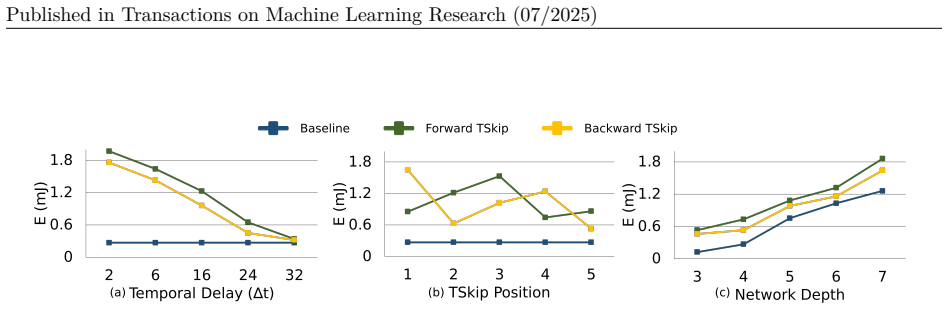
- [Section 4.2 / Figure 6] The ablation study plots do not indicate whether the reported accuracies are single runs or averaged over seeds; please state the number of runs and, if available, error bars, since the paper argues that delay, position, and depth have a systematic effect.
- [Section 5] The discussion says trained TSkips models can perform well 'without explicitly using the temporal skip at inference,' but the Appendix B.2/C.2 experiments replace the skip input with a zero tensor, which is not the same as removing the stored historical state on hardware; please clarify which operation is meant.
Circularity Check
No significant circularity: the TSkips gains are measured on external benchmarks and the NAS ranking is an independent, training-free heuristic.
full rationale
The paper's central claim is an empirical architecture result: augmenting SNN/hybrid backbones with delayed forward/backward skips improves AEE and accuracy on DSEC-flow, DVS128 Gesture, SHD, SSC, and CIFAR10-DVS. These numbers are measured post-training against baselines trained under the same protocol, so no fitted parameter is renamed as a prediction. Equations (3)-(4) define the TSkips mechanism rather than deriving a target from an input; the learned alpha in Eq. (4) is a trained weight, not a fitted proxy for the reported accuracies. The NASWOT-SAHD search (Kim et al., 2022) is a training-free ranking heuristic; the paper reports its Kendall tau (0.58 forward, 0.55 backward) on TSkips-augmented networks, which is a validation of the proxy rather than a circular restatement of results. Self-citations to Kosta & Roy (2023), Negi et al. (2024), and Ponghiran et al. (2023) supply backbones, adaptive-LIF components, and evaluation splits, but the TSkips comparisons are new measurements and do not reduce to those citations; no uniqueness theorem is imported. The strongest manuscript-level concern is not circularity: Eq. (4)'s same-timestep deeper-layer term alpha h^t_{l+k} for backward skips creates a layer-wise causal dependency that the paper does not resolve, but this is a correctness/implementation ambiguity, not a derivation that equals its own input. Overall, the derivation chain is self-contained with respect to the claimed contributions.
Assumptions & free parameters
free parameters (4)
- Temporal delay Δt =
per-dataset values (e.g., DSEC 3-4, DVS 5-8, SHD/SSC 8-24)
- TSkip position (origin and destination layers) =
varying per model, listed in Table 13 and Table 7
- Architecture widths and depths =
various, e.g., 700-124-288-144-20 for SHD Baseline-1
- Learnable scaling factor α =
trained, not reported in final values
assumptions (4)
- standard math LIF neuron dynamics with hard/soft reset (Eqs. 1-2) and ArcTangent surrogate gradient trainability
- domain assumption NASWOT-SAHD score correlates with accuracy for TSkips-augmented networks
- domain assumption Explicit temporal delays do not feed future information, enforced by 0 < t - Δt < T
- domain assumption Custom test split for DSEC-flow following Ponghiran et al. 2023 is an unbiased evaluation
Cite this review
Pith. "Pith review of TSkips: Efficiency Through Explicit Temporal Delay Connections in Spiking Neural Networks." pith.science (2026). https://pith.science/paper/LGUWM3PS
@misc{pith2026241116711,
  author       = {Pith},
  title        = {Pith review of: TSkips: Efficiency Through Explicit Temporal Delay Connections in Spiking Neural Networks},
  year         = {2026},
  howpublished = {\url{https://pith.science/paper/LGUWM3PS}},
  note         = {Machine review of arXiv:2411.16711}
}
read the original abstract
Spiking Neural Networks (SNNs) with their bio-inspired Leaky Integrate-and-Fire (LIF) neurons inherently capture temporal information. This makes them well-suited for sequential tasks like processing event-based data from Dynamic Vision Sensors (DVS) and event-based speech tasks. Harnessing the temporal capabilities of SNNs requires mitigating vanishing spikes during training, capturing spatio-temporal patterns and enhancing precise spike timing. To address these challenges, we propose TSkips, augmenting SNN architectures with forward and backward skip connections that incorporate explicit temporal delays. These connections capture long-term spatio-temporal dependencies and facilitate better spike flow over long sequences. The introduction of TSkips creates a vast search space of possible configurations, encompassing skip positions and time delay values. To efficiently navigate this search space, this work leverages training-free Neural Architecture Search (NAS) to identify optimal network structures and corresponding delays. We demonstrate the effectiveness of our approach on four event-based datasets: DSEC-flow for optical flow estimation, DVS128 Gesture for hand gesture recognition and Spiking Heidelberg Digits (SHD) and Spiking Speech Commands (SSC) for speech recognition. Our method achieves significant improvements across these datasets: up to 18% reduction in Average Endpoint Error (AEE) on DSEC-flow, 8% increase in classification accuracy on DVS128 Gesture, and up to 8% and 16% higher classification accuracy on SHD and SSC, respectively.
Figures


Figures from the paper (9 more)




Reference graph
Works this paper leans on
-
[1]
write newline
" write newline "" before.all 'output.state := FUNCTION n.dashify 't := "" t empty not t #1 #1 substring "-" = t #1 #2 substring "--" = not "--" * t #2 global.max substring 't := t #1 #1 substring "-" = "-" * t #2 global.max substring 't := while if t #1 #1 substring * t #2 global.max substring 't := if while FUNCTION format.date year duplicate empty "emp...
-
[2]
Lapicque’s introduction of the integrate-and-fire model neuron (1907)
Larry F Abbott. Lapicque’s introduction of the integrate-and-fire model neuron (1907). Brain research bulletin, 50 0 (5-6): 0 303--304, 1999
work page 1907
-
[3]
Skip connections in spiking neural networks: An analysis of their effect on network training, 2023
Hadjer Benmeziane, Amine Ziad Ounnoughene, Imane Hamzaoui, and Younes Bouhadjar. Skip connections in spiking neural networks: An analysis of their effect on network training, 2023
work page 2023
-
[4]
A surrogate gradient spiking baseline for speech command recognition
Alexandre Bittar and Philip N Garner. A surrogate gradient spiking baseline for speech command recognition. Frontiers in Neuroscience, 16: 0 865897, 2022
work page 2022
-
[5]
A 240 180 130 db 3 s latency global shutter spatiotemporal vision sensor
Christian Brandli, Raphael Berner, Minhao Yang, Shih-Chii Liu, and Tobi Delbruck. A 240 180 130 db 3 s latency global shutter spatiotemporal vision sensor. IEEE Journal of Solid-State Circuits, 49 0 (10): 0 2333--2341, 2014
work page 2014
-
[6]
Once-for-all: Train one network and specialize it for efficient deployment, 2020
Han Cai, Chuang Gan, Tianzhe Wang, Zhekai Zhang, and Song Han. Once-for-all: Train one network and specialize it for efficient deployment, 2020
2020
-
[7]
Spiking deep convolutional neural networks for energy-efficient object recognition
Yongqiang Cao, Yang Chen, and Deepak Khosla. Spiking deep convolutional neural networks for energy-efficient object recognition. International Journal of Computer Vision, 113: 0 54--66, 2015
work page 2015
-
[8]
One timestep is all you need: Training spiking neural networks with ultra low latency, 2021
Sayeed Shafayet Chowdhury, Nitin Rathi, and Kaushik Roy. One timestep is all you need: Training spiking neural networks with ultra low latency, 2021
work page 2021
Show all 60 references
-
[9]
The heidelberg spiking data sets for the systematic evaluation of spiking neural networks
Benjamin Cramer, Yannik Stradmann, Johannes Schemmel, and Friedemann Zenke. The heidelberg spiking data sets for the systematic evaluation of spiking neural networks. IEEE Transactions on Neural Networks and Learning Systems, 33 0 (7): 0 2744--2757, 2022
2022
-
[10]
Investigating current-based and gating approaches for accurate and energy-efficient spiking recurrent neural networks
Manon Dampfhoffer, Thomas Mesquida, Alexandre Valentian, and Lorena Anghel. Investigating current-based and gating approaches for accurate and energy-efficient spiking recurrent neural networks. In International Conference on Artificial Neural Networks, pages 359--370. Springer, 2022
2022
-
[11]
Rethinking the performance comparison between snns and anns
Lei Deng, Yujie Wu, Xing Hu, Ling Liang, Yufei Ding, Guoqi Li, Guangshe Zhao, Peng Li, and Yuan Xie. Rethinking the performance comparison between snns and anns. Neural networks, 121: 0 294--307, 2020
2020
-
[12]
Incorporating learnable membrane time constant to enhance learning of spiking neural networks
Wei Fang, Zhaofei Yu, Yanqi Chen, Timoth \'e e Masquelier, Tiejun Huang, and Yonghong Tian. Incorporating learnable membrane time constant to enhance learning of spiking neural networks. In Proceedings of the IEEE/CVF international conference on computer vision, pages 2661--2671, 2021
2021
-
[13]
Davison, Jörg Conradt, Kostas Daniilidis, and Davide Scaramuzza
Guillermo Gallego, Tobi Delbrück, Garrick Orchard, Chiara Bartolozzi, Brian Taba, Andrea Censi, Stefan Leutenegger, Andrew J. Davison, Jörg Conradt, Kostas Daniilidis, and Davide Scaramuzza. Event-based vision: A survey. IEEE Transactions on Pattern Analysis and Machine Intell...
2022
-
[14]
Dsec: A stereo event camera dataset for driving scenarios
Mathias Gehrig, Willem Aarents, Daniel Gehrig, and Davide Scaramuzza. Dsec: A stereo event camera dataset for driving scenarios. IEEE Robotics and Automation Letters, 2021 a
2021
-
[15]
E-raft: Dense optical flow from event cameras
Mathias Gehrig, Mario Millhäusler, Daniel Gehrig, and Davide Scaramuzza. E-raft: Dense optical flow from event cameras. In 2021 International Conference on 3D Vision (3DV), pages 197--206, 2021 b
2021
-
[16]
Self-supervised learning of event-based optical flow with spiking neural networks, 2021
Jesse Hagenaars, Federico Paredes-Vallés, and Guido de Croon. Self-supervised learning of event-based optical flow with spiking neural networks, 2021
2021
-
[17]
Learning delays in spiking neural networks using dilated convolutions with learnable spacings, 2023
Ilyass Hammouamri, Ismail Khalfaoui-Hassani, and Timothée Masquelier. Learning delays in spiking neural networks using dilated convolutions with learnable spacings, 2023
2023
-
[18]
Deep residual learning for image recognition, 2015
Kaiming He, Xiangyu Zhang, Shaoqing Ren, and Jian Sun. Deep residual learning for image recognition, 2015
2015
-
[19]
Deep residual learning for image recognition
Kaiming He, Xiangyu Zhang, Shaoqing Ren, and Jian Sun. Deep residual learning for image recognition. In Proceedings of the IEEE conference on computer vision and pattern recognition, pages 770--778, 2016
2016
-
[20]
Long short-term memory
S Hochreiter. Long short-term memory. Neural Computation MIT-Press, 1997
1997
-
[21]
1.1 computing's energy problem (and what we can do about it)
Mark Horowitz. 1.1 computing's energy problem (and what we can do about it). In 2014 IEEE International Solid-State Circuits Conference Digest of Technical Papers (ISSCC), pages 10--14, 2014
2014
-
[22]
Hand gesture recognition system using the dynamic vision sensor
Yu Hu, Ziteng Li, Xinpeng Li, Jianfeng Li, Xintong Yu, Xiaofan Chen, and Lei Wang. Hand gesture recognition system using the dynamic vision sensor. In 2022 5th International Conference on Circuits, Systems and Simulation (ICCSS), pages 102--110, 2022
2022
-
[23]
Densely connected convolutional networks
Gao Huang, Zhuang Liu, Laurens Van Der Maaten, and Kilian Q Weinberger. Densely connected convolutional networks. In Proceedings of the IEEE conference on computer vision and pattern recognition, pages 4700--4708, 2017
2017
-
[24]
Klif: An optimized spiking neuron unit for tuning surrogate gradient function
Chunming Jiang and Yilei Zhang. Klif: An optimized spiking neuron unit for tuning surrogate gradient function. Neural Computation, pages 1--15, 2024
2024
-
[25]
Synaptic plasticity dynamics for deep continuous local learning (decolle)
Jacques Kaiser, Hesham Mostafa, and Emre Neftci. Synaptic plasticity dynamics for deep continuous local learning (decolle). Frontiers in Neuroscience, 14: 0 424, 2020
2020
-
[26]
Dilated convolution with learnable spacings, 2023
Ismail Khalfaoui-Hassani, Thomas Pellegrini, and Timothée Masquelier. Dilated convolution with learnable spacings, 2023
2023
-
[27]
Revisiting batch normalization for training low-latency deep spiking neural networks from scratch
Youngeun Kim and Priyadarshini Panda. Revisiting batch normalization for training low-latency deep spiking neural networks from scratch. Frontiers in neuroscience, 15: 0 773954, 2021
2021
-
[28]
Neural architecture search for spiking neural networks, 2022
Youngeun Kim, Yuhang Li, Hyoungseob Park, Yeshwanth Venkatesha, and Priyadarshini Panda. Neural architecture search for spiking neural networks, 2022
2022
-
[29]
Adam: A method for stochastic optimization
Diederik P Kingma and Jimmy Ba. Adam: A method for stochastic optimization. arXiv preprint arXiv:1412.6980, 2014
2014 arXiv
-
[30]
Adaptive-spikenet: Event-based optical flow estimation using spiking neural networks with learnable neuronal dynamics, 2023
Adarsh Kumar Kosta and Kaushik Roy. Adaptive-spikenet: Event-based optical flow estimation using spiking neural networks with learnable neuronal dynamics, 2023
2023
-
[31]
Fusion-flownet: Energy-efficient optical flow estimation using sensor fusion and deep fused spiking-analog network architectures, 2021
Chankyu Lee, Adarsh Kumar Kosta, and Kaushik Roy. Fusion-flownet: Energy-efficient optical flow estimation using sensor fusion and deep fused spiking-analog network architectures, 2021
2021
-
[32]
Spikeformer: A novel architecture for training high-performance low-latency spiking neural network, 2022
Yudong Li, Yunlin Lei, and Xu Yang. Spikeformer: A novel architecture for training high-performance low-latency spiking neural network, 2022
2022
-
[33]
Blinkflow: A dataset to push the limits of event-based optical flow estimation
Yijin Li, Zhaoyang Huang, Shuo Chen, Xiaoyu Shi, Hongsheng Li, Hujun Bao, Zhaopeng Cui, and Guofeng Zhang. Blinkflow: A dataset to push the limits of event-based optical flow estimation. In 2023 IEEE/RSJ International Conference on Intelligent Robots and Systems (IROS), pages ...
2023
-
[34]
A 128 128 120 db 15 s latency asynchronous temporal contrast vision sensor
Patrick Lichtsteiner, Christoph Posch, and Tobi Delbruck. A 128 128 120 db 15 s latency asynchronous temporal contrast vision sensor. IEEE Journal of Solid-State Circuits, 43 0 (2): 0 566--576, 2008
2008
-
[35]
Sgdr: Stochastic gradient descent with warm restarts, 2017
Ilya Loshchilov and Frank Hutter. Sgdr: Stochastic gradient descent with warm restarts, 2017
2017
-
[36]
Surrogate gradient learning in spiking neural networks: Bringing the power of gradient-based optimization to spiking neural networks
Emre O Neftci, Hesham Mostafa, and Friedemann Zenke. Surrogate gradient learning in spiking neural networks: Bringing the power of gradient-based optimization to spiking neural networks. IEEE Signal Processing Magazine, 36 0 (6): 0 51--63, 2019
2019
-
[37]
Best of both worlds: Hybrid snn-ann architecture for event-based optical flow estimation, 2024
Shubham Negi, Deepika Sharma, Adarsh Kumar Kosta, and Kaushik Roy. Best of both worlds: Hybrid snn-ann architecture for event-based optical flow estimation, 2024
2024
-
[38]
Toward scalable, efficient, and accurate deep spiking neural networks with backward residual connections, stochastic softmax, and hybridization
Priyadarshini Panda, Sai Aparna Aketi, and Kaushik Roy. Toward scalable, efficient, and accurate deep spiking neural networks with backward residual connections, stochastic softmax, and hybridization. Frontiers in Neuroscience, 14: 0 535502, 2020
2020
-
[39]
Back to event basics: Self-supervised learning of image reconstruction for event cameras via photometric constancy
Federico Paredes-Vall \'e s and Guido CHE De Croon. Back to event basics: Self-supervised learning of image reconstruction for event cameras via photometric constancy. In Proceedings of the IEEE/CVF Conference on Computer Vision and Pattern Recognition, pages 3446--3455, 2021
2021
-
[40]
On the difficulty of training recurrent neural networks, 2013
Razvan Pascanu, Tomas Mikolov, and Yoshua Bengio. On the difficulty of training recurrent neural networks, 2013
2013
-
[41]
Hybrid analog-spiking long short-term memory for energy efficient computing on edge devices
Wachirawit Ponghiran and Kaushik Roy. Hybrid analog-spiking long short-term memory for energy efficient computing on edge devices. In 2021 Design, Automation & Test in Europe Conference & Exhibition (DATE), pages 581--586. IEEE, 2021
2021
-
[42]
Event-based temporally dense optical flow estimation with sequential learning, 2023
Wachirawit Ponghiran, Chamika Mihiranga Liyanagedera, and Kaushik Roy. Event-based temporally dense optical flow estimation with sequential learning, 2023
2023
-
[43]
Mamba-spike: Enhancing the mamba architecture with a spiking front-end for efficient temporal data processing, 2024
Jiahao Qin and Feng Liu. Mamba-spike: Enhancing the mamba architecture with a spiking front-end for efficient temporal data processing, 2024
2024
-
[44]
Diet-snn: Direct input encoding with leakage and threshold optimization in deep spiking neural networks, 2020
Nitin Rathi and Kaushik Roy. Diet-snn: Direct input encoding with leakage and threshold optimization in deep spiking neural networks, 2020
2020
-
[45]
Lite-snn: Leveraging inherent dynamics to train energy-efficient spiking neural networks for sequential learning
Nitin Rathi and Kaushik Roy. Lite-snn: Leveraging inherent dynamics to train energy-efficient spiking neural networks for sequential learning. IEEE Transactions on Cognitive and Developmental Systems, pages 1--10, 2024
2024
-
[46]
Exploring spike-based learning for neuromorphic computing: Prospects and perspectives
Nitin Rathi, Amogh Agrawal, Chankyu Lee, Adarsh Kumar Kosta, and Kaushik Roy. Exploring spike-based learning for neuromorphic computing: Prospects and perspectives. In 2021 Design, Automation & Test in Europe Conference & Exhibition (DATE), pages 902--907. IEEE, 2021
2021
-
[47]
Conversion of continuous-valued deep networks to efficient event-driven networks for image classification
B Rueckauer, IA Lungu, Y Hu, M Pfeiffer, and SC Liu. Conversion of continuous-valued deep networks to efficient event-driven networks for image classification. front. neurosci. 11, 682 (2017), 2017
2017
-
[48]
Learning internal representations by error propagation, parallel distributed processing, explorations in the microstructure of cognition, ed
David E Rumelhart, Geoffrey E Hinton, and Ronald J Williams. Learning internal representations by error propagation, parallel distributed processing, explorations in the microstructure of cognition, ed. de rumelhart and j. mcclelland. vol. 1. 1986. Biometrika, 71: 0 599--607, 1986
1986
-
[49]
Convolutional spiking neural networks for spatio-temporal feature extraction
Ali Samadzadeh, Fatemeh Sadat Tabatabaei Far, Ali Javadi, Ahmad Nickabadi, and Morteza Haghir Chehreghani. Convolutional spiking neural networks for spatio-temporal feature extraction. Neural Processing Letters, 55 0 (6): 0 6979--6995, 2023
2023
-
[50]
Eventmix: An efficient data augmentation strategy for event-based learning
Guobin Shen, Dongcheng Zhao, and Yi Zeng. Eventmix: An efficient data augmentation strategy for event-based learning. Information Sciences, 644: 0 119170, 2023
2023
-
[51]
Slayer: Spike layer error reassignment in time, 2018
Sumit Bam Shrestha and Garrick Orchard. Slayer: Spike layer error reassignment in time, 2018
2018
-
[52]
Learnable axonal delay in spiking neural networks improves spoken word recognition
Pengfei Sun, Yansong Chua, Paul Devos, and Dick Botteldooren. Learnable axonal delay in spiking neural networks improves spoken word recognition. Frontiers in Neuroscience, 17: 0 1275944, 2023 a
2023
-
[53]
Adaptive axonal delays in feedforward spiking neural networks for accurate spoken word recognition
Pengfei Sun, Ehsan Eqlimi, Yansong Chua, Paul Devos, and Dick Botteldooren. Adaptive axonal delays in feedforward spiking neural networks for accurate spoken word recognition. In ICASSP 2023 - 2023 IEEE International Conference on Acoustics, Speech and Signal Processing (ICASS...
2023
-
[54]
P.J. Werbos. Backpropagation through time: what it does and how to do it. Proceedings of the IEEE, 78 0 (10): 0 1550--1560, 1990
1990
-
[55]
A new spiking convolutional recurrent neural network (scrnn) with applications to event-based hand gesture recognition
Yannan Xing, Gaetano Di Caterina, and John Soraghan. A new spiking convolutional recurrent neural network (scrnn) with applications to event-based hand gesture recognition. Frontiers in neuroscience, 14: 0 590164, 2020
2020
-
[56]
Accurate and efficient time-domain classification with adaptive spiking recurrent neural networks
Bojian Yin, Federico Corradi, and Sander M Boht \'e . Accurate and efficient time-domain classification with adaptive spiking recurrent neural networks. Nature Machine Intelligence, 3 0 (10): 0 905--913, 2021
2021
-
[57]
Long short-term memory with two-compartment spiking neuron, 2023
Shimin Zhang, Qu Yang, Chenxiang Ma, Jibin Wu, Haizhou Li, and Kay Chen Tan. Long short-term memory with two-compartment spiking neuron, 2023
2023
-
[58]
Spikingformer: Spike-driven residual learning for transformer-based spiking neural network, 2023
Chenlin Zhou, Liutao Yu, Zhaokun Zhou, Zhengyu Ma, Han Zhang, Huihui Zhou, and Yonghong Tian. Spikingformer: Spike-driven residual learning for transformer-based spiking neural network, 2023
2023
-
[59]
Ev-flownet: Self-supervised optical flow estimation for event-based cameras
Alex Zhu, Liangzhe Yuan, Kenneth Chaney, and Kostas Daniilidis. Ev-flownet: Self-supervised optical flow estimation for event-based cameras. In Robotics: Science and Systems XIV. Robotics: Science and Systems Foundation, 2018 a
2018
-
[60]
Unsupervised event-based learning of optical flow, depth, and egomotion, 2018 b
Alex Zihao Zhu, Liangzhe Yuan, Kenneth Chaney, and Kostas Daniilidis. Unsupervised event-based learning of optical flow, depth, and egomotion, 2018 b
2018
Reviewed August 12, 2026 · model on record in the stance chip above.
Discussion (0). Continue with ORCID to comment.