REVIEW 3 major objections 6 minor 79 references
Critical Condition of Core-Collapse Supernovae I: One Dimensional Models
T0 review · 3 major / 6 minor · reviewed 2026-08-12 · deepseek-v4-flash
Pith's one-line read A fitted scaling relation now predicts the critical neutrino luminosity for supernova explosions from four inputs.
desk verdict A careful 1D parameter study that usefully extends the critical luminosity framework to finite pre-shock Mach number, with a real but openly acknowledged numerical caveat at low M that should temper the headline 44% shift. read the letter →
The pith
A machine-rendered reading of the paper's core claim, the machinery that carries it, and where it could break.
The reading
What carries the argument
The central object is the critical curve in the $(L_\nu, \dot{M})$ plane, whose normalization is mapped by raising $L_\nu$ in small steps until the stalled shock advects outward. The controlling device is the outer-boundary Mach number $\mathcal{M}$, which sets the pre-shock pressure through $P_{\mathrm{go}}\simeq \rho v^2/(\Gamma_{\mathrm{go}}\mathcal{M}^2)$ and thereby the thermal content of the accreted matter, while the neutrino optical depth is held fixed at $\tau=2/3$ by adjusting ghost-zone densities. The main diagnostic is the antesonic ratio $\max(c_s^2/v_{\mathrm{esc}}^2)$, the squared ratio of post-shock sound speed to escape velocity, whose near-constant value along the critical curve anchors the paper's comparison of explosion conditions.
What would settle it
Run the $\mathcal{M}=1.3$ series again with pre-shock neutrino heating forcibly set to zero; if $L_\nu^{\mathrm{crit}}$ rises back toward the $\mathcal{M}=2.0$ values, the low-Mach lowering is a numerical artifact rather than the pressurized-inflow effect.
Extended reading notes
Core claim
Across a grid of spherically symmetric, time-dependent accretion models with a general equation of state and optically thin neutrino heating and cooling, the paper finds that the explosion threshold is a critical neutrino luminosity $L_\nu^{\mathrm{crit}}$ and fits it as $$L_\$nu^{{\mathrm{crit}}$} = 32.8 \left(\frac{\dot{M}}{0.5\,M_\odot\,\mathrm{s}^{-1}}\right)^{1.29} \left(\frac{R_\star}{30\,\mathrm{km}}\right)^{n_{R_\star}} \left(\frac{M_\star}{1.4\,M_\odot}\right)^{n_{M_\star}} \left(\frac{\langle\epsilon_{\nu_e}\rangle}{12.6\,\mathrm{MeV}}\right)^{n_\epsilon} $10^{{51}}$\,\mathrm{erg\,s}^{-1},$$ with $n_{R_\star}=-2.58(\dot{M}/0.5)^{-0.16}$, $n_{M_\star}=1.97(\dot{M}/0.5)^{-0.15}$, and $n_\epsilon=-1.69(\dot{M}/0.5)^{0.06}$ at $\mathcal{M}=2.0$. The key physical claim is that the thermal content of the pre-shock flow, parameterized by the outer-boundary Mach number $\mathcal{M}$, changes the normalization: lowering $\mathcal{M}$ from 2.0 to 1.3 reduces $L_\nu^{\mathrm{crit}}$ by about 44 percent, while raising it from 2.0 to 3.0 changes it by about 12 percent, with convergence to pressureless free-fall at high $\mathcal{M}$. The paper further argues that accretion of compositional interfaces such as the Si/O layer therefore promotes explosion two ways at once: a drop in $\dot{M}$ and a rise in entropy that lowers the critical curve. When the antesonic, advection-to-heating timescale, and force-explosion conditions are compared, the antesonic ratio shows the least variation along the critical curve, staying near $\max(c_s^2/v_{\mathrm{esc}}^2)\simeq 0.215\pm0.01$.
Load-bearing premise
The load-bearing assumption is that one outer-boundary Mach number captures the thermal state of the infalling material while the free-nucleon suppression factor completely stops pre-shock neutrino heating; for the lowest-Mach models that suppression fails, so spurious heating may contaminate the pre-shock entropy and partly produce the lowered critical luminosity the paper attributes to pressurized inflow.
Editorial extensions
If this is right
- At fixed accretion rate, pressurized pre-shock inflow lowers the neutrino luminosity required to explode, so models that assume pressureless free-fall overestimate how hard it is to explode realistic progenitors.
- Accretion of an Si/O compositional interface pushes the shock toward explosion through two simultaneous effects: $\dot{M}$ decreases and higher-entropy material lowers $L_\nu^{\mathrm{crit}}$ at fixed $\dot{M}$.
- Along the critical curve, the antesonic ratio stays near $0.215\pm0.01$, varying only about 3-5 percent depending on $\mathcal{M}$, making it the most stable of the tested explosion diagnostics.
- Shock oscillations can temporarily push any diagnostic past its nominal critical value without producing an explosion, so time-averaged rather than instantaneous thresholds are needed near criticality.
- The paper anticipates that the fitted power-law exponents may also depend on $R_\star$, $M_\star$, and $\langle\epsilon_\nu\rangle$ themselves, so the relation is a reference point rather than a universal scaling.
Reading between the lines
- Extension: if the roughly 44 percent normalization shift survives in 2D and 3D, then entropy jumps at compositional interfaces matter as much as $\dot{M}$ drops for predicting which progenitors explode, and progenitor-to-explosion mapping should carry both.
- Extension: a single pre-shock Mach number may be too coarse; a two-parameter family that varies entropy and infall speed separately would test whether the effect is truly pressurized inflow or a more general thermal-content dependence.
- Extension: the near-constant antesonic ratio suggests a practical explosion probe for simulations and eventually observations: record $\max(c_s^2/v_{\mathrm{esc}}^2)$ behind the shock and flag values above roughly 0.215, with oscillations time-averaged.
Editorial analysis
A structured set of objections, weighed in public.
Referee Report
Summary. This paper presents spherically symmetric, time-dependent Athena++ accretion models of the stalled core-collapse supernova shock with a general equation of state and neutrino heating/cooling. Varying the accretion rate, neutrino luminosity, average neutrino energy, PNS radius and mass, and the pre-shock Mach number at fixed neutrino optical depth tau = 2/3, the authors compute the critical neutrino luminosity L_nu^crit separating accretion from explosion. They fit the numerical critical curves to a power-law scaling relation (Eq. 22) with Mdot-dependent exponents (Eqs. 23-25), and they test three proposed explosion diagnostics: the antesonic condition, the advection/heating timescale criterion, and the force explosion condition. The main qualitative claims are that low pre-shock Mach number lowers the normalization of L_nu^crit and that, across the explored model space, the antesonic ratio shows the smallest relative variation, with a near-critical value of about 0.215 +/- 0.01. The low-M behavior is interpreted as evidence that accretion of higher-entropy material across compositional interfaces, such as the Si/O interface, can promote explosion in addition to the well-known decrease in Mdot.
Significance. If the results hold, this is a useful quantitative map of the 1D critical condition and a natural baseline for the planned 2D and 3D extension. The paper has real strengths: the simulations enforce tau = 2/3 through a feedback loop, use stabilized checkpoint models to step in L_nu, check resolution convergence of L_nu^crit to about 1%, and test several published explosion criteria on the same time-dependent data set. The comparison of the antesonic, timescale, and force conditions is informative even where it shows that none of the criteria is exactly constant. However, the central scaling relation is a least-squares fit with no reported uncertainties, and the low-M branch of the study is acknowledged by the authors themselves to be affected by imperfect suppression of pre-shock neutrino heating. The significance is therefore conditional: the framework and diagnostics are valuable, but the quantitative low-M shift and the fit parameters need additional support before the results can be used as calibrated predictions.
major comments (3)
- [Sec. 3.2.1, Eqs. (22)-(25)] The central product of the paper is the power-law scaling relation for L_nu^crit, but the text reports no fit uncertainties, no goodness-of-fit statistic, and no number of fitted model points. Equations (23)-(25) claim weak Mdot dependence of the exponents based on curves like Figure 8, yet no error bars are shown on those fits, and Table 1 calibrates the normalization for each Mach number using a single point. In addition, Eq. (22) contains no M term at all, even though M is a headline input parameter; the M dependence is handled by separately rescaling the prefactor at three discrete values. I request that the authors report the fit covariances and residuals, state the fitting range and number of points, and either extend Eq. (22) to include M explicitly or clearly restrict its validity to M = 2.0.
- [Sec. 3.1 and Fig. 17 caption] The manuscript explicitly acknowledges that for M = 1.3 the free-nucleon suppression factor chi_N in Eq. (17) does not drive the pre-shock Qdot to zero; Figure 1 shows Qdot slowly approaching zero in the pre-shock region, and the Figure 17 caption states that the M = 1.3 profile has a non-zero entropy gradient because Qdot is inadequately suppressed. This contamination is load-bearing for the paper's main quantitative claim, because the 44% decrease in L_nu^crit between M = 2.0 and M = 1.3 (Table 1, Figure 7) is the basis for the compositional-interface interpretation in Section 3.6. Spurious pre-shock heating can raise the entropy and lower the ram pressure of material entering the shock, thereby lowering L_nu^crit artificially. I request a control experiment in which the heating and cooling rates are artificially set to zero for r > R_shock for all M, together with a quantitative estimate of the integrated spurious pre-shock heating relative to the accretion enthalpy flux, so that the physical part of the low-M shift can be separated from the numerical artifact.
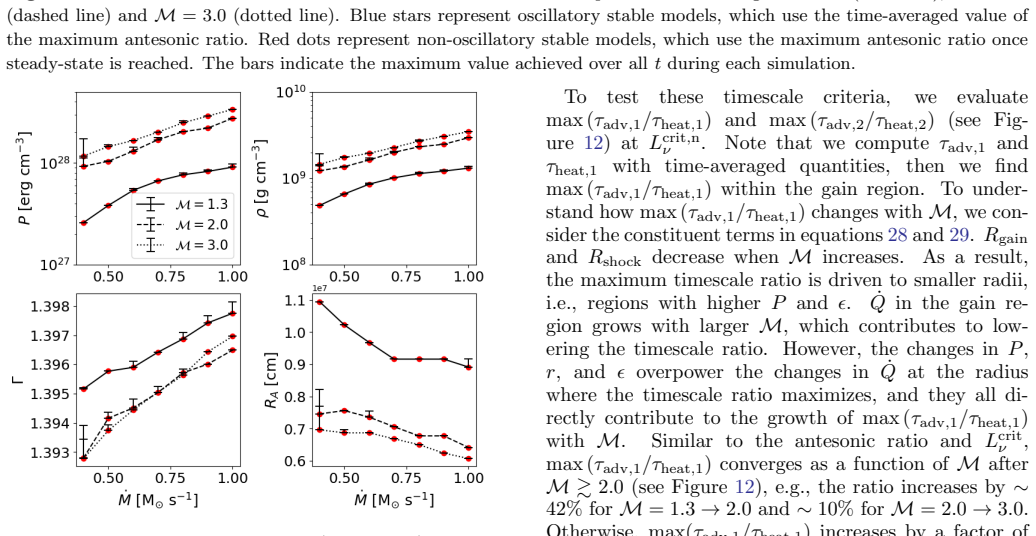
- [Sec. 3.3, Figure 9] The abstract's statement that the antesonic ratio shows the least variation across the model space is based on Figure 9, but the comparison mixes time-averaged maxima for oscillatory models with final-time maxima for non-oscillatory models, and the bars show that instantaneous values can exceed the critical value without leading to explosion. The quoted range 0.215 +/- 0.01 also includes the M = 1.3 models affected by the pre-shock heating problem discussed above. I ask for a version of Figure 9 and the associated statistics restricted to M >= 2.0, and for a statement of how the time-averaging window affects the 3-5% variation quoted in the conclusions. Without this, the 'least variation' claim is not cleanly separated from the grid of models and diagnostics used to define it.
minor comments (6)
- [General] There are several typos, including 'relativistc' in Section 2.2 and 'timscles' in Section 3.4; a careful proofreading pass is needed.
- [Eq. (34)] The notation \dot{M}^{1.0} is ambiguous; it should be written as \dot{M}/(1 M_sun/s) or defined explicitly before use, as is done in the text but not in the equation.
- [Figure 5 caption] The caption states that R_shock stabilizes at ~150-200 km and ~600 km for models that are not the fiducial Rstar = 30 km models; please clarify in the caption which parameter sets produce these radii, since the range quoted in the text is much smaller.
- [Section 2.4 and Section 3.2] The distinction between the first exploding model L_nu^crit and the near-critical stable model L_nu^{crit,n} is clear, but the reader would benefit from an explicit statement of why different sections use one or the other; currently the transition between Sections 3.2 and 3.3 is abrupt.
- [Data availability] The data availability statement says the implementation and data are available upon request; depositing the problem generator and model outputs in a persistent repository would strengthen reproducibility, especially since readers cannot otherwise check the fit values in Eq. (22).
- [Figure 12 caption] The caption attributes the black profile to Eqs. (28)-(29) and the blue profile to Eq. (30), but the latter is defined together with Eq. (31); please correct the cross-reference.
Circularity Check
No significant circularity: Lcrit is measured from explosion runs, Eq. 22 is an explicit least-squares fit, and the three explosion-condition tests do not impose the conditions they claim to test.
full rationale
All load-bearing numbers are measured, not imposed. Lcrit is defined operationally in Section 3.2 as the smallest Lnu at which the stalled shock advects through the outer boundary (vr,out > 0), and every critical-curve point comes from time-dependent Athena++ runs. Equation 22 and the exponents in Eqs. 23-25 are explicitly a least-squares fit to those measured values ('we determine the power law scalings ... by using a least squares method to fit Lcrit'), so there is no fitted input renamed as a prediction: the fit is presented as a fit, and Table 1's 'eqn.' rows are the same fit re-normalized at each M, not independent evidence. The tests of the antesonic condition, timescale ratio, and FEC evaluate Eqs. 26, 28-31, and 33 using simulation fields; none of these conditions is used as the explosion criterion or imposed as a constraint, so the finding that the antesonic ratio varies least is a comparison of diagnostics, not a tautology. The paper cites Pejcha & Thompson (2012) and Raives et al. (2018, 2021) for the theoretical antesonic benchmark, and one author (Thompson) is shared, but these citations supply an external parameter-free threshold (3/16 for isothermal free-fall) that is tested against the data rather than assumed; Eq. 22 does not depend on it. The acknowledged failure of chi_N (Eq. 17) to fully suppress pre-shock heating for M=1.3 (Section 3.1, Figure 1 caption, Figure 17 caption) is a stated numerical-fidelity caveat and could affect the validity of the low-M normalization, but it is not a circular reduction of a result to its own input. No step reduces, by construction, to inputs; score 0.
Assumptions & free parameters
free parameters (9)
- power law normalization C =
32.8
- Mdot exponent =
1.29
- R* exponent normalization =
-2.58
- R* exponent Mdot scaling =
0.16
- M* exponent normalization =
1.97
- M* exponent Mdot scaling =
-0.15
- epsilon exponent normalization =
-1.69
- epsilon exponent Mdot scaling =
0.06
- per-M normalization =
not reported; see Figure 7
assumptions (7)
- domain assumption Neutrino heating and cooling rates of Qian and Woosley (1996), modified for eta_e != 0, are accurate for the accretion flow.
- domain assumption Optically thin neutrino transport with fixed tau = 2/3 captures the critical condition.
- ad hoc to paper The pre-shock thermal content can be parameterized by a single Mach number M at the outer boundary.
- ad hoc to paper The free-nucleon fraction suppression chi_N adequately models the drop in heating across the shock.
- ad hoc to paper The density suppression f_sup = exp(-rho/rho0) prevents spurious high-density heating and cooling.
- domain assumption L_nu_e = L_bar_nu_e = L_nu and eta_nu_e = eta_bar_nu_e = 0.
- standard math The general EoS from Timmes and Swesty (2000) via Coleman (2020) is valid in the modeled regime with rho below about 1e12 g/cm3.
Cite this review
Pith. "Pith review of Critical Condition of Core-Collapse Supernovae I: One Dimensional Models." pith.science (2026). https://pith.science/paper/GRTSJDN6
@misc{pith2026241116857,
  author       = {Pith},
  title        = {Pith review of: Critical Condition of Core-Collapse Supernovae I: One Dimensional Models},
  year         = {2026},
  howpublished = {\url{https://pith.science/paper/GRTSJDN6}},
  note         = {Machine review of arXiv:2411.16857}
}
abstract
When the core of a massive star collapses, neutrino heating can energize the stalled accretion shock, leading to a successful supernova. The critical condition that characterizes the transition from accretion to explosion is a central topic of study and is often characterized by a critical proto-neutron star (PNS) neutrino luminosity $L_\nu^{\rm crit}$, which depends on the post-collapse mass accretion rate $\dot{M}$ from the progenitor. We examine the critical condition by solving the spherically symmetric time-dependent Euler equations with a general equation of state and realistic microphysics for a range of $\dot{M}$, average neutrino energy $\left< \epsilon_{\nu}\right>$, luminosity $L_{\nu}$, PNS radius $R_{\star}$, mass $M_{\star}$, and pre-shock Mach number $\mathcal{M}$ for a fixed neutrino optical depth from the PNS surface of $2/3$. We derive $L_{\nu}^{\mathrm{crit}}$ as a function of the input parameters. We show that pressurized pre-shock flow, as parameterized by low $\mathcal{M}$, changes the normalization of the critical condition because accretion of higher entropy shells at later times after collapse leads to lower $L_{\nu}^{\mathrm{crit}}$. We connect this finding to the onset of explosion due to compositional interface accretion. Across our parameter space, we test critical conditions that have been proposed in the literature, including the ``antesonic" condition, the ``force explosion condition," and the heuristic heating-advection timescale condition. We discuss how shock oscillations impact these critical conditions. Compared to other explosion conditions, we find that the antesonic ratio shows the least variation across the model space we explore. This work is preparatory for similar experiments in 2D axisymmetry and 3D.
Figures


Figures from the paper (13 more)




Reference graph
Works this paper leans on
-
[1]
, " * write output.state after.block = add.period write newline
ENTRY address archivePrefix author booktitle chapter doi edition editor eprint howpublished institution journal key month number organization pages publisher school series title misctitle type volume year version url label extra.label sort.label short.list INTEGERS output.state before.all mid.sentence after.sentence after.block FUNCTION init.state.consts ...
-
[2]
write newline
" write newline "" before.all 'output.state := FUNCTION format.url url empty "" new.block "" url * "" * if FUNCTION format.eprint eprint empty "" archivePrefix empty "" archivePrefix "arXiv" = new.block " " eprint * " " * new.block " " eprint * " " * if if if FUNCTION format.doi doi empty "" " " doi * " " * if FUNCTION format.pid doi empty eprint empty ur...
-
[3]
- [1] #1 = = ^ ^ ^ .\!\!^ d .\!\!^ h .\!\!^ m .\!\!^ s .\!\!^ @mss
thebibliography [1] 20pt to REFERENCES 6pt =0pt -12pt 10pt plus 3pt =0pt =0pt =1pt plus 1pt =0pt =0pt -12pt =13pt plus 1pt =20pt =13pt plus 1pt \@M =10000 =-1.0em =0pt =0pt 0pt =0pt =1.0em @enumiv\@empty 10000 10000 `\.\@m \@noitemerr \@latex@warning Empty `thebibliography' environment \@ifnextchar \@reference \@latexerr Missing key on reference command E...
2021
-
[4]
&H!BXv̒N 9غ B ! B ! B ! 0 B ! B &B ! B D ! B as ! B !lN ! B !I`
thebibliography [1] 20pt to REFERENCES 6pt =0pt 10pt plus 3pt =0pt =0pt =1pt plus 1pt =0pt =0pt -12pt =13pt plus 1pt =20pt =13pt plus 1pt \@M =10000 =-1.0em =0pt =0pt 0pt =0pt =1.0em @enumiv\@empty 10000 10000 `\.\@m \@noitemerr \@latex@warning Empty `thebibliography' environment \@ifnextchar \@reference \@latexerr Missing key on reference command Each re...
2019
-
[5]
Adams S., Kochanek C., Gerke J., Stanek K., Dai X., 2017a, Monthly Notices of The Royal Astronomical Society, 468, 4968
-
[6]
Adams S., Kochanek C., Gerke J., Stanek K., 2017b, Monthly Notices of the Royal Astronomical Society, 469, 1445
-
[7]
Bethe H. A., 1990, @doi [Rev. Mod. Phys.] 10.1103/RevModPhys.62.801 , 62, 801
-
[8]
Bethe H. A., Wilson J. R., 1985, @doi [ ] 10.1086/163343 , https://ui.adsabs.harvard.edu/abs/1985ApJ...295...14B 295, 14
doi:10.1086/163343 1985
Show all 79 references
-
[9]
W., Mezzacappa A., Dineva T., 1995, @doi [ ] 10.1016/0370-1573(94)00102-9 , https://ui.adsabs.harvard.edu/abs/1995PhR...256...69B 256, 69
Bruenn S. W., Mezzacappa A., Dineva T., 1995, @doi [ ] 10.1016/0370-1573(94)00102-9 , https://ui.adsabs.harvard.edu/abs/1995PhR...256...69B 256, 69
1995 doi
-
[10]
Burrows A., 2013, @doi [Reviews of Modern Physics] 10.1103/RevModPhys.85.245 , https://ui.adsabs.harvard.edu/abs/2013RvMP...85..245B 85, 245
2013 doi
-
[11]
Burrows A., Goshy J., 1993, @doi [ ] 10.1086/187074 , https://ui.adsabs.harvard.edu/abs/1993ApJ...416L..75B 416, L75
1993 doi
-
[12]
M., 1985, @doi [ ] 10.1086/184572 , https://ui.adsabs.harvard.edu/abs/1985ApJ...299L..19B 299, L19
Burrows A., Lattimer J. M., 1985, @doi [ ] 10.1086/184572 , https://ui.adsabs.harvard.edu/abs/1985ApJ...299L..19B 299, L19
1985 doi
-
[13]
M., 1986, @doi [ ] 10.1086/164405 , https://ui.adsabs.harvard.edu/abs/1986ApJ...307..178B 307, 178
Burrows A., Lattimer J. M., 1986, @doi [ ] 10.1086/164405 , https://ui.adsabs.harvard.edu/abs/1986ApJ...307..178B 307, 178
1986 doi
-
[14]
Burrows A., Vartanyan D., 2021, @doi [ ] 10.1038/s41586-020-03059-w , https://ui.adsabs.harvard.edu/abs/2021Natur.589...29B 589, 29
2021 doi
-
[15]
A., Dolence J
Burrows A., Radice D., Vartanyan D., Nagakura H., Skinner M. A., Dolence J. C., 2020, @doi [ ] 10.1093/mnras/stz3223 , https://ui.adsabs.harvard.edu/abs/2020MNRAS.491.2715B 491, 2715
2020 doi
-
[16]
Burrows A., Wang T., Vartanyan D., 2024, @doi [ ] 10.3847/2041-8213/ad319e , https://ui.adsabs.harvard.edu/abs/2024ApJ...964L..16B 964, L16
2024 doi
-
[17]
Colella P., 1990, @doi [Journal of Computational Physics] 10.1016/0021-9991(90)90233-Q , https://ui.adsabs.harvard.edu/abs/1990JCoPh..87..171C 87, 171
1990 doi
-
[18]
R., 1984, Journal of computational physics, 54, 174
Colella P., Woodward P. R., 1984, Journal of computational physics, 54, 174
1984
-
[19]
S., 2020, The Astrophysical Journal Supplement Series, 248, 7
Coleman M. S., 2020, The Astrophysical Journal Supplement Series, 248, 7
2020
-
[20]
A., Grasberger W
Colgate S. A., Grasberger W. H., White R. H., 1961, @doi [ ] 10.1086/108573 , https://ui.adsabs.harvard.edu/abs/1961AJ.....66S.280C 66, 280
1961 doi
-
[21]
M., 2013, @doi [ ] 10.1088/0004-637X/775/1/35 , https://ui.adsabs.harvard.edu/abs/2013ApJ...775...35C 775, 35
Couch S. M., 2013, @doi [ ] 10.1088/0004-637X/775/1/35 , https://ui.adsabs.harvard.edu/abs/2013ApJ...775...35C 775, 35
2013 doi
-
[22]
M., 2017, Philosophical Transactions of the Royal Society A: Mathematical, Physical and Engineering Sciences, 375, 20160271
Couch S. M., 2017, Philosophical Transactions of the Royal Society A: Mathematical, Physical and Engineering Sciences, 375, 20160271
2017
-
[23]
M., Ott C
Couch S. M., Ott C. D., 2015, @doi [ ] 10.1088/0004-637X/799/1/5 , https://ui.adsabs.harvard.edu/abs/2015ApJ...799....5C 799, 5
2015 doi
-
[24]
A., Kubrusly C
De Moura C. A., Kubrusly C. S., 2013, AMC, 10
2013
-
[25]
Fern \'a ndez R., 2012, @doi [ ] 10.1088/0004-637X/749/2/142 , https://ui.adsabs.harvard.edu/abs/2012ApJ...749..142F 749, 142
2012 doi
-
[26]
Fern \'a ndez R., 2015, @doi [ ] 10.1093/mnras/stv146310.48550/arXiv.1504.07996 , https://ui.adsabs.harvard.edu/abs/2015MNRAS.452.2071F 452, 2071
2015
-
[27]
Fern \'a ndez R., Thompson C., 2009, The Astrophysical Journal, 697, 1827
2009
-
[28]
Fern \'a ndez R., M \"u ller B., Foglizzo T., Janka H.-T., 2014, Monthly Notices of the Royal Astronomical Society, 440, 2763
2014
-
[29]
Ferreira M., Provid\^encia C. m. c., 2021, @doi [Phys. Rev. D] 10.1103/PhysRevD.104.063006 , 104, 063006
2021 doi
-
[30]
Gabay D., Balberg S., Keshet U., 2015, @doi [ ] 10.1088/0004-637X/815/1/37 , https://ui.adsabs.harvard.edu/abs/2015ApJ...815...37G 815, 37
2015 doi
-
[31]
Gerke J., Kochanek C., Stanek K., 2015, Monthly Notices of the Royal Astronomical Society, 450, 3289
2015
-
[32]
W., 2022, @doi [ ] 10.1093/mnras/stac1811 , https://ui.adsabs.harvard.edu/abs/2022MNRAS.515.1610G 515, 1610
Gogilashvili M., Murphy J. W., 2022, @doi [ ] 10.1093/mnras/stac1811 , https://ui.adsabs.harvard.edu/abs/2022MNRAS.515.1610G 515, 1610
2022 doi
-
[33]
W., O'Connor E
Gogilashvili M., Murphy J. W., O'Connor E. P., 2023, @doi [ ] 10.1093/mnras/stad2155 , https://ui.adsabs.harvard.edu/abs/2023MNRAS.524.4109G 524, 4109
2023 doi
-
[34]
Hanke F., Marek A., M \"u ller B., Janka H.-T., 2012, @doi [ ] 10.1088/0004-637X/755/2/138 , https://ui.adsabs.harvard.edu/abs/2012ApJ...755..138H 755, 138
2012 doi
-
[35]
Hanke F., M \"u ller B., Wongwathanarat A., Marek A., Janka H.-T., 2013, The Astrophysical Journal, 770, 66
2013
-
[36]
T., 2000, @doi [ ] 10.1016/S0375-9474(99)00580-1 , https://ui.adsabs.harvard.edu/abs/2000NuPhA.663..119J 663, 119
Janka H. T., 2000, @doi [ ] 10.1016/S0375-9474(99)00580-1 , https://ui.adsabs.harvard.edu/abs/2000NuPhA.663..119J 663, 119
2000 doi
-
[37]
Janka H.-T., 2012, @doi [Annual Review of Nuclear and Particle Science] 10.1146/annurev-nucl-102711-094901 , https://ui.adsabs.harvard.edu/abs/2012ARNPS..62..407J 62, 407
2012 doi
-
[38]
Janka H.-T., Melson T., Summa A., 2016, @doi [Annual Review of Nuclear and Particle Science] 10.1146/annurev-nucl-102115-044747 , https://ui.adsabs.harvard.edu/abs/2016ARNPS..66..341J 66, 341
2016 doi
-
[39]
S., Beacom J
Kochanek C. S., Beacom J. F., Kistler M. D., Prieto J. L., Stanek K. Z., Thompson T. A., Y \"u ksel H., 2008, The Astrophysical Journal, 684, 1336
2008
-
[40]
Kotake K., Ohnishi N., Yamada S., 2007, @doi [ ] 10.1086/509320 , https://ui.adsabs.harvard.edu/abs/2007ApJ...655..406K 655, 406
2007 doi
-
[41]
J., et al., 2015, @doi [ ] 10.1088/2041-8205/807/2/L31 , https://ui.adsabs.harvard.edu/abs/2015ApJ...807L..31L 807, L31
Lentz E. J., et al., 2015, @doi [ ] 10.1088/2041-8205/807/2/L31 , https://ui.adsabs.harvard.edu/abs/2015ApJ...807L..31L 807, L31
2015 doi
-
[42]
A., Murphy J
Mabanta Q. A., Murphy J. W., 2018, @doi [ ] 10.3847/1538-4357/aaaec7 , https://ui.adsabs.harvard.edu/abs/2018ApJ...856...22M 856, 22
2018 doi
-
[43]
J., 1982, @doi [ ] 10.1086/183839 , https://ui.adsabs.harvard.edu/abs/1982ApJ...259L..13M 259, L13
Mazurek T. J., 1982, @doi [ ] 10.1086/183839 , https://ui.adsabs.harvard.edu/abs/1982ApJ...259L..13M 259, L13
1982 doi
-
[44]
Melson T., Janka H.-T., Bollig R., Hanke F., Marek A., M \"u ller B., 2015, @doi [ ] 10.1088/2041-8205/808/2/L42 , https://ui.adsabs.harvard.edu/abs/2015ApJ...808L..42M 808, L42
2015 doi
-
[45]
Mezzacappa A., Endeve E., Messer O. E. B., Bruenn S. W., 2020, @doi [Living Reviews in Computational Astrophysics] 10.1007/s41115-020-00010-8 , https://ui.adsabs.harvard.edu/abs/2020LRCA....6....4M 6, 4
2020 doi
-
[46]
M \"u ller B., Melson T., Heger A., Janka H.-T., 2017, @doi [ ] 10.1093/mnras/stx1962 , https://ui.adsabs.harvard.edu/abs/2017MNRAS.472..491M 472, 491
2017 doi
-
[47]
W., Burrows A., 2008, @doi [ ] 10.1086/592214 , https://ui.adsabs.harvard.edu/abs/2008ApJ...688.1159M 688, 1159
Murphy J. W., Burrows A., 2008, @doi [ ] 10.1086/592214 , https://ui.adsabs.harvard.edu/abs/2008ApJ...688.1159M 688, 1159
2008 doi
-
[48]
W., Dolence J
Murphy J. W., Dolence J. C., 2017, The Astrophysical Journal, 834, 183
2017
-
[49]
Neustadt J., Kochanek C., Stanek K., Basinger C., Jayasinghe T., Garling C., Adams S., Gerke J., 2021, Monthly Notices of the Royal Astronomical Society, 508, 516
2021
-
[50]
D., Burrows A., Almgren A., 2012, @doi [Monthly Notices of the Royal Astronomical Society] 10.1111/j.1365-2966.2012.21002.x , 423, 1805
Nordhaus J., Brandt T. D., Burrows A., Almgren A., 2012, @doi [Monthly Notices of the Royal Astronomical Society] 10.1111/j.1365-2966.2012.21002.x , 423, 1805
2012
-
[51]
D., O'Connor E
Ott C. D., O'Connor E. P., Gossan S., Abdikamalov E., Gamma U. C. T., Drasco S., 2013, @doi [Nuclear Physics B Proceedings Supplements] 10.1016/j.nuclphysbps.2013.04.036 , https://ui.adsabs.harvard.edu/abs/2013NuPhS.235..381O 235, 381
2013 doi
-
[53]
D., Roberts L
Ott C. D., Roberts L. F., da Silva Schneider A., Fedrow J. M., Haas R., Schnetter E., 2018a, @doi [ ] 10.3847/2041-8213/aaa967 , https://ui.adsabs.harvard.edu/abs/2018ApJ...855L...3O 855, L3
-
[54]
A., 2012, @doi [ ] 10.1088/0004-637X/746/1/106 , https://ui.adsabs.harvard.edu/abs/2012ApJ...746..106P 746, 106
Pejcha O., Thompson T. A., 2012, @doi [ ] 10.1088/0004-637X/746/1/106 , https://ui.adsabs.harvard.edu/abs/2012ApJ...746..106P 746, 106
2012 doi
-
[55]
Prasanna T., Coleman M. S. B., Raives M. J., Thompson T. A., 2022, @doi [ ] 10.1093/mnras/stac2651 , https://ui.adsabs.harvard.edu/abs/2022MNRAS.517.3008P 517, 3008
2022 doi
-
[56]
Z., Woosley S
Qian Y. Z., Woosley S. E., 1996, @doi [ ] 10.1086/177973 , https://ui.adsabs.harvard.edu/abs/1996ApJ...471..331Q 471, 331
1996 doi
-
[57]
J., Couch S
Raives M. J., Couch S. M., Greco J. P., Pejcha O., Thompson T. A., 2018, @doi [ ] 10.1093/mnras/sty2457 , https://ui.adsabs.harvard.edu/abs/2018MNRAS.481.3293R 481, 3293
2018 doi
-
[58]
J., Thompson T
Raives M. J., Thompson T. A., Couch S. M., 2021, @doi [ ] 10.1093/mnras/stab286 , https://ui.adsabs.harvard.edu/abs/2021MNRAS.502.4125R 502, 4125
2021 doi
-
[59]
T., M \"u ller E., 2006, @doi [ ] 10.1051/0004-6361:20064855 , https://ui.adsabs.harvard.edu/abs/2006A&A...457..963S 457, 963
Scheck L., Kifonidis K., Janka H. T., M \"u ller E., 2006, @doi [ ] 10.1051/0004-6361:20064855 , https://ui.adsabs.harvard.edu/abs/2006A&A...457..963S 457, 963
2006 doi
-
[60]
Stockinger G., et al., 2020, @doi [ ] 10.1093/mnras/staa1691 , https://ui.adsabs.harvard.edu/abs/2020MNRAS.496.2039S 496, 2039
2020 doi
-
[61]
M., Gardiner T., 2009, New Astronomy, 14, 139
Stone J. M., Gardiner T., 2009, New Astronomy, 14, 139
2009
-
[62]
M., Tomida K., White C
Stone J. M., Tomida K., White C. J., Felker K. G., 2020, @doi [ ] 10.3847/1538-4365/ab929b , https://ui.adsabs.harvard.edu/abs/2020ApJS..249....4S 249, 4
2020 doi
-
[63]
M., Janka H.-T., 2016, The Astrophysical Journal, 821, 38
Sukhbold T., Ertl T., Woosley S., Brown J. M., Janka H.-T., 2016, The Astrophysical Journal, 821, 38
2016
-
[64]
Sukhbold T., Woosley S., Heger A., 2018, The Astrophysical Journal, 860, 93
2018
-
[65]
Summa A., Janka H.-T., Melson T., Marek A., 2018, @doi [ ] 10.3847/1538-4357/aa9ce8 , https://ui.adsabs.harvard.edu/abs/2018ApJ...852...28S 852, 28
2018 doi
-
[66]
Suwa Y., Yamada S., Takiwaki T., Kotake K., 2015, The Astrophysical Journal, 816, 43
2015
-
[67]
Takiwaki T., Kotake K., Suwa Y., 2014, @doi [ ] 10.1088/0004-637X/786/2/83 , https://ui.adsabs.harvard.edu/abs/2014ApJ...786...83T 786, 83
2014 doi
-
[68]
Thompson C., 2000, @doi [ ] 10.1086/308773 , https://ui.adsabs.harvard.edu/abs/2000ApJ...534..915T 534, 915
2000 doi
-
[69]
A., Burrows A., Meyer B
Thompson T. A., Burrows A., Meyer B. S., 2001, The Astrophysical Journal, 562, 887
2001
-
[70]
A., Burrows A., Pinto P
Thompson T. A., Burrows A., Pinto P. A., 2003, The Astrophysical Journal, 592, 434
2003
-
[71]
A., Quataert E., Burrows A., 2005, The Astrophysical Journal, 620, 861
Thompson T. A., Quataert E., Burrows A., 2005, The Astrophysical Journal, 620, 861
2005
-
[72]
X., Swesty F
Timmes F. X., Swesty F. D., 2000, The Astrophysical Journal Supplement Series, 126, 501
2000
-
[73]
F., Spruce M., Speares W., 1994, Shock waves, 4, 25
Toro E. F., Spruce M., Speares W., 1994, Shock waves, 4, 25
1994
-
[74]
A., Dolence J., 2018, Monthly Notices of the Royal Astronomical Society, 477, 3091
Vartanyan D., Burrows A., Radice D., Skinner M. A., Dolence J., 2018, Monthly Notices of the Royal Astronomical Society, 477, 3091
2018
-
[75]
Wang T., Burrows A., 2024, @doi [ ] 10.3847/1538-4357/ad12b8 , https://ui.adsabs.harvard.edu/abs/2024ApJ...962...71W 962, 71
2024 doi
-
[76]
S., 2022, Monthly Notices of the Royal Astronomical Society, 517, 543
Wang T., Vartanyan D., Burrows A., Coleman M. S., 2022, Monthly Notices of the Royal Astronomical Society, 517, 543
2022
-
[77]
E., Heger A., 2007, @doi [ ] 10.1016/j.physrep.2007.02.009 , https://ui.adsabs.harvard.edu/abs/2007PhR...442..269W 442, 269
Woosley S. E., Heger A., 2007, @doi [ ] 10.1016/j.physrep.2007.02.009 , https://ui.adsabs.harvard.edu/abs/2007PhR...442..269W 442, 269
2007 doi
-
[78]
E., Heger A., Weaver T
Woosley S. E., Heger A., Weaver T. A., 2002, @doi [Rev. Mod. Phys.] 10.1103/RevModPhys.74.1015 , 74, 1015
2002 doi
-
[79]
Yamasaki T., Yamada S., 2005, @doi [ ] 10.1086/428496 , https://ui.adsabs.harvard.edu/abs/2005ApJ...623.1000Y 623, 1000
2005 doi
-
[80]
Yamasaki T., Yamada S., 2006, @doi [ ] 10.1086/507067 , https://ui.adsabs.harvard.edu/abs/2006ApJ...650..291Y 650, 291
2006 doi
Reviewed August 12, 2026 · model on record in the stance chip above.
Discussion (0). Continue with ORCID to comment.