REVIEW 4 major objections 4 minor 12 references
Orthogonal Polynomials on Bubble-Diamond Fractals
T0 review · 4 major / 4 minor · reviewed 2026-08-12 · deepseek-v4-flash
Pith's one-line read On every bubble-diamond fractal, explicit Legendre-type polynomials obey a three-term recursion.
desk verdict The three-term recursion in Theorem 4.7 is off by one and false as stated—on the unit interval it already fails at j=0 and j=1—though the monomial and orthogonal polynomial construction on bubble-diamond fractals has real content worth salvaging. read the letter →
The pith
A machine-rendered reading of the paper's core claim, the machinery that carries it, and where it could break.
The reading
What carries the argument
The load-bearing mechanism is the identification of polynomials of degree at most $j$ with the multiharmonic space $H_j=\{u:\Delta^{j+1}u=0\}$, a space of dimension $2j+2$ whose elements are determined by the boundary values $\{\Delta^m u(q_k):m=0,\ldots,j,\ k=1,2\}$. Inside this space the paper uses two computable bases: the multiharmonic functions $f_{jk}$ and the monomials $P_{jk}$, each with a scaling identity under the fractal maps $F_i$ that reduces their construction to finitely many scalar sequences ($a_j,b_j,p_j,q_j$ and $\alpha_j,\beta_j,\eta_j,\gamma_j$). The recursion itself is carried by the auxiliary polynomials $g_{j+1}=-\int_{K_b}G(x,y)p_j(y)\,d\mu(y)$, which satisfy $\Delta g_{j+1}=p_j$ and therefore lie in $H_{j+1}$. The symmetry identity $\langle g_{j+1},p_\ell\rangle=\langle p_j,g_{\ell+1}\rangle$ then forces the expansion of $g_{j+1}$ against the orthogonal basis to contain at most the three consecutive terms appearing in Theorem 4.7, which is what makes the coefficient formulas $s_j$ and $t_j$ explicit.
What would settle it
Compute, for a fixed branching parameter such as $b=2$ and a low degree such as $j=1$, the four functions $f_{01},f_{02},f_{11},f_{12}$ by solving $\Delta^{j+1}f=0$ with the boundary conditions of Proposition 3.2; if these four functions are linearly dependent, or if some $f\in H_j$ with the required boundary data is not reproduced by formula (3.1), then the basis claim that supports the whole construction is false. Alternatively, verify the identity $d_j^{-2}=d_0^{-2}t_1t_2\cdots t_j$ from Theorem 4.7 on a numerically computed example; a mismatch would expose an error in the recursion coefficient formulas.
Extended reading notes
Core claim
The paper's central discovery is that the family $\{\pi_j\}$ obtained by Gram-Schmidt orthogonalization of the monomials $\{P_j\}$ on the bubble-diamond fractal $K_b$ obeys a three-term recursion, exactly the structure that makes classical orthogonal polynomials useful. Theorem 4.7 states $g_{j+1}=p_{j+1}+s_jp_j+t_jp_{j-1}$, where $g_{j+1}$ is the Green-operator image of $p_j$, $p_{-1}=g_0=0$, and the coefficients are $s_j=d_j^2\langle g_{j+1},p_j\rangle$ and $t_j=d_{j-1}^2d_j^{-2}$, with $d_j=\|p_j\|^{-1}$. In the normalized basis $\pi_j=d_jp_j$ the recursion becomes $\tilde g_{j+1}=\sqrt{t_{j+1}}\pi_{j+1}+s_j\pi_j+\sqrt{t_j}\pi_{j-1}$ (Corollary 4.8). To reach this, the paper builds two bases for the space $H_j=\{u:\Delta^{j+1}u=0\}$ of polynomials of degree at most $j$: the multiharmonic functions $f_{jk}$ and the monomials $P_{jk}$, whose boundary values and inner products are computed by explicitly solved recursions (Theorems 3.3, 3.4, 4.3, and 4.4). When $b=1$, the construction reproduces the classical Legendre polynomials.
Load-bearing premise
Everything rests on the premise that knowing the values $\Delta^m u$ at the two boundary points for $m=0,\dots,j$ completely determines every solution of $\Delta^{j+1}u=0$, with exactly $2j+2$ independent solutions at each degree $j$; the paper takes this from spline theory on the Sierpinski gasket, and if the premise failed the polynomial construction would not be well defined.
Editorial extensions
If this is right
- On every $K_b$ the orthonormal family $\{\pi_j\}$ provides an explicit orthogonal basis of each polynomial space $H_j$, so projections onto polynomials of bounded degree can be computed from the scalar coefficient sequences rather than by repeated numerical integration.
- The recursion supplies a Jacobi-matrix description of the Green operator in the polynomial basis, and the coefficient bounds $0\le t_j\le\|G\|_2^2$ and $-\|G\|_2\le s_j\le0$ control the growth of the unnormalized polynomials via $\|p_j\|\le d_0^{-1}\|G\|_2^j$ (Corollary 4.9).
- Setting $b=1$ recovers the classical Legendre polynomials on the interval, so the construction gives a one-parameter family of fractal Legendre systems ranging from the interval to highly branched fractals.
- Theorem 4.4 expresses every monomial inner product in terms of the scalar sequences $\alpha_j,\beta_j,\eta_j,\gamma_j$, so the Gram-Schmidt coefficients and hence the recursion coefficients are determined by finitely many scalar data at each degree.
Reading between the lines
- The paper leaves open whether the span of all $\pi_j$ is dense in $L^2(K_b,\mu)$; on the Sierpinski gasket the analogous polynomials fail to be complete, and the same failure is plausible for $b\ge2$. A numerical check of the Jacobi-operator spectrum or the associated moment problem would settle this.
- A testable extension would be to derive closed-form expressions for $\alpha_j,\beta_j,\eta_j,\gamma_j$ for general $b$; the paper gives recursions, but closed forms would allow direct generation of the Legendre polynomials without solving coupled recursions at each degree.
- The two-point boundary structure suggests that a fractal with more than two boundary points would need a block-tridiagonal recursion rather than a three-term one, and the same Green-operator symmetry argument might carry over to that setting.
- The bounds in Corollary 4.9 hint that the Green operator acts like a compact Jacobi matrix in the polynomial basis; analyzing the corresponding transfer matrix could yield spectral information about the Laplacian on $K_b$.
Editorial analysis
A structured set of objections, weighed in public.
Referee Report
Summary. The paper develops a theory of polynomials and orthogonal polynomials on the bubble-diamond fractals K_b, a family of p.c.f. self-similar fractals with branching parameter b. The authors define monomials as multiharmonic functions (solutions of Δ^{j+1}u=0), compute their inner products through recursive coefficient formulas, apply Gram-Schmidt orthogonalization to obtain an orthonormal family, and claim that this family satisfies a three-term recursion of Legendre type. The main result is Theorem 4.7, which asserts that the antiderivative g_{j+1} of the j-th orthogonal polynomial is expressible as a three-term linear combination of p_{j+1}, p_j, and p_{j-1}.
Significance. If correct, the construction would give an explicit, computable orthogonal polynomial system on a class of fractals with varying spectral dimension, with recursion coefficients computed from inner products and norms rather than fitted. The paper includes reproducible Python code and illustrative figures. However, the central three-term recursion theorem contains a fundamental degree/indexing error: in the b=1 (unit interval) limit it is already false. Several foundational structural claims, notably Proposition 3.2 and Theorem 4.3, are also under-proved. Because the theorem is the paper's main advertised result, the error is load-bearing and cannot be fixed by local revisions.
major comments (4)
- [Theorem 4.7, Eqs. (4.7)–(4.12)] The three-term recursion is invalid because of an off-by-one degree error. Since Δ g_{j+1} = p_j and p_j is a linear combination of P_0,...,P_j with P_n ∈ H_{⌊n/2⌋}, we have p_j ∈ H_{⌊j/2⌋}; hence g_{j+1} ∈ H_{⌊j/2⌋+1}, not H_{j+1} as claimed in (4.8). Consequently the expansion (4.12) of g_{j+1} over {p_ℓ}_{ℓ=0}^{j+1} is not justified; components p_{j+2} and p_{j+3} can be nonzero. A concrete counterexample occurs for b=1, the unit interval: p_1(x)=1/2−x, and g_2(x)=−∫_0^1 G(x,y)p_1(y)dy = −x^3/6 + x^2/4 − x/12, which is a cubic polynomial. The claimed identity g_2 = p_2 + s_1 p_1 + t_1 p_0 is impossible because p_2 is at most quadratic, p_1 linear, and p_0 constant. Thus Theorem 4.7 is false as stated, and the proof's conclusion that a=1 in (4.12) does not follow.
- [Proposition 3.2] The proof that {f_{mk}} is a basis for H_j is incomplete. The sentence 'The first part follows by observing that both sides of (3.1) belong to H_j' only shows that the right-hand side is a function in H_j with the specified boundary data; it does not show that the boundary-value map is surjective onto H_j, nor that the functions f_{mk} are linearly independent. Since this structural result is used repeatedly (e.g., to justify the dimension of the polynomial spaces and the recursive coefficient formulas in Theorems 3.3 and 3.4), a complete proof is needed. The citation to [11] may supply the argument for the Sierpinski gasket, but the bubble-diamond case requires verification.
- [Theorem 4.3, Eq. (4.3)] The recursive formulas for α_j, β_j, η_j, γ_j are stated without proof, with the note that they are 'derived from the same method as [8, Theorem 2.3, Theorem 2.12].' These formulas are load-bearing: they determine the monomials P_{jk} on V_* through (4.1), and all subsequent inner products and Gram-Schmidt coefficients depend on them. The manuscript gives no derivation or indication of how the formulas adapt from [8] to the bubble-diamond setting, leaving the reader unable to check the construction.
- [Definition 2.10] The assertion that G(p,q) = lim_{ℓ→∞} G_ℓ(p,q) 'can be continuously extended to a function on K_b × K_b' is not proved. The Green function is used in Proposition 2.11 to solve the Dirichlet problem and in Theorem 4.7 to define g_{j+1}; without a proof of existence, continuity, and uniqueness of the extension, the analytic foundation for these results is incomplete. At minimum the manuscript should justify the limit and the extension, citing a theorem or providing an argument.
minor comments (4)
- [Definition 4.5] The indexing is inconsistent: the Gram-Schmidt process is applied to {P_j}_{j≥1}, but p_0 = P_0, and the reindexing P_{2j+k}=P_{jk} does not define P_0 for k=1,2. Please clarify the scalar indexing of P_n and the two-parameter notation P_{jk}.
- [Eq. (3.5)] The definition of p_ℓ is confusing: it uses 'i ≠ k' and then 'for i, k, n distinct'. Please clarify which indices are summation indices and which are fixed, and whether the value depends on the choices.
- [Proposition 4.2] The proof states '∆ P_{(j+1)k} = P_{jk}' without comment. This identity is reminiscent of differentiation of monomials in the classical case, but for the two types k=1,2 it needs a precise derivation in the bubble-diamond setting, especially since the boundary conditions in Definition 4.1 involve normal derivatives.
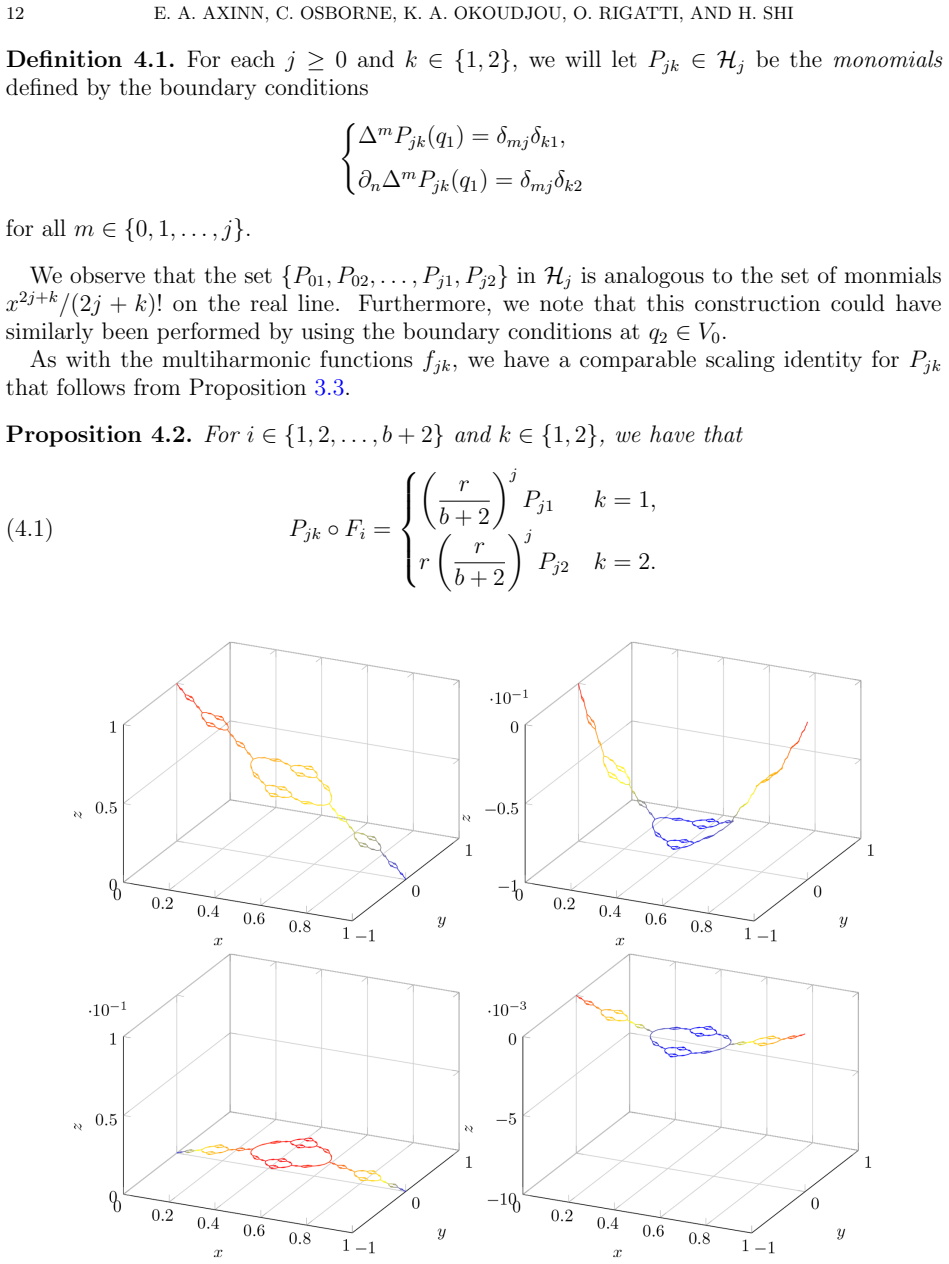
- [Section 5] The link to the Python code is welcome, but the manuscript should state whether the figures are generated from the recursive formulas of Theorems 3.3, 3.4, and 4.3 or directly from the Gram-Schmidt construction; this would help the reader assess which parts of the implementation are independent of the claims.
Circularity Check
No significant circularity: the Gram-Schmidt construction and coefficient computations are self-contained; the indexing gap in Theorem 4.7 is a correctness error, not a circular reduction.
full rationale
The paper's core construction is not circular. Orthogonality is imposed by Gram-Schmidt in Definition 4.5, and the three-term recursion coefficients in Theorem 4.7 are computed from inner products and norms in (4.10), not fitted or assumed. The claimed recursion is not an input to the definition of the polynomials, and no parameter is renamed as a prediction. The cited results from [9], [10], [11], and [8] supply structural lemmas: dimension/representation for H_j, recursive boundary-value formulas, and a Gauss-Green integration-by-parts identity. Although [9] shares an author with the current paper, it is used as a standard tool for computing monomial inner products and for a spectral bound in Corollary 4.9; it does not itself contain the target three-term recursion, so the central claim does not reduce to a self-citation. I also examined the proof of Theorem 4.7 for a possible self-definitional step. The sentence 'It follows from construction that (4.8) Delta g_{j+1} = p_j, where g_{j+1} is in H_{j+1}' is a genuine mathematical gap: under the paper's own indexing P_{2j+k}=P_{jk} in H_j, p_j lies in H_{floor(j/2)}, so Delta g_{j+1}=p_j gives g_{j+1} in H_{floor(j/2)+1}, not H_{j+1}. Similarly, Proposition 3.2's proof only notes that both sides of (3.1) belong to H_j and does not establish surjectivity or uniqueness. These are correctness and proof-completeness problems, not circularity: the false degree assertion is not equivalent to the theorem's conclusion by definition, and the omitted uniqueness proof is not a fitted input. Therefore, under the circularity-only standard, the appropriate finding is no significant circularity, score 0.
Assumptions & free parameters
assumptions (5)
- domain assumption The self-similar measure μ defined by (2.11) exists, is unique, and satisfies μ(K_b)=1.
- domain assumption The Gauss-Green formula (2.16) holds for u ∈ dom Δ and g ∈ dom E.
- domain assumption Green's function G from (2.17) extends continuously to K_b × K_b and is symmetric.
- domain assumption The polynomial space H_j has dimension 2j+2 and every element is determined by the boundary values {Δ^m u(q_k)}.
- domain assumption The scaling identity Δ(f ∘ F_i) = (r/(b+2))(Δ f ∘ F_i) holds.
Cite this review
Pith. "Pith review of Orthogonal Polynomials on Bubble-Diamond Fractals." pith.science (2026). https://pith.science/paper/7BEITUEV
@misc{pith2026241116881,
  author       = {Pith},
  title        = {Pith review of: Orthogonal Polynomials on Bubble-Diamond Fractals},
  year         = {2026},
  howpublished = {\url{https://pith.science/paper/7BEITUEV}},
  note         = {Machine review of arXiv:2411.16881}
}
abstract
We develop a theory of polynomials and, in particular, an analog of the theory of Legendre orthogonal polynomials on the bubble-diamond fractals, a class of fractal sets that can be viewed as the completion of a limit of a sequence of finite graph approximations. In this setting, a polynomial of degree $j$ can be viewed as a multiharmonic function, a solution of the equation $\Delta^{j+1}u=0$. We prove that the sequence of orthogonal polynomials we construct obeys a three-term recursion formula.
Figures


Figures from the paper (3 more)


Reference graph
Works this paper leans on
-
[11]
R. Strichartz and M. Usher. Splines on fractals. Math. Proc. Cambridge Philos. Soc. , 129(2):331–360,
-
[8]
J. Needleman, R. Strichartz, A. Teplyaev, and P. Yung. Calculus on the Sierpinski gasket. I. Polynomials, exponentials and power series. J. Funct. Anal. , 215(2):290–340, 2004. 1, 13
work page 2004
-
[1]
E. Akkermans, G. Dunne, and A. Teplyaev. Physical consequences of complex dimensions of fractals. EPL (Europhysics Letters) , 88(4):40007, nov 2009. 1
work page 2009
-
[2]
Nitsan Ben-Gal, Abby Shaw-Krauss, Robert S. Strichartz, and Clint Young. Calculus on the Sierpinski gasket. II. Point singularities, eigenfunctions, and normal derivatives of the heat kernel. Trans. Amer. Math. Soc., 358(9):3883–3936, 2006. 1
work page 2006
-
[3]
B. Hambly and T. Kumagai. Diffusion on the scaling limit of the critical percolation cluster in the diamond hierarchical lattice. Comm. Math. Phys. , 295(1):29–69, 2010. 1
work page 2010
- [4]
-
[5]
J. Kigami. Analysis on fractals, volume 143 of Cambridge Tracts in Mathematics. Cambridge University Press, Cambridge, 2001. 1
work page 2001
-
[6]
L. Malozemov and A. Teplyaev. Pure point spectrum of the Laplacians on fractal graphs. J. Funct. Anal., 129(2):390–405, 1995. 1
work page 1995
Show all 12 references
-
[7]
Melville, G
E. Melville, G. Mograby, N. Nagabandi, L. Rogers, and A. Teplyaev. Gaps labeling theorem for the Bubble-diamond self-similar graphs. arXiv:2204.11401v2, (2023). , 2024. 1
2023 arXiv
-
[9]
K. A. Okoudjou, R. S. Strichartz, and E. K. Tuley. Orthogonal polynomials on the sierpinski gasket. Constructive Approximation, 37(3):311–340, 2013. 1, 11, 14, 17
2013
-
[10]
Strichartz
R. Strichartz. Differential equations on fractals . Princeton University Press, Princeton, NJ, 2006. A tutorial. 1, 6, 7
2006
-
[2000]
1, 7, 9, 10, 11 Department of Mathematics, University of Michigan, Ann Arbor, MI 48109 Email address : eaxinn@umich.edu Department of Mathematics, Harvard University, Cambridge, MA 02138 Email address : cosborne@alumni.harvard.edu Department of Mathematics, Tufts University, M...
Reviewed August 12, 2026 · model on record in the stance chip above.
Discussion (0). Continue with ORCID to comment.