REVIEW 2 major objections 4 minor 66 references
Detecting eigenvalues in a fourth-order nonlinear Schr\"odinger equation with a non-regular Maslov box
T0 review · 2 major / 4 minor · reviewed 2026-08-12 · deepseek-v4-flash
Pith's one-line read A Maslov-index counting argument proves that unstable eigenvalues of fourth-order NLS solitons are detected by conjugate points at zero spectral parameter, yielding a lower bound on the number of real unstable eigenvalues.
desk verdict Genuinely new Maslov machinery for a fourth-order NLS, but the proof's central homotopy step rests on a wrong claim about the unstable bundle at x=+∞. read the letter →
The pith
A machine-rendered reading of the paper's core claim, the machinery that carries it, and where it could break.
The reading
What carries the argument
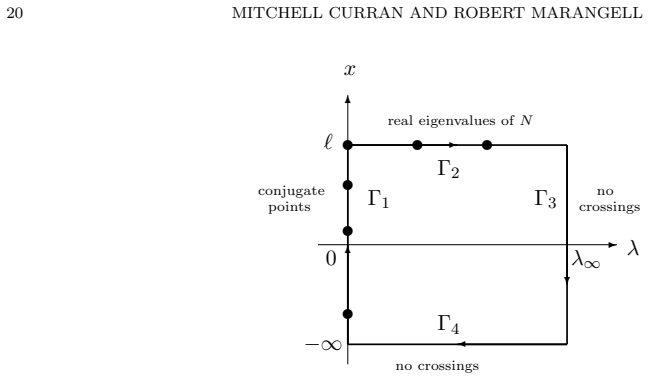
The central objects are the unstable and stable bundles Eᵘ(x,λ) and Eˢ(x,λ): the evaluations at x of solutions of an 8-dimensional first-order system that decay as x → −∞ or x → +∞. These are Lagrangian planes, and an eigenvalue λ₀ of the linearized operator N corresponds to a nontrivial intersection Eᵘ(x,λ₀) ∩ Eˢ(x,λ₀). The argument uses a Maslov box, a rectangular contour in the (x,λ)-plane, together with homotopy invariance and additivity of the Maslov index to transfer counts of conjugate points at λ = 0 to eigenvalues of L+ and L− and then to eigenvalues of N. Non-regular crossings are handled by higher-order crossing forms, defined via root functions and degeneracy spaces, which compute local Maslov contributions without perturbing the path.
What would settle it
Compute, for a specific multipulse soliton family, the dimension of ker(L+) and ker(L−), for example by numerical Evans-function or shooting methods; if either dimension exceeds one, Theorem 1.3's equality P = p_c or Q = q_c fails. Alternatively, for a soliton satisfying the simplicity assumption, numerically count conjugate points and positive eigenvalues; any disagreement with P = p_c and Q = q_c would disprove the theorem.
Extended reading notes
Core claim
For standing-wave solitons of the fourth-order cubic NLS equation iψ_t = ψ_xxxx + σ²ψ_xx − |ψ|²ψ with negative quartic dispersion and hyperbolic origin, this paper proves that the number of positive eigenvalues of the two self-adjoint operators L+ and L− in the linearization equals the number of conjugate points of their unstable bundles at spectral parameter λ = 0: P = p_c and Q = q_c. Since crossings at λ = 0 decouple into separate L+ and L− problems, these counts are obtainable from spatial information alone. The paper then proves that the linearized operator N has at least |P − Q − c| positive real eigenvalues, where c ∈ {−1,0,1} is the Maslov contribution of the non-regular crossing at the zero eigenvalue; hence any soliton with |P − Q| ≥ 2 is spectrally unstable. The proof treats non-regular crossings directly through higher-order crossing forms rather than perturbing them away.
Load-bearing premise
The counting argument collapses if either L+ or L− has a zero mode beyond the known span{ϕₓ} or span{ϕ}.
Editorial extensions
If this is right
- For any soliton satisfying the hypotheses, the Morse indices P and Q can be read off by counting L+ and L− conjugate points at spectral parameter zero, so no Evans-function evaluation at nonzero λ is needed.
- If |P − Q| ≥ 2, the underlying standing wave is spectrally unstable, because the lower bound n₊(N) ≥ |P − Q − c| with c ∈ {−1,0,1} forces at least one positive real eigenvalue.
- When P = 1 and Q = 0, spectral stability is determined solely by the sign of the integral I₂: I₂ < 0 gives spectral stability and I₂ > 0 gives instability.
- The counting formulas extend to even-integer power-law fourth-order NLS equations and, by the same argument, to pure quartic solitons (σ² = 0).
- Theorem 1.5 can be rewritten as n₊(N) ≥ |p_c − q_c − c|, making it a numerically checkable instability certificate from zero-spectral-parameter data.
Reading between the lines
- The paper does not prove Hypothesis 1.1 for the numerically discovered multipulse families; a practical next step is to verify numerically that L+ and L− have no additional zero modes, since the counts P, Q, and c would otherwise shift.
- When I₁ or I₂ vanishes, the correction term is left to higher-order forms; computing those forms would turn the lower bound into an exact eigenvalue count in the degenerate case.
- Because the Maslov index only counts real eigenvalues, the lower bound cannot detect purely imaginary-to-complex bifurcations; a separate mechanism such as Krein-signature or Evans-function analysis would still be needed for non-real unstable spectrum.
- The same Maslov-box and higher-order-crossing-form setup should apply to other fourth-order Hamiltonian systems with soliton or pulse families whose linearizations have degenerate spatial crossings, provided the crossing-form hierarchy terminates via nonvanishing derivatives of the profile.
Editorial analysis
A structured set of objections, weighed in public.
Referee Report
Summary. The paper studies the spectral stability of standing-wave solutions of the fourth-order cubic nonlinear Schrödinger equation with negative quartic and nonzero quadratic dispersion. After rewriting the linearized eigenvalue problem as an 8-dimensional Hamiltonian system, the authors use the Maslov index with Piccione-Tausk higher-order crossing forms to prove that the Morse indices of the two fourth-order selfadjoint operators L_+ and L_- equal the counts of their conjugate points (Theorem 1.3), to derive a lower bound for the number of positive real eigenvalues of the full linearization (Theorem 1.5), and to state a Vakhitov-Kolokolov-type criterion (Theorem 1.9). The main technical novelty is the treatment of non-regular crossings, both in the spectral parameter and in the spatial parameter, including cases where the wave profile vanishes.
Significance. If the main theorems are correct, they give a geometric, parameter-free route to eigenvalue counts and stability criteria for arbitrary homoclinic solitons satisfying the stated spectral simplicity and non-resonance assumptions, extending earlier Maslov-box results to fourth-order operators with non-regular crossings. The paper contains explicit crossing-form computations, states its hypotheses clearly, and includes a numerical demonstration for the Karlsson-Höök solution. However, the proof as written has a gap in the homotopy argument of Lemma 4.5, and the appendix on degenerate spatial crossings omits the derivations of the formulas on which Lemma 4.1 relies.
major comments (2)
- [§4.4, Lemma 4.5; Remark 4.2] The stratum homotopy in Lemma 4.5 does not have constant endpoint intersection dimensions, so Lemma 3.6 cannot be applied. With H1 and H2 as in (4.59), at τ = 1 we have H1(s,1) = bEu_+(1 + (τℓ - 1)s, 0) and H2(s,1) = bEs_+(1 + (τℓ - 1)s, 0). At s = 1 this pair is (Eu_+(ℓ,0), Es_+(ℓ,0)), whose intersection has dimension 1 by Hypothesis 1.1. At s = 0 it is (Eu_+(+∞,0), S_+(0)). By (3.31)-(3.33) and the exponential dichotomy, Eu_+(+∞,0) = U_+(0), and U_+(0) ∩ S_+(0) = {0}; the assertion in Remark 4.2 and in Lemma 4.6 that x = +∞ is always a one-dimensional conjugate point is therefore not justified and appears false. Consequently (4.55), and hence the proof of (4.60) and of Theorem 1.3, is not established. The equality may be recoverable by a direct perturbation argument using Remark 3.5, but as written the homotopy step is invalid.
- [Appendix A] The degenerate cases φ(x0) = 0 are load-bearing for Lemma 4.1 and therefore for Theorem 1.3, but Appendix A contains only final formulas and no derivations: after stating (A.2)-(A.4), the text says 'we present only the main results,' and the crossing forms (A.7)-(A.9), (A.14), (A.16), (A.18) are asserted without the corresponding root-function and h_i calculations. Since the sign and nondegeneracy of these forms are exactly what proves monotonicity in Lemma 4.1, the proof is incomplete. The authors should provide the full calculations or a compact but verifiable induction scheme establishing these formulas.
minor comments (4)
- [§3.1, Eq. (3.13)] The reference '[59, Theroem 1.1]' contains a typo: 'Theroem' should be 'Theorem'.
- [Lemma 4.8] The notation for the unstable subspace is not uniform: the statement uses U_+(λ) while parts of the proof use U+(λ); please make the subscript placement consistent.
- [§6, Figure 2] The caption states that the eigenvalue curves are asymptotic to λ = 0 but never cross, which is in tension with the claim in Remark 4.2 of a conjugate point at x = +∞; this tension should be resolved explicitly in the text.
- [§1.1, Hypothesis 1.1] The theorems are conditional on Hypothesis 1.1, but the paper does not verify this hypothesis for the multipulse families of [6]; a remark clarifying that this is an open condition to be checked in applications would help the reader.
Circularity Check
No significant circularity: the Morse and Maslov counts are derived from the stated spectral hypotheses via explicit crossing-form and homotopy computations, not fitted to the conclusion.
full rationale
The derivation chain for Theorems 1.3 and 1.5 is self-contained given the stated hypotheses. Theorem 1.3 is obtained by (i) computing the relative crossing forms of the Lagrangian paths x -> (Eu_+(x,0), S_+(0)) in Lemma 4.1, showing monotonicity and fixed signs; (ii) establishing the stratum homotopy (4.55) in Lemma 4.5 with endpoint intersection dimensions controlled by Hypothesis 1.1; (iii) isolating the endpoint contributions in Lemma 4.6; and (iv) applying homotopy invariance and additivity of the Maslov index. The Morse indices P and Q enter only as the signed counts of crossings along Gamma_2, computed independently in Lemma 4.7 through the definite relative crossing form; there is no parameter fitted to make P = pc or Q = qc hold. Theorem 1.5's lower bound follows from the Maslov-box identity (3.45), Lemma 5.1, Lemma 5.2, and an explicit second-order crossing-form computation at the corner (ell,0) giving c through the integrals I1 and I2; the signs of I1 and I2 are not chosen to force the bound. The paper's citation of its own [26] is for background material (identical-zero spectral-parameter crossing forms, the initial-point formula (3.18), and details of a selfadjoint reduction in Lemma 5.5); each use is either accompanied by independent references ([27], [57]) or is a stated auxiliary lemma not equivalent to the target theorem. No uniqueness theorem is imported from the authors, and no known result is merely renamed. The numerical application to the Karlsson-Hoök solution is an external check, not an input to the proof. The skeptical concern about the endpoint of the stratum homotopy in Lemma 4.5 concerns a technical mathematical claim, not circularity: even if that step were erroneous, the error would be a correctness gap rather than a reduction of the conclusion to its premises.
Assumptions & free parameters
assumptions (5)
- domain assumption Hypothesis 1.1: ker(L-) = span{phi} and ker(L+) = span{phi_x}
- domain assumption Conditions (1.10)-(1.11): hyperbolicity of the origin and distinct spatial eigenvalues, i.e. beta > 0 for sigma^2 = -1, beta > 1/4 for sigma^2 = 1, and beta != 1/4 when sigma^2 = -1
- domain assumption The soliton phi is a homoclinic orbit to the origin; existence of such orbits is not proved here, only assumed
- standard math Fredholm solvability of -L- v = phi_x and L+ u = phi, which holds because phi_x is orthogonal to ker L- and phi to ker L+
- standard math Analyticity of the stable and unstable bundles in x and lambda, plus exponential dichotomies, imported from [3,60]
Cite this review
Pith. "Pith review of Detecting eigenvalues in a fourth-order nonlinear Schr\"odinger equation with a non-regular Maslov box." pith.science (2026). https://pith.science/paper/KHJQOAIR
@misc{pith2026241116903,
  author       = {Pith},
  title        = {Pith review of: Detecting eigenvalues in a fourth-order nonlinear Schr\"odinger equation with a non-regular Maslov box},
  year         = {2026},
  howpublished = {\url{https://pith.science/paper/KHJQOAIR}},
  note         = {Machine review of arXiv:2411.16903}
}
read the original abstract
We use the Maslov index to study the eigenvalue problem arising from the linearisation about solitons in the fourth-order cubic nonlinear Schr\"odinger equation (NLSE). Our analysis is motivated by recent work by Bandara et al., in which the fourth-order cubic NLSE was shown to support infinite families of multipulse solitons. Using a homotopy argument, we prove that the Morse indices of two selfadjoint fourth-order operators appearing in the linearisation may be computed by counting conjugate points, as well as a lower bound for the number of real unstable eigenvalues of the linearisation. We also give a Vakhitov-Kolokolov type stability criterion. The interesting aspects of this problem as an application of the Maslov index are the instances of non-regular crossings, which feature crossing forms with varying ranks of degeneracy. We handle such degeneracies directly via higher order crossing forms, using a definition of the Maslov index developed by Piccione and Tausk.
Figures

Reference graph
Works this paper leans on
-
[6]
R. I. Bandara, A. Giraldo, N. G. R. Broderick, and B. Krauskopf. Infinitely many multipulse solitons of different symmetry types in the nonlinear Schr¨ odinger equation with quartic dispersion. Phys. Rev. A, 103(6):063514, 2021. 2, 3, 5, 6, 8, 9
work page 2021
-
[1]
N. Akhmediev, A. Buryak, and M. Karlsson. Radiationless optical solitons with oscillating tails. Opt. Commun., 110(5-6):540 – 544, 1994. 2
work page 1994
-
[2]
J. P. Albert. Positivity properties and stability of solitary-wave solutions of model equations for long waves. Comm. Partial Differential Equations , 17(1-2):1–22, 1992. 42
work page 1992
-
[3]
J. Alexander, R. Gardner, and C. Jones. A topological invariant arising in the stability analysis of travelling waves. J. Reine Angew. Math. , 410:167–212, 1990. 4, 10, 17, 32, 33
work page 1990
-
[4]
V. I. Arnol’d. On a characteristic class entering into conditions of quantization. Funkcional. Anal. i Priloˇ zen., 1:1–14, 1967. 11, 12, 19
work page 1967
-
[5]
V. I. Arnol’d. Sturm theorems and symplectic geometry. Funktsional. Anal. i Prilozhen. , 19(4):1–10, 95, 1985. 12, 14
work page 1985
-
[7]
R. I. Bandara, A. Giraldo, N. G. R. Broderick, and B. Krauskopf. Generalized and multi-oscillation solitons in the nonlinear Schr¨ odinger equation with quartic dispersion.Chaos, 33(7):Paper No. 073154, 19, 2023. 2
work page 2023
-
[8]
R. I. Bandara, A. Giraldo, N. G. R. Broderick, and B. Krauskopf. Bifurcations of periodic orbits in the generalised nonlinear schr¨ odinger equation. To appear in Journal of Computational Dynamics , 12(2):178–211, 2025. 2
work page 2025
Show all 66 references
-
[9]
M. Beck, G. Cox, C. Jones, Y. Latushkin, K. McQuighan, and A. Sukhtayev. Instability of pulses in gradient reaction-diffusion systems: a symplectic approach. Philos. Trans. Roy. Soc. A , 376(2117):20170187, 20, 2018. 4, 42, 43
2018
-
[10]
Beck and J
M. Beck and J. Jaquette. Validated spectral stability via conjugate points. SIAM J. Appl. Dyn. Syst. , 21(1):366–404, 2022. 4, 43
2022
-
[11]
M. Beck, J. Jaquette, and H. Pieper. The Maslov index, degenerate crossings, and the stability of pulse solutions to the Swift-Hohenberg equations. arXiv preprint, 2024. 4, 5, 8, 42, 43
2024
-
[12]
Blanco-Redondo, C
A. Blanco-Redondo, C. Martijn de Sterke, C. Husko, and B. J. Eggleton. High-energy ultra-short pulses from pure-quartic solitons. In 2017 European Conference on Lasers and Electro-Optics and European Quantum Electronics Conference, page EE 3 2. Optica Publishing Group, 2017. 2
2017
-
[13]
Blanco-Redondo, C
A. Blanco-Redondo, C. Martijn de Sterke, J. Sipe, T. F. Krauss, B. J. Eggleton, and C. Husko. Pure- quartic solitons. Nature Communications, 7(1):10427, 2016. 2
2016
-
[14]
Bose and C
A. Bose and C. K. R. T. Jones. Stability of the in-phase travelling wave solution in a pair of coupled nerve fibers. Indiana Univ. Math. J. , 44(1):189–220, 1995. 4
1995
-
[15]
R. Bott. On the iteration of closed geodesics and the Sturm intersection theory. Comm. Pure Appl. Math., 9(2):171–206, 1956. 19
1956
-
[16]
A. V. Buryak and N. N. Akhmediev. Stability criterion for stationary bound states of solitons with radiationless oscillating tails. Physical Review E , 51(4):3572 – 3578, 1995. Cited by: 59. 2
1995
-
[17]
Chardard, F
F. Chardard, F. Dias, and T. J. Bridges. Computing the Maslov index of solitary waves. I. Hamiltonian systems on a four-dimensional phase space. Phys. D , 238(18):1841–1867, 2009. 4 FOURTH-ORDER NLS AND THE MASLOV INDEX 47
2009
-
[18]
Chardard, F
F. Chardard, F. Dias, and T. J. Bridges. On the Maslov index of multi-pulse homoclinic orbits. Proc. R. Soc. Lond. Ser. A Math. Phys. Eng. Sci. , 465(2109):2897–2910, 2009. 4, 43
2009
-
[19]
Chardard, F
F. Chardard, F. Dias, and T. J. Bridges. Computing the Maslov index of solitary waves, Part 2: Phase space with dimension greater than four. Phys. D , 240(17):1334–1344, 2011. 4
2011
-
[20]
Chen and X
C.-N. Chen and X. Hu. Maslov index for homoclinic orbits of Hamiltonian systems. Ann. Inst. H. Poincar´ e C Anal. Non Lin´ eaire, 24(4):589–603, 2007. 19
2007
-
[21]
Chen and X
C.-N. Chen and X. Hu. Stability analysis for standing pulse solutions to FitzHugh-Nagumo equations. Calc. Var. Partial Differential Equations , 49(1-2):827–845, 2014. 4
2014
-
[22]
Chugunova and D
M. Chugunova and D. Pelinovsky. Two-pulse solutions in the fifth-order KdV equation: rigorous theory and numerical approximations. Discrete Contin. Dyn. Syst. Ser. B , 8(4):773–800, 2007. 3
2007
-
[23]
Chugunova and D
M. Chugunova and D. Pelinovsky. Count of eigenvalues in the generalized eigenvalue problem. J. Math. Phys., 51(5):052901, 19, 2010. 4
2010
-
[24]
Cornwell
P. Cornwell. Opening the Maslov box for traveling waves in skew-gradient systems: counting eigenvalues and proving (in)stability. Indiana Univ. Math. J. , 68(6):1801–1832, 2019. 4, 10, 19, 32, 33, 42
2019
-
[25]
Cornwell and C
P. Cornwell and C. K. R. T. Jones. On the existence and stability of fast traveling waves in a doubly diffusive FitzHugh-Nagumo system. SIAM J. Appl. Dyn. Syst. , 17(1):754–787, 2018. 4, 43
2018
-
[26]
G. Cox, M. Curran, Y. Latushkin, and R. Marangell. Hamiltonian spectral flows, the Maslov index, and the stability of standing waves in the nonlinear Schr¨ odinger equation.SIAM J. Math. Anal., 55(5):4998– 5050, 2023. 5, 15, 39, 40
2023
-
[27]
Deng and C
J. Deng and C. K. R. T. Jones. Multi-dimensional Morse index theorems and a symplectic view of elliptic boundary value problems. Trans. Amer. Math. Soc. , 363(3):1487–1508, 2011. 5, 15
2011
-
[28]
J. J. Duistermaat. On the Morse index in variational calculus. Adv. Math., 21(2):173–195, 1976. 19
1976
-
[29]
H. M. Edwards. A generalized Sturm theorem. Ann. of Math. (2) , 80:22–57, 1964. 19
1964
-
[30]
Furutani
K. Furutani. Fredholm-Lagrangian-Grassmannian and the Maslov index. J. Geom. Phys. , 51(3):269– 331, 2004. 11, 16
2004
-
[31]
Giamb` o, P
R. Giamb` o, P. Piccione, and A. Portaluri. Computation of the Maslov index and the spectral flow via partial signatures. C. R. Math. Acad. Sci. Paris , 338(5):397–402, 2004. 5, 11, 12, 14, 15
2004
-
[32]
Giambo, P
R. Giambo, P. Piccione, and A. Portaluri. On the Maslov index of symplectic paths that are not transversal to the Maslov cycle. Semi-Riemannian index theorems in the degenerate case.arXiv preprint arXiv:math/0306187, 2004. 5, 11, 12, 14, 15, 16
2004 arXiv
-
[33]
Grillakis
M. Grillakis. Linearized instability for nonlinear Schr¨ odinger and Klein-Gordon equations.Comm. Pure Appl. Math. , 41(6):747–774, 1988. 3, 8
1988
-
[34]
Grillakis, J
M. Grillakis, J. Shatah, and W. Strauss. Stability theory of solitary waves in the presence of symmetry. I. J. Funct. Anal. , 74(1):160–197, 1987. 3
1987
-
[35]
Grillakis, J
M. Grillakis, J. Shatah, and W. Strauss. Stability theory of solitary waves in the presence of symmetry, ii. J. Funct. Anal. , 94(2):308–348, 1990. 3
1990
-
[36]
P. Howard. H¨ ormander’s index and oscillation theory.J. Math. Anal. Appl. , 500(1):1–38, 2021. 4, 5, 8
2021
-
[37]
P. Howard. The Maslov index and spectral counts for linear Hamiltonian systems on R. J. Dynam. Differential Equations, 35(3):1947–1991, 2023. 4, 5, 8, 42
1947
-
[38]
Howard, Y
P. Howard, Y. Latushkin, and A. Sukhtayev. The Maslov index for Lagrangian pairs on R2n. J. Math. Anal. Appl., 451(2):794 – 821, 2017. 11
2017
-
[39]
Howard, Y
P. Howard, Y. Latushkin, and A. Sukhtayev. The Maslov and Morse indices for system Schr¨ odinger operators on R. Indiana Univ. Math. J. , 67(5):1765–1815, 2018. 4, 18, 19, 42
2018
-
[40]
C. K. R. T. Jones. Instability of standing waves for nonlinear Schr¨ odinger-type equations. Ergodic Theory Dynam. Systems , 8(Charles Conley Memorial Issue):119–138, 1988. 3, 4, 8
1988
-
[41]
Kapitula, P
T. Kapitula, P. G. Kevrekidis, and B. Sandstede. Counting eigenvalues via the Krein signature in infinite-dimensional Hamiltonian systems. Phys. D , 195(3-4):263–282, 2004. 4
2004
-
[42]
Counting eigenvalues via the Krein sig- nature in infinite-dimensional Hamiltonian systems
T. Kapitula, P. G. Kevrekidis, and B. Sandstede. Addendum: “Counting eigenvalues via the Krein sig- nature in infinite-dimensional Hamiltonian systems” [Phys. D195 (2004), no. 3-4, 263–282; mr2089513]. Phys. D , 201(1-2):199–201, 2005. 4
2004
-
[43]
Kapitula, R
T. Kapitula, R. Parker, and B. Sandstede. A reformulated Krein matrix for star-even polynomial operators with applications. SIAM J. Math. Anal. , 52(5):4705–4750, 2020. 3
2020
-
[44]
Kapitula and K
T. Kapitula and K. Promislow. Stability indices for constrained self-adjoint operators. Proc. Amer. Math. Soc., 140(3):865–880, 2012. 4
2012
-
[45]
Kapitula and K
T. Kapitula and K. Promislow. Spectral and Dynamical Stability of Nonlinear Waves (Vol. 185) . Springer, New York, 2013. 3, 4, 8, 10
2013
-
[46]
Karlsson and A
M. Karlsson and A. H¨ o¨ ok. Soliton-like pulses governed by fourth order dispersion in optical fibers. Optics Communications, 104(4):303–307, 1994. 2, 6
1994
-
[47]
V. I. Karpman. Stabilization of soliton instabilities by higher-order dispersion: Fourth-order nonlinear schr¨ odinger-type equations.Phys. Rev. E , 53:R1336–R1339, Feb 1996. 2 48 MITCHELL CURRAN AND ROBERT MARANGELL
1996
-
[48]
V. I. Karpman and A. G. Shagalov. Solitons and their stability in high dispersive systems. I. Fourth- order nonlinear Schr¨ odinger-type equations with power-law nonlinearities.Phys. Lett. A , 228(1-2):59– 65, 1997. 2, 8
1997
-
[49]
V. I. Karpman and A. G. Shagalov. Stability of solitons described by nonlinear Schr¨ odinger-type equa- tions with higher-order dispersion. Phys. D , 144(1-2):194–210, 2000. 2, 8
2000
-
[50]
T. Kato. Perturbation Theory for Linear Operators . Springer-Verlag, Berlin, 1980. 32, 35
1980
-
[51]
Natali and A
F. Natali and A. Pastor. The fourth-order dispersive nonlinear Schr¨ odinger equation: orbital stability of a standing wave. SIAM J. Appl. Dyn. Syst. , 14(3):1326–1347, 2015. 3, 40, 42
2015
-
[52]
Parker and A
R. Parker and A. Aceves. Multi-pulse solitary waves in a fourth-order nonlinear Schr¨ odinger equation. Phys. D , 422:132890, 2021. 3
2021
-
[53]
Parker and B
R. Parker and B. Sandstede. Periodic multi-pulses and spectral stability in Hamiltonian PDEs with symmetry. J. Differential Equations , 334:368–450, 2022. 3
2022
-
[54]
D. E. Pelinovsky. Inertia law for spectral stability of solitary waves in coupled nonlinear Schr¨ odinger equations. Proc. R. Soc. Lond. Ser. A Math. Phys. Eng. Sci. , 461(2055):783–812, 2005. 4
2005
-
[55]
D. E. Pelinovsky. Localization in Periodic Potentials: From Schr¨ odinger Operators to the Gross–Pitaevskii Equation. Cambridge University Press, New York, 2011. 3, 4, 8, 9
2011
-
[56]
Peterhof, B
D. Peterhof, B. Sandstede, and A. Scheel. Exponential dichotomies for solitary-wave solutions of semi- linear elliptic equations on infinite cylinders. J. Differential Equations , 140(2):266–308, 1997. 11
1997
-
[57]
Piccione and D
P. Piccione and D. V. Tausk. A student’s guide to symplectic spaces, Grassmannians and Maslov index . Publica¸ c˜ oes Matem´ aticas do IMPA. [IMPA Mathematical Publications]. Instituto de Matem´ atica Pura e Aplicada (IMPA), Rio de Janeiro, 2008. 5, 9, 12, 13, 14, 16
2008
-
[58]
Y. L. Qiang, N. G. R. Broderick, and C. M. Martijn de Sterke. Analytic method for finding stationary solutions to generalized nonlinear Schr¨ odinger equations.Phys. D , 462:Paper No. 134148, 6, 2024. 9
2024
-
[59]
Robbin and D
J. Robbin and D. Salamon. The Maslov index for paths. Topology, 32(4):827–844, 1993. 4, 5, 11, 12, 14, 15, 16, 17
1993
-
[60]
Sandstede
B. Sandstede. Stability of travelling waves. In Handbook of dynamical systems, Vol. 2 , pages 983–1055. North-Holland, Amsterdam, 2002. 10, 17
2002
-
[61]
Sandstede and A
B. Sandstede and A. Scheel. Absolute and convective instabilities of waves on unbounded and large bounded domains. Phys. D , 145(3-4):233–277, 2000. 42
2000
-
[62]
K. K. K. Tam, T. J. Alexander, A. Blanco-Redondo, and C. Martijn de Sterke. Solitary wave solutions in nonlinear media with quartic and quadratic dispersion—implications for high-power lasers. In Frontiers in Optics / Laser Science , page JW4A.78. Optica Publishing Group, 2018. 2
2018
-
[63]
K. K. K. Tam, T. J. Alexander, A. Blanco-Redondo, and C. Martijn de Sterke. Stationary and dynamical properties of pure-quartic solitons. Opt. Lett., 44(13):3306–3309, Jul 2019. 2, 5
2019
-
[64]
K. K. K. Tam, T. J. Alexander, A. Blanco-Redondo, and C. Martijn de Sterke. Generalized dispersion kerr solitons. Phys. Rev. A , 101:043822, Apr 2020. 2, 3, 5
2020
-
[65]
N. G. Vakhitov and A. A. Kolokolov. Stationary solutions of the wave equation in a medium with nonlinearity saturation. Radiophysics and Quantum Electronics , 16:783–789, 1973. 3, 8
1973
-
[66]
Weidmann
J. Weidmann. Spectral theory of ordinary differential operators, volume 1258 of Lecture Notes in Math- ematics. Springer-Verlag, Berlin, 1987. 7
1987
Reviewed August 12, 2026 · model on record in the stance chip above.
Discussion (0). Continue with ORCID to comment.