REVIEW 4 major objections 4 minor 28 references
HGC: A hybrid method combining gravity model and cycle structure for identifying influential spreaders in complex networks
T0 review · 4 major / 4 minor · reviewed 2026-08-12 · deepseek-v4-flash
Pith's one-line read This paper proposes HGC, a centrality score that combines a gravity model with effective distance and cycle structure, and reports that it identifies influential spreaders more accurately than seven comparison methods on eight real-world…
desk verdict A coherent hybrid centrality that is competitive with, not clearly better than, LGM; the abstract overstates what Table 2 shows. read the letter →
The pith
A machine-rendered reading of the paper's core claim, the machinery that carries it, and where it could break.
The reading
What carries the argument
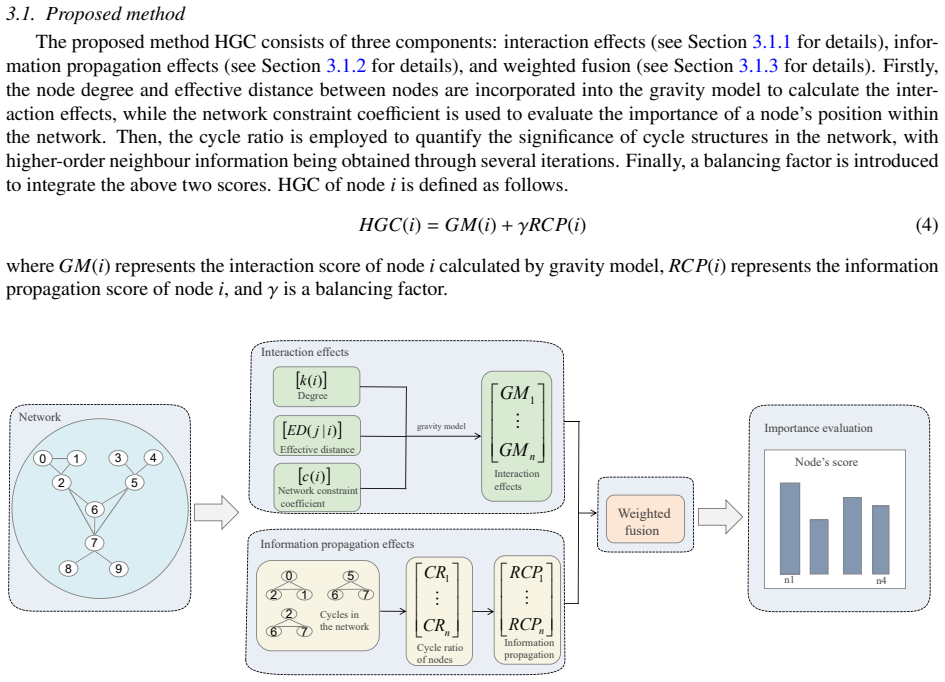
The machinery is a two-term centrality. First, a gravity term $GM(i)=\sum_{ED(j|i)\le R} e^{-c(i)} k_i k_j / ED_{j|i}^2$, where $c(i)$ is Burt's network constraint coefficient for structural holes, $k$ is degree, and effective distance $ED_{j|i}=1-\log_2(a_{ij}/k_i)$ replaces shortest-path distance. Second, a propagation term $RCP(i)=\sum_{l=1}^{T} I_l(i)$ with $I_l(i)=l^{-2}\sum_{j\in\Lambda_i} I_{l-1}(j)$, seeded by the cycle ratio $CR(i)$, which quantifies involvement in other nodes' shortest cycles. The balancing factor $\gamma=\langle GM\rangle/\langle RCP\rangle$ fuses the two scores. Taken together, the machinery encodes three ideas: influence decays with probability-based asymmetric distance, bridging positions (structural holes) add weight, and nodes embedded in cycles inherit propagation power from their neighbours.
What would settle it
Take a tree network (no cycles at all): HGC's RCP term is zero for every node, so HGC collapses to its gravity term; if HGC then still outperforms LGM by the same margin it shows on cyclic networks, the cycle component is not the source of the claimed advantage. Alternatively, rerun the Facebook comparison with a different shortest-cycle enumeration and check whether the top-k list changes materially.
Extended reading notes
Core claim
The central discovery is a single score, $HGC(i) = GM(i) + \gamma RCP(i)$, where $GM(i)$ accumulates $e^{-c(i)} k_i k_j / ED_{j|i}^2$ over neighbours within a radius $R$, $RCP(i)$ spreads each node's cycle ratio through $l^2$-damped neighbour iterations, and $\gamma = \langle GM\rangle/\langle RCP\rangle$ balances the two scales. The effective distance $ED_{j|i}=1-\log_2 P_{j|i}$, with $P_{j|i}=a_{ij}/k_i$, makes the distance from $i$ to $j$ different from the distance from $j$ to $i$, so influence between a pair is no longer symmetric. The cycle ratio $CR(i)$ counts how strongly node $i$ participates in the shortest cycles of neighbouring nodes, and the RCP iteration carries that structural information to higher-order neighbours. The paper argues that these two ingredients, asymmetric effective distance and cycle-based propagation, are what let HGC identify nodes that SIR spreading actually starts from better than the seven baselines.
Load-bearing premise
The method assumes that the number of shortest cycles passing through each pair of nodes can be computed for any network, but no algorithm or complexity bound is given for that computation, so the method's rankings on large networks like Facebook and Power depend on an unspecified cycle-enumeration choice.
Editorial extensions
If this is right
- HGC gives more accurate full-network rankings than the seven baselines on five of eight test networks, with second-best performance on the sparse Power grid.
- The top-10 nodes chosen by HGC produce faster-growing SIR infection curves than baseline top-10 sets in Jazz, USAir, NS, and Facebook.
- HGC's monotonicity is the highest of all methods on every network studied, so its scores separate nodes more finely and produce fewer tied ranks.
- Because the method uses only second-order neighbourhoods ($R=2$) and two propagation iterations ($T=2$), it remains a local computation once cycle ratios are known.
Reading between the lines
- The paper gives no algorithm or complexity bound for computing the cycle-number matrix $c_{ij}$, so on large networks such as Facebook the reported rankings depend on an unspecified shortest-cycle enumeration; this leaves the method's practical scalability open.
- The asymmetric effective distance could be carried directly into directed or weighted networks, where influence asymmetry is the norm, though the paper's experiments are limited to undirected unweighted graphs.
- A natural ablation would compare HGC against its own gravity-only term: if most of the Kendall-tau gain survives without $RCP(i)$, then cycle structure is not the decisive ingredient the narrative suggests.
- The balancing factor $\gamma$ is data-dependent, and on near-tree networks where cycle ratios vanish the RCP term collapses, so behaviour on very sparse networks is an untested regime.
Editorial analysis
A structured set of objections, weighed in public.
Referee Report
Summary. The paper proposes HGC, a hybrid centrality for identifying influential spreaders in undirected unweighted networks. HGC combines a gravity-model interaction term using effective distance and structural-hole constraint with an information-propagation term based on cycle ratio, fused through a balancing factor. The method is evaluated on eight real-world networks using SIR simulations and compared with seven baselines in terms of Kendall's tau, Jaccard similarity, and monotonicity. The authors claim that HGC outperforms all seven compared methods.
Significance. If the claims were fully supported, HGC would be a useful contribution to influential-spreader identification, since it combines asymmetric effective-distance information with cycle-structure information rather than fitting free parameters to SIR outcomes. The paper has strengths: evaluation on multiple real networks, comparison with several established baselines, and no circular fitting of the target result. However, the headline claim of universal superiority is contradicted by the paper's own table, and the method's core interaction term appears to be disabled by the chosen truncation radius as written. These issues must be resolved before the contribution can be assessed.
major comments (4)
- [Abstract; Section 5.1, Table 2] The opening claim that HGC outperforms all seven compared methods is not supported by Table 2. LGM attains higher Kendall's tau on USAir (0.7758 vs 0.766), Yeast (0.8099 vs 0.8085), and Power (0.7383 vs 0.7145), and on the five networks where HGC leads, the advantages over LGM are between 0.005 and 0.018. The SIR reference values are stochastic averages of 1000 runs, yet no confidence intervals, standard deviations, or significance tests are reported. The abstract and conclusion should either be narrowed to "competitive with" or "best on five of eight," or the margins need statistical support.
- [Section 3.1.1, Eq. (5)] The truncation radius R=2 appears incompatible with the effective-distance definition. From Eq. (1), the effective distance from a source i of degree k_i to any adjacent node j is 1 - log2(1/k_i) = 1 + log2(k_i), which exceeds 2 whenever k_i > 2. Therefore, under the condition ED(j|i) ≤ R in Eq. (5), GM(i)=0 for all nodes of degree greater than 2, and the gravity/interaction component contributes nothing for typical nodes in the datasets (e.g., USAir has average degree 12.8). Please clarify whether R is a hop count or an effective-distance threshold; if the latter, the experiments need to be redone with a meaningful R, and if the former, Eq. (5) must be revised.
- [Section 3.1.2, Eq. (8), Algorithm 1] The computation of the cycle number matrix c_ij is not specified. The paper only states that c_ij counts shortest cycles through i and j, but gives no algorithm, data structure, or complexity bound. On Facebook (4039 nodes) and Power (4941 nodes), enumerating all shortest cycles through every pair is nontrivial; if an approximation or a cycle basis is used instead, the reported rankings depend on an unspecified choice. A complete and reproducible specification of this step is required.
- [Section 5, Tables 2 and 3] No sensitivity or ablation analysis is provided for the fixed choices R=2, T=2, and the balancing factor gamma. Since gamma is set as a ratio of averages and is not tuned to the SIR outcome, this is not circular, but the narrow margins in Table 2 leave open the possibility that the results depend heavily on these choices. Reporting results for R=1,2,3 and T=1,2,3, together with an ablation that removes the GM or RCP term, would substantiate the claimed contribution of each component.
minor comments (4)
- [Section 4.4, Eq. (11)] The Jaccard similarity coefficient is defined for sets, but the text refers to sequences; please clarify that the top-k lists are converted to sets and state the range of k used in Figure 4.
- [Section 5.3, Table 3] The text says RDP achieved the best performance in the Email network and that RDP and LGM attained the highest values in PB and Facebook, but Table 3 shows HGC tied for first in all of those networks; please correct the description.
- [Figures 4 and 5] The axis labels and legends in Figures 4 and 5 appear garbled in the manuscript version; please provide high-resolution figures with readable text.
- [Algorithm 1] Line 12 computes the balancing factor gamma inside the neighbor loop; this should be computed once after the GM and RCP accumulations are complete.
Circularity Check
No circular derivation: HGC is an independently evaluated heuristic; no parameter is fitted to the SIR target.
full rationale
The derivation chain of HGC is self-contained and does not reduce to its evaluation target. The method score HGC(i) = GM(i) + γ RCP(i) combines a gravity-model interaction term GM(i) (Eq. 5), built from degree, effective distance, and the network constraint coefficient, with a cycle-ratio propagation term RCP(i) (Eqs. 6–7) built from the cycle ratio CR(i) (Eq. 8). The balancing factor γ = ⟨GM⟩/⟨RCP⟩ (Eq. 9) is computed from the method's own component scores, so it is used only to put the two terms on a common scale; it is not fitted to SIR outcomes or to the evaluation rankings. The truncation radius R = 2 and iteration count T = 2 are fixed in advance with a stated small-world justification, not tuned against the epidemic simulations. The evaluation compares the resulting ranking against independent SIR simulations using Kendall's tau, Jaccard similarity, and monotonicity; no fitted parameter is renamed as a prediction, and no definition of the method presupposes the SIR ranking it aims to predict. The cited prior work (cycle ratio, gravity model, effective distance) supplies building blocks, but the HGC combination is a new heuristic, and the empirical claim of outperformance — even if contestable on statistical grounds, as on USAir, Yeast, and Power — is a claim about benchmark results, not a circular derivation. Therefore no circularity step can be exhibited from the paper's own equations.
Assumptions & free parameters
free parameters (3)
- Balancing factor gamma =
network-dependent ratio mean(GM)/mean(RCP), not reported
- Truncation radius R =
2
- Iterations T =
2
assumptions (5)
- domain assumption Effective distance defined by transition probabilities (ED_{j|i}=1-log2(P_{j|i})) is a valid distance metric for shortest-path aggregation
- domain assumption Gravity analogy: influence between nodes scales as product of degrees divided by squared effective distance
- domain assumption Cycle ratio CR(i) defined in Eq. 8 captures node importance via involvement in shortest cycles
- ad hoc to paper The cycle number matrix c_ij is computable for arbitrary large graphs
- domain assumption SIR model with recovery probability lambda=1 and beta=beta_c is the ground truth for spreading influence
Cite this review
Pith. "Pith review of HGC: A hybrid method combining gravity model and cycle structure for identifying influential spreaders in complex networks." pith.science (2026). https://pith.science/paper/6HYCLJFF
@misc{pith2026241117138,
  author       = {Pith},
  title        = {Pith review of: HGC: A hybrid method combining gravity model and cycle structure for identifying influential spreaders in complex networks},
  year         = {2026},
  howpublished = {\url{https://pith.science/paper/6HYCLJFF}},
  note         = {Machine review of arXiv:2411.17138}
}
read the original abstract
Identifying influential spreaders in complex networks is a critical challenge in network science, with broad applications in disease control, information dissemination, and influence analysis in social networks. The gravity model, a distinctive approach for identifying influential spreaders, has attracted significant attention due to its ability to integrate node influence and the distance between nodes. However, the law of gravity is symmetric, whereas the influence between different nodes is asymmetric. Existing gravity model-based methods commonly rely on the topological distance as a metric to measure the distance between nodes. Such reliance neglects the strength or frequency of connections between nodes, resulting in symmetric influence values between node pairs, which ultimately leads to an inaccurate assessment of node influence. Moreover, these methods often overlook cycle structures within networks, which provide redundant pathways for nodes and contribute significantly to the overall connectivity and stability of the network. In this paper, we propose a hybrid method called HGC, which integrates the gravity model with effective distance and incorporates cycle structure to address the issues above. Effective distance, derived from probabilities, measures the distance between a source node and others by considering its connectivity, providing a more accurate reflection of actual relationships between nodes. To evaluate the accuracy and effectiveness of the proposed method, we conducted several experiments on eight real-world networks based on the Susceptible-Infected-Recovered model. The results demonstrate that HGC outperforms seven compared methods in accurately identifying influential nodes.
Figures


Figures from the paper (2 more)


Reference graph
Works this paper leans on
-
[1]
A. I. E. Hosni, K. Li, S. Ahmad, Minimizing rumor influence in multiplex online social networks based on human individual and social behaviors, Information Sciences 512 (2020) 1458–1480, https://doi.org/10.1016/j.ins.2019.10.063
-
[2]
W. Xu, T. Li, W. Liang, J. X. Yu, N. Yang, S. Gao, Identifying structural hole spanners to maximally block information propagation, Information Sciences 505 (2019) 100–126, https://doi.org/10.1016/J.INS.2019.07.072
-
[3]
P. Zhu, Q. Zhi, Y . Guo, Z. Wang, Analysis of epidemic spreading process in adaptive networks, IEEE Transactions on Circuits and Systems II: Express Briefs 66 (2018) 1252–1256, https://doi.org/10.1109/TCSII.2018.2877406
arXiv 2018
-
[4]
S. Yao, N. Fan, J. Hu, Modeling the spread of infectious diseases through influence maximization, Optimization Letters 16 (2022) 1563–1586, https://doi.org/10.1007/s11590-022-01853-1
-
[5]
S. S. Chaharborj, K. N. Nabi, K. L. Feng, S. S. Chaharborj, P. S. Phang, Controlling COVID-19 transmission with isolation of influential nodes, Chaos, Solitons & Fractals 159 (2022) 112035, https://doi.org/10.1016/j.chaos.2022.112035
arXiv 2022
-
[6]
L. C. Freeman, A set of measures of centrality based on betweenness, Sociometry (1977) 35–41 https://doi.org/10.2307/3033543
doi:10.2307/3033543 1977
-
[7]
L. C. Freeman, et al., Centrality in social networks: Conceptual clarification, Social Network: Critical Concepts in Sociology. Londres: Routledge 1 (2002) 238–263, https://doi.org/10.1016/0378-8733(78)90021-7
-
[8]
T. Fan, L. L ¨u, D. Shi, T. Zhou, Characterizing cycle structure in complex networks, Communications Physics 4 (2021) 272, https://doi.org/10.1038/s42005-021-00781-3
Show all 28 references
-
[9]
P. Bonacich, Factoring and weighting approaches to status scores and clique identification, Journal of Mathematical Sociology 2 (1972) 113–120, https://doi.org/10.1080/0022250X.1972.9989806
1972
-
[10]
L. L ¨u, T. Zhou, Q.-M. Zhang, H. E. Stanley, The H-index of a network node and its relation to degree and coreness, Nature Communications 7 (2016) 10168, https://doi.org/10.1038/ncomms10168
2016 doi
-
[11]
Z. Li, X. Huang, Identifying influential spreaders using local information, Mathematics 11 (2023) 1302, https://doi.org/10.3390/math11061302
2023 doi
-
[12]
L.-l. Ma, C. Ma, H.-F. Zhang, B.-H. Wang, Identifying influential spreaders in complex networks based on gravity formula, Physica A: Statistical Mechanics and its Applications 451 (2016) 205–212, https://doi.org/10.1016/j.physa.2015.12.162
2016 doi
-
[13]
Z. Li, T. Ren, X. Ma, S. Liu, Y . Zhang, T. Zhou, Identifying influential spreaders by gravity model, Scientific Reports 9 (2019) 8387, https://doi.org/10.1038/s41598-019-44930-9
2019 doi
-
[14]
Z. Li, X. Huang, Identifying influential spreaders in complex networks by an improved gravity model, Scientific Reports 11 (2021) 22194, https://doi.org/10.1038/s41598-021-01218-1
2021 doi
-
[15]
Z. Li, X. Huang, Identifying influential spreaders by gravity model considering multi-characteristics of nodes, Scientific Reports 12 (2022) 9879, https://doi.org/10.1038/s41598-022-14005-3
2022 doi
-
[16]
S. Zhu, J. Zhan, X. Li, Identifying influential nodes in complex networks using a gravity model based on the H-index method, Scientific Reports 13 (2023) 16404, https://doi.org/10.1038/s41598-023-43585-x . 11
2023 doi
-
[17]
J. T. Lizier, F. M. Atay, J. Jost, Information storage, loop motifs, and clustered structure in complex networks, Physical Review E—Statistical, Nonlinear, and Soft Matter Physics 86 (2012) 026110, https://doi.org/10.1103/PhysRevE.86.026110
2012 doi
-
[18]
D. Shi, G. Chen, W. W. K. Thong, X. Yan, Searching for optimal network topology with best possible synchronizability, IEEE Circuits and Systems Magazine 13 (2013) 66–75, https://doi.org/10.1109/MCAS.2012.2237145
2013
-
[19]
Ruths, D
J. Ruths, D. Ruths, Control profiles of complex networks, Science 343 (2014) 1373–1376, https://doi.org/10.1126/science.1242063
2014 doi
-
[20]
R. S. Burt, Structural holes and good ideas, American Journal of Sociology 110 (2004) 349–399, https://doi.org/10.1086/421787
2004 doi
-
[21]
H. W. Hethcote, The mathematics of infectious diseases, SIAM Review 42 (2000) 599–653, https://doi.org/10.1137/S0036144500371907
2000 doi
-
[22]
M. G. Kendall, A new measure of rank correlation, Biometrika 30 (1938) 81–93, https://doi.org/10.1093/BIOMET/30.1-2.81
1938 doi
-
[23]
Zareie, A
A. Zareie, A. Sheikhahmadi, M. Jalili, M. S. K. Fasaei, Finding influential nodes in social networks based on neighborhood correlation coefficient, Knowledge-based systems 194 (2020) 105580, https://doi.org/10.1016/j.knosys.2020.105580
2020
-
[24]
J. Bae, S. Kim, Identifying and ranking influential spreaders in complex networks by neighborhood coreness, Physica A: Statistical Mechanics and its Applications 395 (2014) 549–559, https://doi.org/10.1016/j.physa.2013.10.047
2014 doi
-
[25]
Brockmann, D
D. Brockmann, D. Helbing, The hidden geometry of complex, network-driven contagion phenomena, Science 342 (2013) 1337–1342, https://doi.org/10.1126/science.1245200
2013 doi
-
[26]
D. J. Watts, S. H. Strogatz, Collective dynamics of ‘small-world’ networks, Nature 393 (1998) 440–442, https://doi.org/10.1038/30918
1998 doi
-
[27]
Kitsak, L
M. Kitsak, L. K. Gallos, S. Havlin, F. Liljeros, L. Muchnik, H. E. Stanley, H. A. Makse, Identification of influential spreaders in complex networks, Nature Physics 6 (2010) 888–893, https://doi.org/10.1038/nphys1746
2010 doi
-
[28]
Castellano, R
C. Castellano, R. Pastor-Satorras, Thresholds for epidemic spreading in networks, Physical Review Letters 105 (2010) 218701, https://doi.org/10.1103/PhysRevLett.105.218701. 12
2010 doi
Reviewed August 12, 2026 · model on record in the stance chip above.
Discussion (0). Continue with ORCID to comment.