REVIEW 4 major objections 5 minor 36 references
Two epoch spectra-imagery of PV Cep outflow system
T0 review · 4 major / 5 minor · reviewed 2026-08-12 · deepseek-v4-flash
Pith's one-line read The HH 215 jet from PV Cep is tilted about 30 degrees to the line of sight, which changes its true speed from roughly 600 to about 300 km/s and its deprojected length to about 0.2 pc.
desk verdict Solid two-epoch kinematics for HH 215 with a genuinely new knot and velocity splits; the headline 30° inclination is plausible but the ±5° understates the scatter among the four knots used. read the letter →
The pith
A machine-rendered reading of the paper's core claim, the machinery that carries it, and where it could break.
The reading
What carries the argument
The load-bearing identity is the standard inclination relation $\tan i = V_t/|V_r|$ for a knot moving along the flow axis, where $V_t$ is the tangential velocity from proper motions and $V_r$ the heliocentric radial velocity. The paper applies this to the knots B, E, F, and I selected because their proper-motion position angles (about $325^\circ$-$343^\circ$) align with the high-velocity channel; averaging their $V_r$ and $V_t$ values gives $i\approx30^\circ\pm5^\circ$. The supporting observational machinery is the Fabry-Perot data cube technique, which yields radial-velocity-resolved images in H$\alpha$ and [S II] 6716 Å, and a cross-correlation offset method for measuring proper motions between the 2003 and 2020-2021 epochs.
What would settle it
A decisive test would be to measure the proper motion of the newly emerged knot A once a second post-2020 epoch is available: if A does not continue along the same ~325° axis at a speed consistent with $i\approx30^\circ$, the common-axis assumption—and with it the derived inclination, jet speed, and outflow lengths—would collapse.
Extended reading notes
Core claim
On its own terms, the paper's central result is a geometric one: the HH 215 flow from PV Cep is tilted at $i\approx30^\circ\pm5^\circ$ between the flow axis and the line of sight, derived from the mean tangential and radial velocities of the knots B, E, F, and I that lie on the high-velocity channel. With this tilt, the true jet speed is about 300 km/s, HH 215 extends about 0.2 pc, and the whole bipolar outflow HH 315 + HH 215 reaches about 3.6 pc, assuming the far side keeps the same inclination. A secondary discovery is a newly appeared knot (A) about 4 arcseconds from the star, whose estimated kinematic age of roughly 46 years places its ejection near the 1976-1977 outburst, providing one of the first observational links between a specific photometric eruption of the source and the formation of an HH knot.
Load-bearing premise
The result rests on treating knots B, E, F, and I as moving along one straight flow axis, so that the ratio of their averaged tangential and radial velocities measures the tilt of that axis.
Editorial extensions
If this is right
- The true space velocity of the HH 215 jet is about 300 km/s, roughly half the earlier estimate, so previous dynamical and energetic calculations for this outflow are overstated.
- The deprojected size of HH 215 becomes about 0.2 pc, and the full bipolar outflow HH 315 + HH 215 extends about 3.6 pc, comparable to other parsec-scale outflows.
- The circumstellar disk of PV Cep should have an inclination to the plane of the sky of about $30^\circ$, matching the jet's tilt, a prediction that can be checked with high-resolution submillimeter imaging.
- The new knot A, with a kinematic age of roughly 46 years, ties its formation to the 1976-1977 maximum of PV Cep, supporting the picture in which episodic accretion events in eruptive young stars produce discrete ejection events.
- Revised geometry feeds back into stellar parameters such as luminosity and mass-loss rate, which the paper notes should be recomputed in future work.
Reading between the lines
- If the $i\approx30^\circ$ value is adopted, the earlier disk-based estimate of $62^\circ$ cannot both be right unless the jet is not perpendicular to the disk; resolving this tension is a direct test of the assumed disk-jet geometry.
- The unusually wide spread of proper-motion position angles within one jet suggests that some knots (D and G) are not ballistic ejecta but oblique shocks at cavity walls; a model of the jet with precession and a surrounding cavity could predict the observed angle distribution and be tested against the next epoch of images.
- A natural extension of the knot-A result is to monitor PV Cep photometrically and spectroscopically; if future knots appear within a few years after each new outburst, the episodic-ejection link becomes a predictive calibration for this source.
- The adopted distance of 350 pc carries uncertainty; if a revised parallax changes the distance, the deprojected lengths and tangential velocities scale linearly, so the 0.2 pc and 3.6 pc figures should carry an uncertainty budget from distance as well as from $i$.
Editorial analysis
A structured set of objections, weighed in public.
Referee Report
Summary. The paper presents two-epoch Fabry-Perot interferometric observations of the HH 215 outflow from PV Cep in H-alpha and [S II] 6716, obtained with the 6 m SAO telescope in 2003 and 2020-2021. The authors measure proper motions and radial velocities for the knot series A-I, discover a new knot A near the source, identify a high-velocity inner channel, and derive a flow inclination of i ≈ 30° ± 5° from the mean tangential and radial velocities of four knots (B, E, F, I). From this they infer a space velocity of about 300 km/s, a deprojected HH 215 length of about 0.2 pc, and a total bipolar outflow length of about 3.6 pc, and they argue that the new knot A was ejected during the 1976-1978 maximum. The paper also discusses the morphology of knots D and I, which show two-component radial velocity structure.
Significance. If the derived inclination is correct, the paper resolves a long-standing discrepancy in the PV Cep outflow kinematics: the previous estimate of about 600 km/s for the jet speed is revised down to about 300 km/s, and the HH 215 flow is shown to be only mildly inclined to the line of sight. The discovery of a new knot that plausibly corresponds to the 1976-1978 outburst provides a rare observational link between eruptive events and knot ejection in a Herbig-Haro flow. The two-epoch scanning Fabry-Perot technique, with radial velocities from two independent lines and proper motions tied to field stars, is a strong observational approach. The paper reports epoch-to-epoch radial velocity agreement to better than 5 km/s for overlapping knots, which lends credibility to the kinematic measurements. However, the central quantitative claim, the inclination angle, rests on a small number of knots and on an assumption of a common straight flow axis; the scatter among individual knots is larger than the quoted uncertainty. The downstream results (space velocity, lengths, disk orientation) all scale with i, so the significance of the paper depends on the robustness of this derivation.
major comments (4)
- [Section 4, Table 1] The derivation of i ≈ 30° ± 5° from the mean values of Vt and |Vr| for knots B, E, F, and I assumes that these four knots share a single straight 3D flow axis. The individual values in Table 1 imply i = arctan(96/236) ≈ 22°, arctan(169/276) ≈ 31°, arctan(240/275) ≈ 41°, and arctan(125/255) ≈ 26° (using the [S II] radial velocities), a spread of about 19 degrees that far exceeds the quoted ±5°. Moreover, knot E has a PM position angle of 343°, which is 11° away from the adopted 332° axis, so using its full Vt overestimates the along-axis tangential velocity. The paper does not explain the scatter or quantify its effect on the derived inclination. Because every subsequent quantitative statement (space velocity ~300 km/s, HH 215 length 0.2 pc, bipolar length 3.6 pc, disk inclination) scales with i, the central claim needs a more robust treatment, such as fitting a single 3D velocity vector with a proper chi-square statistic or, at minimum, reporting a weighted mean and the observed scatter.
- [Table 1] No uncertainties are listed for the radial velocities Vr(Hα) and Vr([S II]) of the knots. The quoted uncertainty of ±5° on the inclination therefore cannot be reproduced from the tabulated data. The text mentions that the epoch-to-epoch agreement is better than 2-5 km/s for some knots, but per-knot measurement errors are not given. The authors should provide per-knot velocity errors and propagate them, together with the PM errors, into the final inclination uncertainty. Without this, the precision of the headline number is not auditable.
- [Section 4] The paper notes that Hamidouche (2010) measured the PV Cep disk inclination as 62° to the plane of the sky, but then simply states 'we tend to assume as more credible values 332° for PA and 30° for i'. This is a direct contradiction between the derived flow-axis inclination and the published disk orientation: if the disk is at 62°, a perpendicular outflow would have i = 62°, not 30°. The PM argument that i = 62° would imply Vt ≈ 500 km/s and exceed the observed values is a good one, but it should be stated explicitly for the inclination, not only for the position angle, and the authors should discuss whether a jet-disk misalignment of several tens of degrees is plausible or whether the 1.3 mm disk measurement is unreliable. The current discussion is too terse for such an important discrepancy.
- [Section 4, paragraph 2] The selection of knots B, E, F, and I is based on their location near the high-velocity channel and the similarity of their PM vectors to the channel axis. The subsequent exclusion of knots D and G from this average, followed by the claim that their different PAs support oblique shocks, introduces a mild circularity: the same data are used to define the flow axis and then to interpret the outliers. The analysis would be more convincing if the flow axis were defined independently (e.g., from the morphology of the high-velocity channel in the position-velocity diagrams of Fig. 4) and the selected knots were then tested for consistency with that axis.
minor comments (5)
- [Abstract] The phrase 'abut 325°' should read 'about 325°'.
- [Section 3.3] The method of estimating the proper-motion uncertainties is not described; the authors should state how the errors in Table 1 were obtained (e.g., from the cross-correlation peak width or from the scatter of field-star offsets).
- [Section 4] The sentence 'we get i ≈ 30° ± 5°' does not specify which radial-velocity line (Hα or [S II]) was used for the mean Vr; since the two lines give slightly different values, this should be stated explicitly.
- [Section 4] The phrase 'The case of knot D appears more close to the standard picture' should read 'closer'.
- [Section 4] The calculation of the 3.6 pc total length is not shown; writing it out as 2.6 pc × (350/500) / sin(30°) would remove ambiguity about the distance rescaling and deprojection.
Circularity Check
No significant circularity: the inclination is derived from independently measured proper motions and radial velocities under an explicit single-axis assumption; the central result is not forced by definition or by self-citation.
full rationale
The paper's central quantitative claim, i ≈ 30°±5°, is obtained by trigonometric combination of measured proper-motion speeds and radial velocities of knots B, E, F, and I: the mean tangential velocity (≈157.5 km/s) divided by the mean absolute radial velocity (≈260.5 km/s) gives atan(157.5/260.5) ≈ 31°, matching the quoted value. Both inputs are observational quantities from Table 1, not outputs of the model being claimed. The knot selection is based on position angles near the high-velocity channel and proximity to that channel, not on the inclination itself, so there is no fitting of the target quantity. The deprejected lengths (0.2 pc and 3.6 pc) scale by 1/sin i and therefore inherit the single-axis assumption, but this is a stated geometrical assumption, not circularity. The comparison with Caratti o Garatti et al. (2013) provides an external check on radial velocities, and the kinematic age of knot A uses an assumed velocity from other knots to test against the external lightcurve; neither reduces to the paper's own conclusion. The self-citations are to instrument/data-reduction papers and earlier variability studies, none of which carry the load of the inclination derivation. The paper also honestly notes the absence of similar PM differences in the literature and that no interaction evidence has been found, which is a limitation on the oblique-shock interpretation rather than a circular step. No equation or derived quantity is equivalent by construction to its own input, so the analysis is self-contained and non-circular.
Assumptions & free parameters
free parameters (1)
- Assumed tangential velocity of knot A =
About 145 km/s, the mean of knots B, F, E, I
assumptions (4)
- domain assumption PV Cep distance equals 350 pc (Gaia DR3 gives 356 pc, Vioque et al. 343 pc)
- domain assumption Knots B, E, F, and I lie on a single straight flow axis and their mean radial and tangential velocities represent the space velocity of the flow
- domain assumption Knot A was created by a single episodic ejection traveling ballistically from the source without deceleration
- domain assumption The 1976-78 maximum of PV Cep is an established photometric epoch from prior literature
Cite this review
Pith. "Pith review of Two epoch spectra-imagery of PV Cep outflow system." pith.science (2026). https://pith.science/paper/TCDW2MIZ
@misc{pith2026241117171,
  author       = {Pith},
  title        = {Pith review of: Two epoch spectra-imagery of PV Cep outflow system},
  year         = {2026},
  howpublished = {\url{https://pith.science/paper/TCDW2MIZ}},
  note         = {Machine review of arXiv:2411.17171}
}
abstract
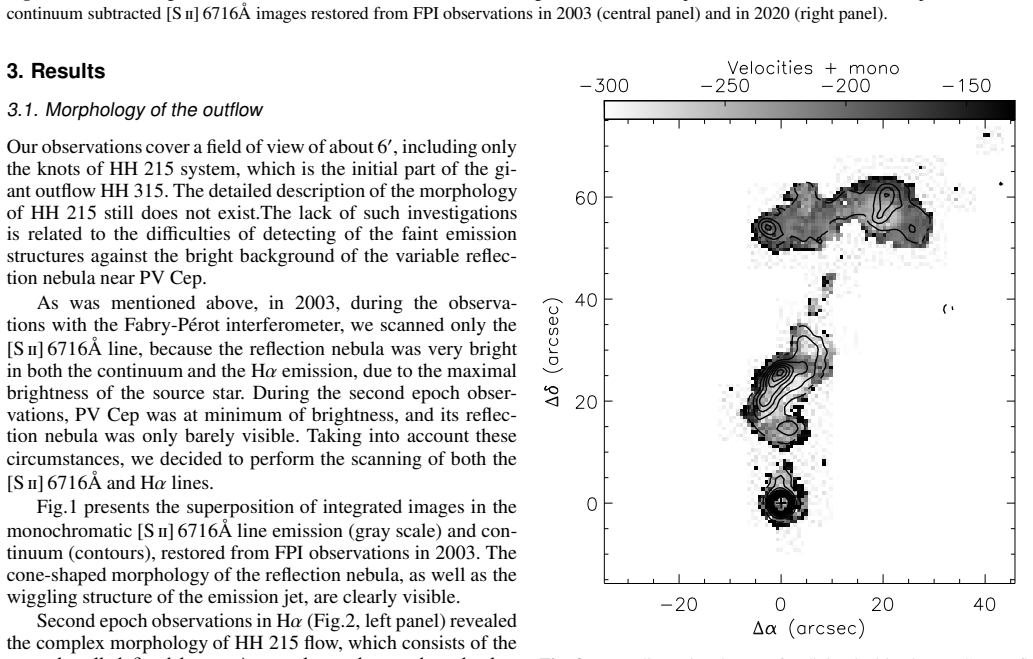
We continue to study the structure and kinematics of HH flows. Herbig-Haro (HH) flows exhibit large variety of morphological and kinematical structures. Both proper motion (PM) and radial velocity investigations are essential to understand the physical nature of such structures. We investigate the kinematics and PM of spectrally separated structures in the PV Cep HH flow HH 215. We present the observational results obtained with a 6 m telescope (Russia) using the SCORPIO multi-mode focal reducer with scanning Fabry-Perot interferometer. Two epochs of the observations of the PV Cep region in H$\alpha$ and [SII] emission (2003 and 2020-2021) allowed us to study the morphology of HH 215 jet in detail and to measure the PM and the radial velocities for its inner structures. Already known emission knots in the HH 215 flow and new features were studied. Moreover, a newly-formed HH knot was revealed, presumably formed during the large maximum of PV Cep star in 1976-1977. We found the high-velocity inner channel in the HH 215 ionized outflow, oriented accordingly to the mean direction of the whole HH outflow and the axis of the symmetry of the reflection nebula. The HH-knots located along the axis of the high-velocity channel have a position angle coinciding with its axis (abut 325$^{\circ}$), however other ones have completely different value (about 25$^{\circ}$), which supports the idea that those knots are formed by oblique shocks. We derived the value of i $\approx$ 30$^{\circ}$$\pm$ 5$^{\circ}$ for the inclination angle between the flow axis and the line of sight. The total length of HH 215 outflow should be about 0.2 pc, and the full length of the bipolar outflow from PV Cep (HH 315 + HH 215) can be estimated as 3.6 pc, assuming that it more or less keeps the same inclination angle.
Figures


Figures from the paper (4 more)


Reference graph
Works this paper leans on
-
[1]
Afanasiev V.L., & Moiseev A.V., 2005, Astronomy Letters, 31, 194
work page 2005
-
[2]
Afanasiev V.L., & Moiseev A.V., 2011, Baltic Astronomy, 20, 363
work page 2011
-
[3]
Andreasyan, H. R., Magakian, T. Yu., Movsessian, T. A. & Moiseev, A. V. \ 2021, Astrophysics, 64,187
work page 2021
-
[4]
F., Canto, J., et al.\ 1992, , 395, 494
Anglada, G., Rodriguez, L. F., Canto, J., et al.\ 1992, , 395, 494. doi:10.1086/171670
doi:10.1086/171670 1992
- [5]
-
[6]
Caratti o Garatti, A., Lopez, R. G., Weigelt, G. et al., 2013, , 554, A66
work page 2013
- [7]
- [8]
Show all 36 references
-
[9]
V., Harlan, E
Cohen, M., Kuhi, L. V., Harlan, E. A., et al.\ 1981, , 245, 920
1981
-
[10]
Giannini, T., Giunta, A., Gangi, M. et al. 2022, , 929, 129
2022
-
[11]
J., & Whitney, B
Gomez, M., Kenyon, S. J., & Whitney, B. A.\ 1997, , 114, 265
1997
-
[12]
Gyulbudagyan, A. L. & Magakyan, T. Y.\ 1977, SvAL, 3, 58
1977
-
[13]
L., Magakian, T
Gyulbudagyan, A. L., Magakian, T. Yu. & Amirkhanian, A. S.\ 1977, SvAL, 3, 84
1977
-
[14]
Hamidouche, M.\ 2010, , 722, 204
2010
-
[15]
A., Heathcote, S., Cecil, G
Hartigan, P., Morse, J. A., Heathcote, S., Cecil, G. \ 1993, , 414, L121
1993
-
[16]
M., et al.\ 2011, , 736, 29
Hartigan, P., Frank, A., Foster, J. M., et al.\ 2011, , 736, 29
2011
-
[17]
H., 1977, , 217, 693
Herbig, G. H., 1977, , 217, 693
1977
-
[18]
H., 1989, European Southern Observatory Conference and Workshop Proceedings, 33, 233
Herbig, G. H., 1989, European Southern Observatory Conference and Workshop Proceedings, 33, 233
1989
-
[19]
& Balog, Z., 2008, in Handbook of Star Forming Regions Vol
Kun M., Kiss, Z.T. & Balog, Z., 2008, in Handbook of Star Forming Regions Vol. I, Astronomical Society of the Pacific, Bo Reipurth, ed
2008
-
[20]
2011, , 413, 2689
Kun, M., Szegedi-Elek, E., Mo\'or, A et al. 2011, , 413, 2689
2011
-
[21]
Magakian, T. Yu. & Movsessian, T. A.\ 2001, Astrophysics, 44, 419
2001
-
[22]
et al.\ 2023, , 672, A113
Massi, F., Caratti o Garatti, A., Cesaroni, R. et al.\ 2023, , 672, A113
2023
-
[23]
M.\ 1984, , 277, 634
Levreault, R. M.\ 1984, , 277, 634
1984
-
[24]
Levreault, R. M. & Opal, C. B.\ 1987, , 93, 669
1987
-
[25]
et al.\ 2022, , 661, A106
L\'opez, R., Estalella, R., Beltr\'an, M.T. et al.\ 2022, , 661, A106
2022
-
[26]
Moiseev, A.V.,\ 2002, Bull. Spec. Astrophys. Obs., 54, 74
2002
-
[27]
Moiseev, A.V.,\ 2021, Astrophysical Bulletin, 76, 316
2021
-
[28]
Moiseev, A.V., & Egorov, O.V.\ 2008, Bull. Spec. Astrophys. Obs., 63, 181
2008
-
[29]
A., Magakian, T
Movsessian, T. A., Magakian, T. Yu., Bally, J. et al.\ 2007, , 470, 605
2007
-
[30]
A., Magakian, T
Movsessian, T. A., Magakian, T. Y., & Moiseev, A. V.\ 2012, , 541, A16
2012
-
[31]
J., Sarcander, M., et al.\ 1987, , 175, 231
Neckel, T., Staude, H. J., Sarcander, M., et al.\ 1987, , 175, 231
1987
-
[32]
P.\ 1987, Irish Astronomical Journal, 18, 21
Ray, T. P.\ 1987, Irish Astronomical Journal, 18, 21
1987
-
[33]
Reipurth, B., Bally, J., & Devine, D.\ 1997, , 114, 2708
1997
-
[34]
Reipurth, B., Heathcote, S., Morse, J., et al.\ 2002, , 123, 362
2002
-
[35]
D., Baines, D
Vioque, M., Oudmaijer, R. D., Baines, D. et al.\ 2018, , 620, A128
2018
-
[36]
Whelan, E.T., Dougados, C., Perrin, M.D. et al. 2010. , 720, L119
2010
Reviewed August 12, 2026 · model on record in the stance chip above.
Discussion (0). Continue with ORCID to comment.