REVIEW 2 major objections 4 minor 81 references
Quasiparticle interference in altermagnets
T0 review · 2 major / 4 minor · reviewed 2026-08-12 · deepseek-v4-flash
Pith's one-line read Spin-resolved quasiparticle interference can image the d-wave spin-split Fermi surface of altermagnets and can tell Zeeman splitting apart from Rashba spin-orbit coupling.
desk verdict A careful, honest model-level QPI calculation for altermagnets whose central diagnostic—imaginary FT-LDOS as a clean SOC-vs-Zeeman discriminator—holds up, with one heuristic stability argument worth tightening before publication. read the letter →
The pith
A machine-rendered reading of the paper's core claim, the machinery that carries it, and where it could break.
The reading
What carries the argument
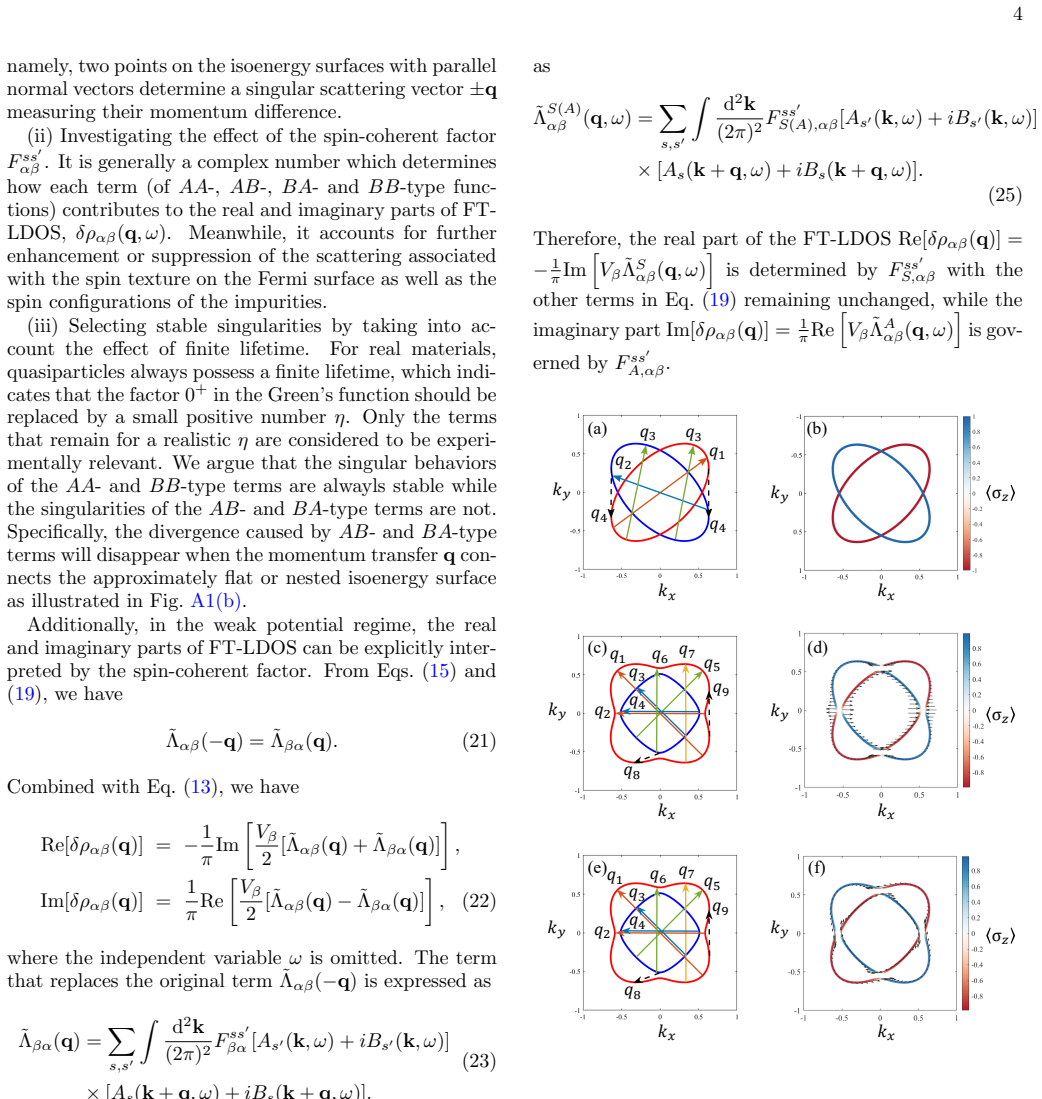
The central machinery is the response function $\Lambda_{\alpha\beta}(q,\omega)$ for the FT-LDOS, decomposed through the Lehmann representation into products of spectral functions labelled AA, AB, BA, and BB. Singular scattering vectors are fixed by the joint-density-of-states condition $\omega^s_{k+q}=\omega=\omega^{s'}_{k}$ with parallel gradients $\nabla\omega^s_{k+q}\times\nabla\omega^{s'}_{k}=0$, and the spin-coherent factor $F^{ss'}_{\alpha\beta}=\mathrm{Tr}[\sigma_\alpha |s,k+q\rangle\langle s,k+q|\sigma_\beta |s',k\rangle\langle s',k|]$ then modulates which of these vectors survive in a given probe and scattering channel. The machinery also imposes a stability criterion: AA- and BB-type singularities stay sharp for finite-lifetime quasiparticles, whereas AB- and BA-type singularities are argued to wash out on flat or nested sections of the Fermi surface.
What would settle it
A spin-resolved STS experiment on a metallic altermagnet with a well-defined magnetic impurity could settle the claim: in the Rashba-SOC scenario the imaginary part of the FT-LDOS should be nonzero in the $(0,x)$, $(0,y)$, $(x,z)$, and $(y,z)$ channels with sign changes as $q_x$ or $q_y$ crosses zero, while the Zeeman scenario predicts these channels vanish; additionally, observing peaks at the nominally unstable vectors $q_4$, $q_8$, or $q_9$ would contradict the stability cutoff used to select the predicted patterns.
Extended reading notes
Core claim
The paper argues that the QPI patterns are governed by a small set of singular scattering vectors connecting points on the isoenergy surfaces with parallel normals, with the spin-coherent factor per probe and scattering channel deciding which vectors appear and with what sign. For the pristine $d$-wave altermagnet, the $(0,z)$ and $(z,0)$ channels show the altermagnetic Fermi surface as two orthogonal ellipses with opposite spin at a doubled momentum scale, while the $(x,x)$ and $(y,y)$ channels expose inter-band scattering between opposite-spin bands. A Zeeman field deforms the isoenergy surfaces into petal shapes through a Lifshitz transition and opens new scattering vectors, but all FT-LDOS patterns remain real. Rashba spin-orbit coupling produces the same Fermi-surface geometry with different spin winding, and it generates nonzero imaginary parts of the FT-LDOS in the $(0,x)$, $(0,y)$, $(x,z)$, and $(y,z)$ channels, which the paper proposes as an unambiguous way to distinguish the two origins of spin splitting.
Load-bearing premise
The predicted QPI maps depend on the assumption that only AA- and BB-type singularities stay sharp for finite-lifetime quasiparticles, so the unstable scattering vectors q4, q8, and q9 can be dropped from the patterns.
Editorial extensions
If this is right
- Spin-resolved STS can map an altermagnetic Fermi surface without relying on spin-resolved photoemission, using the $(0,z)$ and $(z,0)$ channels to see the two-ellipse structure directly.
- A petal-shaped contour in the backscattering-dominated QPI marks a Lifshitz transition of the altermagnetic Fermi surface induced by either Zeeman or Rashba splittings.
- Observing real FT-LDOS everywhere is consistent with Zeeman-like splitting, while nonzero imaginary parts in the $(0,x)$, $(0,y)$, $(x,z)$, or $(y,z)$ channels indicate Rashba spin-orbit coupling.
- Enhancement and suppression across different impurity-spin and probe-spin combinations encode the local spin direction on the Fermi surface, not just its geometry.
Reading between the lines
- The channel-selection logic likely extends to other spin-momentum coupling forms; one could derive symmetry rules for which $(\alpha,\beta)$ pairs carry imaginary FT-LDOS, making the Zeeman-versus-SOC test systematic.
- Because the predicted maps are dominated by backscattering, a simple inversion may be possible in practice: the bright contours are roughly a doubled copy of the Fermi surface, so geometry extraction could be model-free.
- The finite-lifetime stability of AB/BA singularities is argued from a schematic picture; a quantitative treatment of disorder or electron-electron scattering would test whether the dropped vectors $q_4$, $q_8$, and $q_9$ can ever contribute observable weight.
- In three-dimensional altermagnets, flat isoenergy sheets are common and may alter the stability dichotomy, so the same decomposition would need to be re-examined before applying the predictions to surface-sensitive probes.
Editorial analysis
A structured set of objections, weighed in public.
Referee Report
Summary. The manuscript develops a theory of quasiparticle interference (QPI) for point impurities in a two-dimensional d-wave altermagnet, with optional Zeeman splitting and Rashba spin-orbit coupling. Using the T-matrix/Born formalism and a reduced-response decomposition into spin-coherent factors and AA/BB/AB/BA term types, it derives selection rules for the singular scattering vectors and computes the FT-LDOS for many probe/scattering channels. It predicts that pristine altermagnets show doubled elliptical contours with spin-specific intensities, that Zeeman and SOC cases develop petal-shaped backscattering contours associated with a Lifshitz transition, and, most distinctively, that the SOC case produces imaginary FT-LDOS components in certain channels while the Zeeman case does not.
Significance. If the predictions hold, spin-resolved scanning tunneling spectroscopy can directly image the d-wave spin-split Fermi surface of an altermagnet and distinguish altermagnetic, Zeeman, and Rashba-SOC origins of the spin splitting. The analytic decomposition into spin-coherent factors and the explicit formulas in Eqs. (26)-(35) are a useful toolkit, and the numerical parameters are stated transparently. The central falsifiable prediction, that imaginary FT-LDOS appears only in the SOC case, is clearly formulated and experimentally testable. However, the load-bearing stability claim that certain scattering vectors are suppressed by finite quasiparticle lifetime is only argued heuristically, so the completeness of the predicted patterns is conditional.
major comments (2)
- [Sec. III (after Eq. (20)) and Appendix (Fig. A1)] The rule that AA- and BB-type singularities are 'always stable' while AB- and BA-type singularities are not is presented as a schematic argument, not a derivation. This rule is load-bearing because it is used to discard q4 in the pristine case and q8/q9 in the Zeeman/SOC cases, and because the imaginary FT-LDOS in the (0,x) and (0,y) SOC channels is proportional to a purely imaginary antisymmetric spin-coherent factor (Eq. (34)) and therefore enters Im[delta_rho] exclusively through AB+BA combinations. Please provide either (i) an asymptotic analysis of the four term types for finite eta, giving the precise geometric conditions under which AB/BA contributions cancel, or (ii) a direct numerical demonstration at the eta=0.013 used in Figs. 2-4 that the discarded vectors have negligible weight while the retained peaks, including the imaginary peaks in Fig. 4(a,b), survive. Without this, the predicted QPI patterns are conditional on an unproven assertion.
- [Sec. IV A (after Table I)] The real-part FT-LDOS in the pristine channels (0,0), (0,z), (z,0), and (z,z) is stated to be carried entirely by AB- and BA-type terms, and these real patterns are among the paper's main predictions. The Appendix's stability language therefore cannot be a global statement that AB/BA singularities are unstable; it must be a precise geometric criterion depending on the scattering vector. Please state the criterion explicitly and verify it for each retained vector (q1-q3) and each discarded vector (q4 and q8/q9). This is also needed for the SOC imaginary channel (0,x), where Im[delta_rho] is proportional to AB+BA: if those terms are broadly suppressed, the central Zeeman-versus-SOC discriminator in that channel would vanish.
minor comments (4)
- [Sec. III] The text contains a typo: 'alwayls' should be 'always'.
- [Fig. 4 caption] The caption says 'altermagnet with Zeeman splitting' but the parameters are lambda=0.075 and Delta=0, and the text describes these panels as the SOC case; please correct the caption.
- [Introduction and Eq. (5)] There are minor typos: 'presense' should be 'presence' and 'spacial' should be 'spatial'.
- [Appendix, Eq. (A1)] The notation in Eq. (A1) and the surrounding text is dense; please clarify that the line integral is taken along the isoenergy contour omega_{s'}(k)=omega and that the parameter t runs over the full contour.
Circularity Check
No circularity: QPI patterns are computed directly from the model Hamiltonian without fitting any output; self-citations are peripheral.
full rationale
The paper computes FT-LDOS directly from the model Hamiltonian H0(k) in Eq. (1) via the T-matrix and Born expression Eq. (15), with no parameter fitted to any QPI output. The central claims, that stable singular scattering vectors lie on isoenergy contours with parallel normals (Eq. (20)) and that imaginary FT-LDOS appears only in the SOC case (Eqs. (34)-(35)), follow from the analytic spin-coherent factor decomposition and Lehmann representation, not from an input/output equivalence. Self-citations [30] and [77] are peripheral: [30] is used for the Zeeman-induced Lifshitz transition and spin configuration description, while [77] is a note-added related-work reference; neither supplies a fitted constant nor imports a load-bearing uniqueness theorem. The heuristic stability argument for excluding AB/BA-type singularities (Sec. III, step (iii); Fig. A1) is not derived in full and could affect the completeness of the predicted patterns, but that is a correctness or robustness caveat, not circularity: the prediction is conditional on the stated finite-lifetime assumption, and no quantity is re-identified as its own input. The paper is therefore self-contained with respect to its central QPI predictions.
Assumptions & free parameters
free parameters (6)
- J =
1
- Delta (Zeeman splitting) =
0.04
- lambda (Rashba SOC) =
0.075
- omega (energy) =
0.3
- eta (lifetime broadening) =
0.013
- V0 (impurity strength) =
0.05
assumptions (5)
- domain assumption Two-band effective Hamiltonian H0(k) = k^2 + J kx ky sigma_z + Delta sigma_x + lambda(ky sigma_x - kx sigma_y) describes a 2D d-wave altermagnet.
- domain assumption The impurity potential is a delta function and the Born approximation T approximately V is valid in the weak-potential regime V0=0.05.
- ad hoc to paper Only AA- and BB-type singularities are stable under finite lifetime eta; AB- and BA-type singularities are suppressed.
- domain assumption Single scattering channel assumption: only one type of impurity (nonmagnetic or magnetic along a fixed direction) is present at a time.
- standard math Lehmann representation with eigenstates of H0 and the standard T-matrix formalism holds.
Cite this review
Pith. "Pith review of Quasiparticle interference in altermagnets." pith.science (2026). https://pith.science/paper/NTZVEKZX
@misc{pith2026241117185,
  author       = {Pith},
  title        = {Pith review of: Quasiparticle interference in altermagnets},
  year         = {2026},
  howpublished = {\url{https://pith.science/paper/NTZVEKZX}},
  note         = {Machine review of arXiv:2411.17185}
}
read the original abstract
A novel collinear magnetic phase, termed ``altermagnetism,'' has recently been uncovered, characterized by zero net magnetization and momentum-dependent collinear spin-splitting. To understand the intriguing physical effects of altermagnets and explore their potential applications, it is crucial to analyze both the geometric and spin configurations of altermagnetic Fermi surfaces. Here, we conduct a comprehensive study of the quasiparticle interference (QPI) effects induced by both nonmagnetic and magnetic impurities in metallic altermagnets, incorporating the influence of Zeeman splitting and spin-orbit coupling. By examining the QPI patterns for various spin polarizations of magnetic impurities and different spin-probe channels, we identify a series of distinctive signatures that can be used to characterize altermagnetic Fermi surfaces. These predicted signatures can be directly compared with experimental results obtained through spin-resolved scanning tunneling spectroscopy.
Figures


Figures from the paper (1 more)

Reference graph
Works this paper leans on
-
[1]
(A10) Here ˆRα is a π-rotation about the α = x, y, zaxis and ˆR0 = ˆI
When α = β, F ss′ αα (k, k + q) = 1 2 (1 + ss′ ˆdk+q · ˆRα ˆdk). (A10) Here ˆRα is a π-rotation about the α = x, y, zaxis and ˆR0 = ˆI
-
[2]
When α = 0,β ̸= 0, F ss′ 0β (k, k + q) = 1 2 (sˆdβ k+q + s′ ˆdβ k + iss′ X ij ϵβji ˆdi k+q ˆdj k) = 1 2 [sˆdβ k+q + s′ ˆdβ k + iss′(ˆdk × ˆdk+q)β]. (A11)
-
[3]
When β = 0,α ̸= 0, F ss′ α0 (k, k + q) = 1 2 (sˆdα k+q + s′ ˆdα k + iss′ X ij ϵαij ˆdi k+q ˆdj k) = 1 2 [sˆdα k+q + s′ ˆdα k + iss′(ˆdk+q × ˆdk)α]. (A12)
-
[4]
When α ̸= 0, β ̸= 0, α ̸= β, F ss′ αβ (k, k + q) = 1 2 [is X i ϵαiβ ˆdi k+q + is′ X i ϵαβi ˆdi k +ss′(ˆdα k+q ˆdβ k + ˆdβ k+q ˆdα k)]. (A13) Finally, we consider the stability of singularities in the response functions when accounting for the finite lifetime of quasiparticles [67]. In the Green’s functions, we re- place the infinitesimal term 0+ with a po...
-
[5]
N´ eel, Magnetism and local molecular field, Science 174, 985 (1971)
L. N´ eel, Magnetism and local molecular field, Science 174, 985 (1971)
1971
-
[6]
ˇSmejkal, J
L. ˇSmejkal, J. Sinova, and T. Jungwirth, Emerging re- search landscape of altermagnetism, Physical Review X 12, 040501 (2022)
2022
-
[7]
I. Mazin, Editorial: Altermagnetism—a new punch line of fundamental magnetism, Physical Review X 12, 040002 (2022). 12
work page 2022
-
[8]
ˇSmejkal, J
L. ˇSmejkal, J. Sinova, and T. Jungwirth, Beyond conven- tional ferromagnetism and antiferromagnetism: A phase with nonrelativistic spin and crystal rotation symmetry, Physical Review X 12, 031042 (2022)
2022
Show all 81 references
-
[9]
Hayami, Y
S. Hayami, Y. Yanagi, and H. Kusunose, Momentum- dependent spin splitting by collinear antiferromagnetic ordering, Journal of the Physical Society of Japan 88, 10.7566/jpsj.88.123702 (2019)
2019 doi
-
[10]
ˇSmejkal, A
L. ˇSmejkal, A. B. Hellenes, R. Gonz´ alez-Hern´ andez, J. Sinova, and T. Jungwirth, Giant and tunneling magne- toresistance in unconventional collinear antiferromagnets with nonrelativistic spin-momentum coupling, Physical Review X 12, 011028 (2022)
2022
-
[11]
Feng, G.-Y
W. Feng, G.-Y. Guo, J. Zhou, Y. Yao, and Q. Niu, Large magneto-optical kerr effect in noncollinear anti- ferromagnetsmn3x(x=rh,ir,pt), Physical Review B 92, 144426 (2015)
2015
-
[12]
Shao, S.-H
D.-F. Shao, S.-H. Zhang, M. Li, C.-B. Eom, and E. Y. Tsymbal, Spin-neutral currents for spintronics, Nature Communications 12, 10.1038/s41467-021-26915- 3 (2021)
2021 doi
-
[13]
Gonz´ alez-Hern´ andez, L.ˇSmejkal, K
R. Gonz´ alez-Hern´ andez, L.ˇSmejkal, K. V´ yborn´ y, Y. Ya- hagi, J. Sinova, T. Jungwirth, and J. ˇZelezn´ y, Ef- ficient electrical spin splitter based on nonrelativistic collinear antiferromagnetism, Physical Review Letters 126, 127701 (2021)
2021
-
[14]
A. Bose, N. J. Schreiber, R. Jain, D.-F. Shao, H. P. Nair, J. Sun, X. S. Zhang, D. A. Muller, E. Y. Tsymbal, D. G. Schlom, and D. C. Ralph, Tilted spin current generated by the collinear antiferromagnet ruthenium dioxide, Na- ture Electronics 5, 267 (2022)
2022
-
[15]
Nagaosa, J
N. Nagaosa, J. Sinova, S. Onoda, A. H. MacDonald, and N. P. Ong, Anomalous hall effect, Reviews of Modern Physics 82, 1539 (2010)
2010
-
[16]
T. Sato, S. Haddad, I. C. Fulga, F. F. Assaad, and J. van den Brink, Altermagnetic anomalous hall effect emerging from electronic correlations, Physical Review Letters 133, 086503 (2024)
2024
-
[17]
Hayami and H
S. Hayami and H. Kusunose, Essential role of the anisotropic magnetic dipole in the anomalous hall effect, Physical Review B 103, l180407 (2021)
2021
-
[18]
H. Bai, Y. Zhang, Y. Zhou, P. Chen, C. Wan, L. Han, W. Zhu, S. Liang, Y. Su, X. Han, F. Pan, and C. Song, Efficient spin-to-charge conversion via altermagnetic spin splitting effect in antiferromagnet ruo2, Physical Review Letters 130, 216701 (2023)
2023
-
[19]
H. Bai, L. Han, X. Feng, Y. Zhou, R. Su, Q. Wang, L. Liao, W. Zhu, X. Chen, F. Pan, X. Fan, and C. Song, Observation of spin splitting torque in a collinear anti- ferromagnet ruo2, Physical Review Letters 128, 197202 (2022)
2022
-
[20]
Karube, T
S. Karube, T. Tanaka, D. Sugawara, N. Kadoguchi, M. Kohda, and J. Nitta, Observation of spin-splitter torque in collinear antiferromagnetic ruo2, Physical Re- view Letters 129, 137201 (2022)
2022
-
[21]
J. A. Ouassou, A. Brataas, and J. Linder, dc joseph- son effect in altermagnets, Physical Review Letters 131, 076003 (2023)
2023
-
[22]
C. Sun, A. Brataas, and J. Linder, Andreev reflection in altermagnets, Physical Review B 108, 054511 (2023)
2023
-
[23]
Savitsky, Researchers discover new kind of magnetism, Science 383, 574 (2024)
Z. Savitsky, Researchers discover new kind of magnetism, Science 383, 574 (2024)
2024
-
[24]
Hayami, Y
S. Hayami, Y. Yanagi, and H. Kusunose, Bottom-up de- sign of spin-split and reshaped electronic band structures in antiferromagnets without spin-orbit coupling: Proce- dure on the basis of augmented multipoles, Physical Re- view B 102, 144441 (2020)
2020
-
[25]
I. I. Mazin, Altermagnetism in mnte: Origin, predicted manifestations, and routes to detwinning, Physical Re- view B 107, l100418 (2023)
2023
-
[26]
P. E. Faria Junior, K. A. de Mare, K. Zollner, K.-h. Ahn, S. I. Erlingsson, M. van Schilfgaarde, and K. V´ yborn´ y, Sensitivity of the mnte valence band to the orientation of magnetic moments, Physical Review B 107, l100417 (2023)
2023
-
[27]
ˇSmejkal, A
L. ˇSmejkal, A. Marmodoro, K.-H. Ahn, R. Gonz´ alez- Hern´ andez, I. Turek, S. Mankovsky, H. Ebert, S. W. D’Souza, O. ˇSipr, J. Sinova, and T. Jungwirth, Chiral magnons in altermagnetic ruo2, Physical Review Letters 131, 256703 (2023)
2023
-
[28]
Milivojevi´ c, M
M. Milivojevi´ c, M. Orozovi´ c, S. Picozzi, M. Gmitra, and S. Stavri´ c, Interplay of altermagnetism and weak ferro- magnetism in two-dimensional ruf4, 2D Materials 11, 035025 (2024)
2024
-
[29]
H.-Y. Ma, M. Hu, N. Li, J. Liu, W. Yao, J.-F. Jia, and J. Liu, Multifunctional antiferromagnetic materials with giant piezomagnetism and noncollinear spin current, Nature Communications 12, 10.1038/s41467-021-23127- 7 (2021)
2021 doi
-
[30]
Osumi, S
T. Osumi, S. Souma, T. Aoyama, K. Yamauchi, A. Honma, K. Nakayama, T. Takahashi, K. Ohgushi, and T. Sato, Observation of a giant band splitting in alter- magnetic mnte, Physical Review B 109, 115102 (2024)
2024
-
[31]
Z. Lin, D. Chen, W. Lu, X. Liang, S. Feng, K. Yamagami, J. Osiecki, M. Leandersson, B. Thiagarajan, J. Liu, C. Felser, and J. Ma, Observation of giant spin splitting and d-wave spin texture in room temperature altermag- net ruo2 (2024), arXiv:2402.04995 [cond-mat.mtrl-sci]
2024 arXiv
-
[32]
Hiraishi, H
M. Hiraishi, H. Okabe, A. Koda, R. Kadono, T. Muroi, D. Hirai, and Z. Hiroi, Nonmagnetic ground state in ruo2 revealed by muon spin rotation, Physical Review Letters 132, 166702 (2024)
2024
-
[33]
Keßler, L
P. Keßler, L. Garcia-Gassull, A. Suter, T. Prokscha, Z. Salman, D. Khalyavin, P. Manuel, F. Orlandi, I. I. Mazin, R. Valentı, and S. Moser, Absence of magnetic or- der in ruo 2: insights from µsr spectroscopy and neutron diffraction (2024), arXiv:2405.10820 [cond-mat.mtrl-sci]
2024 arXiv
-
[34]
Z.-X. Li, X. Wan, and W. Chen, Diagnosing alter- magnetic phases through quantum oscillations (2024), arXiv:2406.04073 [cond-mat.str-el]
2024 arXiv
-
[35]
Avraham, J
N. Avraham, J. Reiner, A. Kumar-Nayak, N. Morali, R. Batabyal, B. Yan, and H. Beidenkopf, Quasiparticle interference studies of quantum materials, Advanced Ma- terials 30, 10.1002/adma.201707628 (2018)
2018 doi
-
[36]
M. F. Crommie, C. P. Lutz, and D. M. Eigler, Imaging standing waves in a two-dimensional electron gas, Nature 363, 524 (1993)
1993
-
[37]
P. T. Sprunger, L. Petersen, E. W. Plummer, E. Lægs- gaard, and F. Besenbacher, Giant friedel oscillations on the beryllium(0001) surface, Science 275, 1764 (1997)
1997
-
[38]
Capriotti, D
L. Capriotti, D. J. Scalapino, and R. D. Sedgewick, Wave- vector power spectrum of the local tunneling density of states: Ripples in ad-wave sea, Physical Review B 68, 014508 (2003)
2003
-
[39]
Wang and D.-H
Q.-H. Wang and D.-H. Lee, Quasiparticle scattering in- terference in high-temperature superconductors, Physical Review B 67, 020511 (2003)
2003
-
[40]
Hanaguri, Y
T. Hanaguri, Y. Kohsaka, M. Ono, M. Maltseva, P. Cole- 13 man, I. Yamada, M. Azuma, M. Takano, K. Ohishi, and H. Takagi, Coherence factors in a high- t c cuprate probed by quasi-particle scattering off vortices, Science 323, 923 (2009)
2009
-
[41]
J. E. Hoffman, K. McElroy, D.-H. Lee, K. M. Lang, H. Eisaki, S. Uchida, and J. C. Davis, Imaging quasipar- ticle interference in bi2sr2cacu2o9+delta, Science 297, 1148 (2002)
2002
-
[42]
Pereg-Barnea and M
T. Pereg-Barnea and M. Franz, Theory of quasiparti- cle interference patterns in the pseudogap phase of the cuprate superconductors, Physical Review B 68, 180506 (2003)
2003
-
[43]
J. Lee, K. Fujita, A. R. Schmidt, C. K. Kim, H. Eisaki, S. Uchida, and J. C. Davis, Spectroscopic fingerprint of phase-incoherent superconductivity in the underdoped bi2sr2cacu2o9+delta, Science 325, 1099 (2009)
2009
-
[44]
G. M. Rutter, J. N. Crain, N. P. Guisinger, T. Li, P. N. First, and J. A. Stroscio, Scattering and interference in epitaxial graphene, Science 317, 219 (2007)
2007
-
[45]
Pereg-Barnea and A
T. Pereg-Barnea and A. H. MacDonald, Chiral quasipar- ticle local density of states maps in graphene, Physical Review B 78, 014201 (2008)
2008
-
[46]
Brihuega, P
I. Brihuega, P. Mallet, C. Bena, S. Bose, C. Michaelis, L. Vitali, F. Varchon, L. Magaud, K. Kern, and J. Y. Veuillen, Quasiparticle chirality in epitaxial graphene probed at the nanometer scale, Physical Review Letters 101, 206802 (2008)
2008
-
[47]
Dombrowski, W
D. Dombrowski, W. Jolie, M. Petrovi´ c, S. Runte, F. Craes, J. Klinkhammer, M. Kralj, P. Lazi´ c, E. Sela, and C. Busse, Energy-dependent chirality effects in quasifree-standing graphene, Physical Review Letters 118, 116401 (2017)
2017
-
[48]
Jolie, J
W. Jolie, J. Lux, M. P¨ ortner, D. Dombrowski, C. Her- big, T. Knispel, S. Simon, T. Michely, A. Rosch, and C. Busse, Suppression of quasiparticle scattering signals in bilayer graphene due to layer polarization and destruc- tive interference, Physical Review Letters 120, 1068...
2018
-
[49]
X. Zhou, C. Fang, W.-F. Tsai, and J. Hu, Theory of quasiparticle scattering in a two-dimensional system of helical dirac fermions: Surface band structure of a three- dimensional topological insulator, Physical Review B 80, 245317 (2009)
2009
-
[50]
W.-C. Lee, C. Wu, D. P. Arovas, and S.-C. Zhang, Quasi- particle interference on the surface of the topological in- sulatorbi2te3, Physical Review B 80, 245439 (2009)
2009
-
[51]
Beidenkopf, P
H. Beidenkopf, P. Roushan, J. Seo, L. Gorman, I. Droz- dov, Y. S. Hor, R. J. Cava, and A. Yazdani, Spatial fluc- tuations of helical dirac fermions on the surface of topo- logical insulators, Nature Physics 7, 939 (2011)
2011
-
[52]
Kohsaka, M
Y. Kohsaka, M. Kanou, H. Takagi, T. Hanaguri, and T. Sasagawa, Imaging ambipolar two-dimensional carri- ers induced by the spontaneous electric polarization of a polar semiconductor bitei, Physical Review B 91, 245312 (2015)
2015
-
[53]
Kohsaka, T
Y. Kohsaka, T. Machida, K. Iwaya, M. Kanou, T. Hanaguri, and T. Sasagawa, Spin-orbit scattering vi- sualized in quasiparticle interference, Physical Review B 95, 115307 (2017)
2017
-
[54]
Batabyal, N
R. Batabyal, N. Morali, N. Avraham, Y. Sun, M. Schmidt, C. Felser, A. Stern, B. Yan, and H. Bei- denkopf, Visualizing weakly bound surface fermi arcs and their correspondence to bulk weyl fermions, Science Ad- vances 2, 10.1126/sciadv.1600709 (2016)
2016 doi
-
[55]
Inoue, A
H. Inoue, A. Gyenis, Z. Wang, J. Li, S. W. Oh, S. Jiang, N. Ni, B. A. Bernevig, and A. Yazdani, Quasiparticle in- terference of the fermi arcs and surface-bulk connectivity of a weyl semimetal, Science 351, 1184 (2016)
2016
-
[56]
A. K. Mitchell and L. Fritz, Signatures of weyl semimet- als in quasiparticle interference, Physical Review B 93, 035137 (2016)
2016
-
[57]
Zheng and M
H. Zheng and M. Zahid Hasan, Quasiparticle interference on type-i and type-ii weyl semimetal surfaces: a review, Advances in Physics: X 3, 1466661 (2018)
2018
-
[58]
A. Topp, R. Queiroz, A. Gr¨ uneis, L. M¨ uchler, A. W. Rost, A. Varykhalov, D. Marchenko, M. Krivenkov, F. Rodolakis, J. L. McChesney, B. V. Lotsch, L. M. Schoop, and C. R. Ast, Surface floating 2d bands in lay- ered nonsymmorphic semimetals: Zrsis and related com- pounds, Phy...
2017
-
[59]
Queiroz and A
R. Queiroz and A. Stern, Selection rules for quasipar- ticle interference with internal nonsymmorphic symme- tries, Physical Review Letters 121, 176401 (2018)
2018
-
[60]
Zhu, T.-R
Z. Zhu, T.-R. Chang, C.-Y. Huang, H. Pan, X.-A. Nie, X.-Z. Wang, Z.-T. Jin, S.-Y. Xu, S.-M. Huang, D.-D. Guan, S. Wang, Y.-Y. Li, C. Liu, D. Qian, W. Ku, F. Song, H. Lin, H. Zheng, and J.-F. Jia, Quasiparti- cle interference and nonsymmorphic effect on a floating band surface ...
2018 doi
-
[61]
Biderang, M.-H
M. Biderang, M.-H. Zare, and J. Sirker, Proximity-driven ferromagnetism and superconductivity in the triangular rashba-hubbard model, Phys. Rev. B105, 064504 (2022)
2022
-
[62]
Biderang, A
M. Biderang, A. Leonhardt, N. Raghuvanshi, A. P. Schnyder, and A. Akbari, Drumhead surface states and their signatures in quasiparticle scattering interference, Phys. Rev. B 98, 075115 (2018)
2018
-
[63]
P. J. Hirschfeld, D. Altenfeld, I. Eremin, and I. I. Mazin, Robust determination of the superconducting gap sign structure via quasiparticle interference, Phys. Rev. B 92, 184513 (2015)
2015
-
[64]
Akbari and P
A. Akbari and P. Thalmeier, Full t-matrix approach to quasiparticle interference in non-centrosymmetric su- perconductors, The European Physical Journal B 86, 10.1140/epjb/e2013-40859-6 (2013)
2013 doi
-
[65]
Wiesendanger, Spin mapping at the nanoscale and atomic scale, Reviews of Modern Physics81, 1495 (2009)
R. Wiesendanger, Spin mapping at the nanoscale and atomic scale, Reviews of Modern Physics81, 1495 (2009)
2009
-
[66]
S. Jeon, Y. Xie, J. Li, Z. Wang, B. A. Bernevig, and A. Yazdani, Distinguishing a majorana zero mode using spin-resolved measurements, Science 358, 772 (2017)
2017
-
[67]
Cornils, A
L. Cornils, A. Kamlapure, L. Zhou, S. Pradhan, A. Kha- jetoorians, J. Fransson, J. Wiebe, and R. Wiesendanger, Spin-resolved spectroscopy of the yu-shiba-rusinov states of individual atoms, Physical Review Letters119, 197002 (2017)
2017
-
[68]
Guo and M
H.-M. Guo and M. Franz, Theory of quasiparticle inter- ference on the surface of a strong topological insulator, Physical Review B 81, 041102 (2010)
2010
-
[69]
PEREG-BARNEA and M
T. PEREG-BARNEA and M. FRANZ, Quasiparticle in- terference patterns as a test for the nature of the pseudo- gap phase in the cuprate superconductors, International Journal of Modern Physics B 19, 731 (2005)
2005
-
[70]
E. N. Economou, Green ’s functions in quantum physics, Vol. 7 (Springer Science & Business Media, 2006)
2006
-
[71]
Zhang, Q
D.-B. Zhang, Q. Han, and Z. D. Wang, Local and global patterns in quasiparticle interference: A reduced response function approach, Physical Review B 100, 205112 (2019). 14
2019
-
[72]
Dieny and M
B. Dieny and M. Chshiev, Perpendicular magnetic anisotropy at transition metal/oxide interfaces and appli- cations, Reviews of Modern Physics 89, 025008 (2017)
2017
-
[73]
S. E. Barnes, J. Ieda, and S. Maekawa, Rashba spin-orbit anisotropy and the electric field control of magnetism, Scientific Reports 4, 10.1038/srep04105 (2014)
2014 doi
-
[74]
A. V. Balatsky, I. Vekhter, and J.-X. Zhu, Impurity- induced states in conventional and unconventional super- conductors, Reviews of Modern Physics 78, 373 (2006)
2006
-
[75]
G. S. Diniz and E. Vernek, Suppressed kondo screening in two-dimensional altermagnets, Physical Review B 109, 155127 (2024)
2024
-
[76]
P. G. Derry, A. K. Mitchell, and D. E. Logan, Quasi- particle interference from magnetic impurities, Physical Review B 92, 035126 (2015)
2015
-
[77]
A. K. Mitchell, P. G. Derry, and D. E. Logan, Mul- tiple magnetic impurities on surfaces: Scattering and quasiparticle interference, Physical Review B 91, 235127 (2015)
2015
-
[78]
A. K. Mitchell, D. Schuricht, M. Vojta, and L. Fritz, Kondo effect on the surface of three-dimensional topo- logical insulators: Signatures in scanning tunneling spec- troscopy, Physical Review B 87, 075430 (2013)
2013
-
[79]
H. Oka, O. O. Brovko, M. Corbetta, V. S. Stepanyuk, D. Sander, and J. Kirschner, Spin-polarized quantum confinement in nanostructures: Scanning tunneling mi- croscopy, Reviews of Modern Physics 86, 1127 (2014)
2014
-
[80]
Sukhachov and J
P. Sukhachov and J. Linder, Impurity-induced friedel os- cillations in altermagnets and p -wave magnets, Physical Review B 110, 205114 (2024)
2024
-
[81]
W. Chen, X. Zhou, D. Zhang, Y.-Q. Xu, and W.-K. Lou, Impurity scattering and friedel oscillations in altermag- nets, Physical Review B 110, 165413 (2024)
2024
Reviewed August 12, 2026 · model on record in the stance chip above.
Discussion (0). Continue with ORCID to comment.