REVIEW 3 major objections 4 minor 1 cited by
Uniformization of gasket Julia sets
T0 review · 3 major / 4 minor · reviewed 2026-08-12 · deepseek-v4-flash
Pith's one-line read Fat gasket Julia sets admit quasiconformal uniformization by round gaskets, and only those do.
desk verdict First uniformization classification for gasket Julia sets, likely correct in substance, but Lemma 8.2 has a genuine gap and the proof leans on three unpublished preprints. read the letter →
The pith
A machine-rendered reading of the paper's core claim, the machinery that carries it, and where it could break.
The reading
What carries the argument
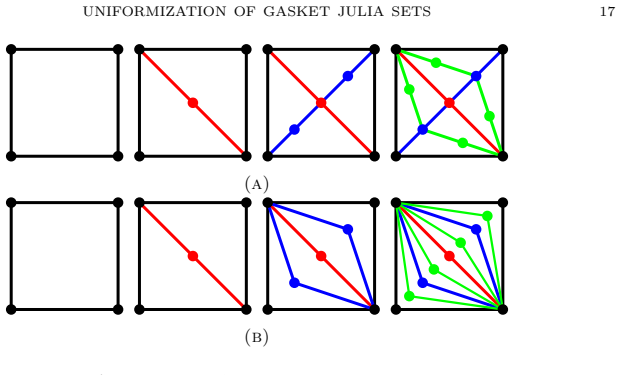
The load-bearing construction is a finite subdivision rule for the contact graph of the gasket Julia set, a recursive rule for subdividing polygons that records which Fatou components touch. Through the theory of circle packings with subdivision rules, this graph is realized as the tangency graph of an infinite circle packing whose limit set is homeomorphic to J(R), and the dynamics of the rational map become a Markov map on the packing, meaning a map that sends tiles to unions of tiles, with exponentially small dilatation at deep levels. A circle-homeomorphism extension theorem for piecewise quasiconformal maps then extends the boundary conjugacy between Markov partitions, circle partitions whose images are unions of partition arcs, to a quasiconformal or David homeomorphism of each Fatou component, and a metric characterization of quasiconformality, bounded eccentric distortion on the Julia set, promotes the map to a global quasiconformal or David map of the sphere.
What would settle it
Look for a rational map with no Julia critical points and gasket Julia set that is quasiconformally equivalent to a round gasket but has two Fatou components meeting at an angle at some contact point; Theorem 1.2 would be false. In practice, compute the multiplier at a periodic contact point: a repelling point or a parabolic point of multiplicity 2 in a QC-round gasket Julia set would violate the claimed equivalence.
Extended reading notes
Core claim
The central discovery is a three-way equivalence for a rational map R without Julia critical points whose Julia set J(R) is a gasket. Quasiconformal uniformization of J(R) by a round gasket, the geometric condition that J(R) is a fat gasket, and the dynamical condition that every contact point is eventually mapped to a parabolic periodic point with multiplicity 3 are one and the same. The David-map analogue identifies David uniformization with the condition that every Fatou component is a quasidisk, i.e., the image of a disk under a quasiconformal map of the sphere, which is equivalent to the absence of parabolic cycles of multiplicity 2. The paper also constructs an explicit rational map and Kleinian group whose gasket limit sets are not homeomorphic yet are locally quasiconformally equivalent, and derives a non-injective quasiregular symmetry for a gasket limit set.
Load-bearing premise
The construction of the circle-packing model presupposes that the rational map is topologically conjugate on its Julia set, via a homeomorphism of the whole sphere, to a hyperbolic post-critically finite rational map; if that conjugacy does not extend across the complementary Fatou components, the finite subdivision rule and the uniformization argument collapse.
Editorial extensions
If this is right
- If the main theorems are right, fatness, meaning tangential contact of Fatou components, is the exact geometric signature of quasiconformal roundness for gasket Julia sets.
- The David theorem enlarges the uniformization class: gasket Julia sets whose Fatou components are all quasidisks, with no parabolic cycle of multiplicity 2, become round via exponentially integrable distortion even when quasiconformal straightening fails.
- Every contact point of a fat gasket Julia set is eventually mapped to a parabolic point of multiplicity 3, so the entire tangency combinatorics is governed by eventual landing on one parabolic cycle.
- The existence of a four-chart atlas locally identifying a gasket Julia set with a Kleinian limit set shows there is no local or analytic obstruction to quasiconformal equivalence between the two families.
- Gasket limit sets admit non-injective local quasiregular symmetries, in contrast to Sierpiński carpet limit sets, which are locally rigid.
Reading between the lines
- Editorial inference: the three-way equivalence suggests a numerical test for roundness, namely computing multipliers at periodic contact points and checking that each is a parabolic point of multiplicity 3.
- Editorial inference: the subdivision-rule construction likely extends to gasket Julia sets with Julia critical points by passing to sub-hyperbolic approximations, which would give a conjectural roundness criterion for a wider class of rational maps.
- Editorial inference: because the local QC atlas has only four charts, the same gluing template should produce infinitely many pairs of Julia sets and limit sets that are locally but not globally quasiconformally equivalent.
Editorial analysis
A structured set of objections, weighed in public.
Referee Report
Summary. The paper characterizes gasket Julia sets of rational maps without Julia critical points that admit uniformization by round gaskets. Theorem 1.2 states equivalence among quasiconformal uniformization, the geometric condition that the gasket is fat (Fatou components meet tangentially), and the dynamical condition that every contact point is eventually mapped to a parabolic periodic point of multiplicity 3. Theorem 1.3 gives an analogous equivalence among David uniformization, all Fatou components being quasidisks, and the absence of parabolic cycles of multiplicity 2. The proofs combine finite subdivision rules, circle packings with renormalization, an extension theorem for piecewise quasiconformal circle maps, and metric criteria for quasiconformality. The paper also proves a local quasiconformal equivalence theorem between a gasket Julia set and a Kleinian limit set.
Significance. If correct, these results constitute a substantial advance: they provide the first uniformization criteria for gasket Julia sets, going beyond the known Sierpiński carpet case, and they isolate sharp geometric and dynamical obstructions. The construction of finite subdivision rules from the dynamics and the use of exponential contraction of circle packings is an ambitious and promising framework. The local quasiconformal equivalence result in Theorem 1.5 is interesting and concrete. However, the correctness of the main theorems is contingent on several issues: a gap in the proof of the key conjugacy lemma (Lemma 8.2), a self-admitted missing proof in Proposition 4.3, and essential reliance on unpublished preprints [LZ23], [LN24], [LZ24]. These dependencies must be resolved before the central claims can be fully verified.
major comments (3)
- [§8, Lemma 8.2] The proof of Lemma 8.2 does not establish the claimed extension of φ̃ to a sphere homeomorphism. From the facts that φ̃ is a uniform limit of sphere homeomorphisms and that φ̃(∂U) is a Jordan curve contained in J(g̃), it does not follow that there is a Jordan region V bounded by φ̃(∂U) with V disjoint from J(g̃): in a gasket, a Jordan curve lying in the Julia set can have Julia points on both sides unless it is the boundary of a complementary component, and the image of a boundary curve under an arbitrary homeomorphism of J is not automatically such a boundary. The uniform-limit property controls only Hausdorff distance, not which side of the curve is free of J(g̃). This extension is load-bearing, since Proposition 8.1 transfers the finite subdivision rule from g to f through φ; without a sphere-homeomorphism conjugacy, the contact graph of J(f) is not identified with that of a hyperbolic post-critically finite map and the subsequent circle-packing construction collapses. A correct argument, for example using prime-end or conformal extension properties of gasket Julia sets, is needed. The sentence claiming that topological conjugacy on J implies that g̃ has no Julia critical points is also logically unjustified, since critical points are defined in the Fatou set, though this point may be harmless if sub-hyperbolic maps by definition have no Julia critical points.
- [§4, Proposition 4.3] Proposition 4.3 asserts that, for a simple irreducible acylindrical finite subdivision rule, there exists a subdivision rule R̃ whose faces at every level are polygons with induced-subgraph boundaries, and states that the proof is identical to [LZ23, Proposition 4.3] even though the induced-subgraph assertion is not contained in that reference. This stronger property is used in the standing assumptions (S1) and (S1′) and hence in Lemma 4.5, Proposition 8.1, and the final uniformization theorems. Since the manuscript explicitly acknowledges that the assertion is missing from the cited source, the proof should be included in full, or the statement should be weakened and the consequences reworked.
- [Global] The central uniformization theorems depend essentially on several results from unpublished preprints by the authors and their collaborators: Theorem 3.7 and [LN24, Theorems 1.4 and 1.7], the circle-packing theorems in [LZ23] (Theorems 5.2, 5.7, 5.8, 5.10, 5.13), and [LZ24, Theorem 4.1] for the construction in Section 10. While citing preprints is acceptable, the paper as it stands cannot be fully verified without access to proofs of these key results, and the manuscript does not state the precise forms of the theorems that it needs. This is a load-bearing dependency for the main claim.
minor comments (4)
- [Title] The title contains a spacing error: 'UNIFORMIZA TION' should be 'UNIFORMIZATION'.
- [§1.3] In the proof outline, 'for the the contact graph' has a duplicated 'the'.
- [§2.1, Lemma 2.1] The interval notation 'f |[1,0]' should presumably be 'f |[0,1]'.
- [§5, Definition 5.1] The sentence 'we mean an blueorientation-preserving homeomorphism' contains a stray 'blue' and a missing space; it should read 'an orientation-preserving homeomorphism'.
Circularity Check
No significant circularity: the main proof is constructive and does not assume its conclusions.
full rationale
The derivation chain is not circular. The main equivalences are proved by constructing a finite subdivision rule from the dynamics (Proposition 8.1), using the circle-packing theory of [LZ23] to realize the contact graph by a round gasket, and then proving the resulting homeomorphism is quasiconformal or David via the circle extension theorem [LN24] and the metric criterion [Nta24]. The geometric and dynamical criteria are established independently in Section 7 from local dynamics rather than from the uniformization conclusions. None of the hypotheses of Theorems 1.2 or 1.3 includes the conclusion; no parameter is fitted, and no object is defined in terms of the uniformizing map. The paper does rely substantially on the authors' own prior preprints, especially [LZ23], [LN24], and [LZ24], and these citations are load-bearing for circle-packing realization, the extension theorem, and the construction of the rational map in Theorem 1.5. However, those references are external results with stated assumptions that do not include the present theorems; self-citation is not circularity by itself under the review rules. The notable weakness in Lemma 8.2, where the absence of Julia critical points is inferred from a topological conjugacy on the Julia set, is a potential correctness gap rather than a circular step. Overall, no equation or constructed object reduces by definition to the input data.
Assumptions & free parameters
assumptions (8)
- domain assumption Standing hypothesis: f is a rational map without critical points on its Julia set and J(f) is a gasket (Definition 1.1).
- standard math Milnor's classification: for a rational map without Julia critical points, every periodic point is attracting, repelling, or parabolic; there are no Cremer points or Siegel disks.
- domain assumption Realization and rigidity theorems for circle packings with finite subdivision rules ([LZ23, Theorems A, E], quoted as Theorem 5.2).
- domain assumption Exponential contraction, asymptotic conformality, renormalization, and Teichmuller mapping results for circle packings ([LZ23, Theorems C, D, 5.15], quoted as Theorems 5.7, 5.8, 5.10, 5.13).
- domain assumption Extension theorem for conjugacies of expansive circle maps ([LN24, Theorem 4.1], quoted as Theorem 3.7).
- domain assumption Quasidisk and David rigidity results for parabolic basins ([LN24, Theorem 1.7]).
- domain assumption Absolute continuity criterion for quasiconformality ([Nta24, Theorem 3.1], quoted as Theorem 2.5).
- domain assumption Existence of a hyperbolic post-critically finite model ([CT18, Theorem 1.3, 1.4] and [McM88, Corollary 3.6]).
Cite this review
Pith. "Pith review of Uniformization of gasket Julia sets." pith.science (2026). https://pith.science/paper/MVONJPV6
@misc{pith2026241117227,
  author       = {Pith},
  title        = {Pith review of: Uniformization of gasket Julia sets},
  year         = {2026},
  howpublished = {\url{https://pith.science/paper/MVONJPV6}},
  note         = {Machine review of arXiv:2411.17227}
}
read the original abstract
The object of the paper is to characterize gasket Julia sets of rational maps that can be uniformized by round gaskets. We restrict to rational maps without critical points on the Julia set. Under these conditions, we prove that a Julia set can be quasiconformally uniformized by a round gasket if and only if it is a fat gasket, i.e., boundaries of Fatou components intersect tangentially. We also prove that a Julia set can be uniformized by a round gasket with a David homeomorphism if and only if every Fatou component is a quasidisk; equivalently, there are no parabolic cycles of multiplicity 2. Our theorem applies to show that gasket Julia sets and limit sets of Kleinian groups can be locally quasiconformally homeomorphic, although globally this is conjectured to be false.
Figures


Figures from the paper (6 more)


Forward citations
Cited by 1 Pith paper
-
Algebraic correspondences and Schwarz reflections: Where rational dynamics meets Kleinian groups
Algebraic correspondences mate rational maps with Kleinian groups, and the modular Mandelbrot set is homeomorphic to the Mandelbrot set—this survey reports those results.
Reference graph
Works this paper leans on
-
[110]
[CT18] G. Cui and L. Tan, Hyperbolic-parabolic deformations of rational maps , Sci. China Math. 61 (2018), no. 12, 2157–2220. [Ha ¨ ı00] P. Ha ¨ ıssinsky,D´ eformationJ-´ equivalente de polynˆ omes g´ eometriquement finis, Fund. Math. 163 (2000), no. 2, 131–141. [Ha ¨ ı98] P. Ha ¨ ıssinsky,Chirurgie parabolique, C. R. Acad. Sci. Paris S´ er. I Math.327 (1...
work page 2018
-
[1973]
[LZ23] Y. Luo and Y. Zhang, Circle packings, renormalizations and subdivision rules (2023). Preprint arXiv:2308.13151. [LZ24] Y. Luo and Y. Zhang, On quasiconformal non-equivalence of gasket Julia sets and limit sets (2024). Preprint. [McM88] C. McMullen, Automorphisms of rational maps , Holomorphic functions and moduli I, Springer, New York, NY, 1988, pp...
-
[1993]
[CR80] E. M. Coven and W. L. Reddy, Positively expansive maps of compact manifolds , Global theory of dynamical systems (Proc. Internat. Conf., Northwestern Univ., Evanston, Ill., 1979), Lecture Notes in Mathematics, Springer, Berlin, 1980, pp. 96–
work page 1979
-
[1995]
Reprint of the 1972 edition. [LLM22] R. Lodge, Y. Luo, and S. Mukherjee, Circle packings, kissing reflection groups and critically fixed anti-rational maps, Forum Math. Sigma 10 (2022), Paper No. e3, 38pp. [LLM24] Y. Luo, M. Lyubich, and S. Mukherjee, A general dynamical theory of Schwarz reflections, B-involutions, and algebraic correspondences (2024). P...
arXiv 2022
-
[1996]
Merenkov, Local rigidity for hyperbolic groups with Sierpi´ nski carpet boundaries , Compos
[Mer14a] S. Merenkov, Local rigidity for hyperbolic groups with Sierpi´ nski carpet boundaries , Compos. Math. 150 (2014), no. 12, 1928–1938. [Mer14b] S. Merenkov, Local rigidity of Schottky maps , Proc. Amer. Math. Soc. 142 (2014), no. 12, 4321–4332. [Mil06] J. Milnor, Dynamics in one complex variable , Third edition, Annals of Mathematics Studies, vol. ...
work page 2014
-
[2001]
[HP12] P. Ha ¨ ıssinsky and K. M. Pilgrim, Quasisymmetrically inequivalent hyperbolic Julia sets, Rev. Mat. Iberoam. 28 (2012), no. 4, 1025–1034. [HR69] E. Hemmingsen and W. Reddy, Expansive homeomorphisms on homogeneous spaces, Fund. Math. 64 (1969), 203–207. 48 YUSHENG LUO AND DIMITRIOS NTALAMPEKOS [Kel66] J. A. Kelingos, Boundary correspondence under q...
work page 2012
-
[2006]
Ntalampekos, Non-removability of the Sierpi´ nski gasket, Invent
[Nta19] D. Ntalampekos, Non-removability of the Sierpi´ nski gasket, Invent. Math. 216 (2019), no. 2, 519–595. [Nta20] D. Ntalampekos, A removability theorem for Sobolev functions and detour sets , Math. Z. 296 (2020), 41–72. [Nta24] D. Ntalampekos, Metric definition of quasiconformality and exceptional sets , Math. Ann. 389 (2024), no. 3, 3231–3253. [NY2...
work page 2019
-
[2009]
A magnification of the limit set in Figure 1.1
UNIFORMIZATION OF GASKET JULIA SETS 47 V W Figure 10.4. A magnification of the limit set in Figure 1.1. The open sets V, Wfor the quasiregular symmetry are illustrated. [BA56] A. Beurling and L. Ahlfors, The boundary correspondence under quasiconformal map- pings, Acta Math. 96 (1956), 125–142. [Bis07] C. J. Bishop, Conformal welding and Koebe’s theorem, ...
work page 1956
Show all 10 references
-
[2010]
[PZ04] C. L. Petersen and S. Zakeri, On the Julia set of a typical quadratic polynomial with a Siegel disk , Ann. of Math. (2) 159 (2004), no. 1, 1–52. [QYZ19] W. Qiu, F. Yang, and J. Zeng, Quasisymmetric geometry of Sierpi´ nski carpet Julia sets, Fund. Math. 244 (2019), no. ...
2004
-
[2017]
Bonk, Uniformization of Sierpi´ nski carpets in the plane, Invent
[Bon11] M. Bonk, Uniformization of Sierpi´ nski carpets in the plane, Invent. Math. 186 (2011), no. 3, 559–665. [BP78] A. F. Beardon and Ch. Pommerenke, The Poincar´ e metric of plane domains, J. Lon- don Math. Soc. (2) 18 (1978), no. 3, 475–483. [CG93] L. Carleson and T. W. G...
2011
Reviewed August 12, 2026 · model on record in the stance chip above.
Discussion (0). Continue with ORCID to comment.