REVIEW 3 major objections 5 minor 40 references
An Astronomical Interpretation of the Nebra Sky Disc
T0 review · 3 major / 5 minor · reviewed 2026-08-12 · deepseek-v4-flash
Pith's one-line read This paper argues that the Nebra Sky Disc contains a second, scaled drawing of the Auriga star line whose distance ratios match the sky, so its Bronze Age makers must have measured angular distances.
desk verdict A careful, reproducible archaeoastronomical study whose central claim — that the Nebra disc contains a scaled star map proving distance measurement — fails for want of a chance-alignment null model, though the beta-day astronomy and measurement appendices deserve serious referee attention. read the letter →
The pith
A machine-rendered reading of the paper's core claim, the machinery that carries it, and where it could break.
The reading
What carries the argument
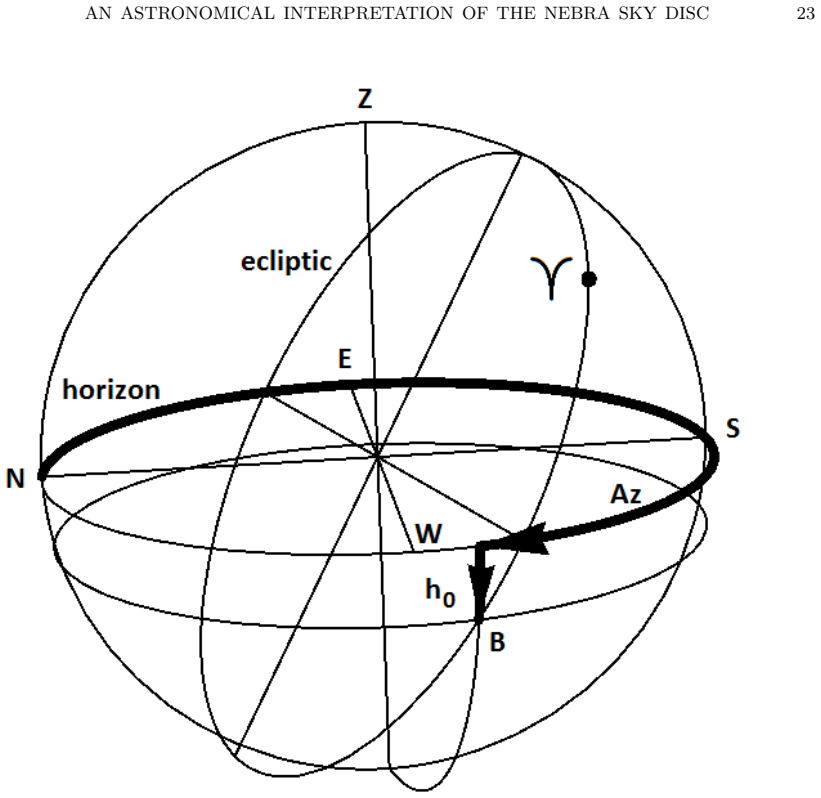
The load-bearing object is the Auriga line, the four-star chain epsilon Gem, theta Aur, beta Aur, alpha Aur that forms a characteristic bent line in the sky. The paper's second representation of this line on the disc is the mechanism: its pixel-measured relative distances and the angle between the alpha Aur–epsilon Gem direction and the beta Aur–Pleiades direction are compared with the same quantities computed on the celestial sphere, and the small differences are read as evidence of intentional scaled transfer. Around this sit the beta day (the day the Pleiades appear vertically below beta Aur at nautical twilight) and the beta point (the corresponding point on the ecliptic), whose slow drift relative to the vernal equinox makes the day a stable agricultural anchor.
What would settle it
Re-measure the second Auriga line on a photogrammetrically corrected 3D scan of the disc, keeping the star identifications fixed in advance; if the relative lengths epsilon Gem–theta Aur and theta Aur–beta Aur then differ from the celestial-sphere values by more than the paper's tolerances, the scale-drawing claim is refuted.
Extended reading notes
Core claim
The central discovery the paper claims is a second occurrence of the Auriga line on the disc. When the disc is rotated so the middle star of the Pleiades rosette is vertically below the plate read as beta Aur, the chain epsilon Gem, theta Aur, beta Aur, alpha Aur reproduces the same bent line these stars form in the Bronze Age sky, and measurements on photographs give relative lengths and an inclination angle close to the celestial-sphere values. On that basis the paper says the distance agreement proves the Nebra people measured star distances and transferred them to scale; the detailed section labels this Conjecture 5.9 and then uses circle fitting and confidence intervals to make the to-scale conclusion (Corollary 5.10) very likely. The same beta-day geometry is used to propose a sowing rule: start sowing on the second round lunar phase after the day the Pleiades hang below beta Aur at dusk.
Load-bearing premise
The load-bearing premise is that the specific gold plates identified as epsilon Gem, theta Aur, beta Aur, alpha Aur, and the Pleiades are deliberate star markers rather than decorative dots; if that identification is arbitrary or chosen after the fact, matching distance ratios would be expected and would not prove measurement.
Editorial extensions
If this is right
- If the second Auriga line is a true scale drawing, the Nebra people performed naked-eye angular measurement and similarity scaling in the Bronze Age, without writing or numerals.
- The beta day gives a repeatable February warning date 24 to 28 days before the heliacal setting of the Pleiades, so farmers could sow on the second round lunar phase after it.
- Because the beta point drifts only about 21 to 25 arcseconds per year relative to the vernal equinox, starting lunar years on the first new moon after the beta day would automatically insert leap months, reproducing a lunisolar calendar locally.
- The beta event is now absent on the Mittelberg but still visible at more southern latitudes, which explains why the method is not evident to modern observers at the site.
Reading between the lines
- An extension the paper does not attempt: run the same ratio-matching test on the Taurus-'plough' group, which the paper treats only qualitatively; an independent distance match there would strengthen the measurement conclusion.
- The strength of the claim depends on how many dot subsets on the disc could plausibly be matched to the sky; a formal chance-match analysis over all star plates is the natural next calculation.
- If the claim holds, the disc would push quantitative angular measurement in Europe back by more than a millennium and suggest that scale mapping can arise without writing or formal arithmetic.
Editorial analysis
A structured set of objections, weighed in public.
Referee Report
Summary. The paper argues that the Nebra Sky Disc encodes a Bronze Age method for fixing agricultural dates: the identification of the Taurus/Plough pattern, an 'Auriga line' (ϵ Gem, θ Aur, β Aur, α Aur), a 'beta day' when the Pleiades are vertically below β Aur at dusk, and a second, scaled representation of the Auriga line on the Disc. The author claims that the close agreement of measured distances and angles on the second representation with celestial-sphere values proves that the Nebra people measured star distances, and then proposes that the beta day anchored either a lunisolar calendar or a sowing date tied to lunar phases.
Significance. If the scaled-map claim were established, it would be a significant result for European archaeoastronomy, implying quantitative angular and distance measurement and scale transfer in the Early Bronze Age. The paper is admirably transparent about its methods: it uses two photographs, reports repeated measurements, constructs confidence intervals for some angles, provides detailed Stellarium procedures, and explicitly labels the distance-measurement claim as a conjecture in Section 5.2.4. However, the evidence does not establish the central claim: the star-to-plate identification is made after the sky pattern is known, no chance-alignment baseline is provided, and the 'probability 1' statement in Section 7 is not a legitimate statistical conclusion. The significance of the paper is therefore conditional on a substantially stronger analysis than the manuscript currently provides.
major comments (3)
- [§2.3, §5.2.4, Appendix B, §7] The load-bearing star-to-plate identification is made after the sky pattern is known, and no chance-alignment baseline is provided. Section 2.3 identifies the first Auriga line from pattern and star count alone, explicitly allowing distances to differ; Section 5.2.4 then selects a second set of plates whose distances happen to resemble the sky. The paper never specifies how the four plates assigned to ϵ Gem, θ Aur, β Aur, and α Aur were chosen from the many gold plates on the disc, nor does it compute the probability that some four-plate subset would approximate the sky configuration under a similarity transform. The confidence intervals in Appendix B (e.g., Propositions B.2 and B.3) quantify repeated manual measurement error conditional on the assumed mapping; they do not quantify uncertainty about the identification. Consequently, the statement in Section 7 that 'with probability 1 the Disc image Figure 20 is a scaled representation of the Auriga line' is not a probability over hypotheses and cannot support the abstract's claim that the disc 'proves' that the Nebra people measured distances.
- [Tables 24, 29, 32, 33; Proposition B.3] The quantitative agreement is weaker than claimed and is internally inconsistent across the two photos. Table 33 lists relative-length deviations of −0.100 and −0.136 for β Aur–θ Aur and angle deviations of −3.65° and −1.54° relative to the celestial sphere; no null distribution is given, so these values cannot be judged as 'amazingly well' agreeing. Moreover, the two methods applied to Lipták's photo yield incompatible estimates of the same angle: Table 29 gives γ = 101.2184°, while Proposition B.3 reports a 95% confidence interval of 103.489°–103.589° for γ, a discrepancy of about 2.3° that the paper does not acknowledge. At minimum, the claimed precision needs to be reconciled and compared with the scatter expected from random plate selection.
- [§5.2.4, Conjecture 5.9, Corollary 5.10, §7] The manuscript is internally inconsistent about the epistemic status of its main result. Section 5.2.4 states that the distance-measurement claim is 'deliberately formulated as a conjecture because there are still uncertainties,' and lists unresolved issues including single quick measurements and possible image distortion. Corollary 5.10 and Section 7 nevertheless assert that Figure 20 is a scaled representation 'with probability 1' and that the hypothesis is proved. The later sections do not remove the listed uncertainties, so the claims of proof are not supported by the manuscript's own evidence.
minor comments (5)
- [Throughout] Stellarium is misspelled as 'Stelarium' in several places, and 'arthmetic' appears in Section B.1; 'Torn on' in Appendix D.3, step 5 should be 'Turn on'.
- [Appendix E.1] The coordinate 'N 51°16′60.00″' is not a valid sexagesimal value; it should be written as 51°17′0″.
- [§B.1.2 and Figure 34] The text says Lipták's photo was rotated by −3.47°, while the caption of Figure 34b says '+3.47°'; the sign should be reconciled.
- [Table 17] The star name is given as 'Arctur' in the table but as 'Arcturus' elsewhere; the spelling should be made consistent.
- [§B.1.2] The phrase 'from leftfa to ϵ Tau' appears to be a fragment; it should read 'from left to ϵ Tau' or similar.
Circularity Check
Post-hoc plate selection plus a rotation-imposed alignment make the 'proof' of scaled star-distance measurement circular at the key step.
-
fitted input called prediction
[Section 5.2.4 / Appendix B / Section 7]
"There is a hint on the Sky Disc that the purpose of the Disc is actually to determine beta days. It appears that the Auriga line is shown a second time on the disc (see Fig. 20). ... From our investigations in Appendix B it follows that with probability 1 the Disc image Figure 20 is a scaled representation of the Auriga line."
The load-bearing input is the mapping of specific gold plates to ϵ Gem, θ Aur, β Aur, α Aur, and the Pleiades. The paper gives no rule for choosing these plates among the disc's many dots; the only stated basis is that a second Auriga line 'appears' and that the chosen distances 'correspond more closely to reality.' Appendix B then measures exactly those pre-selected plates, and Section 7 elevates the resulting agreement to 'with probability 1.' Since the same post-hoc identification defines the target and is then used as confirmation, and no chance-alignment or alternative-mapping baseline is computed, the agreement is not an independent test of the hypothesis.
-
self definitional
[Section 5.2.4 and Corollary 5.10]
"If we now rotate the Sky Disc so that the middle star of the Pleiades object on the Disc is perpendicular under the star β Aur, we get an inclination of this Auriga line which is very similar to that which occurs when the Pleiades are perpendicular under β Aur in the Bronze Age on the Mittelberg (see Fig. 21). ... Corollary 5.10. Figure 20 shows an image of the Pleiades at the moment when they are vertically below β Aur."
The perpendicularity of the Pleiades center below β Aur in Figure 20 is imposed by the rotation described in the quoted sentence: the disc is rotated until the middle Pleiades star lies vertically under β Aur. Corollary 5.10 then presents this same imposed alignment as a property that the disc 'shows,' i.e., as confirmation of the beta-day scenario. Any planar image can be rotated to make an arbitrary point vertically below another, so this clause of the corollary is true by construction rather than by measuring the disc. The residual comparison of the inclination angle is a separate, non-imposed check, but the corollary's first assertion and the 'with probability 1' framing inherit the imposed alignment.
full rationale
The paper's celestial-sphere calculations in Appendix B.2 are external and reproducible, and the deviations in Table 33 are genuine quantitative comparisons; if the plate mapping had been fixed a priori, the agreement would be non-circular evidence. The circularity is in the identification step: the second Auriga line is asserted from the same visual similarity that it is then used to prove, and no objective rule identifies the four star plates or the Pleiades center among the disc's many candidate dots. The rotation in Fig. 20 enforces the very vertical alignment that Corollary 5.10 reports as a finding. These are not self-citation issues; they are input-selection and definitional issues. Score 6 reflects partial circularity: the distance-ratio comparison has independent external content, but the claim that the agreement 'proves' the Nebra people measured distances depends on a mapping chosen after the fact and on an alignment imposed by rotation.
Assumptions & free parameters
free parameters (3)
- Solar depth h0 for beta-day visibility =
-9 degrees primary, -12 degrees alternative
- Arcus visionis sigma for the Pleiades =
16 degrees and 20 degrees
- Star-to-plate identification mapping =
specific plates assigned to epsilon Gem, theta Aur, beta Aur, alpha Aur, eta Tau, and Taurus stars
assumptions (4)
- standard math Stellarium's long-term models of precession, nutation, proper motion, and refraction are accurate for the years -2101 to -1601.
- domain assumption The Nebra Sky Disc's gold objects are intentional depictions of celestial phenomena, with the seven-star rosette representing the Pleiades.
- domain assumption Bronze Age observers could see stars down to about magnitude 5 or 6 and could estimate vertical alignment within about 1.6 to 2 degrees.
- ad hoc to paper The second Auriga line is a scaled map, with omitted stars, equidistant spacings, and the shifted beta Aur explained as deliberate artistic choices.
invented entities (2)
-
Auriga line on the Sky Disc, second representation
-
Beta day and beta point
Cite this review
Pith. "Pith review of An Astronomical Interpretation of the Nebra Sky Disc." pith.science (2026). https://pith.science/paper/OAVZ76GC
@misc{pith2026241117307,
  author       = {Pith},
  title        = {Pith review of: An Astronomical Interpretation of the Nebra Sky Disc},
  year         = {2026},
  howpublished = {\url{https://pith.science/paper/OAVZ76GC}},
  note         = {Machine review of arXiv:2411.17307}
}
read the original abstract
We agree with the interpretation of W. Schlosser, that the Nebra Sky Disc is a reminder of a method of determining a start date (and possibly also an end date) of the farming year. We extend this interpretation. We think that we found the constellation Taurus on the Disc, which forms by addition of three stars from the constellation Gemini the pattern of a plough of Bronze Age. Moreover we found a line on the disc consisting of the stars epsilon Gem, theta Aur, beta Aur and alpha Aur, which we called the Auriga line. We think that the Nebra people used the Auriga line to determine the day (which we call beta day) on which the Pleiades are vertically below beta Aur at dusk in February. We found a second representation of the Auriga line on the Disc where the distance ratios between the stars are very precisely equal to the distance ratios in the sky, and where the Pleiades are vertically below beta Aur. This proves that the Nebra people must have measured the distances, and that our hypothesis is correct. The beta day could have been used to harmonize a lunisolar calendar with the solar year. However, the most likely possibility seems to us that a good sowing date could be determined by setting the sowing on the second round lunar phase after the beta day. (By round lunar phases we mean the full moon and the new moon.) Such a sowing date makes it possible to start a week count based on the lunar phases with the sowing in order to determine other agricultural dates. The astronomical knowledge for this procedure can be gained by astronomical observations only. No mathematical calculations and import of knowledge from a Mediterranean culture are necessary.
Figures


Figures from the paper (40 more)






Reference graph
Works this paper leans on
-
[1]
P. Ahnert. Kleine praktische Astronomie . Johann Ambrosius Barth, Leipzig, 1974
work page 1974
-
[2]
R. Brandt. Himmelsbeobachtungen mit dem Feldstecher . Johann Ambrosius Bart, Leipzig, 1972
work page 1972
-
[3]
R. Gebhard and R. Krause. Kritische Anmerkungen zum Fundkomplex der sog. Himmelss- cheibe von Nebra. Arch¨ aologische Informationen, 43:1–22, 2020. Early View, published online
work page 2020
-
[4]
G¨ unther.Astronomische Geographie, volume 92 of Sammlung G¨ oschen
S. G¨ unther.Astronomische Geographie, volume 92 of Sammlung G¨ oschen. G. J. G¨ oschen’sche Verlagshandlung, Leipzig, 1905
work page 1905
-
[5]
R. Hansen. Die Himmelsscheibe von Nebra - neu interpretiert: Sonne oder Mond? Wie der Mensch der Bronzezeit mit Hilfe der Himmelsscheibe Sonnen- und Mondkalender ausgleichen konnte. Arch¨ aologie in Sachsen-Anhalt, 4/2/2006:289–304, 2007
work page 2006
-
[6]
R. Hansen. Sonne oder Mond? Verewigtes Wissen aus der Ferne. In H. Meller and F. Bertemes, editors, Der Griff nach den Sternen: Wie Europas Eliten zu Macht und Reich- tum kamen. Internationales Symposium in Halle (Saale), 16. - 21. Februar 2005 , volume 5 of Tagungen des Landesmuseums f¨ ur Vorgeschichte Halle, pages 953–962, Halle (Saale), 2010
work page 2005
-
[7]
L. Ideler. Handbuch der mathematischen und technischen Chronologie , volume 1. August R¨ ucker, Berlin, 1825
-
[8]
L. Ideler. Handbuch der mathematischen und technischen Chronologie , volume 2. August R¨ ucker, Berlin, 1826. 88 B. FIEDLER
Show all 40 references
-
[9]
Kurzmann
P. Kurzmann. Die neolithische Sternkarte von Tal-Qadi auf Malta. Archaeologie online,
-
[10]
Kurzmann
P. Kurzmann. Weitere Untersuchungen zur neolithischen Sternkarte von Tal-Qadi auf Malta. Archaeologie online, 2016. https://www.archaeologie-online.de/artikel/2016/weitere- untersuchungen-zur-neolithischen-sternkarte-von-tal-qadi-malta/
2016
-
[11]
Lorenzen
D. Lorenzen. Offenbar kein Bezug zum Brocken. Astronomische Zweifel an der Himmelss- cheibe von Nebra, 12.03.2021. https://www.deutschlandfunk.de/offenbar-kein-bezug-zum- brocken-astronomische-zweifel-an-100.html, 2021
2021
-
[12]
Lorenzen
D. Lorenzen. Fehlerhafte Annahme seit 2003. Kein Brocken-Blick mit der Himmelsscheibe. 12.04.2022. https://www.deutschlandfunk.de/kein-brocken-blick-mit-der-himmelsscheibe- 100.html, 2022
2003
-
[13]
J. Meeus. Astronomical Algorithms . Willmann-Bell, Inc., Richmond, Virginia, 2. edition, 1998
1998
-
[14]
H. Meller. Die Himmelsscheibe von Nebra - ein fr¨ uhbronzezeitlicher Fund von außergew¨ ohnlicher Bedeutung.Arch¨ aologie in Sachsen-Anhalt, 1:7–20, 2002
2002
-
[15]
H. Meller. Nebra: Vom Logos zum Mythos - Biographie eines Himmelsbildes. In H. Meller and F. Bertemes, editors, Der Griff nach den Sternen: Wie Europas Eliten zu Macht und Reichtum kamen. Internationales Symposium in Halle (Saale), 16. - 21. Februar 2005 , vol- ume 5 of Tagung...
2005
-
[16]
Meller and K
H. Meller and K. Michel. Die Himmmelsscheibe von Nebra. Propyl¨ aen in Ullstein Buchverlage GmBH, Berlin, 7. edition, 2021
2021
-
[17]
Meller and K
H. Meller and K. Michel. Griff nach den Sternen . Propyl¨ aen in Ullstein Buchverlage GmBH, Berlin, 2. edition, 2021
2021
-
[18]
M¨ uller.Grundz¨ uge der Astronomie, volume 18 ofKleine naturwissenschaftliche Bibliothek, Physik
B. M¨ uller.Grundz¨ uge der Astronomie, volume 18 ofKleine naturwissenschaftliche Bibliothek, Physik. BSB B. G. Teubner Verlagsgesellschaft, Leipzig, 1973
1973
-
[19]
Neugebauer
P.V. Neugebauer. Astronomische Chronologie, Bd.2, Tafeln. Walter de Gruyter & Co., Berlin, Leipzig, 1929
1929
-
[20]
Web page ”Useful Constants”
EOP Product Centre of the International Earth Rotation and Reference Sys- tems Service (IERS). Web page ”Useful Constants”. https://hpiers.obspm.fr/eop- pc/index.php?index=constants&lang=en, 2021. IERS EOP PC Observatoire de Paris, 61, avenue de l’Observatoire, 75014 Paris, FRANCE
2021
-
[21]
P´ asztor and C
E. P´ asztor and C. Roslund. An interpretation of the Nebra disc.Antiquity, 81:267–278, 2007
2007
-
[22]
Pernicka
E. Pernicka. Die naturwissenschaftlichen Untersuchungen der Himmelsscheibe. In H. Meller, editor, Der geschmiedete Himmel: Die weite Welt im Herzen Europas vor 3600 Jahren , pages 34–37, Stuttgart, 2004. Theiss
2004
-
[23]
Pernicka, J
E. Pernicka, J. Adam, G. Borg, et al. Why the Nebra Sky Disc Dates to the Early Bronze Age. An Overview of the Interdisciplinary Results.Archaeologia Austriaca, 104:89–122, 2020
2020
-
[24]
M. Sachs. Wahrscheinlichkeitsrechnung und Statistik . Mathematik-Studienhilfen. Fach- buchverlag Leipzig im Carl Hanser Verlag, M¨ unchen, 3. edition, 2009
2009
-
[25]
Schlosser
W. Schlosser. Zur astronomischen Deutung der Himmelsscheibe von Nebra. Arch¨ aologie in Sachsen-Anhalt, 1:21–23, 2002
2002
-
[26]
Schlosser
W. Schlosser. Die Himmelsscheibe von Nebra - Astronomische Untersuchungen. In H. Meller, editor, Der geschmiedete Himmel: Die weite Welt im Herzen Europas vor 3600 Jahren , pages 44–47, Stuttgart, 2004. Theiss
2004
-
[27]
Schlosser
W. Schlosser. Die Himmelsscheibe von Nebra - Astronomische Untersuchungen. In H. Meller and F. Bertemes, editors, Der Griff nach den Sternen: Wie Europas Eliten zu Macht und Re- ichtum kamen. Internationales Symposium in Halle (Saale), 16. - 21. Februar 2005 , volume 5 of Tagu...
2005
-
[28]
C. Schoch. The ”Arcus Visionis” of the Planets in the Babylonian Observations. MNRAS, 84(9):731, 1924
1924
-
[29]
F. Soldati. PeakFinder. https://www.peakfinder.com/
-
[30]
GIMP 2.10.32 (revision 1), 2022-06-20
The GIMP Development Team. GIMP 2.10.32 (revision 1), 2022-06-20. https://www.gimp.org
2022
-
[31]
Web page ”UNESCO-Weltdokumentenerbe Die Himmels- scheibe von Nebra, Astronomisches Wissen der Vorzeit”
Deutsche UNESCO-Kommission. Web page ”UNESCO-Weltdokumentenerbe Die Himmels- scheibe von Nebra, Astronomisches Wissen der Vorzeit”. https://www.unesco.de/kultur- und-natur/weltdokumentenerbe/weltdokumentenerbe-deutschland/himmelsscheibe-nebra. Deutsche UNESCO-Kommission e. V.,...
-
[32]
van der Waerden
B.L. van der Waerden. Die Sichtbarkeit der Sterne in der N¨ ahe des Horizontes. Viertel- jahresschrift der naturforschenden Gesellschaft in Z¨ urich, 99/1:20–39, 1954
1954
-
[33]
R. Walker. Das Peakfinder Programm. Ein Tool f¨ ur Arch¨ aoastronomie. Version 2.1 10/2021. https://www.ursusmajor.ch/astrospektroskopie/richard-walkers-page/index.html
2021
-
[34]
Zimmermann
A Weigert and H. Zimmermann. Brockhaus ABC Astronomie. VEB F. A. Brockhaus Verlag, Leipzig, 4. edition, 1973
1973
-
[35]
Web page ”Astronomische Daten”
AG Klimatologie Westf¨ alische Wilhelms-Universit¨ at M¨ unster. Web page ”Astronomische Daten”. https://www.uni-muenster.de/Klima/wetter/astro.php. Westf¨ alische Wilhelms- Universit¨ at M¨ unster, AG Klimatologie, Heisenbergstr. 2, 48149 M¨ unster, Germany
-
[36]
Plejaden
Wikipedia. Plejaden. https://de.wikipedia.org/wiki/Plejaden
-
[37]
Mathematica, Version 13.2
Wolfram Research, Inc. Mathematica, Version 13.2. Champaign, IL, 2022
2022
-
[38]
Zotti, S.M
G. Zotti, S.M. Hoffmann, F. Ch´ ereau, and G. Ch´ ereau. The Simulated Sky: Stellarium for Cultural Astronomy Research. Journal of Skyscape Archaeology , 6(2):221–258, 2021. https://doi.org/10.1558/jsa.17822
2021 doi
-
[39]
Zotti and A
G. Zotti and A. Wolf. Stellarium 0.21.0 user guide [online], 2021. Accessed March 2021. https://stellarium.org. Bernd Fiedler, Eichelbaumstr. 13, D-04249 Leipzig, Germany URL: http://www.fiemath.de/ Email address : bfiedler@fiemath.de
2021
-
[2014]
https://www.archaeologie-online.de/artikel/2014/die-neolithische-sternkarte-von-tal- qadi-auf-malta/
2014
Reviewed August 12, 2026 · model on record in the stance chip above.
Discussion (0). Continue with ORCID to comment.