REVIEW 4 major objections 4 minor 3 cited by
Image Generation with Supervised Selection Based on Multimodal Features for Semantic Communications
T0 review · 4 major / 4 minor · reviewed 2026-08-12 · deepseek-v4-flash
Pith's one-line read This paper claims that transmitting both image features and CLIP text prompts lets a receiver generate thousands of candidate images and select the best one, keeping reconstruction quality high even under noisy channels.
desk verdict Promising selection-based idea, but the headline PSNR numbers are likely retrieval artifacts from training-set overlap. read the letter →
The pith
A machine-rendered reading of the paper's core claim, the machinery that carries it, and where it could break.
The reading
What carries the argument
The central object is the MultiSem multimodal semantic representation: a ResNet-50 image feature vector and CLIP text prompts, either concatenated or fused through a multi-head cross-attention network with residual connections and layer normalization. The receiver uses a class-conditional diffusion U-Net to generate a candidate image set, and a selection module scores each candidate by a combined cosine and Euclidean distance against the received features. Text prompts act as a coarse filter that narrows the candidate set, and image features then refine the choice, which is what makes sequential MMSemCom robust at low signal-to-noise ratios.
What would settle it
Transmit a test image whose class or visual style was excluded from diffusion training and measure PSNR at 10 dB SNR; if the best candidate among the 5,000 generated images is far from the target, the selection mechanism cannot recover the reported 35 dB and performance falls to the quality of the closest class-conditional sample.
Extended reading notes
Core claim
Adding text-level semantics to image-level semantics for supervising generation improves both fidelity and robustness in wireless image transmission. The system extracts image features with a ResNet-50 backbone and derives text prompts with CLIP, combines them into a multimodal semantic representation called MultiSem, and transmits that representation over AWGN or Rayleigh channels. At the receiver, a class-conditional diffusion U-Net trained on the same dataset samples 5,000 candidate images, and a selection module ranks them by averaged cosine and Euclidean distances to the received multimodal features. Sequential selection, which filters first by text then by image features, is the most noise-robust variant and reaches 35.62 dB PSNR at 10 dB SNR, while simultaneous selection using only 256 bytes of fused features reaches 30.75 dB. The paper argues that because noise affects which candidate is chosen rather than the pixels of the output, the system avoids the performance cliff that end-to-end decoders show at low SNR.
Load-bearing premise
The reported high PSNR depends on the receiver's diffusion model having been trained on the same dataset from which the test images are drawn, so a near-identical copy of the target image is likely to exist somewhere among the 5,000 generated candidates.
Editorial extensions
If this is right
- Channel noise acts on the selection query rather than on the output pixels, so the decoded image is always a clean sample from the diffusion model's learned distribution.
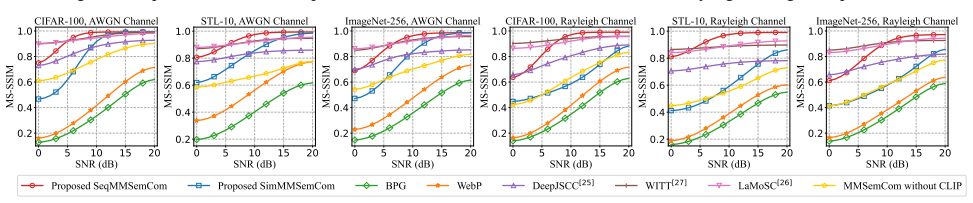
- Sequential MMSemCom sustains above 25 dB PSNR even at 0 dB SNR and reaches 35.62 dB at 10 dB SNR on in-distribution data, avoiding the sharp degradation seen in end-to-end baselines.
- Simultaneous MMSemCom transmits only 256 bytes of fused features and still achieves 30.75 dB PSNR at 10 dB SNR, giving the highest PSNR-per-kilobyte efficiency among the compared modes.
- Increasing the number of CLIP prompts improves selection accuracy up to about three to five prompts, after which communication overhead grows faster than reconstruction quality.
- Walsh-code orthogonal multiplexing extends the generation-and-selection framework to multiple users, with both users maintaining high PSNR and MS-SSIM once the SNR is above roughly 10 dB.
Reading between the lines
- If the candidate set is generated offline and fixed, the receiver-side selection is effectively a nearest-neighbor search in a shared embedding space; channel noise then perturbs only the query features, so the scheme is a form of robust retrieval rather than generation.
- The best achievable PSNR is capped by the best candidate among the generated images, so increasing the candidate count should raise that ceiling at the price of linearly more sampling; a PSNR-versus-N curve would quantify this trade-off directly.
- The simultaneous mode's 256-byte overhead invites a direct comparison with conventional codecs transmitting the same byte budget, which would isolate whether the gain comes from the fused features or from the diffusion prior.
- The authors' stated future move to text-to-image synthesis would remove the dependence on the training dataset, but it would also change the claim from pixel-level fidelity of a known image to semantic fidelity of a described scene.
Editorial analysis
A structured set of objections, weighed in public.
Referee Report
Summary. The paper proposes MMSemCom, a semantic communication framework that transmits multimodal semantic features (ResNet-50 image features and CLIP text prompts) and reconstructs the image at the receiver by generating a large candidate set with a class-conditional diffusion model and then selecting the best candidate using sequential or simultaneous selection mechanisms. The authors also extend the scheme to a multiuser scenario using Walsh codes and provide communication-overhead and computational-complexity analyses. The headline empirical claims are high reconstruction fidelity (e.g., 35.62 dB PSNR and 0.996 MS-SSIM for sequential MMSemCom at 10 dB SNR in Table I) and robustness at low SNR.
Significance. The generate-then-select paradigm is, in principle, an interesting alternative to direct neural decoding in semantic communication, and the manuscript contains a fairly complete architecture description with explicit overhead and complexity formulas. However, the empirical validation is undermined by a train/test overlap: the receiver's diffusion model is trained on the complete CIFAR-100 and STL-10 sets, while evaluation images are drawn from those same sets. With 50,000 training epochs and p=5,000 sampled candidates, the reported near-perfect PSNR/MS-SSIM figures are plausibly explained by retrieval of memorized near-duplicates rather than by generative reconstruction. A second architectural gap is that the class condition required by the diffusion model is not specified as being transmitted or recovered in the simultaneous mode. The OOD generalization claim is supported only by a garbled figure with no quantitative table. The paper does not provide code or model checkpoints, so the experiments are not independently reproducible.
major comments (4)
- [VI-A, VI-C, Table I] The evaluation protocol allows the diffusion model to have memorized the test images. Section VI-A states that the receiver's diffusion model is trained on the complete CIFAR-100 and STL-10 image sets, and Section VI-C states that test images are randomly selected from those same datasets; no held-out split is described. After 50,000 training epochs on datasets of 60,000 and 13,000 images, and with p=5,000 diffusion samples per transmitted image at inference, the candidate set can contain the original image or a near-identical copy. The selection mechanism in Eqs. (14)-(19) then retrieves that near-duplicate using the transmitted image and text features, which explains the near-perfect PSNR (35.62 dB) and MS-SSIM (0.996) in Table I. This makes the headline result a retrieval artifact rather than a generative reconstruction result. The authors must evaluate on a properly disjoint train/test split and report the overlap rate between the generated candidate set and the target image, or otherwise demonstrate that the reported gains persist for images not in the training set.
- [III-B1, III-B2, Section VI] The receiver's diffusion model is class-conditional (Eq. (9), Algorithm 1), but the manuscript never specifies how the receiver obtains the class condition c. In the sequential method, the transmitted text prompts may indirectly carry class information, but in the simultaneous method the transmitter sends only the fused feature vector FFused (Section VI-B). No class label or equivalent condition is included in the transmitted overhead (Eq. (25)-(26)), and no mechanism is described for recovering c from the received fused feature. Without a specification of how c is known at the receiver, the conditional generation step is not well defined, and the claimed end-to-end operation cannot be reproduced. Please clarify how c is transmitted or inferred, and update the overhead analysis accordingly.
- [VI-D4, Fig. 11] The out-of-distribution generalization claim is not quantitatively supported. Section VI-D4 asserts that SeqMMSemCom and SimMMSemCom exhibit only minor degradation on FGVC-Aircraft and Stanford-Cars and maintain a significant advantage over BPG and LaMoSC, but Fig. 11 is rendered as unreadable placeholder text and no numerical PSNR/MS-SSIM results or comparison table are provided. Without numbers, the reader cannot verify the claimed OOD robustness. Provide a table with mean PSNR, MS-SSIM, and baselines on these datasets.
- [VI-C, Figs. 7-10] The comparison with BPG and WebP is not a fair channel comparison. BPG and WebP are source codecs, yet they are plotted as functions of SNR and transmission distance in Figs. 7-10, without specifying how compressed bits are mapped to channel symbols, protected, and transmitted over the AWGN or Rayleigh channel. To support the claim of outperforming 'existing communication systems,' all schemes should be evaluated under the same channel-use/bit-rate constraints and the same channel model. As presented, the gains over BPG and WebP are not well defined.
minor comments (4)
- [Eqs. (14)-(19)] The summation indices in the distance formulas are inconsistent with the feature dimensions: in Eq. (14) the sum runs over p (the number of generated images) while the text feature FText(x) has dimension ntext × dtext; in Eq. (17) the sum runs over q, but FImage(x) is a single vector of dimension dimage; in Eq. (19) the sum again runs over p for a fused feature of dimension dfusion. Please correct these expressions or clarify the intended averaging.
- [VI-A, VI-C] The training budget is described as '50,000 epochs' in Section VI-A and '50,000 iterations' in the bullet points of Section VI-C; please use consistent terminology, since the number of epochs is highly relevant to the memorization concern.
- [Table III] The table header says 'DeePJSCC' while the text and references use 'DeepJSCC'; please fix the capitalization.
- [VI-D1] In the path-loss paragraph, 'in Eq. 2' appears to refer to the channel model in Section II, but that equation is not numbered; please add the equation number or fix the cross-reference.
Circularity Check
Table I's 35.62 dB PSNR is largely a retrieval artifact: the receiver's diffusion model is trained on the complete CIFAR-100/STL-10 sets and evaluated on the same sets, so the selection step can recover a memorized near-duplicate rather than reconstruct from transmitted semantics.
-
fitted input called prediction
[Section VI-A (Dataset), Section VI-B (Demonstration), Section VI-C (Performance Comparison); Table I]
"Our training datasets include the complete CIFAR-100 and STL-10 image sets... In the receiver, we train the DM for 50,000 epochs utilizing the same dataset, sampling p = 5000 images at the inference time step T = 40... we randomly select five images from the CIFAR-100 and STL-10 datasets and evaluate the average PSNR and MS-SSIM of these images under varying SNRs."
The receiver's diffusion model is trained on the complete CIFAR-100 and STL-10 sets, and the test images are drawn from those same datasets. After 50,000 epochs and with p=5000 sampled candidates per test image, a near-copy of the target image can be present in the candidate set; the selector in Eqs. (14)-(19) then retrieves it using the transmitted features. The reported PSNR (35.62 dB at 10 dB in Table I) therefore measures retrieval from the diffusion model's training data, not reconstruction from noisy semantics. The paper's own statement that 'the images produced through diffusion training closely resemble the original images' confirms that candidate images are near-duplicates of training images. OOD tests are only qualitative (Fig. 11) and do not rescue the in-distribution numbers.
full rationale
There is no equation-level circularity in the proposed encoder/decoder architecture: the fusion and selection mechanisms are defined independently of the evaluation images, and the system is benchmarked against external codecs (BPG, WebP, DeepJSCC, LaMoSC, WITT). However, the headline empirical claim reduces, by construction, to a retrieval benchmark. The diffusion model is trained on the complete CIFAR-100 and STL-10 sets, and the test images are randomly selected from those same sets; with 50,000 training epochs and 5,000 sampled candidates per inference, the candidate pool can contain memorized near-duplicates of the target. The selection step then identifies the closest such duplicate, so the reported PSNR/MS-SSIM primarily reflect the diffusion model's training-set coverage rather than the semantic communication pipeline's ability to reconstruct from noisy transmitted features. This is a fitted-input-called-prediction pattern: the generative model is fit to the test distribution, and the 'prediction' is the retrieved training image. The central architectural idea (multimodal features improve selection) retains independent content, and the OOD experiments, though qualitative, attempt to address generalization, so the circularity is partial rather than total.
Assumptions & free parameters
free parameters (7)
- p (number of generated candidate images) =
5000
- q (text-filtered candidate subset size) =
100
- ntext (number of CLIP prompts) =
3
- dimage (image feature dimension) =
32
- dfusion (fused feature dimension) =
64
- T (diffusion inference steps) =
40
- test-specific CLIP prompt set =
e.g., bird, yellow, on a tree
assumptions (5)
- standard math Walsh code matrix Wd satisfies Wd Wd^T = d I, giving orthogonal user separation.
- domain assumption CLIP embeddings map images and text into a shared space where cosine similarity reflects semantic relevance.
- domain assumption Pre-trained ResNet-50 ImageNet features are effective semantic representations for the transmitted images.
- domain assumption The class-conditional diffusion model can generate images that include a candidate close to the target image.
- ad hoc to paper Evaluation images are drawn from the same distribution used to train the diffusion model, which permits memorization.
invented entities (1)
-
MultiSem multimodal semantic feature
Cite this review
Pith. "Pith review of Image Generation with Supervised Selection Based on Multimodal Features for Semantic Communications." pith.science (2026). https://pith.science/paper/EDCDYGX3
@misc{pith2026241117428,
  author       = {Pith},
  title        = {Pith review of: Image Generation with Supervised Selection Based on Multimodal Features for Semantic Communications},
  year         = {2026},
  howpublished = {\url{https://pith.science/paper/EDCDYGX3}},
  note         = {Machine review of arXiv:2411.17428}
}
read the original abstract
Semantic communication (SemCom) has emerged as a promising technique for the next-generation communication systems, in which the generation at the receiver side is allowed with semantic features' recovery. However, the majority of existing research predominantly utilizes a singular type of semantic information, such as text, images, or speech, to supervise and choose the generated source signals, which may not sufficiently encapsulate the comprehensive and accurate semantic information, and thus creating a performance bottleneck. In order to bridge this gap, in this paper, we propose and investigate a SemCom framework using multimodal information to supervise the generated image. To be specific, in this framework, we first extract semantic features at both the image and text levels utilizing the Convolutional Neural Network (CNN) architecture and the Contrastive Language-Image Pre-Training (CLIP) model before transmission. Then, we employ a generative diffusion model at the receiver to generate multiple images. In order to ensure the accurate extraction and facilitate high-fidelity image reconstruction, we select the "best" image with the minimum reconstruction errors by taking both the aided image and text semantic features into account. We further extend multimodal semantic communication (MMSemCom) system to the multiuser scenario for orthogonal transmission. Experimental results demonstrate that the proposed framework can not only achieve the enhanced fidelity and robustness in image transmission compared with existing communication systems but also sustain a high performance in the low signal-to-noise ratio (SNR) conditions.
Figures


Figures from the paper (9 more)




Forward citations
Cited by 3 Pith papers
-
A Survey on Semantic Communication for Vision: Categories, Frameworks, Enabling Techniques, and Applications
A survey that classifies visual semantic communication into preservation, expansion, and refinement categories and reviews their machine-learning components and applications.
-
Censored Sampling for Topology Design: Guiding Diffusion with Human Preferences
Guiding a pretrained topology-diffusion generator with human-preference reward classifiers is claimed to suppress floating-material and boundary-violation failure modes without retraining the generator.
-
Semantic Communications for Digital Signals via Carrier Images
A method for joint transmission of images and digital signals by mapping binary data to mask locations in a Masked Autoencoder, with a sparse index encoding to reduce overhead.
Reference graph
Works this paper leans on
-
[1]
A mathematical theory of communication,
C. E. Shannon, “A mathematical theory of communication,” Bell Syst. Tech. J., vol. 27, no. 3, pp. 379–423, Jul. 1948
1948
-
[2]
B. Gu, D. Li, H. Ding, G. Wang, and C. Tellambura, “Breaking the interference and fading gridlock in backscatter communications: State- of-the-art, design challenges, and future directions,” IEEE Commun. Surv. Tutorials, pp. 1–1, Jul. 2024
work page 2024
-
[3]
A lite distributed semantic communication system for internet of things,
H. Xie and Z. Qin, “A lite distributed semantic communication system for internet of things,” IEEE J. Sel. Areas Commun. , vol. 39, no. 1, pp. 142–153, Jan. 2021
2021
-
[4]
Semantic communications: Overview, open issues, and future research directions,
X. Luo, H.-H. Chen, and Q. Guo, “Semantic communications: Overview, open issues, and future research directions,” IEEE Wirel. Commun. , vol. 29, no. 1, pp. 210–219, Feb. 2022
work page 2022
-
[5]
Rethinking modern communication from semantic coding to semantic communication,
K. Lu, Q. Zhou, R. Li, Z. Zhao, X. Chen, J. Wu, and H. Zhang, “Rethinking modern communication from semantic coding to semantic communication,” IEEE Wirel. Commun. , vol. 30, no. 1, pp. 158–164, Feb. 2023
work page 2023
-
[6]
Semantic communications for digital signals via carrier images,
Z. Yan and D. Li, “Semantic communications for digital signals via carrier images,” IEEE Wireless Commun. Lett. , vol. 14, no. 6, pp. 1816– 1820, Jun. 2025
work page 2025
-
[7]
Toward semantic communications: Deep learning-based image semantic coding,
D. Huang, F. Gao, X. Tao, Q. Du, and J. Lu, “Toward semantic communications: Deep learning-based image semantic coding,” IEEE J. Sel. Areas Commun. , vol. 41, no. 1, pp. 55–71, Jan. 2023
2023
-
[8]
Deep learning enabled semantic communication systems,
H. Xie, Z. Qin, G. Y . Li, and B.-H. Juang, “Deep learning enabled semantic communication systems,” IEEE Trans. Signal Process., vol. 69, pp. 2663–2675, Apr. 2021
2021
Show all 33 references
-
[9]
Trading computing power for reducing communication loads: A semantic communication perspective,
G. Zheng, M. Wen, L. Xu, and Z. Ding, “Trading computing power for reducing communication loads: A semantic communication perspective,” IEEE Trans. Commun. , pp. 1–1, Mar. 2025
2025
-
[10]
Computation-aware offload- ing for dnn inference tasks in semantic communication assisted mec systems,
G. Zheng, M. Wen, Z. Ning, and Z. Ding, “Computation-aware offload- ing for dnn inference tasks in semantic communication assisted mec systems,” IEEE Trans. Wireless Commun. , vol. 24, no. 4, pp. 2693– 2706, Apr. 2025
2025
-
[11]
Predictive and adaptive deep coding for wireless image transmission in semantic communication,
W. Zhang, H. Zhang, H. Ma, H. Shao, N. Wang, and V . C. M. Leung, “Predictive and adaptive deep coding for wireless image transmission in semantic communication,” IEEE Trans. Wirel. Commun. , vol. 22, no. 8, pp. 5486–5501, Aug. 2023
2023
-
[12]
A gan-based semantic communication for text without csi,
J. Mao, K. Xiong, M. Liu, Z. Qin, W. Chen, P. Fan, and K. B. Letaief, “A gan-based semantic communication for text without csi,” IEEE Trans. Wirel. Commun., vol. 23, no. 10, pp. 14 498–14 514, Oct. 2024
2024
-
[13]
Cddm: Channel denoising diffusion models for wireless semantic communications,
T. Wu, Z. Chen, D. He, L. Qian, Y . Xu, M. Tao, and W. Zhang, “Cddm: Channel denoising diffusion models for wireless semantic communications,” IEEE Trans. Wirel. Commun. , vol. 23, no. 9, pp. 11 168–11 183, Sep. 2024
2024
-
[14]
Latency-aware generative semantic communications with pre-trained diffusion models,
L. Qiao, M. B. Mashhadi, Z. Gao, C. H. Foh, P. Xiao, and M. Bennis, “Latency-aware generative semantic communications with pre-trained diffusion models,” IEEE Wireless Commun. Lett. , vol. 13, no. 10, pp. 2652–2656, Oct. 2024
2024
-
[15]
Semantic communication for multi-modal data transmission,
J. Gu, X. Zhang, Q. Cui, and X. Tao, “Semantic communication for multi-modal data transmission,” in Proc. Int. Conf. Wirel. Commun. Signal Process. (WCSP) , Nov. 2023, pp. 208–213
2023
-
[16]
A novel lightweight joint source- channel coding design in semantic communications,
X. Yu, D. Li, N. Zhang, and X. Shen, “A novel lightweight joint source- channel coding design in semantic communications,” IEEE Internet Things J., vol. 12, no. 11, pp. 18 447–18 450, Jun. 2025
2025
-
[17]
Semantic- enabled 6g communication: A task-oriented and privacy-preserving perspective,
S. Guo, A. Zhang, Y . Wang, C. Feng, and T. Q. S. Quek, “Semantic- enabled 6g communication: A task-oriented and privacy-preserving perspective,” IEEE Network , pp. 1–1, Mar. 2025
2025
-
[18]
Task-oriented communication for graph data: A graph information bottleneck approach,
S. Li, Y . Wang, S. Guo, and C. Feng, “Task-oriented communication for graph data: A graph information bottleneck approach,” IEEE Trans. Cognit. Commun. Networking , pp. 1–1, Sep. 2024
2024
-
[19]
Trustworthy image semantic communication with genai: Explainablity, controllability, and efficiency,
X. Wang, D. Ye, C. Feng, H. H. Yang, X. Chen, and T. Q. S. Quek, “Trustworthy image semantic communication with genai: Explainablity, controllability, and efficiency,” IEEE Wireless Commun. , vol. 32, no. 2, pp. 68–75, Apr. 2025
2025
-
[20]
Generative ai for physical layer communications: A survey,
N. Van Huynh, J. Wang, H. Du, D. T. Hoang, D. Niyato, D. N. Nguyen, D. I. Kim, and K. B. Letaief, “Generative ai for physical layer communications: A survey,” IEEE Trans. Cognit. Commun. Networking , vol. 10, no. 3, pp. 706–728, Jun. 2024
2024
-
[21]
Generative ai-driven semantic communication networks: Architecture, technologies and applications,
C. Liang, H. Du, Y . Sun, D. Niyato, J. Kang, D. Zhao, and M. A. Imran, “Generative ai-driven semantic communication networks: Architecture, technologies and applications,” IEEE Trans. Cogn. Commun. Netw. , pp. 1–1, Jul. 2024
2024
-
[22]
Selection-based image generation for semantic communication systems,
C. Liang, D. Li, Z. Lin, and H. Cao, “Selection-based image generation for semantic communication systems,” IEEE Commun. Lett. , vol. 28, no. 1, pp. 34–38, Jan. 2024
2024
-
[23]
Imagenet classification with deep convolutional neural networks,
A. Krizhevsky, I. Sutskever, and G. E. Hinton, “Imagenet classification with deep convolutional neural networks,” in Proc. Adv. Neural Inf. Process. Syst. (NeurIPS) , vol. 25, Dec. 2012
2012
-
[24]
Learning transferable visual models from natural language supervision,
A. Radford, J. W. Kim, C. Hallacy, A. Ramesh, G. Goh, S. Agarwal, G. Sastry, A. Askell, P. Mishkin, J. Clark et al. , “Learning transferable visual models from natural language supervision,” in Proc. Int. Conf. Mach. Learn. (ICML) , Jul. 2021, pp. 8748–8763
2021
-
[25]
Enhancing multimodal understanding with clip-based image-to-text transformation,
C. Che, Q. Lin, X. Zhao, J. Huang, and L. Yu, “Enhancing multimodal understanding with clip-based image-to-text transformation,” in Proc. Int. Conf. Big Data Technol. (ICBDT) , Dec. 2023, pp. 414—-418
2023
-
[26]
Conditional text image generation with diffusion models,
Y . Zhu, Z. Li, T. Wang, M. He, and C. Yao, “Conditional text image generation with diffusion models,” in Proc. IEEE Conf. Comput. Vis. Pattern Recognit. (CVPR) , Jun. 2023, pp. 14 235–14 245
2023
-
[27]
Deep residual learning for image recognition,
K. He, X. Zhang, S. Ren, and J. Sun, “Deep residual learning for image recognition,” in Proc. IEEE Conf. Comput. Vis. Pattern Recognit. (CVPR), Jun. 2016, pp. 770–778
2016
-
[28]
Clip-kd: An empirical study of clip model distillation,
C. Yang, Z. An, L. Huang, J. Bi, X. Yu, H. Yang, B. Diao, and Y . Xu, “Clip-kd: An empirical study of clip model distillation,” in Proc. IEEE Conf. Comput. Vis. Pattern Recognit. , Jun. 2024, pp. 15 952–15 962
2024
-
[29]
U-net: Convolutional networks for biomedical image segmentation,
O. Ronneberger, P. Fischer, and T. Brox, “U-net: Convolutional networks for biomedical image segmentation,” in Med. Image Comput. Comput. Assist. Interv. (MICCAI) , Nov. 2015, pp. 234–241
2015
-
[30]
Unipc: A unified predictor- corrector framework for fast sampling of diffusion models,
W. Zhao, L. Bai, Y . Rao, J. Zhou, and J. Lu, “Unipc: A unified predictor- corrector framework for fast sampling of diffusion models,” inProc. Adv. Neural Inf. Process. Syst. (NeurIPS) , vol. 36, Dec. 2023
2023
-
[31]
Deep joint source- channel coding for wireless image transmission,
E. Bourtsoulatze, D. Burth Kurka, and D. G ¨und¨uz, “Deep joint source- channel coding for wireless image transmission,” IEEE Trans. Cognit. Commun. Networking , vol. 5, no. 3, pp. 567–579, Sep. 2019
2019
-
[32]
Lamosc: Large language model-driven semantic communication system for visual trans- mission,
Y . Zhao, Y . Yue, S. Hou, B. Cheng, and Y . Huang, “Lamosc: Large language model-driven semantic communication system for visual trans- mission,” IEEE Trans. Cognit. Commun. Networking , vol. 10, no. 6, pp. 2005–2018, Dec. 2024
2005
-
[33]
Witt: A wireless image transmission transformer for semantic communications,
K. Yang, S. Wang, J. Dai, K. Tan, K. Niu, and P. Zhang, “Witt: A wireless image transmission transformer for semantic communications,” in Proc. IEEE Int. Conf. Acoust. Speech Signal Process. (ICASSP) , 2023, pp. 1–5
2023
Reviewed August 12, 2026 · model on record in the stance chip above.
Discussion (0). Continue with ORCID to comment.